
AI & Presentations

Every Slide Is Beautiful Now

AI tools have solved the design problem. They haven't solved the thinking problem. Here's what happens when gorgeous becomes generic—and why the next battleground is narrative.

Listen
Infinite gallery of identical perfect slides in violet void, one shattering to reveal a glowing narrative thread
Smartphone showing AI interface generating a perfectly branded presentation automatically
01

Canva Just Made the Design Layer Invisible

Here's the moment the design moat evaporated: Canva announced direct integrations with both ChatGPT and Claude this week. You can now generate a fully branded, on-brand presentation without ever leaving a text-based AI chat. Your company's logo, fonts, and color palette flow in through Canva Brand Kits. The human never touches a design tool.

Think about what that means. The entire visual design layer—the thing that justified $40/month SaaS subscriptions and entire design teams—is now an API call. You type "make me a Q1 board deck" into ChatGPT, and Canva's engine does the rest. The slides look perfect. They always look perfect. That's the problem.

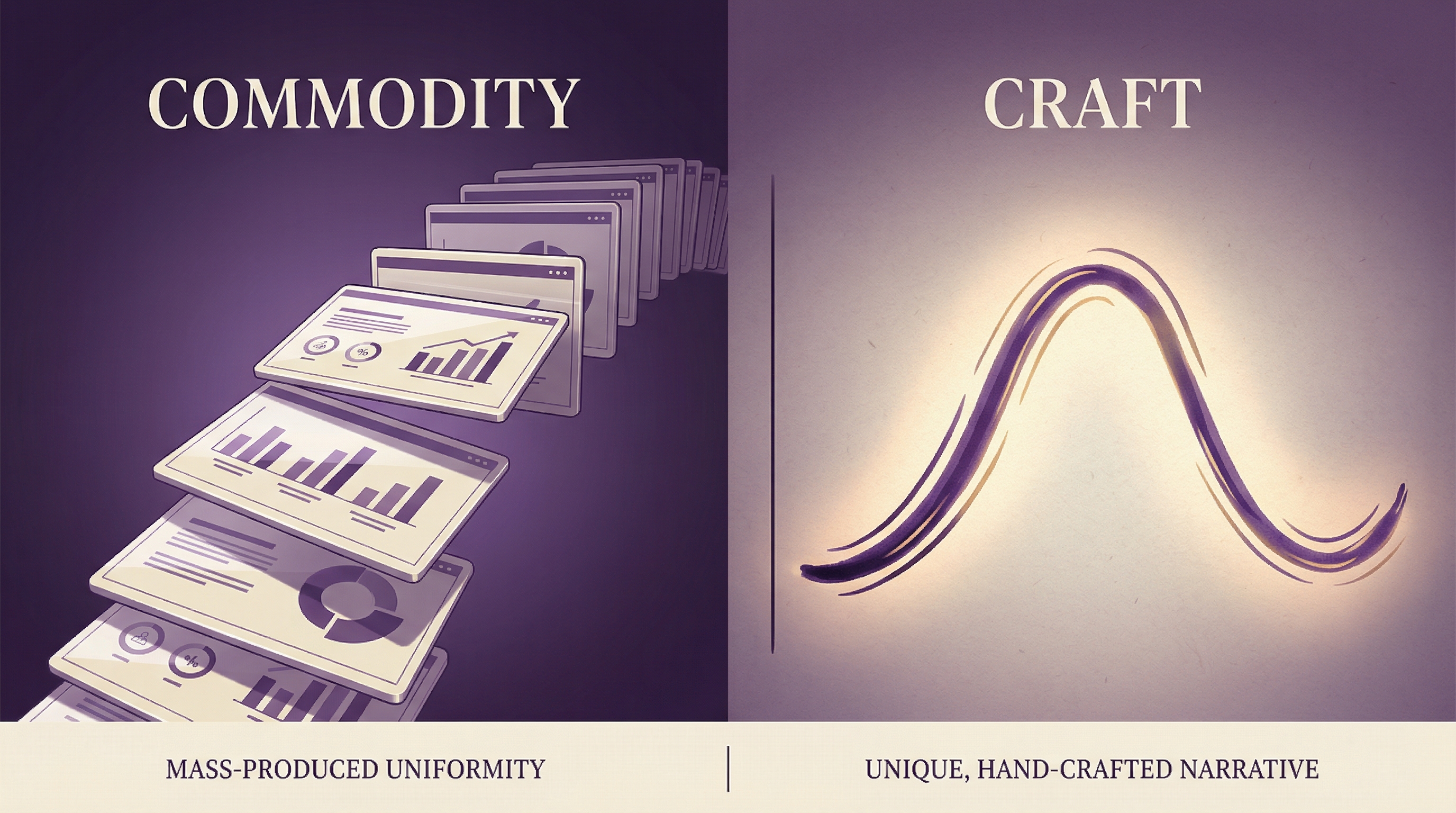
When everyone's slides are beautiful, beautiful stops being a signal. It becomes noise. The only variable left is what you actually said—the argument, the structure, the story. Morningstar's coverage noted this effectively commoditizes the design layer entirely, and they're right. The question is whether Canva understands it's now in the narrative business, not the design business.
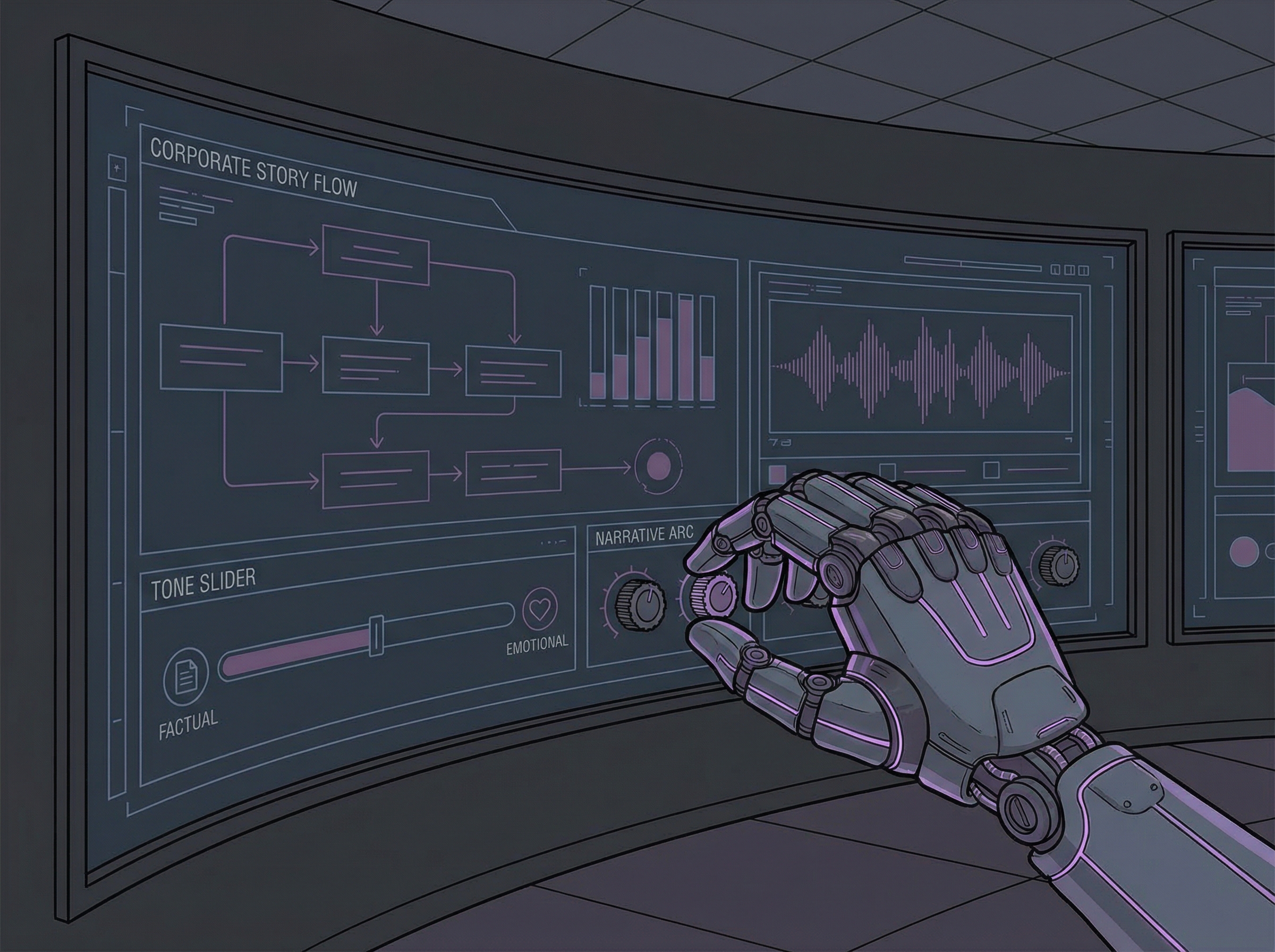
Robotic hand adjusting narrative control dials on a corporate presentation screen
02

Microsoft Admits the Slide Isn't the Product

Microsoft's latest Copilot update for PowerPoint is revealing—not for what it adds, but for what it signals. The update shifts Copilot from a chatbot that generates slides to an autonomous agent that accesses enterprise brand kits, sets narrative tone, and controls presentation length. It's the first time Microsoft has built "narrative controls" directly into an AI slide tool.

The new "narrative tone" and "presentation length" dials are an explicit admission: the slide itself was never the hard part. Arranging boxes on a screen is a solved problem. What enterprises actually struggle with is saying the right thing, in the right order, at the right length, for the right audience. That's a writing problem, not a design problem.

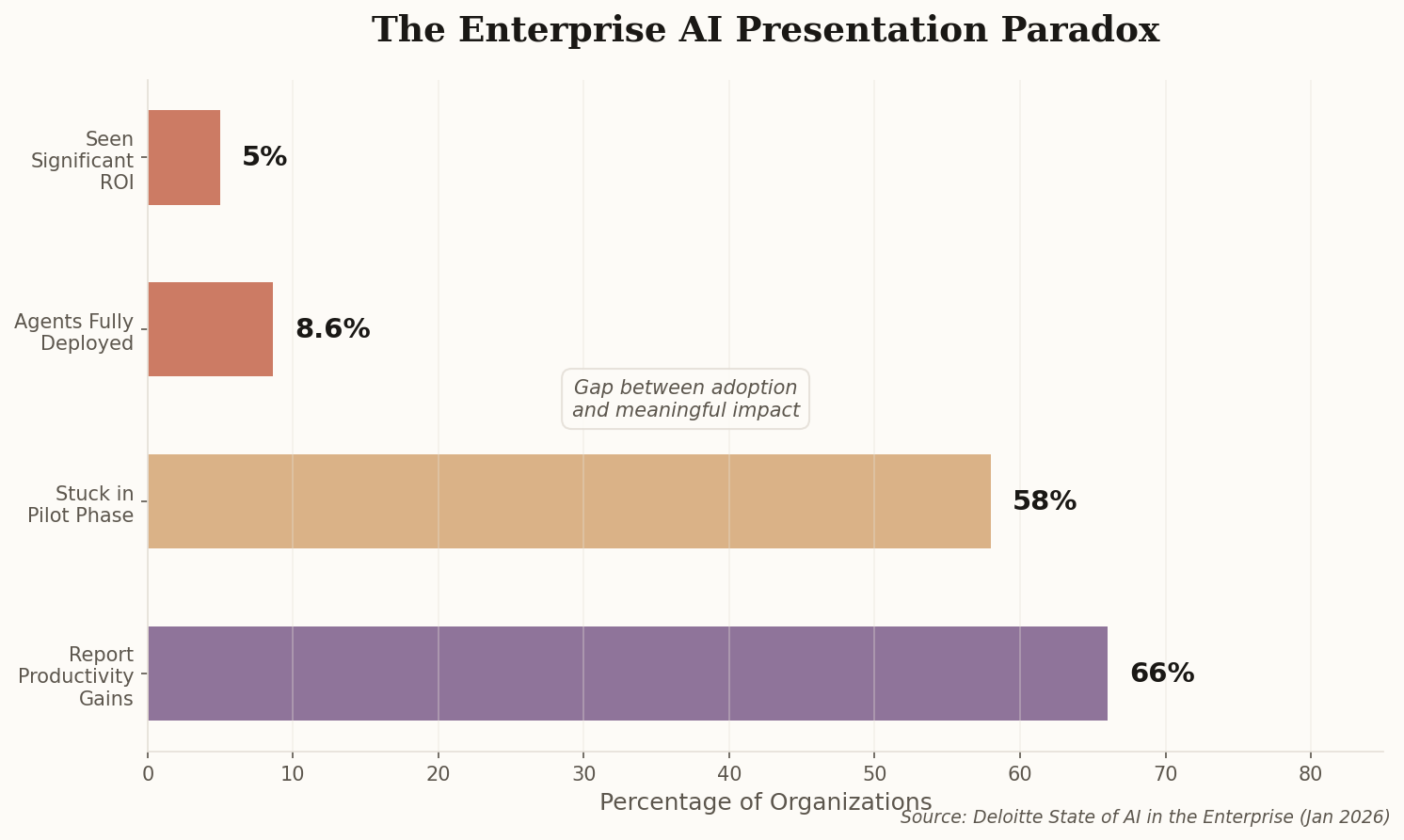
Horizontal bar chart showing enterprise AI adoption paradox: 66% report productivity gains but only 5% see significant ROI
The enterprise AI paradox: most organizations report productivity gains from AI tools, but almost none have seen meaningful returns. The gap is narrative skill, not tool access.

The new "view-only" mode for AI-drafted content is equally telling. Enterprises are now worried enough about the quality of AI-generated narratives that they need governance controls to prevent half-baked decks from circulating. The wild west of "let Copilot write it" is giving way to careful editorial oversight. Good.

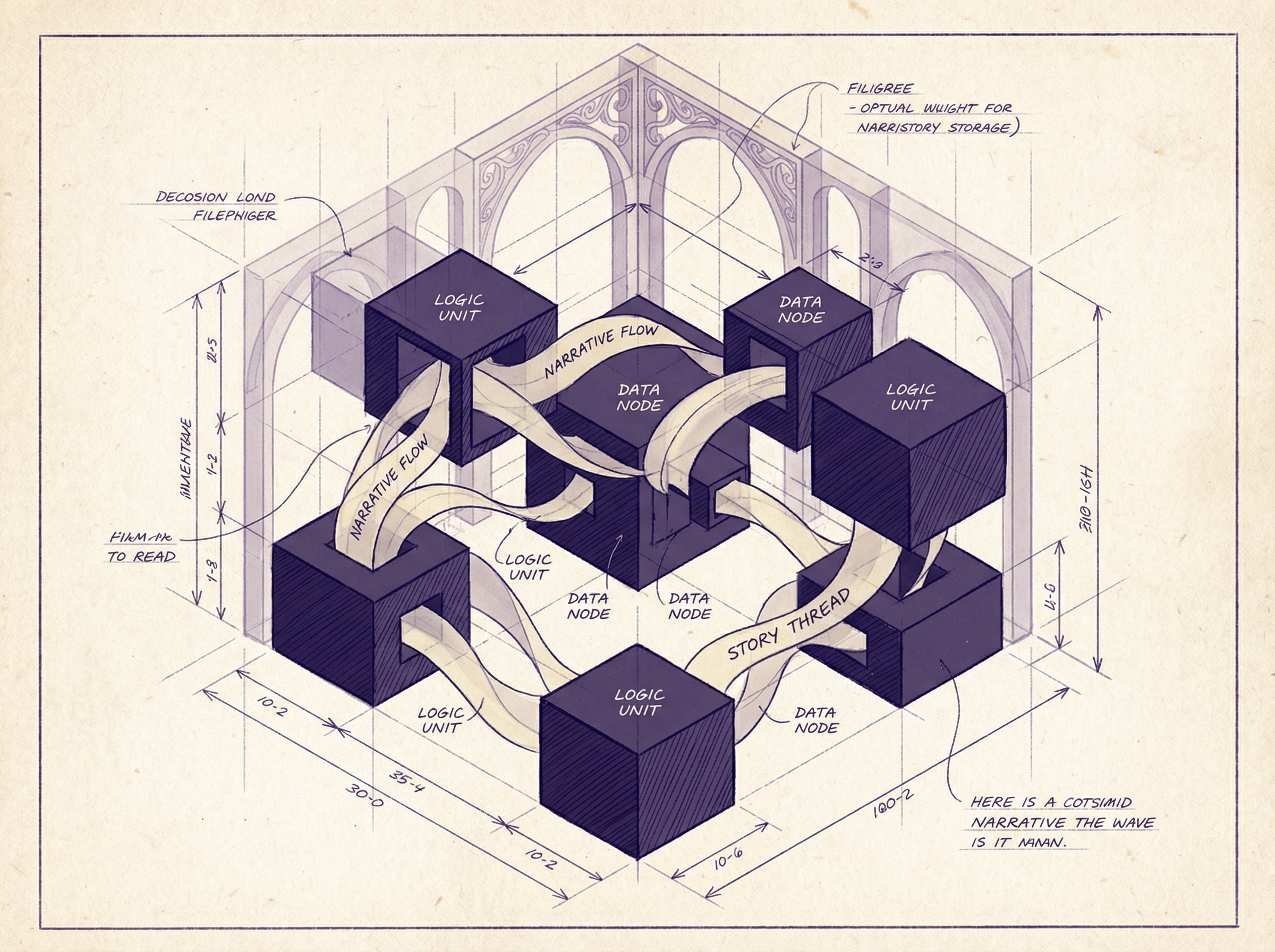
Abstract architectural framework of logical building blocks connected by narrative threads
03

The Rise of the Logic-First Deck

While Canva and Gamma race to make slides prettier, a quieter revolution is happening in the opposite direction. Prezent.ai and GenPPT are gaining enterprise traction by ignoring aesthetics almost entirely and focusing on business storytelling frameworks instead.

Their pitch: your slides don't need to look better. They need to think better. Prezent.ai uses the SCQA framework—Situation, Complication, Question, Answer—to structure executive-ready narratives before a single visual element is placed. It's the McKinsey approach to presentations, automated. And it turns out executives care more about whether your argument holds together than whether your gradient is on-trend.

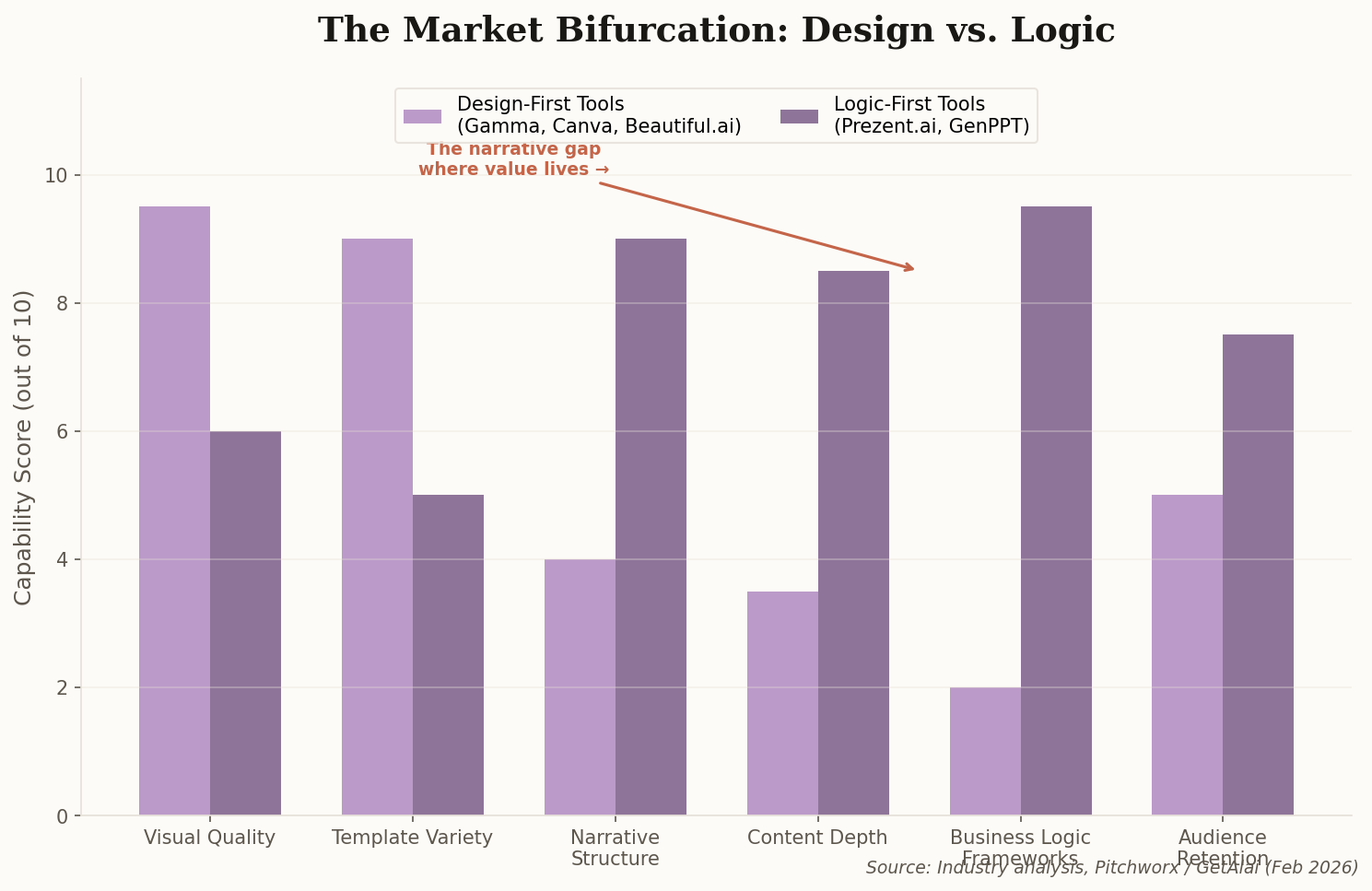
Bar chart comparing design-first tools vs logic-first tools across six capability dimensions
The market bifurcation is stark: design-first tools dominate visual quality and template variety, while logic-first tools win on narrative structure, content depth, and business frameworks. The "narrative gap" is where differentiated value lives.

This bifurcation is the story of 2026. On one side: tools that make things look amazing (a solved problem). On the other: tools that help you structure an argument (an unsolved problem). The market is voting with its enterprise contracts, and the logic-first tools are winning the deals that matter.

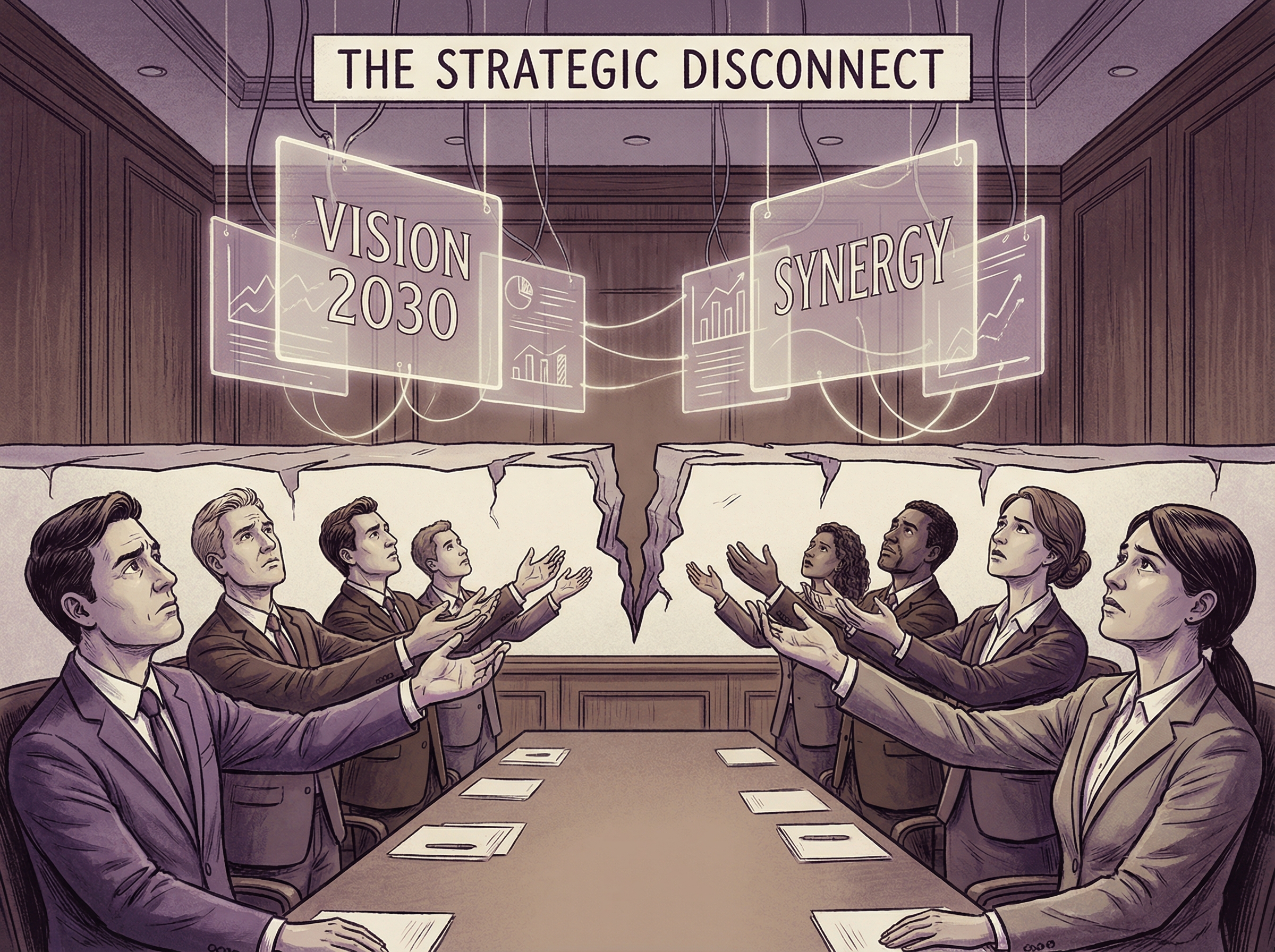
Corporate executives reaching for beautiful slides floating just out of reach, representing the disconnect between tool adoption and value
04

$2.5 Billion in Tools, Zero Narrative Skills

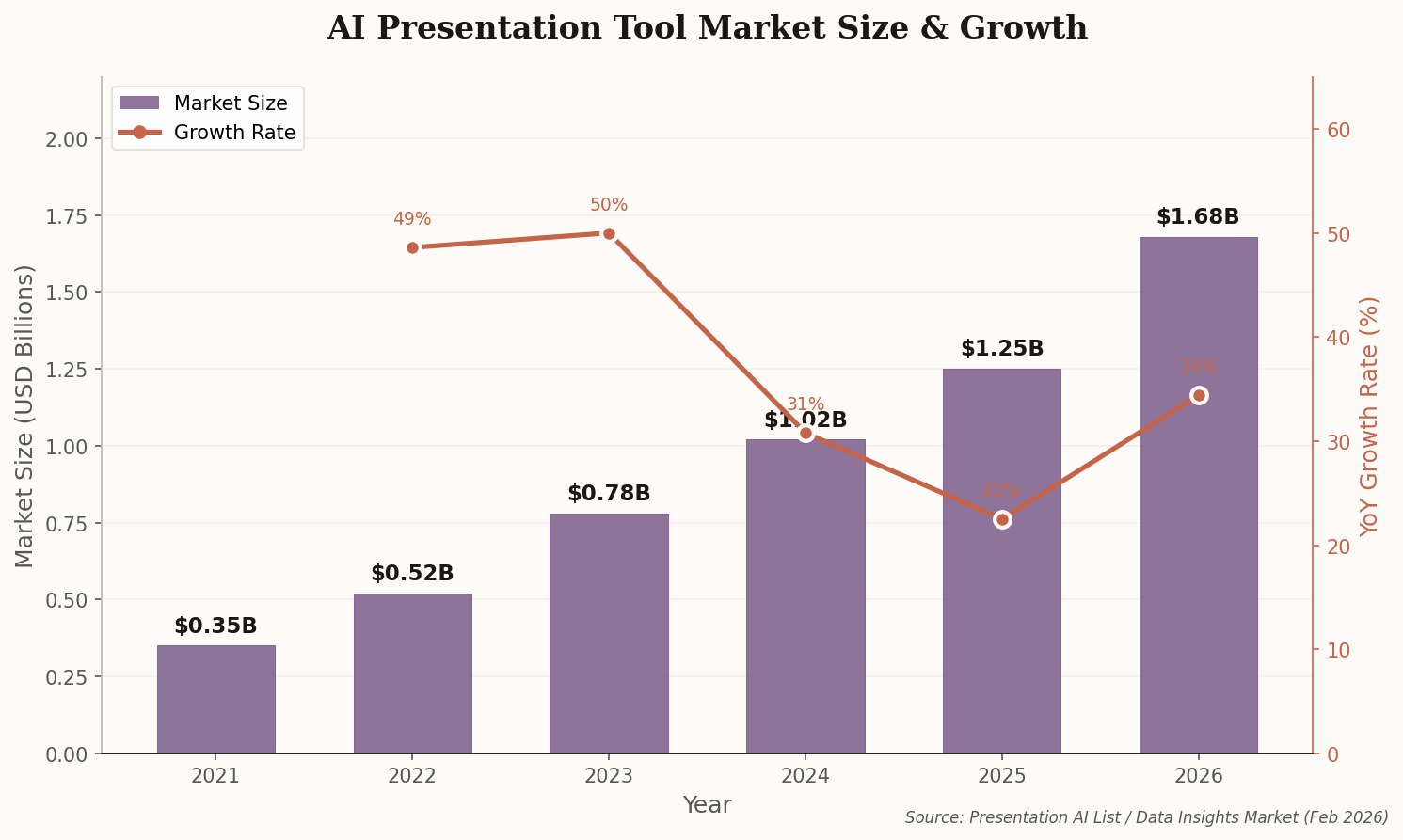
The numbers are brutal. The AI presentation market is projected to hit $2.5 billion this year, and 66% of organizations report productivity gains from these tools. But—and this is a devastating "but"—only 8.6% have AI agents fully deployed in production, and a staggering 95% report they've yet to see significant returns on their AI investments.

Bar chart showing AI presentation market growth from $0.4B in 2022 to $2.5B projected in 2026
The AI presentation tool market has grown 6x in four years. But market size tells us nothing about whether the output is actually good.

Deloitte's latest State of AI in the Enterprise report calls it "pilot purgatory"—organizations that have bought the tools, run the training sessions, celebrated the demos, and then watched employees produce the same mediocre presentations, only now with nicer fonts. The skill gap isn't technical. It's narrative. People don't know how to tell a story with data, and no amount of AI-generated gradient backgrounds will fix that.

The implication is clear: the next wave of enterprise spending won't be on slide generators. It'll be on narrative training—human coaching and AI-assisted storytelling frameworks that teach people to think before they deck.

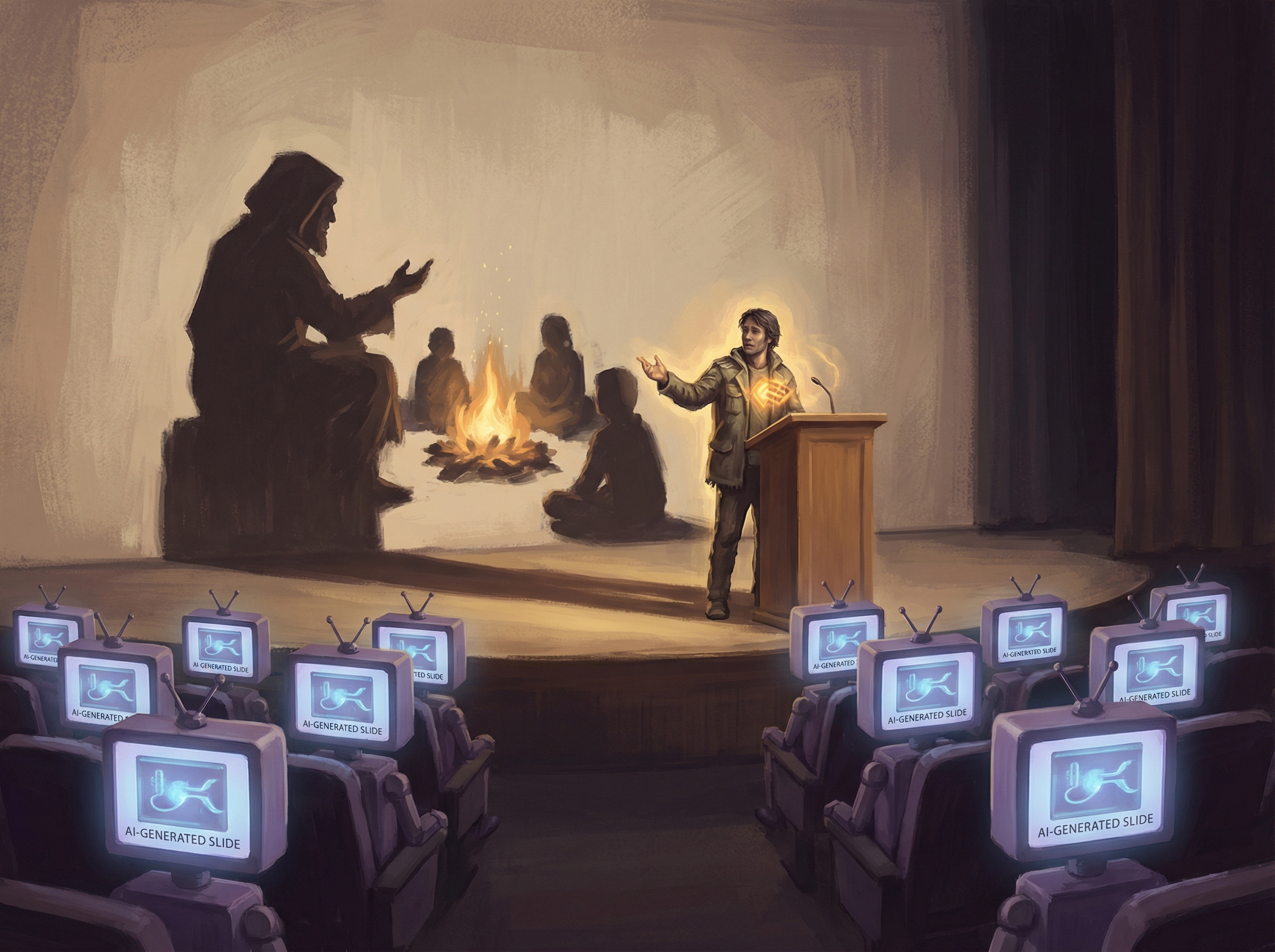
Human presenter at podium casting shadow of campfire storyteller, with AI slide-robots in the audience
05

The 26% Retention Gap Nobody Talks About

StoryChief's analysis puts a number on what we all felt intuitively: audiences retain 26% more information from story-led presentation formats compared to standard AI-generated layouts. Not because the story-led formats look better—they often look simpler—but because they respect the way human brains actually process information: through narrative arcs, tension, and resolution.

The report explicitly names the "risk of homogenization" in AI-generated decks. When every tool produces the same clean sans-serif headers, the same tasteful color gradients, the same stock-photo-adjacent imagery, the audience's brain does what it always does with undifferentiated stimuli: it tunes out. The slides become wallpaper.

"With the visual burden largely handled by AI, the emphasis will increasingly fall on the presenter's ability to infuse authenticity." — StoryChief analysis, January 2026

The emerging solution isn't to make AI slides less beautiful—that ship has sailed. It's to build tools that focus on "smart content assistance": AI that structures the narrative arc (rising action, climax, resolution) rather than just the layout grid. The presenters who win in 2026 won't be the ones with the best-looking slides. They'll be the ones who made you feel something.

Crumbling magic hat with wilted presentation slides spilling out, abandoned stage, twilight violet tones
06

Tome's Retreat: The Magic Trick Is Over

If you want to understand why "beautiful slides" aren't a business model, look at Tome. The company that once dazzled investors with AI-generated presentations has quietly pivoted away from consumer slide generation entirely. The new focus: revenue-generating sales teams who need repeatable, vertical-specific decks. General-purpose "one-click slide generation" is dead as a standalone product category.

Industry commentary in early 2026 has been unusually blunt. Multiple analysts now classify Tome as a "legacy" tool—remarkable for a company that was a darling of the AI presentation wave just 18 months ago. The lesson: when you build a magic trick, you need the trick to stay magical. And the trick of generating beautiful slides stopped being magical the moment every other tool learned to do it too.

The survivors are the companies that understood something Tome didn't: the slide is a vehicle for a story, not the story itself. Prezent.ai's framework-first approach, Microsoft's narrative controls, even Canva's seamless LLM integration—they all bet on content over chrome. Tome bet on chrome. Chrome tarnishes.

The Design Tax Is Gone. The Narrative Tax Just Arrived.

For two decades, professionals paid a "design tax"—hours wrestling with alignment, color theory, and layout—to make presentations that didn't embarrass them. AI just eliminated that tax entirely. But it exposed a much older debt: the inability to structure a compelling argument. The tools that win from here aren't the ones that make your slides beautiful. They're the ones that make your thinking visible. In 2026, the best-dressed deck with nothing to say loses to the plain one with a point.