Display Technology

The Wall Has Won

Every major TV manufacturer just declared war on your living room wall. From 130-inch MicroLED flagships to 10,000-nit brightness cannons, the 2026 lineup isn't just bigger — it's a different species entirely.

Listen
Massive premium televisions displayed in a sleek showroom, screens glowing with vivid colors against dark reflective floors
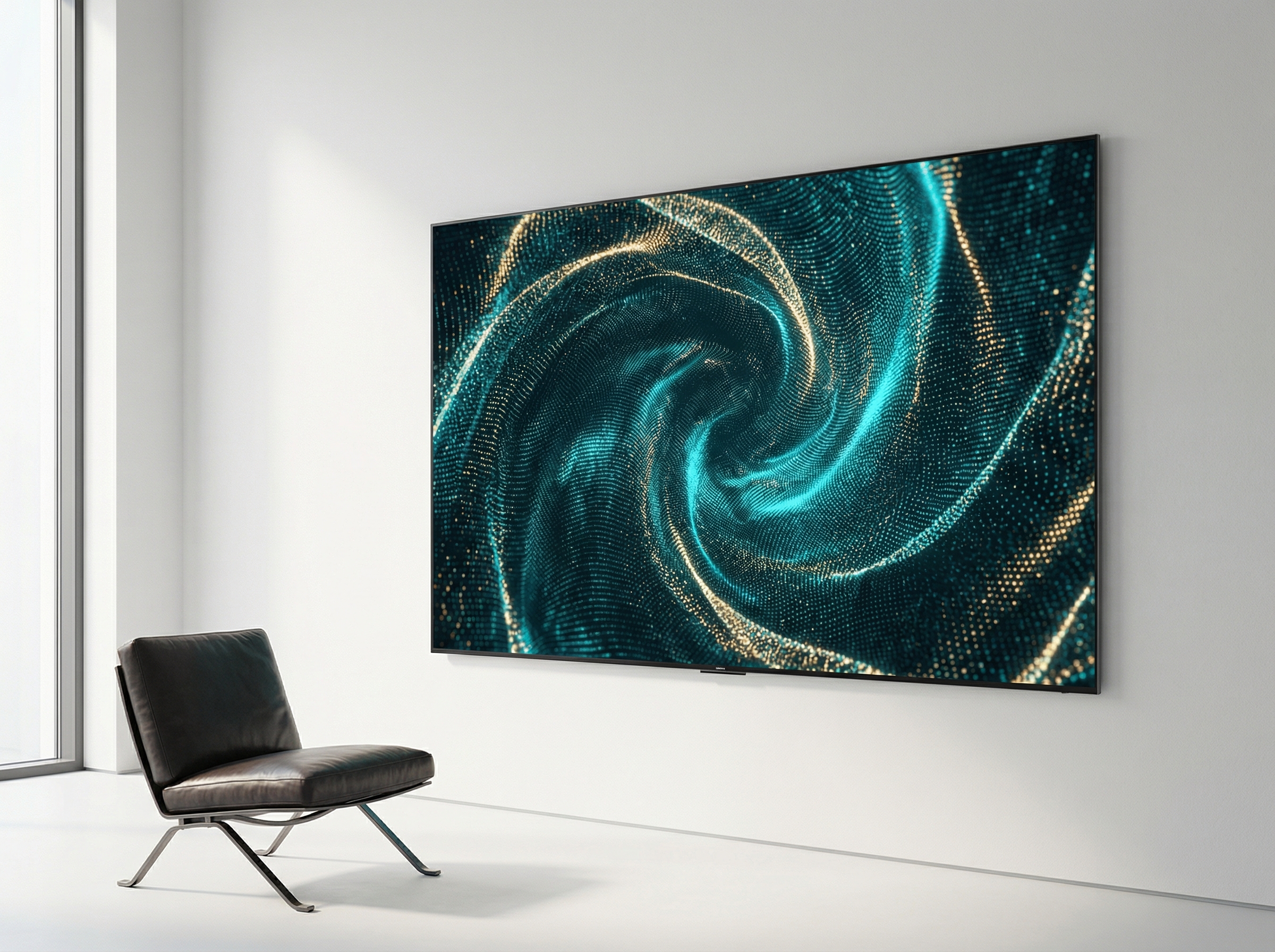
A colossal Samsung 130-inch MicroLED television mounted on a minimalist wall, its enormous screen dwarfing the furniture below
01

Samsung Drops a 130-Inch MicroLED Bomb and Dares You Not to Look

Let's start with the elephant in the room—or rather, the elephant that is the room. Samsung unveiled the R95H at CES 2026, the world's first 130-inch Micro RGB television, and it doesn't just occupy your wall. It replaces it. Powered by the Micro RGB AI Engine Pro, each sub-100µm LED is individually controlled for light and color, delivering 100% coverage of the BT.2020 color gamut—a spec that, until very recently, existed only in cinema reference monitors.

The design tells you everything about Samsung's ambitions. Called the "Timeless Frame," it borrows from a shelved 2013 concept and wraps the panel in a substantial border that makes the screen appear to float. This isn't a television pretending to be art. It's a television so confident in its presence that it demands a picture frame. HDR10+ Advanced, Eclipsa Audio, and a Vision AI Companion suite with conversational search round out a feature set that reads like a CES keynote condensed into a single product.

Here's the critical detail: Samsung isn't putting this on shelves yet. The R95H is a statement piece, a technology preview designed to anchor the brand's position at the absolute top of the display hierarchy. But the sub-100µm LED manufacturing it demonstrates? That's the real product. When those diodes trickle down to the 89-inch and 101-inch models Samsung will sell, the entire premium TV market shifts.
Two premium televisions side by side in a dark gallery, one showing deep OLED blacks and the other bursting with vivid MicroLED colors
02

LG Plays Both Sides of the Display War—and It Might Be the Smartest Move at CES

While Samsung went all-in on its MicroLED halo product, LG quietly executed the most strategically interesting play at CES. The company unveiled two premium lines simultaneously: the G6 OLED and the MRGB95 Micro RGB. In other words, LG isn't choosing between OLED and MicroLED. It's betting on both.

The G6 uses a second-generation Primary RGB Tandem OLED panel—the same architecture that made the G5 a reference-class display—but cranked up by 20% in brightness with "Hyper Radiant Colour Technology." The Reflection Free Premium coating brings screen reflectance below 0.5%, which means this is the first OLED you might actually consider for a bright room. All processing runs through the Alpha 11 Gen3 AI Processor, and What Hi-Fi? was visibly impressed at the hands-on demo.

Meanwhile, the MRGB95 Micro RGB Evo targets the truly large screen segment—75, 86, and 100 inches only. It claims 100% coverage of BT.2020, DCI-P3, and Adobe RGB simultaneously via its "RGB Primary Colour Ultra" system. And then there's the Wallpaper W6, just 9mm thin, because apparently LG thought the lineup wasn't dramatic enough already.

The strategy is clear: OLED owns the picture quality crown in the 55-83 inch range; Micro RGB owns the 75+ giant-screen segment. No competitor is playing this dual game as effectively.

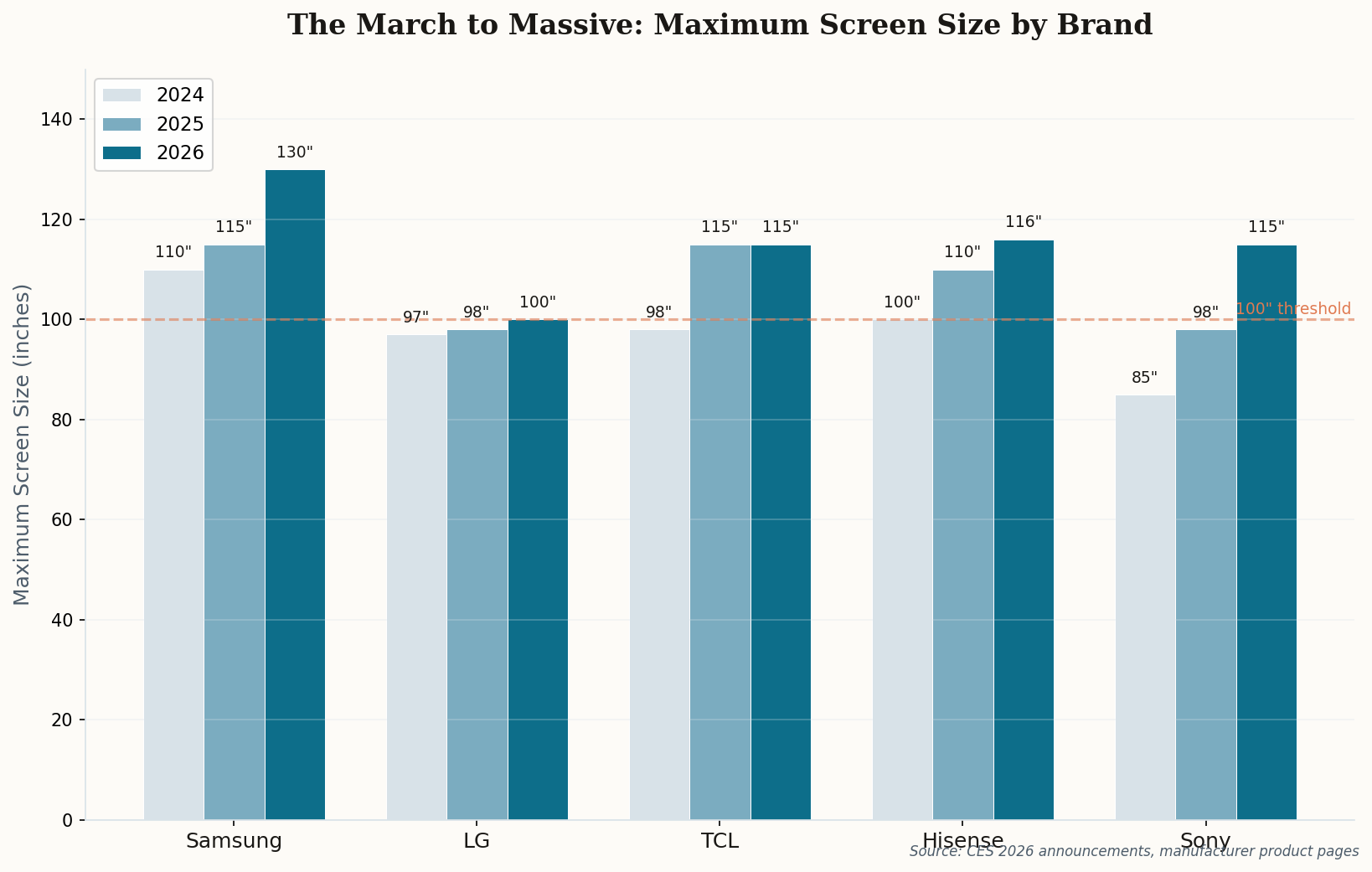
Bar chart showing maximum screen sizes offered by Samsung, LG, TCL, Hisense, and Sony from 2024 to 2026, showing a clear trend toward 100+ inch screens across all brands
Every major manufacturer now offers screens above 100 inches. The question isn't whether you can buy a wall-sized TV—it's which technology you want powering it.
Abstract visualization of display panel architecture showing quantum dot layers and OLED panel technology
03

Samsung's OLED Lineup Goes Full Pragmatist: QD-OLED Meets W-OLED in One Family

This is the story that would have made headlines any other year: Samsung is using LG Display panels in its own OLED TVs. The 2026 lineup features four models—S85H, S90H, S95H, and the new flagship S99H—and not all of them use Samsung's own QD-OLED technology. The 83-inch S99H and the entire S85H entry-level series use LG's Tandem W-OLED panels instead.

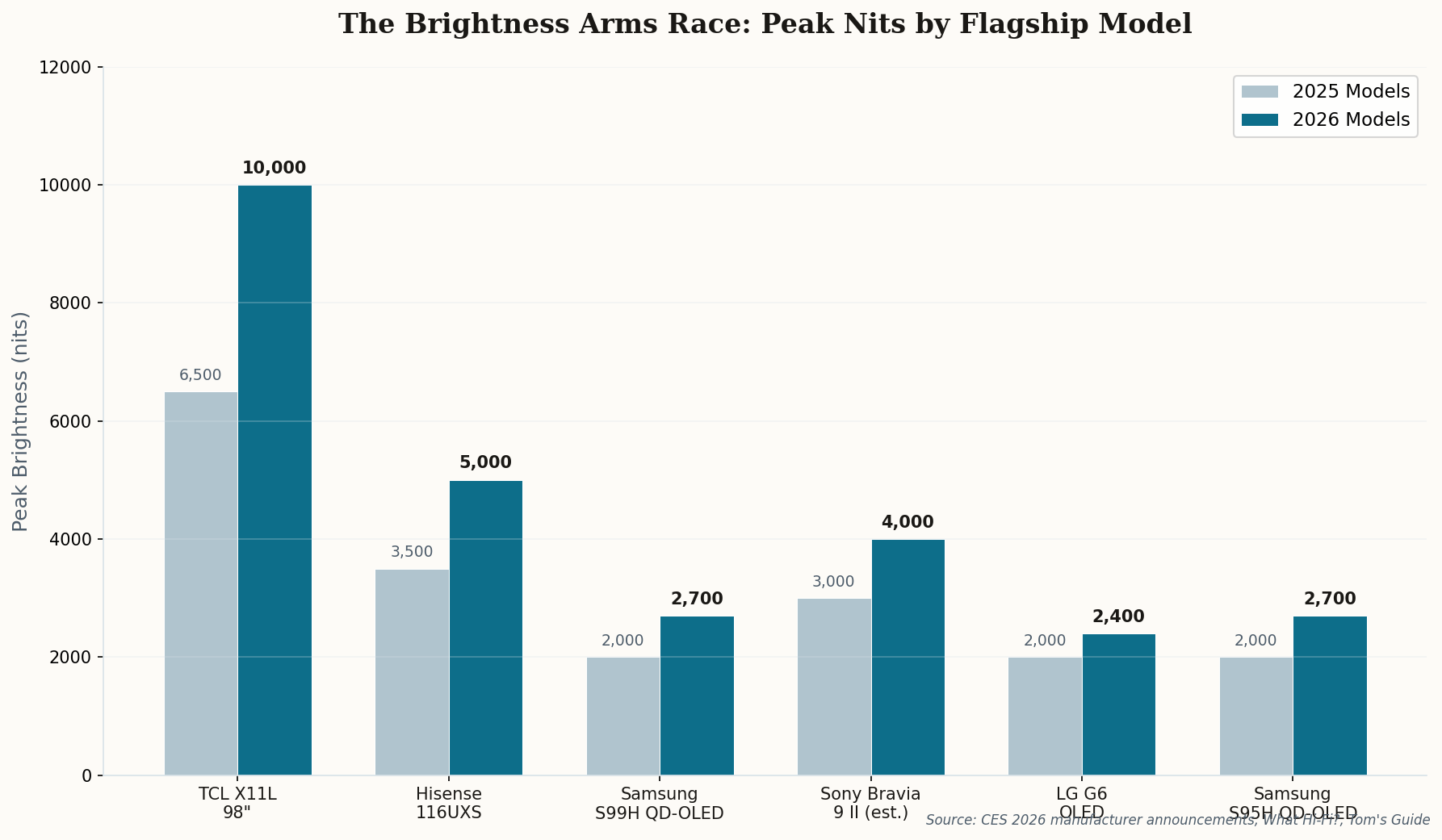
The pragmatism here is stunning. Rather than force QD-OLED into every size and price point, Samsung picked the best panel technology for each product slot. The S95H reaches 2,700 nits in Movie mode (up from 2,000 on the S95F), gains a 48-inch option, and adopts a picture-frame design that echoes the R95H halo product. The S99H flagship gets Glare Free 3.0 coating, a 165Hz refresh rate, and a 35% brightness bump over last year.

All four models ship with Eclipsa Audio, HDR10+ Advanced, Dolby Atmos, Tizen OS 10.0, and a commitment to seven years of OTA updates. That last detail matters more than any spec: Samsung is signaling that a 2026 OLED isn't a disposable gadget. It's infrastructure.

Bar chart comparing peak brightness in nits between 2025 and 2026 flagship TV models, showing dramatic increases across all brands
The brightness gap between LCD-based technologies and OLED continues to narrow, but TCL's 10,000-nit X11L operates in a different universe entirely.
An impossibly bright television cutting through darkness, rays of light casting dramatic shadows
04

TCL's 10,000-Nit X11L Doesn't Just Beat the Competition—It Embarrasses Them

There's a number in the TV industry that nobody thought we'd see on a consumer product this decade: 10,000 nits. TCL just put it on a $10,000 price tag, and the implications are genuinely disorienting. The 98-inch X11L uses Super Quantum Dot (SQD) Mini-LED backlighting with 20,736 local dimming zones to deliver peak brightness that would have been science fiction two years ago.

This isn't merely "brighter than OLED." At 10,000 nits, the X11L can reproduce specular highlights—the glint of sunlight on water, the flash of a camera—with a physicality that no other consumer display can match. The 100% BT.2020 coverage via Super Quantum Dots means those highlights arrive in accurate color, not the blown-out white that plagued earlier Mini-LED implementations.

But TCL isn't a one-trick pony here. The RM9L RGB Mini-LED series pushes up to 115 inches at 9,000 nits, and the Q10M Ultra brings RGB Mini-LED to the upper-mid tier. Then there are the practical specs: 4K/144Hz native gaming, HD/288Hz via Game Accelerator, Dolby Vision IQ, HDR10+, and IMAX Enhanced certification. Best Buy already has the 98-inch listed at $9,999.99—a number that sounds absurd until you remember Samsung's 98-inch QD-OLED costs nearly three times that.

The nits race in context: Your phone probably peaks around 2,000 nits. A cinema projector delivers roughly 48 nits. The human eye begins to find light uncomfortable around 10,000 nits. TCL has built a TV that can, in peak moments, reach the literal threshold of visual discomfort. Whether that's a feature or a warning depends on your curtains.

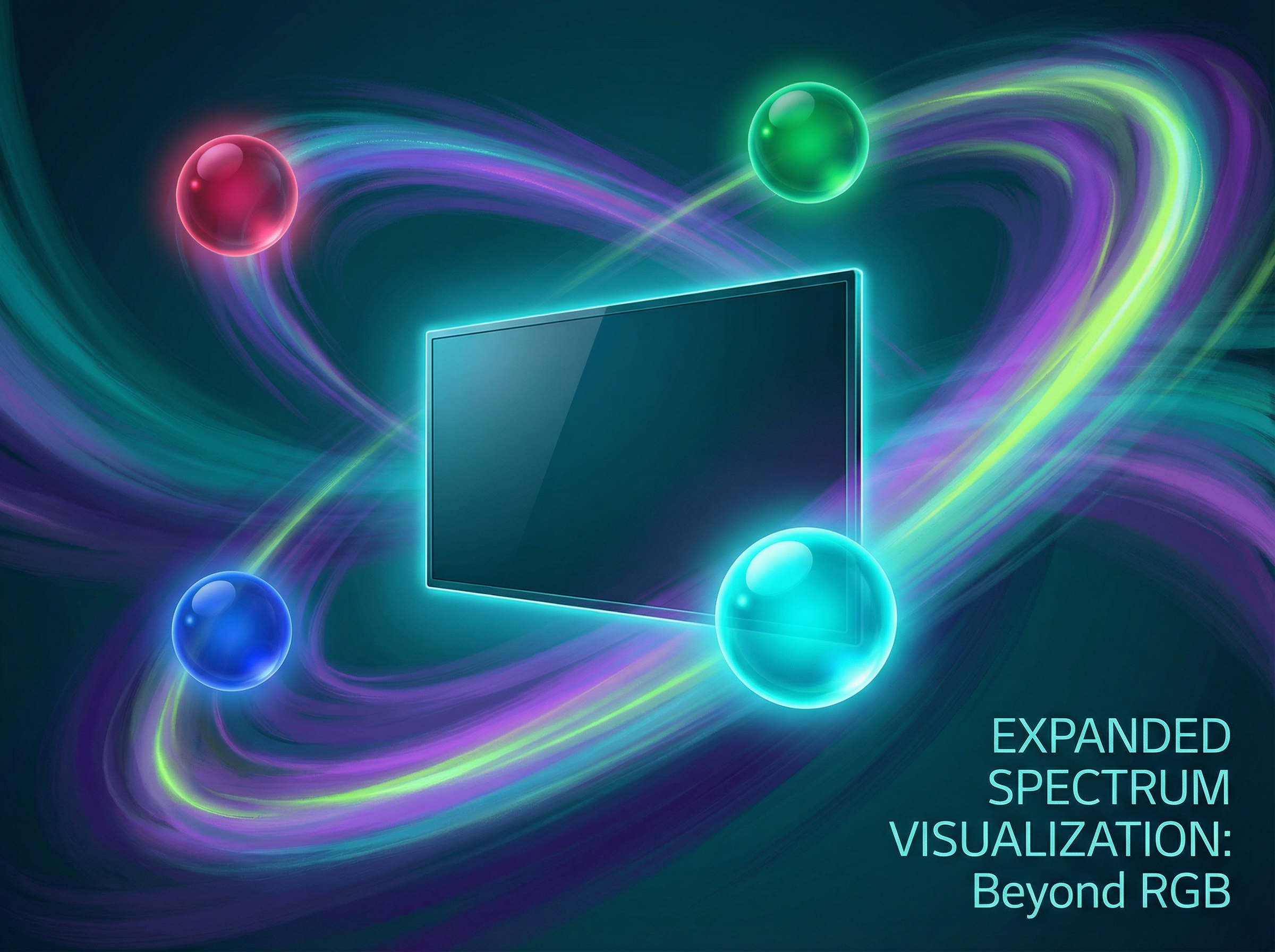
Visualization of four luminous color spheres representing red, green, blue, and cyan primary colors orbiting a display panel
05

Hisense Bets That the Future of TV Isn't Brighter—It's a Color You've Never Seen

While everyone else was measuring brightness in nits, Hisense asked a different question: what if the TV could show you colors that no current display can reproduce? The answer is the 116UXS, a 116-inch RGB Mini-LED Evo with a quiet revolution in its backlight: a fourth primary color. Cyan.

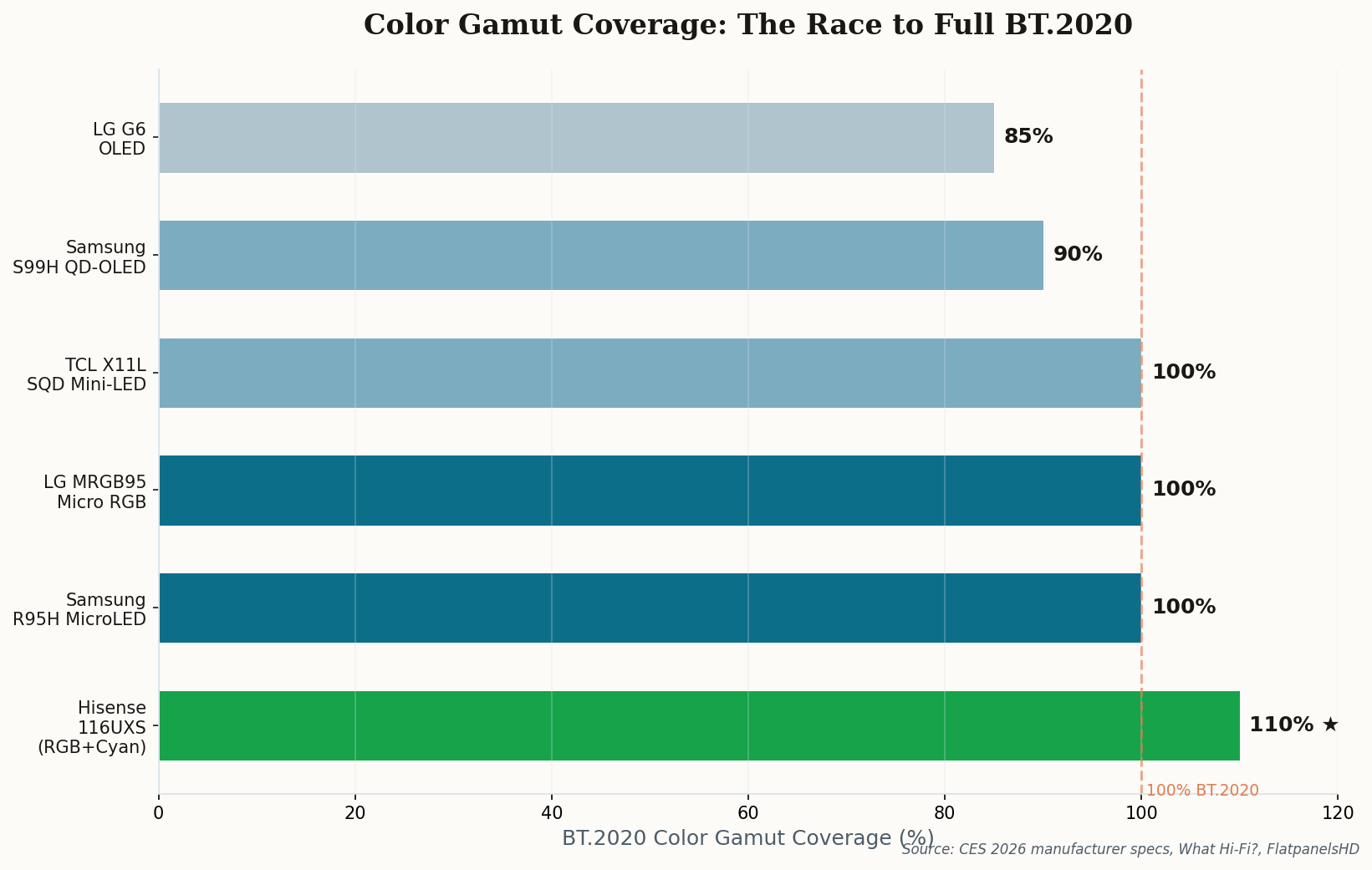
Here's why that matters. Traditional RGB backlights mix red, green, and blue to create every color you see. But human vision is most sensitive to subtle changes in the cyan-to-green range—exactly the part of the spectrum where three-primary systems struggle. By adding a dedicated cyan LED, the 116UXS achieves 110% of BT.2020 coverage. Not 100%. One hundred and ten. It's rendering colors that exist in the real world but have never been reproduced on a consumer screen.

The flagship comes with a Devialet Opéra de Paris 6.2.2 audio system and a 1.57-inch profile that makes the 116-inch panel look almost delicate. Hisense also debuted a 163-inch RGBY MicroLED prototype that adds yellow as a fourth primary to hit a different slice of BT.2020 at 100% coverage.

The broader lineup—the UR9 and UR8 series—brings RGB Mini-LED to 55-100 inch sizes at accessible price points. But the 116UXS is the statement: Hisense isn't trying to be the cheapest. It's trying to show colors nobody else can.

Horizontal bar chart showing BT.2020 color gamut coverage percentages for 2026 flagship TVs, with Hisense 116UXS leading at 110%
Hisense's four-primary system is the only consumer display to exceed 100% of the BT.2020 specification, suggesting the industry standard itself may need updating.
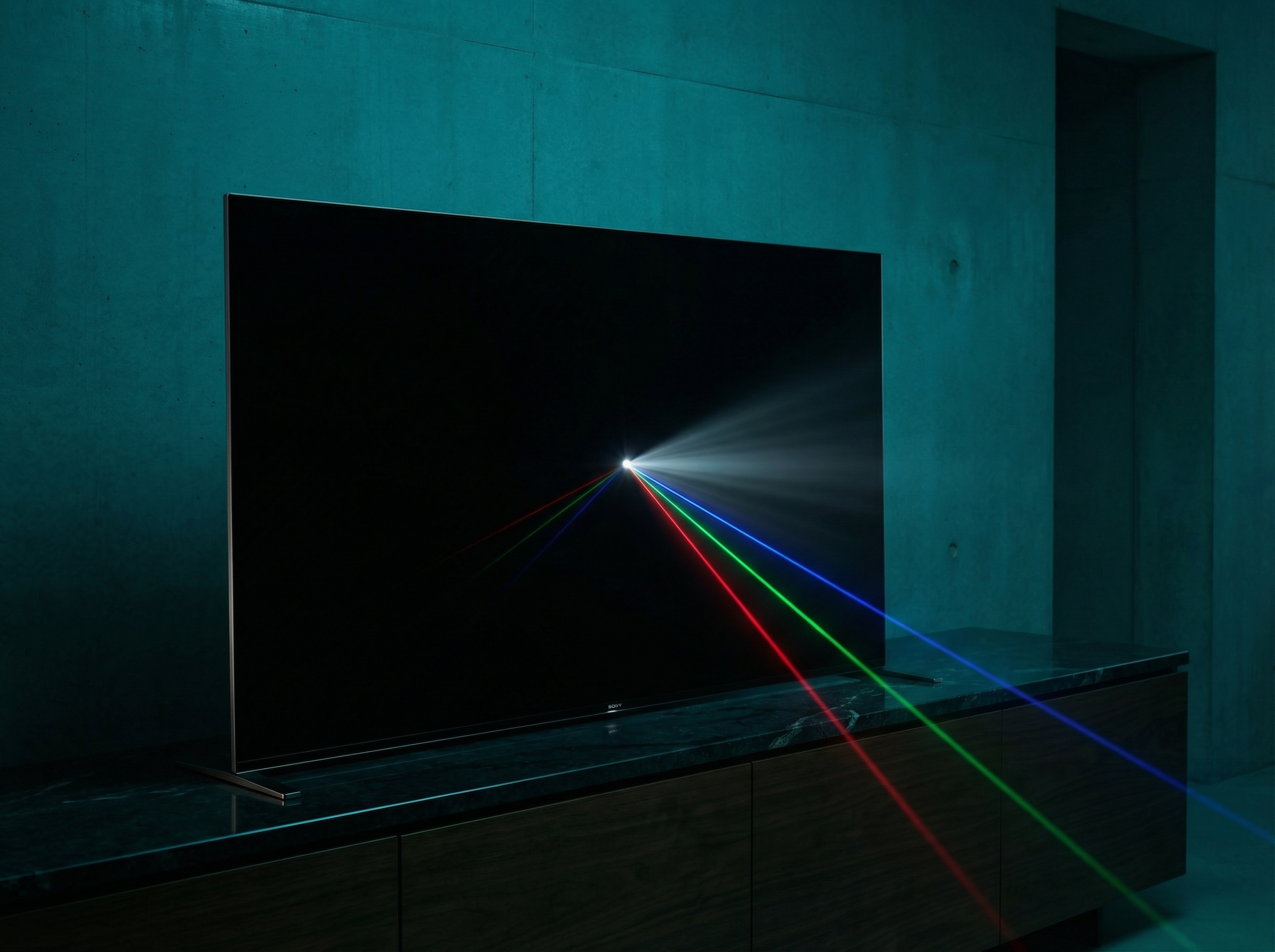
A mysterious premium television in shadow with a beam of perfectly calibrated RGB light emerging from its surface
06

Sony's Silence Is the Loudest Statement at CES

Sony barely showed up to CES 2026. And that might be the most interesting thing any TV company did this year.

While competitors filled convention halls with brightness records and screen-size superlatives, Sony kept its cards close. What we know comes from a trademark filing—"True RGB"—registered in Japan and Canada for LED screens and televisions. Supply chain reports from FlatpanelsHD suggest a Bravia 9 II (75, 85, and 98 inches) with 15,000 local dimming zones and up to 4,000 nits peak brightness, plus a Bravia 7 II (65, 75, 85 inches) with 5,100 zones and 2,000-2,500 nits.

If those specs are accurate, Sony isn't competing on raw numbers. The Bravia 9 II's 4,000 nits would be formidable but well below TCL's 10,000. Instead, Sony's bet is clearly on processing—the "True" in "True RGB" suggesting that accuracy and precision will matter more than peak output. This is classic Sony: let the others race to the top of the spec sheet, then deliver a viewing experience that makes specs feel irrelevant.

The expected launch window is mid-2026, with sizes up to 115 inches. Sony's entry will intensify an already brutal market—but if history is any guide, the Bravia lineup will be the one reviewers at RTINGS and HDTVTest recommend without reservation, specs be damned.

The Living Room Is Dead. Long Live the Viewing Room.

The 2026 TV lineup makes one thing undeniably clear: the era of the "big screen" is over because every screen is big now. When five manufacturers simultaneously offer displays above 100 inches with color reproduction that exceeds cinema standards, the conversation shifts from "how big?" to "what matters?" Samsung bets on pixel density with MicroLED. TCL bets on brightness. Hisense bets on color. Sony bets on processing. LG bets on both OLED and MicroLED at once. The only loser? The projector industry—and anyone who just finished renovating their media room.