
EV Adoption

The World Plugged In Without Us

China sold 900,000 EVs in January alone. Ford's EV sales dropped 69%. Norway's market cratered 77% after subsidies ended. Six stories from a week that proved the electric transition isn't slowing down — it's just leaving certain countries behind.

Listen
Electric vehicle charging at a futuristic station with a glowing world map, symbolizing global EV adoption
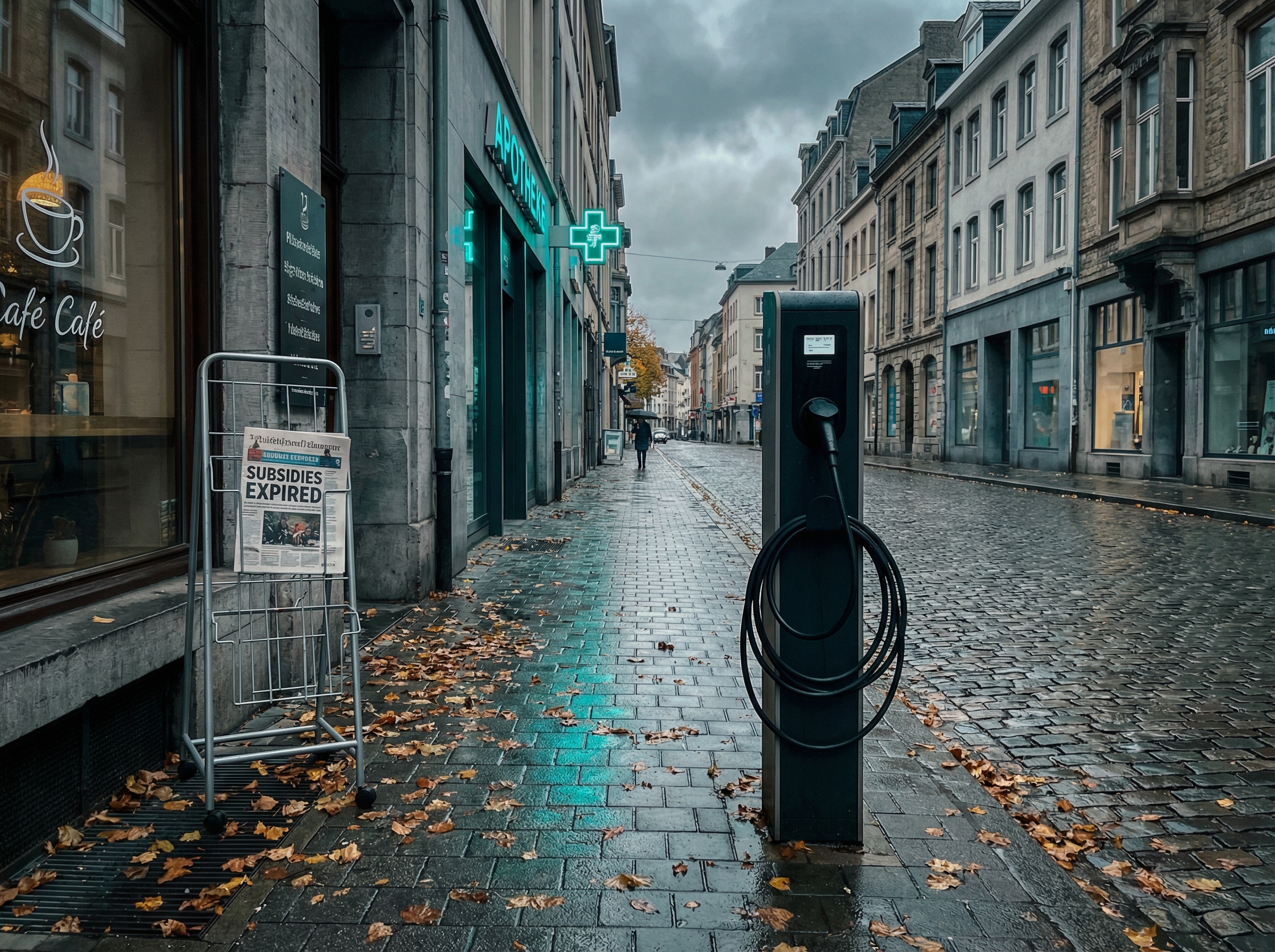
Empty EV charging station on a European street corner under overcast skies
01

Europe Proves EVs Still Run on Subsidies

Norway — the world's poster child for EV adoption — just had its car market implode. New car registrations plummeted 76.7% in January after the government trimmed purchase incentives. Let that sink in: the country where EVs once held over 90% market share saw total car sales collapse almost overnight. This isn't a blip. It's the sound of a market that was artificially inflated by government subsidies exhaling for the first time.

The contagion isn't limited to Oslo. Across the English Channel, UK battery electric vehicle growth stalled at a pathetic 0.1%, with market share slipping to 20.6% — its lowest since April 2025. Germany and Sweden, reading the room, rushed to introduce new targeted incentives for 2026 to prevent their own free falls.
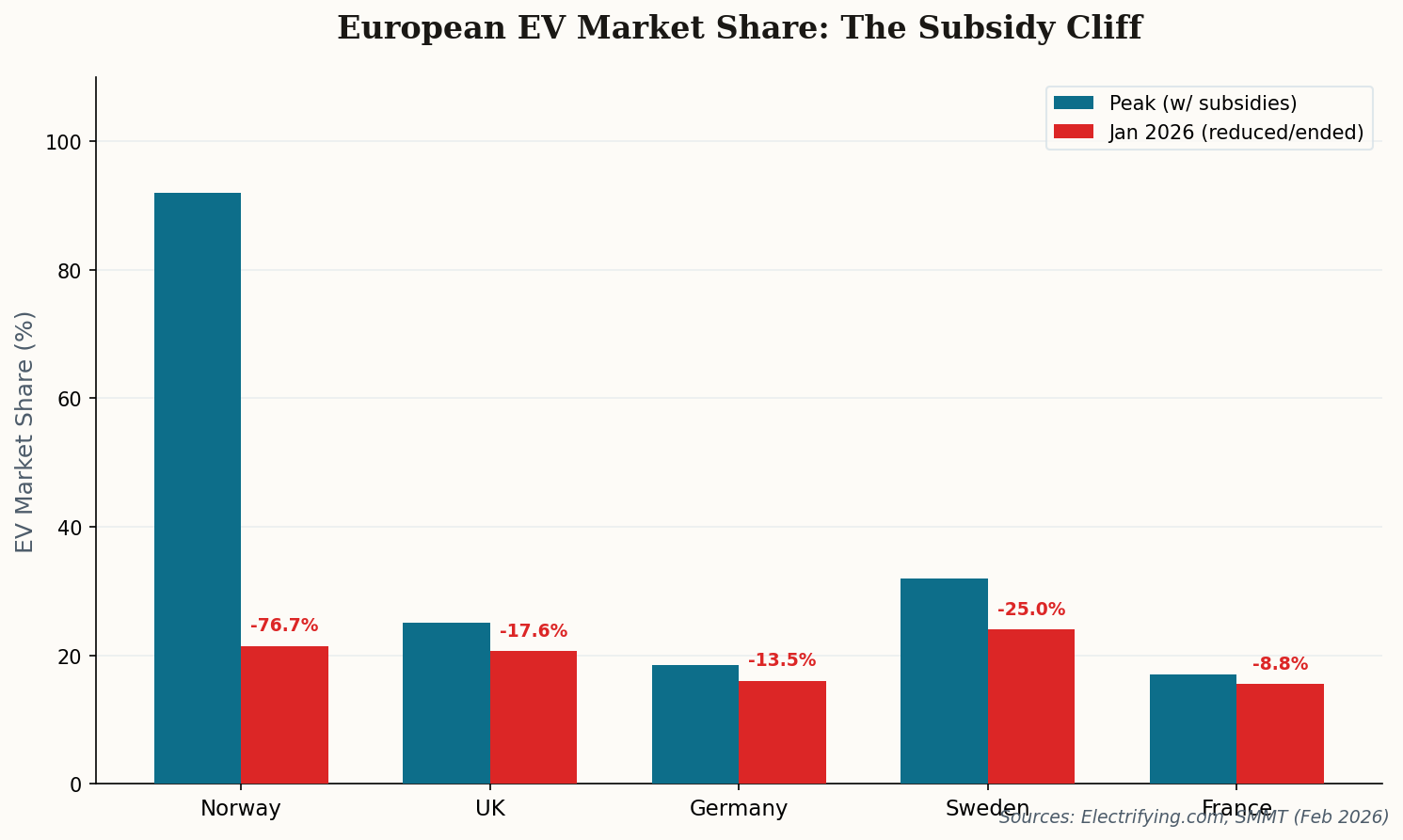
Bar chart showing European EV market share decline after subsidy changes, with Norway falling from 92% to 21.4%
Norway's market share dropped from 92% to 21.4% after incentive cuts — a 76.7% crash that reveals the subsidy dependency underneath Europe's EV leadership.

Here's the uncomfortable truth: outside of China, there is not a single major market where EV adoption has proven it can sustain itself without government life support. Every time a subsidy ends, sales crater. Every time a new one launches, sales spike. We're not witnessing an organic technology transition — we're watching a policy-dependent market react to the presence or absence of taxpayer money. Manufacturers planning production volumes around these numbers are essentially betting on the political calendar.
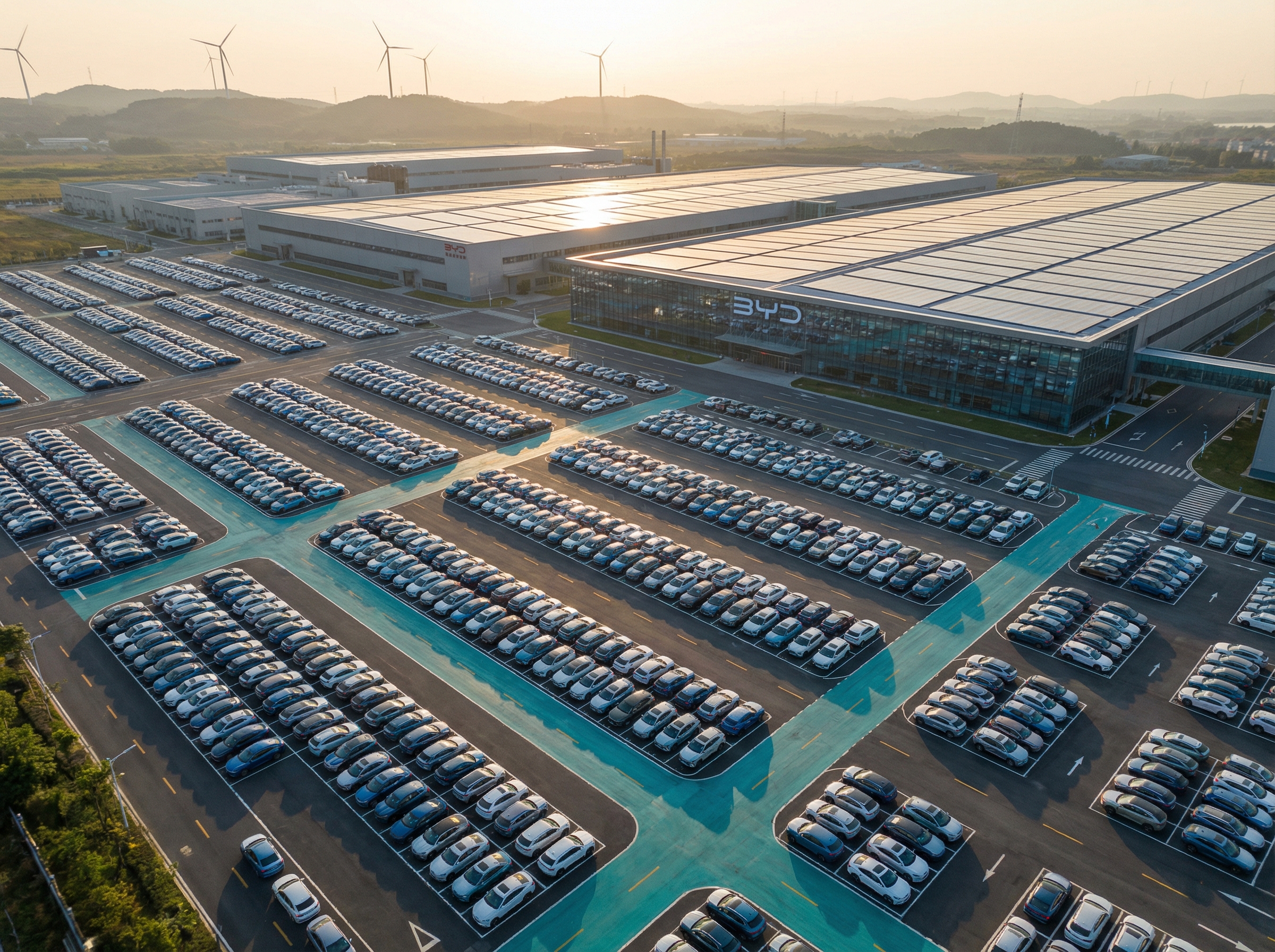
Aerial view of a massive Chinese EV factory with thousands of vehicles in organized rows
02

900,000 Units in January. China Doesn't Need Your Subsidies.

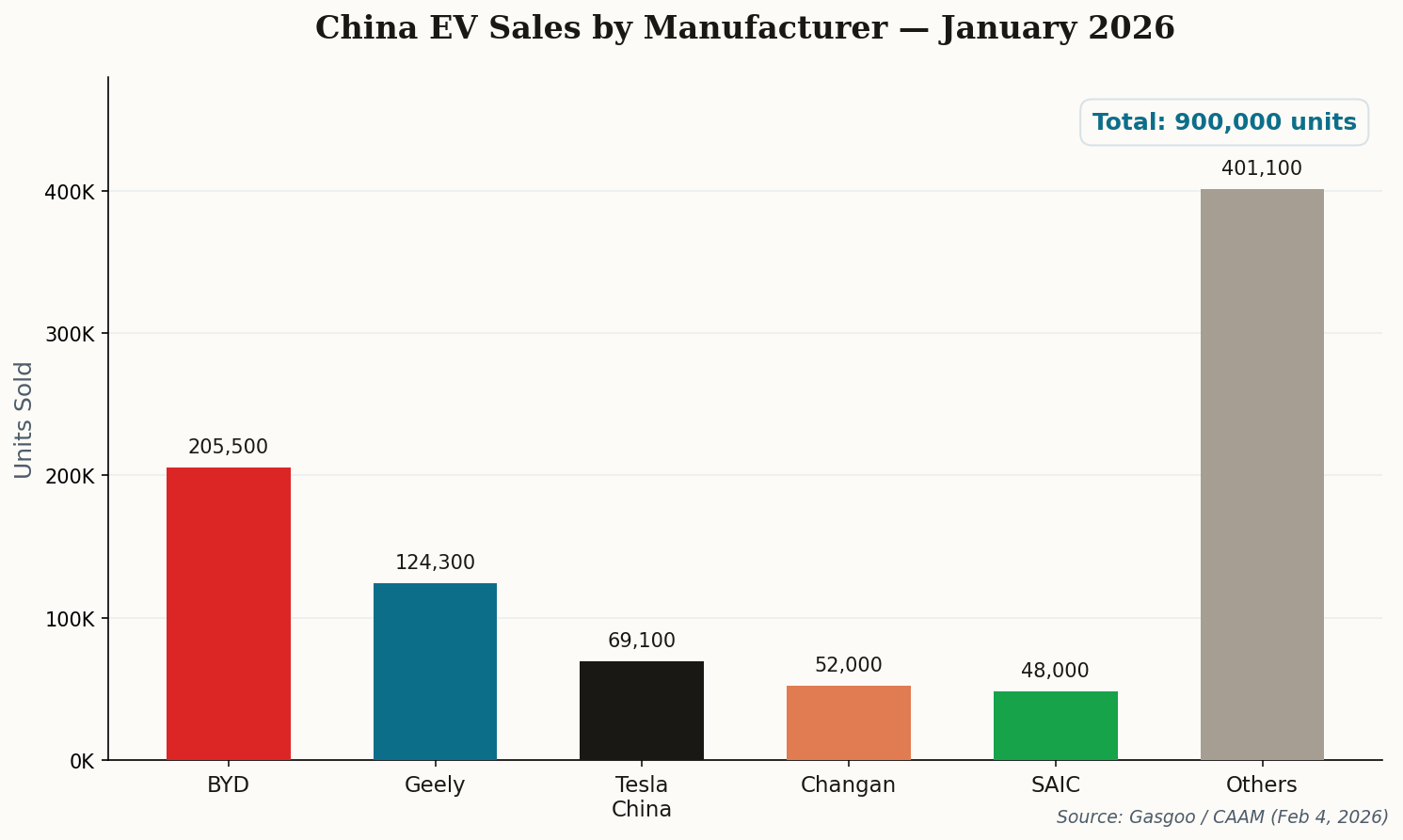
While Europe was learning what happens when the government stops writing checks, China shrugged off a 5% purchase tax reinstatement and still moved 900,000 new energy vehicles in January. That's not a typo. Nine hundred thousand. In a single month. With 1% growth, no less, despite a tax that was specifically designed to cool demand after a December rush.

BYD led the pack with 205,500 units — a number that, by itself, would make it the dominant automaker in most countries on Earth. Geely followed at 124,300, and Tesla's Shanghai operation delivered 69,100. China now commands 62% of the total global EV market share, a figure that's less "market leadership" and more "market ownership."

Bar chart showing China January 2026 EV sales by manufacturer, with BYD leading at 205,500 units
BYD alone outsold the entire US EV market in January. China's total: 900,000 new energy vehicles in a single month.

The strategic implication is staggering. China's EV ecosystem has achieved escape velocity — the point where scale economics, supply chain integration, and consumer familiarity create a self-reinforcing cycle that no longer depends on policy nudges. They've built the battery factories, the charging networks, the consumer brands, and the export logistics. Everyone else is now competing for the remaining 38% of a market that China defined.

A lone electric pickup truck parked in an empty dealership lot under dramatic lighting
03

Ford's EV Bet Just Lost 69% of Its Chips

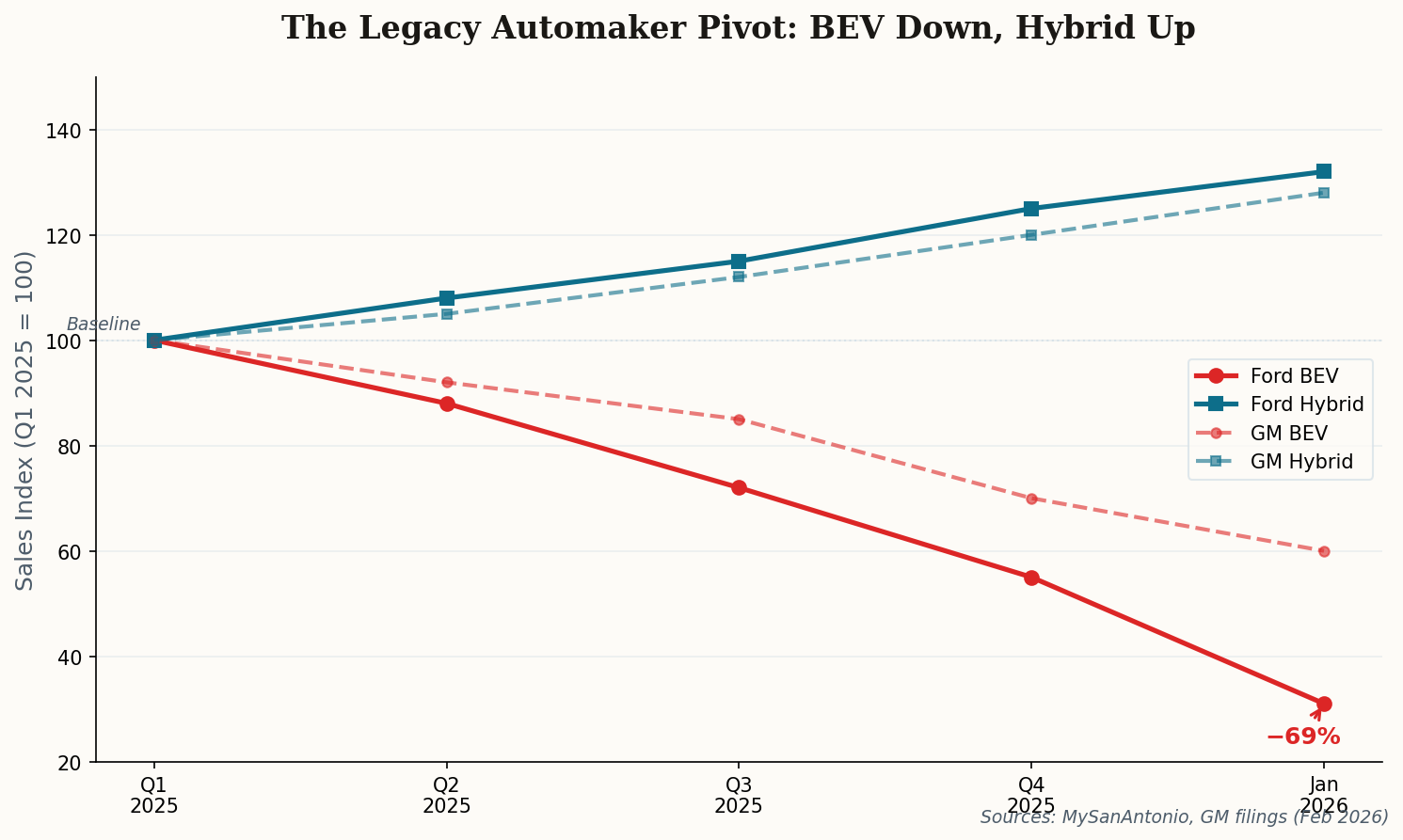
When Ford announced it was splitting its business into Ford Blue (legacy) and Ford Model e (electric), the message was clear: the future is electric, and we're going all-in. That was the narrative. The reality arrived with January's sales data, and it reads like a surrender document. Ford's EV deliveries cratered 69% year-over-year — a decline so steep it makes you wonder whether Model e needs to be renamed Model "eh."

Meanwhile, Ford's hybrid and crossover sales remained robust, which tells you exactly where American consumers are placing their bets right now. They don't want to abandon internal combustion entirely. They want a halfway house. Hybrids offer the emotional comfort of a gas tank and the talking-point appeal of partial electrification. For suburbanites who drive 40 miles a day and refuel on weekends, a hybrid makes more practical sense than a pure EV — especially when charging infrastructure remains patchy outside major metros.

Line chart showing Ford and GM BEV sales declining sharply while hybrid sales rise steadily
The great pivot: Ford and GM's pure EV sales have collapsed while their hybrid lines grow. This isn't a pause — it's a strategy reversal.

General Motors told a parallel story, booking over $7 billion in charges related to scaling back its own EV ambitions. The Detroit playbook for 2026 is unmistakable: hybrids as the bridge product, pure EVs as the aspiration that can wait. It's a rational short-term response. It's also how you fall permanently behind a Chinese industry that isn't slowing down to let you catch up.

Abstract policy balance scale with incentives and mandates, Canadian maple leaf watermark
04

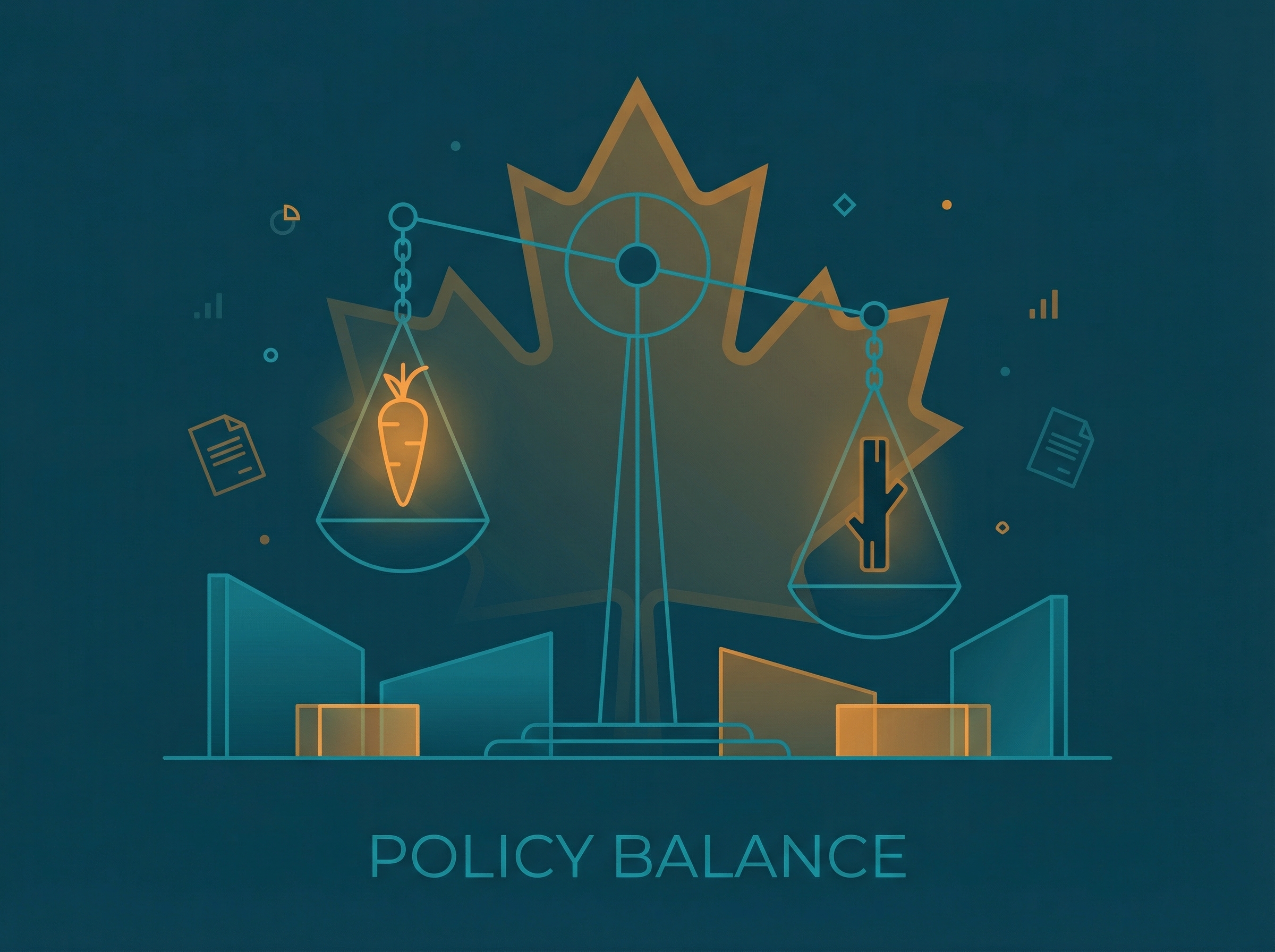
Canada Drops the Stick, Picks Up the Carrot

Ottawa is trying something interesting. Rather than mandating EV sales quotas — which were proving about as effective as asking Canadians to stop drinking Tim Hortons — the government launched an "EV Affordability Program" offering up to $5,000 CAD for eligible electric vehicles. The twist: only cars manufactured in countries with free trade agreements qualify. Chinese-made EVs need not apply.

This is industrial policy wearing a green hat. By restricting eligibility to free trade partners, Canada is explicitly building a trade wall against BYD, NIO, and every other Chinese manufacturer that's been undercutting Western automakers on price. The simultaneous repeal of sales mandates — replaced by emissions standards running through 2032 — signals that Ottawa has accepted the European lesson: you can't regulate your way to adoption. You have to buy your way there.

The question is whether $5,000 moves the needle when the average EV still costs significantly more than an equivalent ICE vehicle. Norway spent years pouring in far more generous incentives — tax exemptions, toll-free driving, HOV lane access — and the moment they pulled back, sales cratered 77%. A $5,000 rebate in a market where a Ford F-150 Lightning starts at $70,000 CAD is a gesture, not a game-changer.

Split-screen concept showing busy electric highway in Asia versus sparse American highway
05

The Great Decoupling: The World Grows 20%, America Shrinks

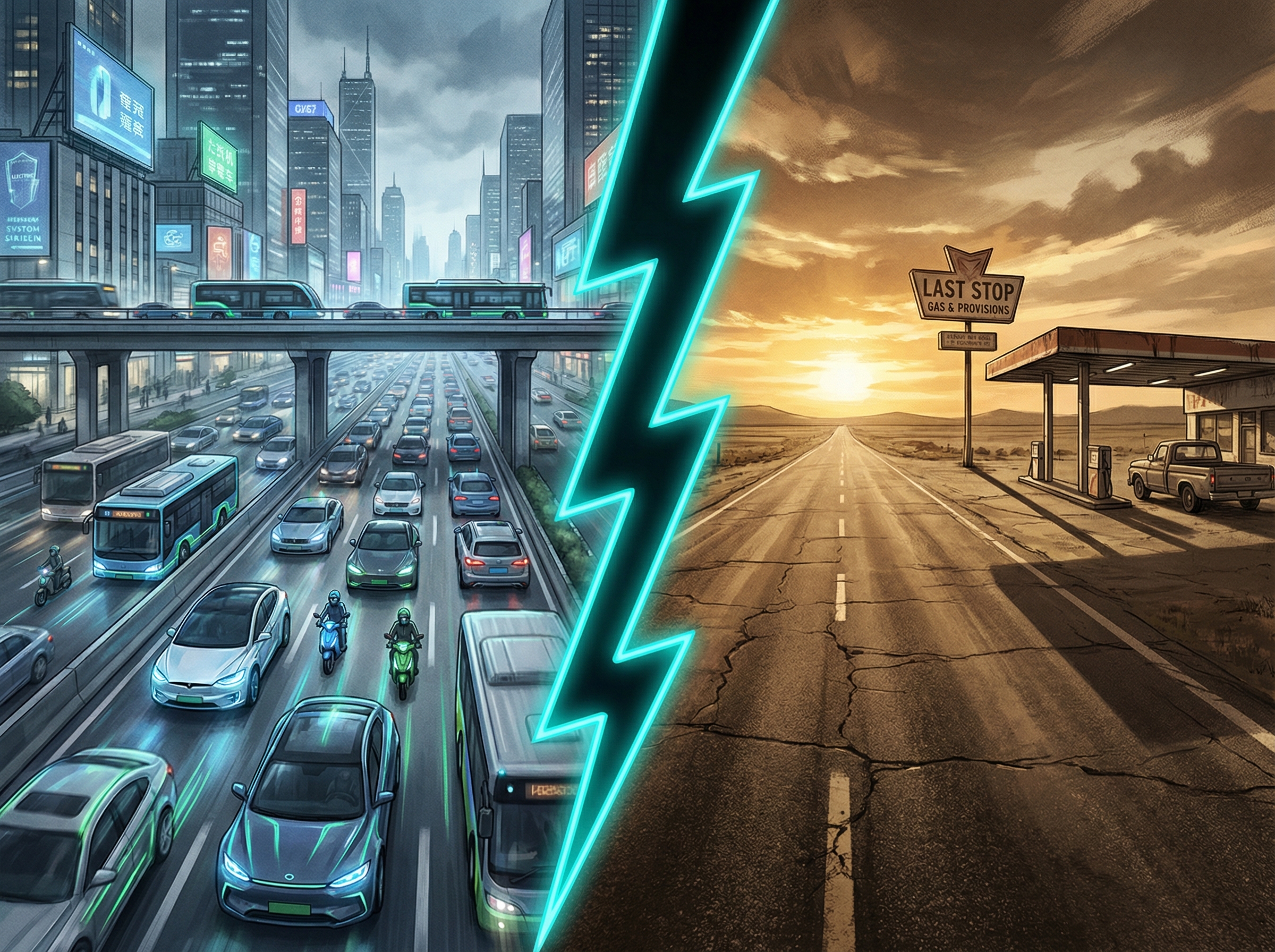
Here's the number that should terrify every American automaker: global EV registrations surged 20% year-over-year entering 2026, while US EV sales declined 2.6%. That's not convergence. That's divergence. The rest of the world is accelerating into electrification, and the United States is tapping the brakes.

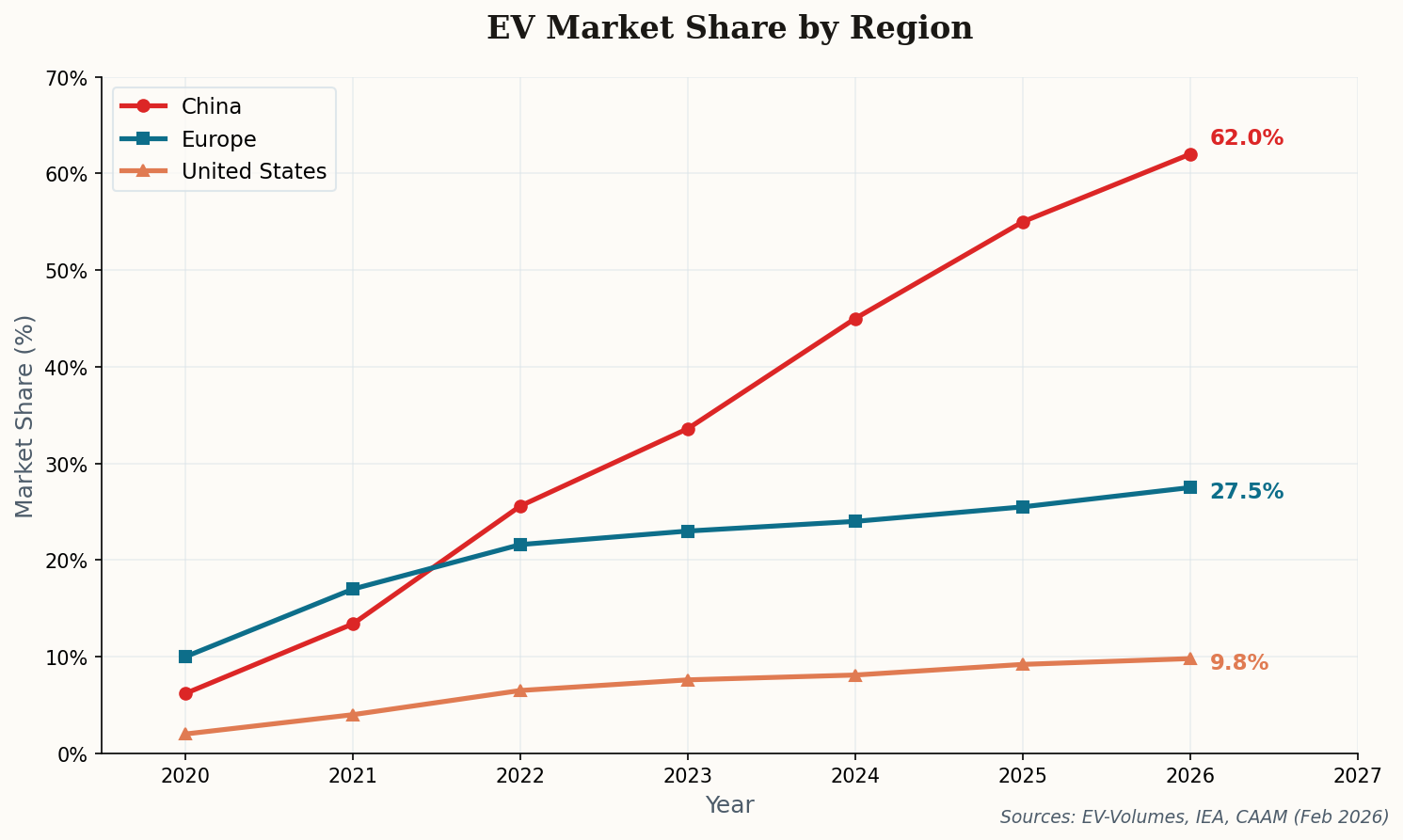
Line chart showing EV market share trajectories for China (62%), Europe (27.5%), and US (9.8%) from 2020-2026
The trajectories tell the story: China at 62% EV market share, Europe at 27.5%, and the US stuck below 10%. The gap is accelerating, not closing.

The US EV market share remains stubbornly below 10% — a number that would have been embarrassing in 2023 and is now approaching strategic crisis territory. Tesla's US deliveries dropped 9% year-over-year, with January 2026 specifically down 32%. When even Tesla can't grow in America, the problem isn't the cars. It's the ecosystem: insufficient charging infrastructure, the evaporation of federal incentives, political polarization around EVs, and legacy dealer networks that still profit more from selling gas trucks.

The global forecast projects EVs hitting 27.5% market share worldwide in 2026. If the US stays below 10%, American automakers will be building cars for a domestic market that's increasingly out of step with the world they export to. That's not just an environmental problem — it's a competitiveness problem. You can't sell 2020-era powertrain technology to 2026-era markets.

Golden Gate Bridge at sunset with electric vehicles crossing, teal light streaks from taillights
06

California Writes Its Own Federal Policy

With Washington pulling the plug on federal EV tax credits, California did what California always does: wrote its own rules. The state allocated $200 million for a new incentive program — capped at $55,000 for sedans and $80,000 for trucks and SUVs — designed explicitly to fill the hole left by the vanished $7,500 federal credit.

The clever part: automakers are required to match state funds to participate, effectively doubling the subsidy pool without doubling the taxpayer cost. It's a market-design move that forces manufacturers to have skin in the game rather than simply passing government money through to consumers. Sixteen other states have signaled they'll maintain their own zero-emission vehicle targets through 2035, creating what amounts to a two-speed America.

The emerging reality: buying an EV in San Francisco will be thousands of dollars cheaper than buying the same car in Dallas. Federal policy used to level the playing field. Now geography determines your EV economics. Whether that's "states' rights in action" or "market fragmentation" depends on where you sit politically — but from a manufacturer's perspective, it's a logistics and pricing nightmare.

California's 16-state coalition represents roughly 40% of the US auto market. If those states maintain aggressive EV incentives while the rest of the country doesn't, we're headed toward a nation where electrification maps perfectly onto the political map. Blue states go electric. Red states go hybrid. And the interstate highway system — the thing that was supposed to unite us — becomes the dividing line between two completely different automotive realities.

The Clock Is Running

The data from this week doesn't tell a story of EVs failing. It tells a story of EVs succeeding — everywhere except the places that decided to stop trying. China's 62% market share wasn't ordained by geography or culture. It was built by sustained investment, aggressive industrial policy, and a willingness to let domestic manufacturers compete on a global stage. The US withdrawal from the Paris Agreement, the evaporation of federal credits, the Detroit retreat to hybrids — these aren't neutral decisions. They're choices with consequences that compound annually. Every year the gap widens, it becomes harder to close. The battery factories, the supply chains, the engineering talent — they're settling into ecosystems now. And ecosystems don't wait.