Vibe Coding

The Year the Vibes Grew Up

One year after Andrej Karpathy coined "vibe coding," the movement's creator says it's already obsolete. This week's news proves he might be right—and that the stakes are higher than anyone expected.

Listen
A cyberpunk command center with holographic code streams and AI agents working autonomously
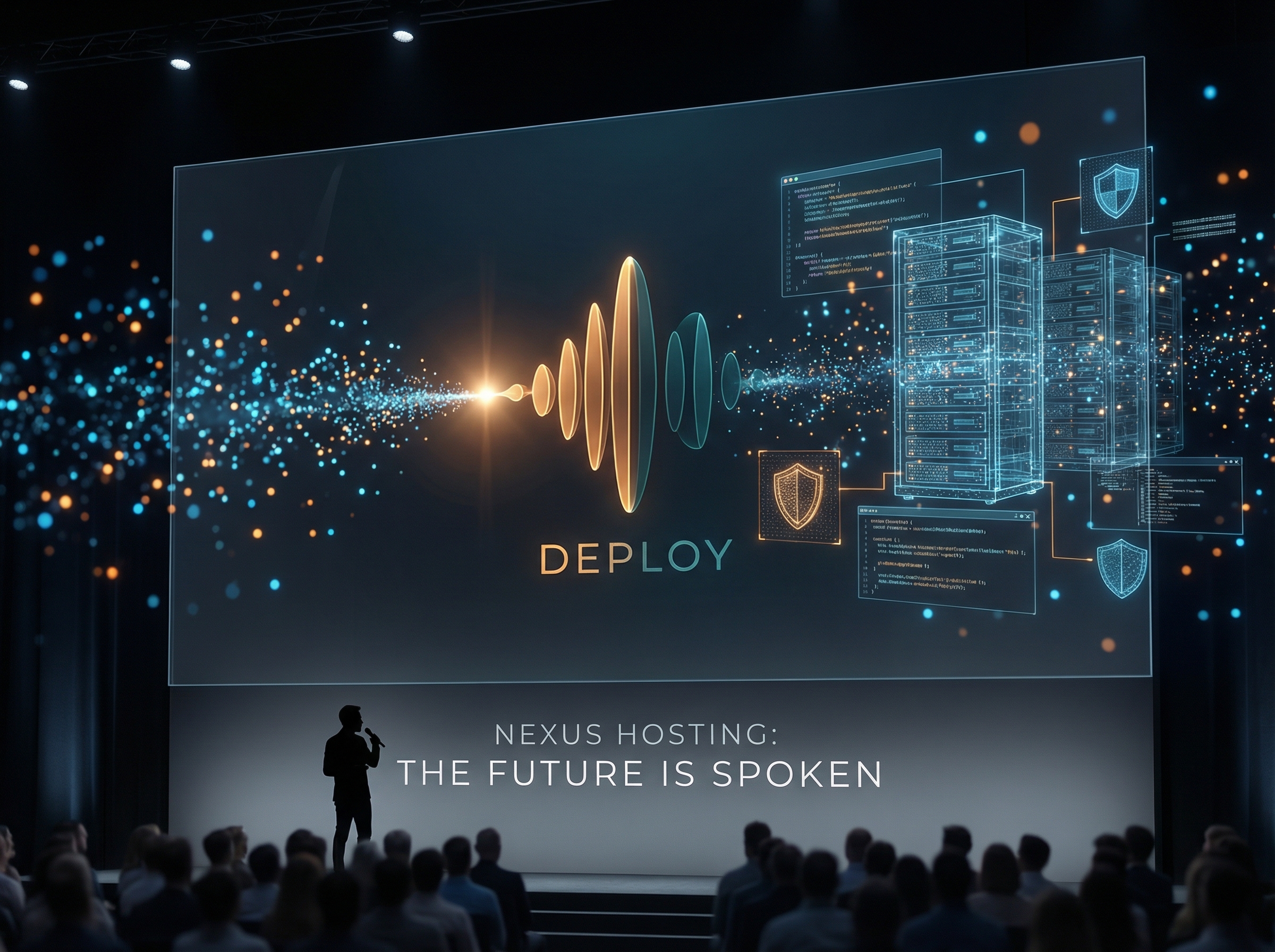
A futuristic hosting dashboard materializing from spoken words
01

SiteGround Wants to Be the Last Tool You Ever Need

Here's a question that would have sounded absurd three years ago: what if your hosting company also wrote your code?

SiteGround launched Coderick AI today, and it's not just another vibe coding tool—it's a full-stack collapse. You describe what you want in plain English. The AI generates production-ready code. And then—here's the twist—it deploys it immediately onto SiteGround's own infrastructure, complete with SSL, authentication, and version control baked in.

CEO Nikolay Todorov calls it "bringing vibe coding to production." Which is exactly the right framing. The dirty secret of every Bolt and Replit project is that generating code is the easy part. Getting it deployed, secured, and maintained is where hobbyist projects go to die. By collapsing the gap between generation and production, SiteGround is betting that the real moat isn't in the AI—it's in everything around it.

The counter-argument writes itself: a hosting company's AI will never match dedicated coding agents from Anthropic or OpenAI. But for the long tail of business websites, portfolios, and internal tools? "Good enough code on bulletproof infrastructure" might beat "brilliant code you can't deploy."
Three luminous AI entities converging into a unified workspace portal
02

GitHub Declares the Agent Wars an Open Platform

The biggest platform move in AI-assisted coding this year isn't a new model. It's a concession.

GitHub launched Agent HQ in public preview yesterday, and the implications are enormous: Copilot Pro+ and Enterprise subscribers can now run Anthropic's Claude and OpenAI's Codex directly inside GitHub, GitHub Mobile, and VS Code. No switching tools. No separate subscriptions. Just a dropdown to pick which AI brain handles your pull request.

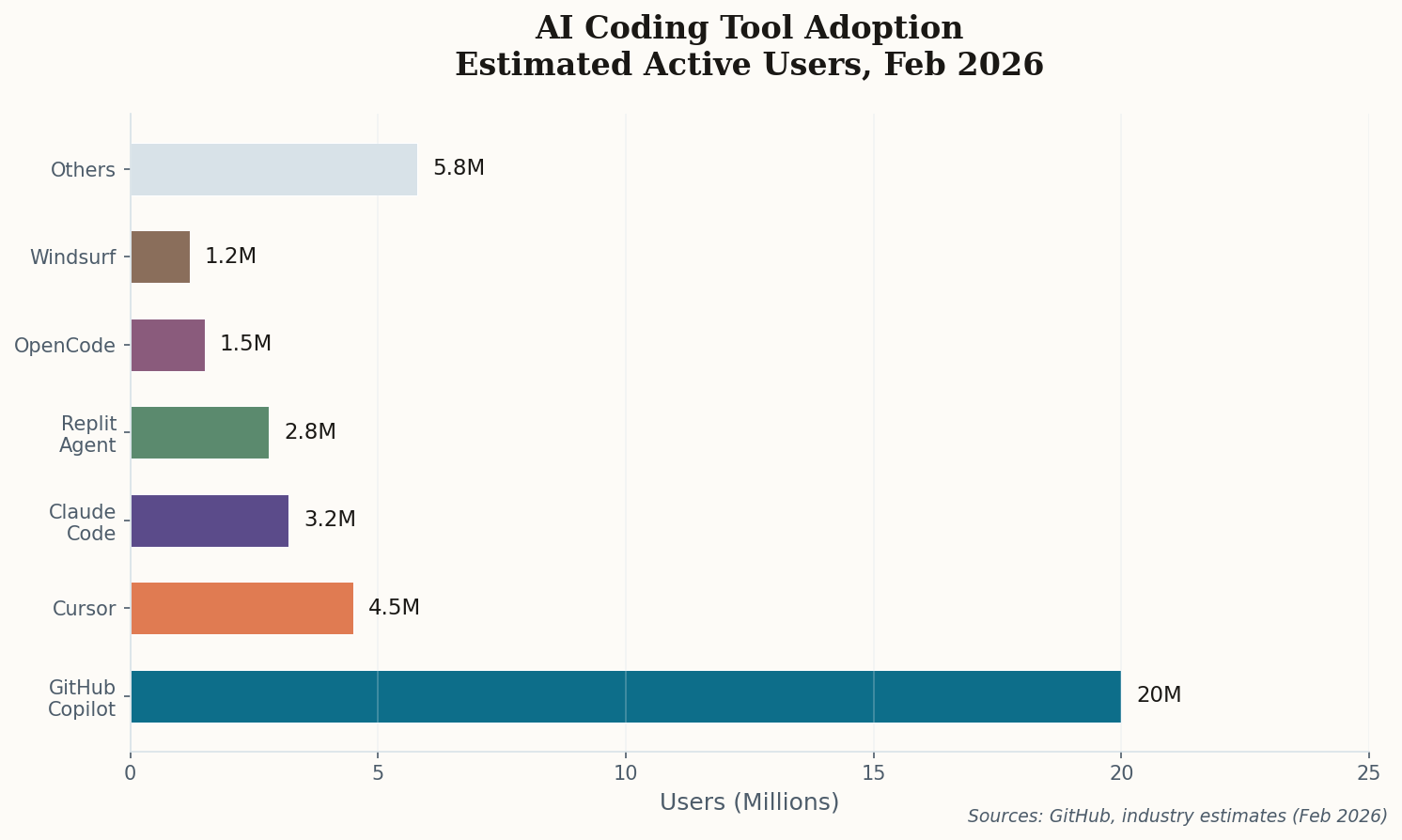
Bar chart showing AI coding tool adoption with GitHub Copilot leading at 20M users
GitHub Copilot's 20M+ user base gives it massive distribution leverage. Opening to rivals is a bet that platform gravity matters more than model exclusivity.

This is GitHub admitting something important: no single AI model will dominate coding. Different tasks demand different strengths—Claude excels at understanding complex codebases, Codex at rapid iteration, Copilot's native agent at deep GitHub integration. By becoming the Switzerland of AI coding, GitHub is placing a bet that distribution matters more than the model. With 20 million users and 90% of the Fortune 100, that's a bet they can afford to make.

For developers, the practical upside is clear: match the agent to the task, all within one workflow. For Anthropic and OpenAI, it's a Faustian bargain—massive reach in exchange for becoming a commodity in someone else's marketplace. Watch the Copilot CLI integration "coming soon"—terminal-based multi-agent workflows could reshape how teams actually ship code.

Evolution from casual vibe coding to structured agentic engineering
03

Karpathy Kills His Own Creation

Exactly one year after coining a term that spawned an industry, Andrej Karpathy wants you to forget it.

In a post on X dated February 4, 2026, Karpathy proposed retiring "vibe coding" in favor of "agentic engineering"—a term he chose carefully. "'Agentic' because the new default is that you are not writing the code directly 99% of the time, you are orchestrating agents who do and acting as oversight," he wrote. "'Engineering' to emphasize that there is an art & science and expertise to it."

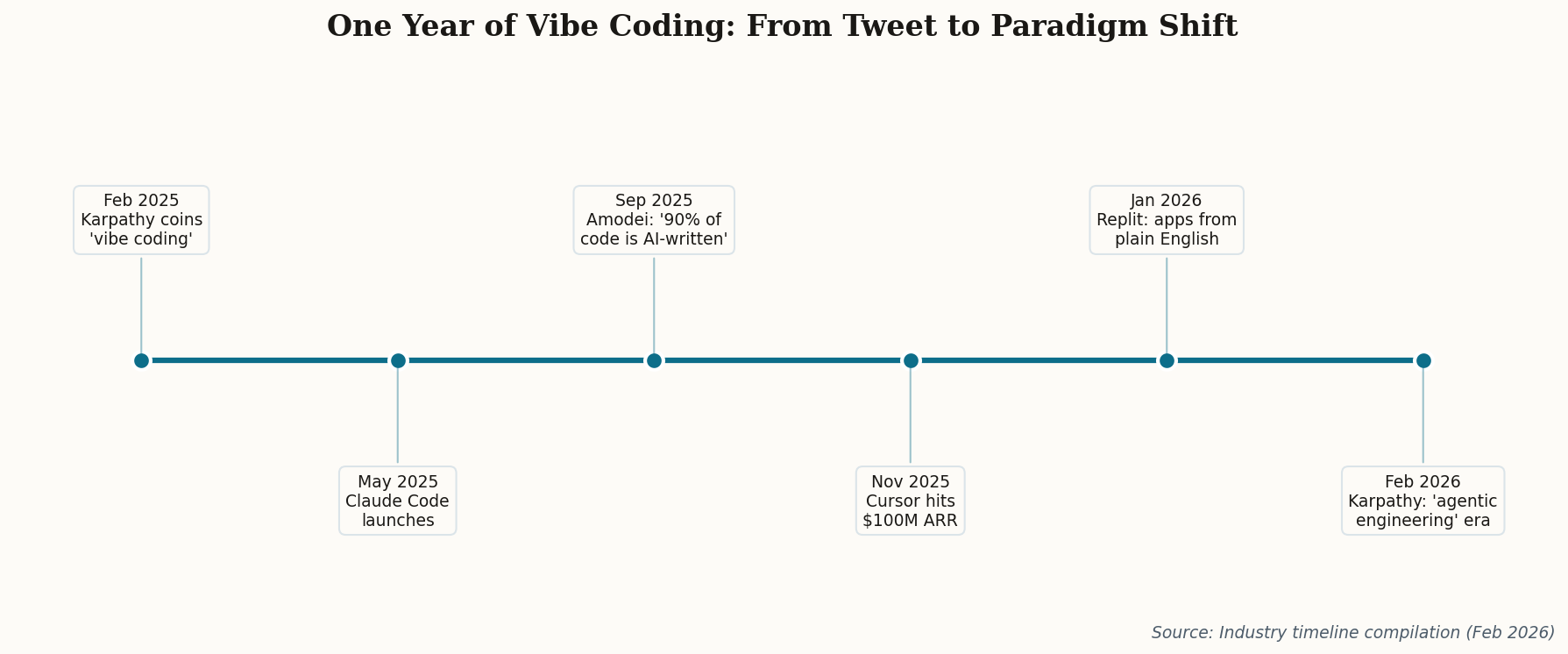
Timeline showing the evolution from Karpathy's original vibe coding tweet to agentic engineering
One year of vibe coding: from a casual tweet to a paradigm shift affecting millions of developers.

The distinction matters more than it looks. "Vibe coding" implied casualness—you didn't need to understand the code, you just needed to vibe. "Agentic engineering" implies mastery of a different kind: knowing which agent to deploy, when to intervene, how to validate output, and where the AI's confidence should end and your judgment should begin. It's the difference between being a passenger and being a pilot.

The timing isn't accidental. Node.js creator Ryan Dahl and Google CEO Sundar Pichai have both recently endorsed AI-driven development as the default mode. Karpathy is trying to steer the narrative before the term he invented becomes a liability—associated more with "let the AI do whatever" than with serious software craft.

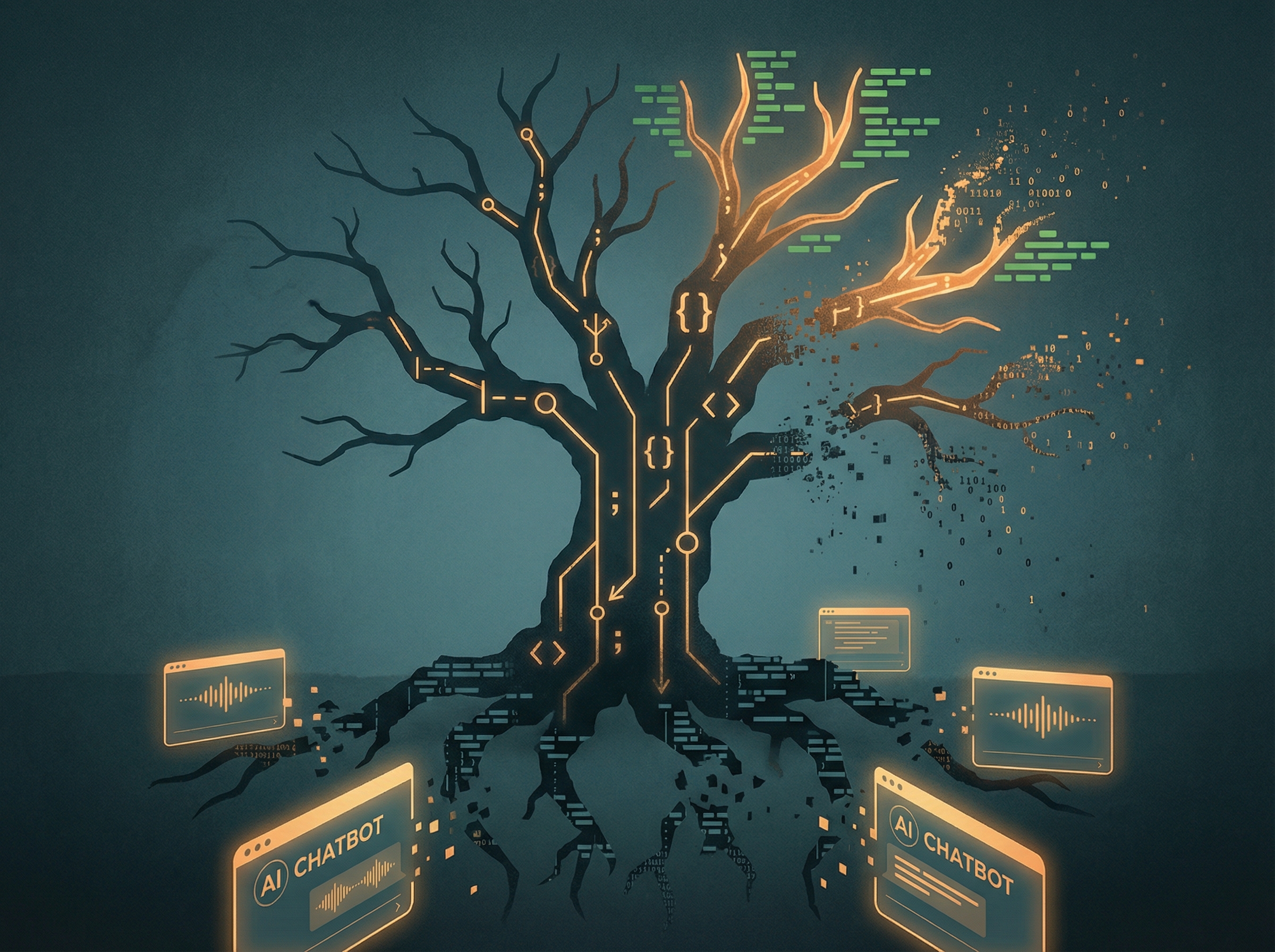
A tree of open source code symbols with roots being severed by AI chatbot interfaces
04

The Open Source Ecosystem Didn't Sign Up for This

A new pre-print paper by Koren et al. (arXiv:2601.15494) makes a claim that should keep every developer up at night: vibe coding is killing open source, and it's happening faster than anyone predicted.

The mechanism is elegant and devastating. When you ask an AI to solve a problem, it draws from training data dominated by popular libraries. You get your answer. You never visit the project's GitHub page. You never file a bug report. You never donate, sponsor, or contribute a patch. The AI becomes an invisible middleman that extracts value from open source while returning nothing.

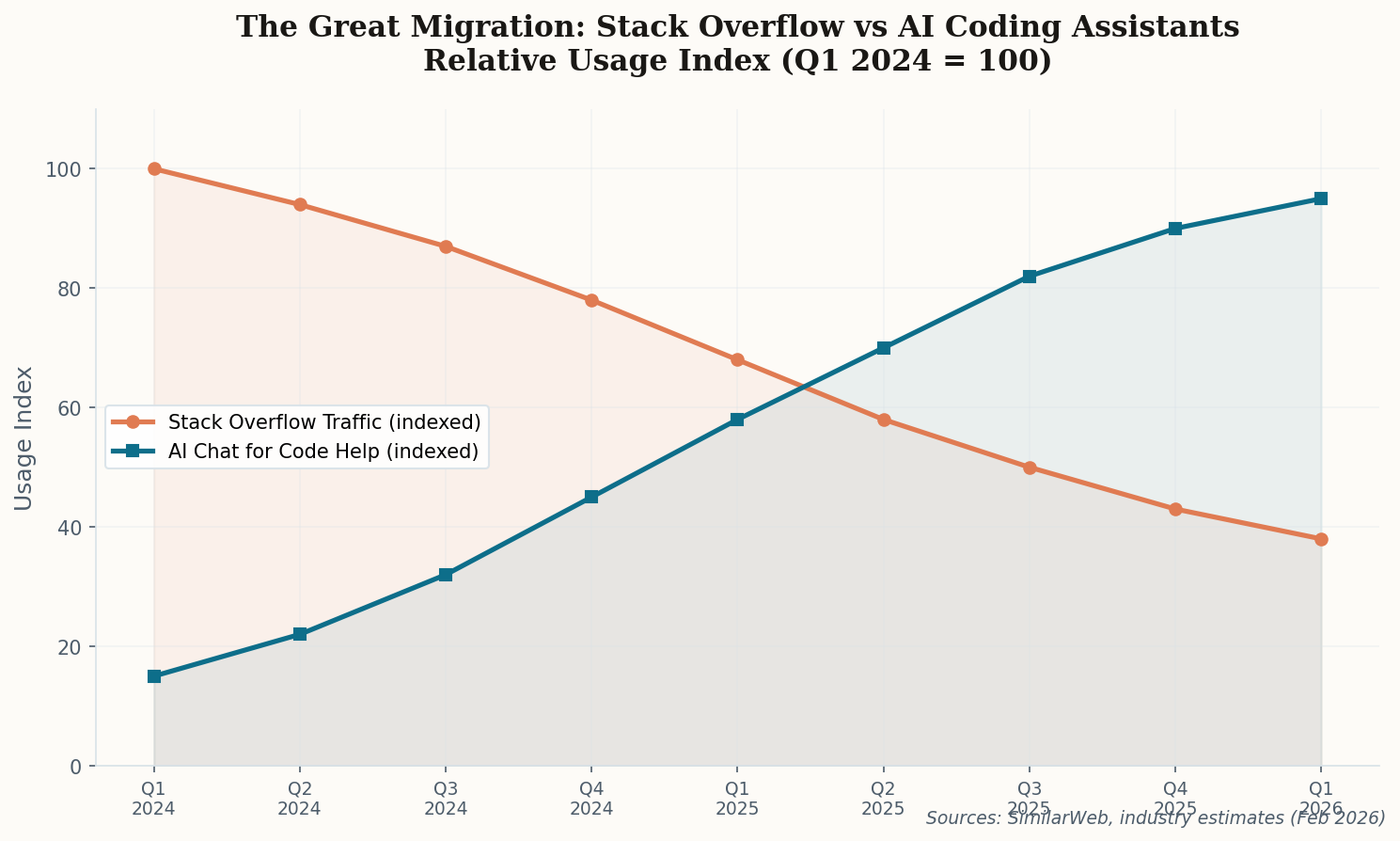
Chart showing Stack Overflow traffic declining while AI coding assistant usage rises
The great migration: public knowledge-sharing is declining as developers shift to private AI conversations. Data reflects industry-wide trends estimated from SimilarWeb and usage reports.

The paper draws a pointed analogy to Spotify: "80% of artists receive minimal compensation" despite their work being the platform's entire value proposition. Open-source maintainers risk becoming the session musicians of the AI era—essential but invisible.

The uncomfortable number: Anthropic CEO Dario Amodei said at the Axios AI+ Summit that "70, 80, 90 percent of the code written in Anthropic is written by Claude." If the company building the AI that generates code from open-source training data doesn't need its own developers to contribute back—who will?

The researchers aren't calling for a halt to AI coding. They're asking a harder question: who pays for the commons when the commons becomes invisible? Smaller, niche projects are most at risk. Many of today's essential tools—Linux, git, TeX, grep—started as one person scratching an itch. If the next generation of those people never encounters the itch because an AI papered over it, what don't we build?

A terminal window floating in space surrounded by a constellation of model icons
05

OpenCode: 95K Stars and a Philosophy Problem

The open-source answer to Claude Code and GitHub Copilot is here, and it's gaining traction fast. OpenCode, built by Anomaly Innovations, crossed 95,000 GitHub stars and it's not hard to see why.

The pitch: a terminal-native AI coding agent that works with 75+ models—Claude, OpenAI, Gemini, and local models through LM Studio—with multi-session support, LSP integration for type-aware suggestions, and MCP server compatibility. It's free. It's open source. And you can use your existing ChatGPT Plus, Copilot, or Claude subscriptions to power it.

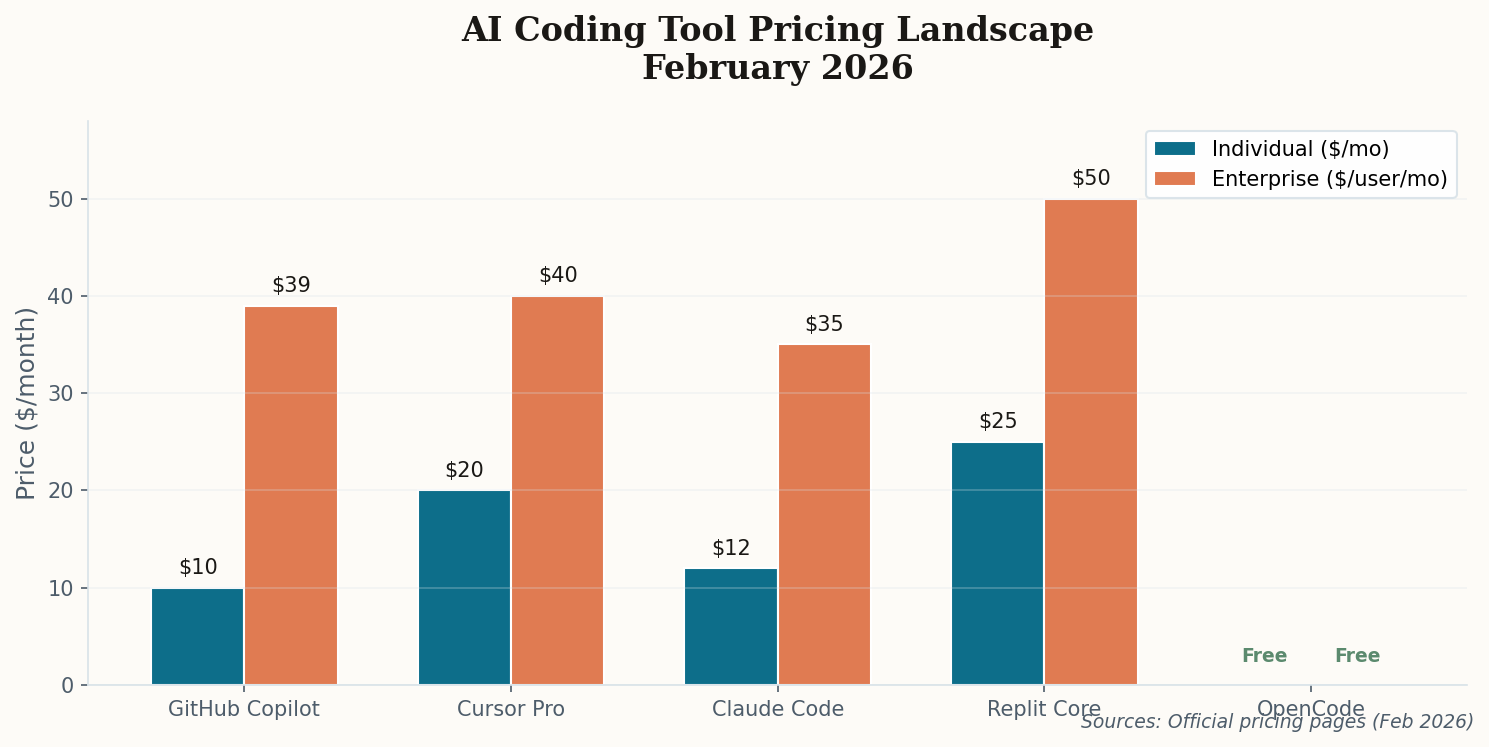
Bar chart comparing pricing of AI coding tools, with OpenCode standing out as free
OpenCode's zero price point is its loudest feature. For developers already paying for model access, it's a compelling alternative to $20-40/month IDE-locked tools.

The philosophical tension is real, though. OpenCode is exactly the kind of project the Koren et al. paper warns about: an open-source tool that makes it easier to consume other open-source projects through AI, potentially without giving back. It's open source eating its own tail. Whether that's a virtuous cycle or a death spiral depends on whether the OpenCode community actively contributes upstream or just extracts. Early signs (hundreds of contributors, active RFC process) are encouraging.

One red flag worth noting: OpenCode "does not appear to ask for permission before running commands." In a world where AI agents are manipulating files and running arbitrary code, the lack of a safety confirmation step is either a power-user feature or a disaster waiting to happen.

A corporate vault door opening to reveal encrypted code columns
06

Cursor Cracks the Enterprise Code (Literally)

Two announcements from Cursor this week tell the same story: the indie darling of AI coding is going corporate, and doing it smartly.

First, a new cryptographic architecture for codebase indexing that uses Merkle trees to create semantic understanding of code without storing the source. Zero persistent storage. Full AI capabilities. This is the kind of technical solution that makes CISOs stop saying "no" and start saying "tell me more."

Second, a strategic partnership with Infosys—one of the world's largest IT services companies with 300,000+ employees. They're establishing a joint Center of Excellence to integrate Cursor into enterprise workflows. The stat that drops jaws: over 20,000 Salesforce engineers (90% of their engineering workforce) are already using Cursor daily.

Here's the competitive picture: Cursor is rated 4.9/5 by users but still lacks SOC 2 and ISO 27001 certifications. The Merkle-tree indexing and Infosys partnership are clearly designed to close that gap. If they can add enterprise compliance to what is already the most beloved coding tool among professionals, the GitHub Copilot vs. Cursor debate could tilt decisively.

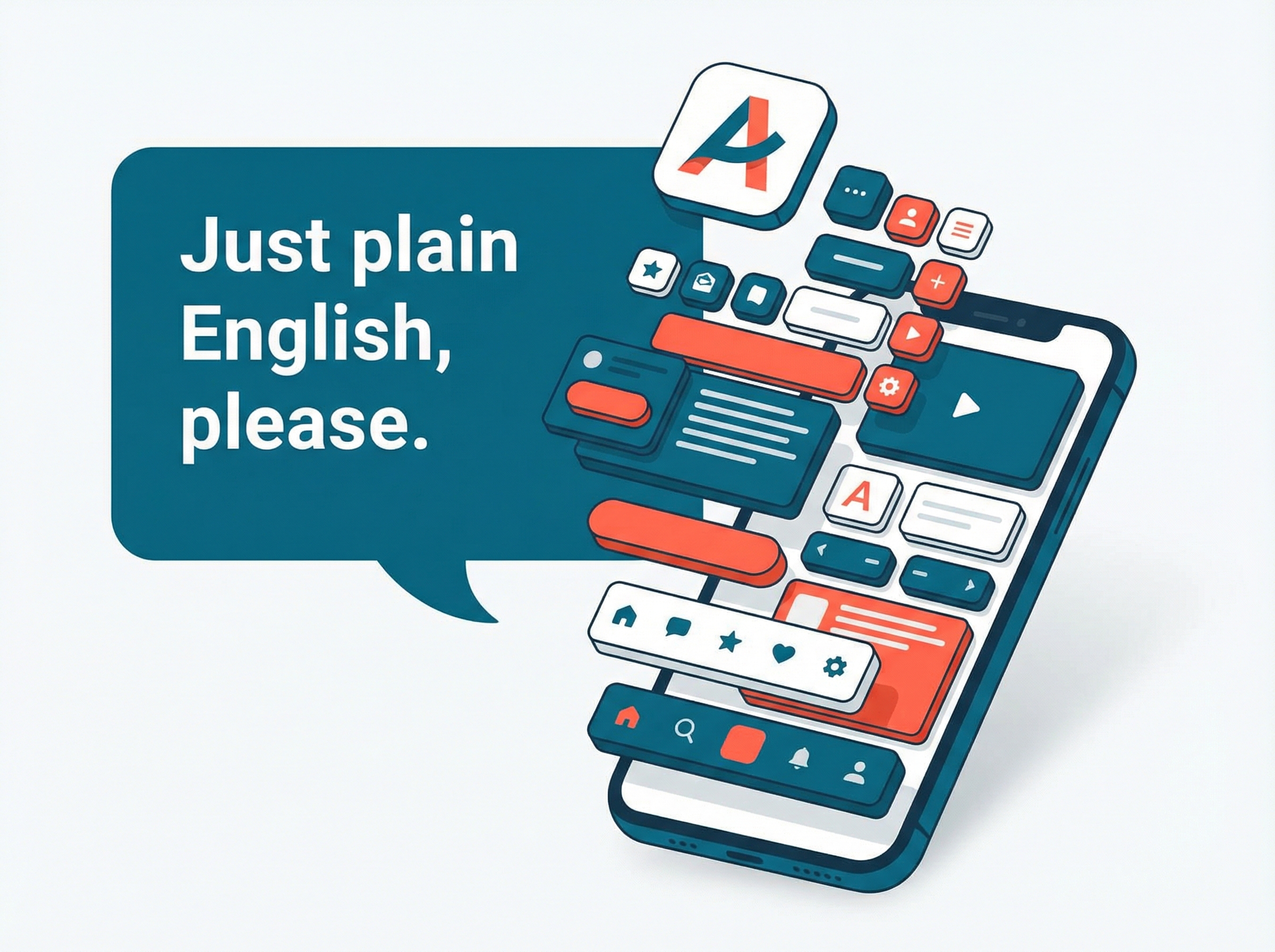
A smartphone screen with a mobile app emerging from a speech bubble of plain English text
07

Replit Says: Just Talk to It and Ship to the App Store

There's a spectrum to vibe coding. On one end: experienced engineers using Claude or Cursor to move faster. On the other: people who've never written a line of code creating production apps. Replit just pushed as far toward the second end as anyone has dared.

Their new feature lets users develop and publish Apple App Store apps using plain English prompts. The Replit Agent handles code generation, project setup, and the submission process. Concept to published app in days, not months. No Xcode required. No Swift knowledge needed.

This is a $9 billion company (after a $400 million funding round) betting that the future of software isn't learning to code—it's learning to describe what you want. Replit CEO Amjad Masad frames it as "democratizing software creation." Critics call it a recipe for App Store pollution.

Both are probably right. The first wave of AI-generated apps will be rough. But the tenth wave? The hundredth? At some point, the quality bar rises and the barrier stays low, and we end up in a world where anyone with a clear idea and $25/month can compete with funded startups. That's either utopian or terrifying, depending on whether you're the one with the idea or the one charging $150/hour to build it.

The Vibe Check

A year in, the vibe coding movement has splintered into something more complex than a tweet could contain. The tools are converging (GitHub's Agent HQ), the critics are organizing (Koren et al.'s open-source paper), and the creator himself has moved on to "agentic engineering." The question for the next year isn't whether AI writes your code—that debate is settled. It's whether the ecosystem that made that AI possible survives the transition. Build accordingly.