Military History

The Mountain That Refused to Die

How a Cold War bunker carved from 2,000 feet of Colorado granite became America's most critical defense installation—again.

Listen
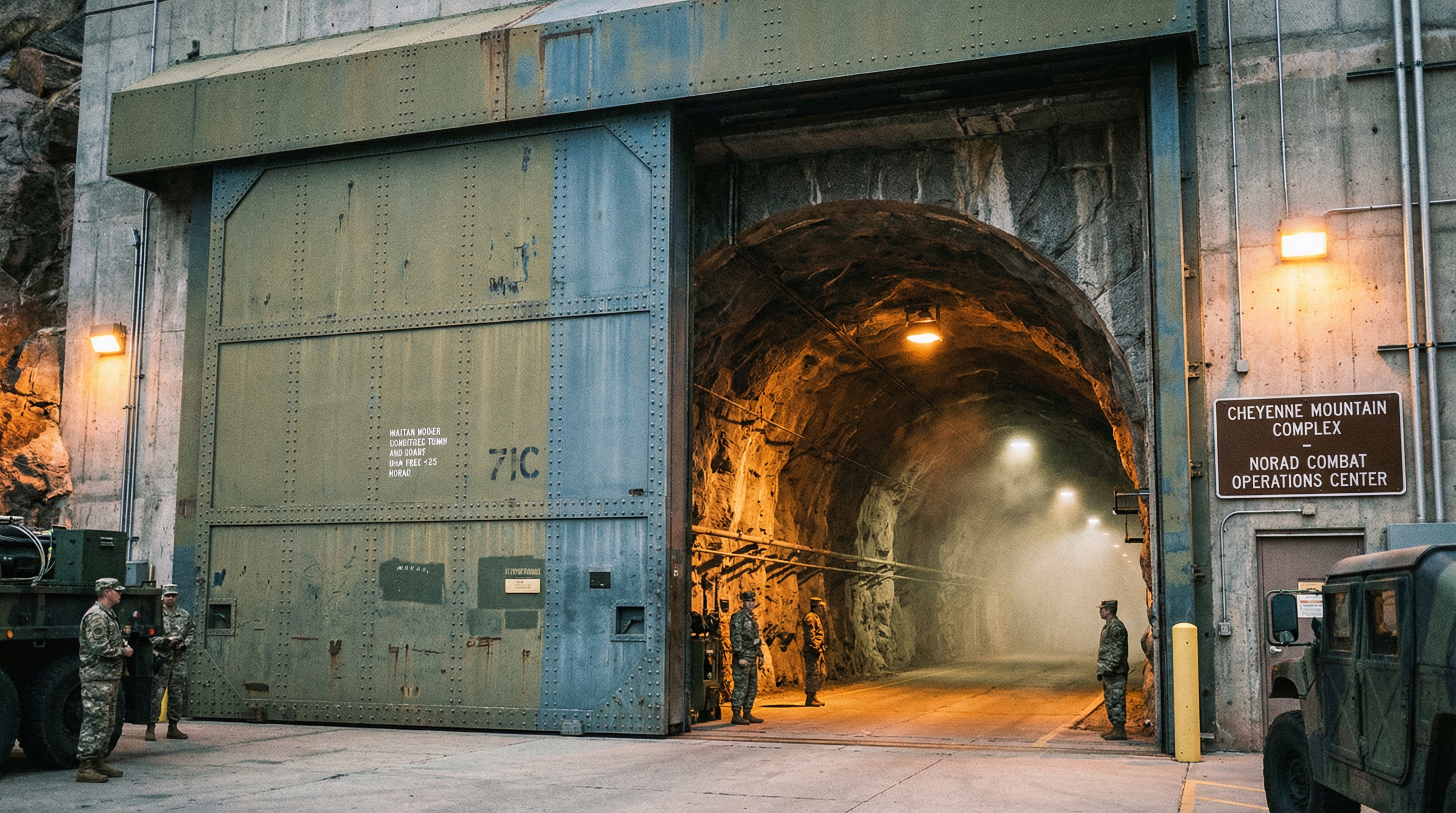
Cheyenne Mountain Complex entrance at dusk, massive blast doors visible in the granite mountainside
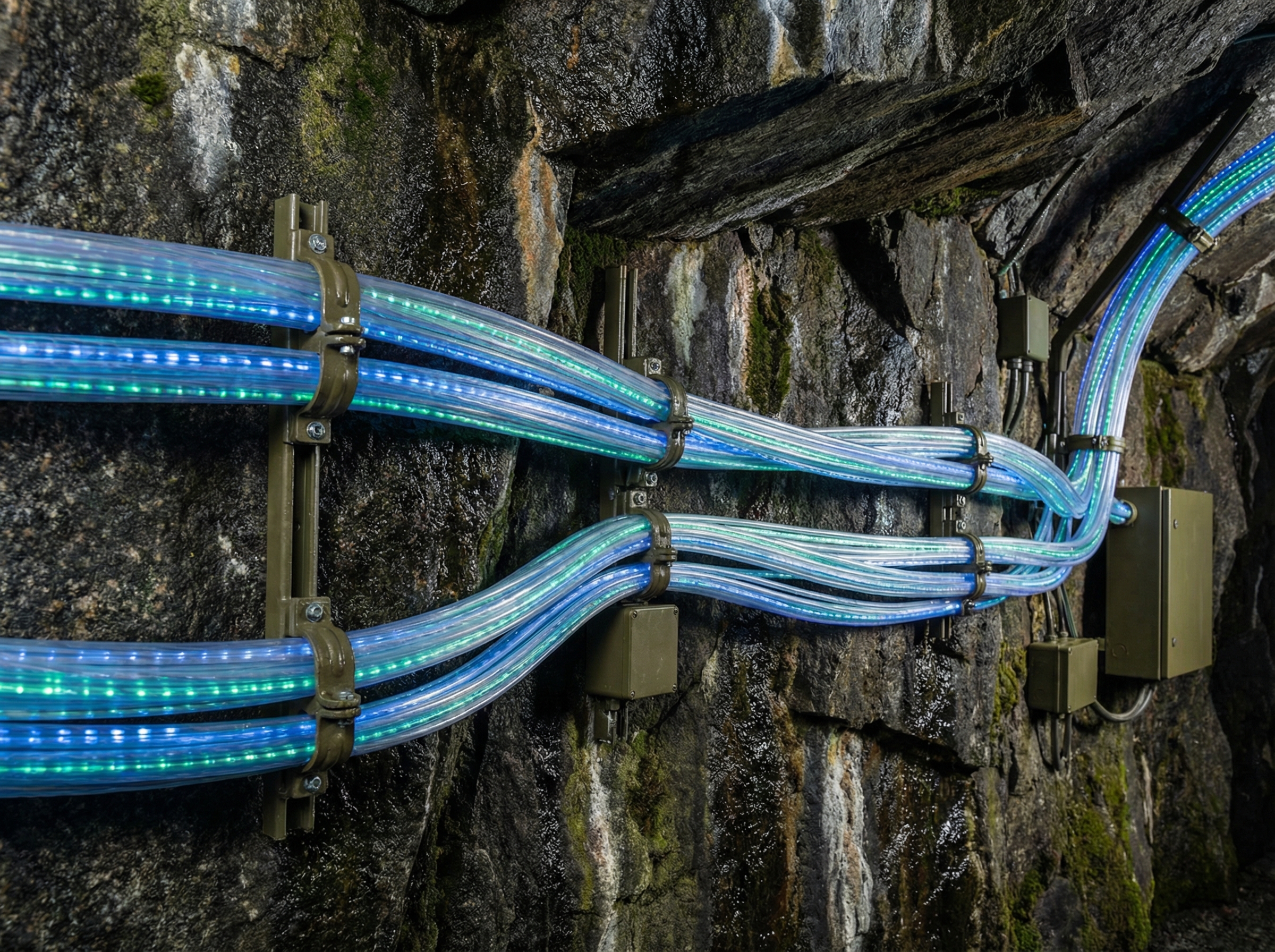
Fiber optic cables glowing against rough granite cave walls
01

3,000 Feet of Fiber Through Solid Granite

In July 2024, the 210th Engineering Installation Squadron completed what might be the most unusual fiber optic installation in history: threading over 3,000 feet of secondary fiber cable through tunnels blasted out of granite in the 1960s. The project wasn't routine maintenance. It was a deliberate bet that the facility once left to gather dust would need bandwidth to match anything the Pentagon operates above ground.

The installation gives Cheyenne Mountain Space Force Station redundant, high-speed data connectivity essential for processing real-time missile warning data. Think about what that means: the same mountain that tracked Soviet bombers on cathode-ray tubes in 1966 now handles satellite telemetry and space domain awareness data at fiber-optic speed. The infrastructure is 60 years old. The data flowing through it measures in milliseconds.

The facility now falls under Space Base Delta 1, reflecting a shift that would have baffled its Cold War architects. NORAD's granite fortress is now, officially, a Space Force installation. The rebranding isn't cosmetic—it tracks the reality that the threats the mountain was built to detect have migrated from bombers to orbits.
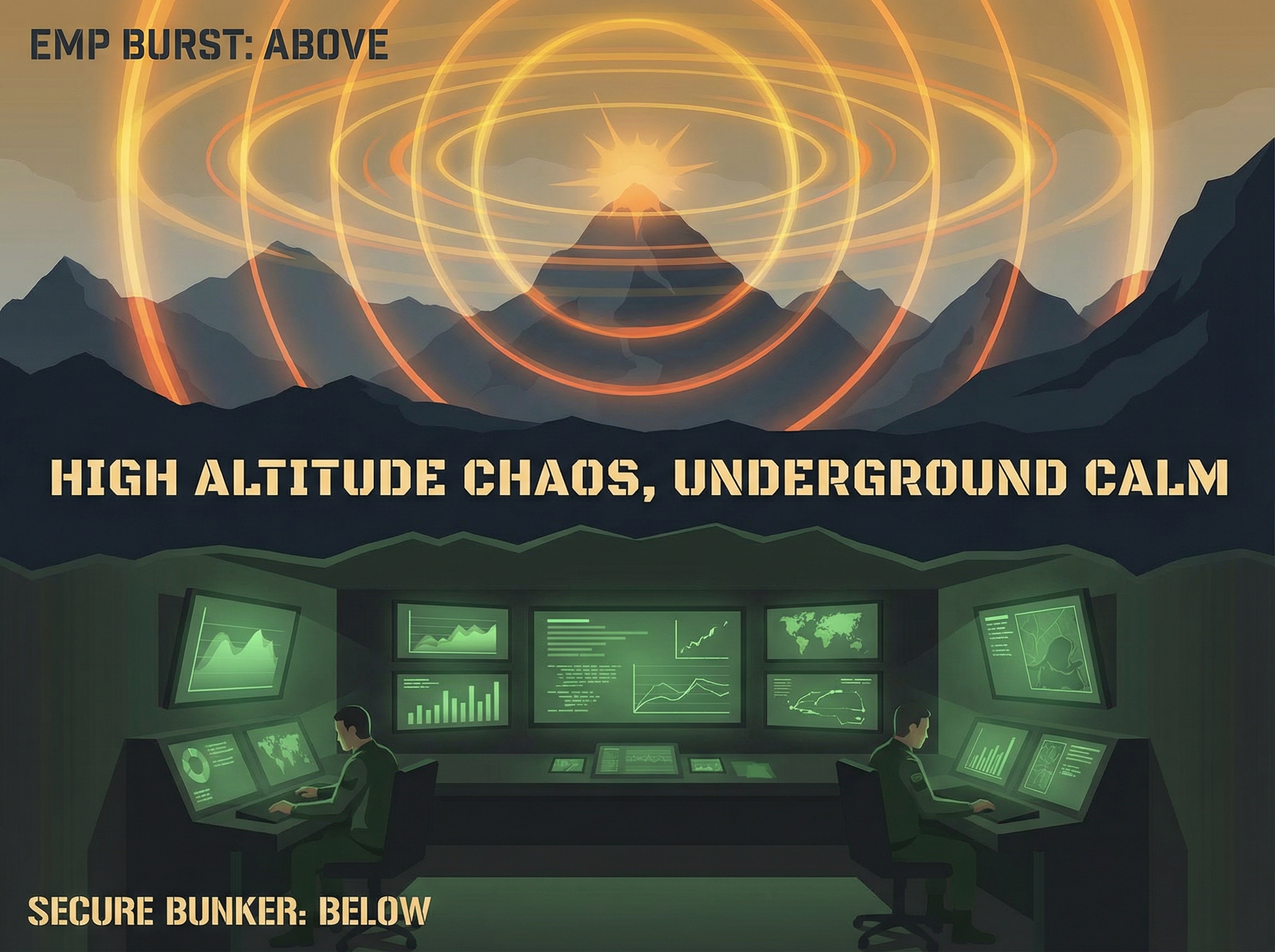
Electromagnetic pulse visualization above mountain silhouettes with protected bunker below
02

The $700 Million Bet on Granite

In 2015, the Pentagon did something it rarely does: it admitted it had been wrong. After nearly a decade of treating Cheyenne Mountain as a relic, the Department of Defense awarded Raytheon a contract worth up to $700 million to modernize and sustain the complex's systems. The specific focus? Electromagnetic pulse resilience.

Admiral William Gortney, then-commander of NORAD/NORTHCOM, made the strategic logic explicit: "Because of the very nature of the way that Cheyenne Mountain's built, it's EMP-hardened. And so, there's a lot of movement to put capability into Cheyenne Mountain and to be able to communicate in there." Translation: every other command center the U.S. operates is vulnerable to an electromagnetic pulse that could fry unshielded electronics across an entire continent. This one isn't.

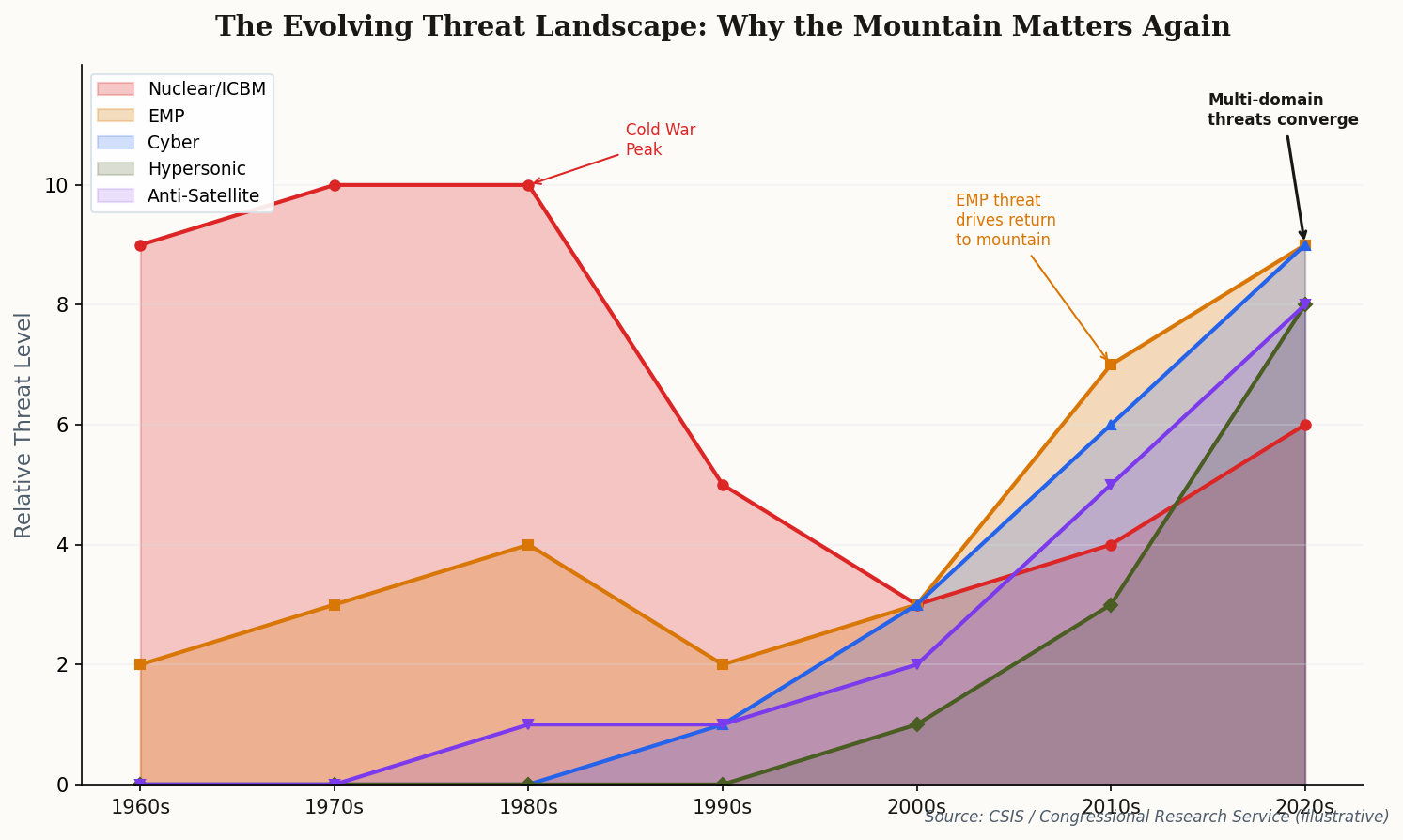
Line chart showing the evolution of military threats from 1960s to 2020s, with EMP and cyber threats rising sharply in recent decades
The threat landscape has shifted dramatically since the Cold War. While nuclear ICBM risk has moderated, EMP, cyber, hypersonic, and anti-satellite threats have converged—making the mountain's unique hardening more valuable than ever. Source: CSIS / Congressional Research Service (illustrative).

The calculus was straightforward. A high-altitude nuclear detonation—or even a sophisticated non-nuclear EMP weapon—could disable the command infrastructure at Peterson Air Force Base and every other above-ground facility in the region. Cheyenne Mountain, buried under 2,000 feet of granite that acts as a natural Faraday cage, would keep running. The $700 million wasn't nostalgia. It was insurance against a scenario that had gone from theoretical to plausible.

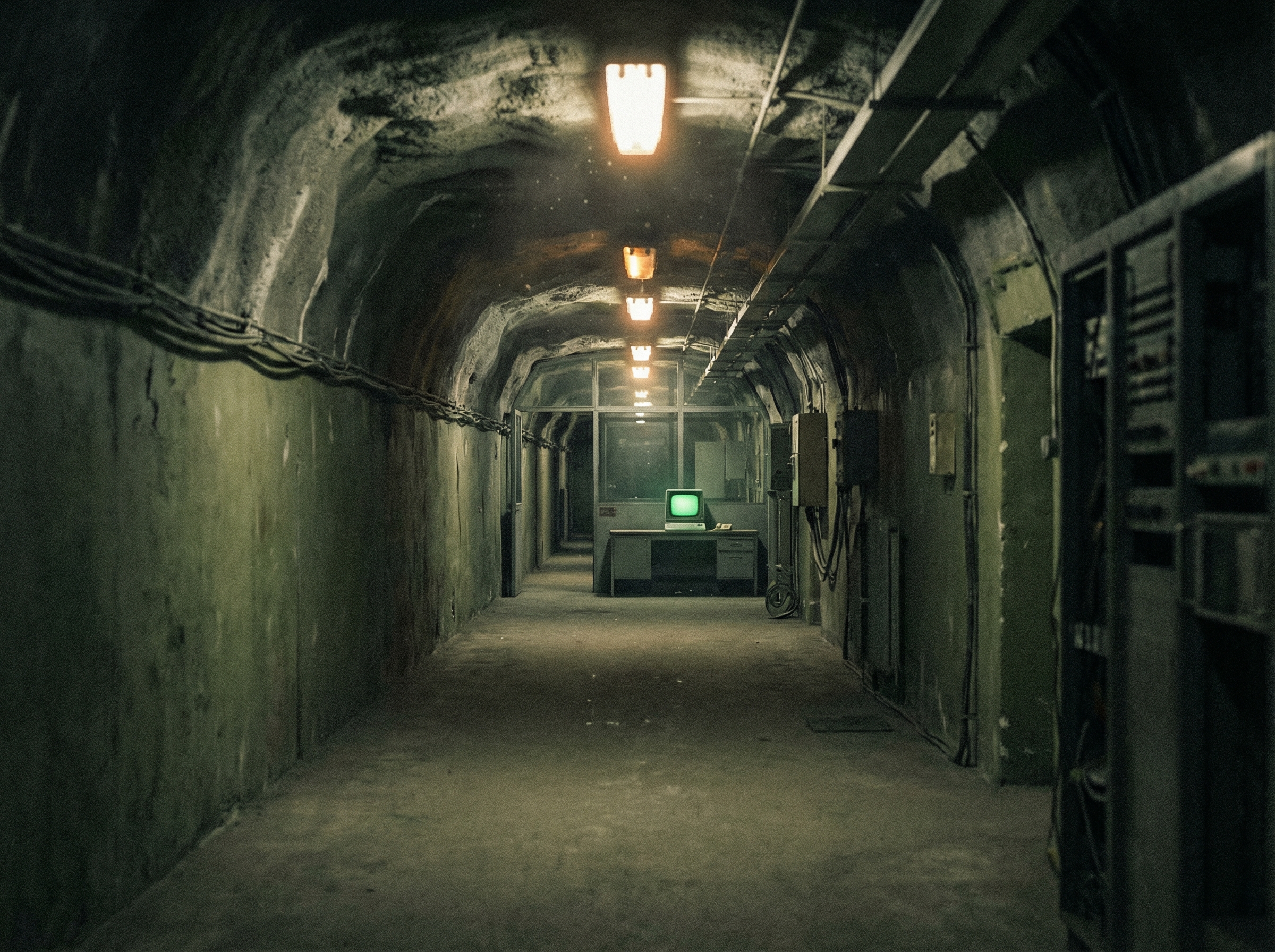
Empty corridors inside a mountain bunker with dim amber lighting
03

The Decade the Mountain Went Quiet

In 2006, NORAD and USNORTHCOM did what seemed sensible at the time: they moved primary operations out of the mountain and into the basement of a building at nearby Peterson Air Force Base. The Cold War was over. The Soviet Union had been dead for 15 years. Running a modern command center inside a 1960s granite bunker was expensive, logistically painful, and—the thinking went—strategically unnecessary.

The mountain was placed on "warm standby." A skeleton crew kept the lights on and the blast doors operational. The facility could be fully reactivated within hours, but the urgency was gone. The 2,000 people who once cycled through 24/7 shifts dwindled to a maintenance team. The corridors designed to survive a multi-megaton nuclear strike now mainly hosted qualification exercises and the occasional VIP tour.

It was the right decision for the wrong era. The threats that would justify the mountain's return—EMP weapons, hypersonic missiles, sophisticated cyber attacks on above-ground infrastructure—were already being developed in labs in Russia and China. The standby period wasn't a mistake so much as a bet on a world that was already changing faster than the intelligence assessments suggested.

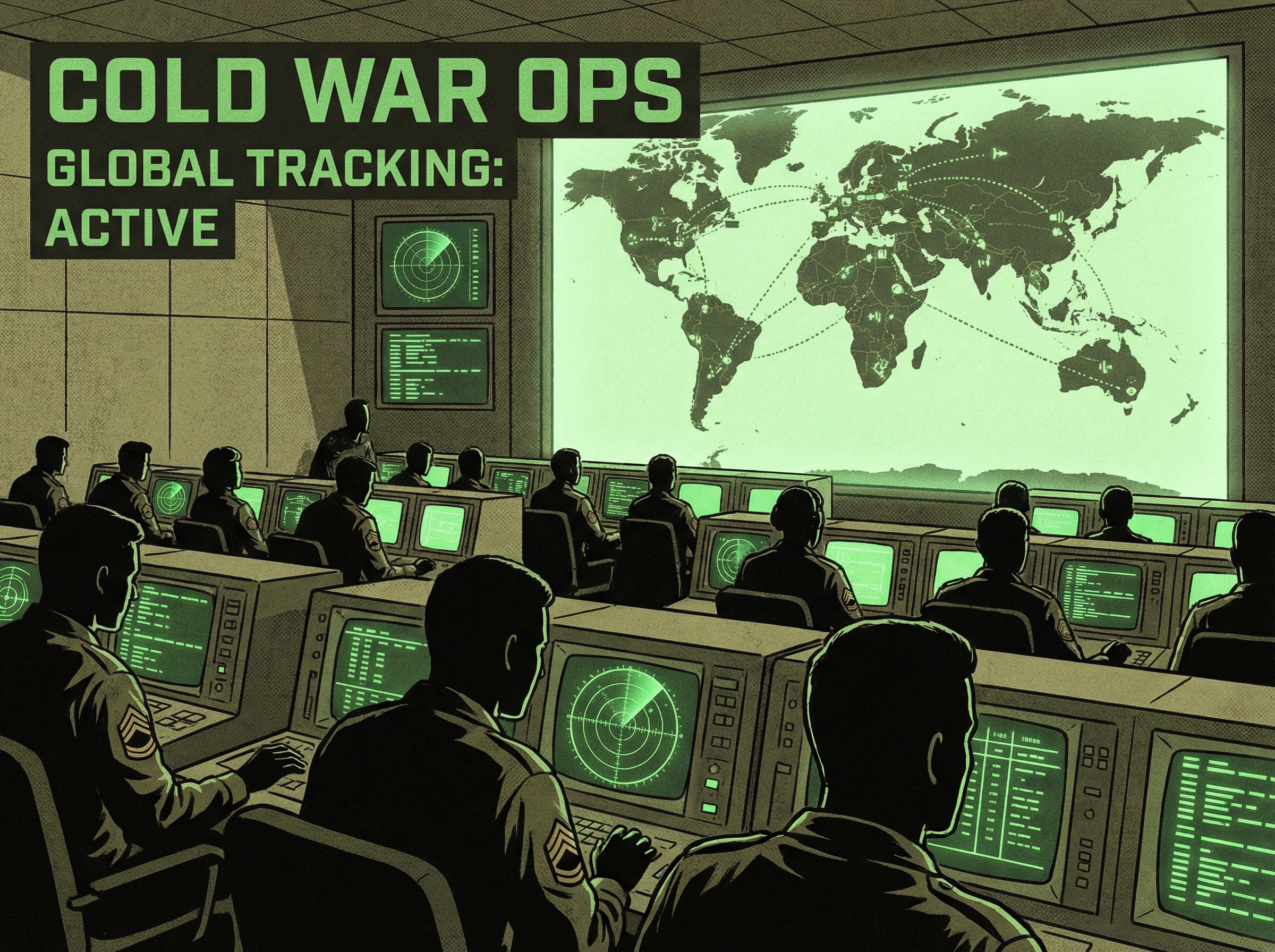
1980s military command center with rows of green CRT monitors and radar displays
04

Crystal Palace: Four Decades as the Free World's Watchtower

For forty years, Cheyenne Mountain was the nerve center of Western defense. From its operational debut on April 20, 1966, through the fall of the Berlin Wall and beyond, the facility—known internally as the "Crystal Palace"—tracked everything that flew, orbited, or launched. At peak operations, nearly 2,000 people worked inside the mountain across round-the-clock shifts, monitoring Soviet missile launches, tracking satellite debris, and maintaining the nuclear command chain that the entire deterrent rested on.

The mountain's self-sufficiency bordered on the surreal. Six 1,750-kilowatt diesel generators provided independent power. Millions of gallons of water sat in underground reservoirs. Air filtration systems could scrub chemical, biological, and radiological contaminants. In the event of nuclear war, the complex could seal its 25-ton blast doors, sever all contact with the outside world, and continue operating for weeks or months. It was less a military installation than a subterranean civilization designed to outlast the surface one.

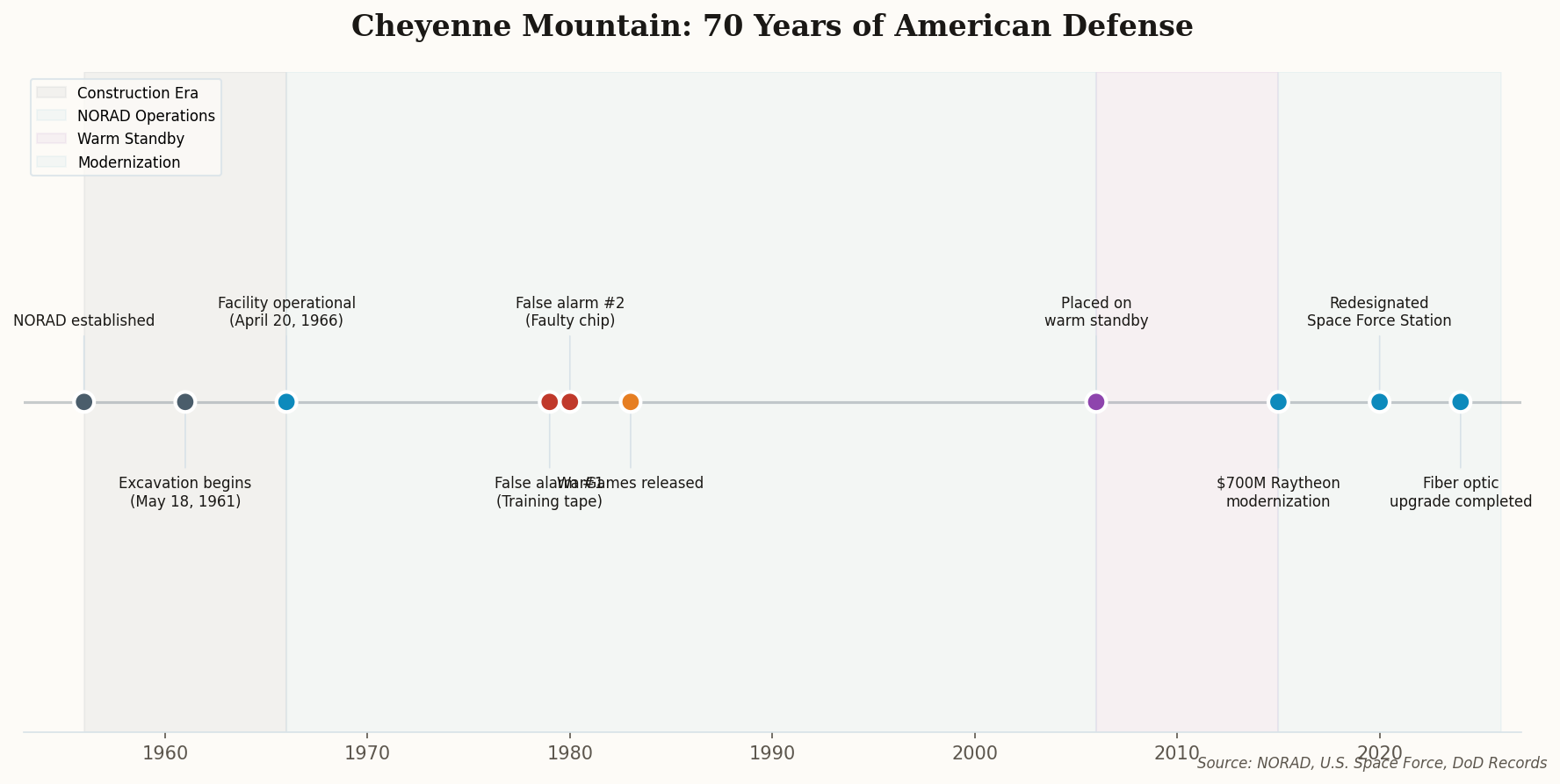
Timeline showing key events in Cheyenne Mountain history from 1956 to 2024
Seven decades of Cheyenne Mountain's evolution: from NORAD's founding through the standby years to its modern revival as a Space Force installation. Key cultural touchstones—WarGames and Stargate SG-1—cemented the facility in public consciousness.

And then there was the culture. WarGames (1983) introduced millions to the idea of a teenage hacker nearly triggering nuclear war from inside NORAD's fictional command center. Stargate SG-1 (1997–2007) set an entire decade of science fiction inside the mountain, complete with an interstellar portal 28 levels down. The real facility was less photogenic than Hollywood's version—more fluorescent lighting and binder-thick checklists than dramatic screens—but the mythology wasn't entirely wrong about the stakes.

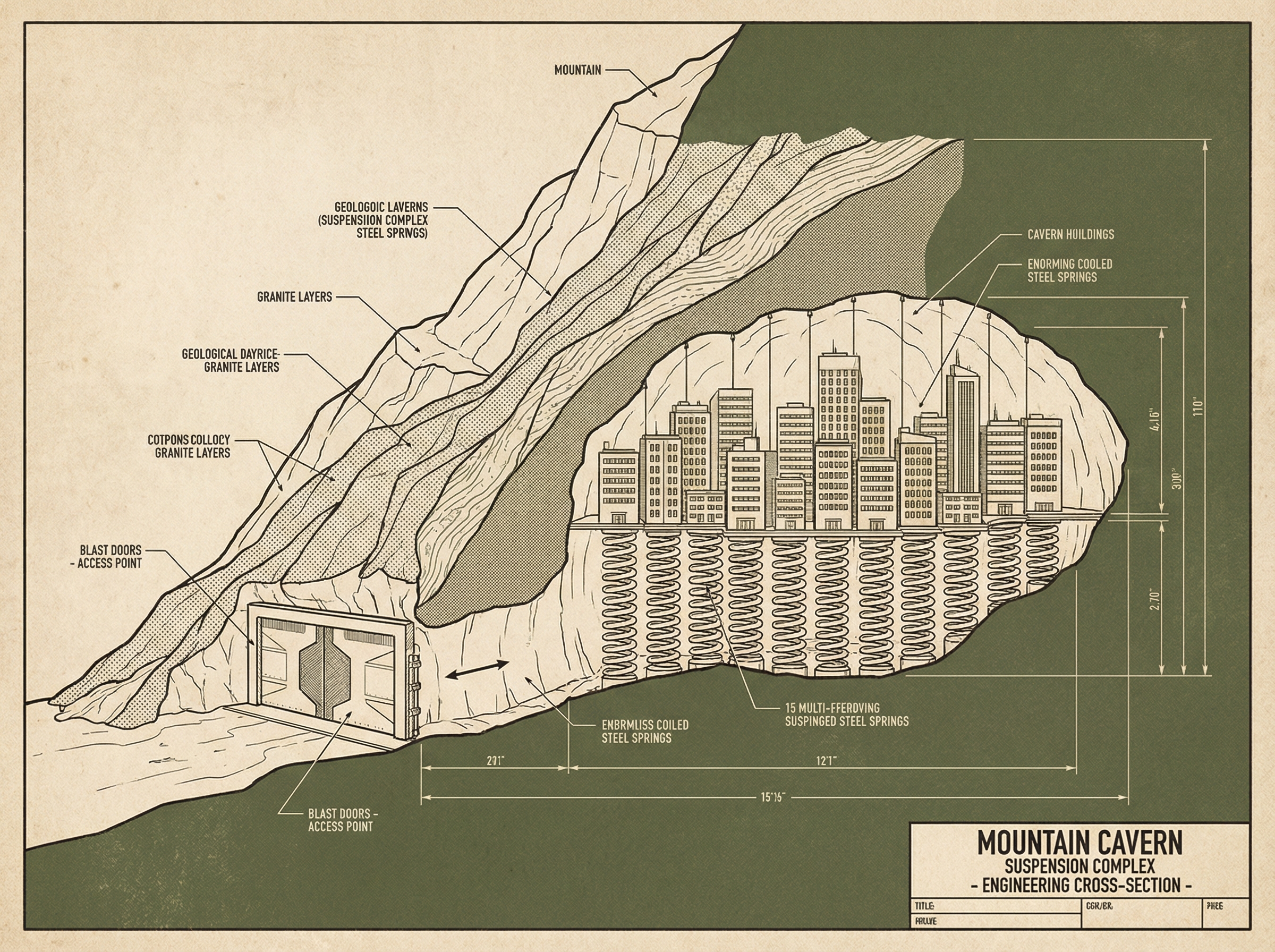
Cross-section cutaway illustration of a mountain with buildings suspended on giant steel springs
05

693,000 Tons of Granite, 1,319 Springs, and One Audacious Idea

The idea sounds like something from a Bond villain's playbook: hollow out a mountain, build a city inside it, and suspend the buildings on springs so they can survive a nuclear blast. But when excavation began on May 18, 1961, the U.S. Army Corps of Engineers was dead serious. Over the next five years, workers blasted and removed 693,000 tons of solid granite from the interior of Cheyenne Mountain, creating a cavern system large enough to house 15 free-standing buildings.

The engineering challenge wasn't just about digging a big hole. A nuclear detonation near the mountain would send a shockwave through the rock, causing the interior walls to "spall"—shattering inward like fragmentation grenades. The solution was 115,000 rock bolts, some up to 30 feet long, driven into the granite walls to hold the mountain together from the inside. Think of them as staples holding a wound shut, except the wound is the inside of a mountain and the staples are steel rods the length of a telephone pole.

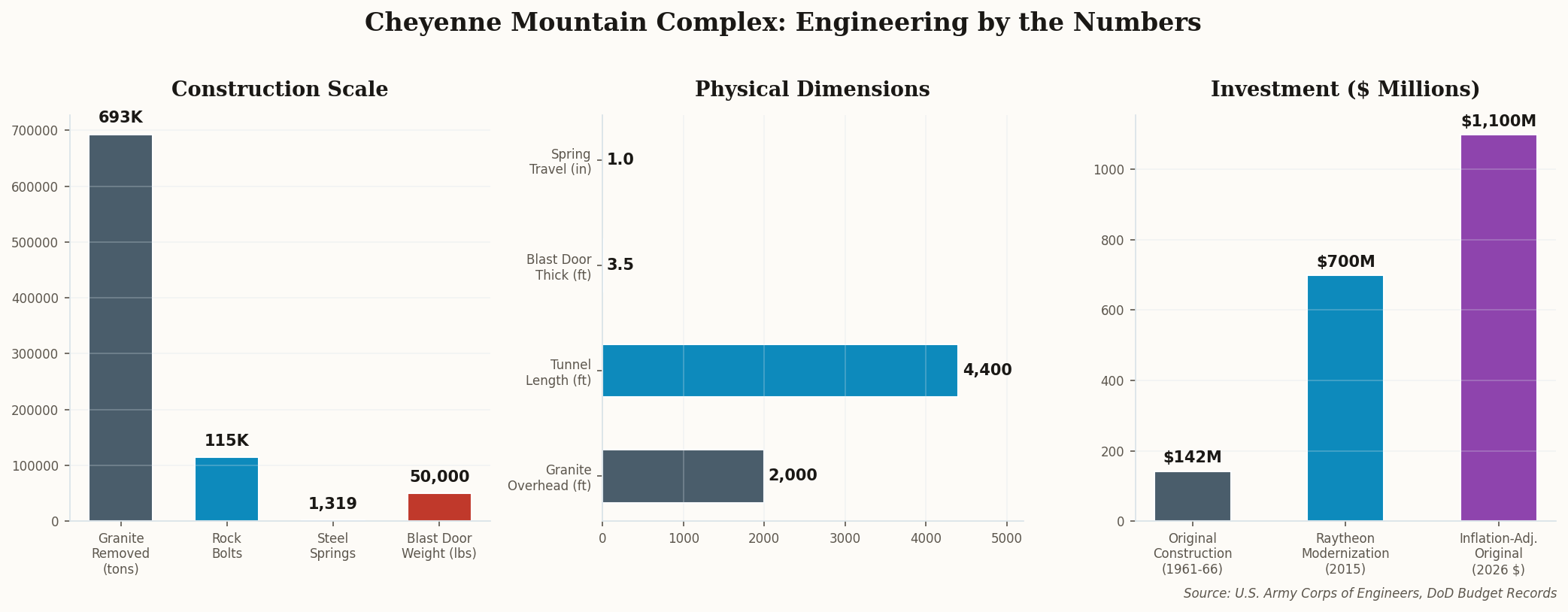
Horizontal bar chart showing key engineering statistics: 693K tons of granite excavated, 1,319 springs, 115K rock bolts, 25-ton blast doors, 2,000 feet of overhead granite, and $1B+ adjusted construction cost
The numbers behind America's underground fortress. The original construction cost was $142.4 million in 1960s dollars—equivalent to over $1 billion today. Every metric reflects the extreme engineering required to build a self-sustaining city inside solid rock.

Then there are the springs. The 15 buildings don't touch the cavern walls or floor in any rigid way. Instead, they rest on 1,319 massive steel springs, each weighing approximately 1,000 pounds. During a nuclear blast or earthquake, the buildings sway up to one inch in any direction, independent of the mountain itself. The blast doors—25 tons of solid steel, 3.5 feet thick, hydraulically operated—can close in 45 seconds. Two people can close them manually. The total cost: $142.4 million in 1960s dollars, equivalent to more than $1 billion today. It was the most expensive hole ever dug, and 60 years later, nothing has replaced it.

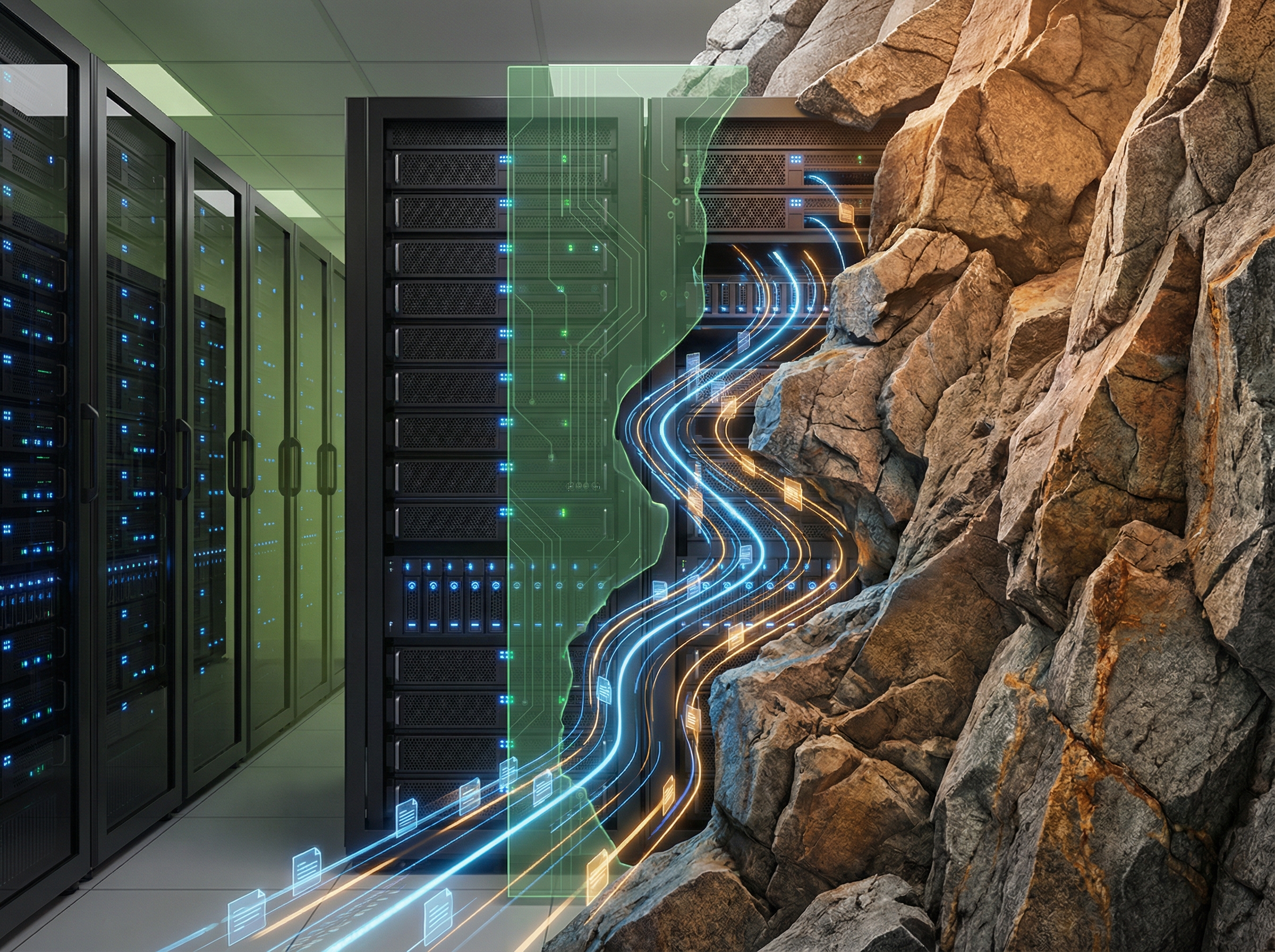
Conceptual illustration showing modern servers merging with raw granite walls
06

Why Granite Still Beats Silicon

Here's the paradox that should keep defense planners up at night: a facility designed in the 1950s, built in the 1960s, and nearly mothballed in the 2000s is now arguably the most important piece of military infrastructure the United States operates. The reason is brutally simple. Modern warfare runs on electronics—GPS, communications, data links, satellite feeds. A single high-altitude electromagnetic pulse could disable all of it across an entire continent. Cheyenne Mountain is one of the few places on Earth where the lights would stay on.

The threats have multiplied. Russia and China are developing hypersonic glide vehicles that compress decision timelines from minutes to seconds. Anti-satellite weapons threaten the orbital infrastructure that everything from navigation to nuclear command depends on. Cyber attacks can penetrate hardened networks at the speed of light. Against this backdrop, the mountain's combination of EMP hardening, physical isolation, and air-gapped systems offers something no above-ground facility can: certainty. As one former NORAD official put it: "It's the only place where we can say with a high degree of certainty that mission-critical data will survive an EMP event."

The Department of the Air Force's FY 2026 budget request emphasizes "nuclear enterprise modernization" and "resilient command and control"—budget-speak that translates directly into continued investment in Cheyenne Mountain. The facility that the Pentagon once considered too expensive to maintain is now too critical to lose. Sixty years after workers first blasted into the granite of the Colorado Front Range, the mountain's builders have been proven right about the one thing that matters: the threats change, but the need for a place that can survive them doesn't.

Still Standing

Cheyenne Mountain endures because it solved a problem that never went away: how do you build something that outlasts the weapons designed to destroy it? The answer, it turns out, is 2,000 feet of granite, 1,319 springs, and the stubborn conviction that geology beats technology. Sixty years on, the mountain is still the last line of defense—not because we couldn't build something better, but because nothing better exists.