Defense & Warfare

The Grunt's New Calculus

Infantry isn't obsolete. But the math that keeps a foot soldier alive has changed more in three years than in the previous thirty. Here's what's moving the needle this week.

Listen
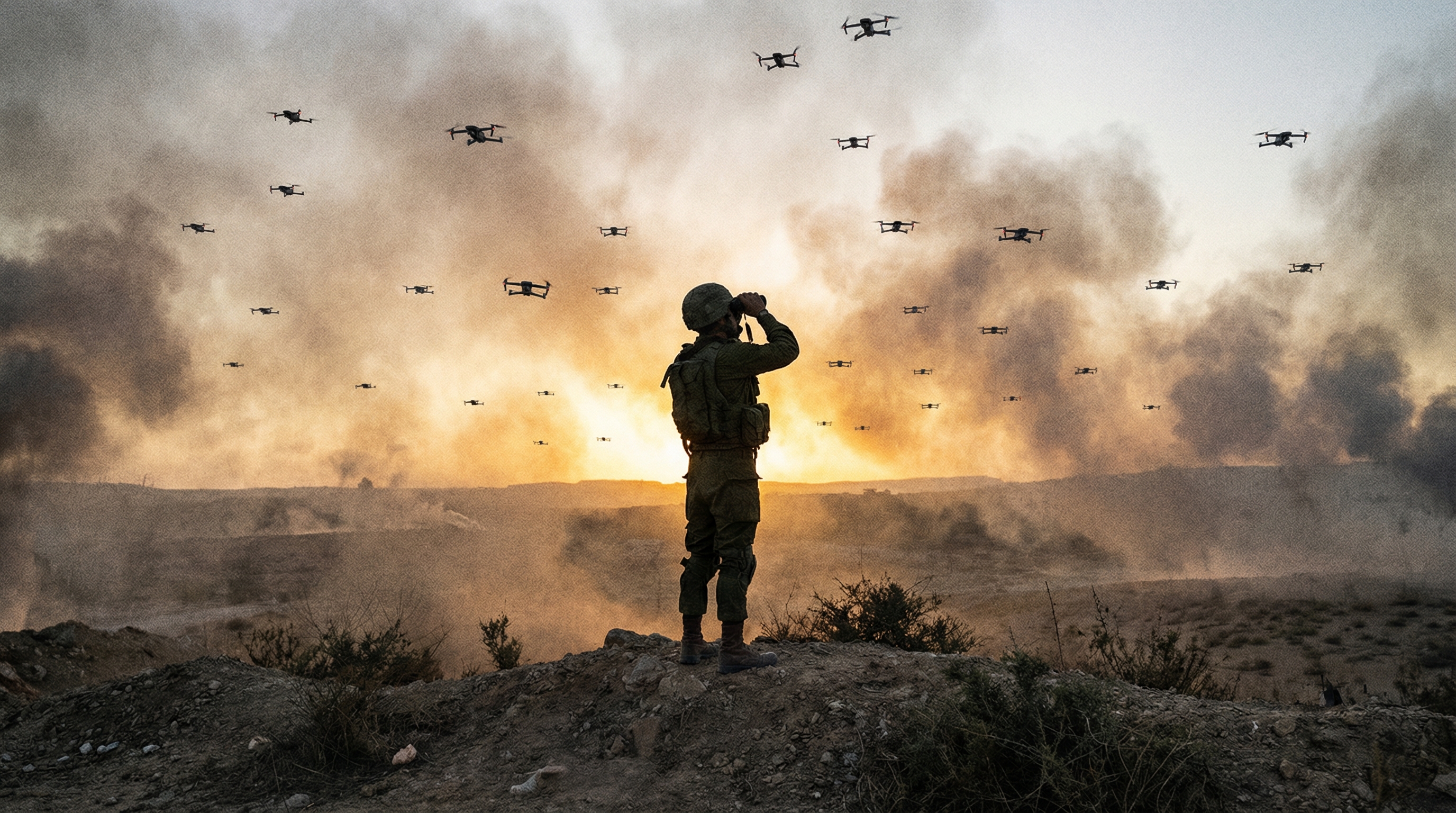
A solitary infantry soldier silhouetted against a dawn sky swarming with combat drones
01

The Army Just Gave Every Squad a Bomber. It Costs Less Than a Rifle Scope.
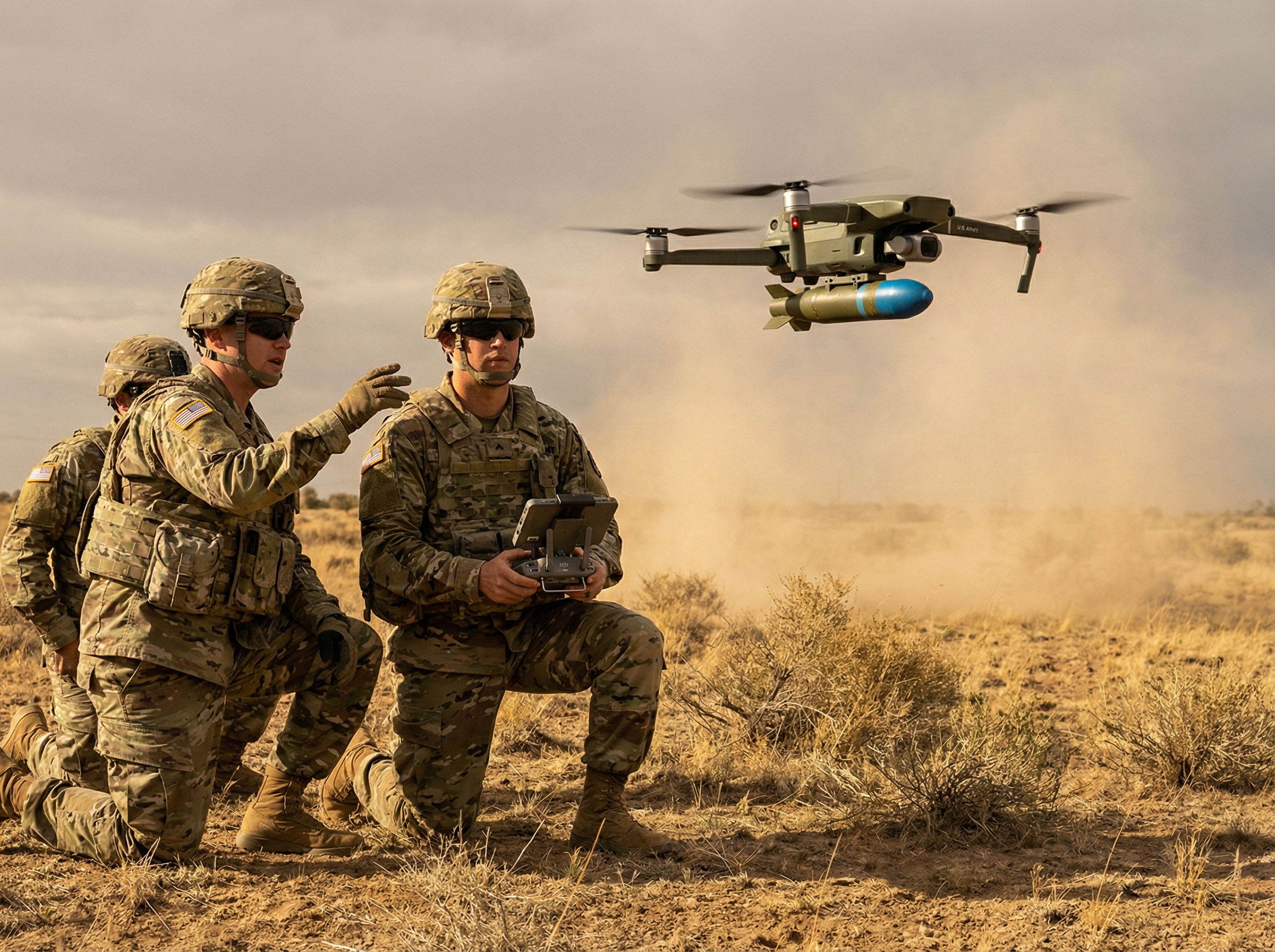
U.S. Army soldiers operating a small quadcopter drone in a training exercise

At Fort Stewart, Georgia, soldiers from the 3rd Infantry Division's 2nd Armored Brigade Combat Team just finished running what may be the most consequential training exercise in a generation. During Spartan Focus drills on February 2, operators from the 6th Squadron, 8th Cavalry Regiment flew C100 reconnaissance drones reconfigured as bombers—dropping 3D-printed training munitions on simulated enemy positions.

That sentence deserves a second read. The Army is teaching cavalry scouts to fly kamikaze quadcopters with printed warheads. The C100 is a medium-range recon platform repurposed as close air support for the infantry squad. Not the brigade. Not the battalion. The squad.

This is Ukraine's lesson, internalized. When War Secretary Pete Hegseth ordered every Army squad to carry expendable drones by October 2026, it sounded like aspirational PowerPoint. Fort Stewart just showed it's real. The exercise focused on integration—how a drone operator coordinates with supported infantry on target ID, release procedures, and deconfliction. The mundane choreography that separates a useful tool from friendly fire.

The implications run deeper than tactics. When a $4,000 drone can do what a $150,000 mortar fire mission used to, you don't just change the squad's kit—you change the entire fires ecosystem. Watch for infantry units to start bypassing traditional fire-support channels entirely.
02

Project Flytrap and the $7.5 Billion Bet on Not Getting Killed by Your Own Medicine

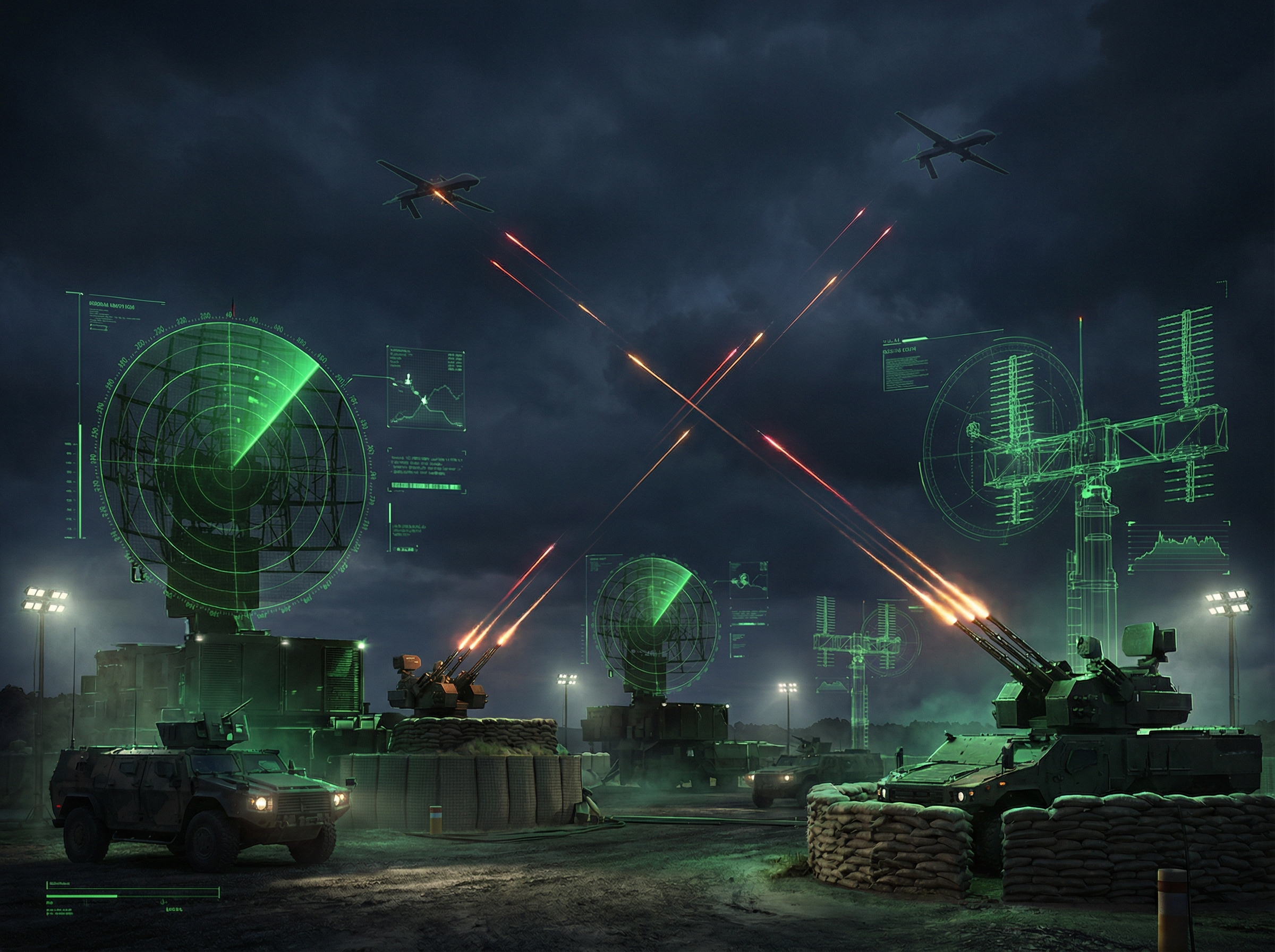
Layered air defense system engaging small drones at night with electronic warfare capabilities

If you're going to hand every squad a drone, you'd better have an answer for when the other side does the same. At Fort Hood, Texas, air defense soldiers from the 6th Battalion, 56th Air Defense Artillery Regiment demonstrated the Army's full counter-drone stack on January 29—and the layering is remarkable.

At the outer ring: KuRFS radar for detecting small, low-signature targets, paired with Coyote interceptor drones to kill what it finds. In the middle: electronic warfare via the LOTUS jammer to sever command links. At close range: an XM914 30mm cannon and M240B machine guns for kinetic last-resort kills. It's the defensive mirror image of the drone revolution—sensors, jammers, interceptors, and good old-fashioned lead, all woven together.

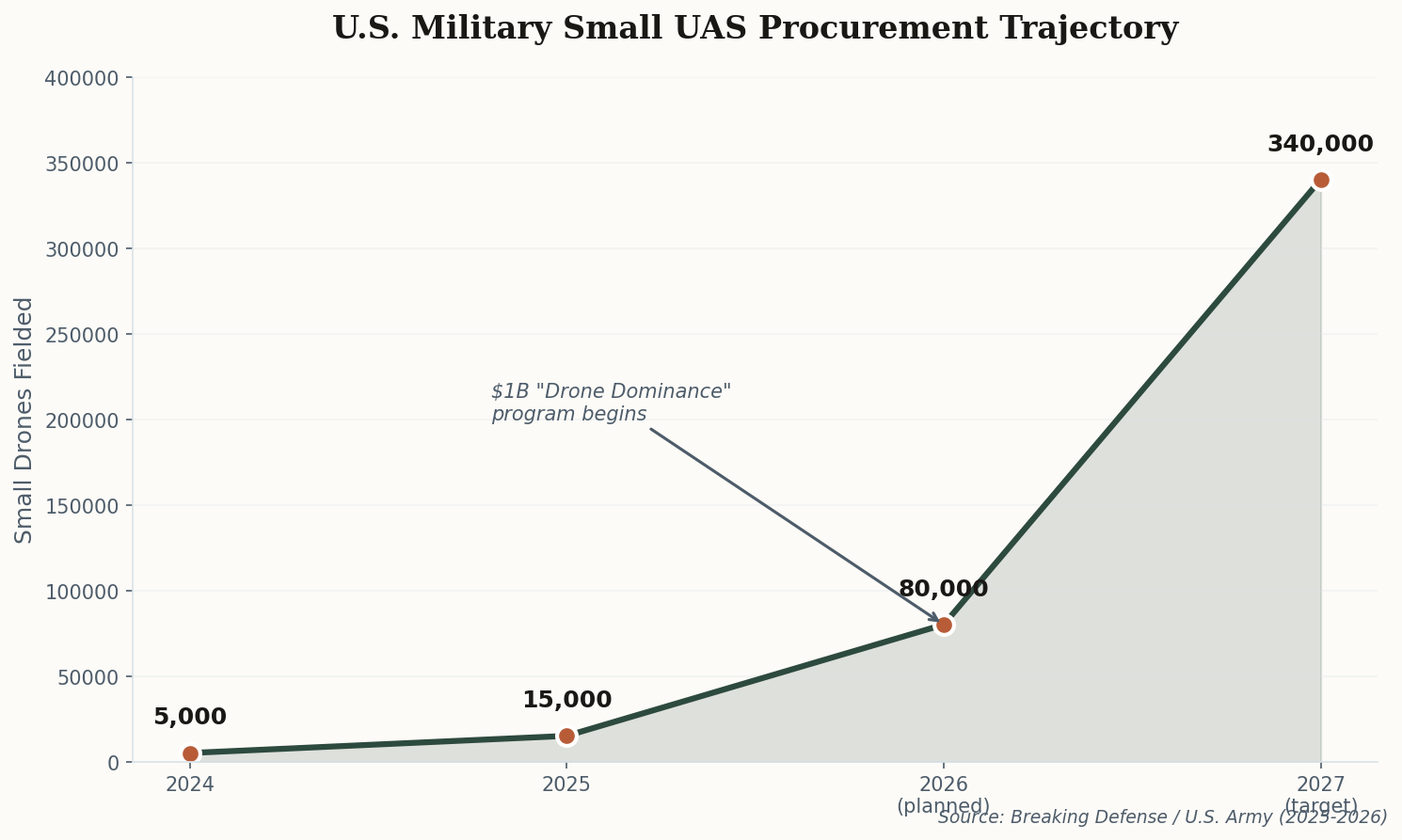
Chart showing U.S. Military Small UAS procurement scaling from 5,000 in 2024 to 340,000 planned for 2027
The Pentagon's drone procurement trajectory reflects the scale of the threat it's trying to counter. The $1B "Drone Dominance" program will manufacture 340,000 small UAS over two years.

Meanwhile, the Project Flytrap kit gives dismounted infantry a portable toolkit: the Skyview acoustic sensor detects drones up to 500 meters out, the NightFighter-S jammer disrupts control frequencies, and the Smash 2000 rifle optic helps shooters actually hit a fast-moving target. There's even a 12-gauge SkyNet shell that fires a net to tangle propellers at 420 feet.

The FY2026 defense budget requests $7.5B for counter-UAS systems across all services, with the Army launching a competition for a high-energy laser weapon designed to be fielded at scale. The per-shot economics of directed energy could finally make drone defense cheaper than drone offense.

The strategic question remains unsettled. The U.S. hasn't fielded a single operational directed-energy counter-drone weapon despite years of R&D. A 2023-24 combat test of Strykers with 50kW lasers reportedly went poorly. Until lasers work at scale, the infantry's best defense is still the jamming-detection-kinetic triad demonstrated at Fort Hood.

03

820,000 Strikes, 240,000 Casualties: Ukraine's Drone Kill Rate Hits 80%

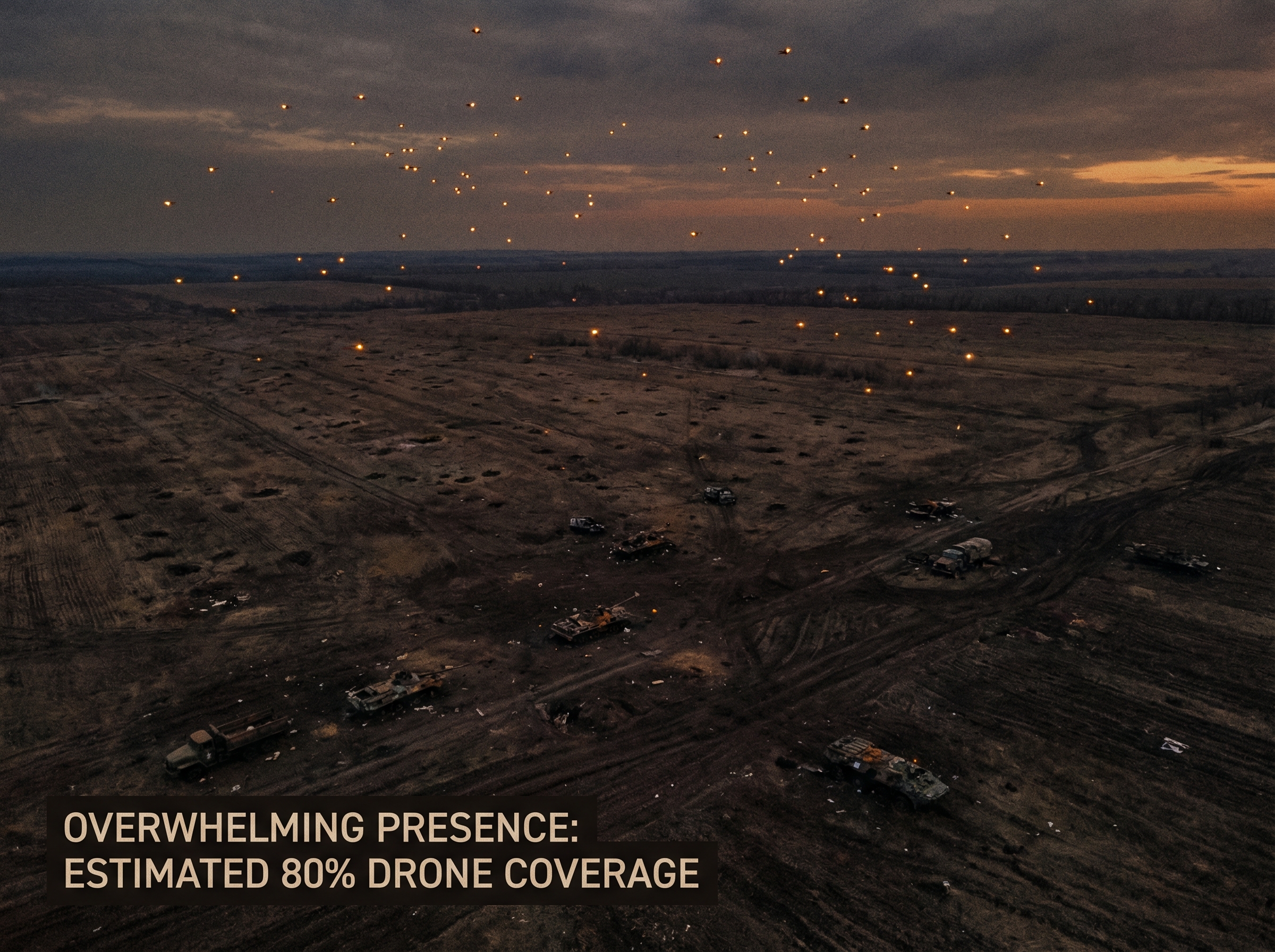
Ukrainian battlefield at dusk with FPV drone lights scattered across a war-scarred landscape

The number that should rewrite every infantry manual on the planet: more than 80% of Russian targets destroyed by Ukrainian forces in 2025 were killed by drones. President Zelensky announced the figure during a January 26 military awards ceremony, and the supporting data from the Ministry of Defense is staggering.

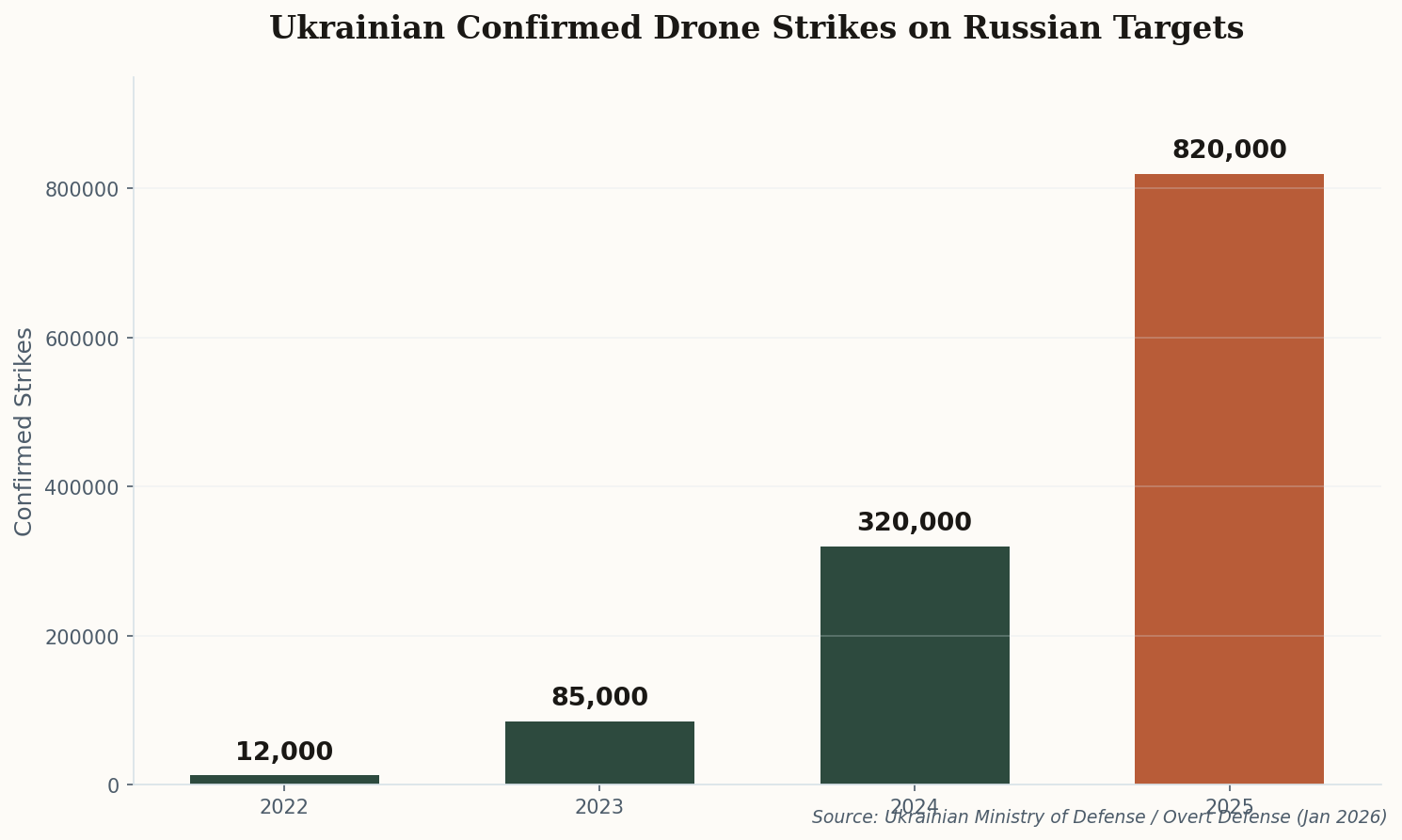
Bar chart showing Ukrainian drone strikes escalating from 12,000 in 2022 to 820,000 in 2025
The exponential growth in Ukrainian drone strikes. From early improvisation in 2022 to an industrial-scale drone army producing 200,000 FPV drones per month by early 2025.

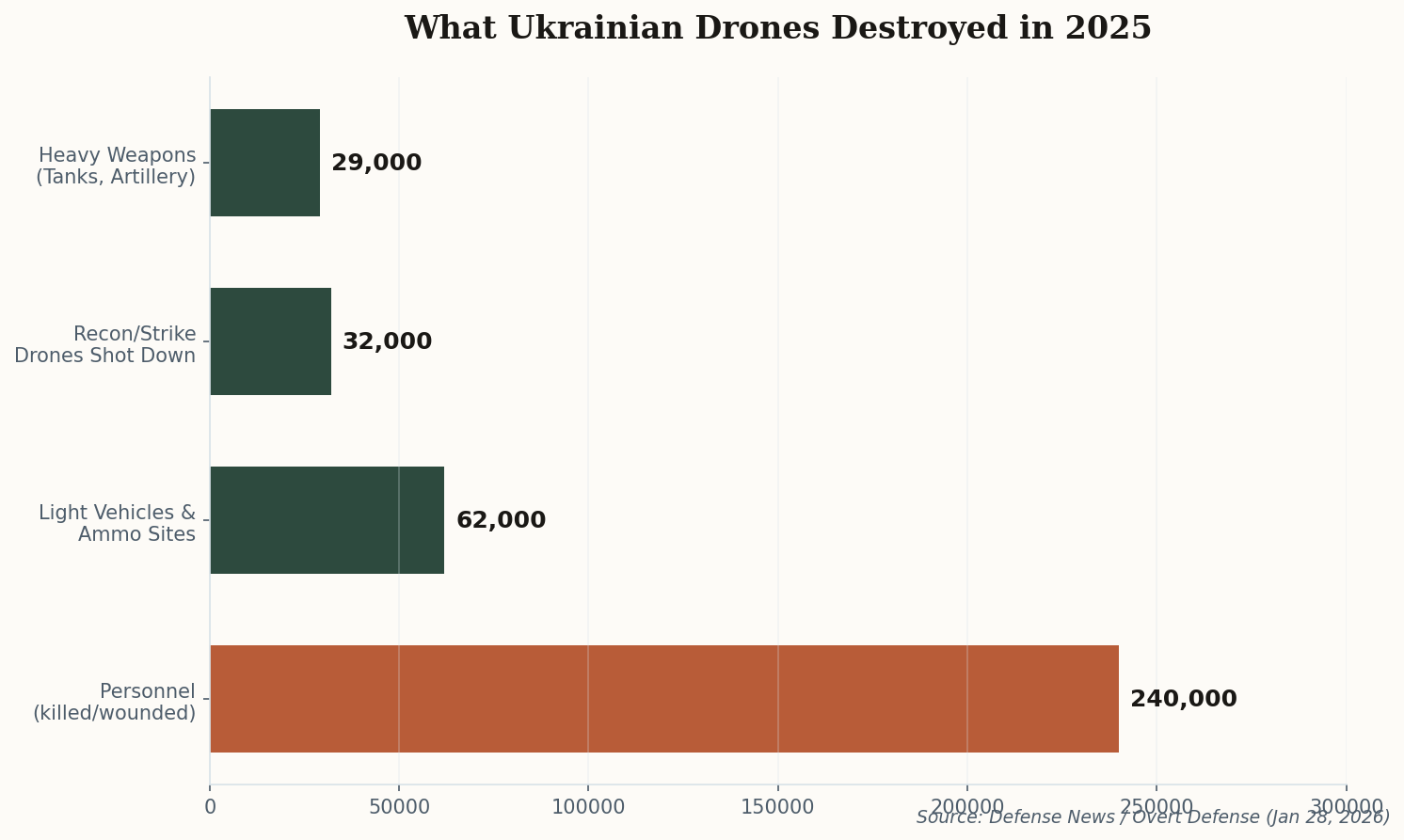
Ukrainian FPV and bomber drones executed nearly 820,000 confirmed strikes in 2025—every one verified by drone video. The hit list: over 240,000 Russian soldiers killed or seriously injured. More than 29,000 heavy weapons platforms (tanks, artillery, IFVs) destroyed or disabled. 62,000 lighter targets (vehicles, ammo dumps). And 32,000 Russian drones shot down by other drones.

Horizontal bar chart showing breakdown of Ukrainian drone targets: 240K personnel, 62K light vehicles, 32K enemy drones, 29K heavy weapons
The full breakdown of what Ukrainian drones destroyed in 2025. Personnel casualties dwarf materiel losses, reflecting how FPV drones have become the primary anti-infantry weapon on the modern battlefield.

Ukraine's Brave1 marketplace incentivizes performance: units earn electronic points for confirmed kills, redeemable for more drones and EW equipment. It's gamification of warfare, and it works. The "drone wall"—a 15-20km kill zone stretching from the front line—has turned Russian infantry assaults into what frontline reporters describe as fields of bodies.

But here's the critical caveat, courtesy of RUSI: drones are most effective in combination with artillery. The 80% figure reflects a shift in the kill mix, not a replacement of combined arms. Russia's adaptation—relocating high-value targets behind dense EW screens and accepting infantry losses—shows how adversaries adjust. The drone advantage is real but perishable.

04

The Marine Rifle Squad Now Has Its Own Cruise Missile (Sort Of)

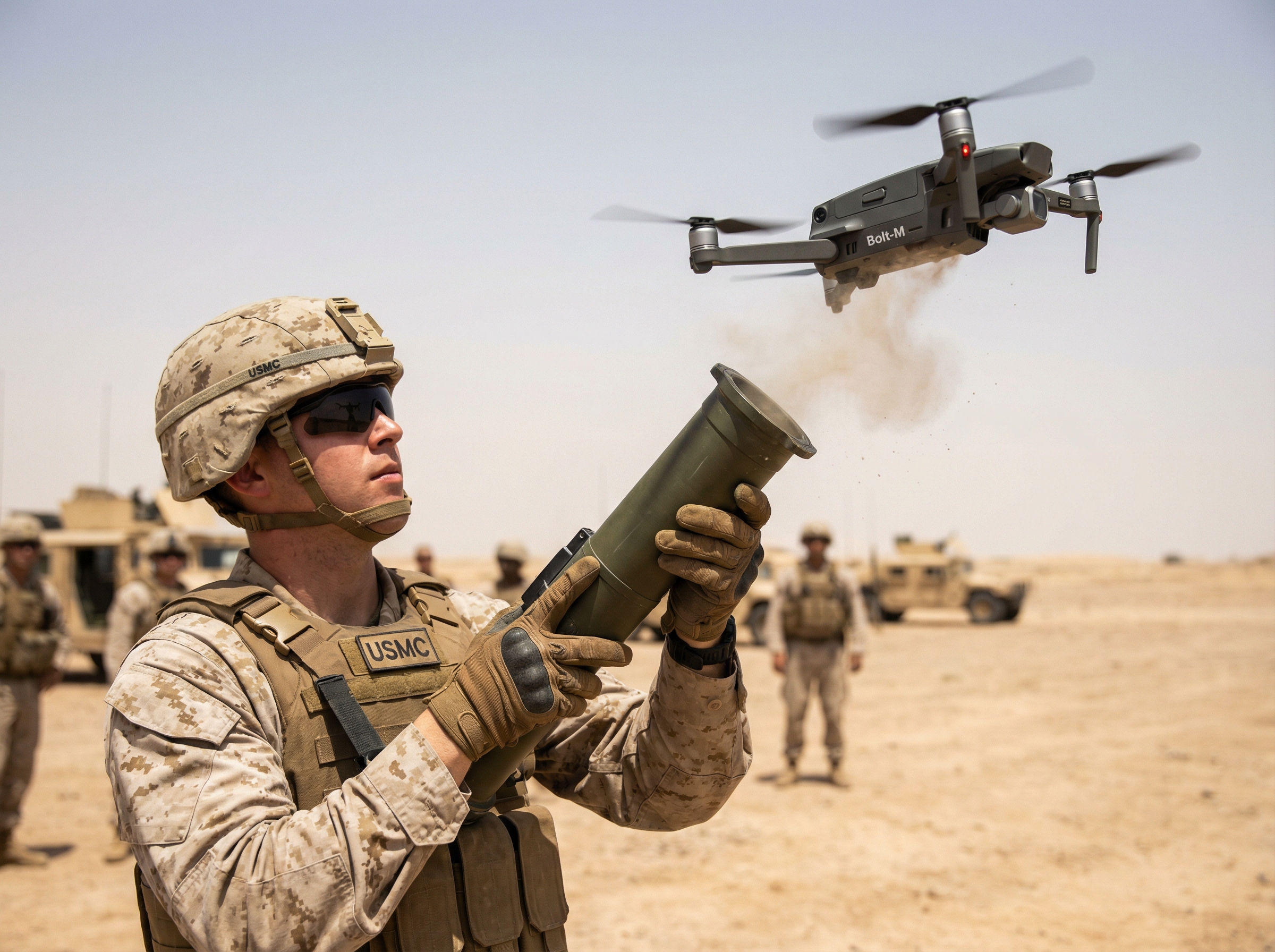
Marine infantryman launching a compact loitering munition from a handheld launcher

The U.S. Marine Corps awarded Anduril Industries a $23.9 million contract to deliver more than 600 Bolt-M loitering munitions under the Organic Precision Fires-Light (OPF-L) program, with deliveries running through 2027. Alongside them: at least 600 Teledyne FLIR Rogue 1 systems. That's 1,200+ lethal drones going directly to infantry rifle squads.

The Bolt-M is a VTOL quadcopter, 13-15 pounds, with 20+ kilometer range and 40 minutes endurance. It launches from the squad level, loiters autonomously over a target area, and strikes on command with human-in-the-loop controls. Think of it as a very small, very patient cruise missile that fits in a backpack.

This is the conceptual shift that matters: the Marine rifle squad now has organic precision fires at distances that previously required calling in artillery or air support. The latency between "I see a target" and "the target is destroyed" shrinks from minutes (or hours) to seconds. For a service that fights distributed in austere environments—Pacific islands, denied littorals—that compression is existential.

And the USMC isn't stopping at loitering munitions. The Corps is simultaneously preparing to acquire 10,000 FPV drones at a $4,000 per-unit cap, with a new standardized training pipeline to certify hundreds of operators. The question isn't whether infantry squads will carry drones—it's how many, and how lethal.

05

Can Industry Build 10,000 War Drones in a Year? The Marines Are About to Find Out.

Industrial production line manufacturing hundreds of small FPV military drones at scale

The USMC is running what amounts to a stress test for the American defense-industrial base. The ask: 10,000 first-person-view attack drones, $4,000 or less per unit, delivered within a year. This isn't an R&D program. It's a production challenge—can U.S. manufacturers build cheap, lethal drones at scale without depending on Chinese components?

For context, Ukraine produces 200,000 FPV drones per month. The U.S. military's ask of 10,000 in a year is modest by those standards, but it's revolutionary for a Pentagon procurement system accustomed to buying 50 exquisite platforms over five years. The $4,000 cap is the real discipline: it forces manufacturers to prioritize volume over features, which is exactly the opposite of how American defense contracting usually works.

The Marine-developed "HANX" drone offers a template—a $700, 3D-printed unit designed to comply with the National Defense Authorization Act's restrictions on Chinese components. At that price point, drones become truly attritable: you plan to lose them. The math that matters isn't cost-per-unit but cost-per-kill, and cheap FPV drones have the most favorable ratio in the history of precision munitions.

Hegseth's broader mandate amplifies the stakes: "We will deliver tens of thousands of small drones to our force in 2026, and hundreds of thousands by 2027," with $1 billion from the defense bill funding approximately 340,000 small UAS. The supply chain that delivers (or doesn't) on the Marines' 10,000-unit challenge will determine whether that promise is real or vaporware.

06

The Inconvenient Truth: Drones Kill Brilliantly, But They Can't Hold a Trench

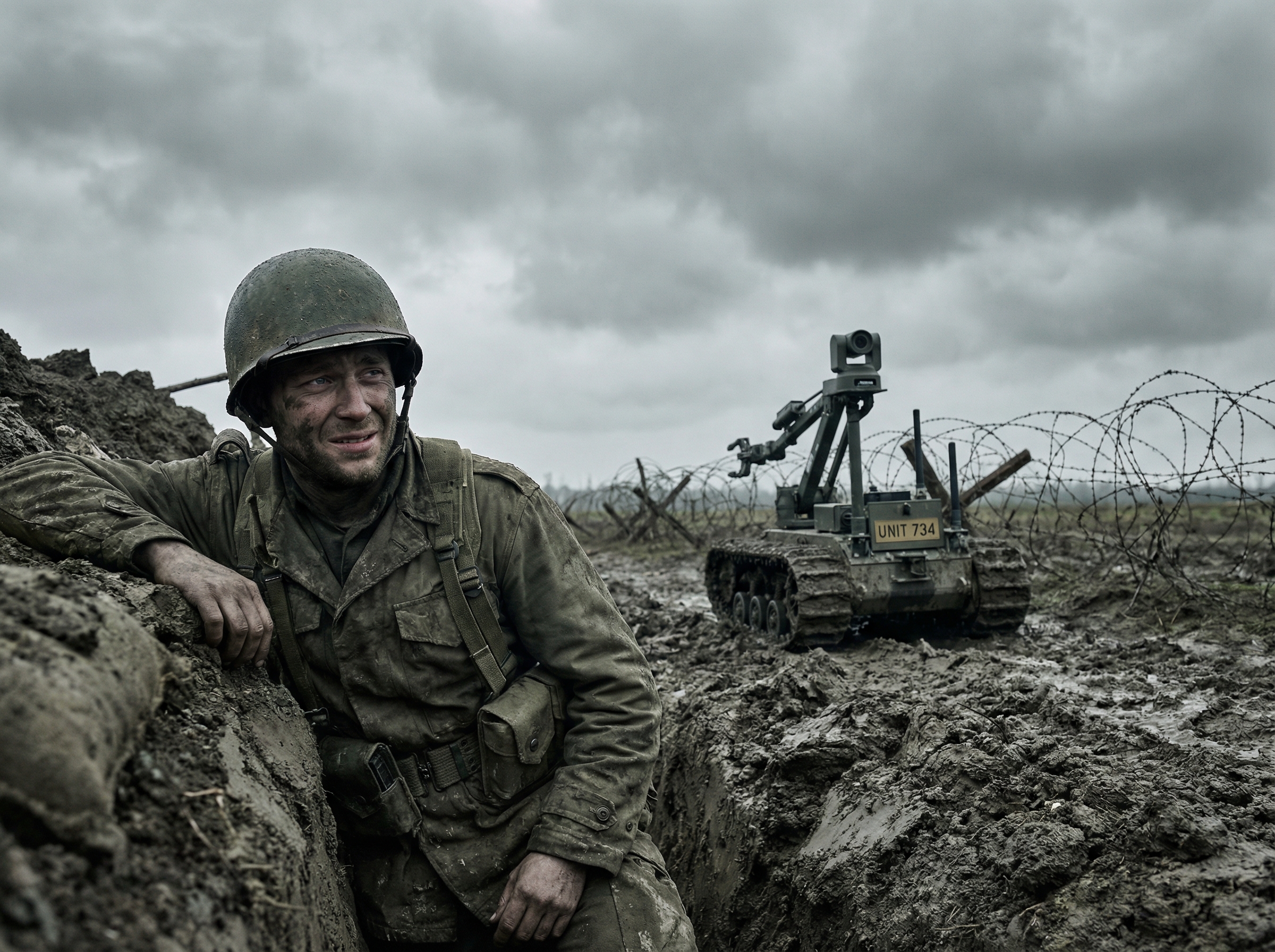
An infantry soldier in a trench watching a small ground robot approach through mud and barbed wire

After all the kill counts and procurement numbers, the Atlantic Council delivers the corrective: Ukraine's expanding robot army—UGVs, autonomous systems, AI-guided munitions—will be crucial in 2026, but these machines cannot replace infantry. Drones and artillery do most of the killing. Vulnerable, flesh-and-blood human beings remain indispensable for holding ground.

The evidence from the front is unambiguous. Ukraine's manpower shortages limit the ability to follow up drone attacks by clearing and holding terrain. Russian infiltration tactics—small units of two or three soldiers on motorbikes, slipping through gaps to disrupt drone and mortar teams—exploit exactly this weakness. You can't send a quadcopter to search a basement or secure an intersection. Not yet.

Ukraine plans to produce 20,000 UGVs in 2026, and they're already deployed as expendable scouts and weapons carriers. When six Russian UGVs were destroyed near Avdiivka, the financial cost was $66,000—far less than losing a squad. The Ukrainska Pravda reports that ground robots armed with machine guns are literally replacing people on parts of the front line.

But the fundamental problem persists: holding a defensive position requires judgment, adaptability, and physical presence that no current robot provides. The fiber-optic FPV drones that both sides now field—unjammable because they use physical cables instead of radio—have created a lethal gray zone where movement is nearly suicidal. In that environment, the infantry soldier's job isn't obsolete. It's just become orders of magnitude more dangerous.

The Calculus Has Changed. The Variable Hasn't.

Every generation of military technology promises to make the foot soldier obsolete—the machine gun, the tank, the helicopter, precision-guided munitions. Every generation is wrong. What drones have actually done is compress the decision space: the time between seeing a threat and dying from it has shrunk from minutes to seconds. The infantry's survival now depends on electronic warfare, acoustic detection, and the ability to operate in a sky that belongs to no one. The grunt isn't going anywhere. But the grunt who can't fly a drone, jam a signal, and read an EW threat display? That grunt has no future on this battlefield.