Greek Mythology

The Bones Don't Lie

Arrowheads in Troy's rubble. A labyrinth on Crete that isn't a metaphor. DNA that connects modern Greeks to the warriors of myth. The line between legend and history is thinner than Homer ever let on.

Listen
Ancient Greek temple ruins with mythological scroll unfurling against a starry sky
Archaeological excavation at Troy showing destruction layer with ancient weapons
01

They Found the Sling Stones Outside Troy's Walls

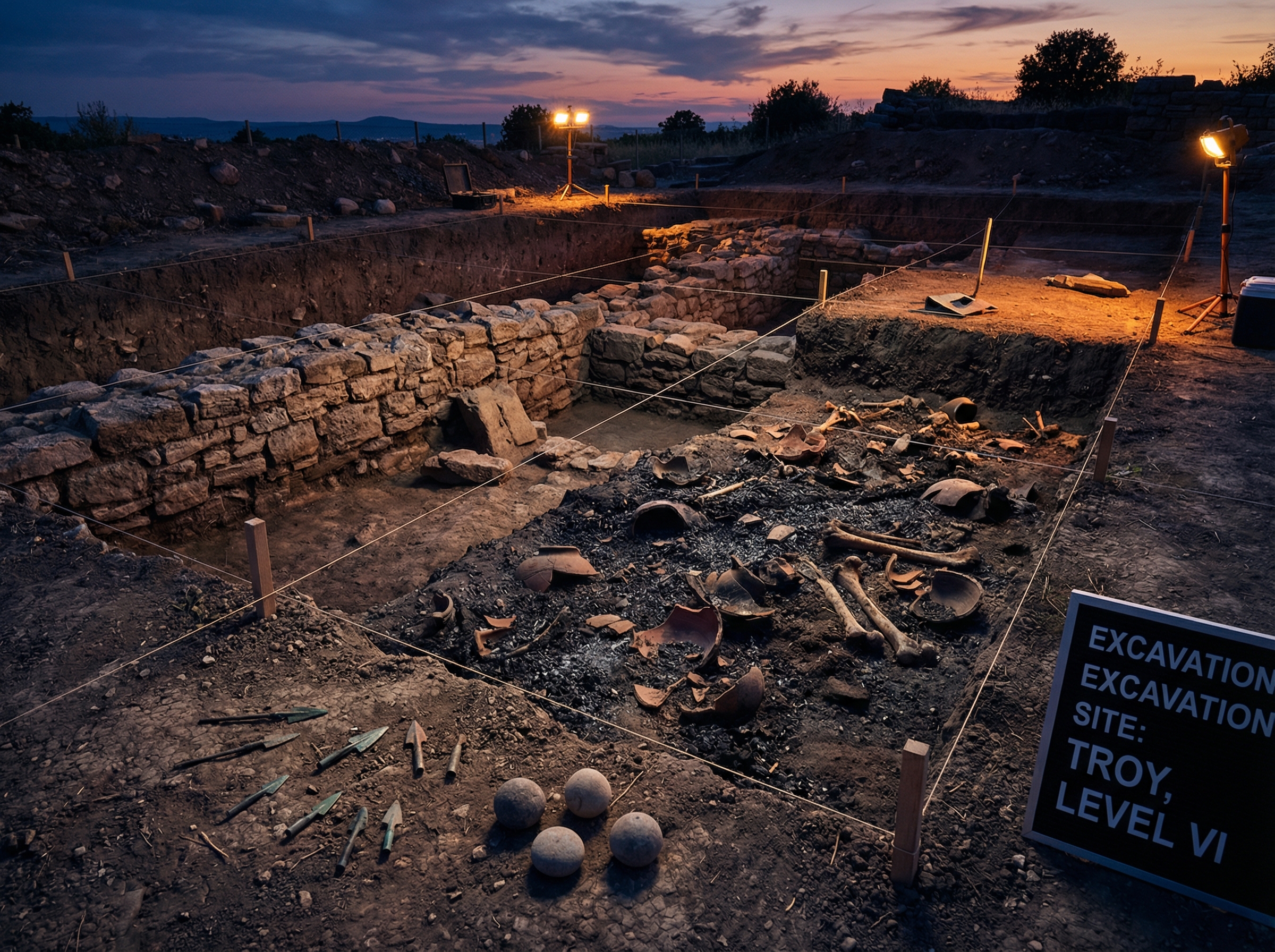
Here's the thing about Heinrich Schliemann: he was right for all the wrong reasons. The 19th-century treasure hunter who dynamited through layers of history at Hisarlik proved Troy was real, but his methods were so destructive that modern archaeologists have spent 150 years cleaning up after him. Now, in excavation seasons running through 2024 and 2025, they're finding what he missed—and it's far more convincing than any golden mask.

Prof. Rüstem Aslan's team has uncovered four skeletons in a destruction layer at Troy VIIa—two men, one woman, one infant—showing signs of violent death and heat exposure. Thousands of sling stones and arrowheads lie concentrated outside a Bronze Age palace structure. Bioarchaeological analysis of the bones reveals siege stress: nutritional deficiency, healed fractures, the biochemical signature of a population under sustained assault. The destruction layer dates to roughly 1180 BC, aligning almost exactly with the traditional date of Troy's fall.

None of this proves Achilles dragged Hector around the walls. But it proves something catastrophic and military happened at exactly the time and place Homer described. The Iliad may be poetry, but the arrowheads outside the walls aren't metaphors.
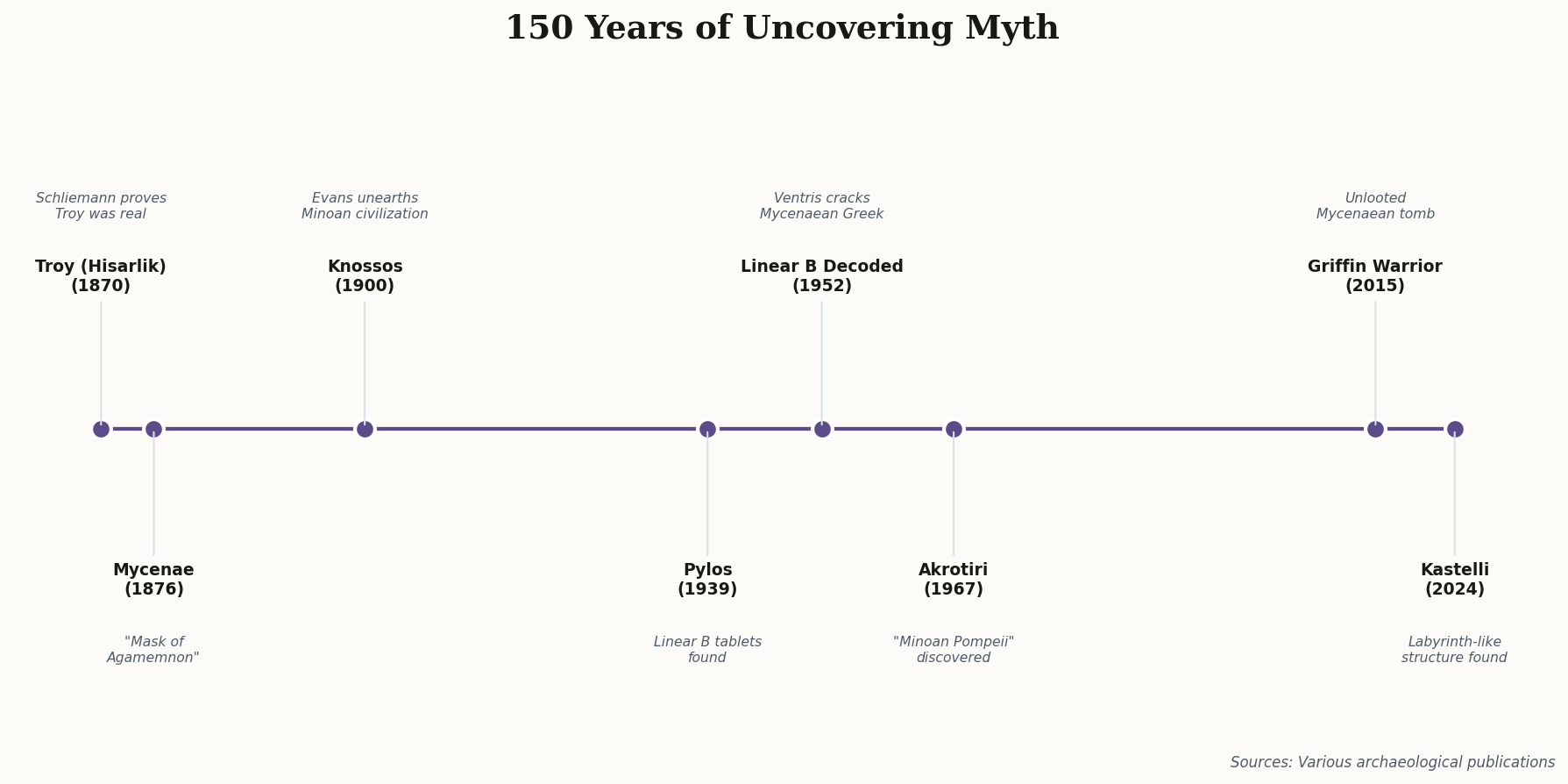
Timeline of major archaeological discoveries related to Greek mythology from 1870 to 2024
150 years of digging up the truth behind the myths — from Schliemann's dynamite to modern forensic archaeology.
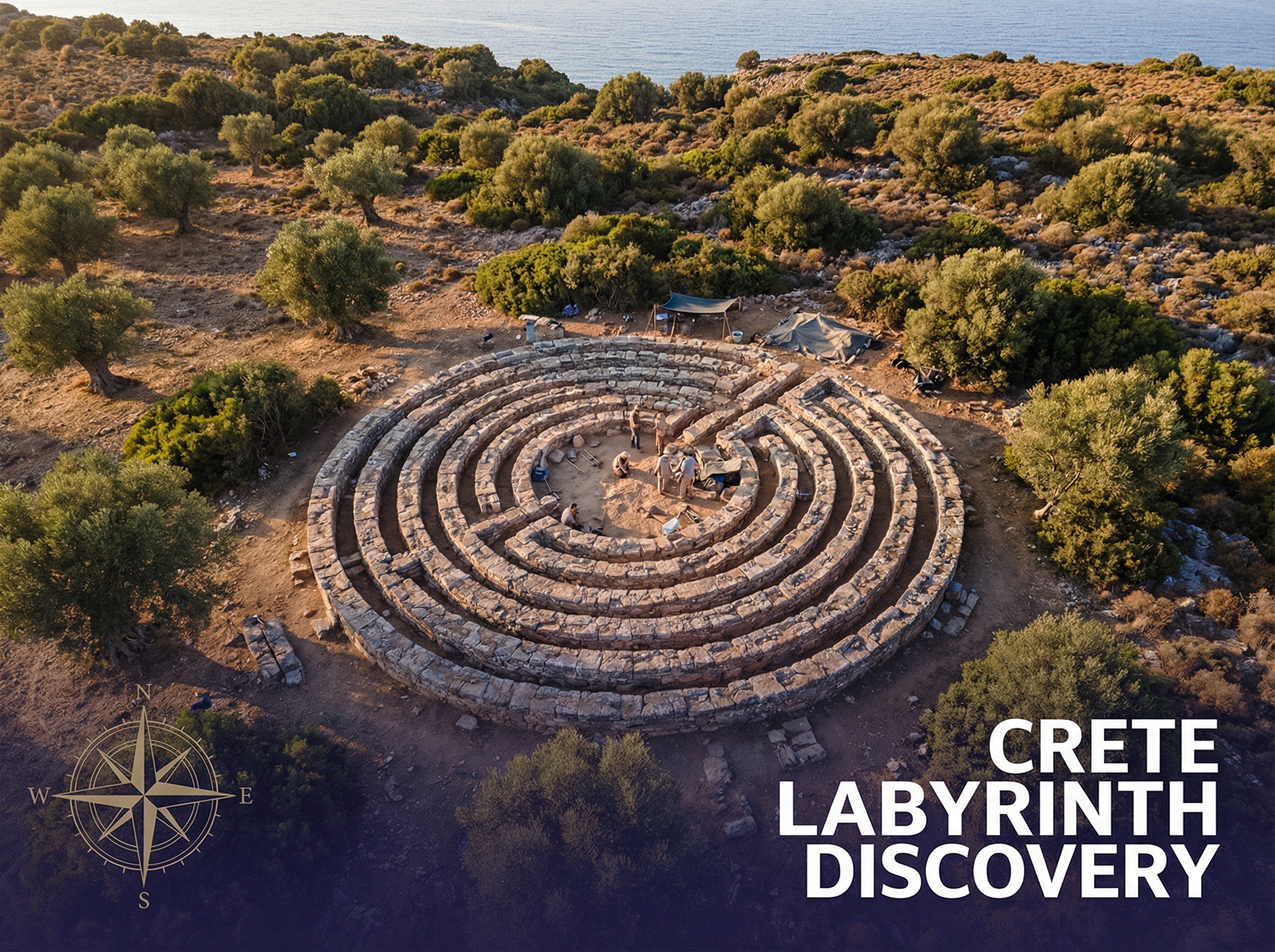
Aerial view of circular stone labyrinth structure on Crete
02

Crete's Real Labyrinth Was Hiding in Plain Sight

For over a century, the "labyrinth" was Knossos. Arthur Evans excavated the palace complex starting in 1900, found its 1,300+ rooms arranged in a disorienting maze, and declared it the inspiration for Theseus's monster-haunted prison. It was a tidy theory. Except Knossos was never a maze—it was an administrative center. People lived and worked there. The "confusion" was just bad architecture.

Then in June 2024, Greek archaeologists announced something genuinely startling. Near Kastelli on Crete, they uncovered a massive circular structure: 1,800 square meters, featuring eight superimposed stone rings in a maze-like configuration. It's 4,000 years old. Unlike Knossos, it appears to be purely ritualistic—no residential quarters, no storage rooms, no administrative records. Just concentric rings of masonry designed to channel movement inward.

This doesn't mean the Minotaur was real. But it suggests the labyrinth myth may be a composite: the bewildering complexity of Knossos plus actual ring-shaped ritual structures where something happened that people found worth remembering for millennia. The Minotaur is fiction. The labyrinth, it turns out, is not.

Volcanic eruption over Santorini caldera with ancient Minoan city being engulfed by waves
03

The Day the Sea Swallowed a Civilization

When Plato wrote about Atlantis in the 4th century BC, he described a powerful island civilization destroyed "in a single day and night" by earthquakes and floods. Most scholars agree he was writing political philosophy, not history. But the question has always been: what gave him the template?

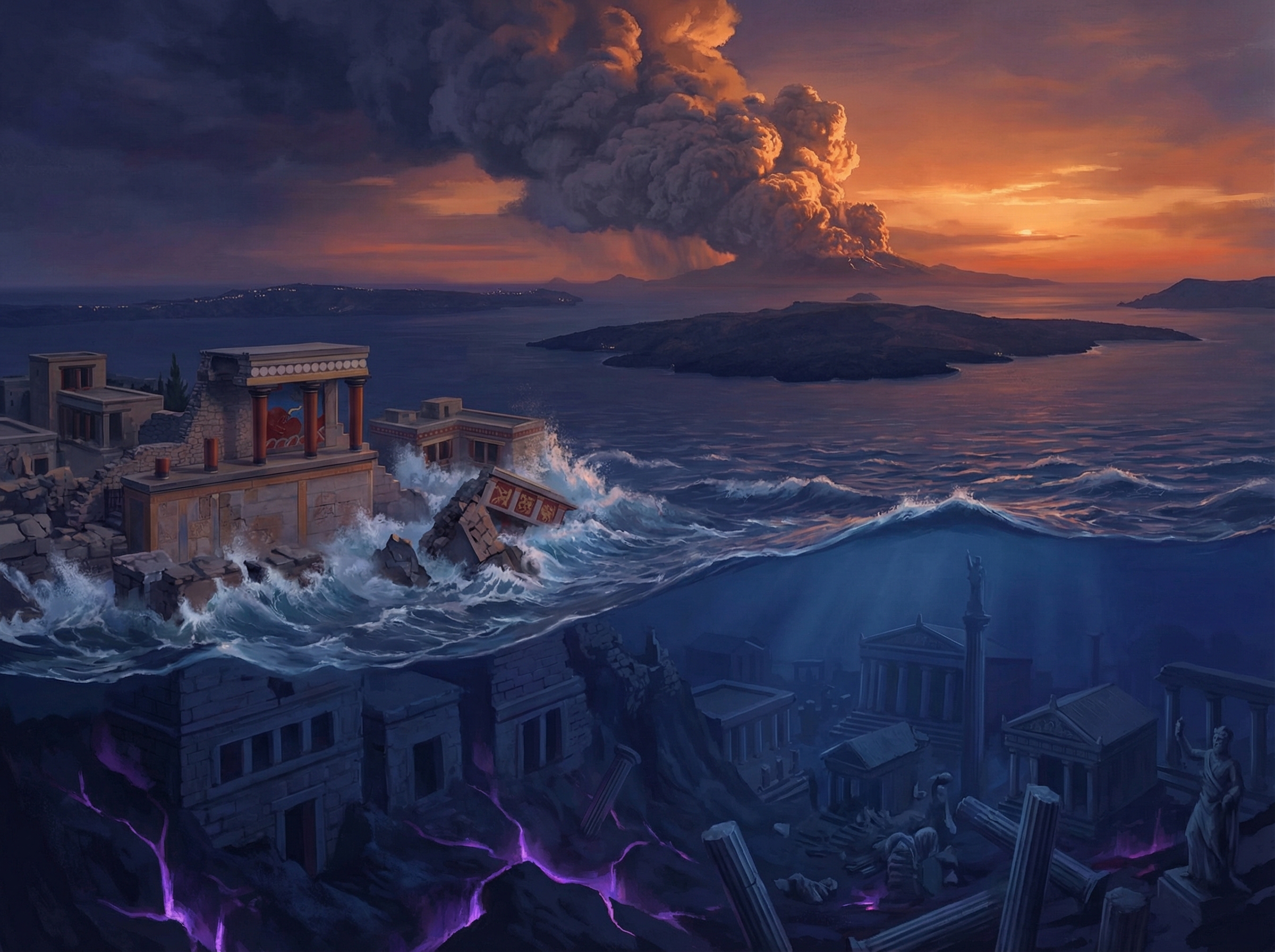
The answer is almost certainly Thera. Around 1600 BC, the volcanic island we now call Santorini erupted with a force that ejected 60 cubic kilometers of rock—roughly four times the power of Krakatoa. The resulting tsunamis devastated the north coast of Crete, 110 kilometers to the south. The thriving Minoan city of Akrotiri was buried under volcanic ash so quickly that frescoes, furniture, and food remain preserved—a "Minoan Pompeii" discovered in 1967.

New dendrochronology and radiocarbon studies from the University of Arizona (2022–2023) have narrowed the eruption date to 1600–1525 BC, resolving a contentious "100-year gap" that had divided archaeologists. The updated timeline places the catastrophe firmly in the Late Minoan IA period—centuries before the final Minoan collapse around 1450 BC. In other words, the eruption didn't kill the Minoans outright. It weakened them. And a weakened civilization, struggling to recover from a cataclysm, makes for exactly the kind of cultural trauma that gets passed down as myth.

Atlantis is fiction. But it's fiction modeled on something real enough to still be smoking.

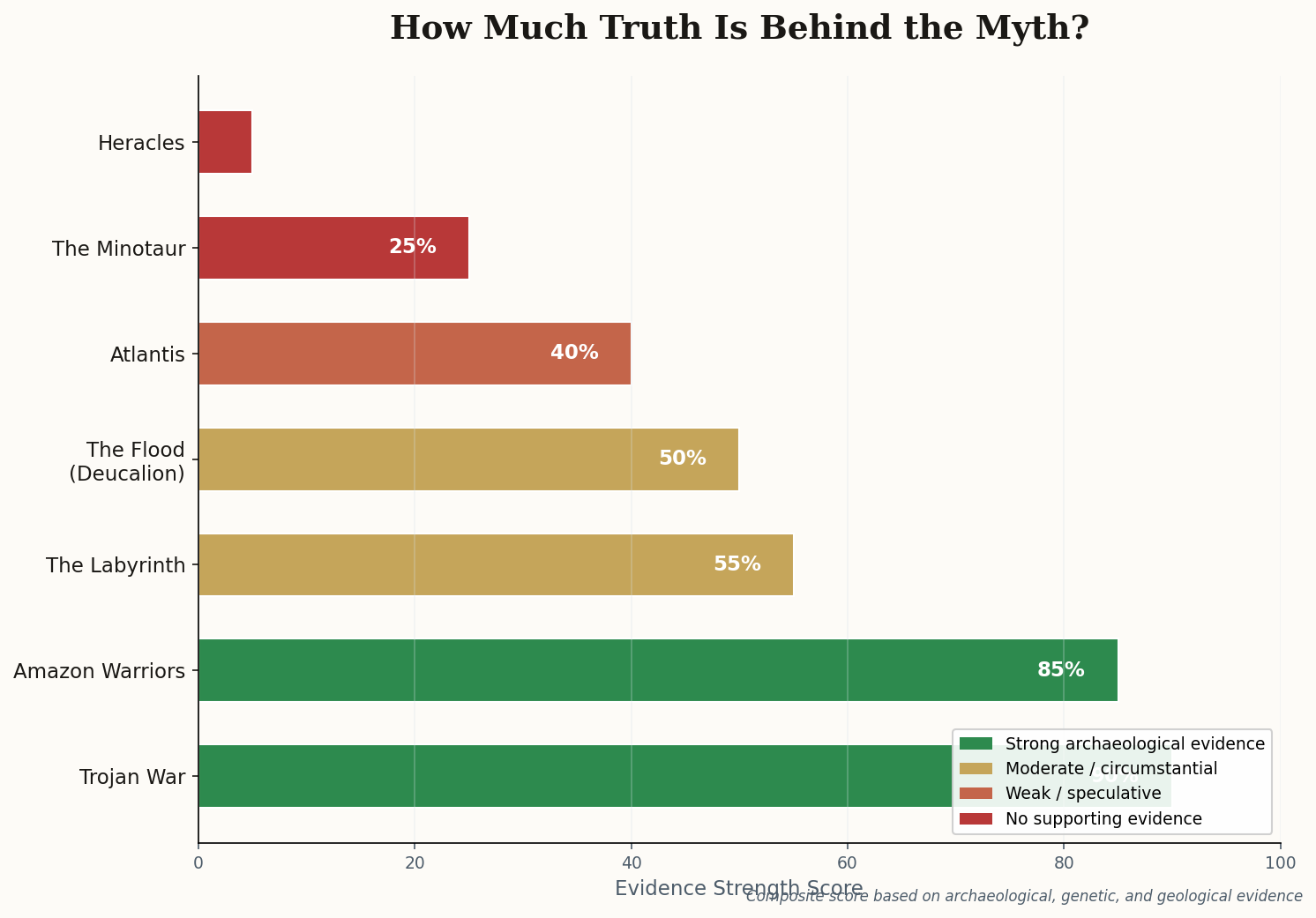
Horizontal bar chart showing evidence strength for various Greek myths
Composite evidence scores for major Greek myths, based on archaeological, genetic, and geological findings.
DNA helix intertwined with Mycenaean gold death mask
04

The Ancients Never Left

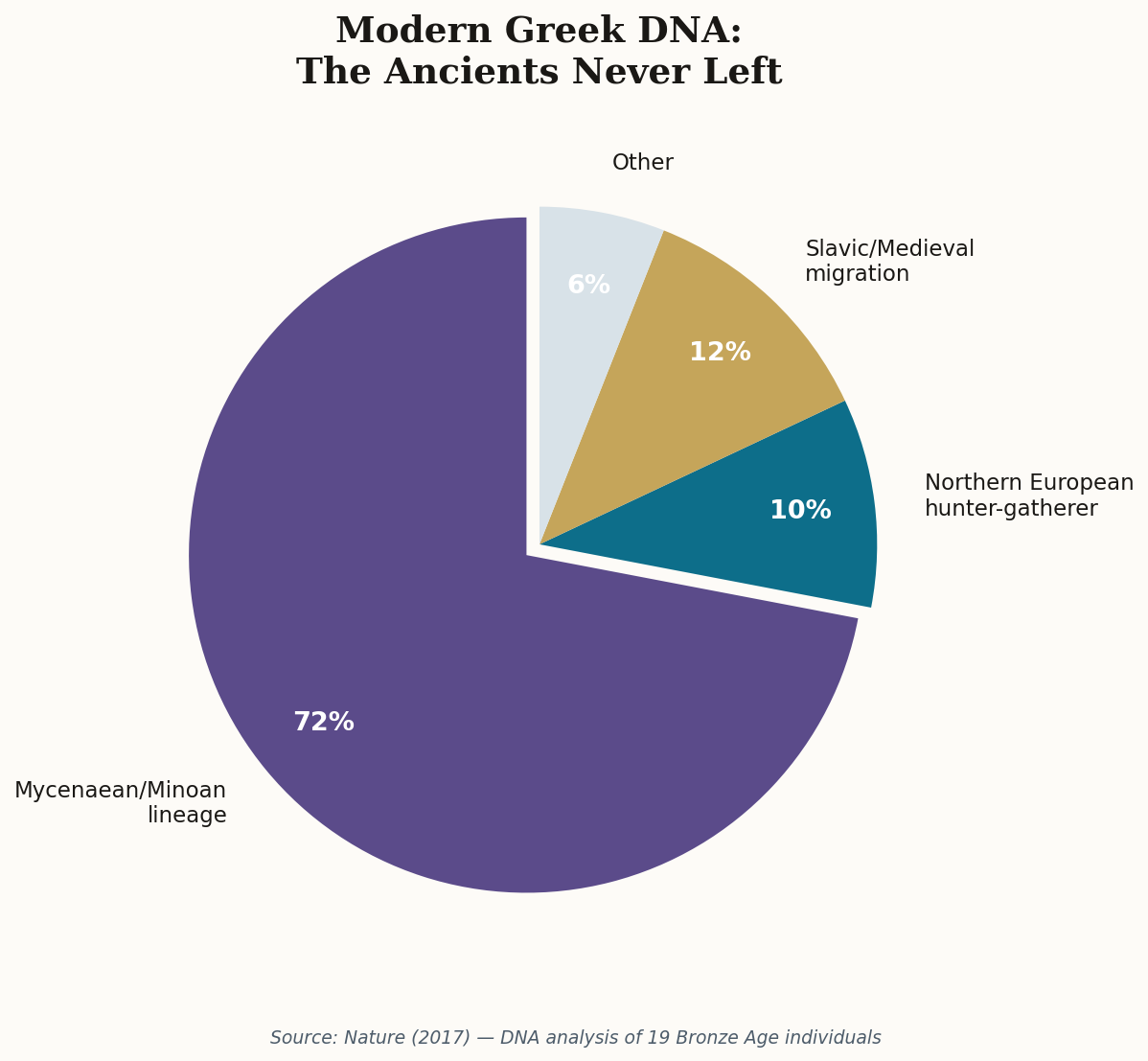
In 2017, a team from the Max Planck Institute and Harvard published a paper in Nature that settled one of the oldest debates in classical studies. They sequenced DNA from 19 Bronze Age individuals—Mycenaeans from mainland Greece and Minoans from Crete—and compared it to modern populations. The result: modern Greeks share roughly 70–80% of their ancestry with these Bronze Age populations.

The Mycenaeans carried a distinct "northern" genetic component—traces of Eastern European and Siberian hunter-gatherers—that the Minoans lacked. This aligns perfectly with the mythological narrative of Greek-speaking warrior tribes arriving from the north and dominating the indigenous Aegean population. The "Coming of the Greeks" wasn't just a story. It was a migration event visible in the genome.

This also demolishes the Fallmerayer thesis—the 19th-century claim that modern Greeks are ethnically unrelated to the ancients, replaced by Slavic populations during the medieval period. The DNA says otherwise: there's been continuity, with admixture, for nearly 4,000 years. The people telling the myths today are, genetically speaking, the people who made them.

Pie chart showing modern Greek DNA composition related to ancient populations
Modern Greek genetic composition — approximately 72% traces directly to Mycenaean and Minoan ancestors. Source: Nature (2017).
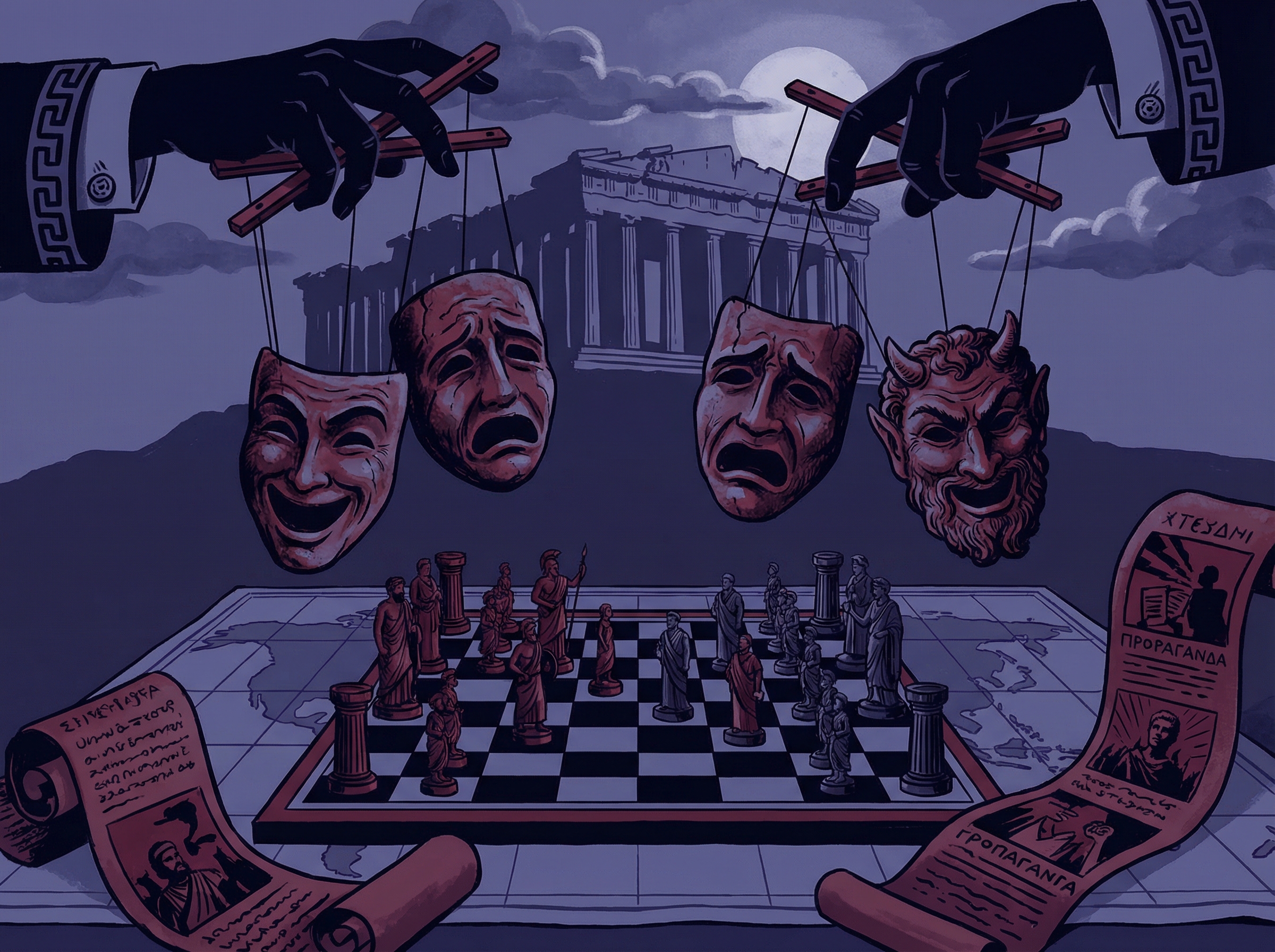
Greek theater masks manipulated as political puppets with Parthenon in background
05

When Athens Invented a Hero to Justify an Empire

Not all myths emerge from misty prehistory. Some are manufactured in broad daylight, for specific political purposes, by people who knew exactly what they were doing.

Take Theseus. In the earliest versions, he's a generic adventurer—he kills a bull, navigates a maze, abandons a princess on an island. Standard heroic fare. But in the 5th century BC, Athens had a problem: it was building an empire and needed a founding myth to rival Sparta's claim to Heracles. So they rebooted Theseus. The Athenian statesman Cimon orchestrated the "discovery" of Theseus's bones on the island of Skyros—conveniently providing justification for Athens to annex the island. The bones were almost certainly those of some random ancient burial. But they were paraded through Athens with full state honors and enshrined in a hero cult.

Meanwhile, Theseus's mythology got a deliberate upgrade. He became the "founder of democracy"—an anachronism that would have baffled anyone living before the 5th century. His labyrinth adventure was recast as a story about Athenian resistance to Cretan tyranny. Alexander the Great later ran the same playbook, commissioning genealogies linking him to Achilles (mother's side) and Heracles (father's side) to legitimize his conquest of half the known world.

Myths weren't just stories people happened to believe. They were tools—deployed, edited, and weaponized by states to justify invasion, colonization, and regime change. The ancient Greeks would have understood modern political spin instinctively.

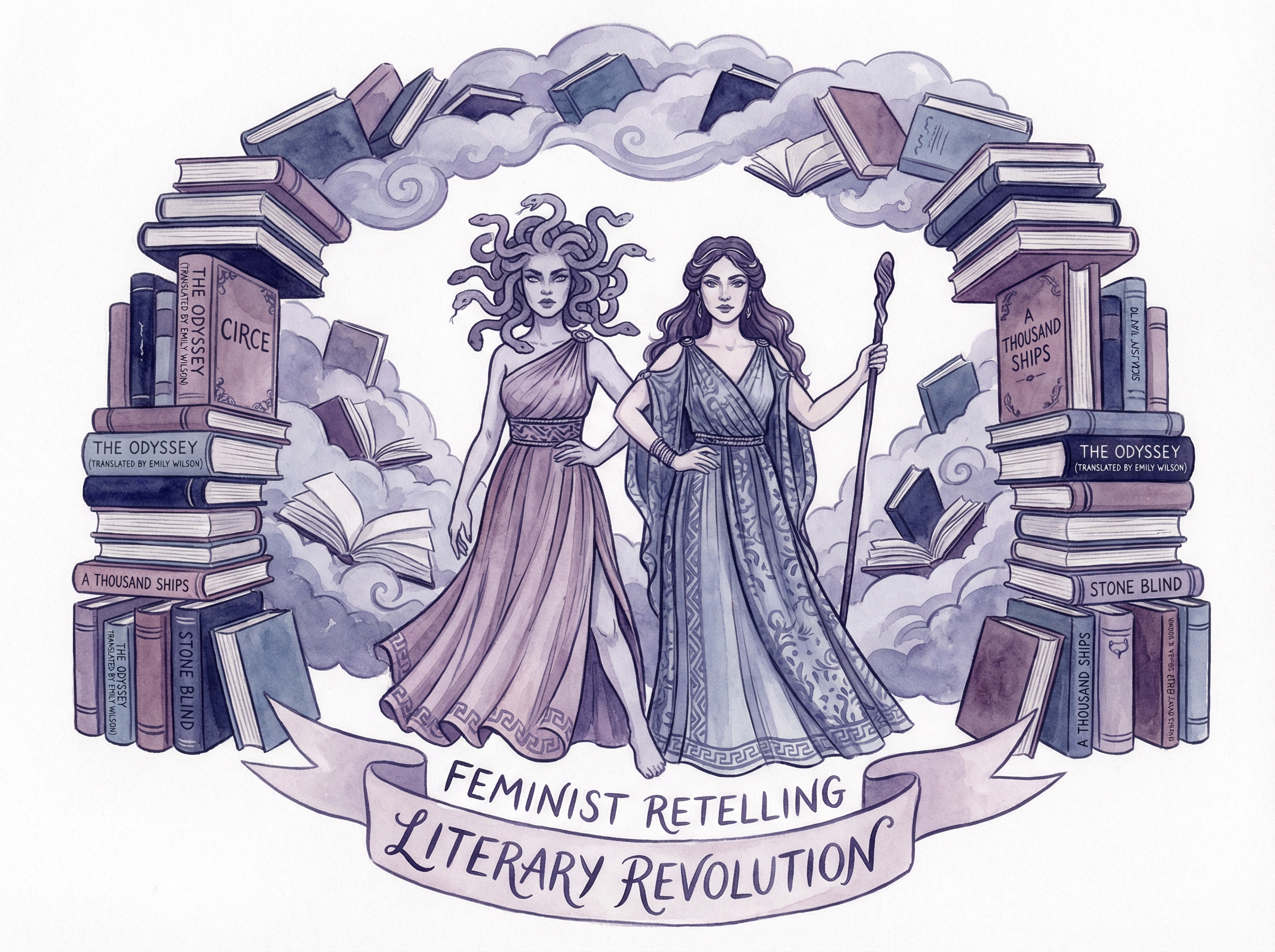
Medusa and Circe as powerful women surrounded by stacks of modern books
06

The Monsters Get to Tell Their Side

Something happened to Greek mythology in the 2020s that Homer never anticipated: the women started talking.

Madeline Miller's Circe and The Song of Achilles have sold over two million copies combined, spawning a distinct publishing sub-genre that Nielsen BookScan data shows is now the dominant form of classical reception. Jennifer Saint's Ariadne gives the woman Theseus abandoned on Naxos her own interior life. Natalie Haynes's Stone Blind recasts Medusa not as a monster but as a victim of divine assault—a reading that actually has ancient precedent in Ovid, though it was largely ignored for two millennia.

These aren't just novels. They're acts of excavation—digging through layers of patriarchal retelling to ask what the myths might have looked like before male poets shaped them for male audiences. Circe was a powerful deity reduced to a witch. Medusa was a priestess punished for being raped. Penelope spent twenty years running a kingdom while everyone told the story of her husband's adventure.

The question these books raise is genuinely destabilizing: if the "truth" of a myth depends on who tells it, how much of what we call Greek mythology is really just Greek masculinity projected backward onto the divine?

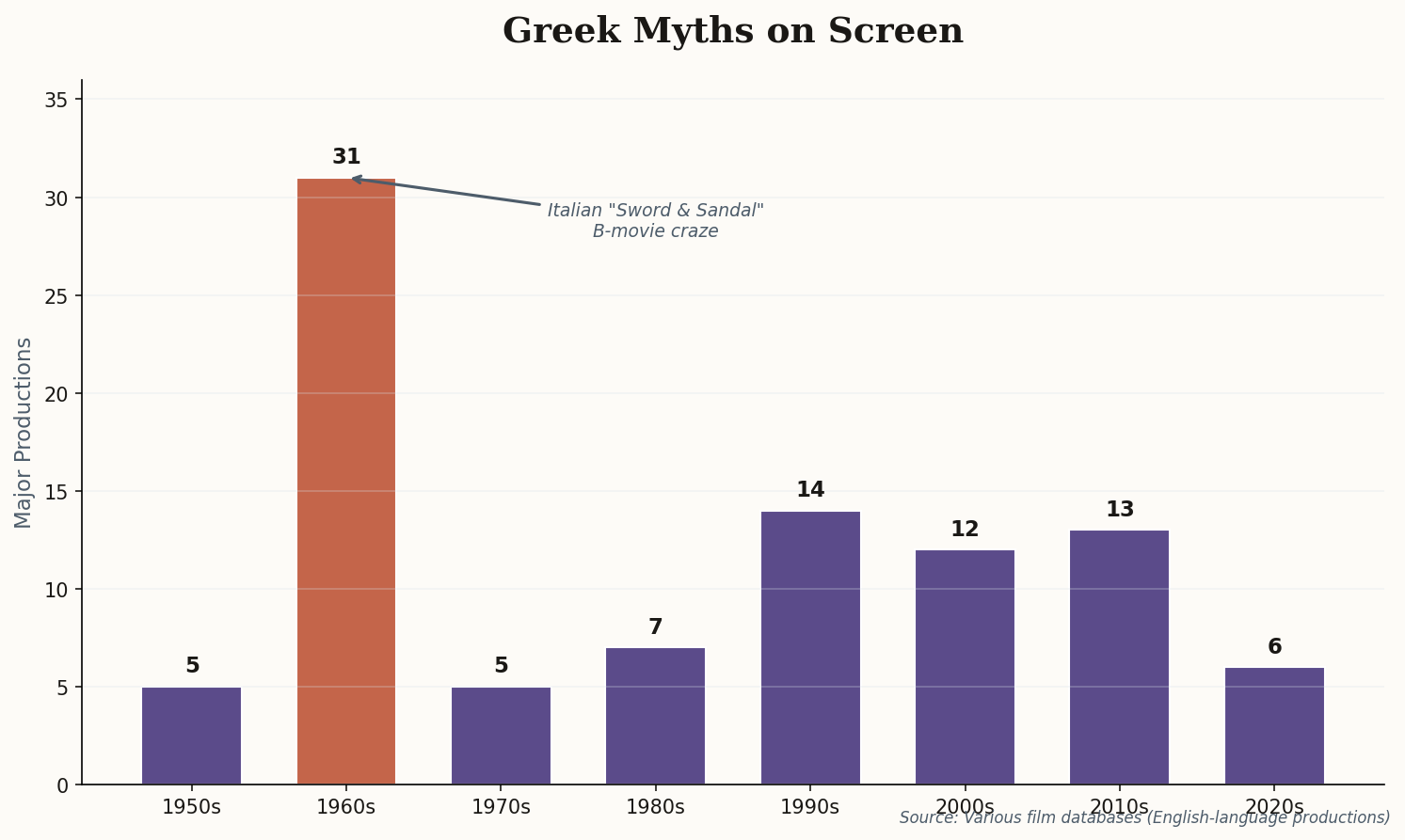
Bar chart showing Greek mythology adaptations in film and TV by decade
Greek myths on screen by decade — the 1960s Italian "Sword & Sandal" craze remains the all-time peak.

Where Legend Meets the Shovel

The Greeks didn't separate myth from history the way we do. For them, Achilles and the Trojan War occupied the same mental space as the Persian Wars—real events involving real people, with the gods mixed in. Modern archaeology hasn't proven them right, exactly. But it's proven something more interesting: that myths often preserve genuine memories of catastrophes, migrations, and power struggles, wrapped in layers of poetry and propaganda that accumulated over centuries of oral retelling. The bones don't lie. But the poets who sang over them certainly took liberties.