Art History

The Seven Who Shattered the Frame

In April 1874, a group of painters told the art establishment to go to hell. A century and a half later, their radical bet is worth billions—and their ideas still haven't been fully absorbed.

Listen
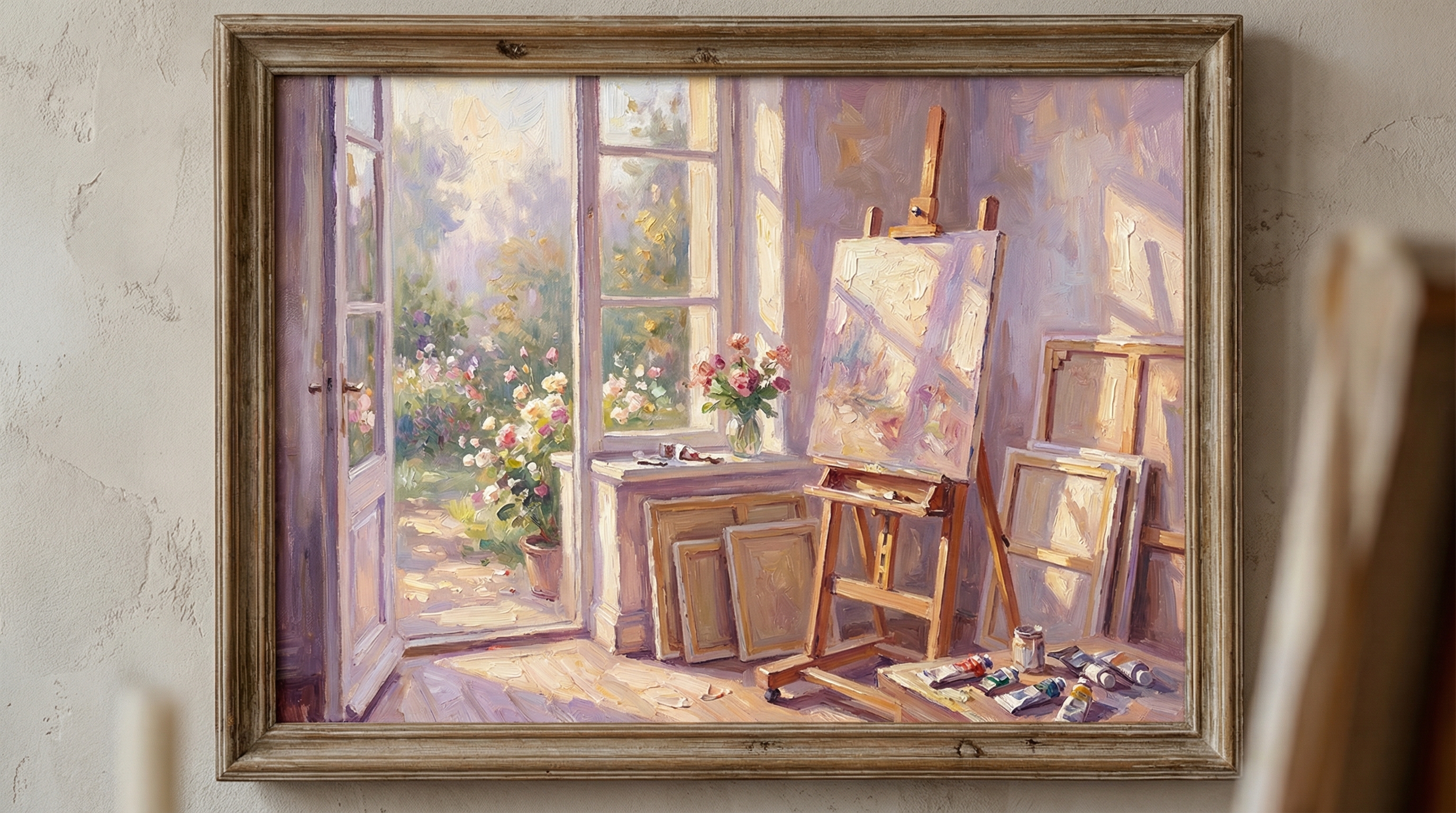
An impressionist-style painting of an artist's studio overlooking a sun-dappled garden with scattered canvases
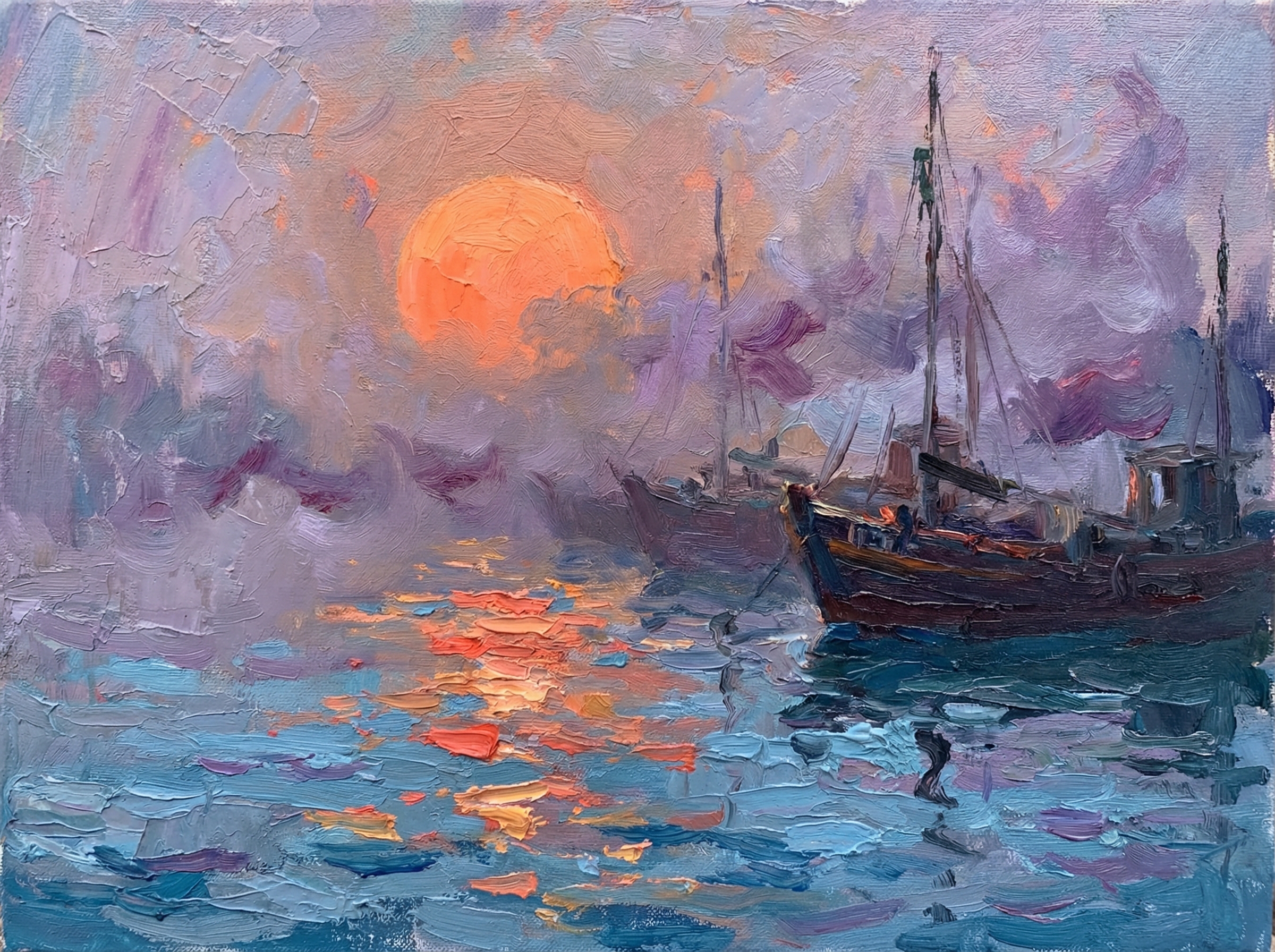
Misty harbor at sunrise with shimmering reflections, in impressionist style
01

Claude Monet: The Man Who Painted Light Until It Blinded Him

Here's the thing about Monet that most people get wrong: he wasn't trying to paint pretty pictures. He was running a decades-long experiment in human perception. When he placed a stroke of pure cobalt blue next to unmixed cadmium yellow on a canvas and let your retina do the mixing, he wasn't being lazy—he was anticipating how digital screens would work a century later. Broken color wasn't a style choice. It was a theory of vision.

The proof is in the series paintings. In the 1890s, Monet started painting the same haystacks, the same cathedral façade, the same stretch of river—over and over, at different hours and in different weather. He'd work on up to fourteen canvases simultaneously at Giverny, switching from one to the next as the light shifted. This wasn't repetition. It was a systematic study of atmosphere that would have made any physicist proud. When Kandinsky saw one of the Haystacks and couldn't identify the subject, the seed of abstract art was planted.

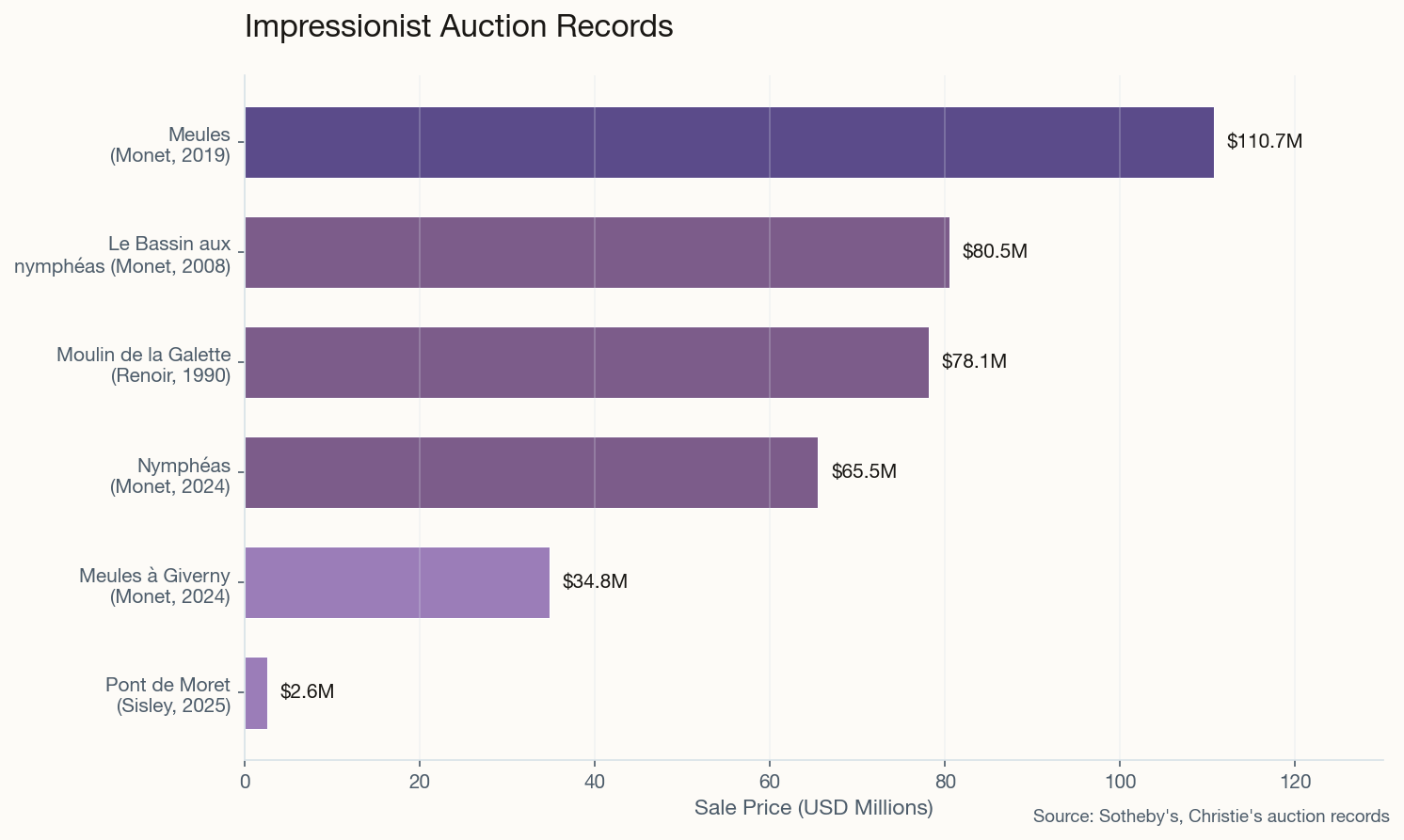
Then cataracts came for his eyes. From 1908, his world turned muddy and reddish-yellow. The late Water Lilies and Japanese Bridge paintings are essentially abstract—swirling, violent, almost expressionist. Critics dismissed them as the fumbling of a blind old man. Half a century later, Abstract Expressionists like Pollock and Rothko would claim him as their forefather. After cataract surgery in 1923, Monet briefly perceived ultraviolet light and painted water lilies in unearthly electric blues that most humans have never seen. A Nymphéas sold for $65.5 million at Sotheby's in 2024. His Meules holds the all-time Impressionist record at $110.7 million.

"My garden is my most beautiful masterpiece." — Claude Monet, who literally diverted a river to build his water garden at Giverny, planting exotic lilies and curating flower colors to match his palette. He didn't paint nature. He grew his paintings.
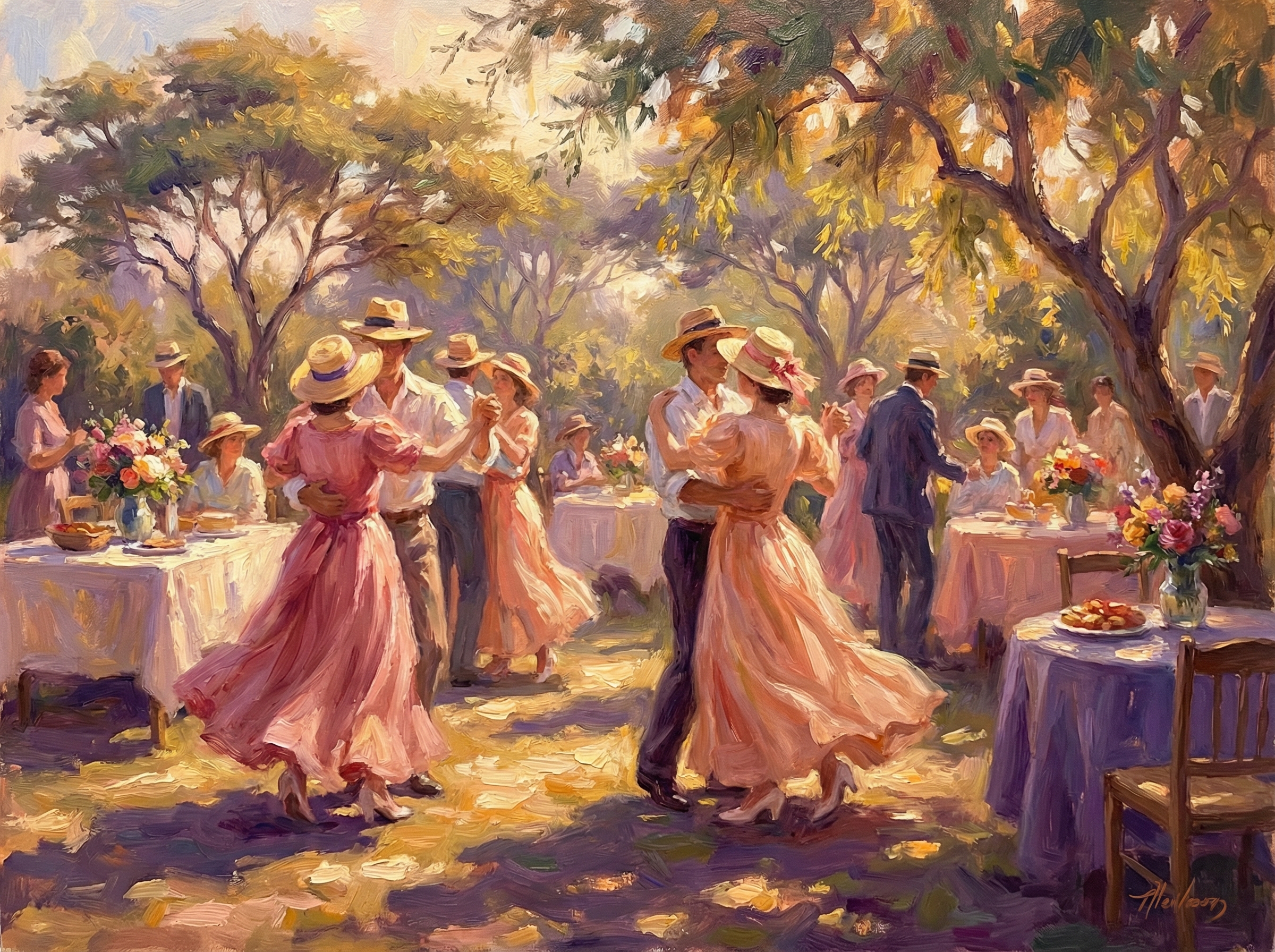
Dappled sunlight through trees onto an outdoor dance, celebrating joie de vivre
02

Renoir: Beauty as a Moral Position

"Why shouldn't art be pretty? There are enough unpleasant things in the world." That line gets Renoir dismissed as lightweight by people who confuse prettiness with shallowness. But look at Dance at Le Moulin de la Galette (1876)—the dappled sunlight isn't decoration. It's the engine of the entire composition, spots of brilliance falling across straw hats and cotton dresses, dissolving the boundary between figure and light. The painting feels like a snapshot because Renoir understood something that wouldn't become common wisdom until photography matured: the most truthful images are the ones that feel accidental.

What makes Renoir genuinely interesting is his crisis. After visiting Italy in the 1880s, he decided he'd "wrung Impressionism dry" and couldn't draw properly. He entered his so-called "Sour Period"—harsh outlines, smooth surfaces, a deliberate rejection of everything that had made him famous. It was a commercial disaster and an artistic necessity. The tension between his Impressionist instincts and his classical ambitions produced Luncheon of the Boating Party (1881), where the background dissolves into shimmer but the figures are modeled with the solidity of Rubens. That conflict made him.

The late years are almost unbearable to contemplate. By 1910, rheumatoid arthritis had curled his fingers permanently. Assistants wedged brushes into his clenched hands, wrapping them with bandages to hold steady. He painted every single day. When Matisse visited and asked why he continued through such agony, Renoir answered: "The pain passes, but the beauty remains." The Barnes Foundation in Philadelphia holds over 180 of his paintings—an entire wing pulsing with that relentless joy.

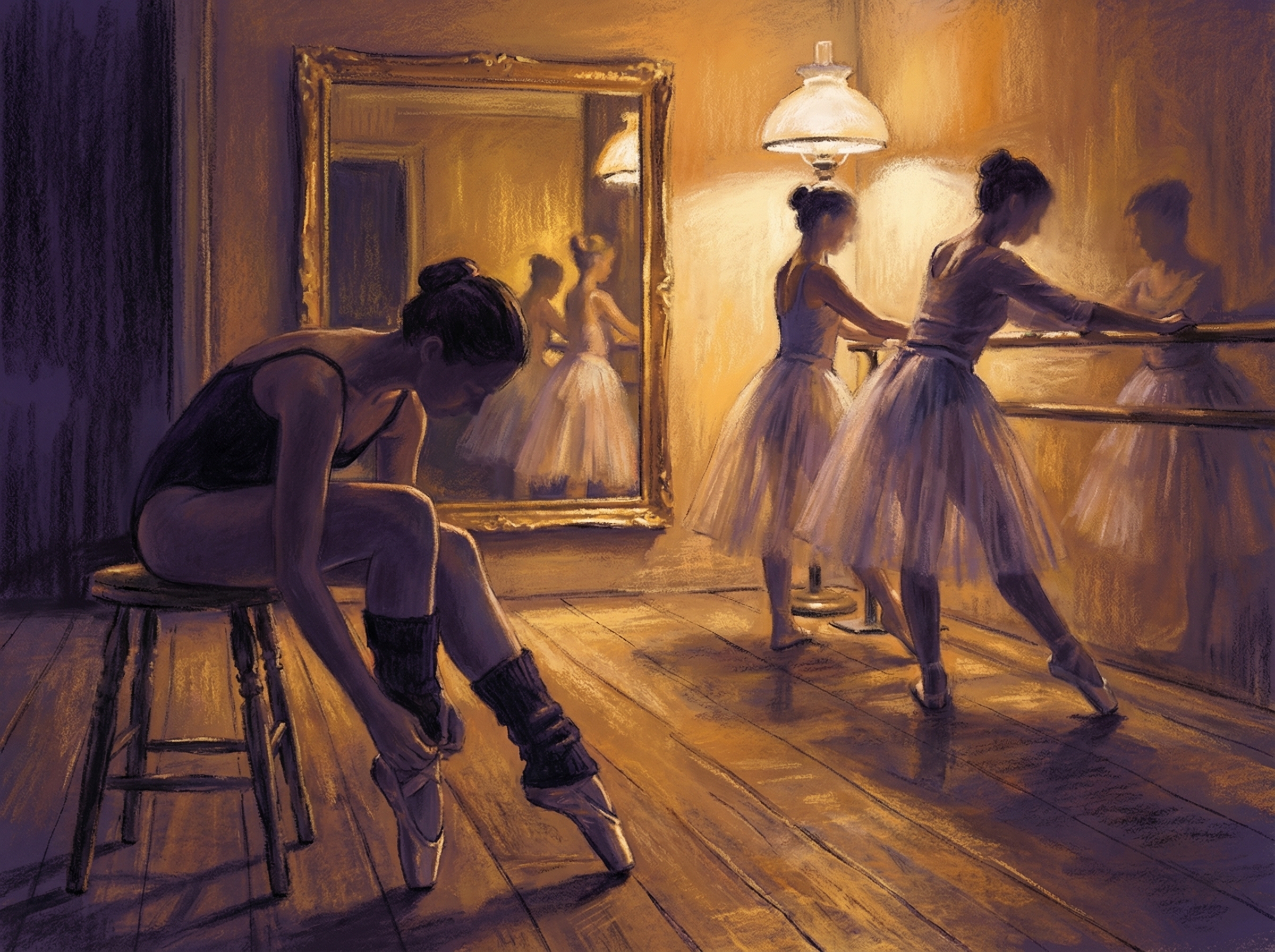
Ballet dancers in a rehearsal studio, asymmetric composition with pastel textures
03

Degas: The Contrarian Who Hated the Word “Impressionist”

Degas despised the term "Impressionist." He preferred "Realist" or "Independent"—and in a perverse way, he was right. While Monet chased sunlight across lily ponds, Degas was in the ballet studio watching fourteen-year-olds rub their aching feet. "You need natural life," he told Monet. "I need artificial life." The gaslit rehearsal room, the café, the boudoir—these were his laboratories, and he dissected them with a surgeon's eye for the mechanics of human movement.

Over half of Degas's output depicts dancers, and not a single one of those images is about glamour. The Dance Class (1874) shows ballerinas scratching their backs, adjusting earrings, looking bored while the old ballet master drones on. L'Absinthe (1876) is a psychological portrait of urban alienation so unsparing that London audiences booed it as "vulgar" when it was shown in 1893. His compositions—figures sliced by the frame edge, views plunging from above—were stolen directly from Japanese woodblock prints and the new medium of photography. He was the first Western painter to truly understand the power of the crop.

His Little Dancer of Fourteen Years (1881)—a wax figure dressed in a real silk bodice, tulle skirt, and a wig of actual human hair—horrified critics who called it "ugly" and "monkey-like." It's now considered a direct ancestor of modern assemblage and installation art. As macular degeneration stole his sight, Degas turned to broad pastels and sculpture, feeling forms he could no longer see. He was brilliant, cruel, anti-Semitic during the Dreyfus Affair, and utterly alone at the end. Genius has never been a synonym for goodness.

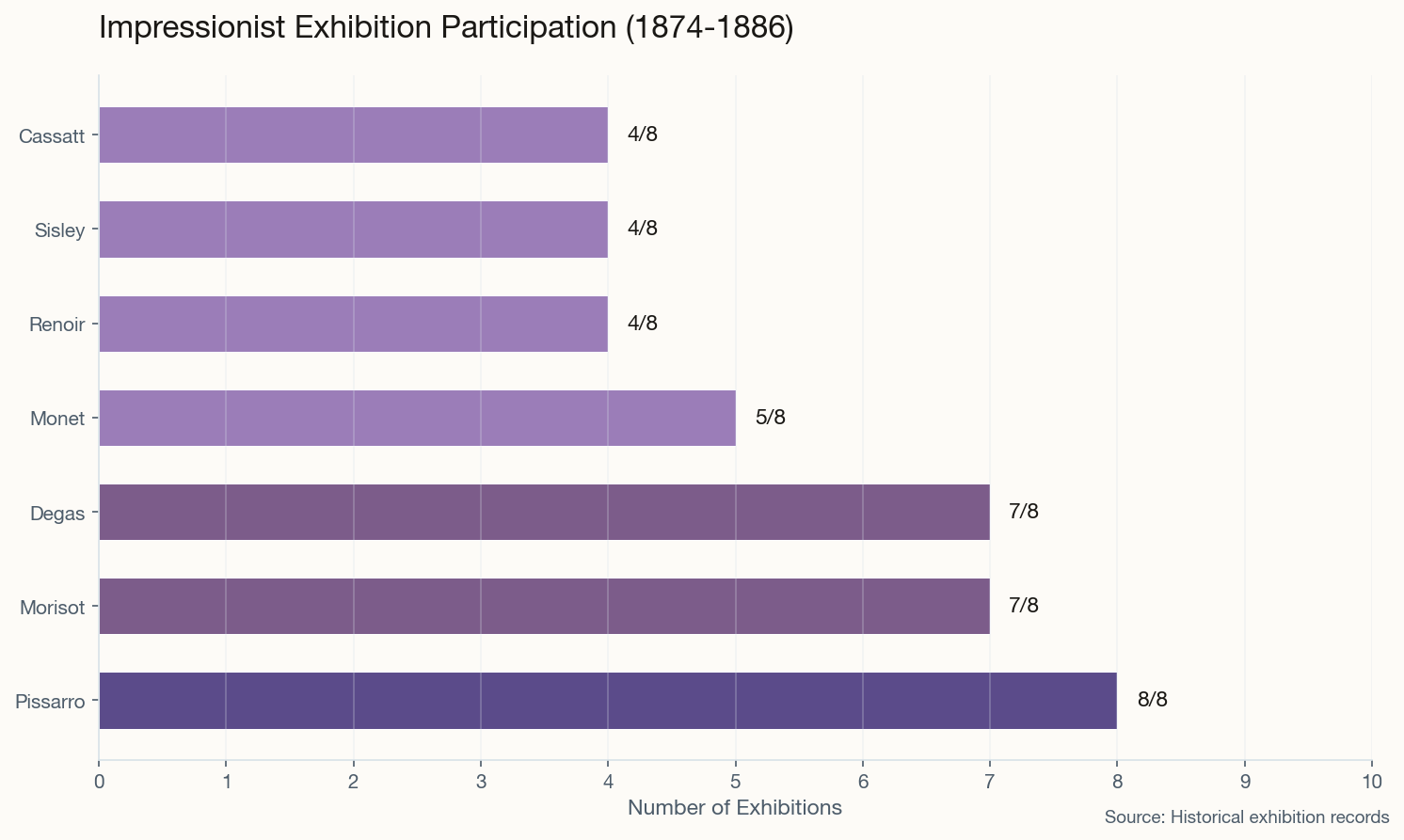
Bar chart showing Impressionist exhibition participation 1874-1886
Only Pissarro participated in all eight Impressionist exhibitions. Degas and Morisot showed at seven of eight, while Monet and Renoir were less consistent.
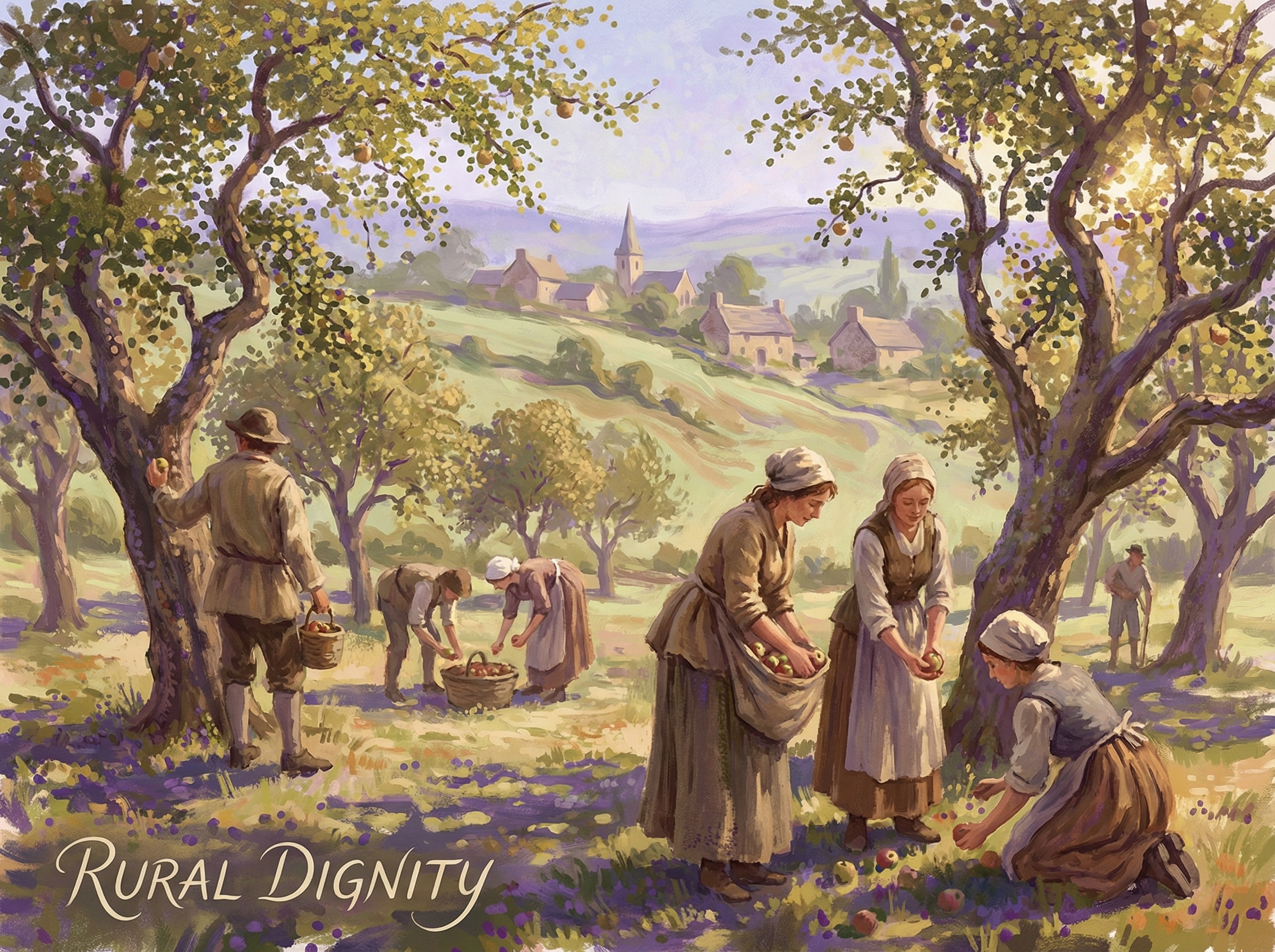
Peasants working in a sunlit orchard with pointillist-inspired technique
04

Pissarro: The Anarchist Who Held Everything Together

If Impressionism were a startup, Camille Pissarro would be the cofounder nobody talks about. He was the oldest of the group, born in the Danish West Indies to a family of Sephardic merchants. He was the only artist to exhibit at all eight Impressionist exhibitions—a feat of loyalty and stubbornness that nobody else could match. While Monet and Renoir feuded and Degas alienated everyone with his tongue, Pissarro kept the peace. Cézanne called himself "a pupil of Pissarro" and described him as "humble and colossal."

What set Pissarro apart was his politics. He was a committed anarchist who believed in a utopian agrarian society free from central authority. While Renoir painted bourgeois leisure and Monet tended his private Eden, Pissarro painted peasants digging potatoes and market women hauling baskets. His Turpitudes Sociales was a portfolio of explicitly anarchist drawings critiquing capitalist exploitation. The paintings weren't propaganda—they treated working people with the same technical sophistication and visual dignity that his colleagues reserved for Parisian parties.

In the 1880s, Pissarro bet his career on Seurat's Pointillism, spending four years painting in tiny dots. Collectors hated it. It was a commercial catastrophe. He abandoned it, finding it "too rigid to capture the sensation of nature," and pivoted to painting Parisian boulevards from hotel windows—his late cityscapes of the Boulevard Montmartre at different times of day are as powerful as anything Monet ever painted in series. Current scholarship is finally examining his Caribbean roots and the colonial trade networks that funded the very leisure class the Impressionists depicted.

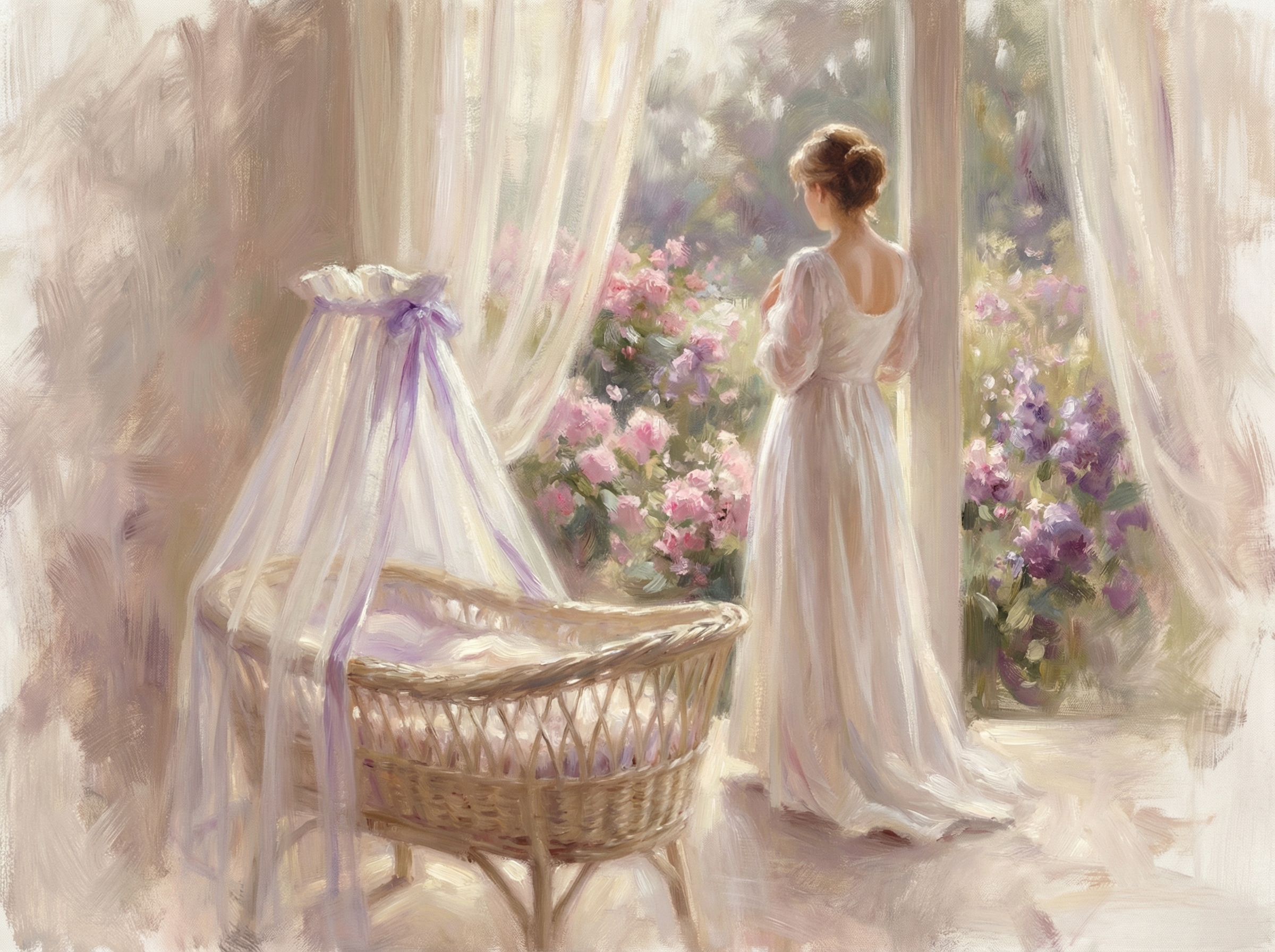
Intimate sunlit veranda with loose feathery brushstrokes and a baby cradle with translucent veil
05

Morisot: The Most Radical Brush in the Room

Here's the irony that art history is only now reckoning with: Berthe Morisot's brushwork was arguably more radical than Monet's. Her strokes are feathery, sketch-like, sometimes leaving bare canvas exposed—treating the painting surface as a breathing entity rather than a window to fill. She exhibited in the first Impressionist show in 1874, when several of the men refused to participate. She was a founding member. Not a footnote.

The restrictions she worked under make her achievements more remarkable, not less. As a grand-bourgeois woman in Second Empire Paris, she couldn't paint in cafés, wander the streets alone, or work from nude models. Her domain was the domestic sphere: gardens, drawing rooms, verandas. But she transformed those constraints into subject matter that none of her male colleagues could access. The Cradle (1872)—her sister watching over a sleeping baby through a translucent veil—is a painting about the invisible labor of motherhood rendered with a technical daring that Manet envied.

Speaking of Édouard Manet: Morisot appeared in several of his most famous works, including The Balcony. She married his brother Eugène, but the more consequential relationship was artistic. She pushed Manet to abandon his dark Spanish palette for the lighter Impressionist one, and to paint outdoors. Her market is now correcting upward, with works reaching over $800,000 at auction in late 2025. The scholarly conversation has shifted from "female Impressionist" to "technical innovator"—a change that's about 130 years overdue.

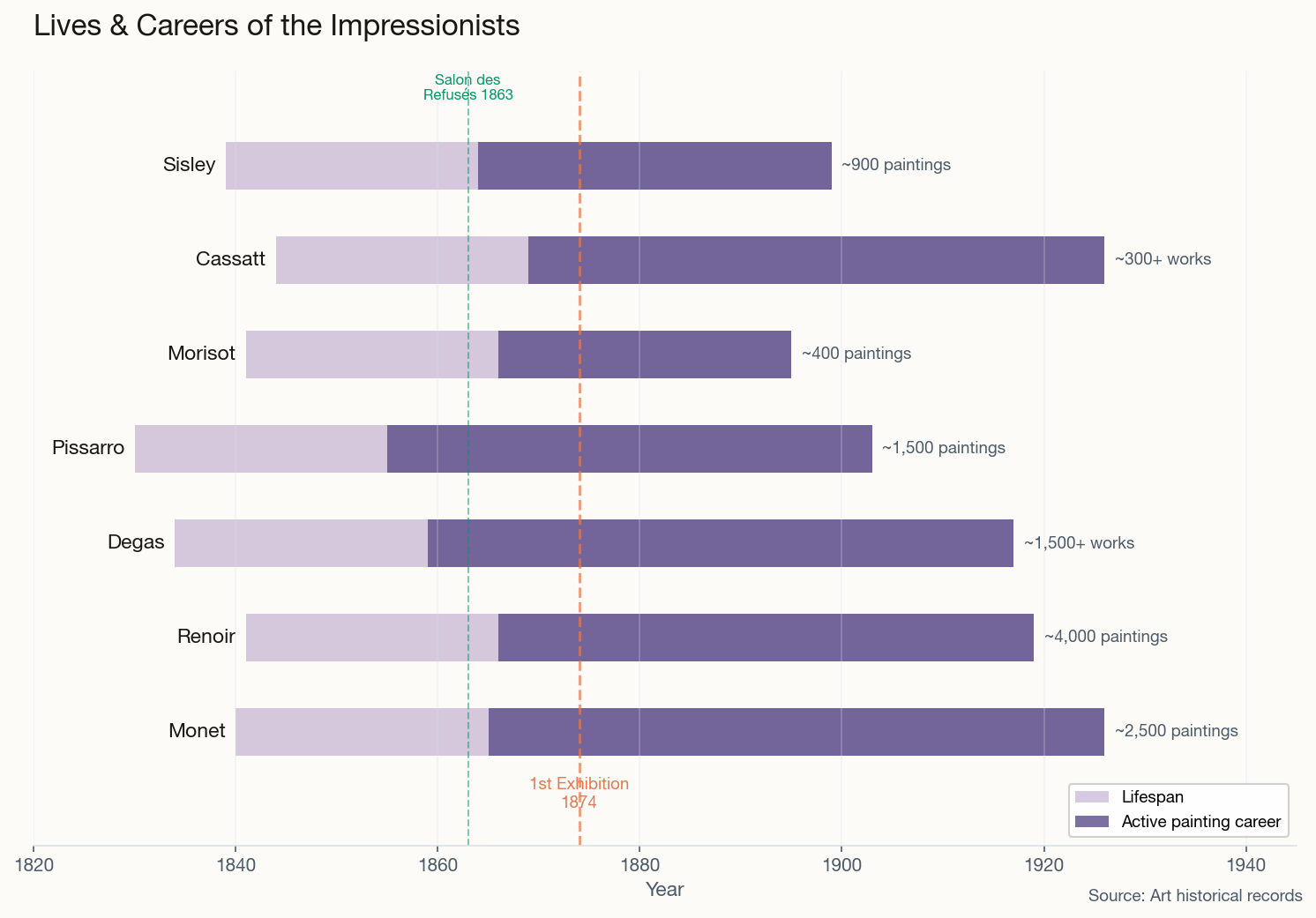
Timeline showing the lives and active careers of the seven Impressionist artists
The Impressionists' careers overlapped for roughly two decades, from the 1860s through the 1880s. Morisot died youngest at 54; Monet and Cassatt both lived to 86.
Mother bathing a child, seen from a high angle with Japanese-print-inspired flat color areas
06

Cassatt: The American Who Bankrolled a Revolution

Mary Cassatt's most consequential act wasn't painting. It was talking her wealthy American friends into buying the paintings of her colleagues when they were still cheap. She advised Louisine Havemeyer and other collectors to acquire Monet, Degas, and Pissarro while the Parisian establishment still sneered at them. This is why the Metropolitan Museum, the Art Institute of Chicago, and the National Gallery in Washington have some of the world's finest Impressionist holdings. Cassatt was, in effect, a one-woman art market maker.

But her paintings deserve to stand on their own merits, and they do. Born in Pennsylvania, she defied her father's wishes to study art in Paris. When Degas saw her work at the Salon and invited her to join the Impressionists, she said: "I accepted with joy. I hated conventional art." Her mother-and-child paintings aren't sentimental Madonnas. They're rigorously observed scenes of modern childcare—the physical weight of holding a squirming toddler, the negotiation of bath time, the tender exhaustion of it all.

The turning point was the 1890 exhibition of Japanese prints in Paris. Cassatt produced a series of ten aquatints that married ukiyo-e aesthetics—flattened space, bold pattern, strong line—to Western printmaking technique. The Child's Bath (1893), viewed from directly above, is pure Japonisme: the rug pattern and the mother's striped dress compress into decorative planes while the child's soft flesh provides the only volumetric relief. It's the bridge between Impressionism and modernism, and Cassatt built it.

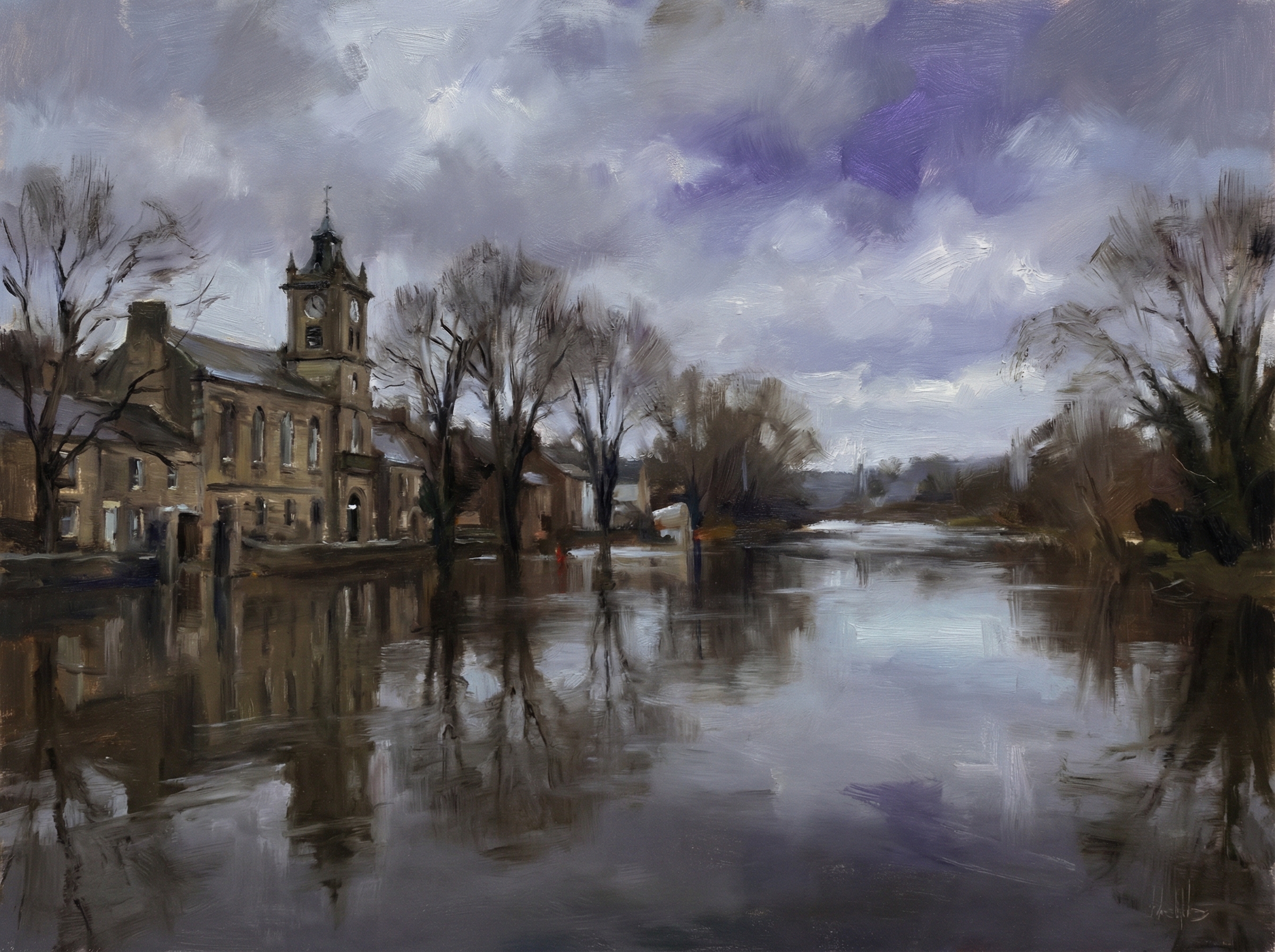
A flooded river town in grey winter light with melancholic silver-blue atmosphere
07

Sisley: The Ghost at the Feast

Alfred Sisley is the artist who makes the entire Impressionist narrative uncomfortable. While Monet evolved toward abstraction, Renoir circled back to classicism, Degas explored sculpture, and Pissarro flirted with Pointillism, Sisley simply painted Impressionist landscapes. For his entire career. He never wavered, never experimented, never pivoted. He was the purest practitioner of the movement, and the art world rewarded his consistency with poverty and obscurity.

Born in Paris to wealthy British parents, he lost everything in the Franco-Prussian War of 1870. He never recovered financially. While his friends achieved fame and comfortable late careers, Sisley lived in genuine desperation, dying of throat cancer in 1899 at age 59—feeling like a failure. The cruel punchline: within months of his death, his paintings began to command serious prices. Flood at Port-Marly (1876), a series depicting the Seine overflowing its banks, is now considered one of the supreme achievements of the movement. He captured the silence of floodwater, the grey reflective quality of an inundated world, with a melancholic beauty that nobody else in the group could match.

The market is finally catching up. In October 2025, his Le pont de Moret-sur-Loing sold for $2.59 million at Christie's, and 92% of his works at auction are now beating their low estimates. He was the master of the effet de neige—painting snow's silence, the specific quality of light bouncing off white surfaces, using blue and purple shadows that anticipate color theory textbooks. If Monet was the CEO of Impressionism, Sisley was the devoted engineer who kept the original product running perfectly while everyone else chased the next thing.

Bar chart of top Impressionist auction prices
Monet dominates the auction market, but Sisley's recent sales suggest a long-overdue correction. The gap between the most and least valued Impressionists spans two orders of magnitude.

The Frame They Left Behind

In 2024, the Musée d'Orsay mounted Paris 1874: Inventing Impressionism to celebrate the 150th anniversary, reuniting works from the original exhibition catalogue. What struck visitors wasn't how revolutionary the paintings looked—it was how normal they seemed. The Impressionists won so completely that we can barely imagine what painting looked like before them. We see the world in their colors now: dappled, fleeting, contingent. Every Instagram filter, every golden-hour photograph, every film that lets light flare into the lens owes something to seven painters who decided that what you see matters more than what you know. The establishment laughed in 1874. The establishment always laughs. And it's always wrong.