Art & Culture

The Dot That Ate Art

Roy Lichtenstein turned a printer's shortcut into the most recognizable visual language in modern art. Nearly three decades after his death, the dots are bigger than ever.

Listen
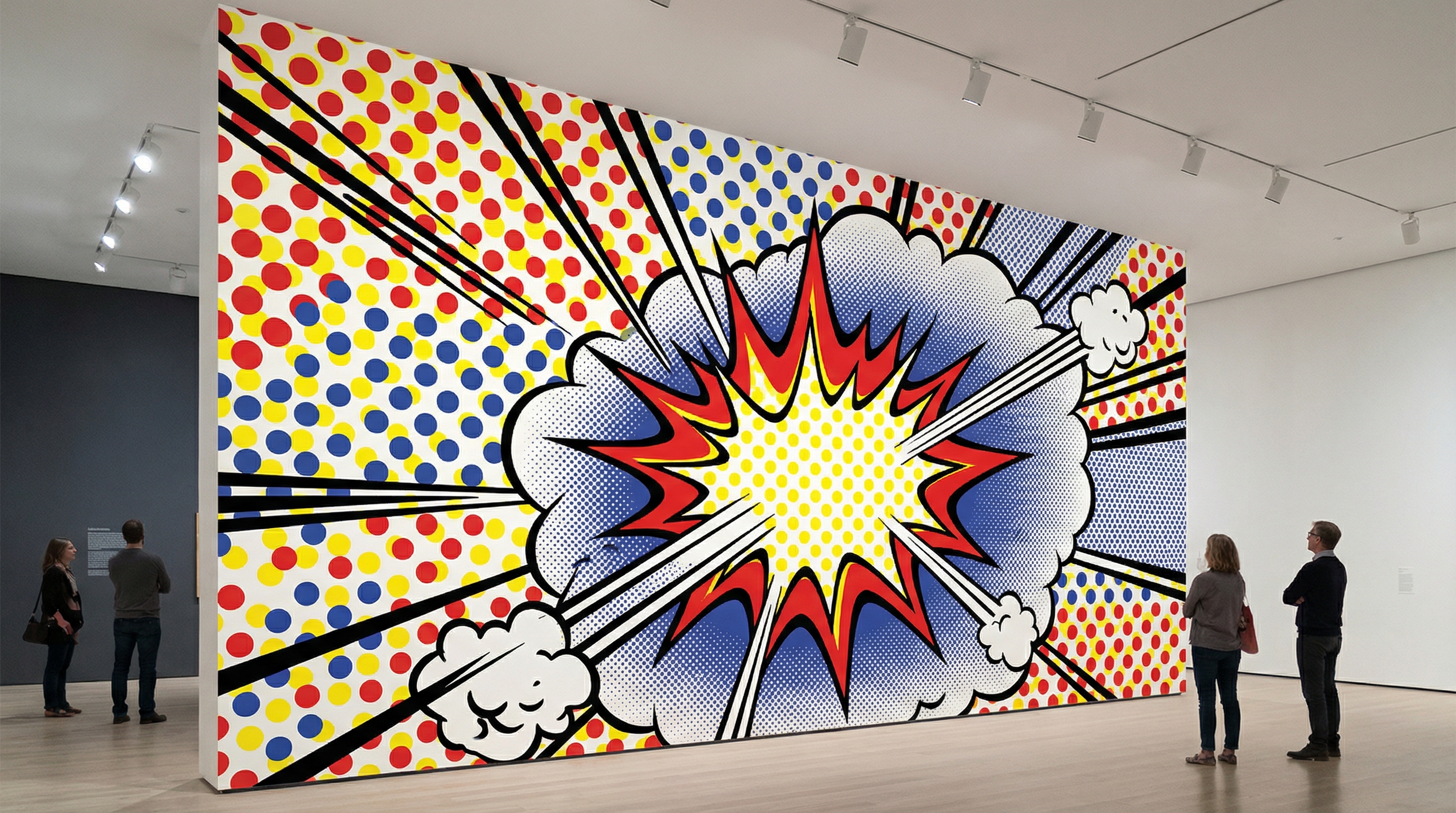
Massive Lichtenstein-style pop art explosion mural in museum gallery, with visitors dwarfed by bold Ben-Day dots in primary red, yellow, and blue
Museum exterior at dusk with massive pop art banner, pedestrians silhouetted against warm primary color glow
01

The Whitney Goes All In: 400 Works, 30 Years of Waiting

The Whitney Museum of American Art is mounting the first major New York retrospective of Roy Lichtenstein in over three decades. Let that sink in. The artist who arguably did more to blur the line between "high" and "low" culture than anyone since Marcel Duchamp hasn't had a comprehensive New York show since the mid-1990s. That's a lifetime in art world terms.

The exhibition brings together more than 400 works—many gifted by the Roy Lichtenstein Foundation—spanning the full arc from his early Abstract Expressionist experiments to the monumental pop canvases that made him a household name. And in a move that feels perfectly Lichtenstein, the U.S. Postal Service is issuing a series of Forever stamps featuring five of his iconic paintings to coincide. The man who made art look like mass production is now literally mass-produced government postage. He would have loved the irony.

What makes this moment matter isn't just institutional nostalgia. A new generation raised on meme culture, remixing, and the TikTok-ification of aesthetics has more in common with Lichtenstein's project than they might realize. He was the original appropriation artist, and the questions he raised about originality, authorship, and the value of the copy are more urgent now than they were in 1963.
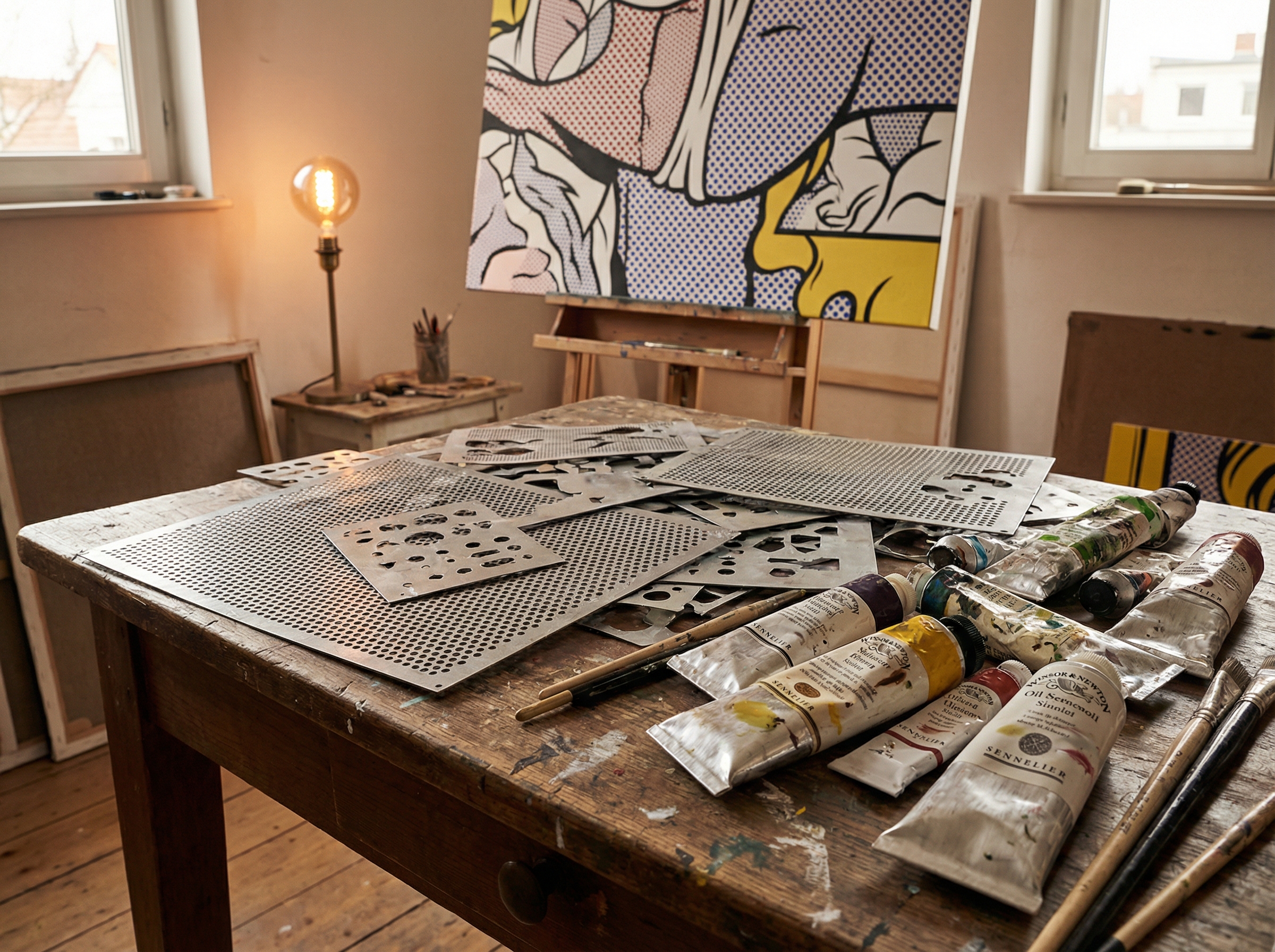
Artist studio with perforated stencil sheets and paint tubes scattered on a wooden table, Ben-Day dot patterns on canvas in background
02

Behind the Dots: The Nasher Reveals Lichtenstein's Secret Workshop

If the Whitney show is the blockbuster, the Nasher Sculpture Center in Dallas is the director's commentary. "Roy Lichtenstein in the Studio" does something rare: it shows you the sweat behind the style. The exhibition, co-organized with Gagosian, puts his handmade stencils, source clippings, and working sketches front and center.

Here's the paradox that defined Lichtenstein's genius: his paintings look machine-made but were entirely hand-crafted. Every Ben-Day dot was individually positioned through perforated metal screens. Every thick black outline was painted with the steady hand of someone who trained in Abstract Expressionism before deciding that a comic book panel had more to say about America than a drip painting ever could.

"I want my painting to look as if it has been programmed." — Roy Lichtenstein. The irony, of course, is that achieving this mechanical look required obsessive manual labor. Sound familiar? Every "effortless" digital product you've used was built the same way.

The Nasher show runs through August and represents a critical corrective to the lazy criticism that Lichtenstein "just copied" comic books. He didn't copy. He translated—from one visual language to another, at a different scale, with different intentions. The studio materials prove it.

Split composition showing comic book panel on one side and fine art painting on the other, noir documentary lighting with ethical tension
03

Who Owns the Panel? The Appropriation Debate Roars Back

The documentary "WHAAM! BLAM! Roy Lichtenstein and the Art of Appropriation" does what polite art criticism has spent decades avoiding: it names names. Russ Heath, Irv Novick, Tony Abruzzo—the comic book illustrators whose panels Lichtenstein transformed into multimillion-dollar canvases. They died in relative obscurity. He became a brand.

The film juxtaposes this reality with uncomfortable precision. A Lichtenstein painting based on a Russ Heath war comic panel sells for $40 million. Heath's original page, if it survived at all, might fetch a few thousand. The talent gap? Arguable. The prestige gap? Undeniable. The ethics? That's where it gets genuinely interesting.

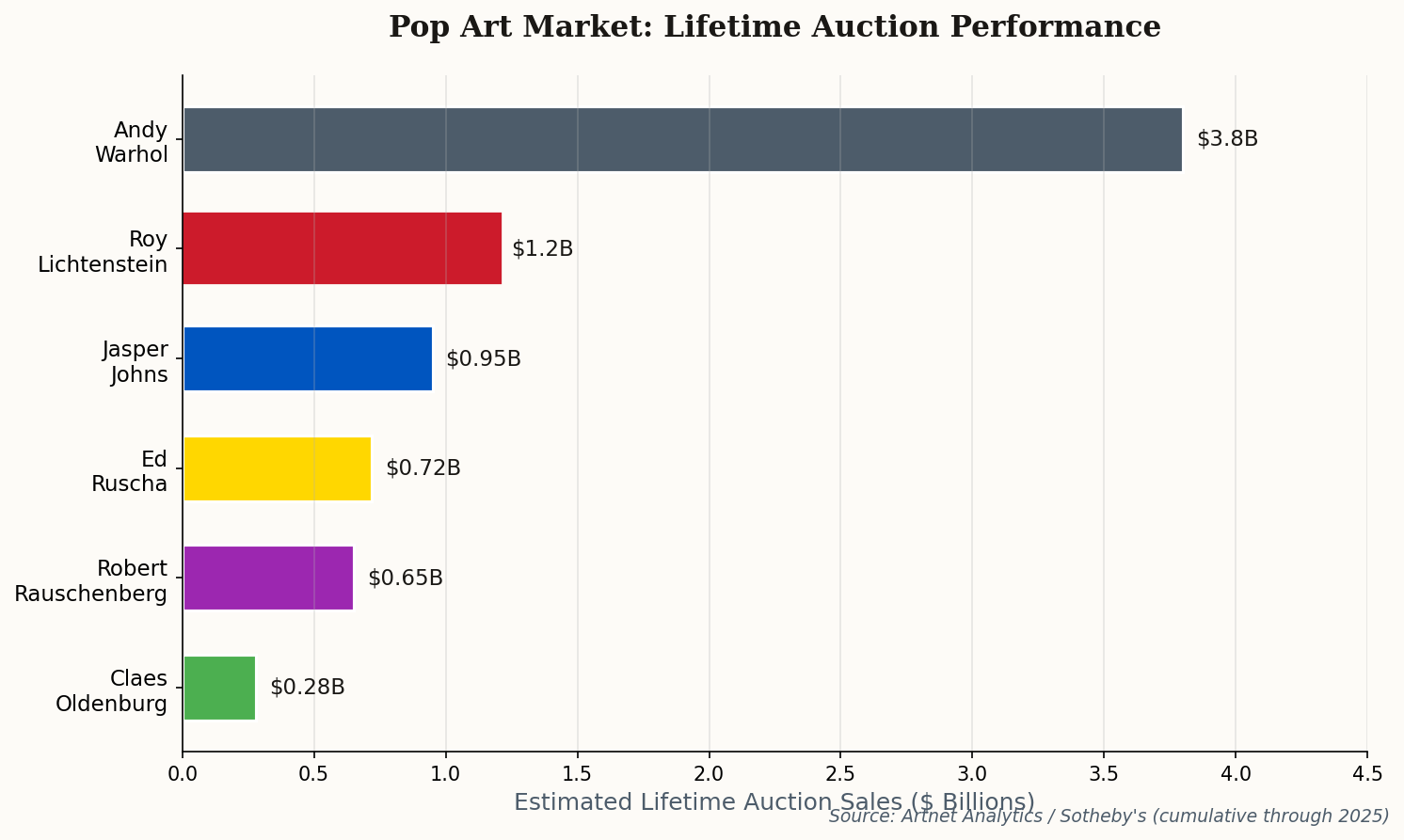
Bar chart comparing lifetime auction performance of major Pop Art artists, with Warhol leading at $3.8B and Lichtenstein at $1.2B
Pop Art market performance by artist. Lichtenstein's $1.2B lifetime auction total places him firmly as the second most commercially successful Pop artist. Source: Artnet Analytics / Sotheby's.

Here's where I land on this: Lichtenstein didn't steal. But he didn't share either. The transformation was real—scale, context, intentionality all changed. But the moral failure wasn't legal, it was cultural. The art world built a mythology around Lichtenstein's "genius" while ignoring the visual vocabulary he built it on. That's a system problem, not a Lichtenstein problem. And in 2026, with AI-generated art raising identical questions about sourcing and credit, the documentary feels less like history and more like prophecy.

Abstract financial visualization with rising bar charts made of Ben-Day dots, gold frames floating upward, pop art auction metaphor
04

Blue-Chip Dots: Why Lichtenstein Is the Art Market's Safe Harbor

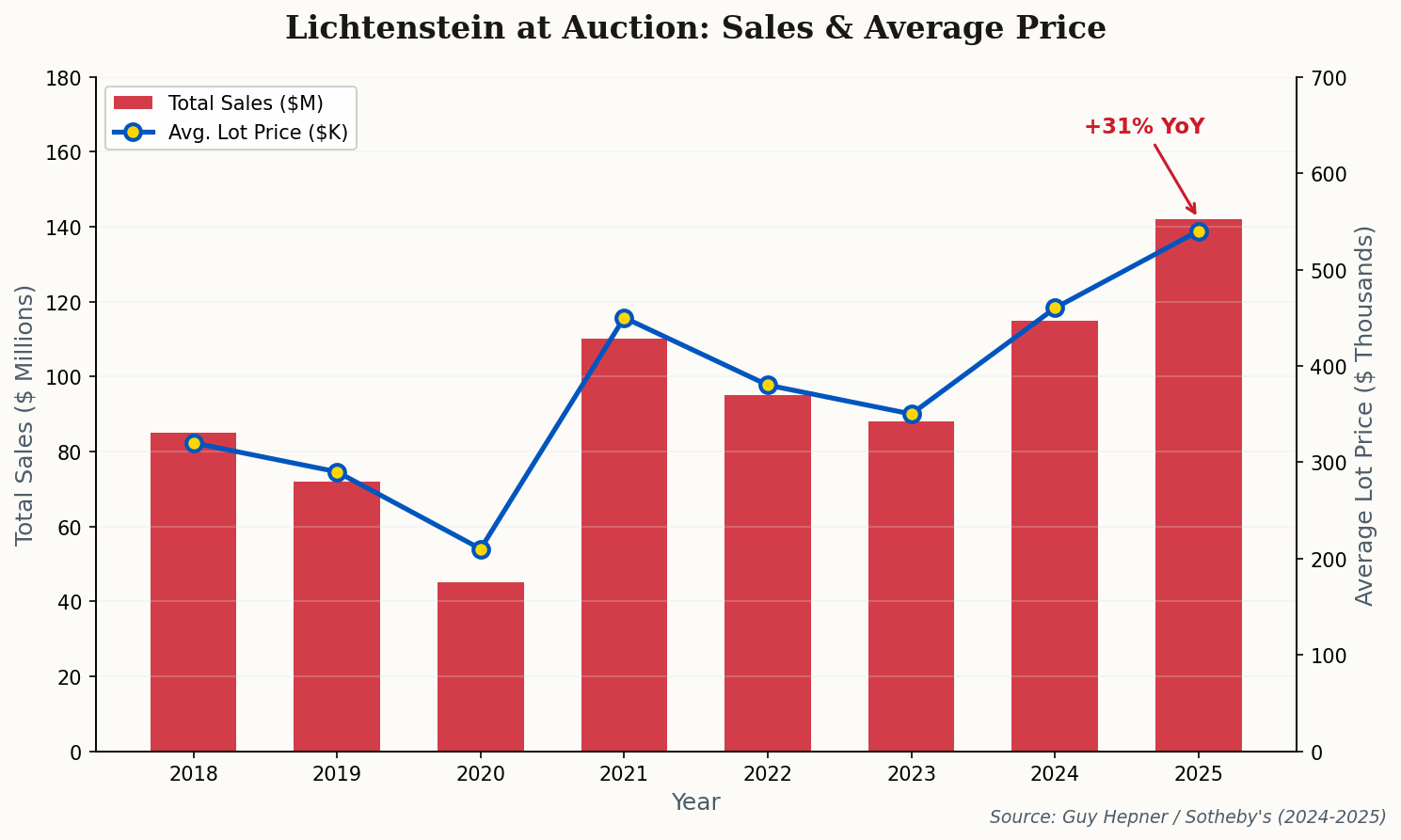
While the broader art market spent the last eighteen months in correction mode—crypto wealth evaporating, speculative contemporary tanking, mega-galleries quietly laying off staff—Lichtenstein's print market did something remarkable: it grew 31% year-on-year. That's not a typo. In a down market, his work went up.

The numbers tell a clear story. Sotheby's "A Legacy Reimagined" series, running from November 2024 through November 2025, systematically liquidated significant portions of the Dorothy & Roy Lichtenstein estate. Notable results included Reverie at $317,500 and Roommates at $206,870. These aren't speculative prices inflated by FOMO—they're institutional bets on permanence.

Bar and line chart showing Lichtenstein auction sales and average lot prices from 2018-2025, demonstrating 31% year-over-year growth
Lichtenstein at auction: total annual sales volume (bars) and average lot price (line). The 31% year-over-year increase in 2025 came against a broadly cooling art market. Source: Guy Hepner / Sotheby's.

What's happening is that Lichtenstein is decoupling from the speculative art market and behaving more like an Old Master—a finite supply of recognized masterworks with institutional demand that doesn't fluctuate with Instagram trends. For collectors and investors watching the art market wobble, that's the signal: the dots aren't going anywhere.

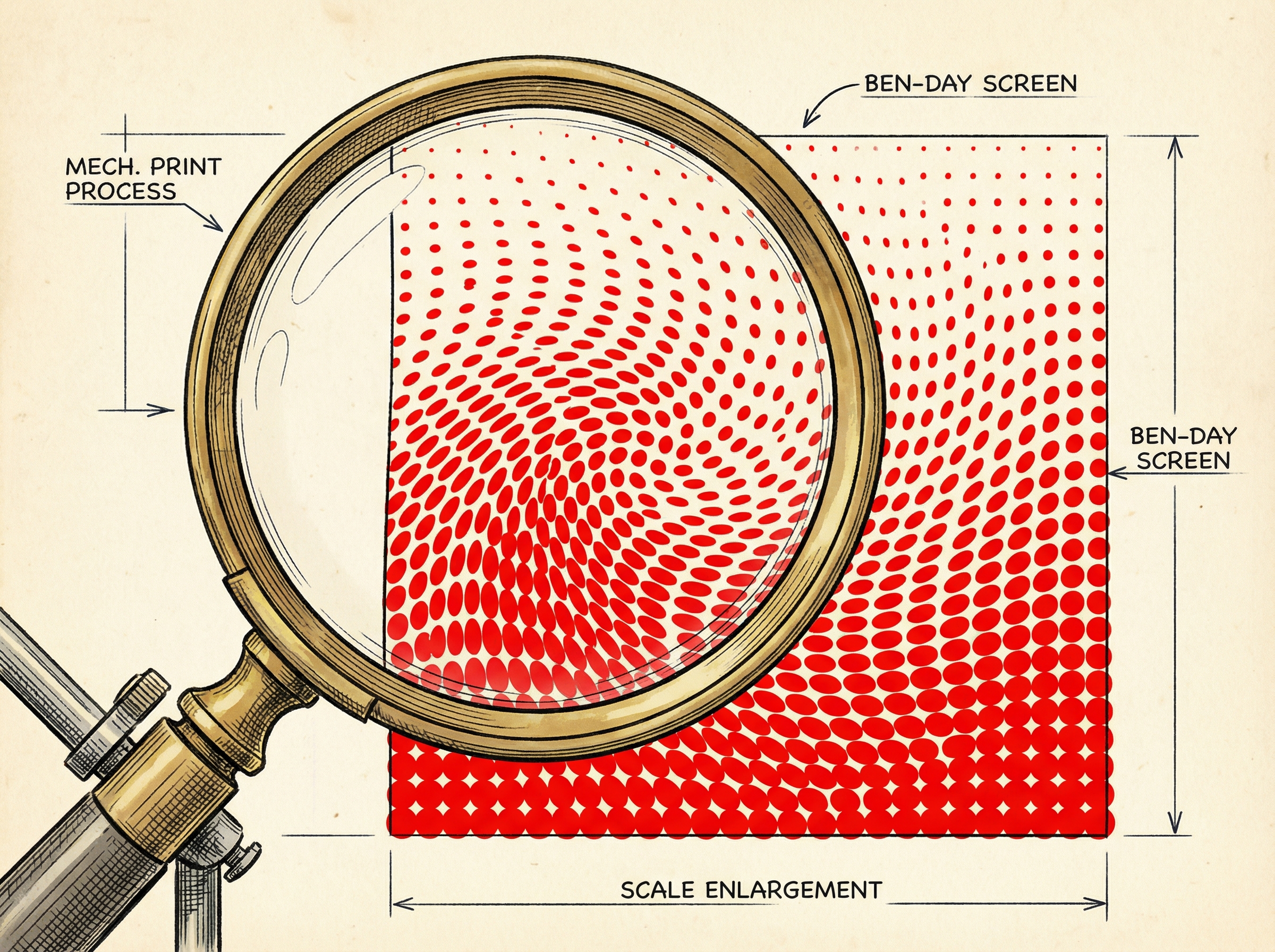
Extreme close-up of Ben-Day dots transitioning from small to large in a hypnotic halftone pattern, magnifying glass revealing the printing process
05

The Anatomy of a Dot: How a Printer's Hack Became Fine Art

Ben-Day dots—named after printer Benjamin Henry Day Jr., who invented the technique in 1879—were never supposed to be seen. They were the invisible infrastructure of cheap color printing: tiny dots of cyan, magenta, yellow, and black arranged in patterns to simulate shading and color gradients. In newspapers and comic books, they were the ultimate utilitarian tool. Nobody looked at them. They were the medium, not the message.

Lichtenstein saw something else entirely. Starting with Look Mickey in 1961, he began hand-painting these dots at massive scale using perforated metal screens and stencils. He restricted his palette to primary red, yellow, and blue—plus black and white—mimicking the four-color printing process. The dots that were supposed to disappear at reading distance became impossible to ignore at gallery scale.

"The dots can have a purely decorative meaning, or they can mean an industrial way of extending the color." What he didn't say: by making the invisible visible, he forced viewers to confront the machinery behind every image they consumed. In an age of deepfakes and algorithmic content, that's not a bad lesson.

The technical brilliance is in what he removed. Abstract Expressionism worshipped the brushstroke as evidence of the artist's soul. Lichtenstein erased it. No gesture, no accident, no visible emotion—just dots, lines, and flat color. He didn't just challenge what art could depict. He challenged what art was supposed to feel like. And that, more than any individual painting, is his lasting contribution.

Comic book fighter jet firing missile into dramatic explosion, bold black outlines with primary yellow burst and Ben-Day dot sky
06

Whaam!, Drowning Girl, Look Mickey: The Holy Trinity of Pop

Three paintings in three years. That's all it took for a struggling ex-Abstract Expressionist in his late thirties to rewrite the rules of contemporary art.

Look Mickey (1961) was the detonator. Based on a children's book illustration, it was the first time Lichtenstein used Ben-Day dots and speech balloons in a fine art context. "Look Mickey, I've hooked a big one!!" reads the bubble, and what he'd hooked was the future. The painting now hangs at the National Gallery of Art in Washington.

Drowning Girl (1963) perfected the formula. Cropped from a panel in DC Comics' Secret Hearts #83, it shows a woman engulfed by waves, thinking: "I don't care! I'd rather sink — than call Brad for help!" Lichtenstein altered the original composition dramatically, tightening the crop to amplify the melodrama. The swirling water became a masterclass in pattern and emotion operating at cross-purposes. It lives at MoMA.

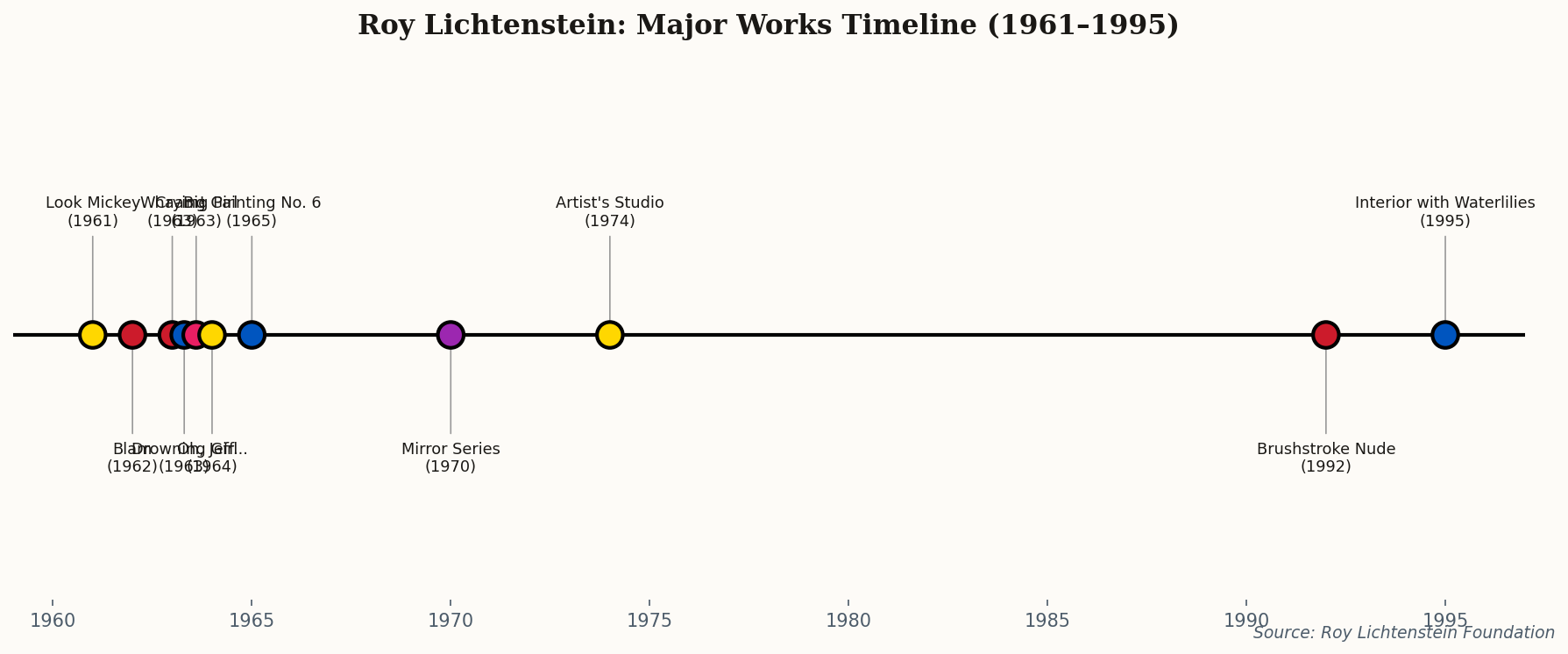
Timeline of Roy Lichtenstein's major works from 1961 to 1995, showing key paintings from Look Mickey through his late career Interiors series
Major works timeline spanning Lichtenstein's Pop Art career, from the breakthrough Look Mickey (1961) through his late-career Interiors series. Source: Roy Lichtenstein Foundation.

Whaam! (1963) was the exclamation point. A 13-foot diptych based on a panel from DC Comics' All-American Men of War, it shows a fighter jet firing a rocket on the left panel and the resulting explosion on the right. The word "WHAAM!" erupts in a starburst that has become one of the most reproduced images in art history. It hangs at the Tate Modern in London, where it has been more or less continuously since 1966—one of the most visited works in the collection.

What united these three paintings wasn't just technique—it was audacity. In the early 1960s, Life magazine ran a feature asking "Is He the Worst Artist in the U.S.?" about Lichtenstein. The art establishment was furious. Abstract Expressionists saw him as a nihilist. Critics called it anti-art. They were exactly right, and that was exactly the point.

The Dot Endures

Roy Lichtenstein was born in 1923 in Manhattan and died in 1997, leaving behind a body of work that did something deceptively simple: it made America look at its own visual culture and take it seriously. He started as a painter nobody noticed and became a painter nobody could ignore. The dots, the outlines, the flat primary colors—they weren't just a style. They were an argument. And in 2026, with the Whitney, the Nasher, and the auction houses all making their bets, it's clear the argument was won a long time ago. The only question left is who gets to own it.