Archaeology & Engineering

The Stones Remember

After 4,500 years and countless theories, modern science is finally cracking the code of how the Great Pyramid was built. Muon scans, lost rivers, and hydraulic lifts are rewriting the textbooks—and the biggest reveal hasn't happened yet.

Listen
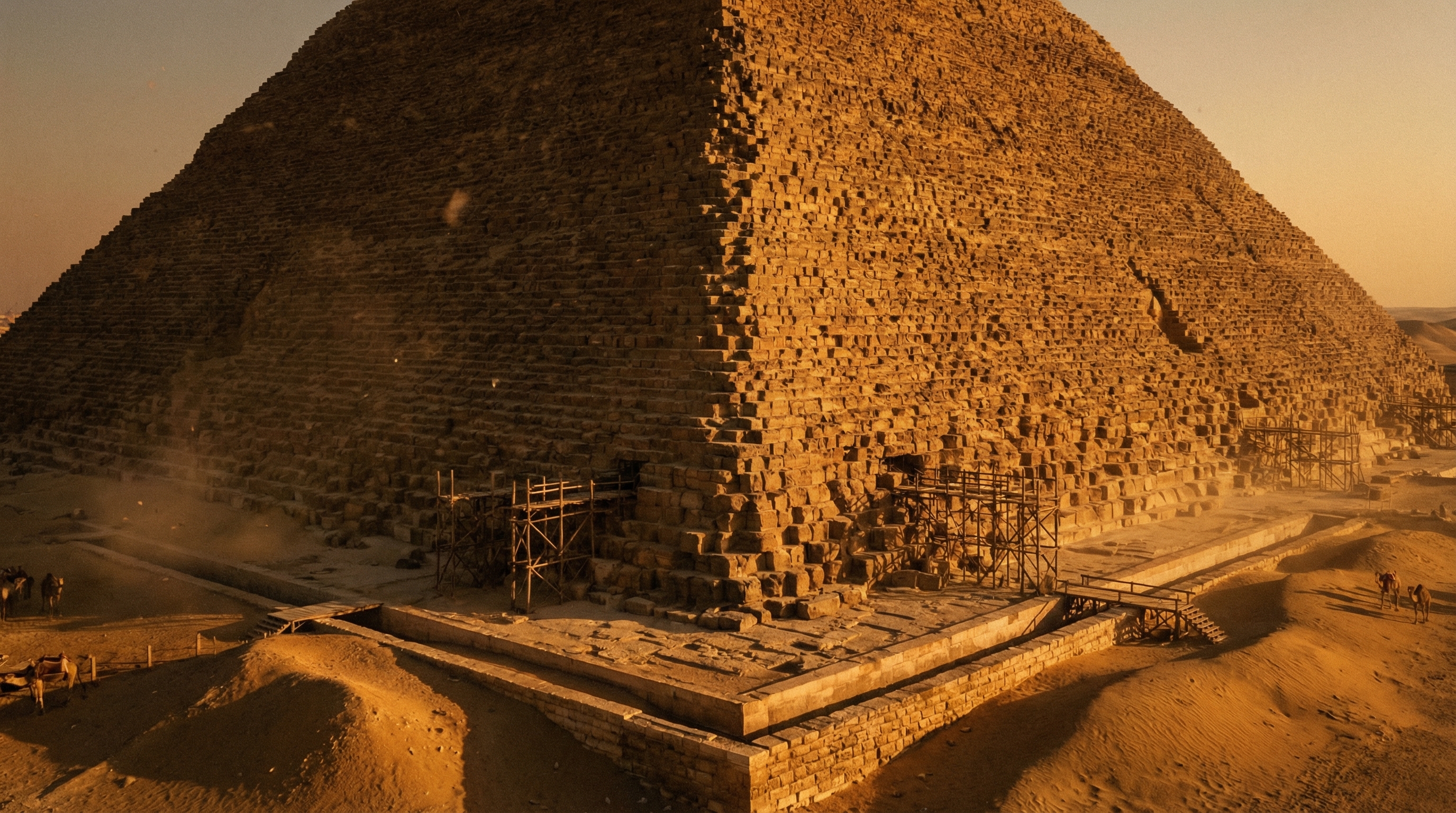
The Great Pyramid of Giza at golden hour, its limestone facade casting long shadows across the desert
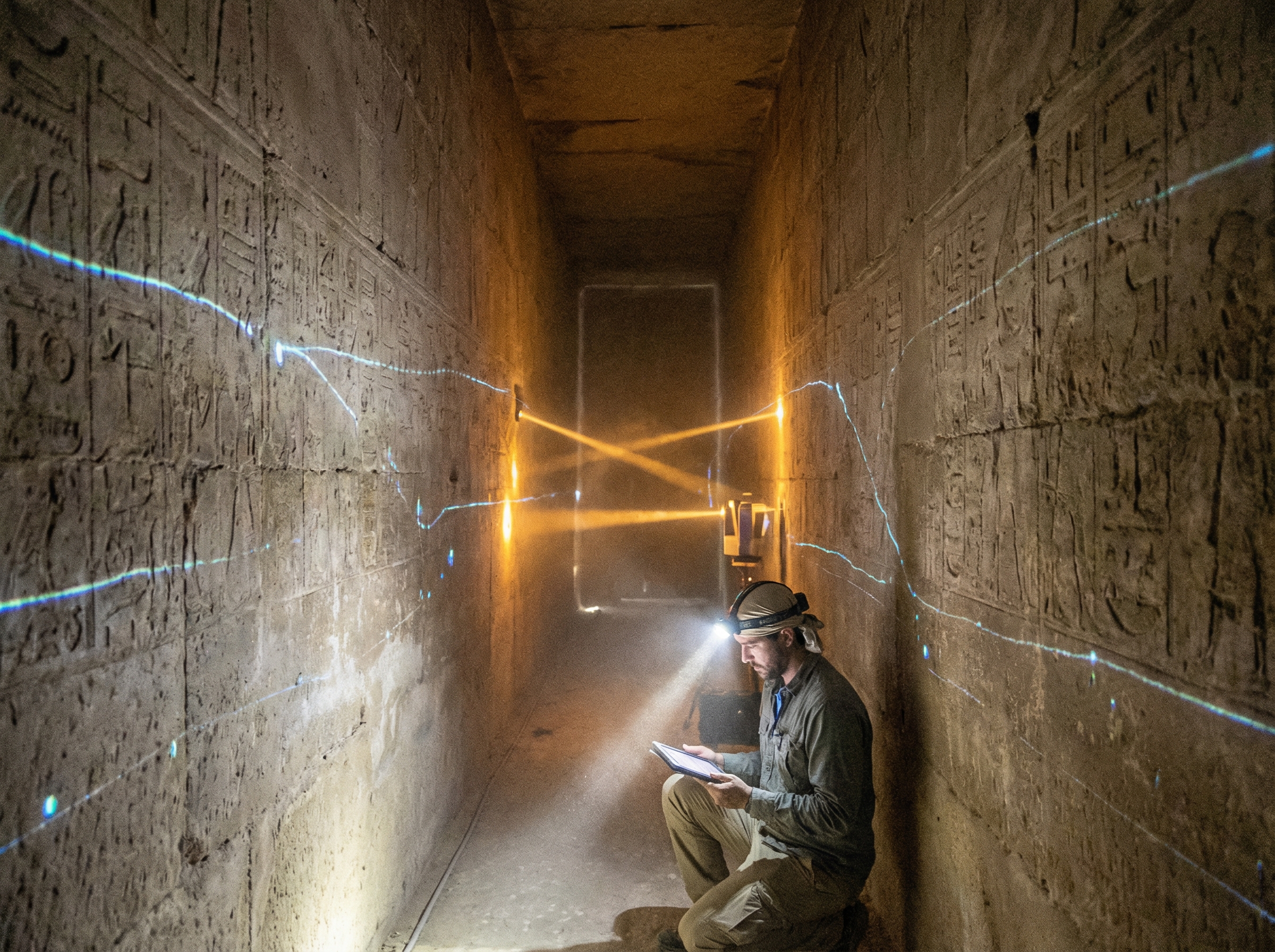
Hidden corridors inside the Great Pyramid revealed by muon scanning technology
01

Hawass Promises a Discovery That Will "Rewrite History"—and Menkaure Just Got More Interesting

Zahi Hawass doesn't do subtle. Speaking at the 44th Sharjah International Book Fair, Egypt's most recognizable archaeologist declared that a forthcoming 2026 announcement from the Great Pyramid will "write a new chapter in the history of the pharaohs." Robots have now cleaned and reached openings in a newly identified 30-meter corridor that humans couldn't previously access. The corridor's contents remain undisclosed pending a full scientific report.

That alone would be the year's biggest archaeological tease. But November also delivered something more concrete: a team from Cairo University and the Technical University of Munich published findings of two previously unknown air-filled cavities behind the eastern facade of the Pyramid of Menkaure—the smallest of Giza's three great pyramids. The first void measures about 1.5 meters wide by 1 meter high; the second is slightly smaller. Numerical simulations confirmed these aren't natural cracks. Egyptologists have suspected a second entrance on Menkaure's eastern face for decades. They may have just found it.

What matters here isn't just the voids themselves—it's the convergence. Non-invasive scanning technologies are opening pyramids without lifting a single stone. The ScanPyramids project's muon tomography gave us the Big Void in 2017, the North Face Corridor in 2023, and now Menkaure's hidden anomalies. Every scan reveals more architecture than anyone expected. The pyramids are more complex than they appear from outside, and we've barely begun cataloguing what's inside them.

The question isn't whether there's more to find inside the pyramids. It's how much of what we thought we knew about their internal architecture will survive the next decade of scanning.
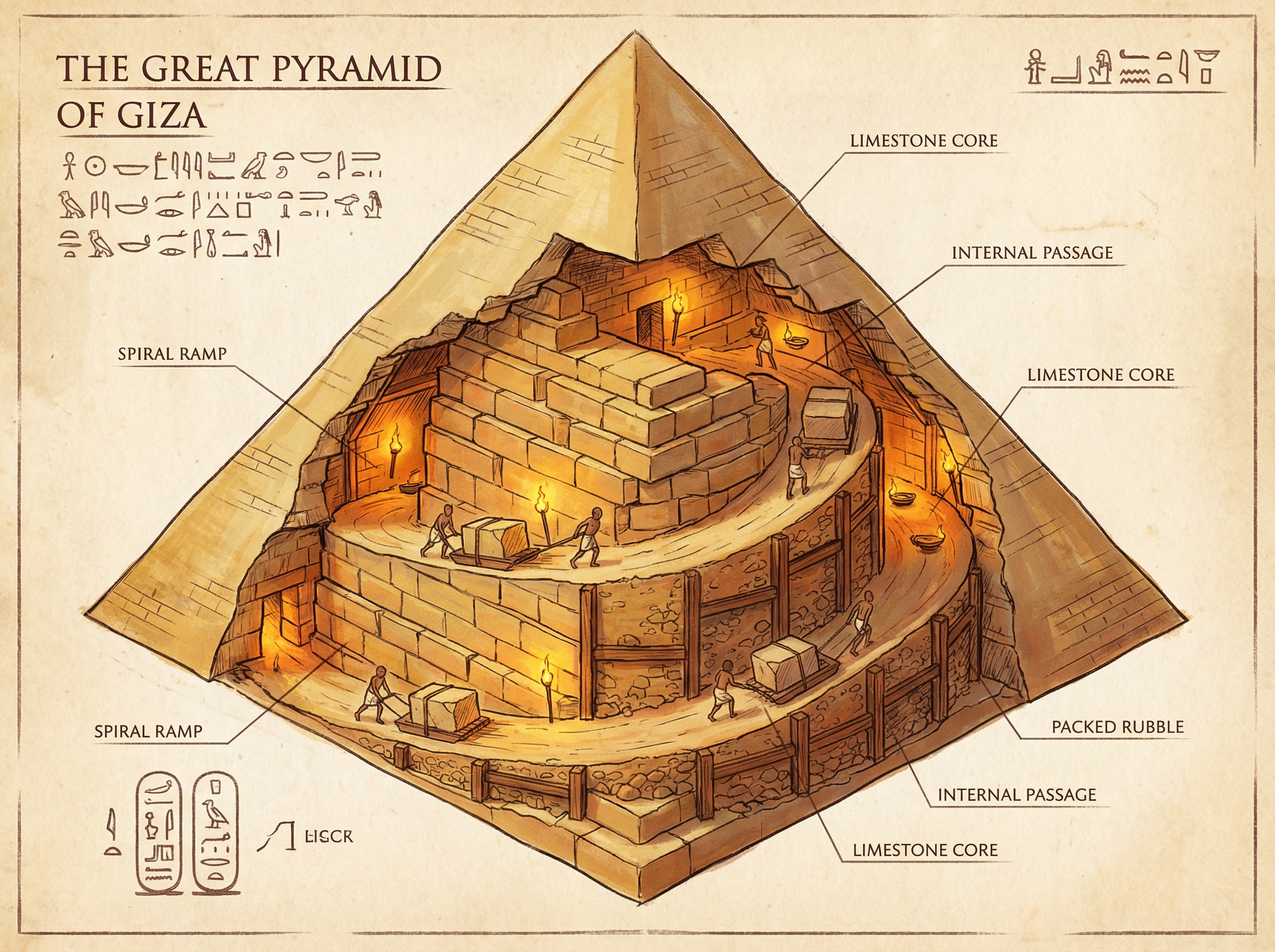
Cross-section of the Great Pyramid showing the proposed internal spiral ramp
02

The Internal Ramp Architect Who Kept Being Right

In 1999, French architect Jean-Pierre Houdin proposed something that sounded absurd: the Great Pyramid was built from the inside out, using a spiral ramp hidden within the structure itself. An external ramp handled the first third of the height, then workers shifted to an internal passage spiraling upward, with turning rooms at each corner. Mainstream Egyptology was skeptical. UCL's David Jeffreys called it "far-fetched and horribly complicated."

Twenty-six years later, Houdin keeps getting vindicated by technology he helped deploy. His collaboration with physicist Hiroyuki Tanaka of the University of Tokyo helped birth the ScanPyramids project. The 2017 Big Void sits exactly where Houdin predicted a counterweight gallery would be. The 2023 North Face Corridor matches his "Noble Circuit" hypothesis. And in a 2024 memoir, he demonstrated that the newly detected Cavity C1 beneath the northeast edge aligns with his predicted rotation rooms between ramp sections.

Now, a 2025 study in Scientific Reports used Electrical Resistivity Tomography—a completely different non-invasive technique—to independently confirm the North Face Corridor's existence. The ERT readings show a void approximately 2.5 by 2.5 meters starting at about 1 meter depth. Cross-validation with a second technology is how science builds confidence. Houdin's theory isn't proven, but the circumstantial evidence is stacking up in a way that would make a prosecutor smile.

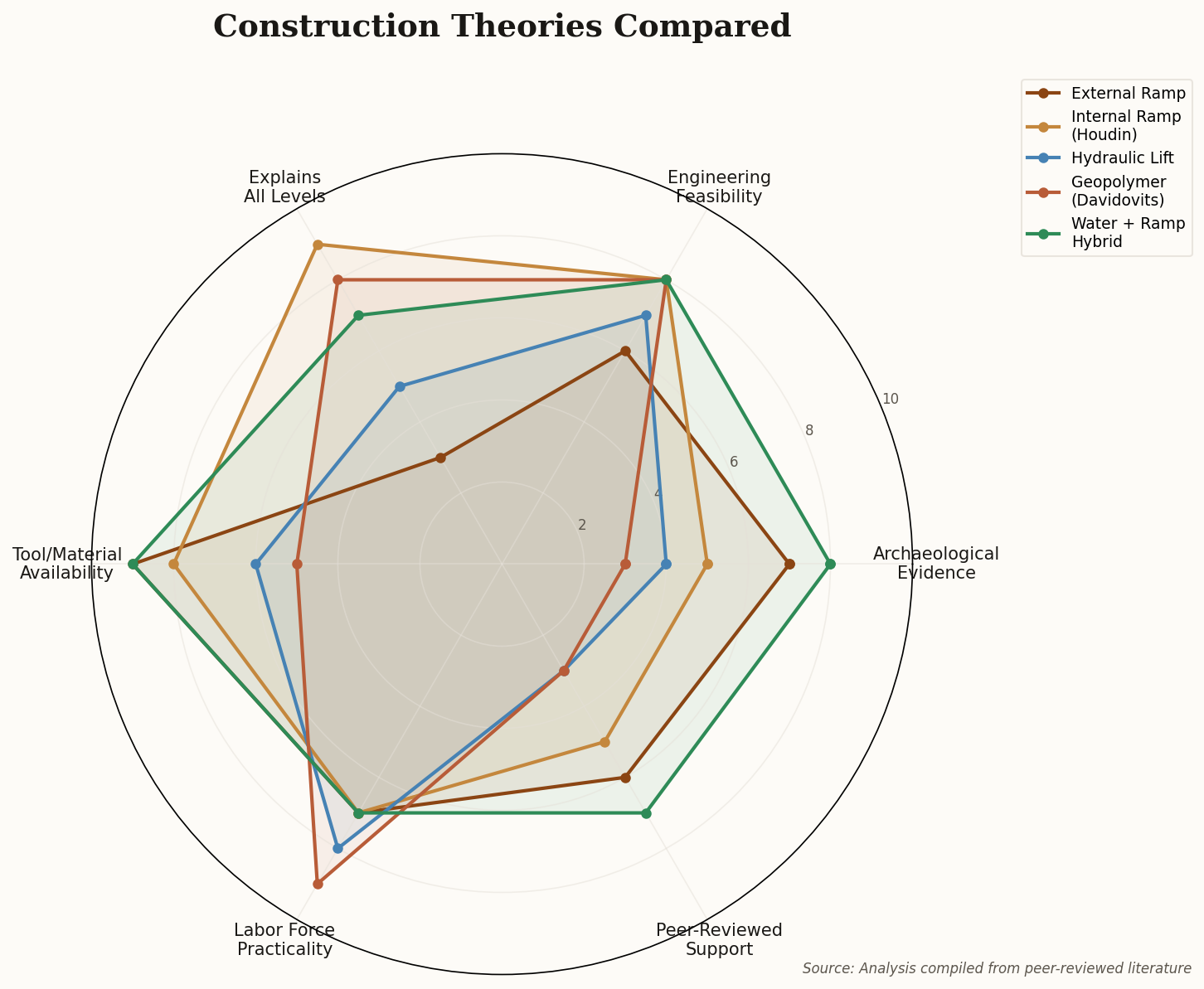
Radar chart comparing construction theories across six criteria: archaeological evidence, engineering feasibility, ability to explain all levels, tool availability, labor practicality, and peer-reviewed support
How the leading construction theories compare across key criteria. The "Water + Ramp Hybrid" approach—combining external ramps, water transport, and possibly internal passages—scores highest overall. Data compiled from peer-reviewed literature.
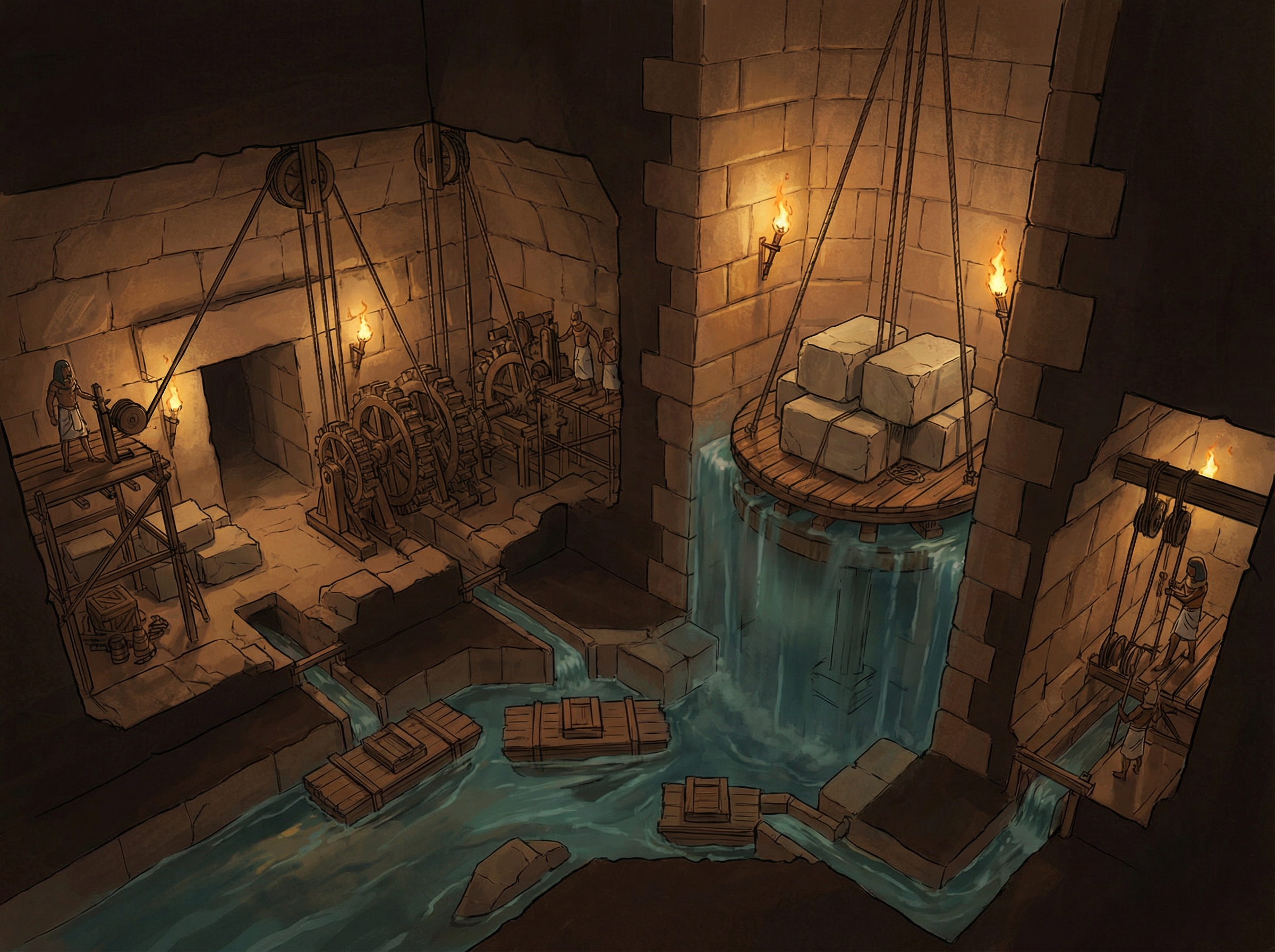
Ancient Egyptian hydraulic lift mechanism inside a step pyramid, with water elevating stone blocks
03

The Volcano Inside the Pyramid: A Hydraulic Lift 2,000 Years Before Roman Aqueducts

Here's an engineering thought experiment: how do you lift a 2.5-tonne limestone block to the top of a pyramid without ramps, pulleys, or anything that leaves visible evidence? Xavier Landreau and colleagues at the CEA Paleotechnic Institute in France think they have the answer, and it involves turning a pyramid into a volcano.

Published in PLOS ONE in August 2024, their study focuses on the Pyramid of Djoser—Egypt's oldest pyramid, built roughly a century before Khufu's Great Pyramid. The team identified two vertical shafts connected by a 200-meter tunnel, both fitted with granite plugs, sealed joints, and side chambers. Their hypothesis: these shafts were hydraulic elevators. Water from ancient streams was channeled through a system of deep trenches into the shafts, where buoyant wooden floats lifted stone blocks upward. The nearby Gisr el-Mudir enclosure—a previously unexplained structure—would have functioned as a check dam regulating water flow.

The researchers call it a "volcano-style" construction method: built from the center outward, powered from below. If validated, it would represent the earliest known use of hydraulic engineering for construction—predating Roman aqueducts by over 2,000 years. The system could handle blocks up to 300 kg, and the paleoclimate data checks out: there was enough water. Critics, including UCL's David Jeffreys, note that ramps and haulage remain the more widely accepted explanation. But nobody has a better explanation for why those sealed shafts and tunnels exist.

The hydraulic lift theory doesn't replace ramp theories—it complements them. The smartest answer to "how did they build the pyramids?" may be: all of the above, deployed differently at different heights and stages.

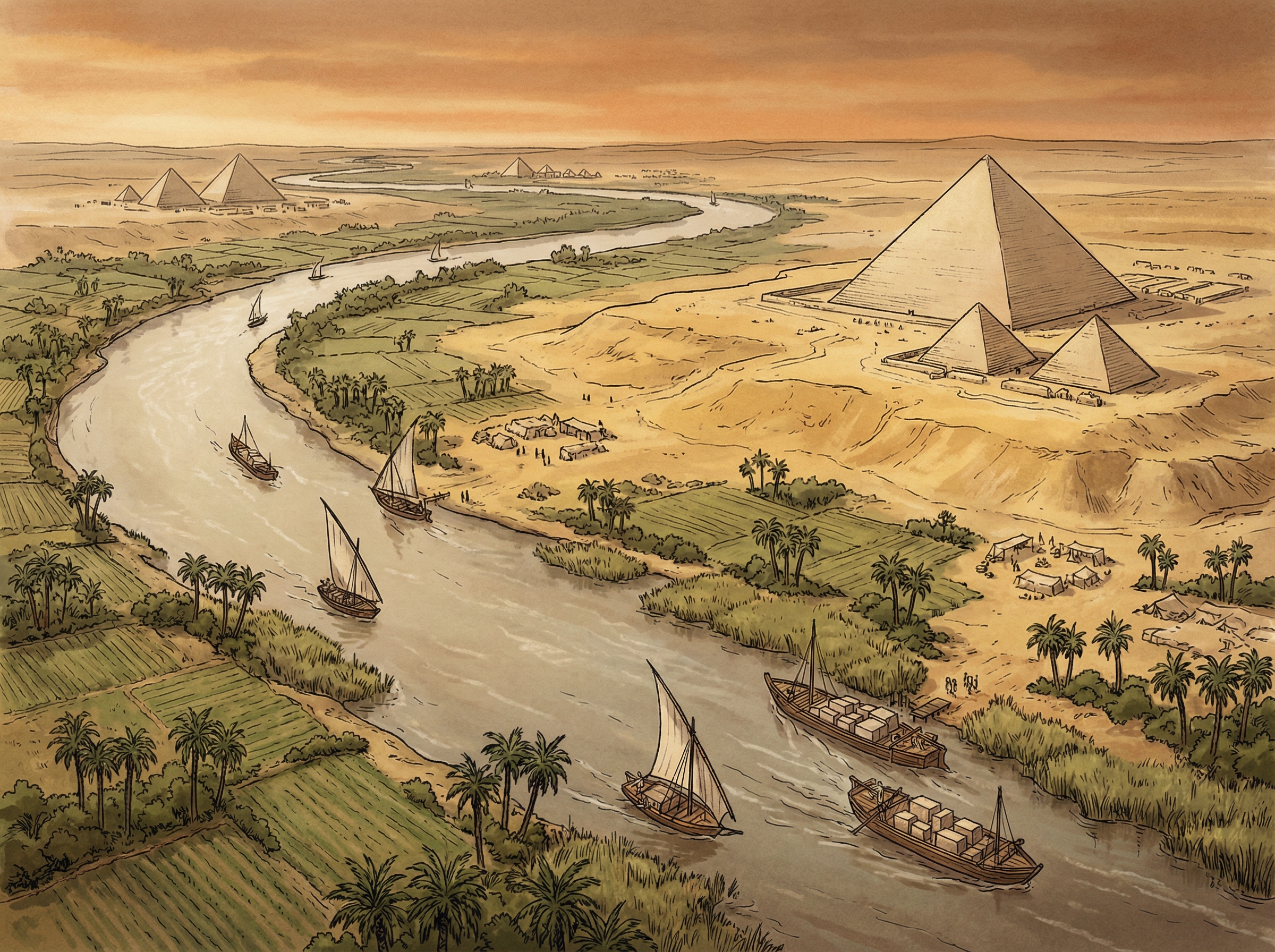
The ancient Ahramat Branch of the Nile flowing past the pyramids, with boats transporting limestone blocks
04

The Ghost River: A 64-Kilometer Nile Branch That Explains Why the Pyramids Are Where They Are

For generations, the obvious question was hiding in plain sight: why did the Egyptians build 31 pyramids along a narrow strip of desert, miles from the modern Nile? In May 2024, a team led by Eman Ghoneim at the University of North Carolina Wilmington answered it. There was a river there. A big one.

Using radar satellite imagery, ground-penetrating radar, and deep soil cores, the researchers mapped a 64-kilometer extinct branch of the Nile buried beneath farmland and desert at the foothills of the Western Desert Plateau. They named it the Ahramat Branch—"ahramat" is Arabic for "pyramids." The ancient waterway was about half a kilometer wide with a depth of at least 25 meters—comparable to the modern Nile. It ran right past the pyramid sites from Giza to Lisht, serving as a construction superhighway for nearly a millennium.

This explains a cascade of previously awkward details. Many pyramids have causeways that lead toward nothing visible today—but they terminate exactly at the mapped riverbank, where Valley Temples would have served as harbors. The Merer Papyri describe shipping limestone blocks by boat to Giza, but the modern Nile is too far away for that to make sense. The Ahramat Branch makes it make sense. The river disappeared around 4,200 years ago, likely killed by windblown sand incursion and drought—which, not coincidentally, roughly coincides with the end of the great pyramid-building era.

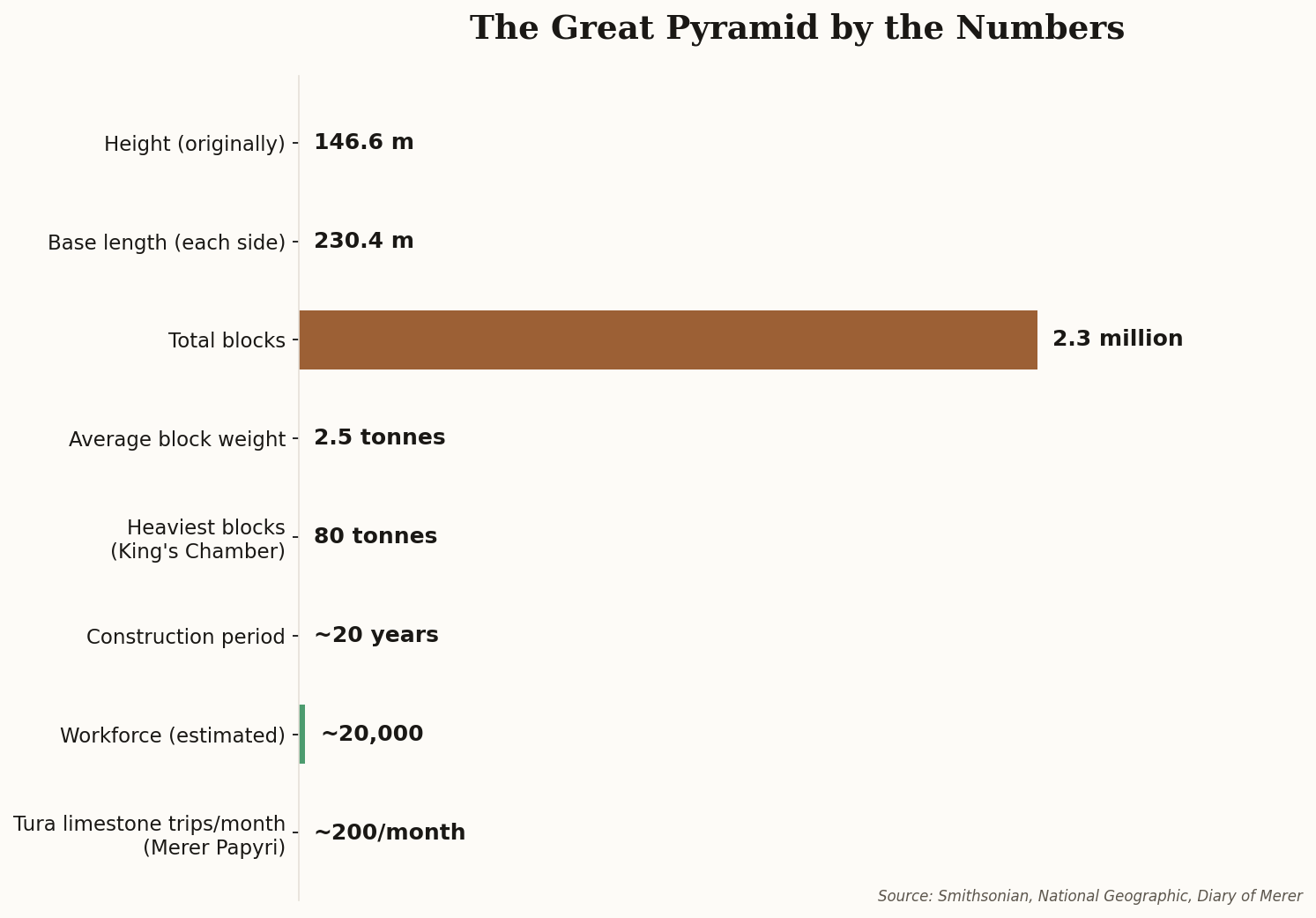
The Great Pyramid by the numbers: height, base length, total blocks, block weight, and other key statistics
The staggering scale of the Great Pyramid. Merer's crew shipped roughly 200 casing blocks per month by boat—a logistical feat that only makes sense with a nearby waterway.
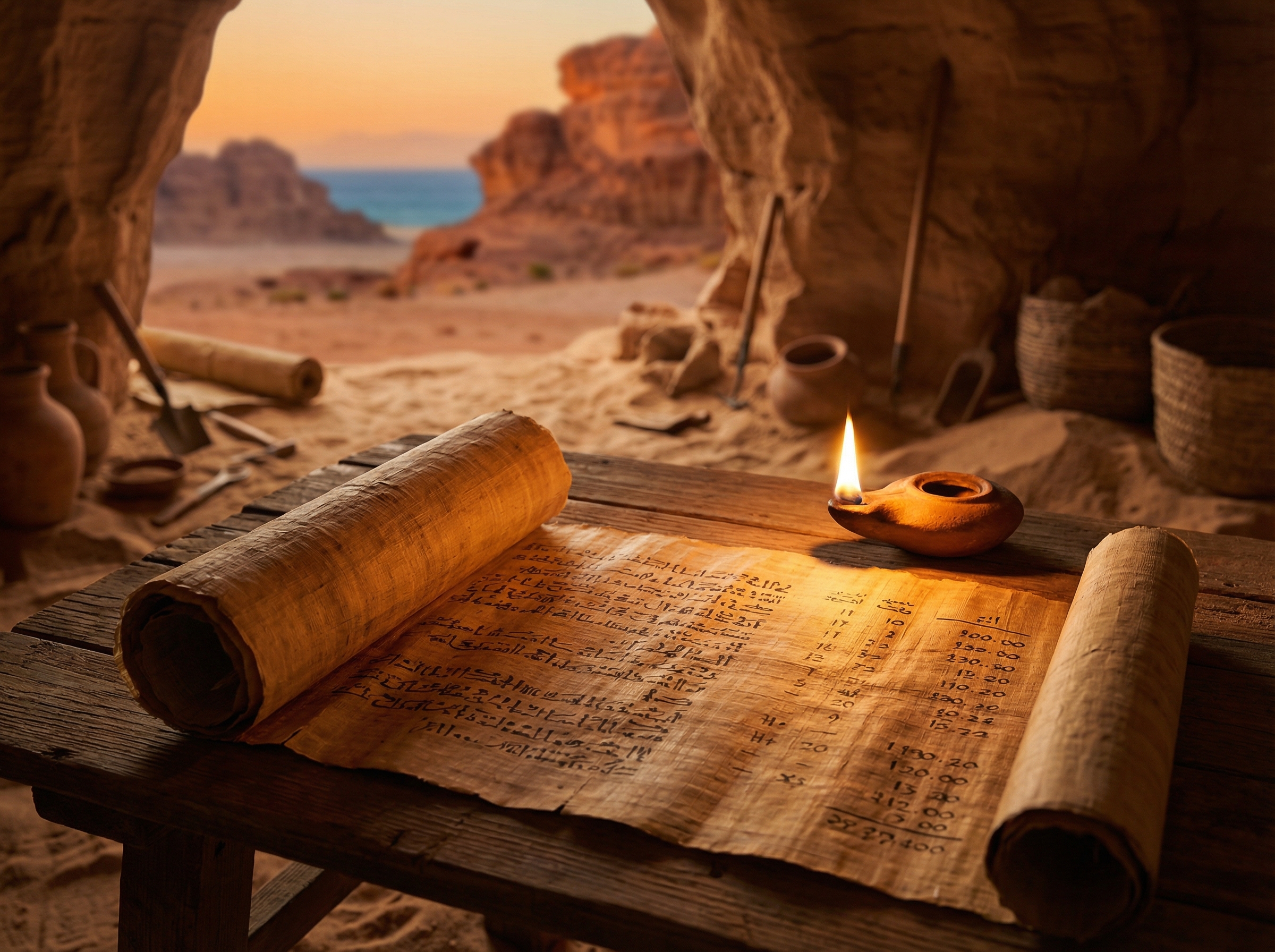
Ancient Egyptian papyrus scrolls with hieratic handwriting recording logistics of pyramid construction
05

The 4,500-Year-Old Logistics Spreadsheet That Proved the Pyramids Weren't Built by Slaves

The single most important document about the Great Pyramid's construction was found nowhere near Giza. In 2013, archaeologists Pierre Tallet of Paris-Sorbonne University and Gregory Marouard discovered a cache of papyri buried at Wadi al-Jarf, a remote Red Sea port—the oldest known papyri with text in the world, dating to the 27th year of Pharaoh Khufu's reign.

The best-preserved sections are the work diary of a middle-ranking official named Merer, who oversaw a team of about 40 boatmen shipping white limestone casing blocks from the Tura quarries to the Giza plateau. His records are meticulous: two to three round trips every ten days, hauling 10-15 blocks per barge, each weighing 2-3 tonnes. That's roughly 200 blocks per month, from July to November. He reports to a nobleman named Ankhhaf—Khufu's half-brother, the project manager for the pyramid's final stages, and the first named individual definitively linked to the construction.

But here's what really matters: these papyri describe payment records. The workers received compensation—including rations of bread, beer, and meat—at levels that match the archaeological evidence from the Giza worker village. Excavated by Mark Lehner's team beginning in 1988, this village contained bakeries, breweries, a copper workshop, and even a medical facility where healed fractures and successful amputations testify to advanced care. Workers were eating 4,000 pounds of beef, sheep, and goat per day. The papyri survived 4,500 years because Tallet believes they were buried hastily when Khufu died—"because of the death of the king, they just stopped everything and closed up the galleries."

The slave narrative was always a myth. Merer's diary doesn't just prove it—it replaces it with something more remarkable: a nationwide logistics operation that fed, housed, and medically treated its workforce. This was the largest managed construction project in human history, and they ran it like a corporation.

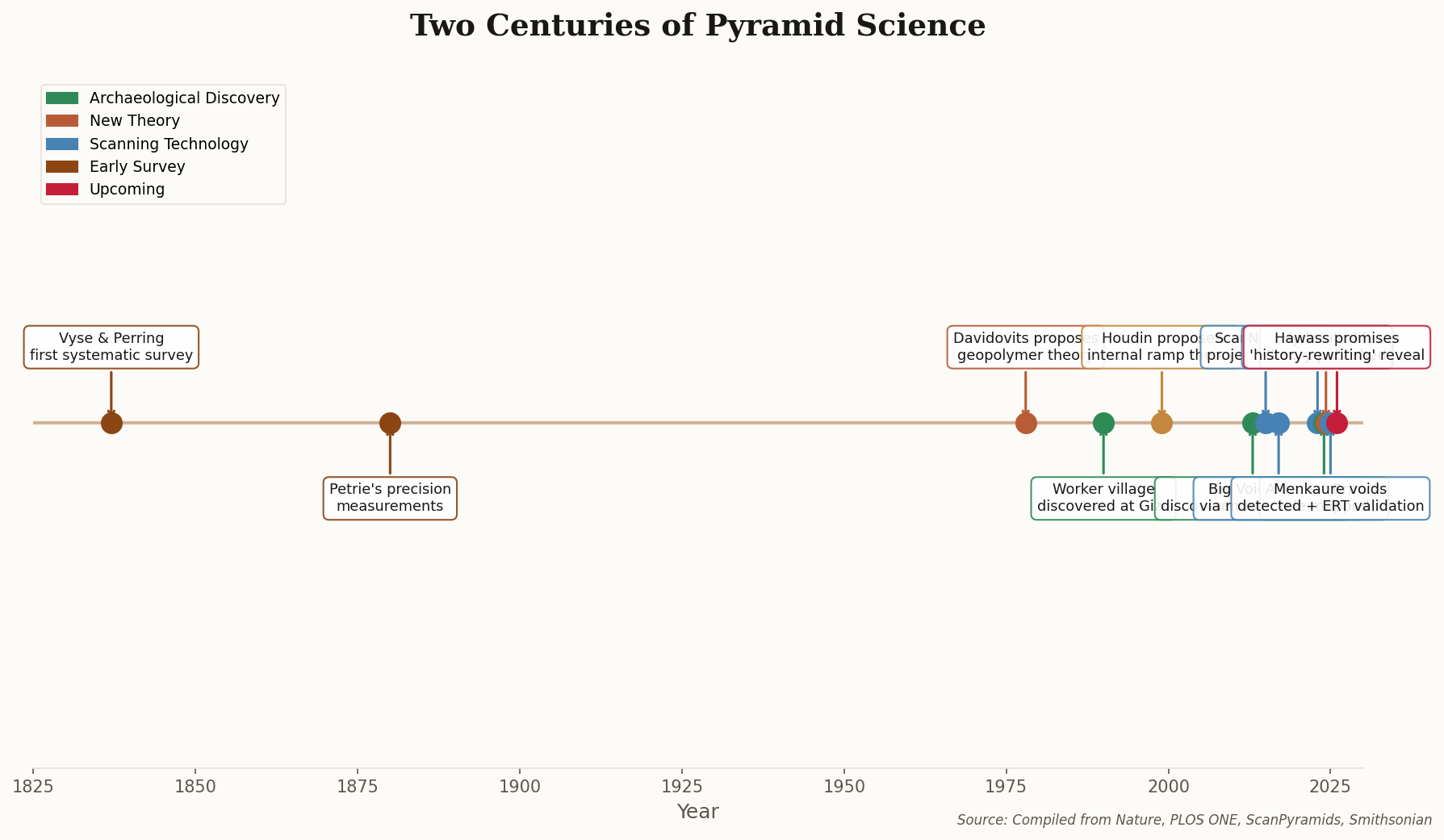
Timeline of two centuries of pyramid science, from Vyse's 1837 survey through Hawass's promised 2026 reveal
Two centuries of pyramid science. Note the acceleration after 2013: the Merer Papyri, ScanPyramids, the Ahramat Branch, and the hydraulic lift theory all arrived in roughly a decade. We're learning faster than ever.
Split view: ancient workers mixing limestone aggregate and modern laboratory analysis of pyramid stone microstructure
06

Cast in Stone: The Geopolymer Theory That Won't Die—and the Evidence That Won't Let It

What if the pyramid builders didn't move 2.3 million stone blocks at all? What if they made them? Since 1978, materials scientist Joseph Davidovits has argued that the pyramid's limestone blocks are a form of ancient concrete—disaggregated limestone mixed with water, lime, kaolin clay, and natron (sodium carbonate), then poured into molds and left to harden via geopolymer chemistry. Workers wouldn't need to haul 2.5-tonne blocks up ramps. They'd carry buckets of slurry.

The theory has serious supporters. A 2006 study by Michel Barsoum at Drexel University, published in the Journal of the American Ceramic Society, found submicron silica spheres and amorphous nanocrystalline structures in pyramid stone samples—signatures consistent with rapid chemical precipitation, not natural geological formation. The authors called the ancient concrete technology "simply astounding." MIT ran proof-of-concept tests and found that a crew of five to ten could cast 1.3 to 4.5-tonne blocks in a couple of weeks using Davidovits's method.

And yet mainstream geology remains unconvinced. Critics argue the limestone matches natural quarry stone from the Mokattam Formation, and that thin-section analysis shows natural fossil shell structures, not cast material. Davidovits counters that thin sections are the wrong method—you need electron microscopy to see the geopolymer bonds. The debate continues into 2025, with the Geopolymer Institute publishing new analyses and conferences. This much is clear: even if geopolymer wasn't the primary method, the Egyptians had the chemistry to do it. Whether they actually did remains one of archaeology's most fascinating open questions.

The Answer Is Probably "All of the Above"

The most credible emerging consensus isn't any single theory—it's that the pyramid builders deployed multiple techniques at different scales and heights. Water transport on the Ahramat Branch. External ramps for the lower courses. Possibly internal ramps or hydraulic lifts for the upper sections. A skilled, well-fed, paid labor force organized into rotating crews with corporate-grade logistics. The Great Pyramid wasn't built by one brilliant trick. It was built by a civilization that threw every engineering solution it had at a single, audacious goal—and executed flawlessly for twenty years. The stones remember. We're just starting to listen.