Art History

The Old Man Mad About Painting

Katsushika Hokusai created the most reproduced image in history while insisting he'd learned nothing before age 70. Nearly two centuries later, he's still teaching us about the art of beginning again.

Listen
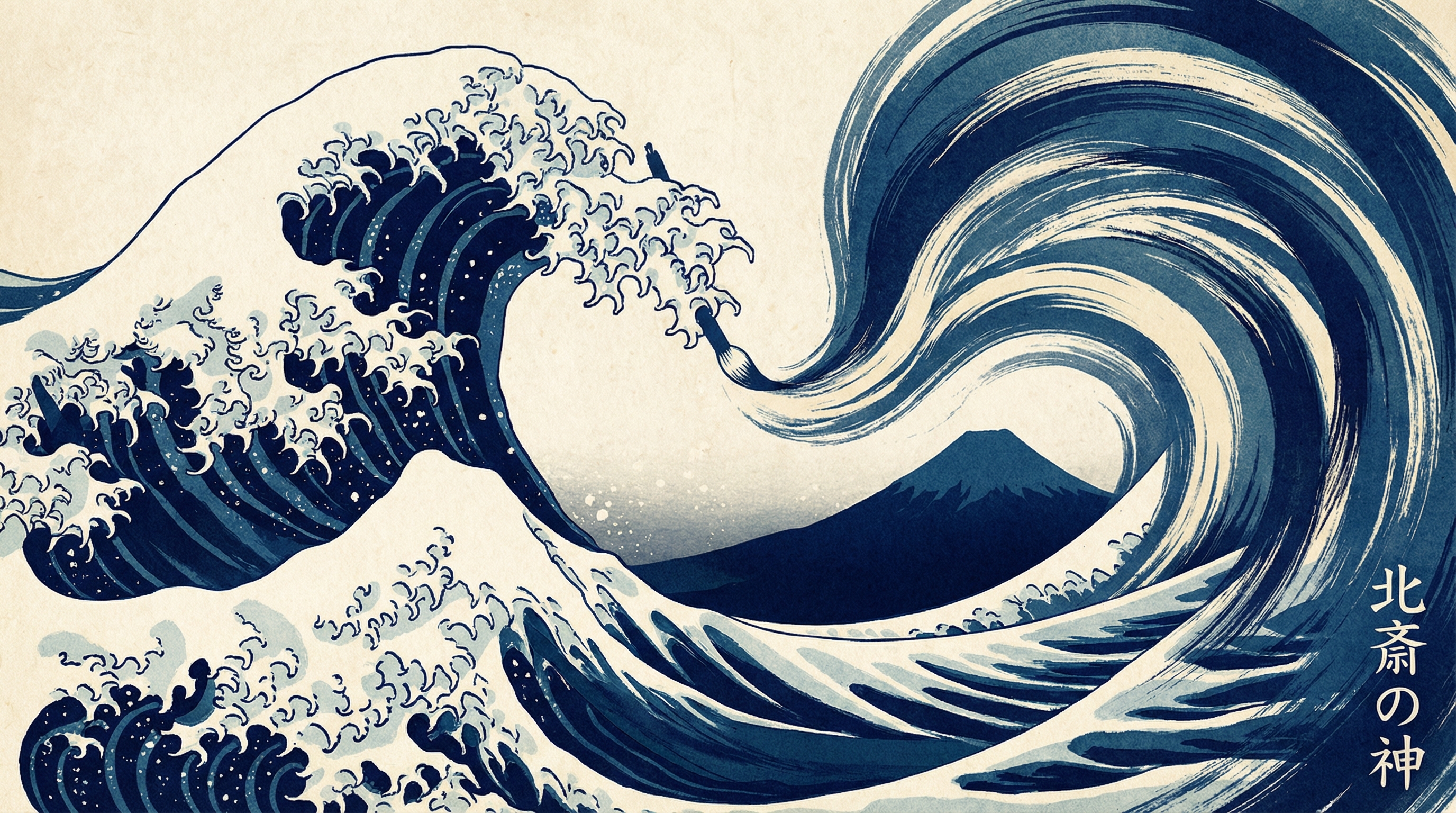
Artistic interpretation of Hokusai's spirit, with swirling Prussian blue waves and Mount Fuji in the Japanese woodblock style
01

A Wave Worth $2.8 Million
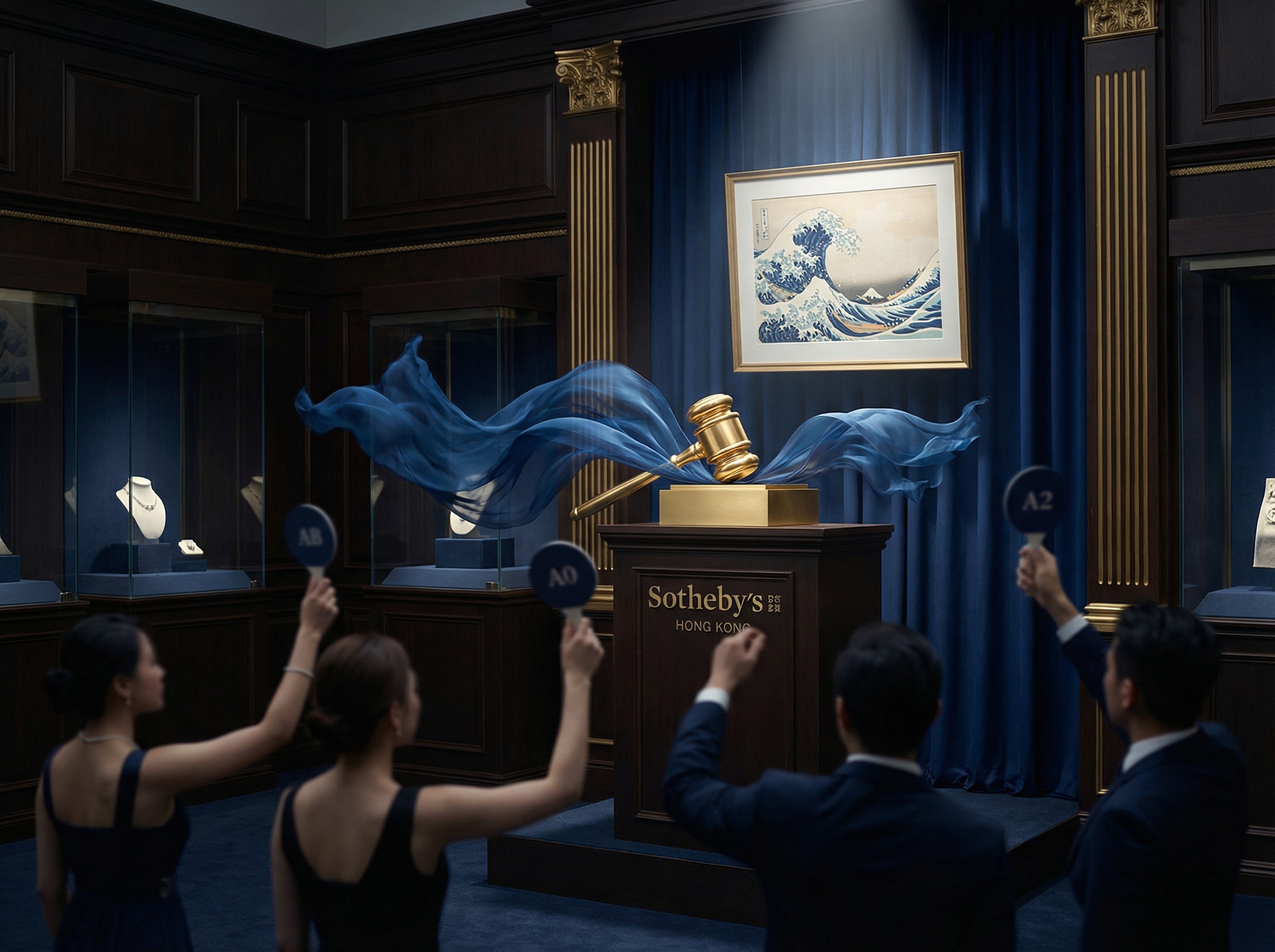
Conceptual visualization of an auction with The Great Wave floating above bidders

When the hammer fell at Sotheby's Hong Kong in November 2025, a single sheet of mulberry paper printed nearly 200 years ago fetched HK$21.7 million—roughly $2.8 million USD. The work? The Great Wave off Kanagawa, Hokusai's immortal image of a towering wave threatening tiny fishing boats as Mount Fuji sits serenely in the distance.

This wasn't just another art sale. It was a 62× increase from 1999, when exceptional impressions of the same print sold for around $45,000. The exponential rise speaks to something beyond collector speculation: Hokusai's wave has become a cultural artifact that transcends art history.
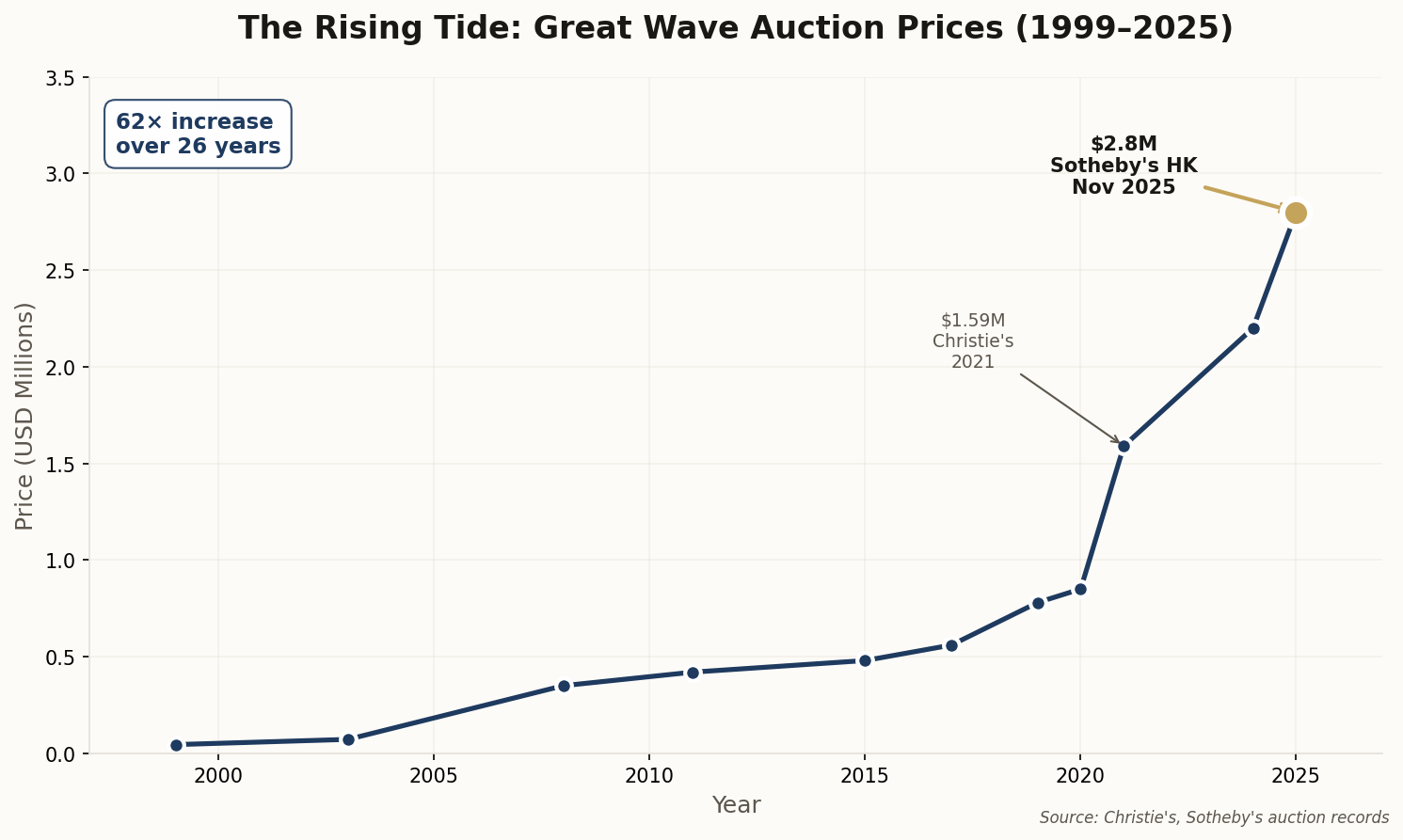
Line chart showing Great Wave auction prices rising from $45K in 1999 to $2.8M in 2025
Auction prices for museum-quality impressions of The Great Wave have risen exponentially over 26 years.

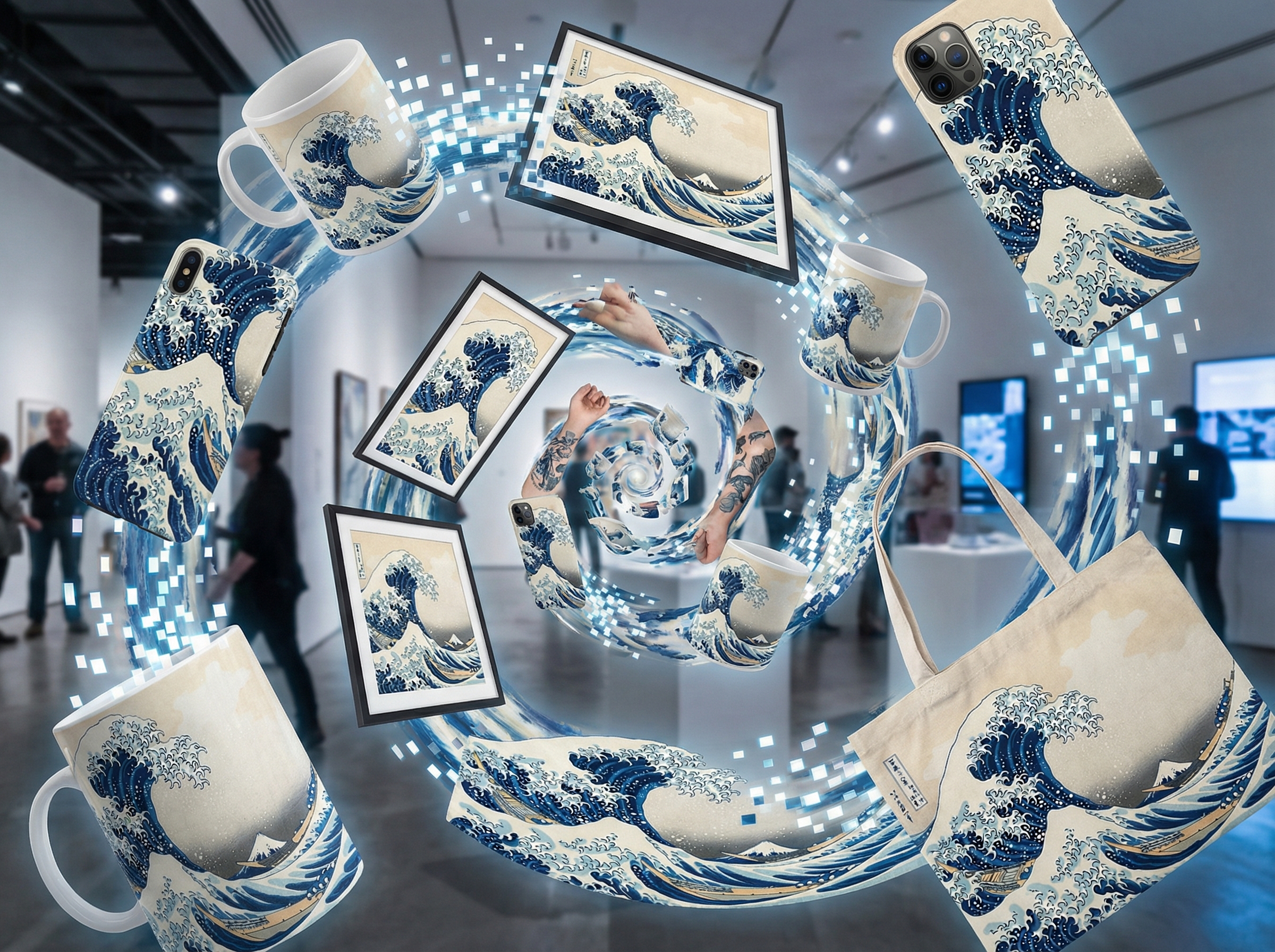
What makes a 190-year-old woodblock print worth as much as a Manhattan apartment? Rarity, certainly—fine impressions are scarce. But the deeper answer is reach. The Great Wave appears on coffee mugs, phone cases, tattoos, and museum walls across every continent. It's the rare artwork that works equally well at 2 inches or 20 feet. That universality has made it priceless precisely because it's everywhere.
02

Tokyo Reveals 16 Never-Before-Seen Works

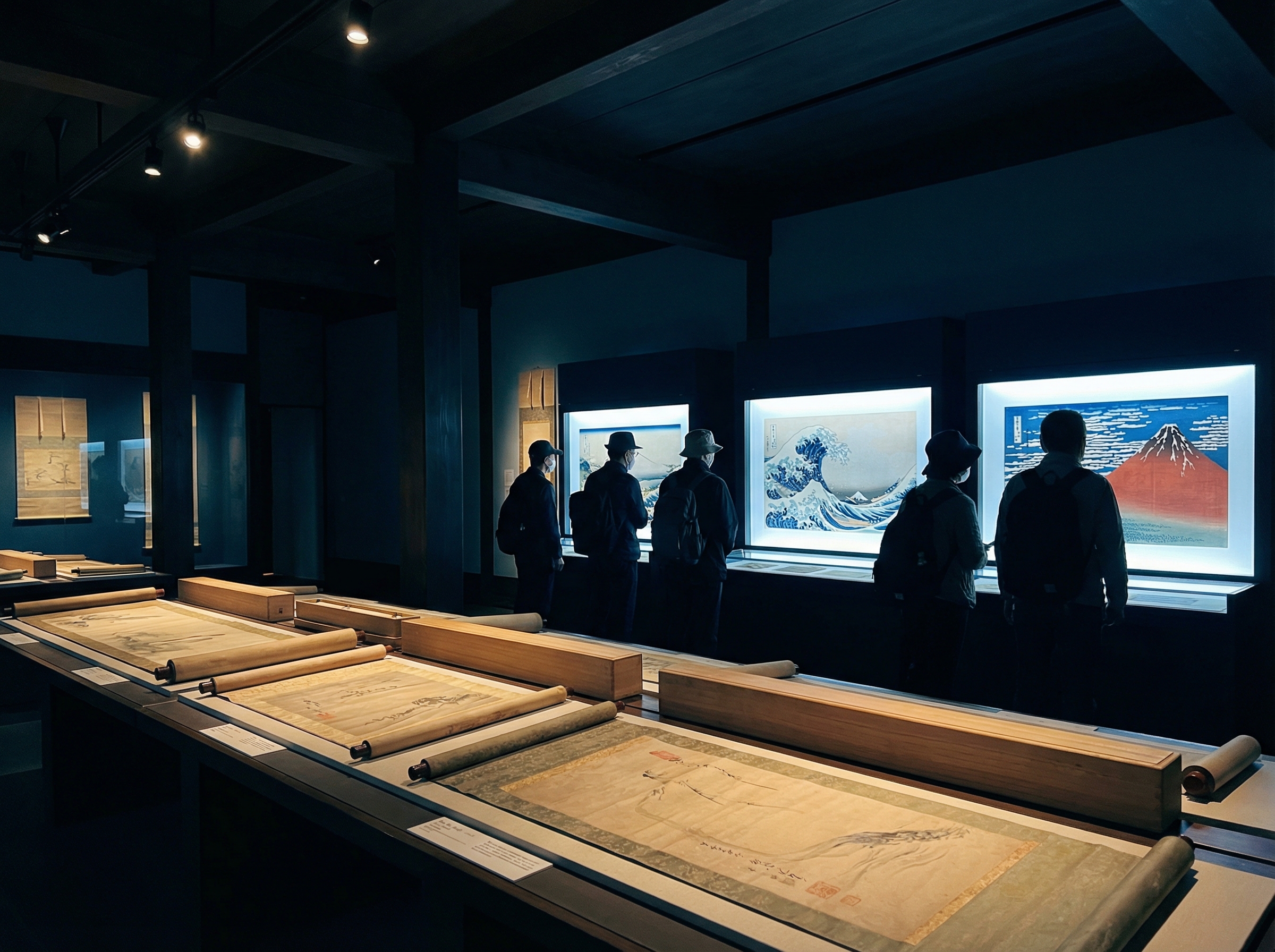
Museum gallery with dramatic lighting revealing hidden Hokusai scroll paintings

While auction records grab headlines, the real news for Hokusai scholars arrived quietly at Tokyo's Creative Museum: 16 hand-drawn works that had never been publicly exhibited. The exhibition, titled HOKUSAI: The Artist Mad About Painting, drew from private collections that have guarded these pieces for generations.

Among the revelations: previously unknown sketches from Hokusai's 70s—the decade he later dismissed as his true beginning. These aren't the bold prints that made him famous. They're intimate brush drawings that show an old man still wrestling with form, still pushing his line work toward some unreachable ideal.

The Tokyo show is part of a broader Hokusai moment. The National Museum of Western Art has announced a Spring 2026 exhibition featuring all 46 prints from the Thirty-six Views of Mount Fuji series, including the rare "Blue Fuji" variant—a chromatic sibling to the famous "Red Fuji" that most viewers have never encountered. Meanwhile, Rome's Palazzo Bonaparte will mount a comprehensive retrospective from March through June 2026.

Why now? The centennial of Hokusai's influence on Western art is long past, and the novelty of "Japonisme" faded generations ago. What remains is the work itself—and a growing recognition that Hokusai's late-career mastery offers something we need: proof that artistic genius doesn't expire.

03

Why One Image Conquered the World

The Great Wave multiplied across modern surfaces - mugs, phones, posters, tattoos

The Great Wave off Kanagawa is arguably the most reproduced image in art history. Not the Mona Lisa—she requires a pilgrimage. Not Starry Night—too many colors to print cheaply. Hokusai's wave is the rare masterpiece that scales perfectly from emoji to billboard.

The composition is pure geometry. The curling wave, with its claw-like foam, occupies a golden spiral. Mount Fuji—Japan's sacred peak—sits tiny and serene in the negative space, a calm eye in the storm. The boats below aren't just human figures for scale; they're the viewer's surrogate, making the image feel immediate and dangerous.

Technical innovation: Hokusai was among the first Japanese artists to use Prussian blue, a synthetic pigment recently imported from Europe. That deep, fade-resistant blue gave the wave its distinctive color and ensured the prints would survive centuries without fading to the muddy browns that plagued earlier works.

But technical mastery doesn't explain cultural dominance. The wave works because it captures a universal tension: the sublime terror of nature and the human instinct to navigate through it anyway. It's beautiful and threatening in equal measure. Claude Debussy saw it and wrote La Mer. Rainer Maria Rilke wrote poetry about it. Every teenager with a laptop has set it as their wallpaper at least once.

Hokusai made the wave as part of a series—Thirty-six Views of Mount Fuji—yet it outgrew its context immediately. The mountain is technically the subject; the wave has always been the star.

04

The Sensei of the Impressionists

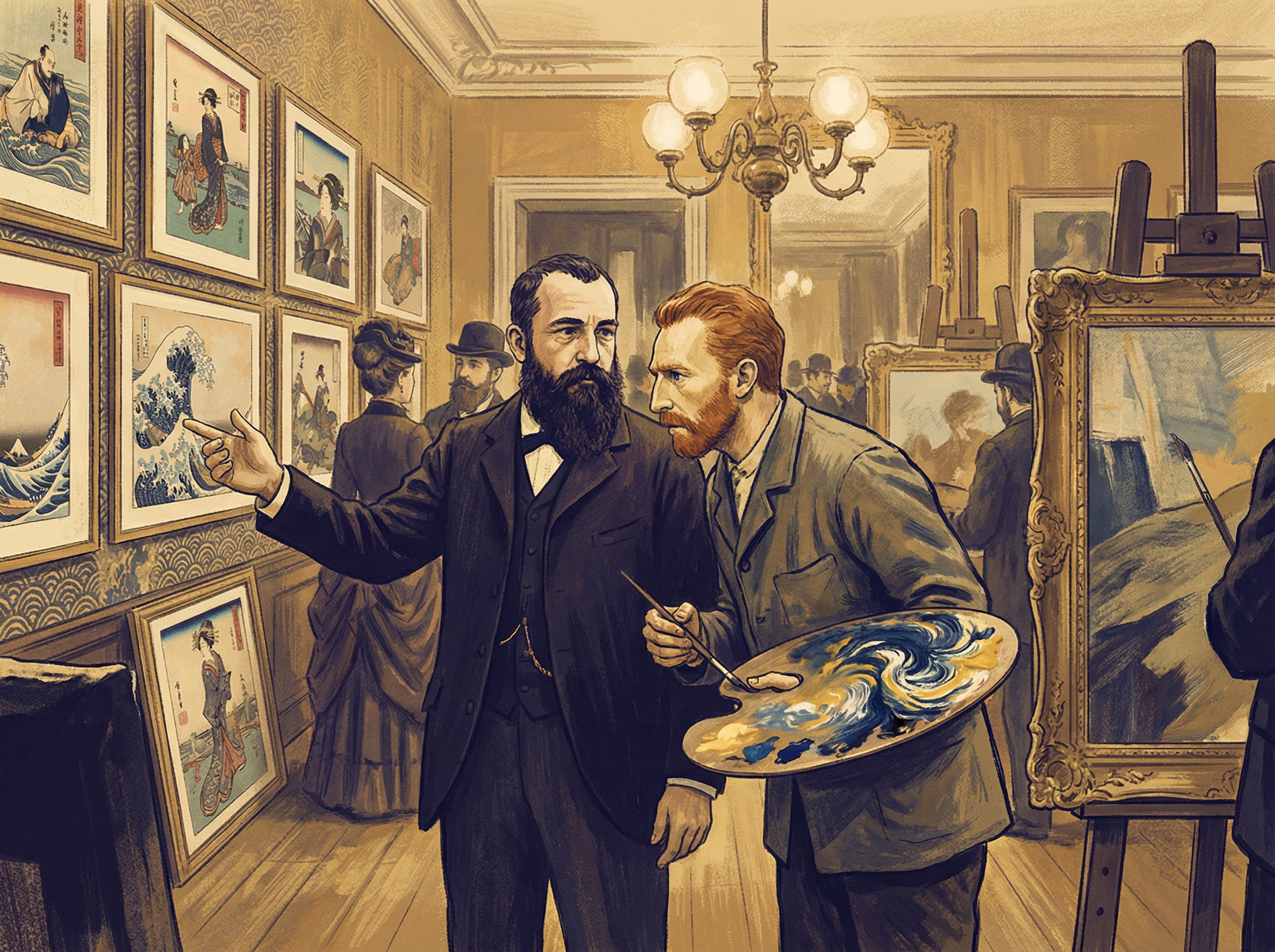
Western artists in a Parisian salon studying Japanese prints, their palettes transforming

When Japan opened to Western trade in the 1850s—six years after Hokusai's death—his prints flooded Europe wrapped around ceramics as packing material. Parisian artists found them and lost their minds.

Claude Monet owned 23 Hokusai prints, still visible today at his home in Giverny. The flattening of space, the bold outlines, the way Hokusai made color do the work of shadow—all of it shows up in Monet's water lilies. Van Gogh was even more direct: "All my work is based to some extent on Japanese art," he wrote to his brother. He copied Hokusai's prints in oil, trying to absorb their emotional clarity through his brush.

Degas studied Hokusai's Manga sketches—15 volumes of drawings covering everything from people bathing to sumo wrestlers to waves in a storm—and borrowed their off-center compositions and obsession with everyday movement. The modern snapshot aesthetic? Hokusai got there first.

The movement they sparked was called Japonisme, and it reshaped Western art from the ground up. Art Nouveau's organic curves came from Hokusai's waves and plants. Whistler's moody tonalism came from his fog and water. Even Picasso, decades later, acknowledged the debt.

The irony: Hokusai never saw the impact. He died in 1849, convinced he'd barely begun to understand his craft. The artists who learned from him went on to define modern art, while he went to his grave wishing for five more years.

05

The Man of Thirty Names

Artist seals and calligraphy stamps scattered like leaves, 30 signatures morphing into one another

Hokusai changed his artist name over 30 times during his career. Not pen names for different genres—complete artistic identities, each signaling a new direction, a new style, a new beginning.

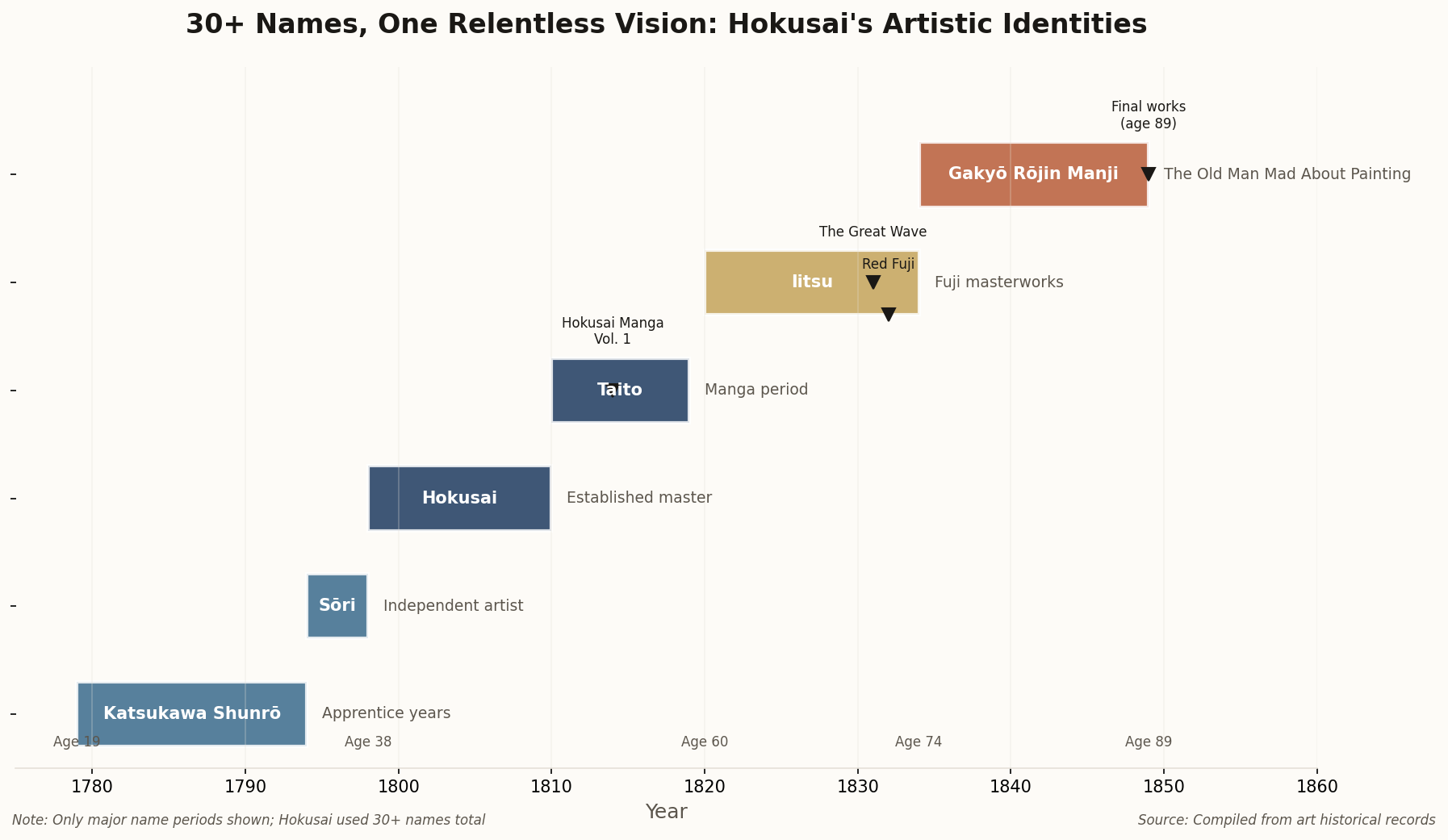
Timeline showing Hokusai's major name periods from Shunro at age 19 to Gakyō Rōjin Manji at age 89
Hokusai's major artistic identities, each representing a distinct phase of his evolution.

He started as Katsukawa Shunrō, an apprentice in the Katsukawa school of ukiyo-e. By his late 30s he was Sōri, then simply Hokusai. In his 60s he became Iitsu—the age when he produced the Fuji series. His final name, adopted at 74, said everything: Gakyō Rōjin Manji, "The Old Man Mad About Painting."

Each name wasn't just a label change. Hokusai reportedly sold his previous names to students, including the right to sign works in that style. When he moved on, he moved on completely—burning the boats, starting fresh.

This serial reinvention seems almost pathological until you see it as practice. Hokusai wasn't running from his past work; he was trying to outrun his own limitations. Every new name was a declaration: the previous version had learned what he could learn. Time to become someone new.

In a creative culture obsessed with "finding your voice," Hokusai offers an alternative: keep changing your voice until the day you die. The work gets better because you refuse to settle into what you already know.

06

"Nothing Before 70 Was Worth Bothering With"

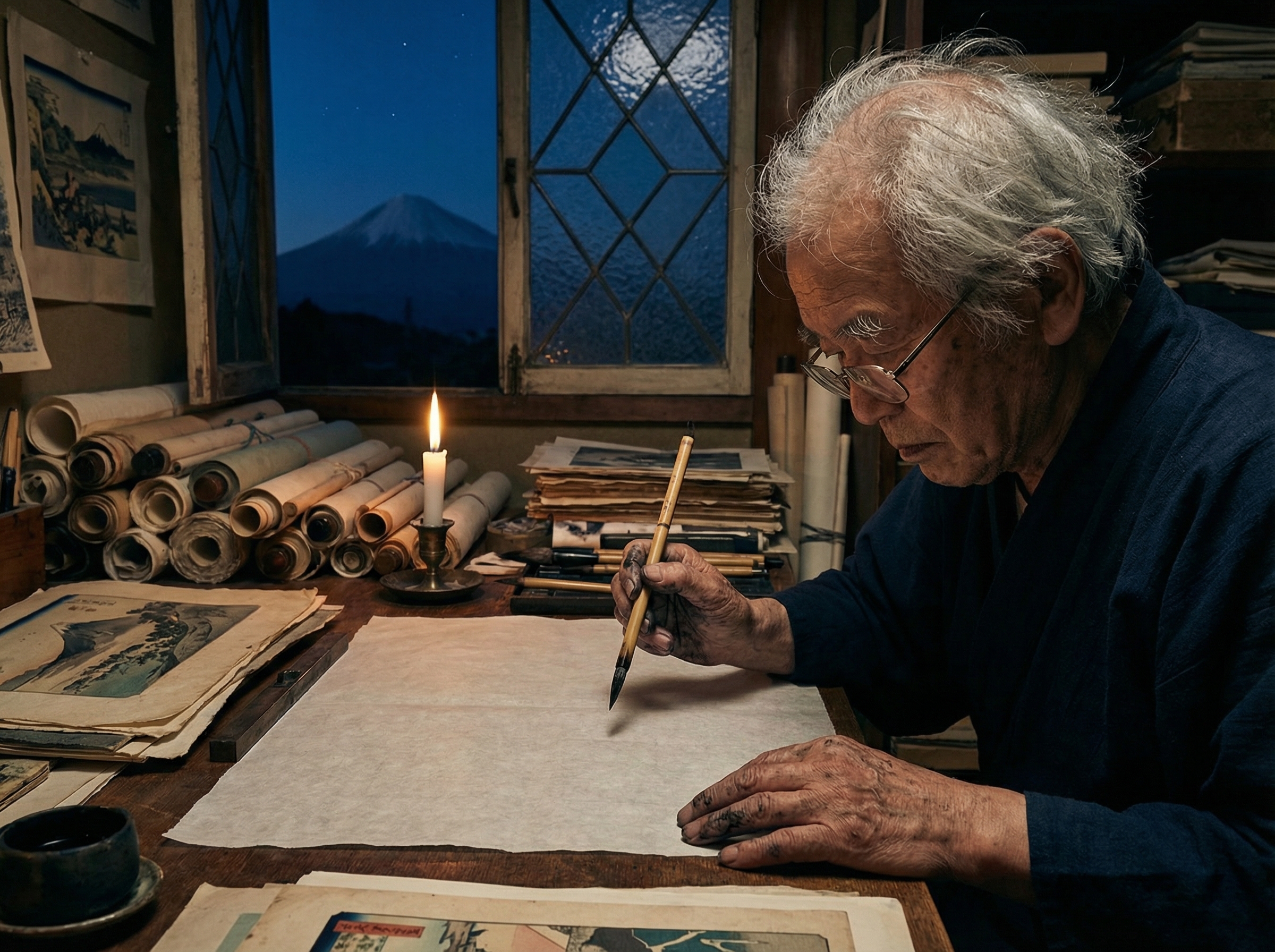
Elderly Japanese master artist with white hair hunched over paper in candlelight

At age 75, Hokusai wrote a postscript to one of his books that has become a manifesto for late bloomers everywhere:

"From the age of six I had a mania for drawing the shapes of things. When I was fifty I had published a universe of designs. But all I have done before the age of seventy is not worth bothering with. At seventy-three I began to grasp the structures of birds and beasts, insects and fish, and the way plants grow. If I keep trying, I will have a better understanding when I am eighty, and at ninety I will have penetrated the deepest meaning of things. At one hundred, I shall be a marvelous artist, and at one hundred and ten, every dot, every line will jump to life."

He didn't make it to 110. He died at 89, reportedly saying: "If heaven will extend my life by ten more years—or even five—I'll manage to become a true artist."

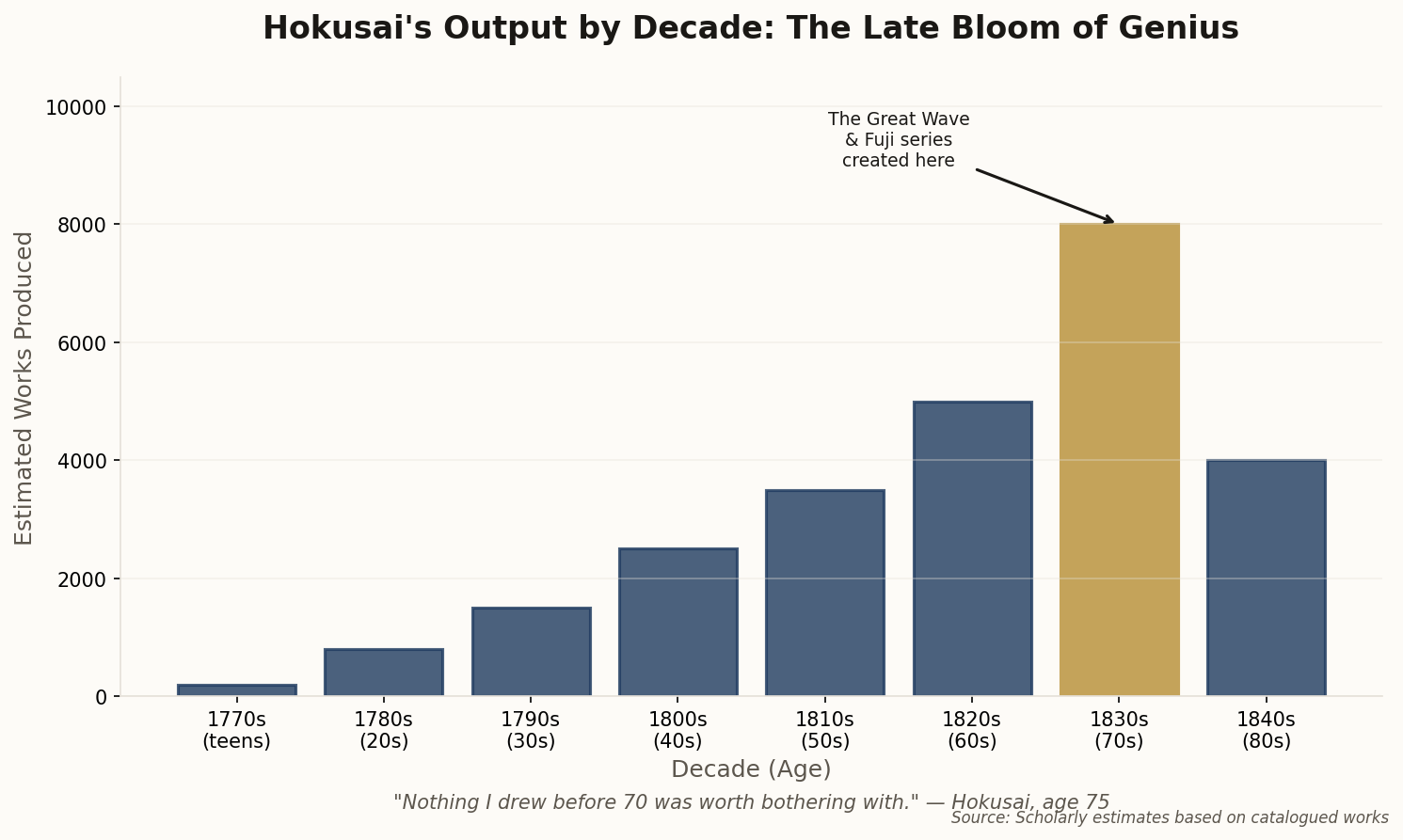
Bar chart showing Hokusai's artistic output peaking dramatically in his 70s
Hokusai's estimated output by decade—his most productive and celebrated work came after age 70.

The data backs up his self-assessment. Hokusai's most prolific decade was his 70s. The Thirty-six Views of Mount Fuji? Created between ages 70 and 72. One Hundred Views of Mount Fuji? Ages 74 to 87. His career wasn't a peak followed by decline—it was a long, slow climb that accelerated when most artists are collecting honors.

Over 70 years, he produced an estimated 30,000 works. That's more than one work per day, every day, for seven decades. And he considered most of it apprentice work.

Hokusai's philosophy isn't comfortable. It denies us the satisfaction of arrival, the moment when we can say "I've made it." But it offers something better: permission to keep going. If the creator of the most recognizable image in art history thought he was just getting started at 75, then maybe mastery isn't a destination. Maybe it's a direction.

Five More Years

Hokusai died reaching for a perfection he'd never let himself grasp. That restlessness—the refusal to be satisfied, the endless beginning again—is what made him timeless. The wave keeps crashing, Mount Fuji keeps watching, and somewhere, the old man is still drawing.