Retirement Planning

The Great Retirement Shuffle

Seven destinations. Seven realities. Greece rises while Ecuador stumbles, and the rulebook keeps changing for Americans plotting their escape.

Listen
A retired couple enjoying morning coffee on a sunlit Mediterranean terrace overlooking the sea
01

Thailand's Tax Trap Remains Unsprung

Golden Thai temple spire casting shadow over stacked currency, symbolizing tax uncertainty

Here's the scenario every Thailand-bound retiree dreads: you've sold the house, wired the proceeds, and now the Thai Revenue Department wants a cut of your life savings. That's been the fear since January 2024, when Thailand started taxing all remitted foreign income—regardless of when you earned it.

A proposed Royal Decree would fix this by exempting income remitted more than 12 months after being earned. Sensible policy. But here's the problem: Thailand's February 8th general election has frozen all legislative action. The decree sits in limbo while expats play the waiting game with their accountants.

The bottom line: If you're planning to move to Thailand in 2026, treat the 2024 rules as gospel until a new government says otherwise. That means potential tax liability on any foreign income you bring in. Structure accordingly.

What makes this particularly maddening is that Thailand remains one of the most affordable places for American retirees. A comfortable lifestyle in Chiang Mai runs $1,500–2,000/month. But tax uncertainty turns a straightforward decision into a spreadsheet nightmare. Watch for movement after the election; the new government will need to address this quickly or risk losing the expat money they've been courting.

02

Mexico Just Priced Out Social Security Retirees

Mexican colonial doorway with staircase of golden coins, representing rising residency costs

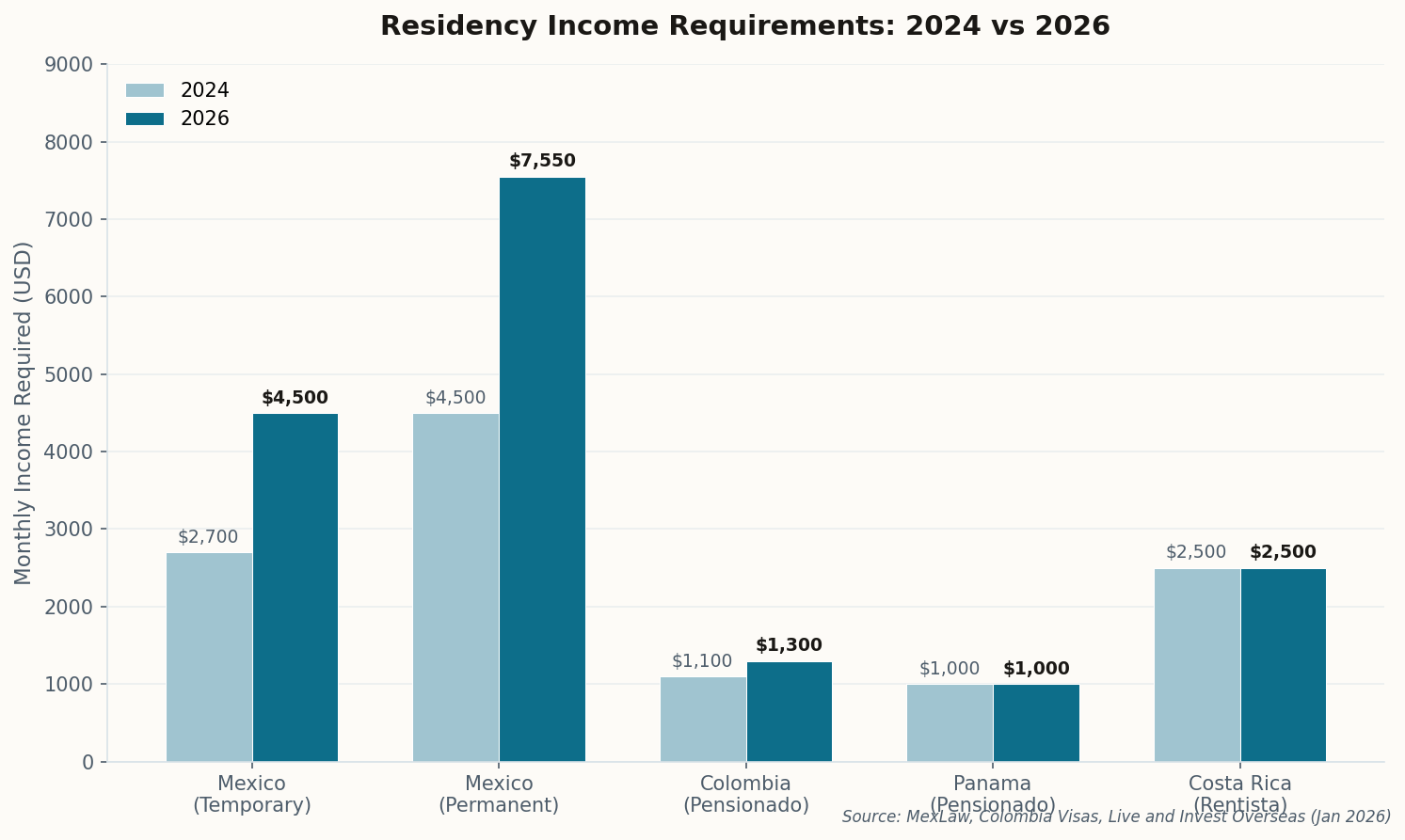
Mexico's 2026 residency math just got brutal. To qualify for Temporary Residency, you now need to prove monthly income of $4,300–4,700 (varies by consulate). Permanent Residency? That's $7,300–7,800/month. These aren't typos.

The culprit is the UMA (Unit of Measurement and Update), the inflation-indexed value Mexico uses for immigration thresholds. Combined with a strong dollar-to-peso exchange rate that paradoxically raises the USD requirement, American retirees who planned to live on Social Security plus modest savings are suddenly priced out.

Bar chart comparing 2024 vs 2026 residency income requirements across Mexico, Colombia, Panama, and Costa Rica
Mexico's requirements have nearly doubled since 2024, while Panama remains unchanged

The average Social Security check in 2026 is around $1,900/month. That's not even halfway to Mexico's temporary residency threshold. Unless you have a pension stacking on top, or substantial investment income, Mexico's legal residency routes are effectively closed.

There's a workaround: the savings-based qualification option, which requires showing approximately $125,000 in liquid assets held for 12 months. But that's a high bar for many, and it ties up capital you might prefer to deploy elsewhere. For 2026 planning, Puerto Vallarta dreams may need to wait—or find creative alternatives like the 6-month tourist visa shuffle that immigration attorneys emphatically do not recommend.

03

Colombia Tightens the Pensionado Playbook

Colombian coffee plantation with passport stamps floating in the wind like leaves

Colombia's M-Pensionado visa has long been the affordable option: prove you have a pension, demonstrate modest income, enjoy Medellín's eternal spring. The 2026 updates don't change that fundamentally, but they do raise the stakes.

The income threshold is now 3x the monthly minimum wage (SMMLV), working out to roughly COP 5.25 million or about $1,300 USD. That's still reasonable compared to Mexico's eye-watering requirements. But there's a catch that trips up many applicants: Colombia demands a lifelong, guaranteed pension. Savings don't count. 401(k) balances don't count. You need actual pension documentation.

The other enforcement tightening: the 180-day rule. You must physically visit Colombia every six months to maintain your visa status. Miss that window, and you're starting over. This kills the "get Colombian residency, live nomadically" strategy some retirees were running.

The play: If you have a traditional pension (federal, state, military, or corporate), Colombia remains one of the best value propositions in the Americas. If you're self-funding retirement from investments, look at Panama or Costa Rica instead.

04

Boquete Takes the Crown (Again)

Lush Panama highlands with Boquete coffee terraces and golden trophy emerging from misty mountains

While International Living crowned Greece their 2026 champion, Live and Invest Overseas went a different direction: Boquete, Panama tops their Annual Overseas Retirement Index. The Algarve came second, Puerto Vallarta third.

Boquete's pitch hasn't changed much—spring-like weather year-round, established expat community, and Panama's use of the US dollar eliminates currency risk entirely. But the 2026 case is stronger than ever because of what didn't change: Panama's Pensionado visa requirements remain at $1,000/month. No income requirement inflation. No new bureaucratic hurdles.

That stability matters. When you're planning a 20-30 year retirement horizon, countries that keep moving the goalposts create long-term risk. Panama has kept its welcome mat in the same spot for years.

The Pensionado benefits also remain best-in-class: 25% off airline tickets, 50% off entertainment, 25% off restaurants, and discounts on everything from electricity to medical procedures. It's not just about low cost of living—it's about systematically subsidized retirement.

One consideration: Boquete is increasingly popular, which means real estate prices have climbed. You're no longer finding steals. But if your priority is stability, dollar-denominated transactions, and government-backed discounts, Panama should be on your shortlist.

05

The Euro Is Coming for Your Retirement Budget

Abstract currency visualization with Euro rising like sun over Mediterranean coastline

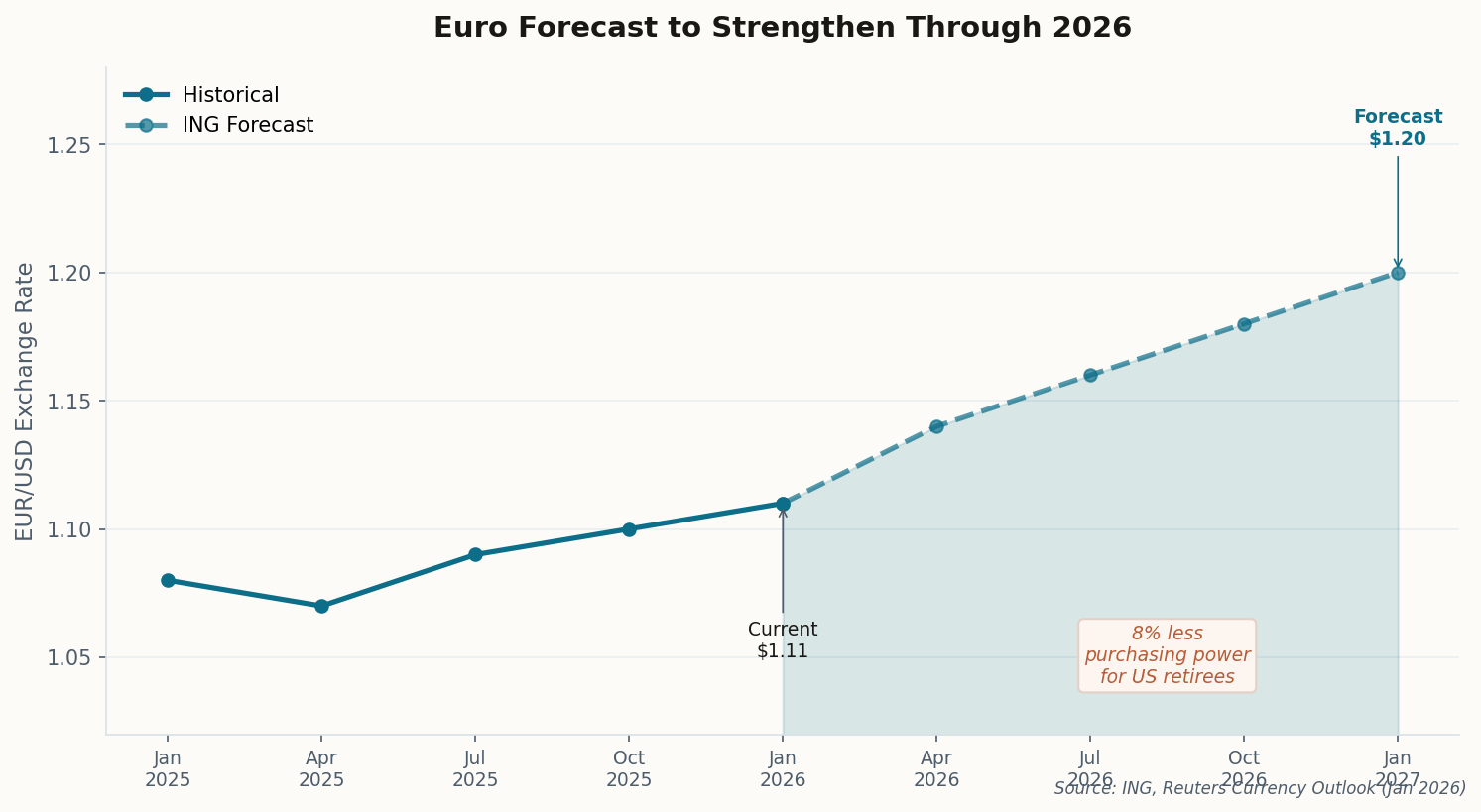
All those Greece and Portugal retirement articles should come with a currency warning label. ING's 2026 outlook forecasts the Euro strengthening to 1.20 against the dollar by year-end—up from 1.11 today. That's an 8% swing that directly erodes American purchasing power.

Line chart showing EUR/USD exchange rate historical data and forecast through 2027
ING forecasts EUR/USD reaching 1.20 by late 2026, driven by Fed rate cuts and Eurozone recovery

The mechanism: expected US Federal Reserve rate cuts (making dollars less attractive) combined with Eurozone economic recovery (making euros more attractive). It's a double squeeze on dollar-denominated retirement income.

What this means practically: that €1,500/month apartment in the Algarve that costs you $1,650 today could cost $1,800 by December. Healthcare, groceries, utilities—everything priced in euros gets 8% more expensive in dollar terms. Over a decade of retirement, currency movements can matter more than the headline cost-of-living differences between countries.

This doesn't disqualify Southern Europe. But it does mean Americans should build currency volatility into their retirement projections rather than assuming today's exchange rates hold. And it strengthens the case for dollarized economies like Panama and Ecuador (security situation aside).

06

Ecuador's Security Crisis Derails a Favorite

Ecuadorian colonial church with storm clouds gathering and caution tape floating in wind

Ecuador used to be the quiet success story: dollarized economy, spectacular scenery, affordable healthcare in Cuenca, and a welcoming stance toward retirees. That narrative took a dark turn when President Daniel Noboa declared a 60-day state of emergency on January 2nd, citing "internal armed conflict."

This isn't diplomatic language. Nine provinces—including the coastal areas of Guayas and Manabí popular with expats—are under emergency measures that suspend normal civil rights. The Armed Forces have been deployed to "dismantle criminal organizations." When a government describes its own security situation as armed conflict, prospective retirees should pay attention.

Reality check: Ecuador's problems didn't emerge overnight. Drug trafficking routes through the country have generated violence for years. But the state of emergency makes official what observers already knew: this is not a stable security environment for 2026 planning.

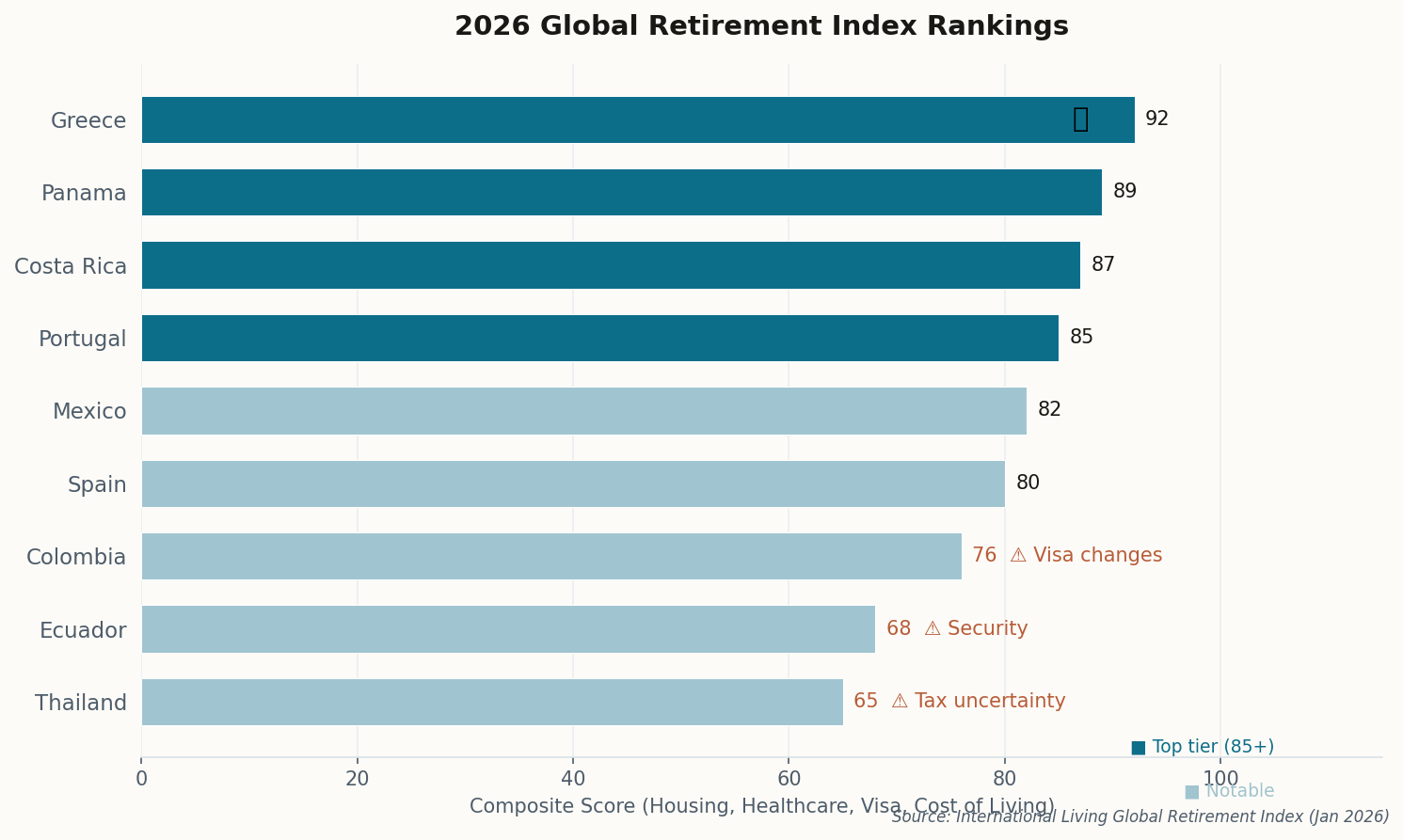
The tragedy is that Ecuador's fundamentals—dollar currency, low cost of living, excellent weather at altitude—remain excellent. The International Living index dinged it to 68 points, down from top-tier status. If security improves, Ecuador could bounce back. For now, it's a wait-and-see.

07

Greece Takes the Throne

Santorini white-washed buildings with blue domes and golden crown floating above

International Living's 2026 Global Retirement Index put Greece on top for the first time, unseating perennial favorites Panama (#2) and Costa Rica (#3). The evaluation weighted housing, healthcare, climate, and visa accessibility—and Greece scored high across all four.

Horizontal bar chart showing 2026 retirement index scores for top destinations with Greece at 92, Panama at 89, Costa Rica at 87
Greece tops the 2026 rankings, but three destinations carry warning flags for Americans

The Greek case is compelling: universal healthcare access for legal residents, a Golden Visa program (though prices have increased), Mediterranean climate, and a cost of living that remains below Western European norms. Athens is increasingly affordable compared to Lisbon or Barcelona, and islands like Santorini offer the lifestyle dreams are made of.

But read the fine print. The Golden Visa minimum investment is now €500,000 in prime areas—up from €250,000. The Euro strengthening issue (see section 05) hits Greece hard. And Greece's bureaucracy is... Greek. Getting residency paperwork processed requires patience that not every Type-A American retiree possesses.

The bigger signal: Southern Europe is emerging as a serious competitor to Latin America for American retirees. Better infrastructure, EU healthcare standards, and cultural attractions offset the higher costs. If the Euro forecast is wrong and the dollar holds stronger than expected, Greece could be the retirement destination of the decade.

The 2030 Horizon

The retirement destination landscape is reshuffling faster than any time in recent memory. Mexico and Thailand are raising barriers. Ecuador is stumbling on security. Greece is ascending. Panama keeps steady. The only constant: doing your homework matters more than ever. Currency risk, visa stability, healthcare access, and security conditions all demand attention before you sign that lease or buy that condo. The good news? You have options. The challenge? Picking the right one.