Prediction Markets

The House Always Wins (Unless It's a Derivative)

Polymarket just posted $7.6 billion in monthly volume. Nevada says it's gambling. The CFTC says it's derivatives. A Venezuelan coup trader says it's retirement. The truth is more interesting than any of them admit.

Listen
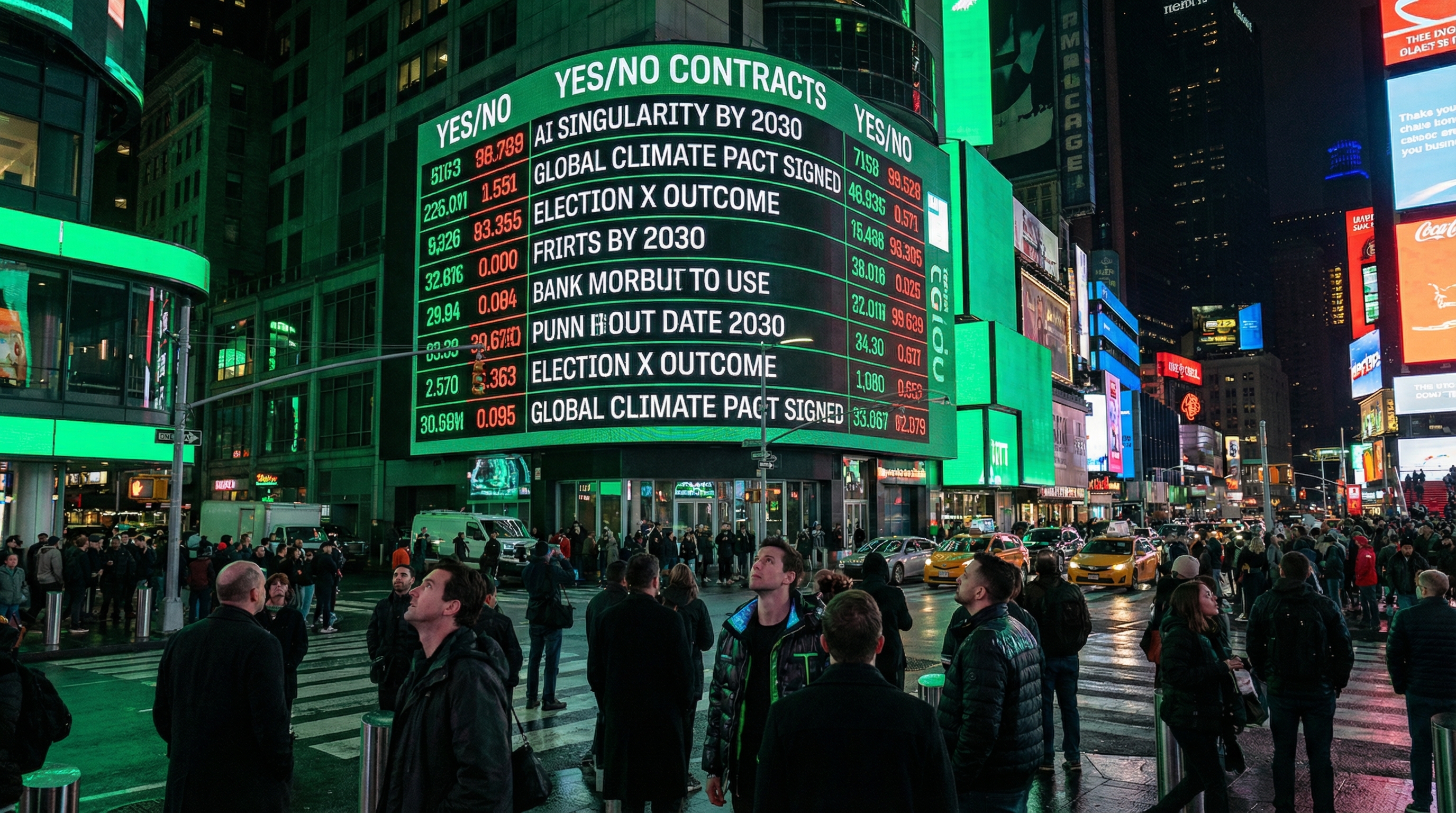
Neon prediction market ticker board in Times Square showing YES/NO contracts on world events
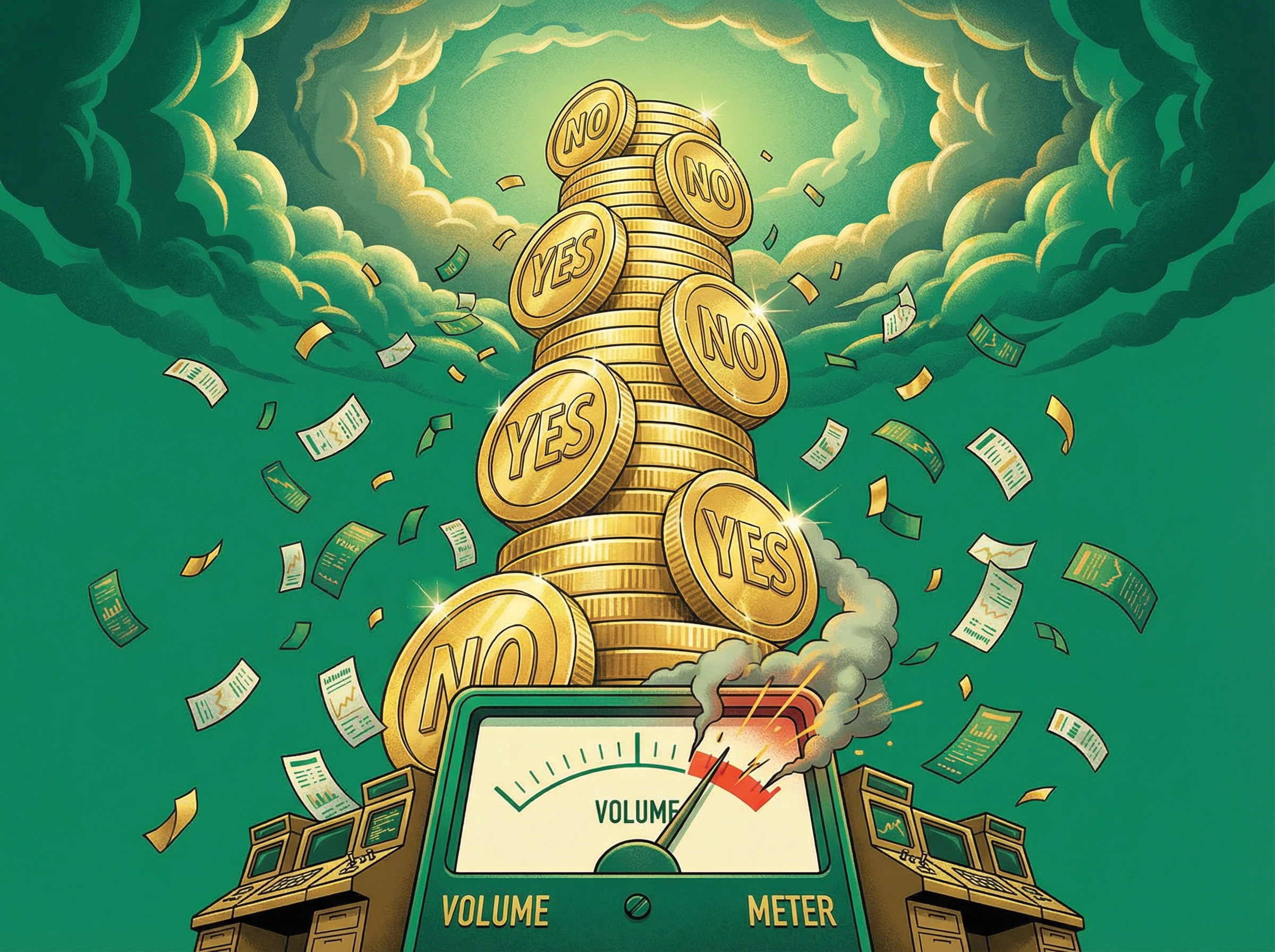
Towering stack of gold coins with YES/NO engravings reaching into the clouds
01

Seven Point Six Billion Reasons This Isn't a Fad

Here's a number that should make every traditional exchange executive lose sleep: $7.66 billion. That's Polymarket's trading volume for January 2026 alone, driving the entire prediction market sector past $12 billion. For context, that's more monthly volume than the CBOE's VIX futures handled in most months of 2024.

The platform generated $2.62 million in on-chain fees for the month—not spectacular by crypto standards, but the volume-to-fee ratio tells you something important: Polymarket is competing on liquidity depth, not extraction. This is the playbook of a platform that thinks it's building infrastructure, not running a casino.
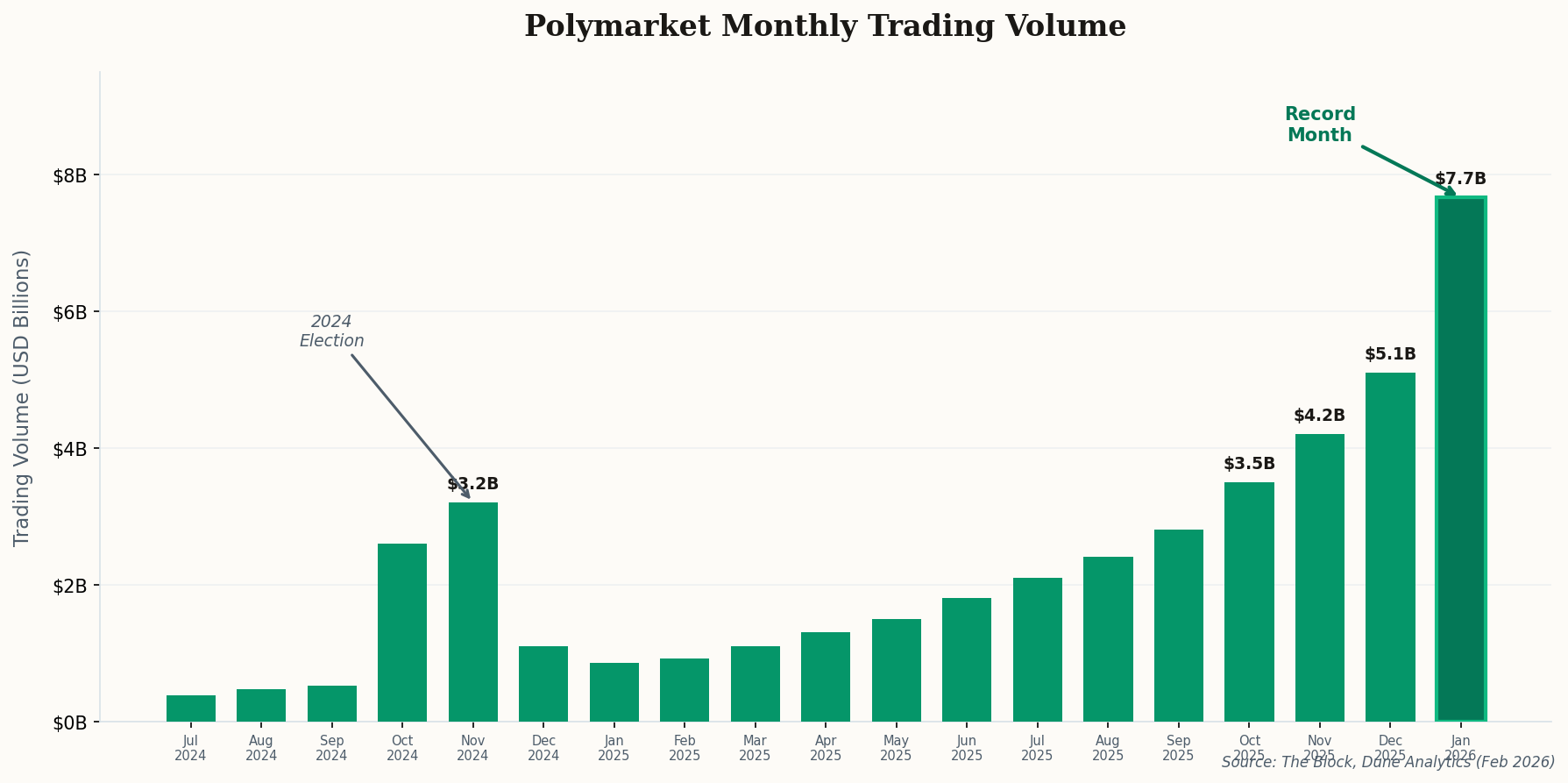
Bar chart showing Polymarket monthly trading volume growth from July 2024 to January 2026, with January 2026 hitting a record $7.66 billion
Polymarket's volume trajectory: from election-cycle spike to sustained exponential growth. January 2026 shattered all records. Source: The Block, Dune Analytics.

What's driving the surge? Three things: the platform's regulated U.S. relaunch after its CFTC settlement, a geopolitical calendar that reads like a Tom Clancy novel, and a generation of traders who grew up treating prediction and speculation as the same verb. The question isn't whether people want to bet on world events. It's whether we call it "investing" when the house is a smart contract.


Shadow figure at a trading terminal with Venezuela map glowing on screen, noir aesthetic
02

Someone Knew About Venezuela Before You Did (And Made $436K)

A trader going by "Burdensome-Mix" created an account in December 2025, traded exclusively on Venezuela-related markets, and profited over $436,000 by betting on Nicolás Maduro's removal—just hours before U.S. forces announced his capture. If this were a novel, you'd call the plot too obvious.

The timing raises the single most uncomfortable question about prediction markets: when the "crowd wisdom" comes from someone with access to classified military intelligence, is it still a market or is it espionage laundering? Traditional insider trading law covers securities—stocks, bonds, derivatives with an underlying asset. Event contracts on geopolitical outcomes occupy a legal void that makes SEC enforcement lawyers twitch.

The core tension: Prediction markets derive their value from information asymmetry—some traders know more than others. But when that asymmetry comes from state secrets rather than better analysis, the entire "wisdom of crowds" thesis collapses into something that looks a lot like front-running with extra steps.

Congress immediately began calling for stricter KYC rules and purpose-built insider trading laws for prediction markets. The crypto-libertarian response is predictable: you can't regulate information. The realist response is simpler: you can regulate the market that monetizes it. This case will likely define the regulatory framework for the next decade.

Abstract visualization of blockchain bridges connecting Solana and Polygon networks
03

The Multi-Chain Hedge: Polymarket Goes Solana

Polymarket markets are now directly tradable via Jupiter, the leading decentralized exchange aggregator on Solana. If you're not steeped in crypto plumbing, here's what this means in plain English: millions of Solana users can now bet on real-world events without switching chains, bridging tokens, or navigating Polygon's occasionally temperamental infrastructure.

This is a strategic hedge as much as a growth play. Polymarket was born on Polygon (an Ethereum Layer 2), and while Polygon has served them well, putting all your eggs in one blockchain is roughly equivalent to building your entire business on a single cloud provider. When Polygon had a 12-hour sequencer outage in June 2025, Polymarket's trading literally stopped. On Solana, transactions confirm in under 400 milliseconds and cost fractions of a cent.

The crypto purists will debate the chain merits endlessly. The business reality is simpler: Polymarket is going where the retail users already are. And right now, Solana's ecosystem has the most active retail trading population in crypto. Meet the gamblers—sorry, investors—where they live.

Dramatic courtroom gavel slamming down on a poker chip and stock certificate
04

Nevada Drops the Gavel: "This Is Gambling, Full Stop"

Of all the states that could have thrown the first punch, Nevada is the most poetic. The state that literally built its economy on gambling has ruled that prediction markets are... gambling. A federal judge granted the Nevada Gaming Control Board a temporary restraining order barring Polymarket from offering event contracts to Nevada residents.

The judge's reasoning cuts to the philosophical heart of this entire newsletter: "The Court finds that the NGCB has shown a likelihood of success on the merits... that Polymarket's event contracts constitute gambling under Nevada law." Polymarket has geo-blocked Nevada users and is preparing for a February 11 preliminary injunction hearing, but the damage to the "we're not gambling" narrative is already done.

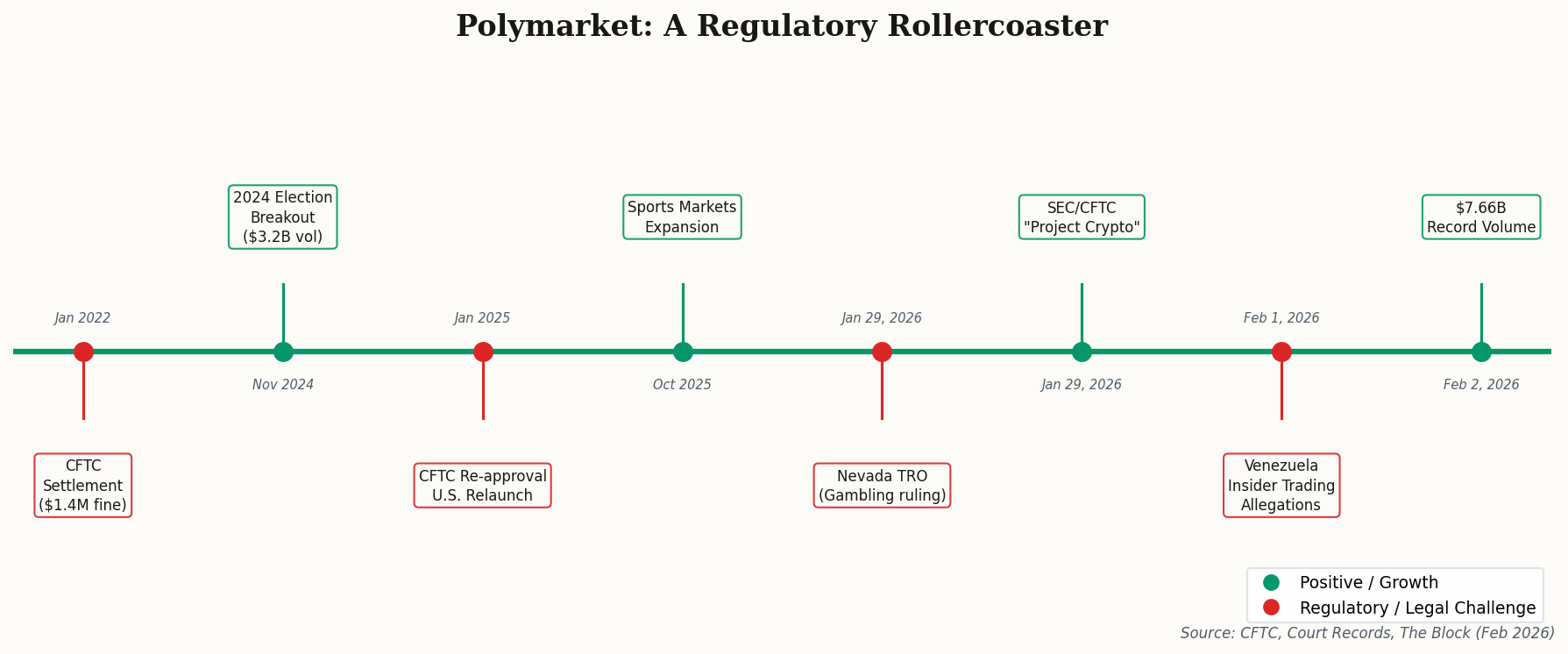
Timeline showing Polymarket's regulatory journey from 2022 CFTC settlement to 2026 Nevada challenge
Polymarket's regulatory rollercoaster: green dots mark growth milestones, red dots mark legal and regulatory challenges. The pattern is clear—every surge in legitimacy triggers a new regulatory response.

Here's what makes this genuinely interesting: the CFTC classifies these products as event contracts—derivatives regulated under the Commodity Exchange Act. Nevada says they're wagers regulated under state gambling law. Both can't be right, and the resolution will likely require either Congressional action or a Supreme Court case that defines the boundary between derivatives and gambling for the digital age. We haven't had one of those since bucket shops were outlawed a century ago.

Two government buildings merging into a unified crystal structure with sunrise behind
05

The Regulators Finally Agree to Agree

On the same day Nevada was slapping Polymarket with a restraining order, something remarkable happened in Washington: SEC Chair Paul Atkins and CFTC Chair Michael Selig announced "Project Crypto"—a joint initiative to create a unified regulatory framework for digital assets and prediction markets.

If you've followed the SEC-CFTC turf war over crypto for the past four years, this is roughly equivalent to the Montagues and Capulets announcing a joint venture. The two agencies have spent more energy fighting each other over jurisdiction than they've spent actually regulating the industry. Selig's statement was unusually direct: "We are moving past the era of regulation by enforcement toward a clear, unified framework that fosters innovation while protecting market integrity."

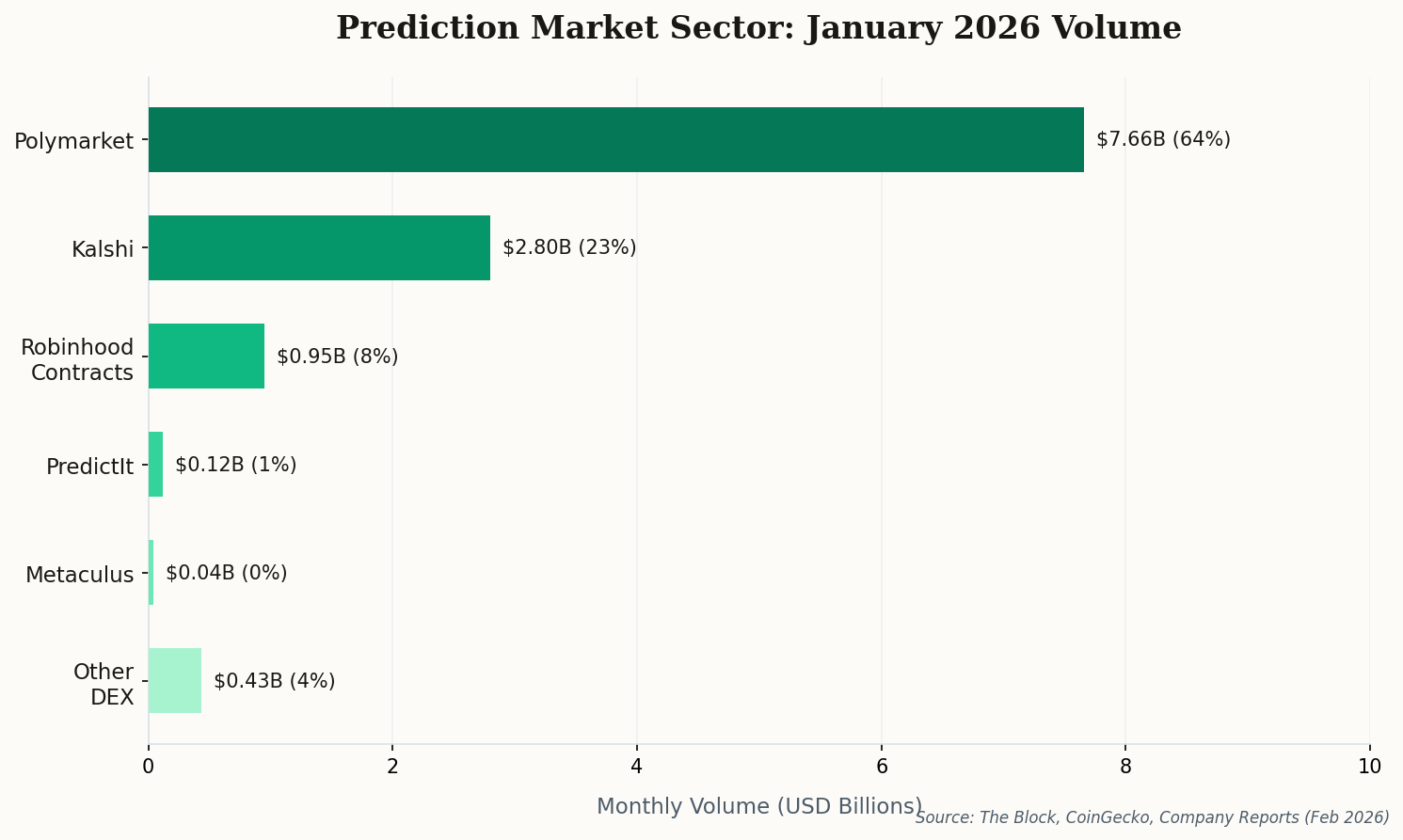
Horizontal bar chart comparing prediction market platform volumes for January 2026
Polymarket dominates the prediction market sector with 64% of January 2026 volume. Kalshi, its primary regulated competitor, handles roughly a third of Polymarket's volume. Source: The Block, CoinGecko.

The practical implication for Polymarket: if Project Crypto succeeds, it could create a single compliance regime instead of the current jurisdictional whack-a-mole. One set of rules, one regulator to satisfy, one framework for whether event contracts are securities, commodities, or something else entirely. Whether Nevada's state-level gambling challenge survives a unified federal framework is the $7.66-billion question.

Soccer ball made of holographic data streams on a perfectly manicured pitch
06

When Your Bookie Gets an Official Sports Partnership

Polymarket signed a multi-year deal to become an official data partner for Major League Soccer. Read that sentence again. A prediction market—which Nevada just called a gambling platform—now has an official partnership with a major professional sports league. The cognitive dissonance is the point.

The partnership gives Polymarket access to real-time, verified match data to settle sports prediction markets instantly. No more disputes about whether a goal counted or a red card was issued—the league's own data feed becomes the source of truth. This is the sports betting equivalent of getting your odds verified by the referee.

The strategic logic is impeccable. DraftKings and FanDuel spent years and billions of dollars arguing that daily fantasy sports weren't gambling—they were "skill-based competitions." They won that argument in most states. Polymarket is running the same playbook: secure mainstream partnerships, build institutional legitimacy, and let the cultural acceptance outrun the regulatory apparatus. The MLS deal doesn't just give them data. It gives them a Fortune 500 co-signer on the "this is legitimate" application.

The Verdict: Both and Neither

Is Polymarket investing or gambling? The honest answer is that the distinction has always been more cultural than structural. When you buy an out-of-the-money call option on a biotech stock before FDA approval, you're making a binary bet on an event outcome—the exact same mechanic as a Polymarket contract. We call one "sophisticated investing" and the other "degenerate gambling" based entirely on which building the trade happens in. Polymarket's real innovation isn't the technology. It's forcing us to confront the fact that the line between Wall Street and Vegas was always drawn in pencil.