History

The Flawed Giant

How will history remember Winston Churchill? The 2026 verdict is in: heroism and moral failure aren't mutually exclusive. They're the same man.

Listen
Bronze statue silhouette against stormy London skies, Parliament in soft focus
01

The Consensus That Took 80 Years
Cracked marble bust with gold kintsugi repairs

For decades, Churchill biography was a binary game. You were either in the Hillsdale College camp—defender of Western civilization, lion against fascism—or you were reading Tariq Ali's counter-narrative of imperial crimes. The middle ground felt like cowardice.

By 2026, the historical profession has arrived somewhere more uncomfortable: both are true. The same man who held Britain together in 1940 oversaw policies that caused millions of deaths in Bengal. The voice that rallied democracy against tyranny also believed, explicitly and in writing, that Indians were "a beastly people with a beastly religion."

This isn't moral relativism. It's the mature recognition that historical figures contain multitudes, and that whitewashing Churchill does as much disservice to understanding World War II as condemning him does to understanding colonial history. The flawed giant isn't a compromise position—it's the only honest one.

The key shift: Pre-2020, "complexity" was often code for avoiding hard conclusions. Post-2020, it means holding two true things at once—and being uncomfortable with both.
02

The Bengal Famine's Long Shadow

Empty rice bowls on cracked earth

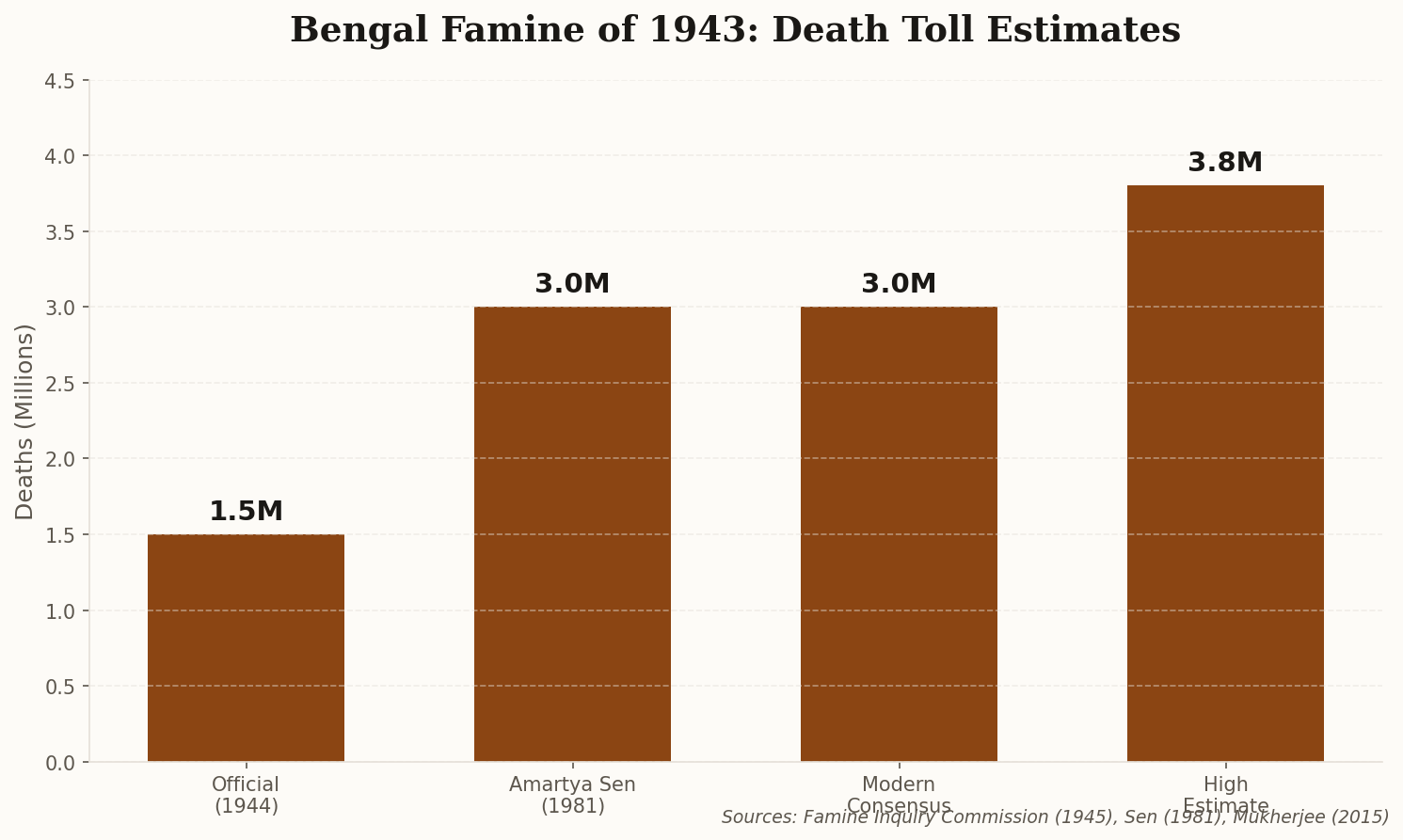
If there's a single event that divides Churchill's legacy along geographic lines, it's the Bengal Famine of 1943. The death toll alone makes it impossible to ignore:

Bengal Famine death toll estimates ranging from 1.5 million to 3.8 million
Death estimates vary by methodology, but even the lowest figures represent a catastrophe comparable to the Armenian Genocide.

Madhusree Mukerjee's 2010 research documented Cabinet decisions to prioritize military shipments over rice imports. Churchill's defenders, including a 2024 CapX piece, counter that Japanese occupation of Burma—not Cabinet racism—caused the shortage. But even sympathetic accounts can't explain away Churchill's documented statement that famine was Indians' own fault for "breeding like rabbits."

The historical debate isn't whether Churchill could have done more. It's whether he wanted to. And that's the question that separates British from Indian memory of the same man.

03

Memory Divided: Same Man, Different Legends

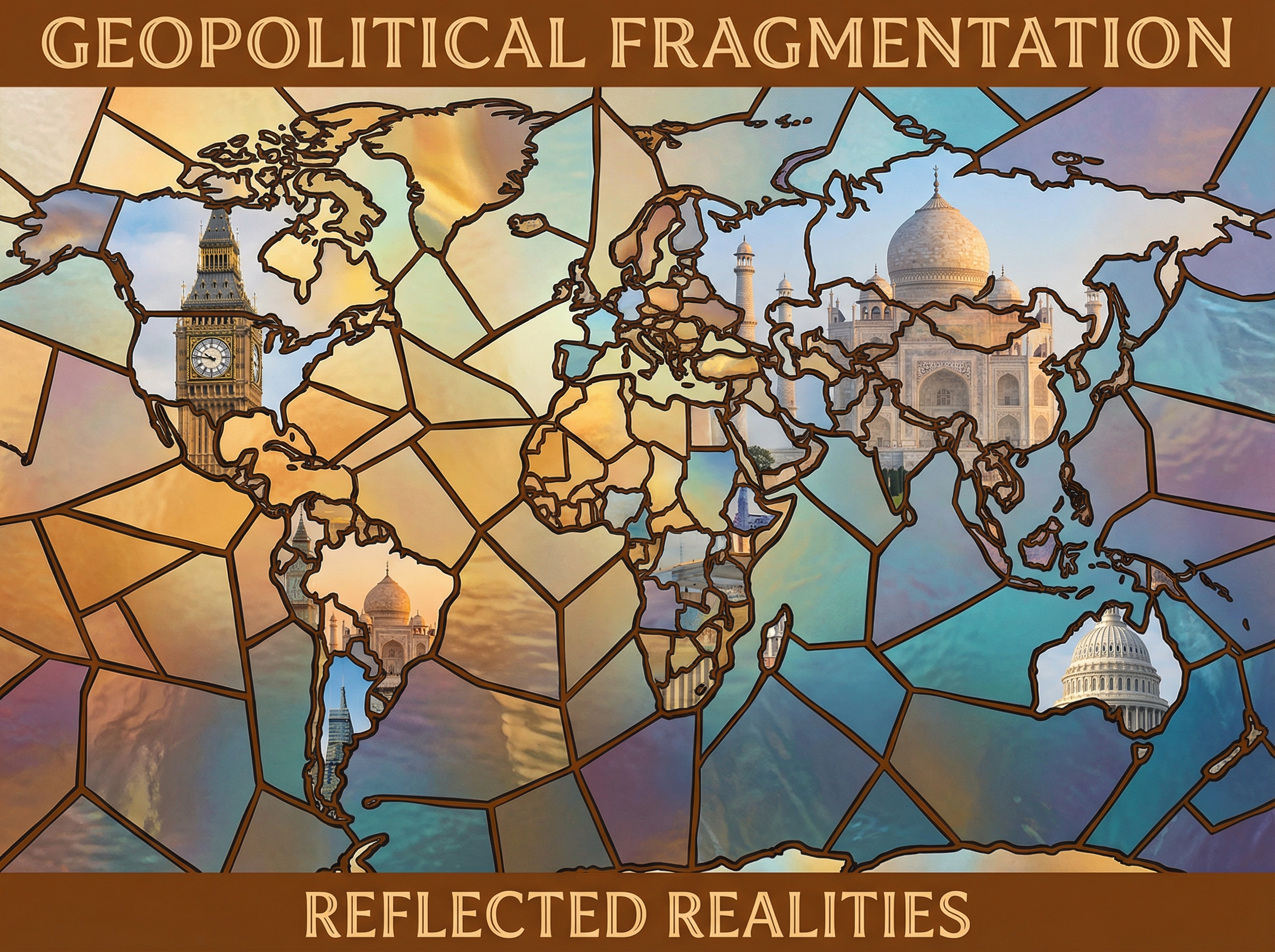
World map fragmenting into glass shards reflecting different landmarks

Ask an American about Churchill and you'll hear about the War Rooms, the bulldog, "finest hour." Ask an Indian and you'll hear about Bengal. Same historical figure, entirely different historical memory.

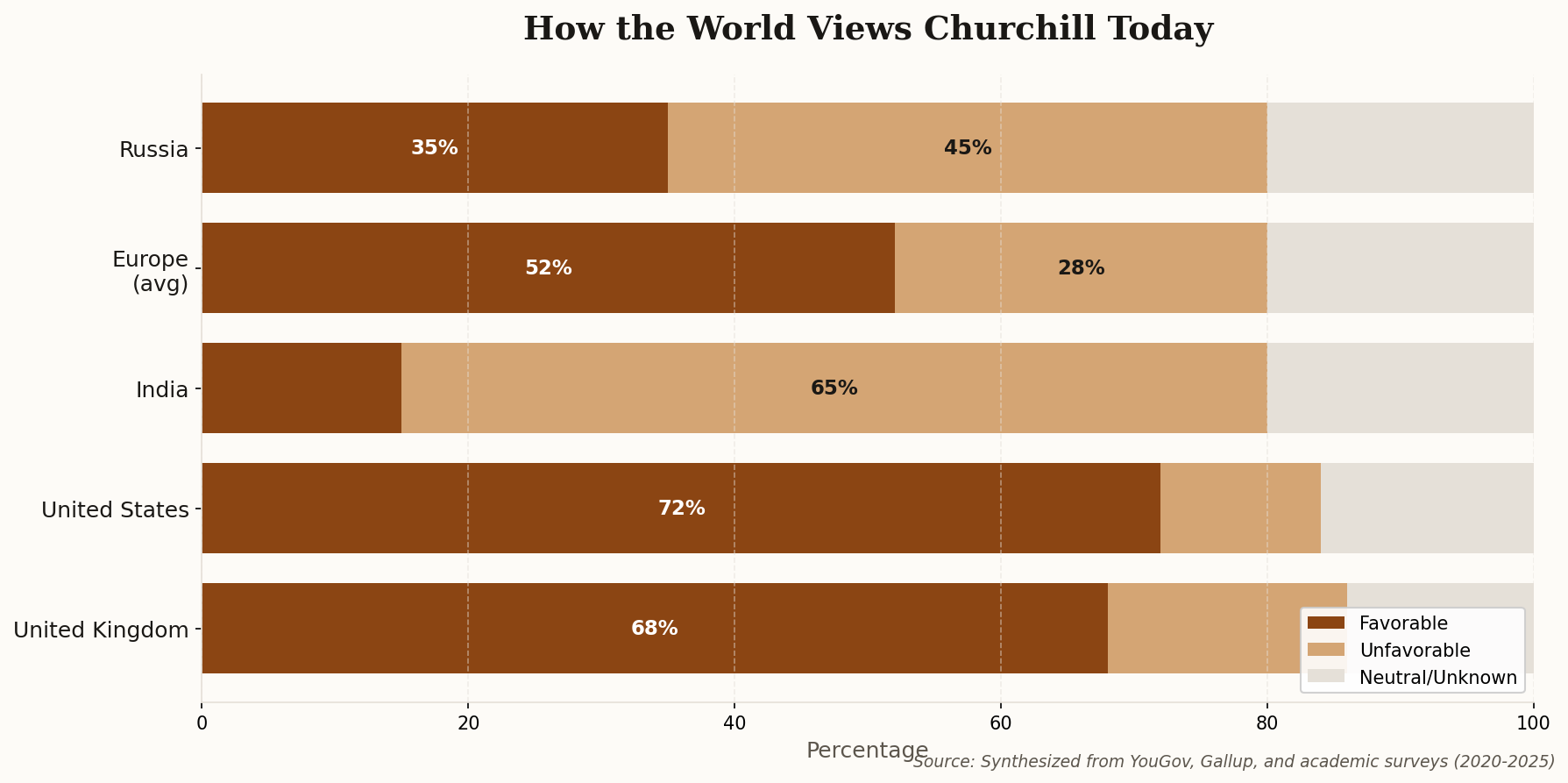
Bar chart showing favorable vs unfavorable views of Churchill by country
Perception varies dramatically by geography. The "special relationship" has preserved Churchill's image in the US far more than in Britain itself.

The numbers tell a stark story. In the UK, older generations still vote him "Greatest Briton"—but younger Britons are increasingly taught the colonial critique. In India, he ranks alongside the architects of partition. In America, he remains an uncomplicated hero, the historical equivalent of a Marvel character.

This isn't a failure of education—it's a feature. Nations remember the history that serves their self-understanding. Britain needs Churchill for Brexit-era "standing alone" mythology. America needs him for the origin story of the Atlantic alliance. India needs him as evidence that British rule was never benevolent.

The question isn't who's right. It's whether we can hold all three truths simultaneously.

04

Darkest Hour's Longest Afterglow

Film projector casting light through cigar smoke

Darkest Hour did something academic history couldn't: it made Churchill feel human. Gary Oldman's portrayal—complete with "black dog" depression, bathroom cigars, and genuine doubt—won the Oscar and reset public imagination of the man.

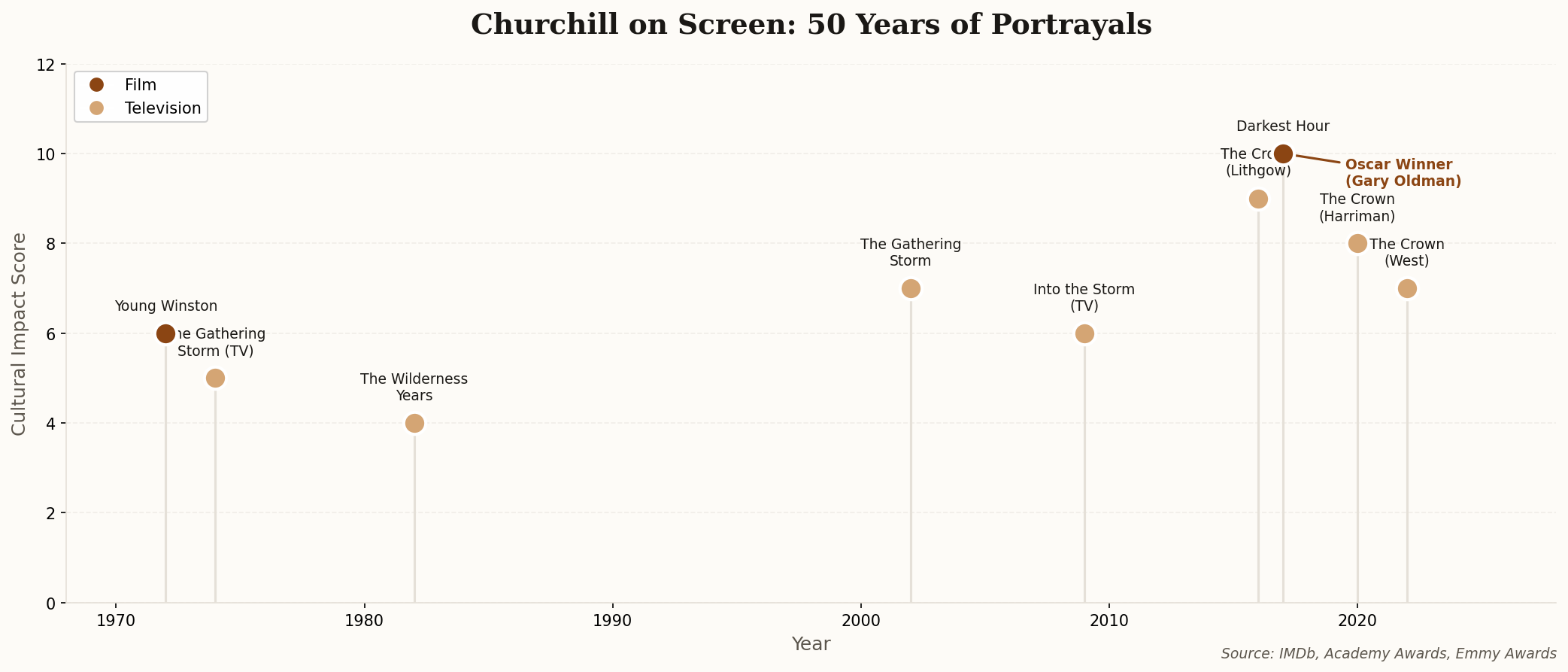
Timeline of Churchill portrayals in film and television from 1972 to 2022
Churchill has been portrayed more often on screen than any other British political figure. The intensity increased dramatically with streaming era prestige drama.

Then came The Crown—three different actors playing Churchill across six seasons. The Sutherland portrait episode, where Clementine burns the unflattering painting, became a cultural moment. Suddenly millions of people knew about Churchill's vanity, his alcoholism, his complicated marriage.

Entertainment doesn't replace historical scholarship. But it determines which scholars get read. Darkest Hour made Churchill human; The Crown made him flawed. Together, they primed a global audience for the "complex figure" narrative that academic historians had been developing for decades.

The irony: Churchill won the Nobel Prize for Literature. He wrote his own mythology. But in the streaming age, it's other people's screenplays that determine how he's remembered.

05

The Great Man Theory, Stress-Tested

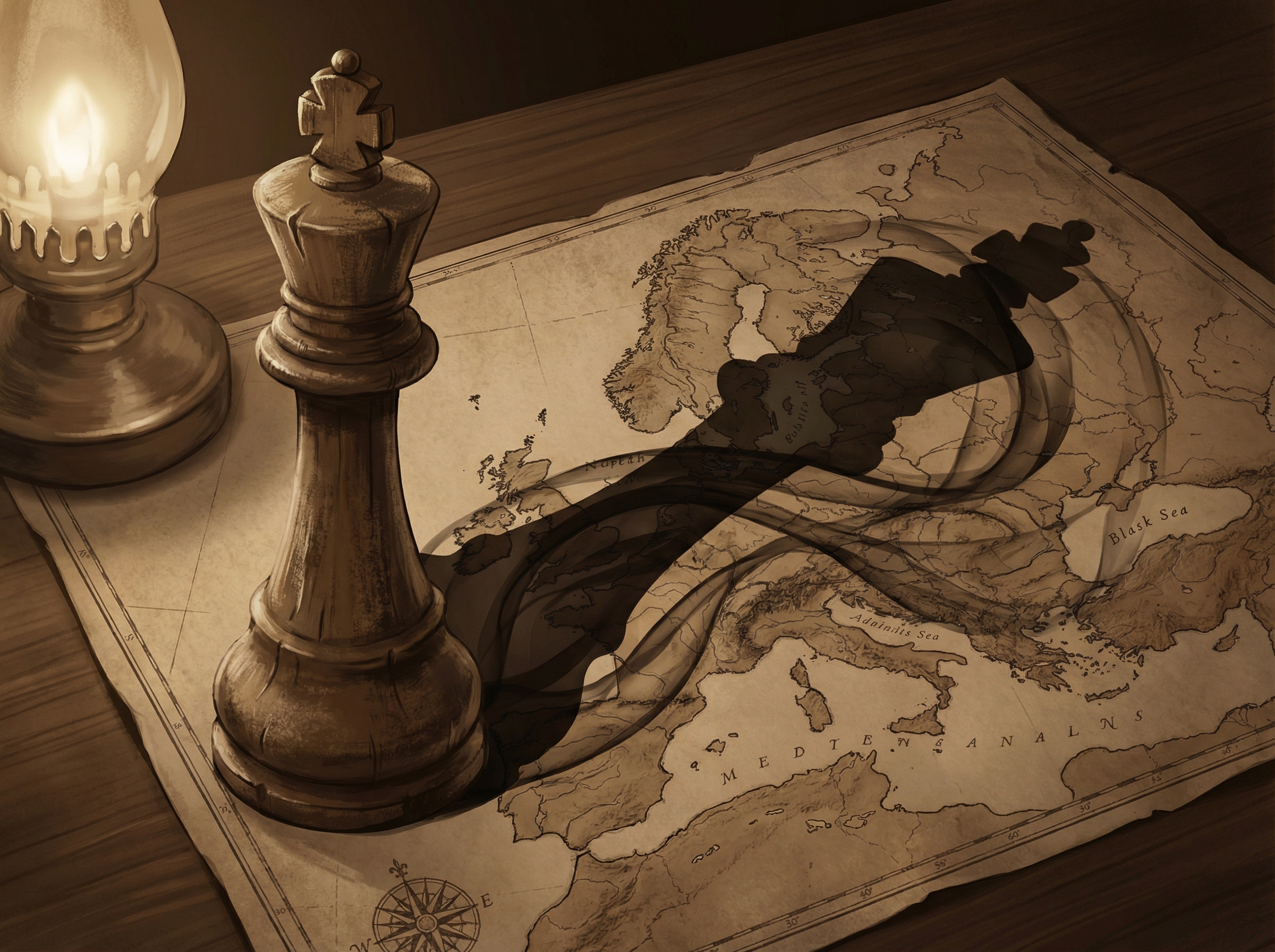
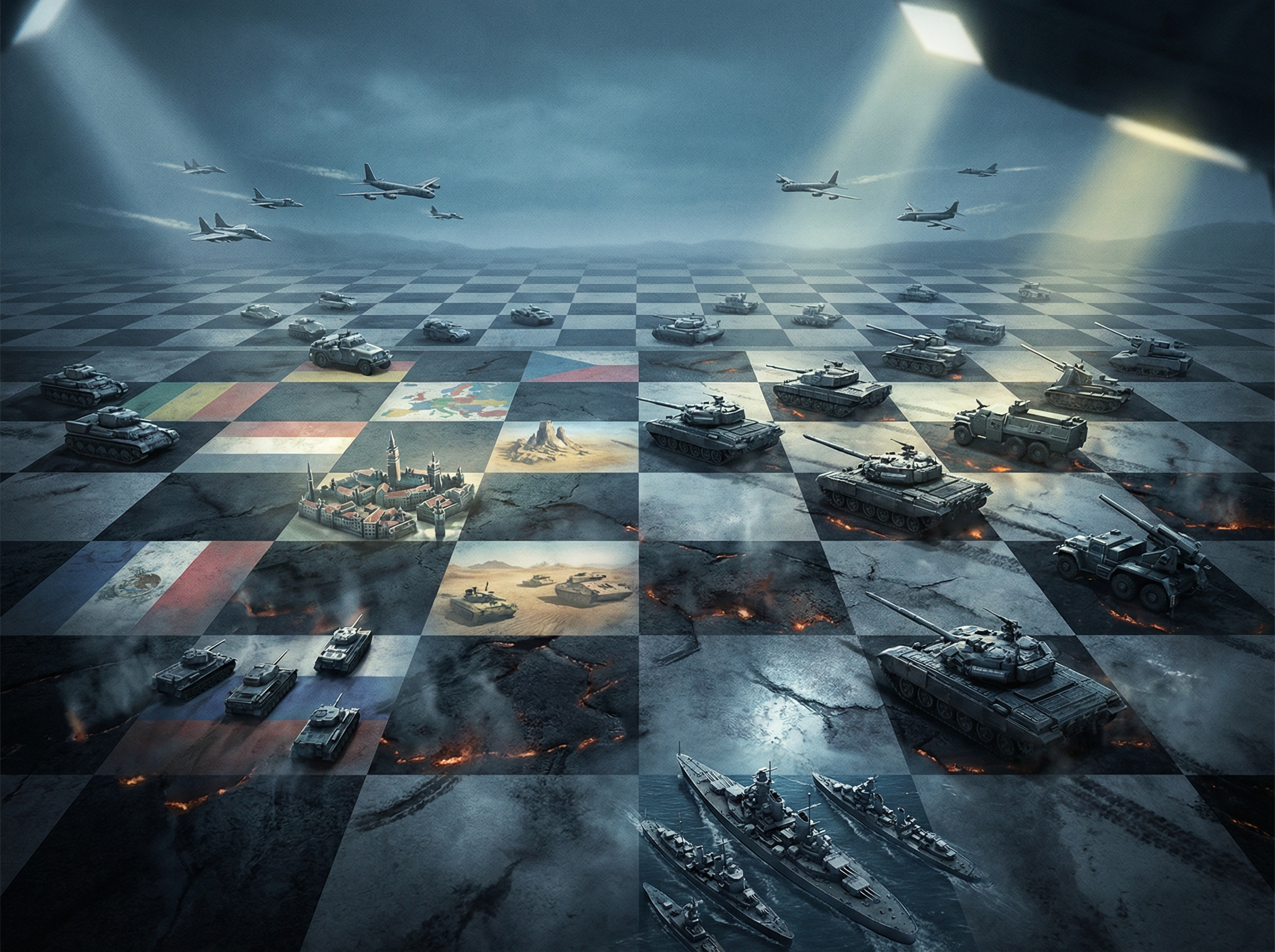
Chess king casting giant shadow across map of Europe

Here's the question that historians still fight about at conferences: Did Churchill save Britain, or would any prime minister have rallied the country against Hitler?

The "great man" camp—well-funded by Hillsdale College and popular with the political right—argues that without specifically Churchill in May 1940, Britain would have negotiated with Hitler. Halifax was ready to. The King preferred Halifax. Only Churchill's force of personality prevented surrender.

The structuralist counter: Britain's strategic position made fighting inevitable. The Royal Navy couldn't be neutralized. American industrial capacity was always going to tip the balance. The Empire provided resources no European power could match. Churchill was a brilliant communicator, but the outcome was determined by logistics, not oratory.

The honest answer is probably both. Structural forces set the parameters. Individual leadership determines what happens within them. Churchill didn't make Britain invincible—but he made Britain believe it was, at the moment that belief mattered most.

The real test of "great man" theory isn't whether Churchill was necessary. It's whether the Bengal Famine was necessary too. If Churchill's individual decisions caused preventable deaths, then individual agency works in both directions.

06

His Own Words, His Own Myth

Fountain pen on manuscript pages with swirling ink patterns

"History will be kind to me, for I intend to write it." Churchill reportedly said this, and whether or not the quote is apocryphal, he did exactly that. His six-volume The Second World War shaped historical memory for two generations. He won the Nobel Prize for Literature in 1953—not for fiction, but for making history literary.

This is the ultimate complication of Churchill's legacy: he wrote the first draft. The speeches we remember—"blood, toil, tears and sweat," "we shall fight on the beaches," "their finest hour"—weren't discovered by historians. They were crafted for immortality by a man who understood that rhetoric creates reality.

The challenge for 21st-century scholarship isn't recovering Churchill's words. It's escaping them. Every account of World War II that uses "their finest hour" uncritically is participating in Churchill's self-mythologizing. Every documentary that plays the speeches over footage of the Blitz is reinforcing narrative choices Churchill himself made.

He wanted to be remembered as the voice that rallied civilization. He succeeded. The question now is whether we can see past the performance to the man—and whether, having seen him clearly, we can still appreciate what the performance achieved.

The Final Verdict

"He saved liberty, but he did not believe in it for everyone." That's the sentence historians will write in the textbooks of 2050. Churchill won World War II and lost the moral high ground—simultaneously. Living with that contradiction is what it means to study history honestly.