Military History

Climb to Glory

How a ragtag unit of skiers, cowboys, and Ivy Leaguers became the most legendary mountain fighting force in American history — then came home and invented an industry.

Listen
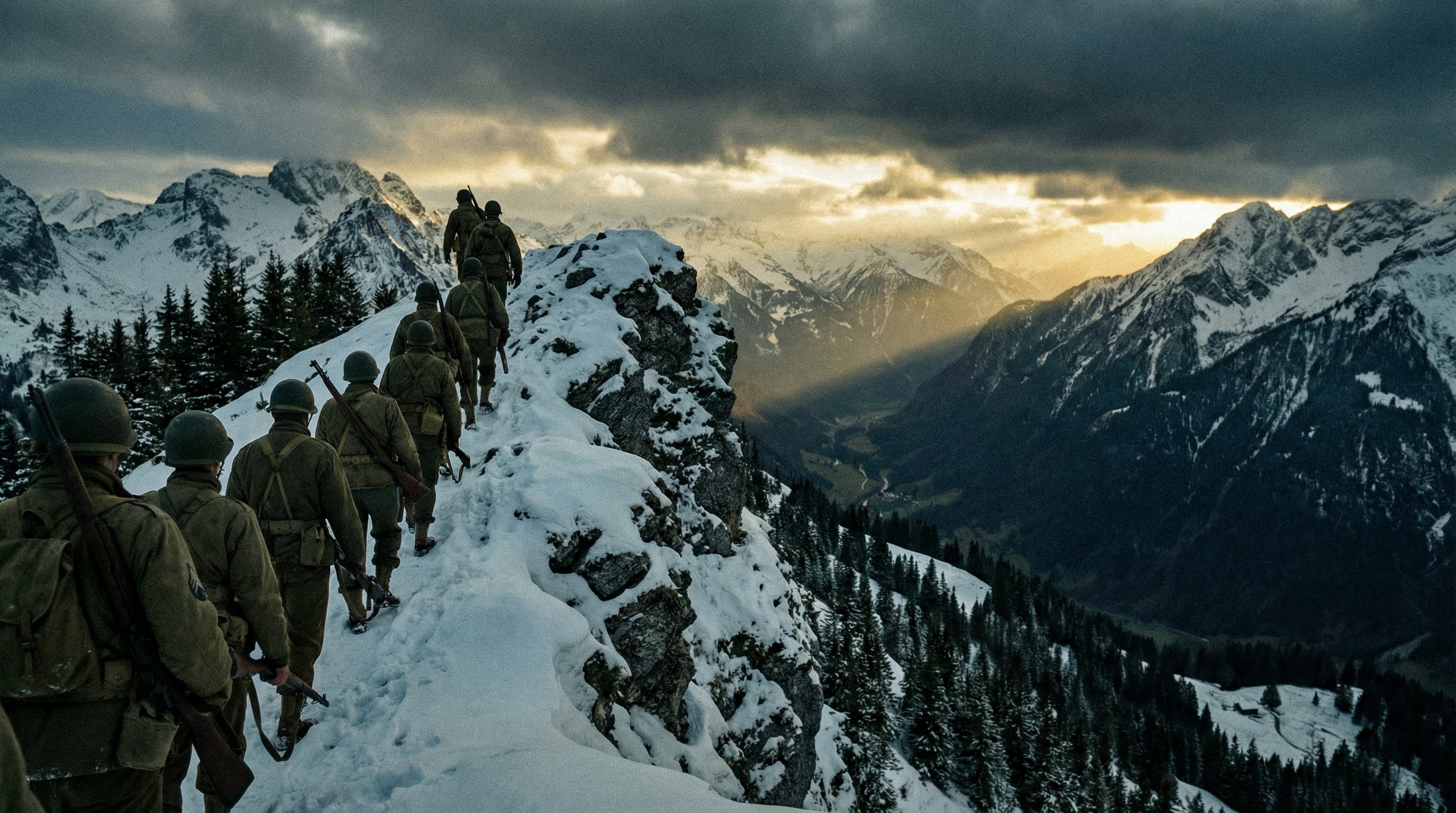
Soldiers of the 10th Mountain Division ascending a snow-covered alpine ridge at dawn during World War II
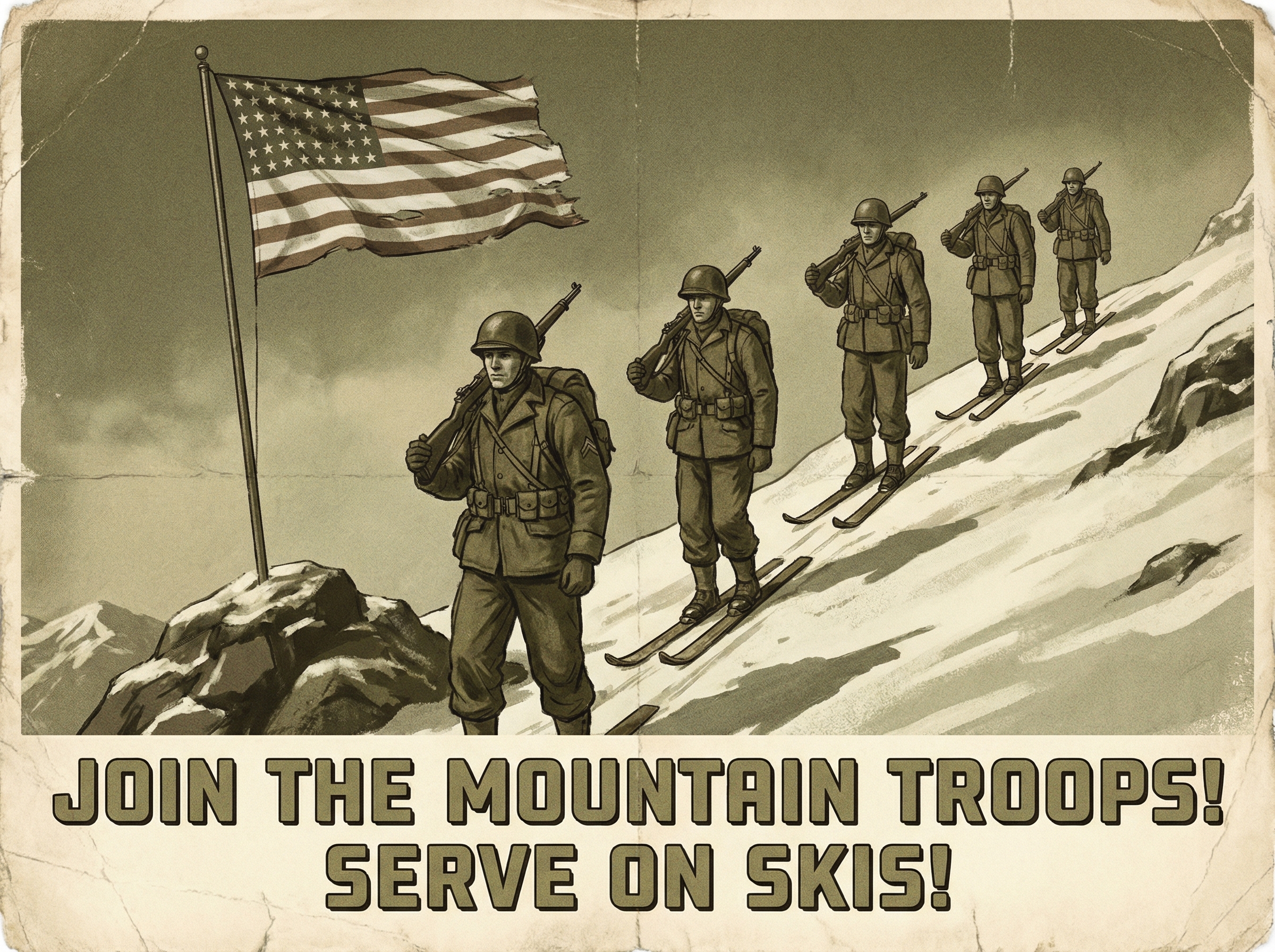
WWII-era ski troops ascending a mountain pass with rifles and equipment
01

The Skiers Who Talked the Army Into a War

In February 1940, four men sat by a roaring fire at the Orvis Inn in Manchester, Vermont, and conceived what would become the most improbable division in the United States Army. They had just watched Finnish ski troops humiliate the invading Soviet Red Army, and one thought kept nagging: the U.S. had nothing remotely comparable.

Charles Minot Dole, founder of the National Ski Patrol, decided to do something about it. He lobbied the War Department relentlessly, and in October 1941, General George C. Marshall handed Dole a mandate unlike anything in military history: recruit your own army unit. The reasoning was elegant — it was easier to train skiers to fight than to train soldiers to ski.

On December 8, 1941 — one day after Pearl Harbor — the Army activated its first mountain unit, the 87th Mountain Infantry Battalion, at Fort Lewis, Washington. The National Ski Patrol became the only civilian organization in American military history to serve as a recruiting agency. By July 1943, with three regiments organized, the unit gained divisional status at Camp Hale, Colorado — initially as the 10th Light Division (Pack Alpine), acquiring its iconic name, the 10th Mountain Division, in November 1944.

What made the recruiting genuinely remarkable was who showed up. Ivy League skiers rubbed shoulders with Norwegian immigrants who'd fled the Nazis, Austrian mountaineers, Colorado miners, Vermont lumberjacks, and Western cowboys. Olympic athletes signed up alongside ranchers who'd never seen a ski lift. It was a division built on a shared love of mountains rather than geography, class, or convention. The Army had never tried anything like it — and hasn't since.
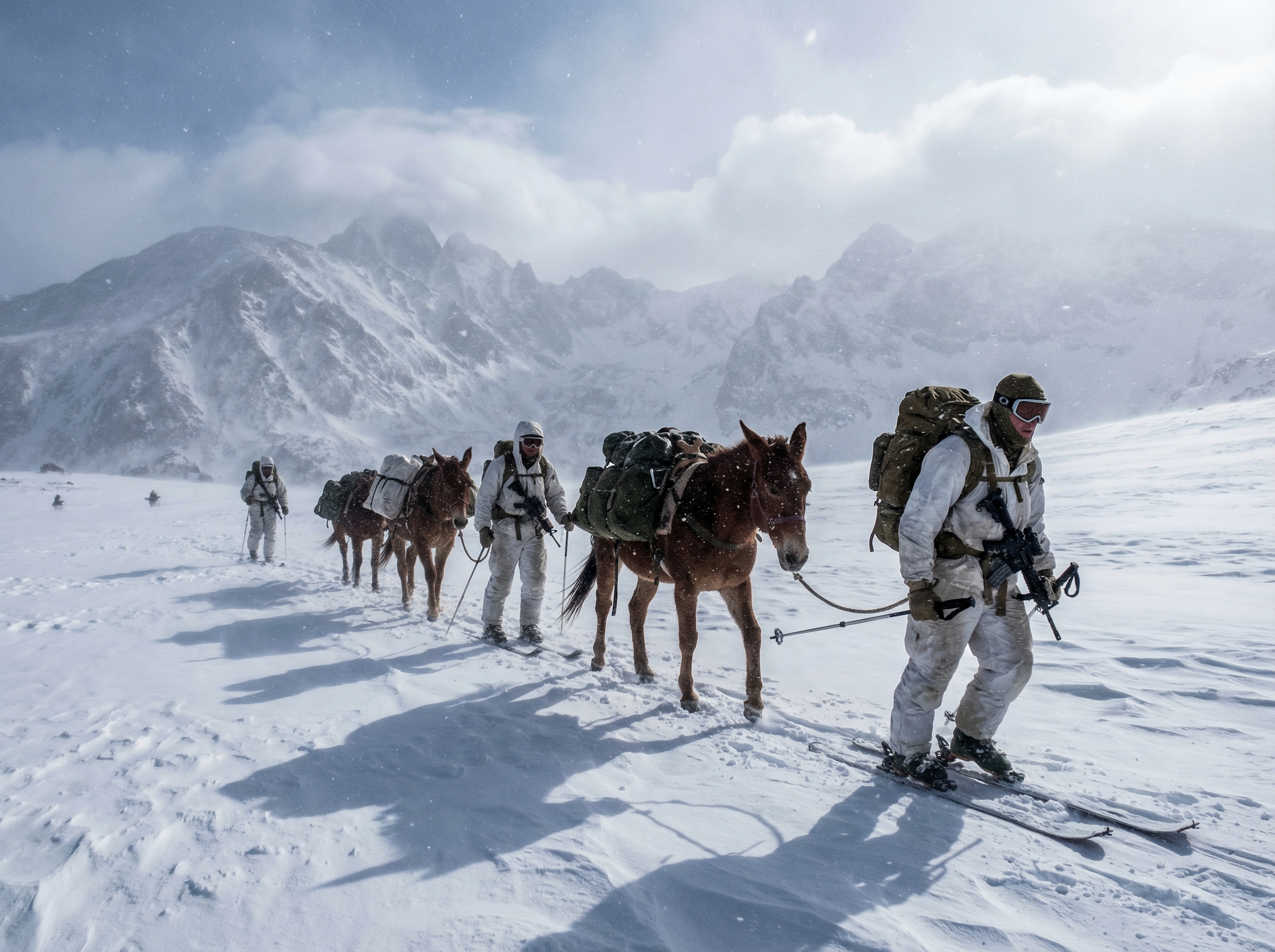
Soldiers training with pack mules in deep snow at Camp Hale, Colorado
02

Camp Hell: Where Mountains Broke Men Before War Could

Camp Hale sat at 9,224 feet in a narrow Colorado valley between Leadville and Red Cliff, making it the highest-altitude permanent military installation in World War II. The soldiers had a different name for it: Camp Hell. And a different name for their persistent, altitude-induced cough: the "Pando Hack," named after the nearby railroad siding.

The training was designed to be worse than combat — and by most accounts, it succeeded. Soldiers skied with full combat loads at altitudes between 9,000 and 14,000 feet. They learned to lead pack mules through chest-deep snow, to rock climb with weapons strapped to their backs, and to survive nights at 20 below zero without shelter. The infamous D-Series maneuvers sent entire companies into the backcountry for weeks at a stretch, navigating blizzards and avalanche terrain with only what they could carry.

Temperatures regularly plunged below minus 30°F. Some men lost fingers and toes to frostbite. The 53,000-acre base was a self-contained city — barracks, hospitals, movie theaters, ski runs, and stables for the division's 5,000 mules. But the real training happened above treeline, where the air was thin enough to make basic movement an ordeal.

Paul Petzoldt, already the most famous American mountaineer of his era after reaching 26,000 feet on K2 in 1938, demonstrated to 12,000 troopers how to properly layer and protect themselves from the elements. He later founded the National Outdoor Leadership School (NOLS) and the Wilderness Education Association — directly translating military mountain training into civilian outdoor education.

Veterans would later say, without irony, that combat in Italy was easier than training in Colorado. That was the point. General George P. Hays wanted men who would be unshakable on any mountain, in any weather, under any fire. At Camp Hale, he got them.

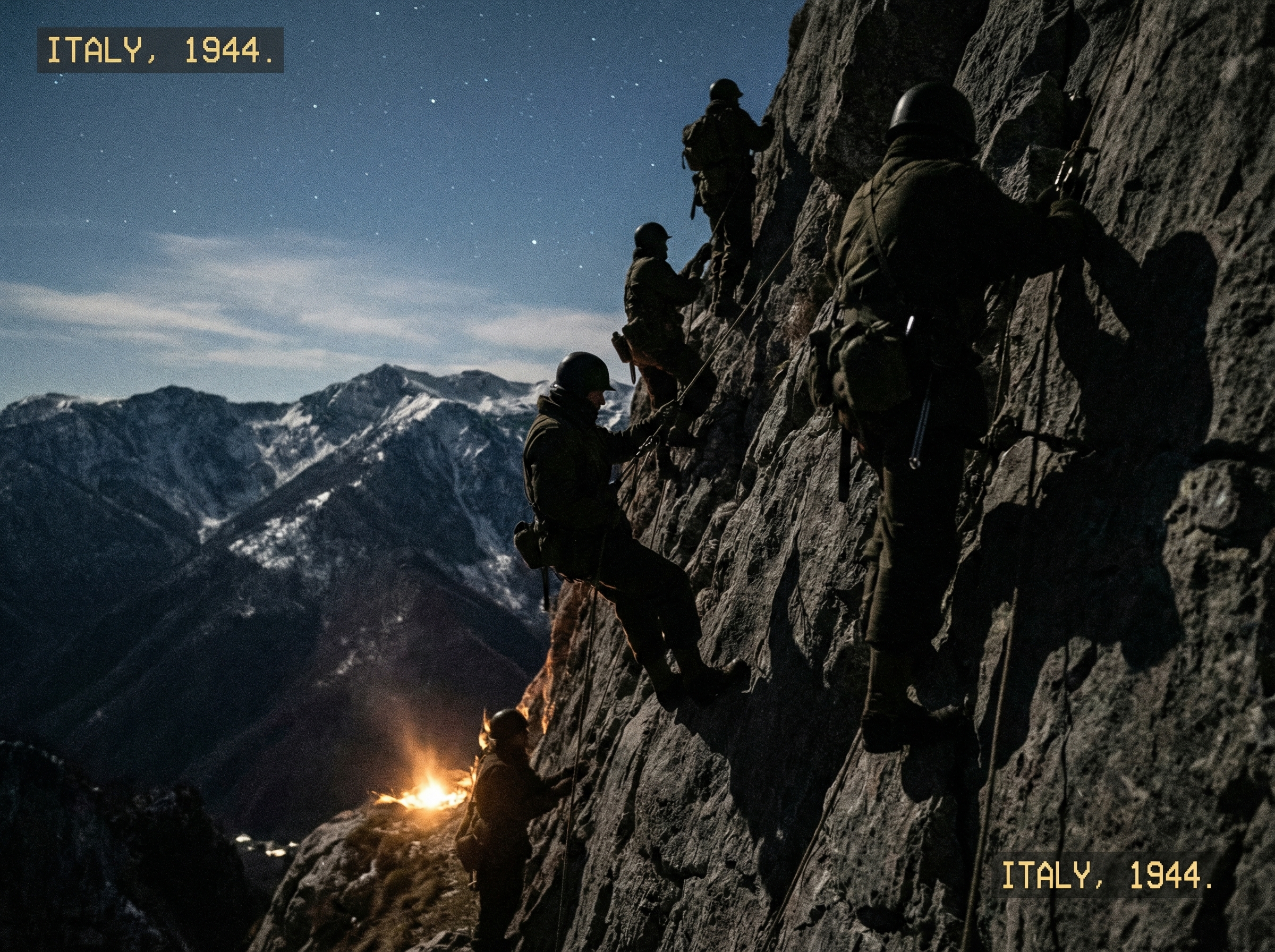
Soldiers climbing a sheer cliff face at night in the Italian Apennines
03

700 Men, One Cliff, Zero Room for Error

For 17 months, the Allies had tried to crack the Gothic Line in Italy's Northern Apennines. Three separate assaults on Mount Belvedere had failed, each time because German artillery observers on Riva Ridge — a steep, three-and-a-half-mile ridgeline to the west — could spot every movement and call down devastating fire. The conventional wisdom was that Riva Ridge's 2,000-foot eastern cliff face couldn't be climbed. The Germans thought so too, and barely bothered to guard it.

The 10th Mountain Division had trained for exactly this moment.

On the night of February 18, 1945, at 7:30 PM, 700 soldiers from the 1st Battalion, 86th Mountain Infantry began their ascent. They climbed between 1,700 and 2,000 vertical feet in darkness, using ropes, pitons, and fixed anchors that scouts had secretly installed over the preceding weeks. When German patrols fired in their direction, they didn't shoot back — silence was everything. By dawn on the 19th, they controlled the ridgeline. The cost: one man wounded.

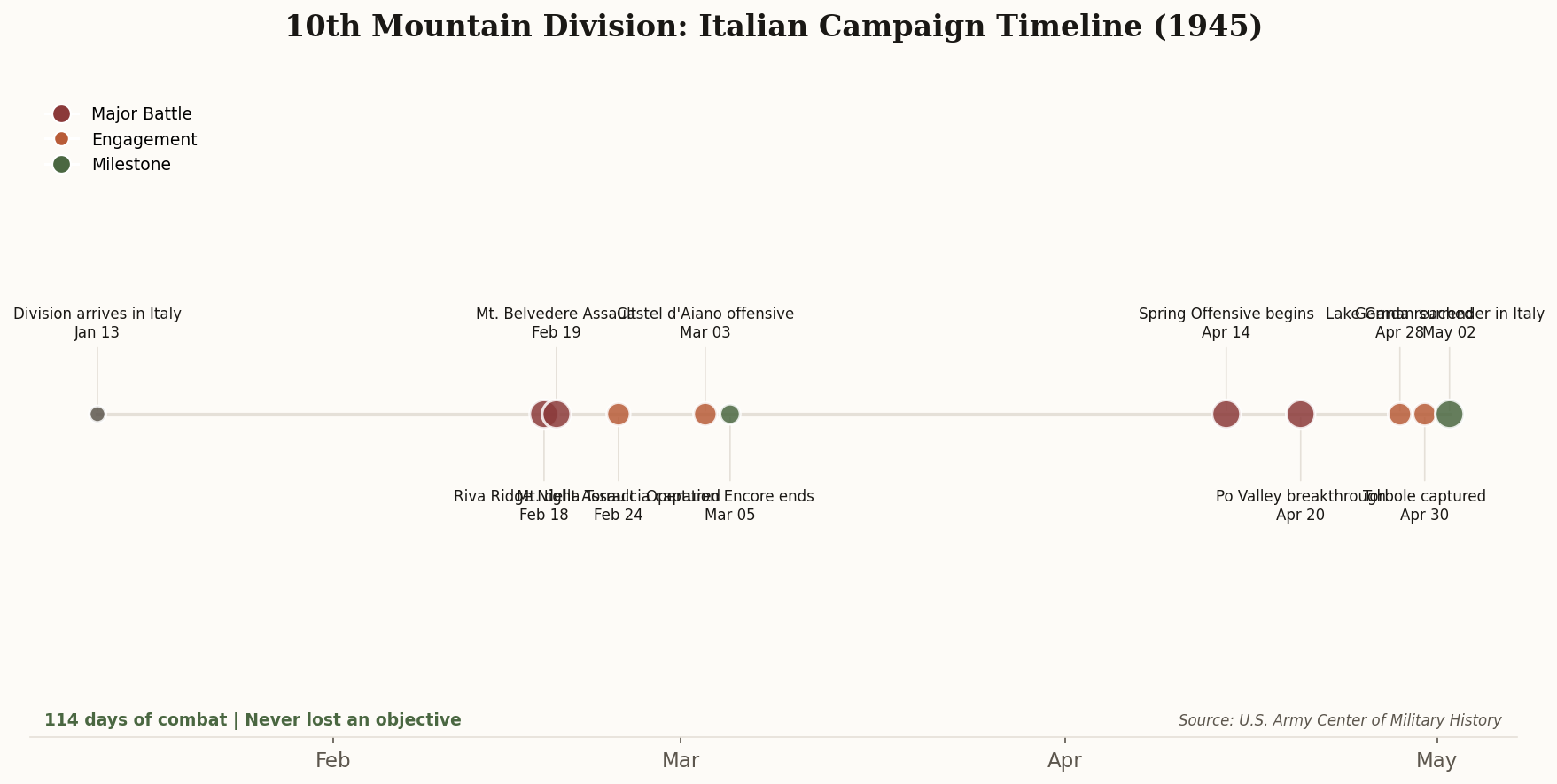
Timeline of the 10th Mountain Division's Italian Campaign from January to May 1945
The Italian Campaign compressed extraordinary violence into just 114 days, from the division's arrival in January to the German surrender in May 1945.

The following night, with Riva Ridge secure, the 85th and 87th Mountain Infantry launched their assault on Mount Belvedere itself. Without a preliminary artillery barrage — another calculated gamble for surprise — they stormed through minefields and machine gun nests. The 85th reached the summit between 3:30 and 5:30 AM. Allied command had expected the operation to take two weeks. The 10th did it in five days.

German counterattacks hammered the ridgeline for five straight days. The cost of Operation Encore was steep: 213 killed, 782 wounded. But the Gothic Line — the barrier that had stalled the entire Italian campaign — was broken. The 10th had done what no other unit could.

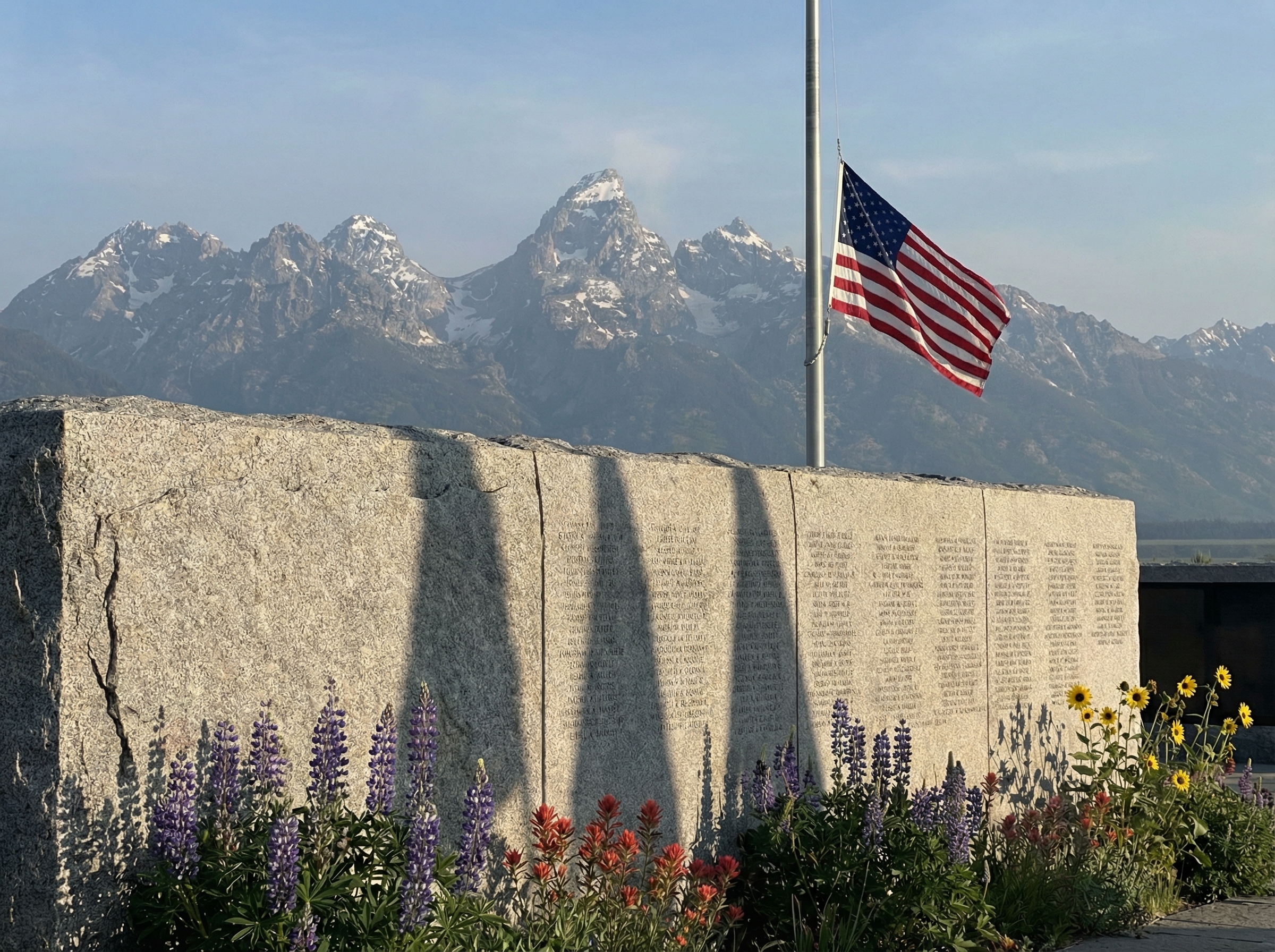
A granite memorial wall bearing the names of fallen 10th Mountain Division soldiers
04

992 Names Etched in Granite

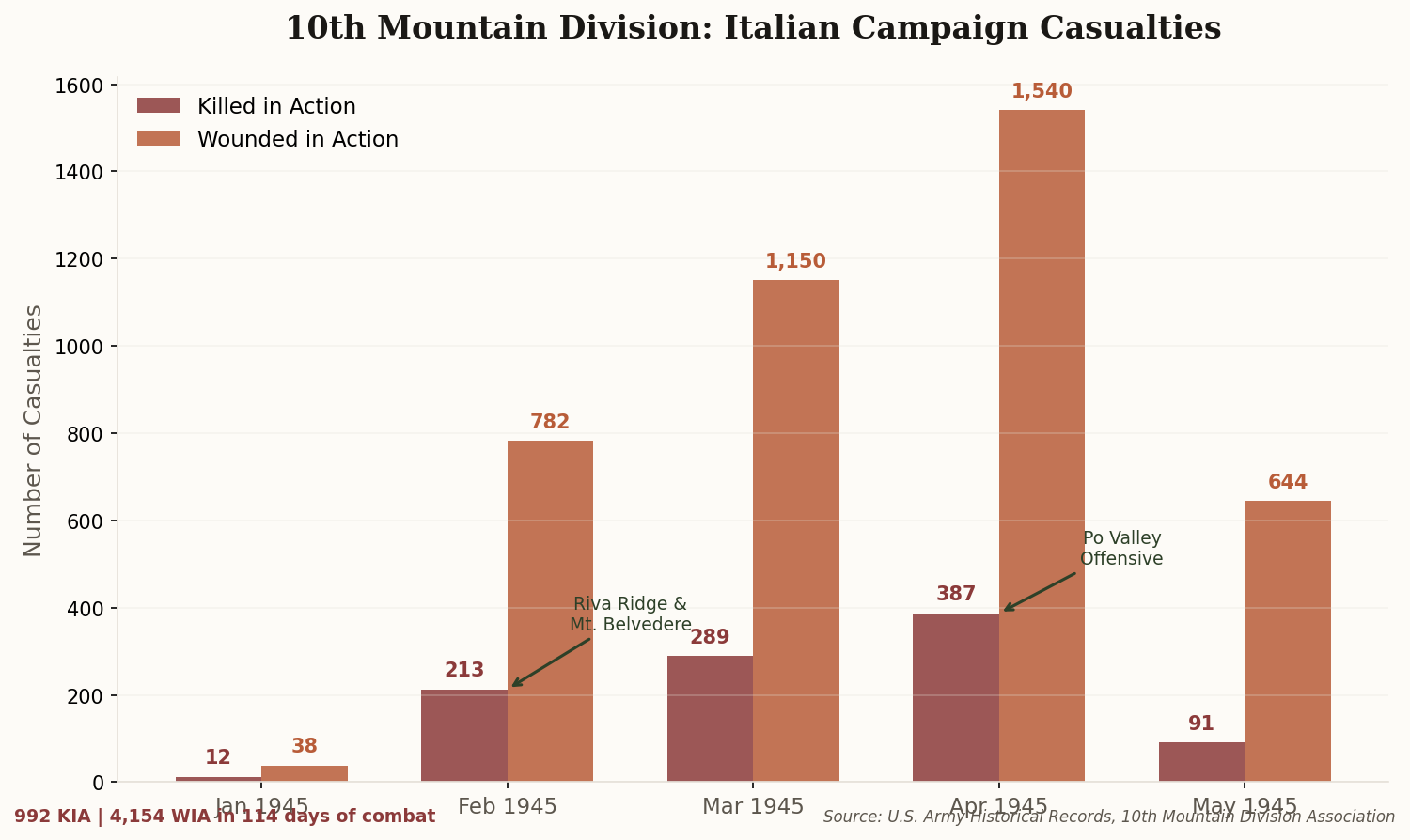
The numbers deserve to be stated plainly. In 114 days of combat in Italy, the 10th Mountain Division suffered 992 men killed in action and 4,154 wounded. That's a casualty rate that ranks among the highest of any American division in the war — compressed into fewer than four months. The division never failed to take an objective, and was never driven from any position it held. The price of that record was extraordinary.

Bar chart showing 10th Mountain Division casualties by month during the Italian Campaign
Monthly casualties spiked during the Riva Ridge/Belvedere assaults in February and the Po Valley offensive in April. The division packed an entire war's worth of fighting into a single spring.

After cracking the Gothic Line, the 10th remained at the spearhead of the Allied drive north. The spring offensive in April was the bloodiest stretch, as the division pushed into the Po Valley and drove toward Lake Garda. They reached the lake on April 28 and captured the town of Torbole on April 30, linking up with partisan forces just days before the German surrender in Italy on May 2, 1945.

Among the wounded was Second Lieutenant Bob Dole, hit by German machine gun fire while attempting to rescue a fallen radioman near Castel d'Aiano on April 14, 1945. Shrapnel severed nerves in his right arm, leaving it permanently paralyzed. He spent 39 months recovering in hospitals. He went on to serve 27 years in the U.S. Senate and run for president in 1996.

Every one of the 992 names is etched in granite on a memorial at the entrance to Ski Cooper on Tennessee Pass, near Camp Hale. It remains one of the most moving military monuments in the American West.

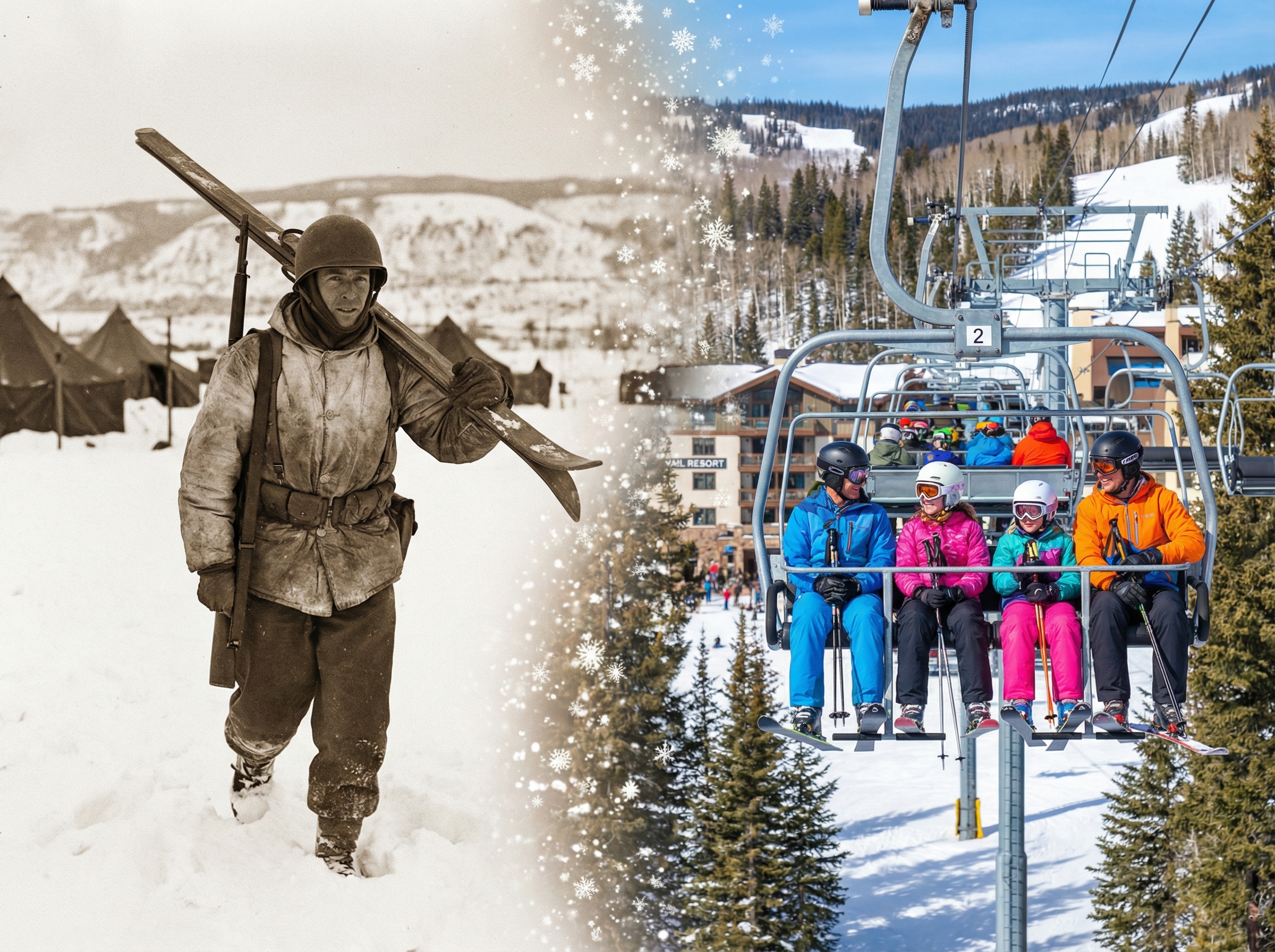
Visual transformation from WWII soldier carrying skis to modern ski resort scene
05

The Veterans Who Invented American Skiing

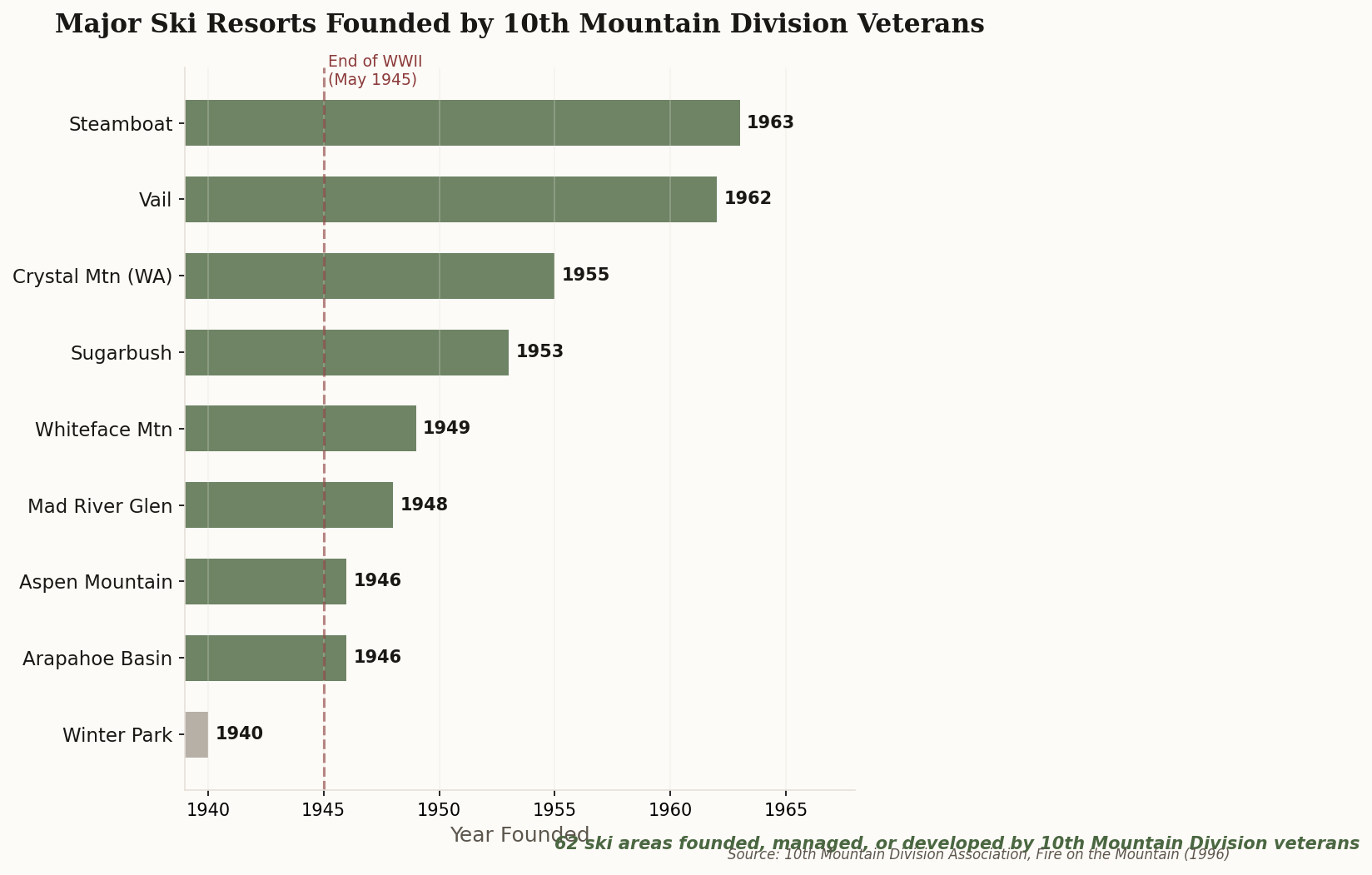
Here's a statistic that still seems too clean to be true: 62 American ski resorts were either founded, managed, or had their ski schools directed by 10th Mountain Division veterans. Before these men came home from the war, skiing in America was an obscure, upper-class New England pastime. Within two decades, they had built it into a national industry.

Timeline of major ski resorts founded by 10th Mountain Division veterans
The post-war ski boom wasn't accidental — it was engineered by veterans who knew mountains, logistics, and how to build from nothing. The dashed line marks the end of WWII.

The most famous story belongs to Pete Seibert. Wounded by mortar fire in 1945 — shrapnel through his helmet, left arm nearly severed, right kneecap destroyed, broken femur — he was told he'd never ski again. He spent 17 of his 39 months in the Army in hospitals. Then he won the Roch Cup in 1947. In 1957, he and rancher Earl Eaton hiked seven hours into the Colorado backcountry and found a mountain nobody had claimed. They opened Vail in 1962.

Friedl Pfeifer, an Austrian who'd grown up skiing in St. Anton, dreamed of building an alpine village in Colorado. During training maneuvers from Camp Hale, he and a small group hiked through the snow to a quiet mining town called Aspen. He looked up at Ajax Mountain and saw exactly what he was looking for. In 1946, Pfeifer co-founded the Aspen Skiing Company and established the ski school that would teach a nation how to turn.

Lawrence Jump created Arapahoe Basin in 1946 with an all-10th Mountain crew. Fritz Benedict, who would later build the famous hut system, became Aspen's first trained architect. Approximately 2,000 veterans became certified ski instructors. Others designed resorts, built lifts, and manufactured equipment. They also changed the economics — resorts opened by 10th Mountain men often included affordable ski schools, making the sport accessible to families for the first time.

Beyond skiing: David Brower became the Sierra Club's first executive director and America's preeminent conservationist. Bill Bowerman, a track coach who trained with the division, popularized jogging in America and co-founded Nike with Phil Knight. Paul Petzoldt founded NOLS. The 10th's influence extended far beyond the slopes.

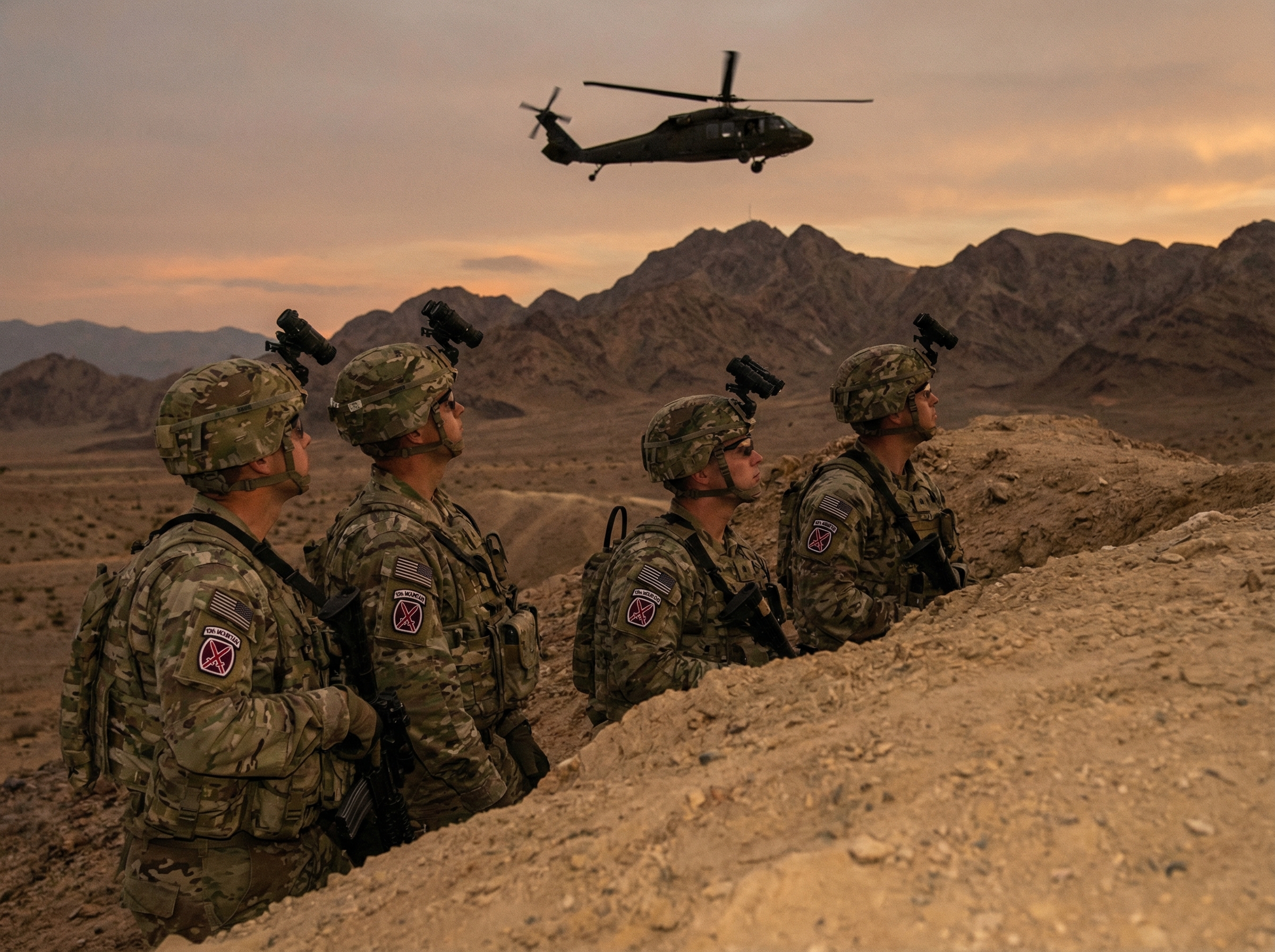
Modern 10th Mountain Division soldiers in desert combat gear with helicopter overhead
06

America's Most Deployed Division

The 10th Mountain Division was deactivated after WWII, then reborn in 1985 at Fort Drum, New York, as a light infantry division. The mountains of northern New York provided a fitting home, though the modern 10th fights in a very different theater than its founders imagined. Since 2002, it has been the most deployed regular Army division in the United States military — a distinction earned in sand and dust, not snow.

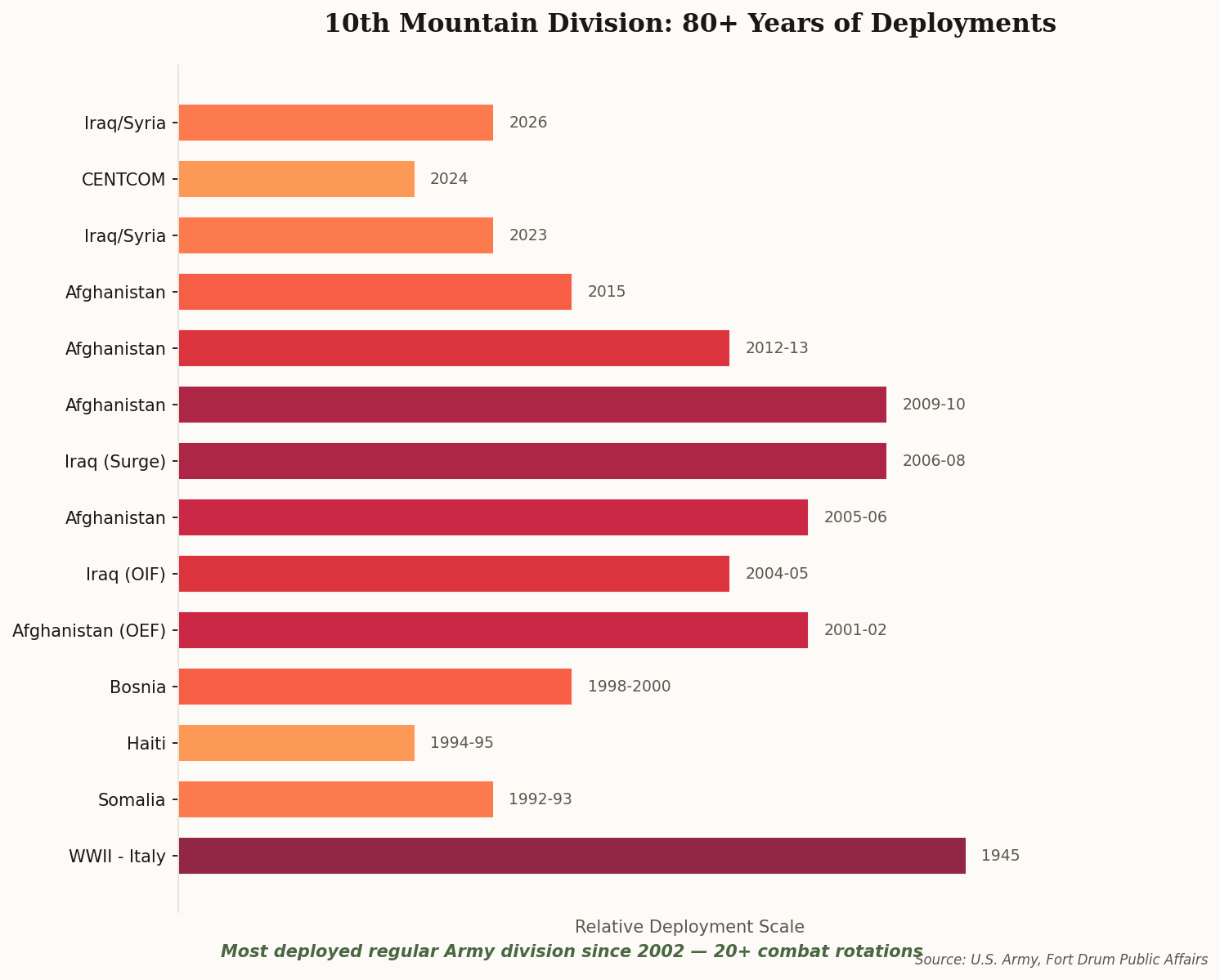
Chart showing 80+ years of 10th Mountain Division deployments from WWII to 2026
From the mountains of Italy to the deserts of Iraq, the 10th Mountain Division has deployed to nearly every major U.S. military operation since its reactivation in 1985.

The modern deployment history reads like a map of American foreign policy. Somalia in 1992–93 (Operation Restore Hope). Haiti in 1994–95. Bosnia at the close of the decade. Then came September 11, and the tempo became relentless: the 10th deployed to Afghanistan in late 2001, securing forward operating bases and fighting in Operation Anaconda. Over the next two decades, the division's combat brigades completed more than 20 rotations to Afghanistan and Iraq.

In 2023, the division fended off nearly 100 Iranian drone attacks on American bases in Iraq and Syria, with three soldiers earning the distinction of drone "ace." In spring 2026, approximately 1,900 soldiers from the 2nd Mobile Brigade Combat Team are deploying to Iraq and Syria under a new organizational structure emphasizing small-unit tactics and emerging technology.

The motto hasn't changed: "Climb to Glory." The mountains have.

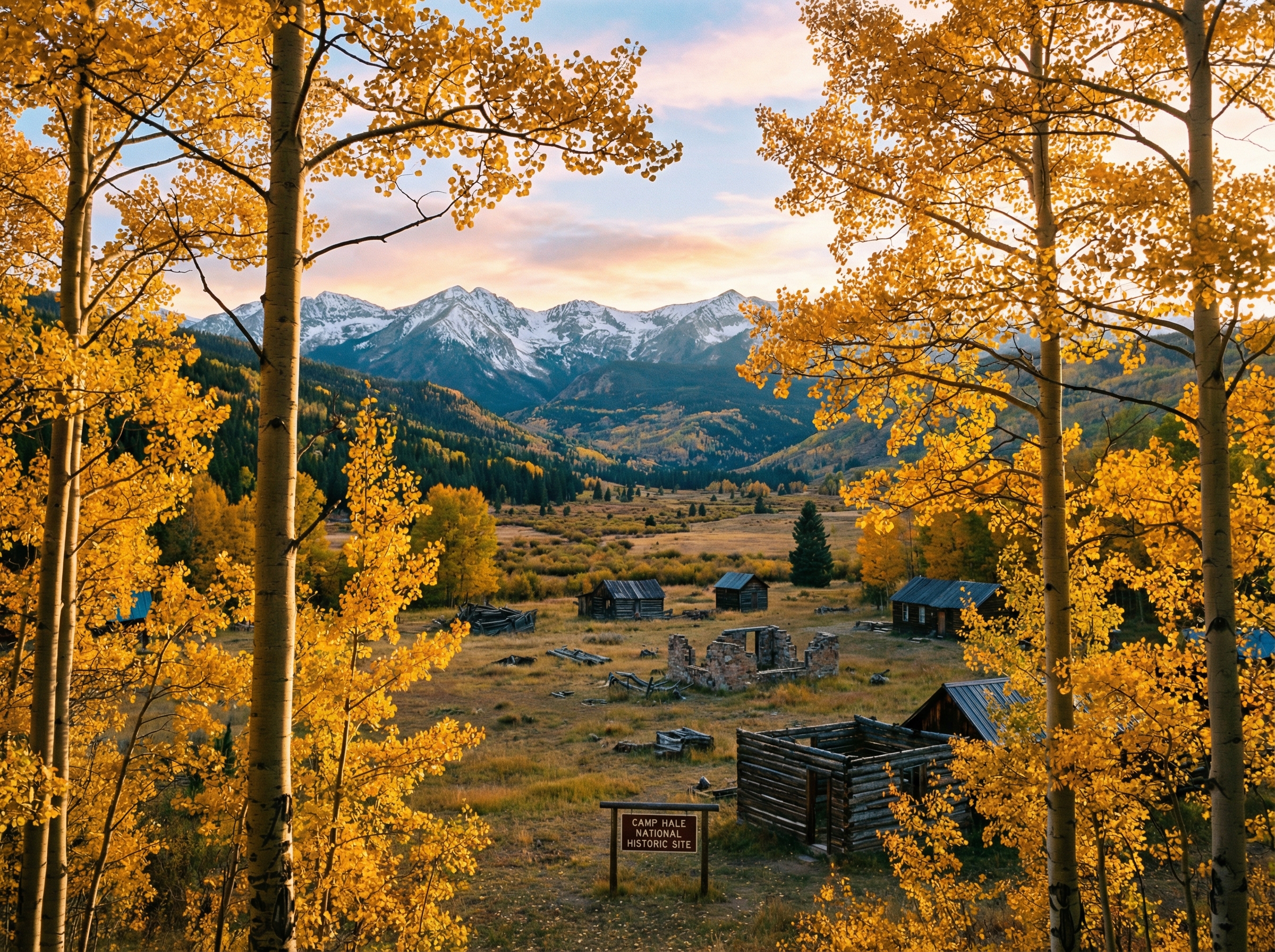
Camp Hale valley in autumn with golden aspen trees and Continental Divide peaks
07

Sacred Ground — From Camp Hell to National Monument

On October 12, 2022, against a backdrop of mountains, evergreens, and yellow-tinged aspens, President Biden signed the declaration establishing the Camp Hale–Continental Divide National Monument — 53,804 acres in the heart of the Colorado Rockies, his first use of the Antiquities Act. "In honor of our nation's veterans, Indigenous people, and their legacy," Biden said. The designation protects not just the training grounds but ten peaks above 13,000 feet, including 14,265-foot Quandary Peak, and critical habitat for elk, lynx, and songbirds.

Today, the Camp Hale valley is a quiet meadow at 9,200 feet, framed by the Continental Divide. The barracks, mess halls, and hospital are gone — demolished in the 1960s — but the foundations remain visible, ghostly rectangles in the grass. Interpretive signs mark where 14,000 men once trained in conditions that would break most modern hikers. It remains public land, open for hiking, skiing, and simply bearing witness.

The monument's future is not entirely certain. A June 2025 DOJ opinion asserted presidential authority to rescind national monument designations — reversing 87 years of legal interpretation. Camp Hale hasn't been specifically targeted, and 92% of Colorado voters polled support keeping it, but the legal ground has shifted.

Meanwhile, the 10th Mountain Division Hut Association maintains 38 backcountry huts connected by 350 miles of trails between Vail, Aspen, and Leadville. The system was conceived by Fritz Benedict, a 10th Mountain veteran and Aspen's first trained architect, who dreamed of replicating the European alpine hut experience in the Rockies. The first two huts were built in 1982; today the network is one of the premier backcountry skiing experiences in North America.

In February 2025, the division marked the 80th anniversary of Riva Ridge. Soldiers from the 173rd Airborne Brigade began their ascent of the actual ridge in Italy at 0400 on February 18 — the same date, the same location, 80 years later. Sergeant Isaac Kirk took his reenlistment oath at the summit of Pizzo di Campiano. Back in Colorado, soldiers completed the Hale-to-Vail traverse, a 26-mile cross-country ski trek from Camp Hale to the resort that Pete Seibert built. Vail held its Legacy Weekend with parades through the village.

Eighty years on, the thread holds. The mountains remember.

Looking Up

The 10th Mountain Division's story is fundamentally about transformation — turning skiers into soldiers, soldiers into entrepreneurs, a training camp into sacred ground, and one division's sacrifice into an entire industry's foundation. It's a reminder that the skills we build for one purpose can reshape the world in ways we never intended. The men who climbed Riva Ridge didn't know they'd one day build Vail. They just knew how to climb.