
Home Storage

Your Data, Your Rules

The home NAS market is experiencing a renaissance. New players, smarter software, and a growing distrust of cloud subscriptions are driving a return to local storage ownership.

Listen
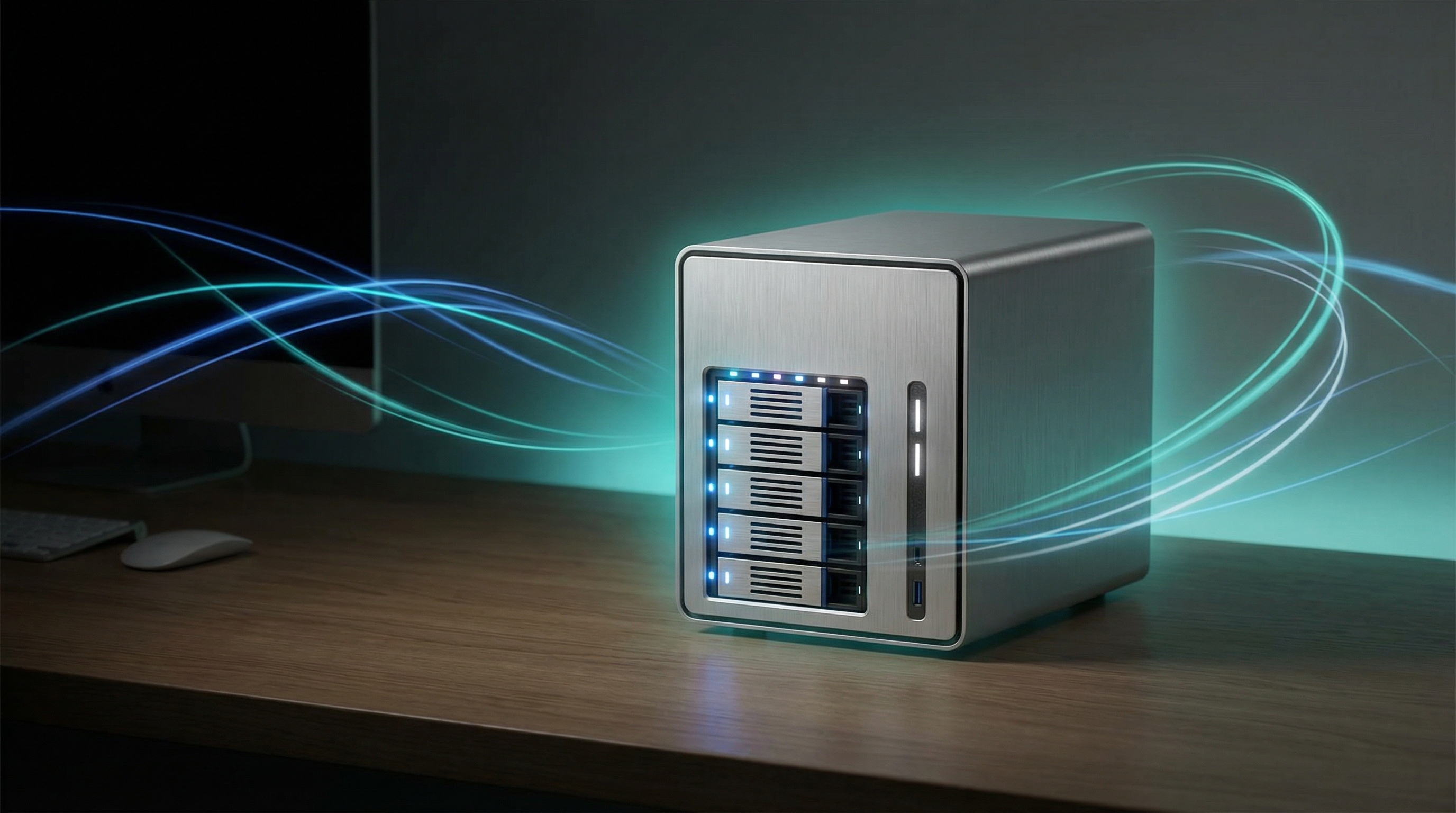
Modern home NAS server with glowing activity LEDs in a minimalist home office
UGREEN NAS with AI visualization at CES
01

UGREEN Crashes the Party with AI-Powered Storage

Two years ago, UGREEN was a nobody in the NAS world. At CES 2026, they unveiled the most aggressive product lineup yet: dual 10GbE networking, Thunderbolt 4 connectivity, 64GB RAM capacity, and—here's the kicker—fully local AI that processes your files without touching the cloud.

The NASync DXP series earned $6.6 million on Kickstarter from over 13,000 backers. That's not a niche product finding its market. That's a direct challenge to Synology and QNAP's decade-long duopoly.

What's remarkable isn't just the specs—it's the philosophy. UGREEN explicitly positions against cloud subscriptions and "opaque data pipelines." Their Local AI Engine analyzes, searches, and summarizes files entirely on-device. Your photos never leave your house to get face recognition.

The takeaway: Competition in consumer NAS is finally heating up. Expect incumbent players to respond with their own local-AI features or risk losing the privacy-conscious segment.

Symbolic image of chains breaking around hard drives
02

Synology Blinks: The HDD Restriction Reversal

Sometimes the best news is a company admitting it was wrong. With DSM 7.3, Synology reversed its controversial policy of warning users about "unverified" third-party drives on Plus, Value, and J series devices.

The backstory: Synology had been pushing branded (read: overpriced) hard drives by displaying alarming messages when users installed standard consumer drives. The community reaction was swift and hostile. Forum threads filled with users threatening to switch to QNAP. Review scores dropped.

Now you can use any compatible 3.5-inch HDD or 2.5-inch SATA SSD without warnings, restrictions on storage pool creation, or guilt-tripping "unverified" messages. It's what the hardware should have allowed from day one.

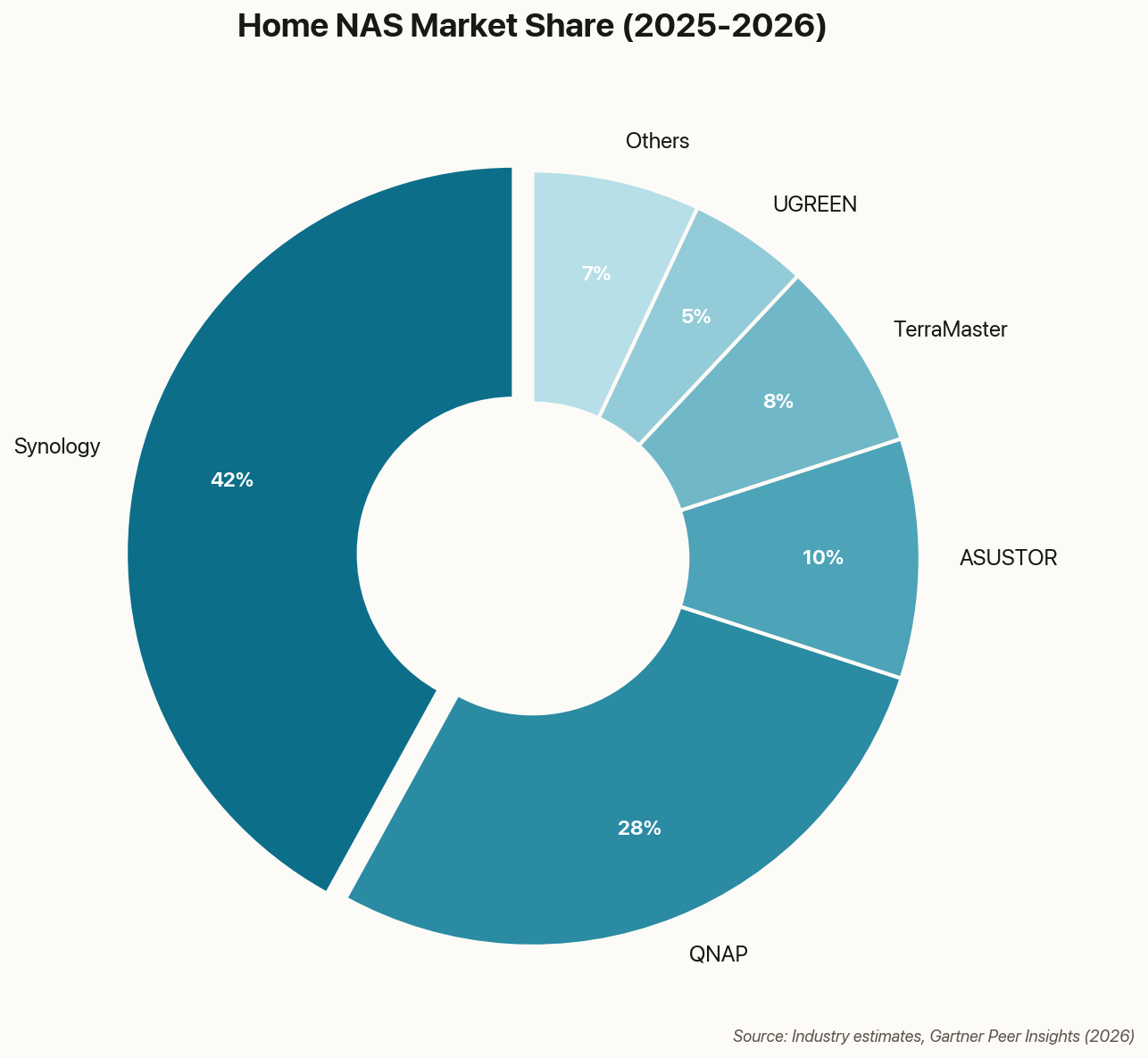
Pie chart showing NAS market share with Synology at 42%, QNAP at 28%, and others
NAS market share remains dominated by Synology and QNAP, but new entrants are gaining ground.

Looking ahead: DSM 8 is expected in 2026. For devices from 2016–2018, DSM 7.3 will be the final major update. Synology seems to be using this release as a goodwill-building bridge to their next-generation platform.

ASUSTOR Lockerstor Gen3 server with AMD Ryzen chip
03

ASUSTOR Goes Nuclear with AMD Ryzen

While Synology and QNAP rely on Intel Celeron processors for their consumer lines, ASUSTOR just changed the equation. The Lockerstor Gen3 series ships with AMD Ryzen V3C14 CPUs boosting up to 3.8 GHz—the kind of silicon you'd find in a serious workstation, not a file server.

The lineup spans 4, 6, 8, and 10-bay configurations, all with ADM 5.0 software. That OS update landed in May 2025 with a refreshed interface and improved Docker support—critical for the home lab crowd running containers for everything from Plex to Home Assistant.

The Gen2+ series (released alongside Gen3) offers a more modest upgrade path: dual 5GbE ports delivering 10 Gbps combined bandwidth. Not everyone needs workstation-class CPU power, but nearly everyone can benefit from faster network transfers.

The calculus: ASUSTOR is betting that enthusiasts will pay a premium for raw performance. At the flagship level, that bet is probably correct. The question is whether they can compete on software polish with Synology's DSM.

TerraMaster NAS in home office setting
04

TerraMaster's Quiet Ascent

TerraMaster has long been the budget option—decent hardware, mediocre software. That narrative is changing. TOS 6 represents their most ambitious operating system overhaul, with a redesigned interface that finally feels modern rather than dated.

The hardware lineup expanded too. The F4-425 Plus ($570) packs an Intel N95 quad-core, 8GB DDR4, 2.5GbE, and three M.2 slots into a four-bay enclosure. That's competitive spec-for-spec with QNAP's TS-464, often at a lower street price.

For the all-flash crowd, the F8 SSD Plus targets creative professionals with 8 bays, Intel 8-core CPU, 4K hardware decoding, and 10GbE. It's not consumer-priced, but it shows TerraMaster's ambition to move upmarket.

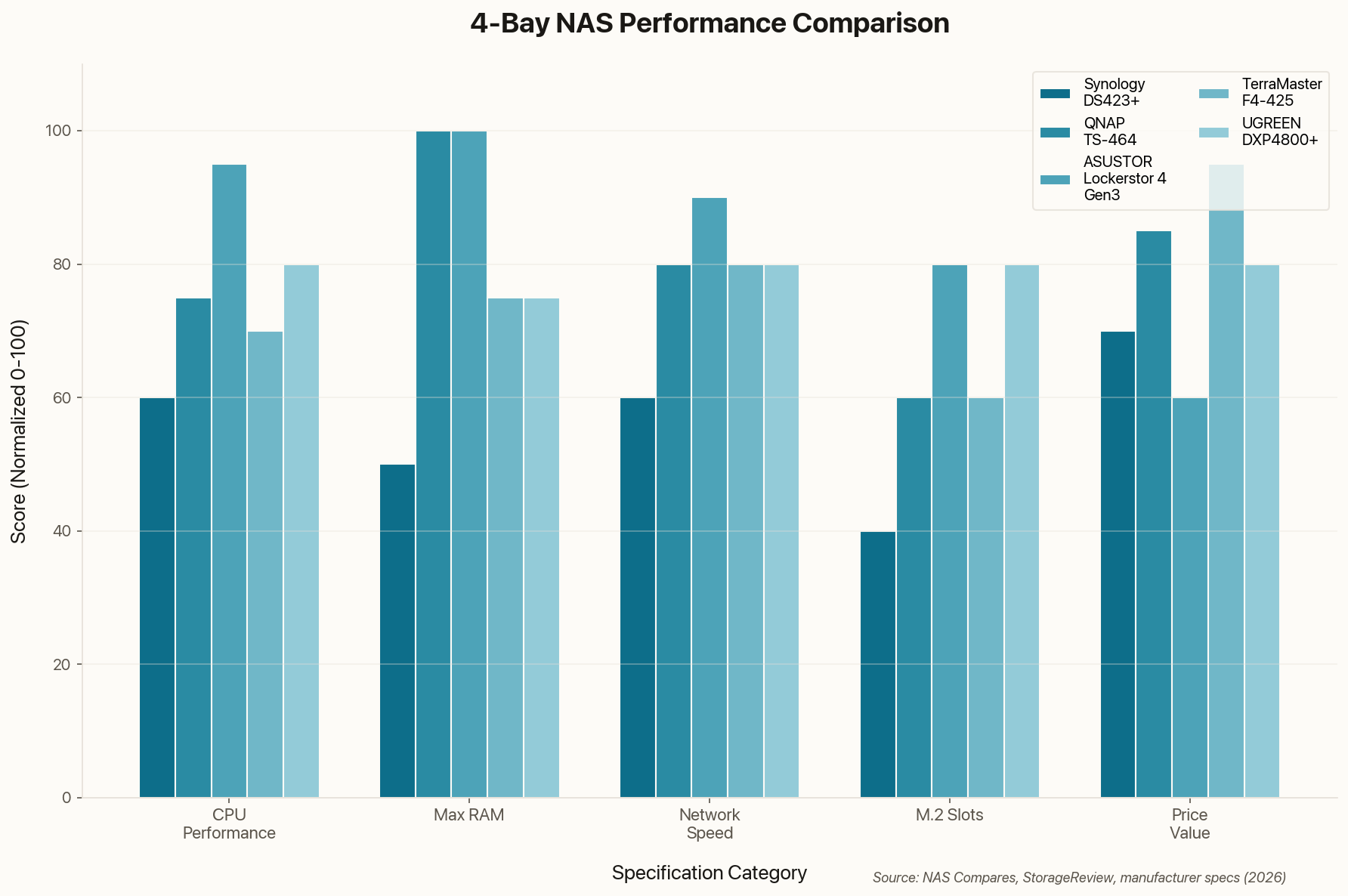
Bar chart comparing NAS performance across CPU, RAM, network speed, M.2 slots, and price value
4-bay NAS comparison showing normalized scores. TerraMaster leads on price-value; ASUSTOR dominates raw performance.

TOS 7 is coming: Registration for the Insider Preview closed recently. The new version promises a built-in virtual machine manager—closing a gap with QNAP's Virtualization Station.

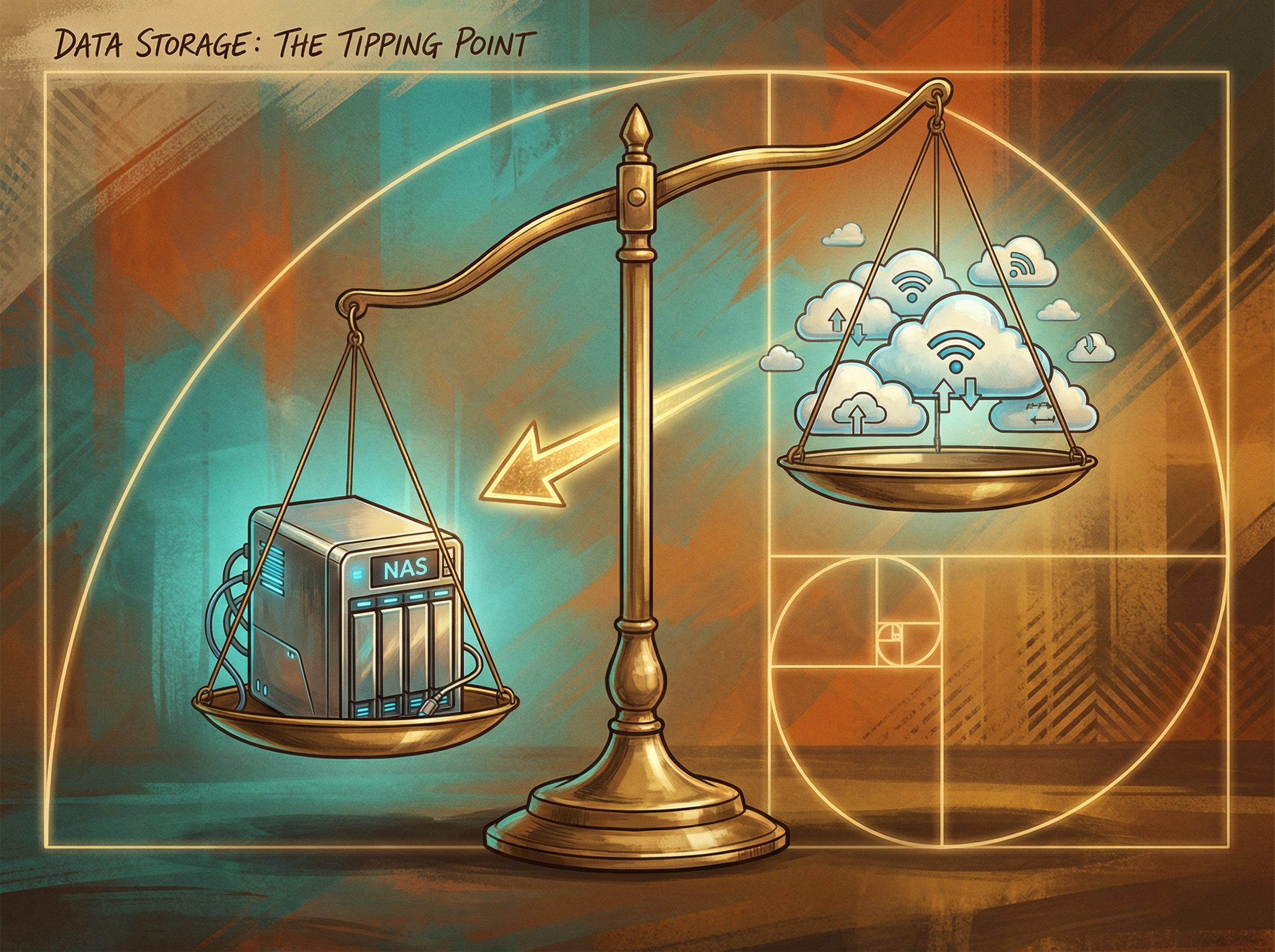
Balance scale with NAS server on one side and cloud icons on the other
05

The Tipping Point: When Local Wins

There's a clearly defined data threshold where cloud storage stops being convenient and starts being a significant monthly expense. If you're managing 10TB of family photos, video projects, and backups, the math is stark.

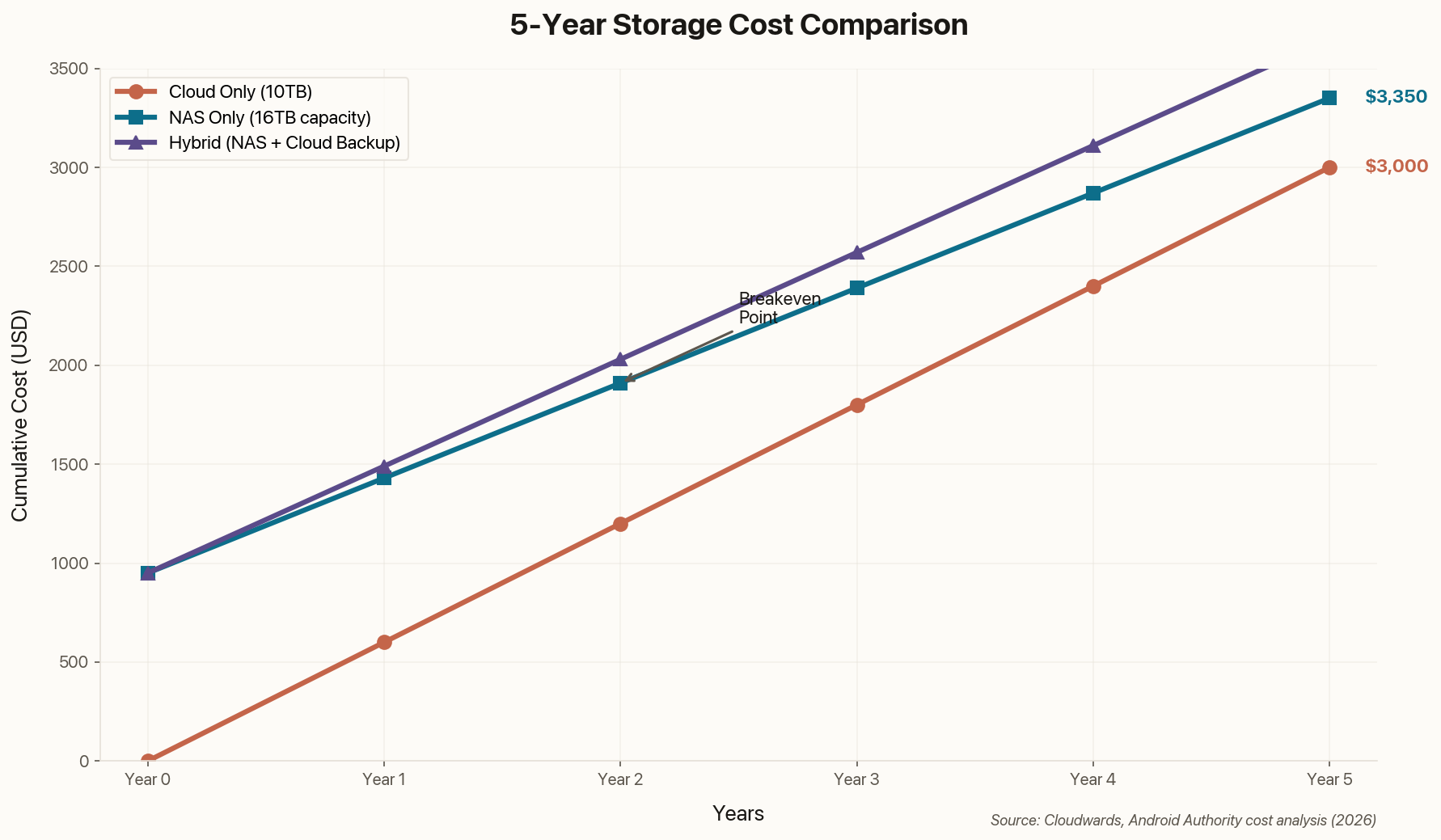
Cloud storage for 10TB runs roughly $50/month or $600/year. A capable NAS like the Synology DS423+ or QNAP TS-464 costs around $550, plus $400 for two 8TB drives. That's $950 upfront—breakeven in under two years, with far more storage capacity and complete data sovereignty.

Line chart showing 5-year cost comparison between cloud storage, NAS only, and hybrid approach
Five-year cost projection shows NAS breaking even around year 2. Hybrid approaches offer the best balance of local speed and off-site protection.

The privacy argument has teeth too. With local storage, you control encryption keys, access logs, and data retention. No terms of service can change on you. No jurisdiction questions about where your data physically resides.

The smart play: A hybrid model—NAS for primary storage plus a cloud backup service (like Backblaze B2 at ~$5/month) for off-site disaster recovery. You get speed, privacy, and protection against fire or theft.

Photos organizing themselves with AI visualization overlay
06

AI Finally Comes to Your Photo Library

For years, Google Photos and Apple Photos had a killer feature that local NAS couldn't match: intelligent organization. Upload your photos, and AI would recognize faces, identify objects, and create albums automatically. It was magic—if you were willing to upload your entire life to a corporation's servers.

Synology Photos finally closed that gap with subject and object recognition in DSM 7.2. The app's AI analyzes every photo in your collection, identifying themes and objects beyond just faces. It builds a searchable database entirely on your local hardware.

The catch: you need a Plus-series NAS for the AI features to work properly, and the DS224+ specifically benefits from a RAM upgrade beyond the default 2GB. The deep learning algorithms are genuinely resource-intensive.

For power users wanting more advanced features, self-hosted alternatives like Immich and PhotoPrism offer even richer AI capabilities via Docker. The NAS becomes the platform; you choose the software.

The bigger picture: Local AI on consumer hardware is the theme of 2026. Whether it's UGREEN's on-device processing or Synology's photo recognition, the industry is responding to users who want smart features without surveillance capitalism.

The Ownership Moment

Subscriptions fatigued us. Privacy scandals educated us. And now, hardware prices have caught up to make local ownership genuinely practical. The home NAS has evolved from a techie hobby into a legitimate alternative to renting your digital life from cloud providers. The question isn't whether you need one—it's which one fits your household.