Higher Education

The Great Dismantling

H-1B hiring freezes hit Texas and Florida. Gender studies programs eliminated. The Dear Colleague letter buried. AI becomes infrastructure. This week reveals how quickly the architecture of American higher education can be unmade.

Listen
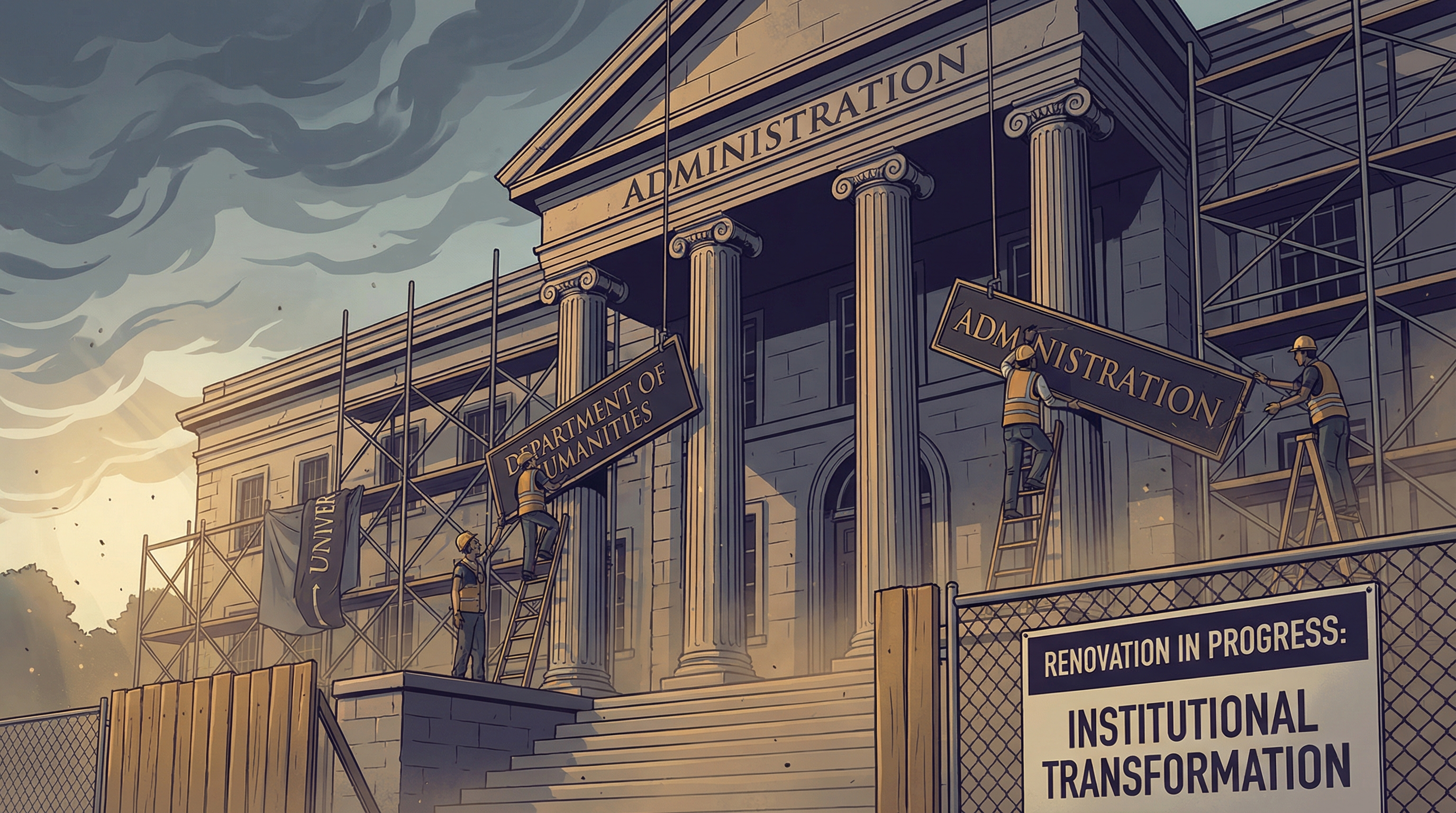
Editorial illustration of university administration building surrounded by scaffolding and construction barriers, workers removing signage
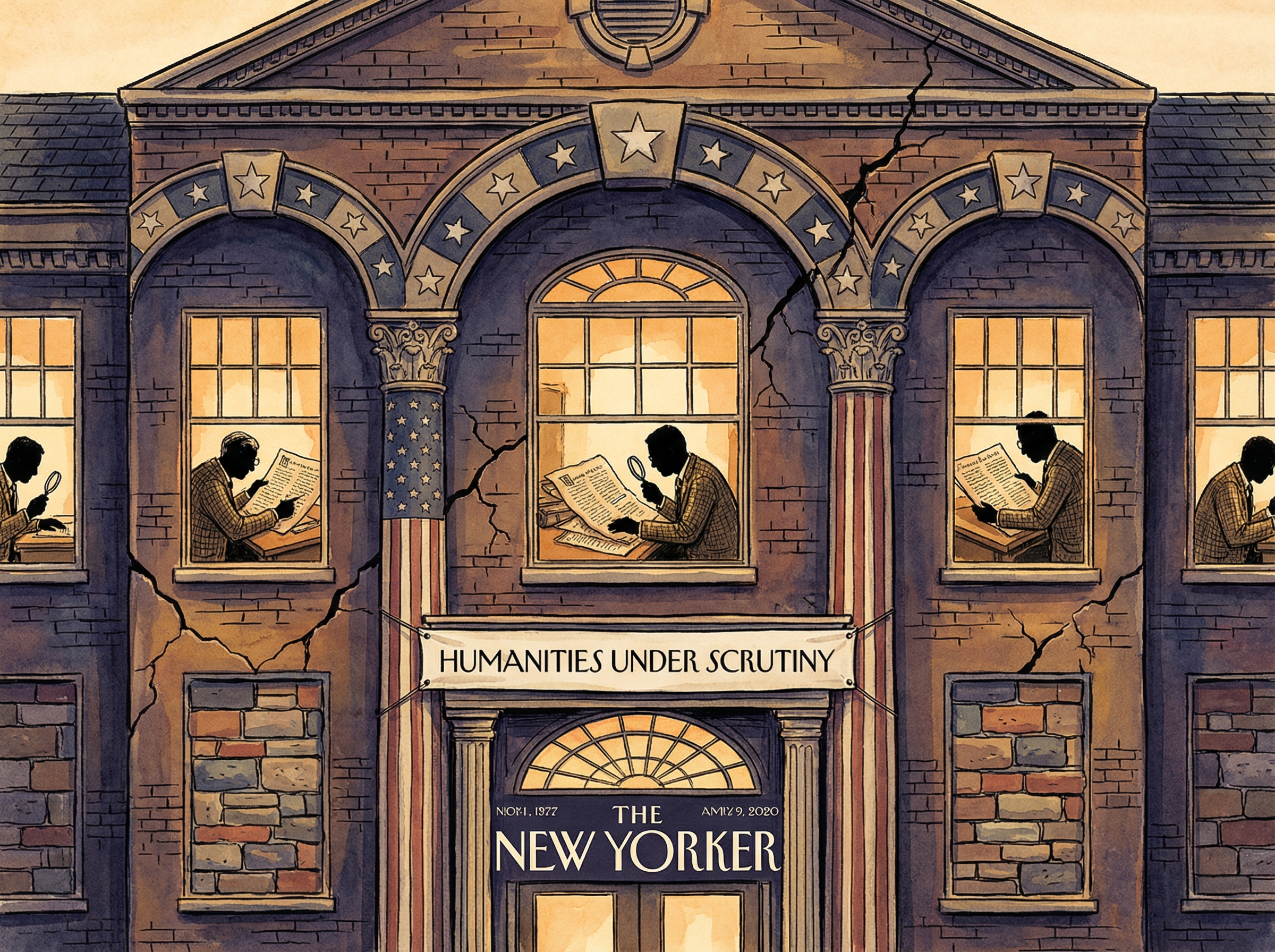
University humanities building with American flag motifs, cracks forming in facade, scholars examining documents
01

Does American Studies Have a Credibility Problem?

Richard D. Kahlenberg's new opinion piece examines a Progressive Policy Institute report that asks an uncomfortable question: has American Studies become so ideologically insular that it's alienating students, the public, and even potential allies within the academy?

The critique from the center-left hits differently than attacks from the right. When a progressive think tank argues that a discipline has become "rigid" and "self-referential," it signals something more than partisan warfare. It suggests that internal intellectual diversity—long claimed as a core academic value—may have eroded.

The political timing is brutal: As legislatures scrutinize humanities curricula and question the value of "non-vocational" majors, internal critiques provide external cover. The discipline's defenders face a strategic choice: dismiss the critique as concern-trolling, or engage with the possibility that insularity has costs.

For American Studies faculty watching programs shrink and tenure lines disappear, abstract debates about intellectual diversity feel almost quaint. The more immediate question: in an environment where entire departments are being eliminated, does methodological self-examination help or simply add another shovel to the grave-digging?
Department of Education building exterior, official letterhead documents fluttering away in wind
02

The Final Retreat on Race-Conscious Policy

The Department of Education officially withdrew its final appeal regarding the "Dear Colleague" letter—the Biden-era guidance that had attempted to preserve some space for race-conscious practices after the Supreme Court's affirmative action ruling. The legal battle is over. The dismantlers won.

The letter had been a lifeline, however tenuous. It offered institutions cover to continue considering race in limited, carefully structured ways. Its abandonment doesn't just end that guidance—it signals that the federal government has no interest in defending institutions that pursue diversity through any means the administration deems suspect.

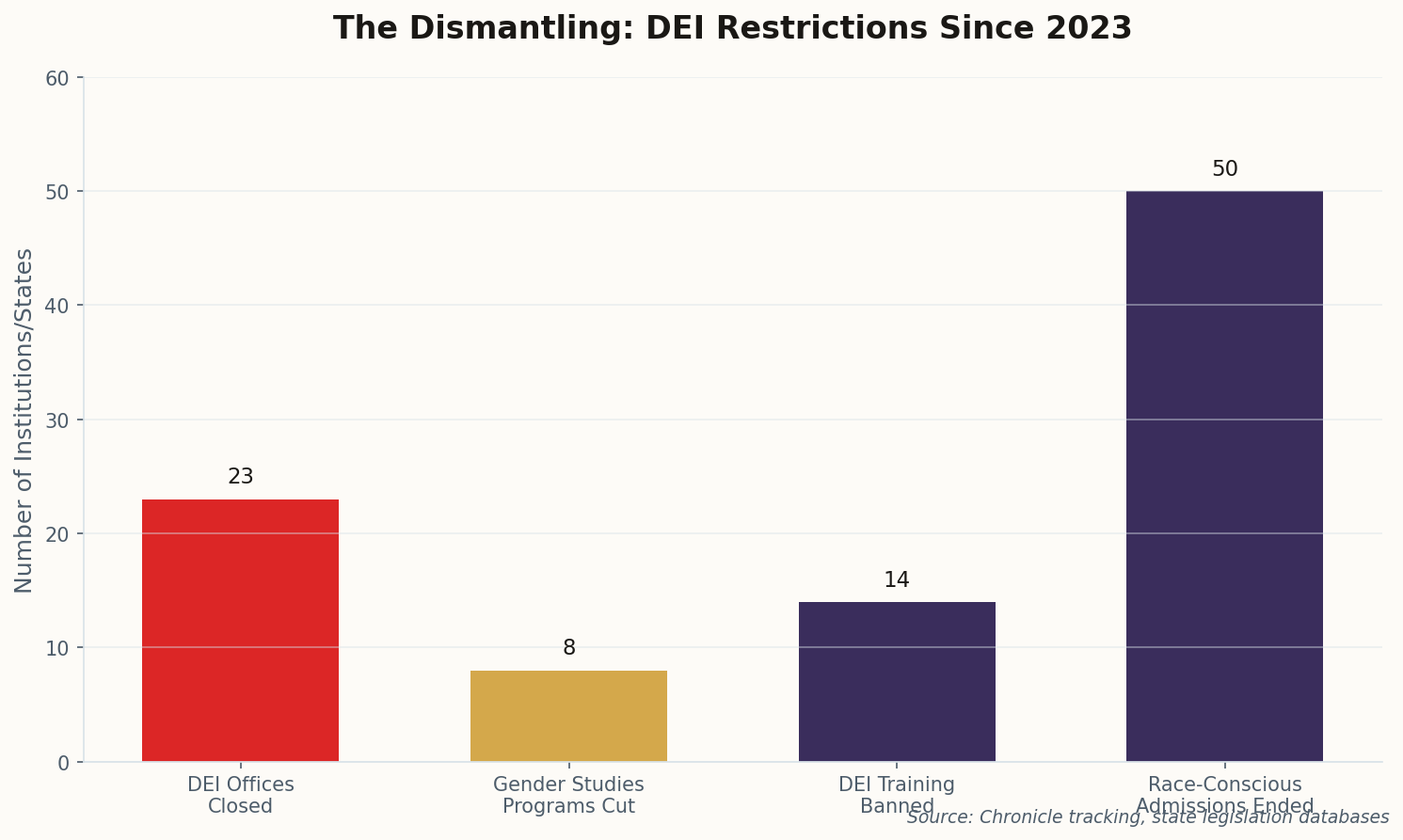
Bar chart showing DEI-related restrictions since 2023: 23 DEI offices closed, 8 gender studies programs cut, 14 DEI training bans, 50 race-conscious admissions ended
Source: Chronicle tracking, state legislation databases

University counsel offices are recalibrating. The question is no longer "what can we defend in court?" but "what will draw federal attention at all?" Some institutions will quietly continue race-aware practices under different names. Others will retreat entirely. The chilling effect was always the point.

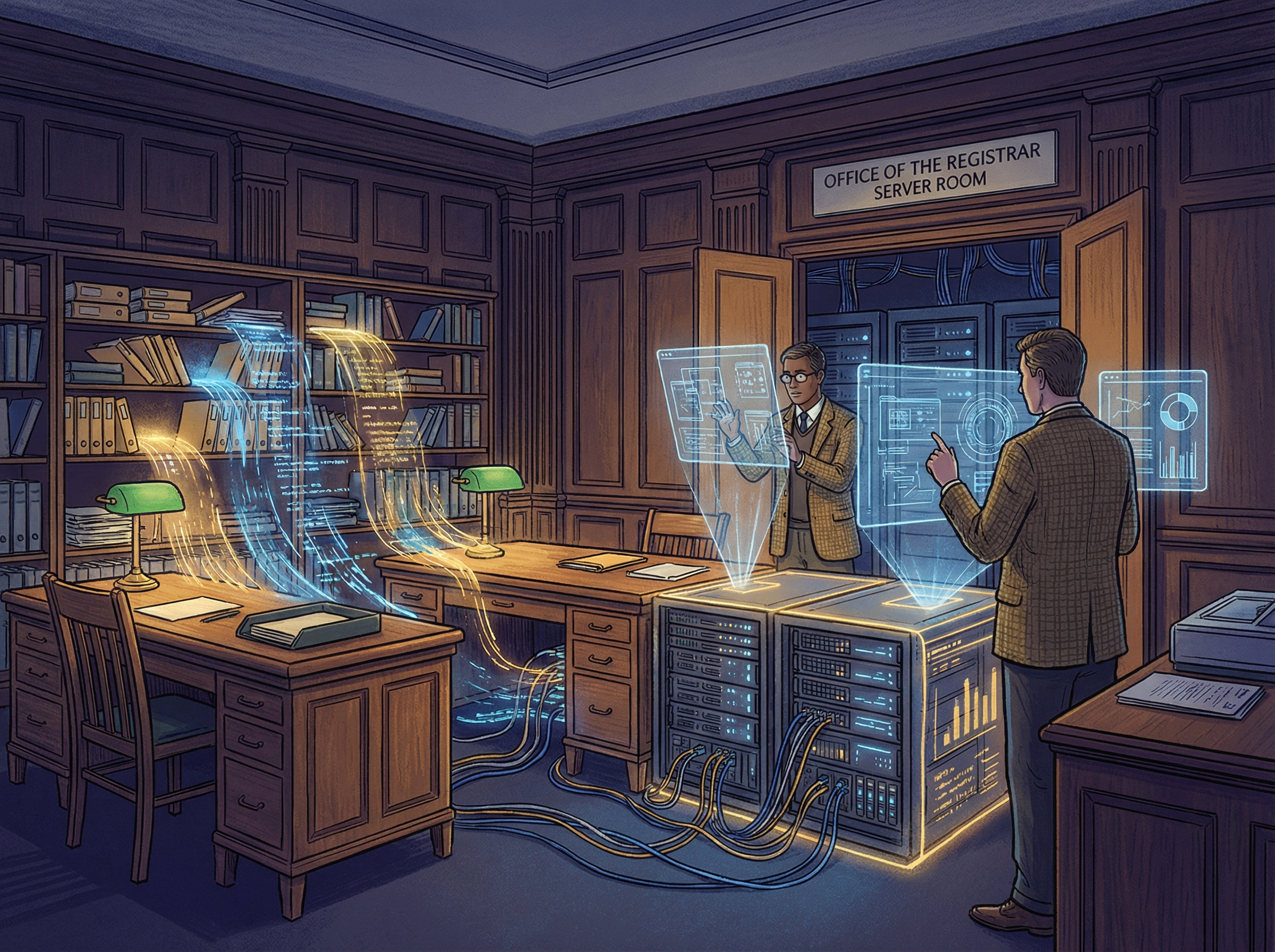
University registrar office transforming into server room, traditional desks morphing into server racks
03

AI Becomes Infrastructure

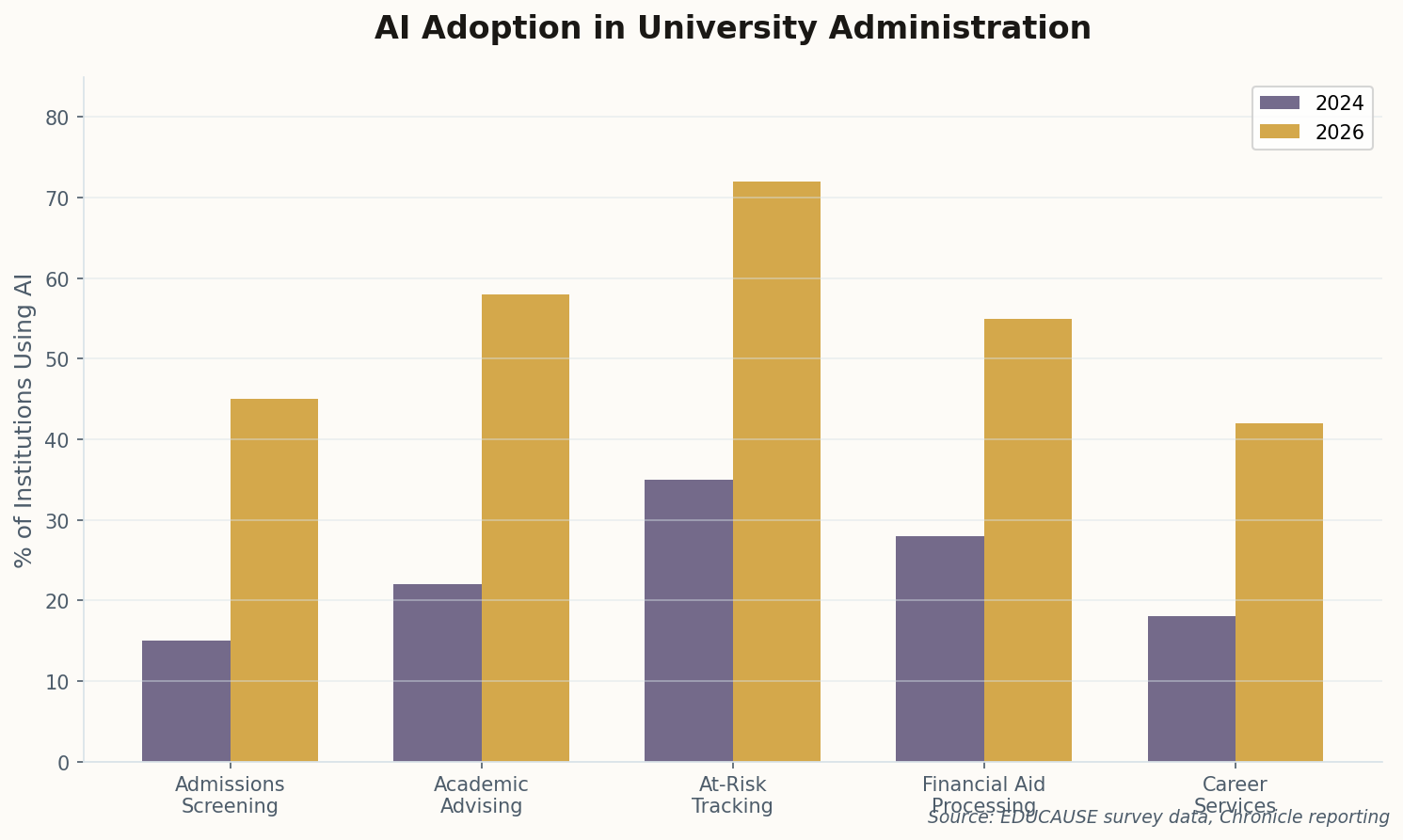
The conversation about AI in higher education has shifted. It's no longer about whether professors should allow ChatGPT on assignments. It's about whether institutions can function without AI embedded in their core operations—admissions screening, academic advising, "at-risk" student tracking, financial aid processing.

Grouped bar chart comparing AI adoption in 2024 vs 2026 across admissions, advising, at-risk tracking, financial aid, and career services
Source: EDUCAUSE survey data, Chronicle reporting

The shift happened quietly. While faculty debated academic integrity, administrators were signing contracts with vendors promising "scalable student success solutions." At-risk tracking systems now flag students based on patterns invisible to human advisors—and often unexplainable to the students themselves.

The governance question nobody's asking: Who approved these systems? At most institutions, AI infrastructure decisions happen in IT and enrollment management offices, far from faculty senates. By the time the academic side notices, the contracts are signed and the data pipelines are built.

The irony is thick: the same faculty who can't agree on AI policies for a single course have already lost the institutional battle. AI isn't waiting for faculty governance. It's already advising students, processing applications, and deciding who gets flagged for intervention.

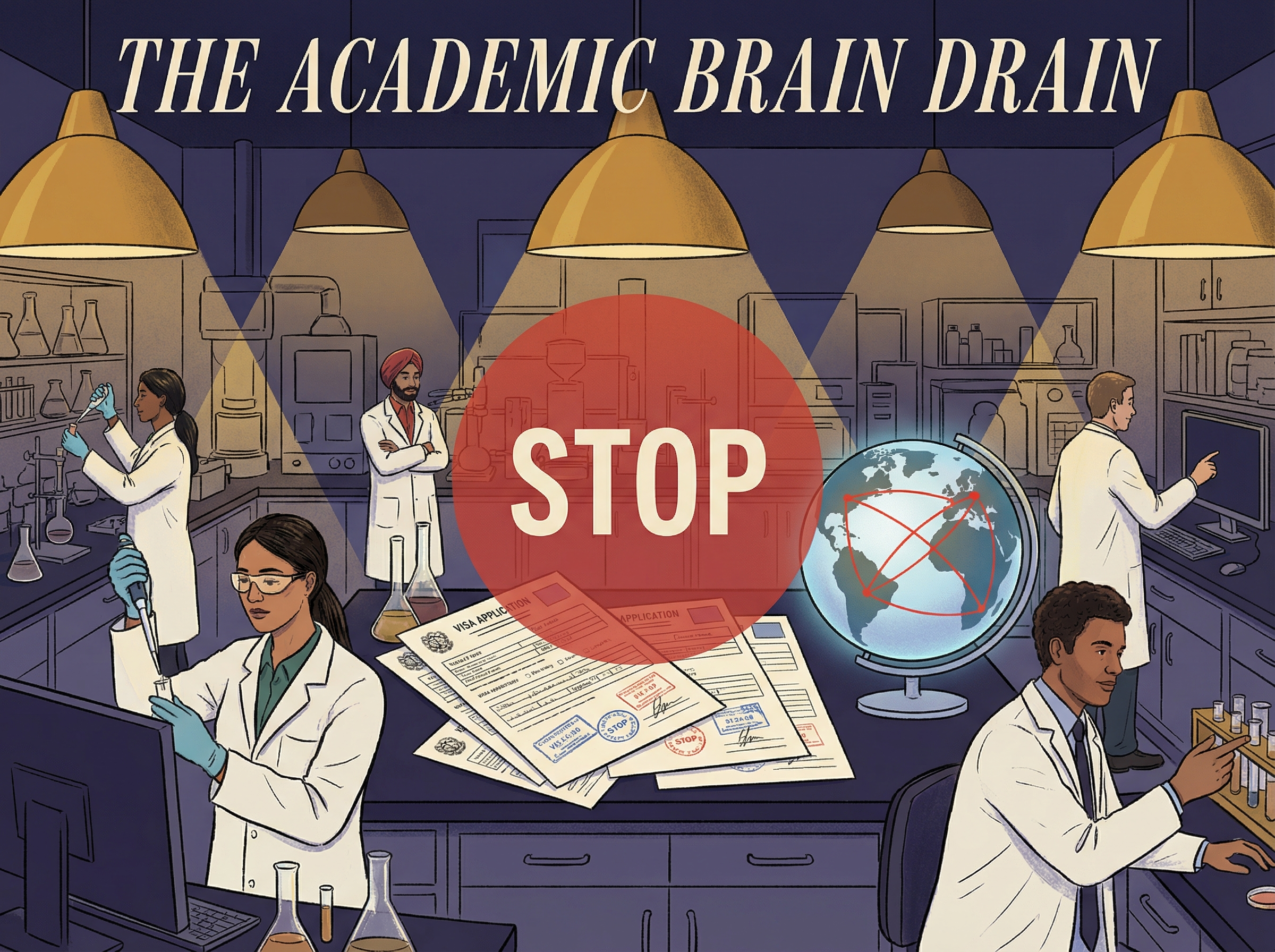
University research laboratory with international scientists, pause symbol overlaid on visa documents
04

Texas and Florida Freeze International Hiring

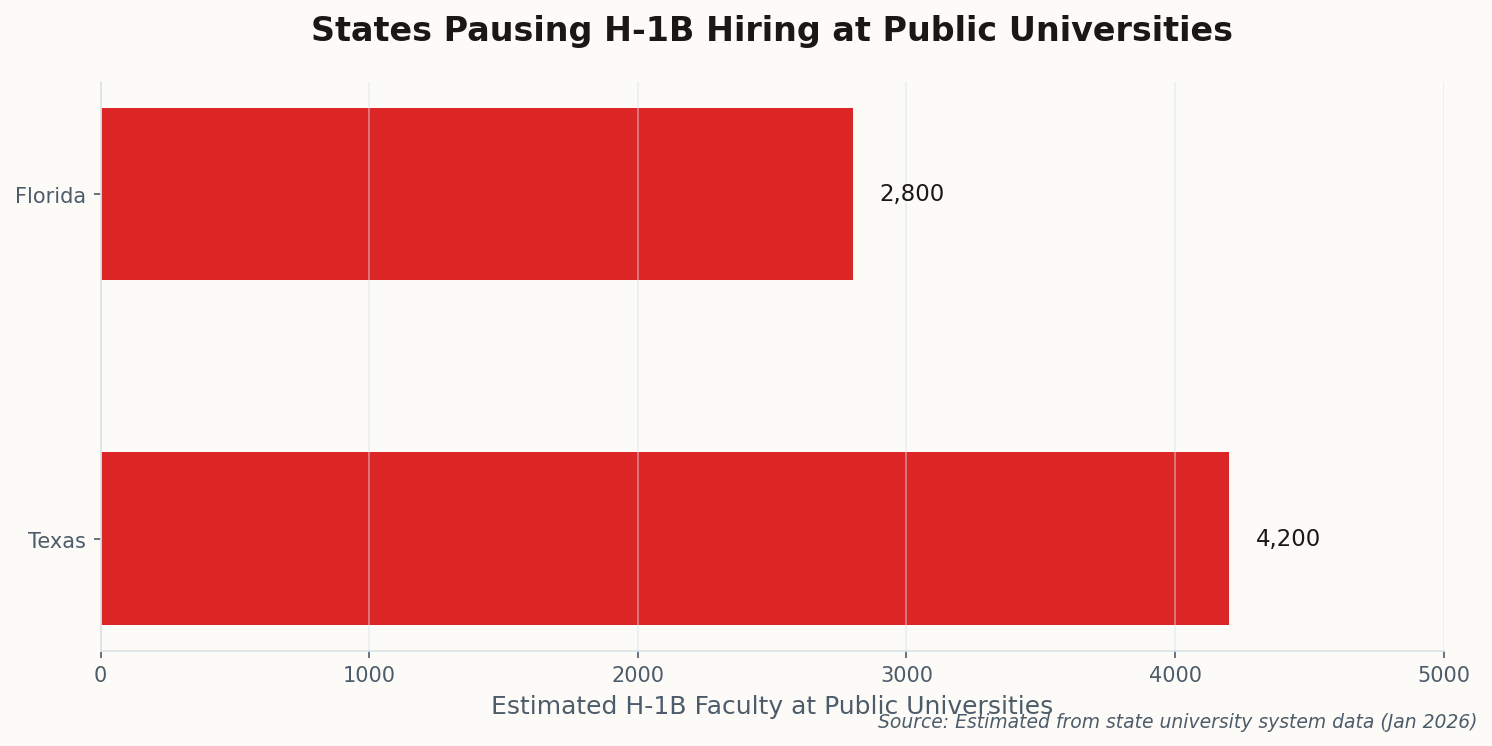
Two major Republican-led states have initiated pauses on H-1B visa sponsorships for new employees at public universities. Florida's Board of Governors voted to freeze such hirings for a year. Texas Governor Greg Abbott ordered a similar halt until the legislature meets in 2027.

Horizontal bar chart showing estimated H-1B faculty at Texas and Florida public universities
Source: Estimated from state university system data (Jan 2026)

The stated rationale is "America First" employment policy—prioritizing domestic workers for scarce academic positions. The practical effect is immediate chaos in search committees. Departments mid-search are scrambling to figure out which candidates are suddenly ineligible. International scholars who've been building careers at these institutions are wondering if they have futures there.

Research universities are particularly exposed. STEM departments at Texas A&M, UT-Austin, Florida, and Florida State have built world-class programs partly by recruiting international talent. That pipeline just got cut. The scholars will go elsewhere—to California, to Massachusetts, to Canada, to Europe. The research capacity won't be replaced by domestic hiring alone.

Other states are watching. If Texas and Florida face no political backlash, expect the model to spread.

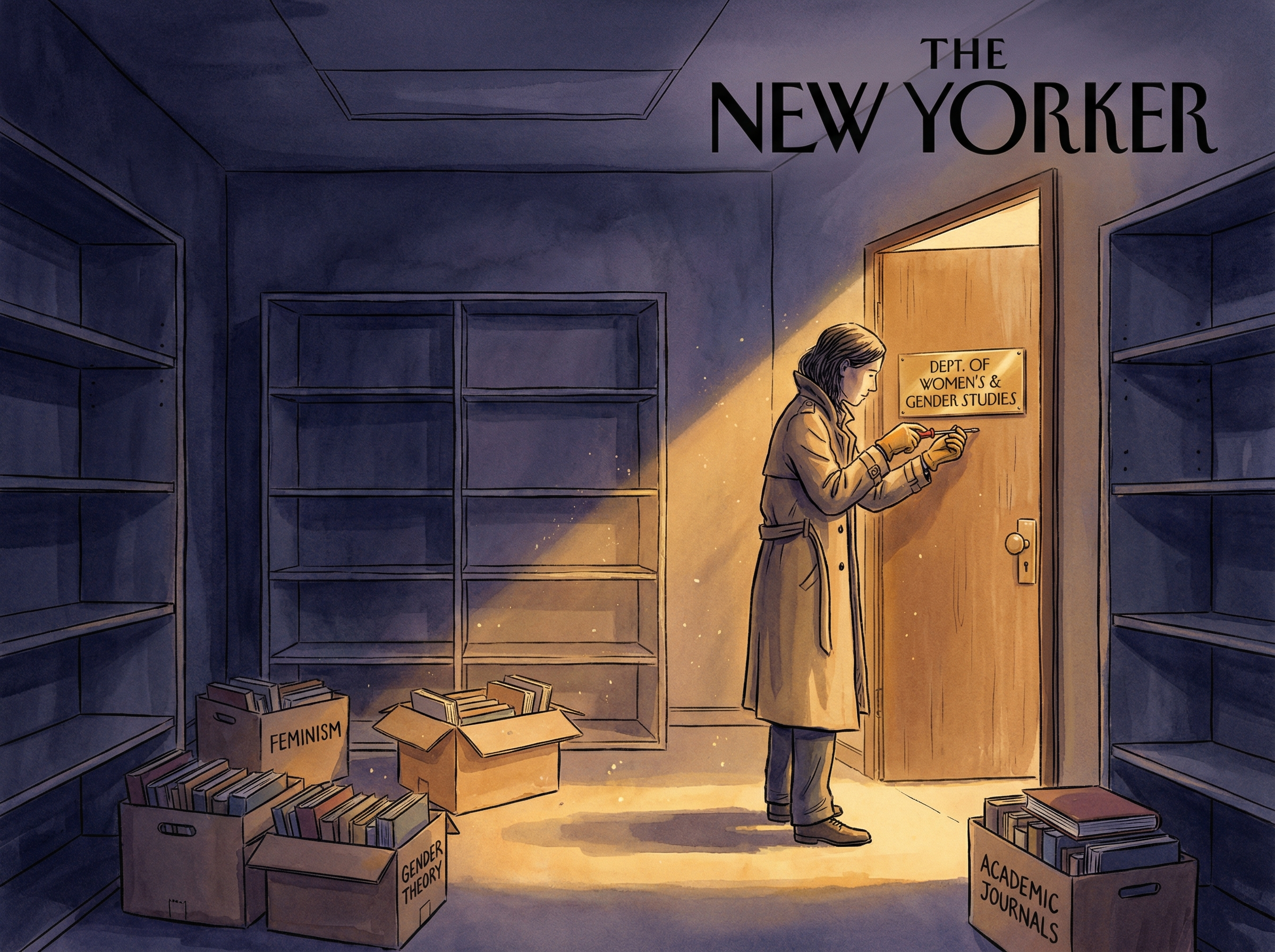
University department office being dismantled, bookshelves emptied, door nameplate being unscrewed
05

Texas A&M Eliminates Women's and Gender Studies

Texas A&M University has announced the elimination of its Women's and Gender Studies degree program, following new state policies restricting the advocacy of "race and gender ideology" at public institutions. It's one of the first—and most prominent—examples of a major flagship university dissolving an established academic department in direct response to anti-DEI legislation.

The program's faculty are being "redistributed" to other departments. Current majors can complete their degrees, but no new students will be admitted. The library holdings, the course catalog, the accumulated intellectual infrastructure of decades—all of it will scatter or disappear.

"We're not being fired. We're being erased. There's a difference, and it's worse."
— Anonymous faculty member

The precedent matters more than this single program. If Texas A&M can eliminate Gender Studies without significant political cost, what stops other states from targeting African American Studies, Ethnic Studies, or any discipline that examines power, identity, and inequality? The answer, increasingly, is: nothing.

Faculty in targeted disciplines at public universities face an impossible calculation. Stay and fight, knowing the institution may not survive to protect you? Or leave for private universities or other states, draining the very expertise these states claim to be defending against "indoctrination"?

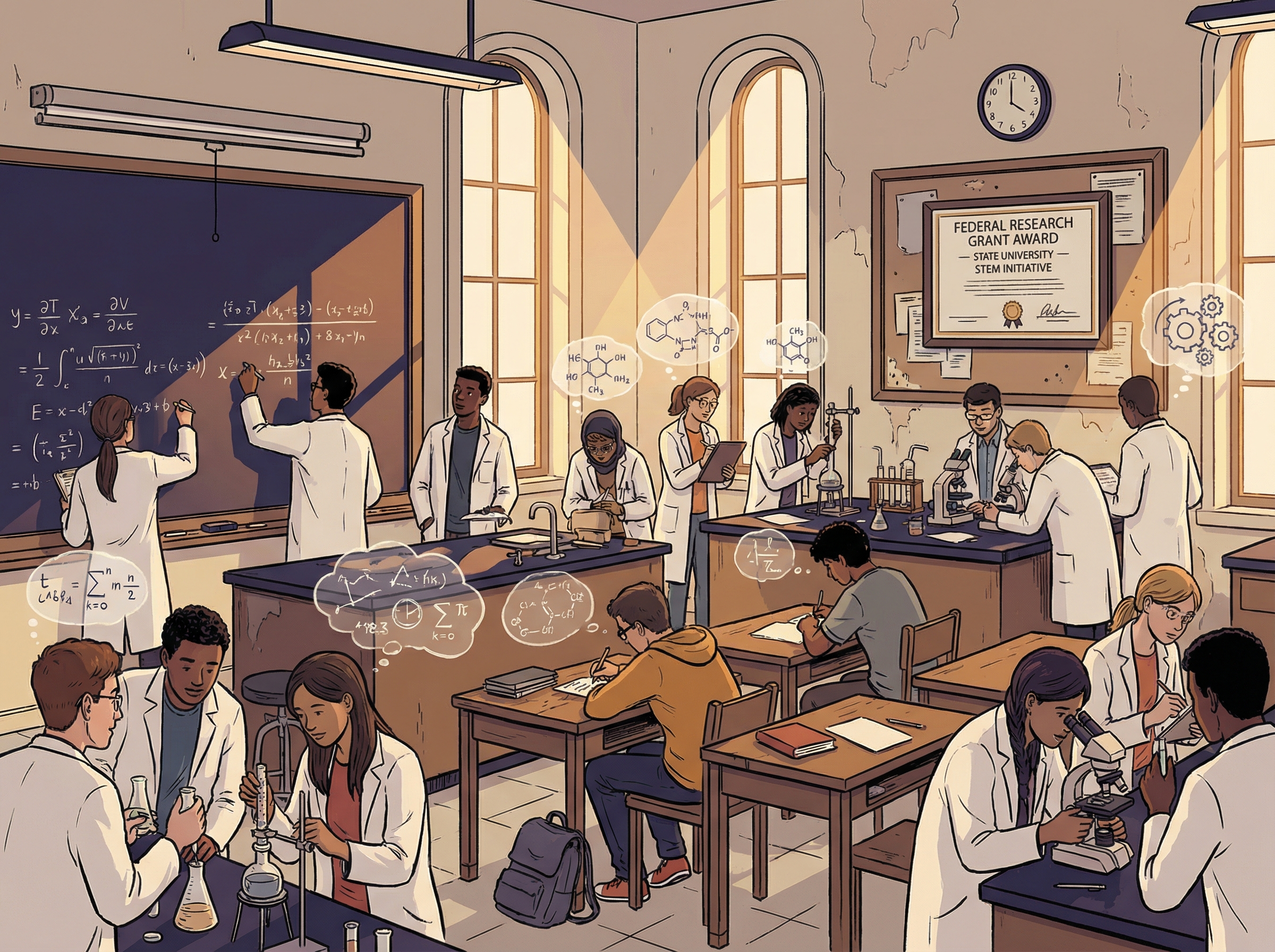
STEM classroom with diverse undergraduate students working on equations, mathematical formulas floating in air
06

NSF Doubles Down on Student Success

Amidst fears of federal research budget cuts, the National Science Foundation announced major awards to institutions like Cal State LA specifically targeting undergraduate success in STEM fields. The grants focus on practical interventions—pre-calculus support, peer tutoring, pathway programs—rather than blue-sky research.

Read the tea leaves carefully. When federal agencies prioritize "student success" and "workforce readiness" over pure research, it signals a reorientation of what counts as worthy science funding. The grants that survive budget scrutiny are the ones that produce measurable employment outcomes, not the ones that advance fundamental knowledge.

The silver lining for teaching-focused institutions: Regional comprehensives and community colleges have always done this work. If federal priorities shift toward student success metrics, institutions that specialize in teaching may finally get resources commensurate with their mission. The R1 research universities, meanwhile, face a different calculation.

For faculty at research institutions, the message is clear: fundable science increasingly means applied science with clear workforce implications. Basic research—the kind that produced mRNA vaccines, GPS, and the internet—may have to find other patrons. The NSF's pivot isn't subtle. It's survival.

Demolition and Construction

Every story this week involves something being taken apart: visa pathways, academic departments, legal protections, traditional governance. But dismantling isn't random destruction—it's selective removal to make space for something else. AI infrastructure rises as faculty governance retreats. Workforce training gains funding as basic research loses it. The question isn't whether higher education will change. It's who gets to decide what replaces what's being demolished.