
2026 Midterms

The Midterm Map Is Being Redrawn

Democrats are building momentum, California's future is up for grabs, and the House is hemorrhaging institutional knowledge. Here's where the 2026 battle lines are forming.

Listen
Stylized illustration of American democracy in motion, with red and blue waves colliding around a ballot box
San Jose cityscape with California state outline
01

California's Moderate Gambit Begins

San Jose Mayor Matt Mahan officially threw his hat in the ring for California governor on Friday, and he's not playing by the usual rules. In a state where Democratic primaries typically reward whoever can sprint furthest left, Mahan is betting that exhausted voters want something different: a "common sense" candidate who prioritizes results over ideological purity.

"California needs a reality check," Mahan declared at his launch. "We need to focus on results, not ideology." It's a message that would be unremarkable in a swing state but sounds almost radical in Sacramento.

The gubernatorial field remains wide open, with no clear frontrunner and massive undecided numbers. Mahan's entry complicates life for Katie Porter and Xavier Becerra, who now face pressure from the center at the same moment they're fighting for progressive oxygen. Whether California Democrats are ready to elect a moderate remains the central question of this race—and Mahan is about to test that hypothesis with real money and real voters.
Michigan Great Lakes with electoral district lines glowing
02

Michigan's Senate Race: Wide Open, Highly Consequential

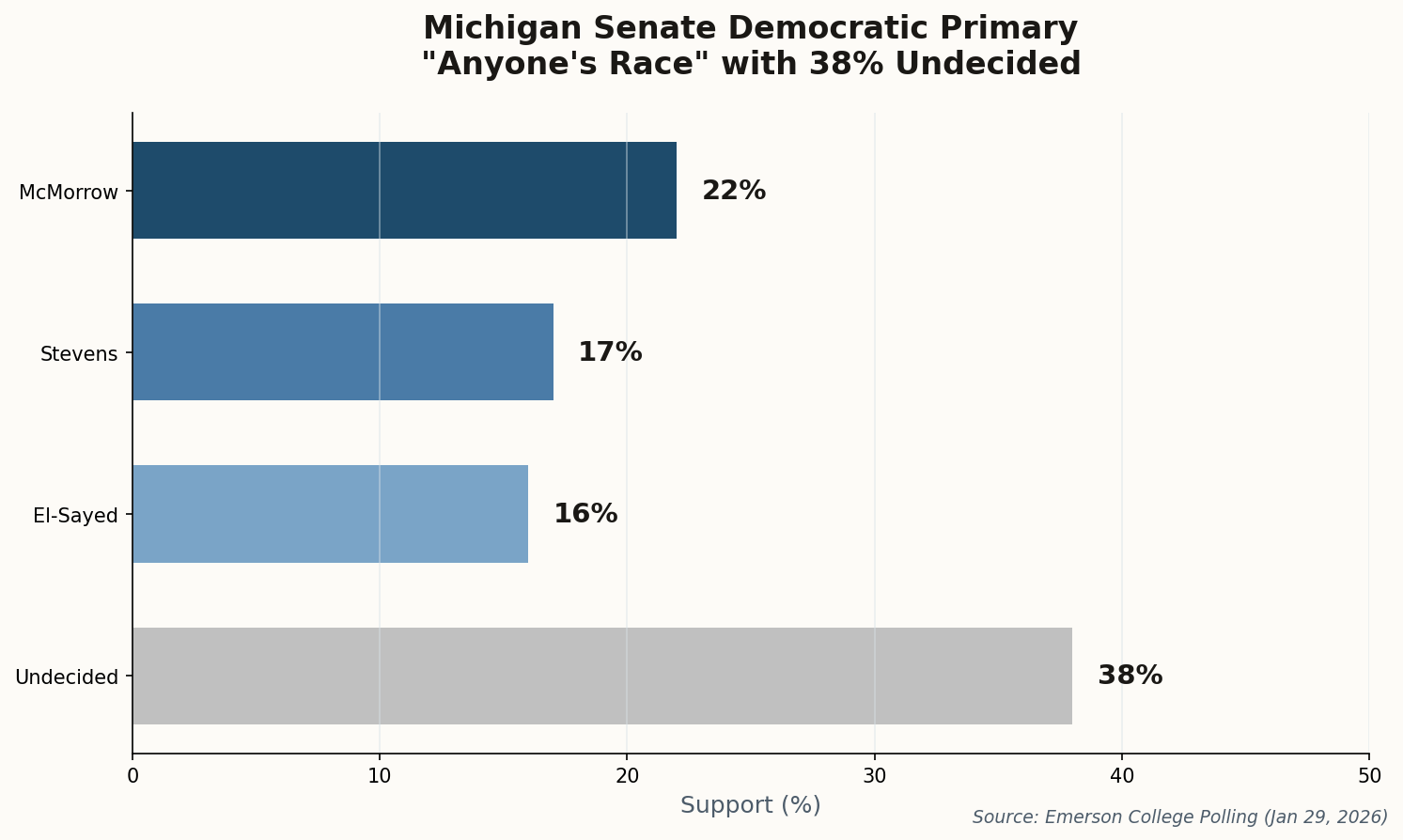
State Senator Mallory McMorrow—who became a viral sensation in 2022 with her floor speech denouncing being called a "groomer"—leads the Democratic primary for Michigan's open Senate seat. But "leads" might be overstating it: she's at 22%, with Rep. Haley Stevens at 17% and Abdul El-Sayed at 16%.

Bar chart showing Michigan Democratic primary polling with McMorrow at 22%, Stevens at 17%, El-Sayed at 16%, and 38% undecided
With 38% undecided, the Michigan Democratic Senate primary remains anyone's race. Source: Emerson College, Jan 29, 2026.

The real story? That staggering 38% undecided. Michigan voters are keeping their powder dry, and there's still time for the race to transform entirely.

The good news for Democrats: in a general election matchup, McMorrow leads likely Republican nominee Mike Rogers 46-43. That's a tight margin, but it suggests Democrats can hold this seat if they nominate someone who connects with the state's complex coalition of union workers, suburban professionals, and college-town progressives. Michigan may be the tipping point for Senate control—and right now, it's tilting ever so slightly blue.

Maryland state outline being redrawn, gerrymandering concept art
03

Maryland Democrats Draw the Nuclear Option

In the House battle for every last seat, Maryland Democrats have decided subtlety is overrated. The state House of Delegates fast-tracked a congressional map that would likely flip the state's sole Republican seat—MD-01, currently held by Rep. Andy Harris—by surgically connecting the conservative Eastern Shore with heavily Democratic Baltimore suburbs.

"This map is a political sham designed to silence conservative voices in Maryland," fumed the Republican Minority Leader. He's not wrong about the intent, if perhaps overwrought about the framing. Gerrymandering is, after all, a bipartisan sport.

The catch: Senate President Bill Ferguson has raised legal concerns, and courts have struck down aggressive gerrymanders before. If the map survives judicial review, it's one more House seat in Democrats' column—potentially the difference between a narrow majority and a fragile minority. Every district matters when margins are this thin, and Maryland Democrats are betting it's worth the legal risk.

Abstract bar chart visualization with blue bars rising
04

Democrats Build a Six-Point Cushion

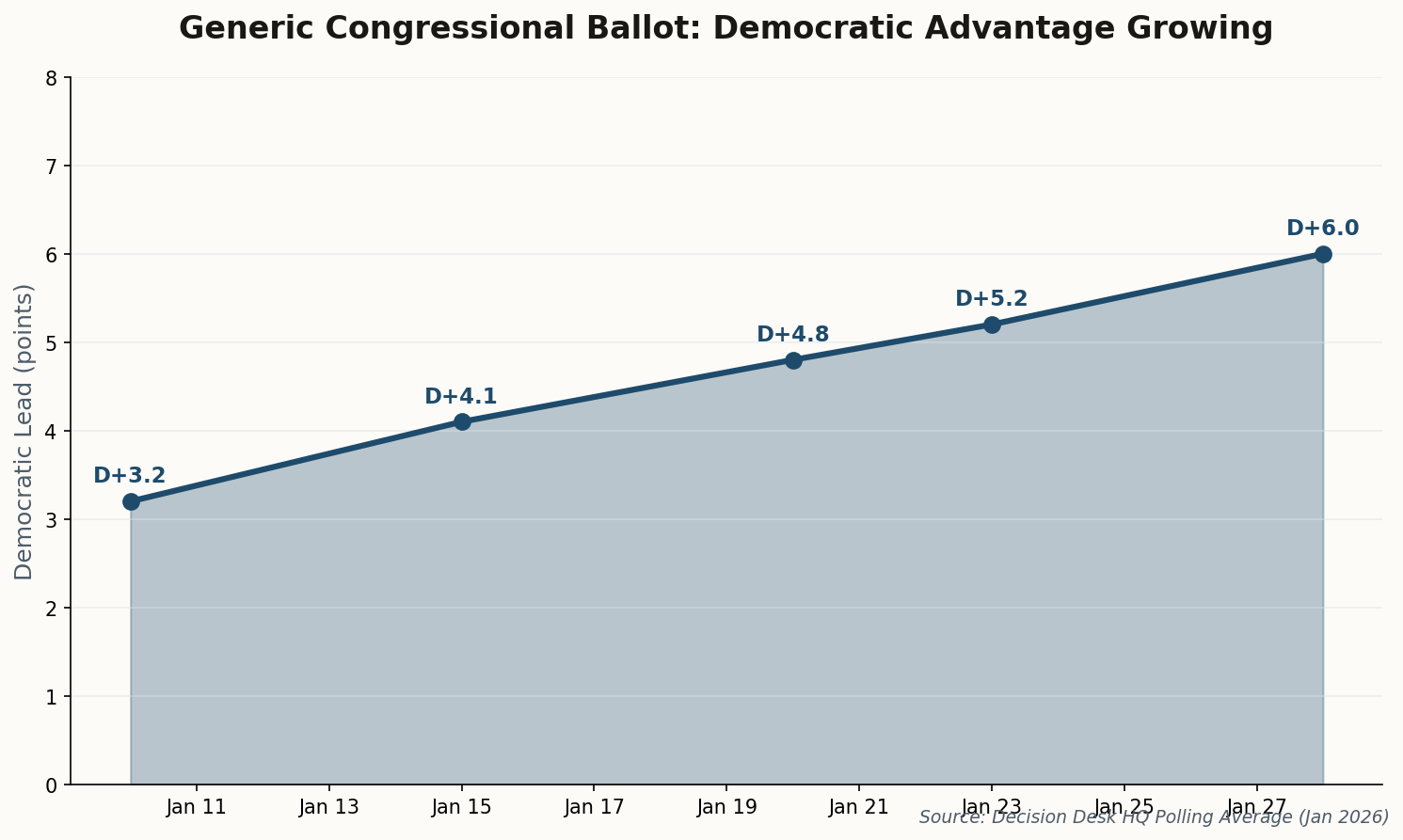
When Fox News—not exactly a Democratic house organ—releases a poll showing Democrats leading Republicans 52% to 46% on the generic congressional ballot, it's worth paying attention. The January 23-26 survey confirms what other pollsters have been finding: a sustained and perhaps widening Democratic advantage heading into the midterms.

Line chart showing Democratic generic ballot advantage growing from D+3.2 on Jan 10 to D+6.0 on Jan 28
The generic ballot trendline shows steady Democratic gains through January. Source: Decision Desk HQ Polling Average.

The generic ballot is, as political scientists love to remind us, "the single best predictor of the House popular vote." A six-point lead wouldn't just flip the House—it would likely deliver a comfortable Democratic majority, undoing the GOP's narrow 2024 gains.

Of course, nine months is forever in politics. But the structural environment—whatever's driving these numbers—shows no signs of reversing. Republicans hoping for a midterm rescue may need to hope for external events rather than internal improvement.

Whiteboard with campaign strategy diagrams, California bear reimagined
05

Porter's Comeback Tour Takes Shape

Katie Porter lost the 2024 Senate primary, but she's not going quietly. The whiteboard-wielding former congresswoman is positioning herself as a top-tier gubernatorial candidate, and new reporting suggests she's been doing something unusual for a politician: apologizing.

"I've done a lot of listening and learning," Porter told the LA Times. "I'm ready to fight for California families." The subtext is her acknowledged past controversies regarding staff treatment—the kind of behind-the-scenes behavior that sank other candidates when it went public.

Porter retains massive name recognition and formidable fundraising potential. If she can rehabilitate her reputation with Democratic activists, she could consolidate the progressive vote and force a clash with moderates like Mahan. The California governor's race is shaping up as a proxy war for the soul of the Democratic Party—and Porter wants to be on the winning side of that argument.

Empty congressional desk with American flag, sunset light streaming through window
06

The Exodus Continues: Another Senior Republican Calls It Quits

Rep. Vern Buchanan has seen enough. After 20 years representing Florida's Gulf Coast, the senior Ways and Means Committee member announced he won't seek reelection. "It has been the honor of a lifetime," he said, "but I believe the time has come to pass the torch."

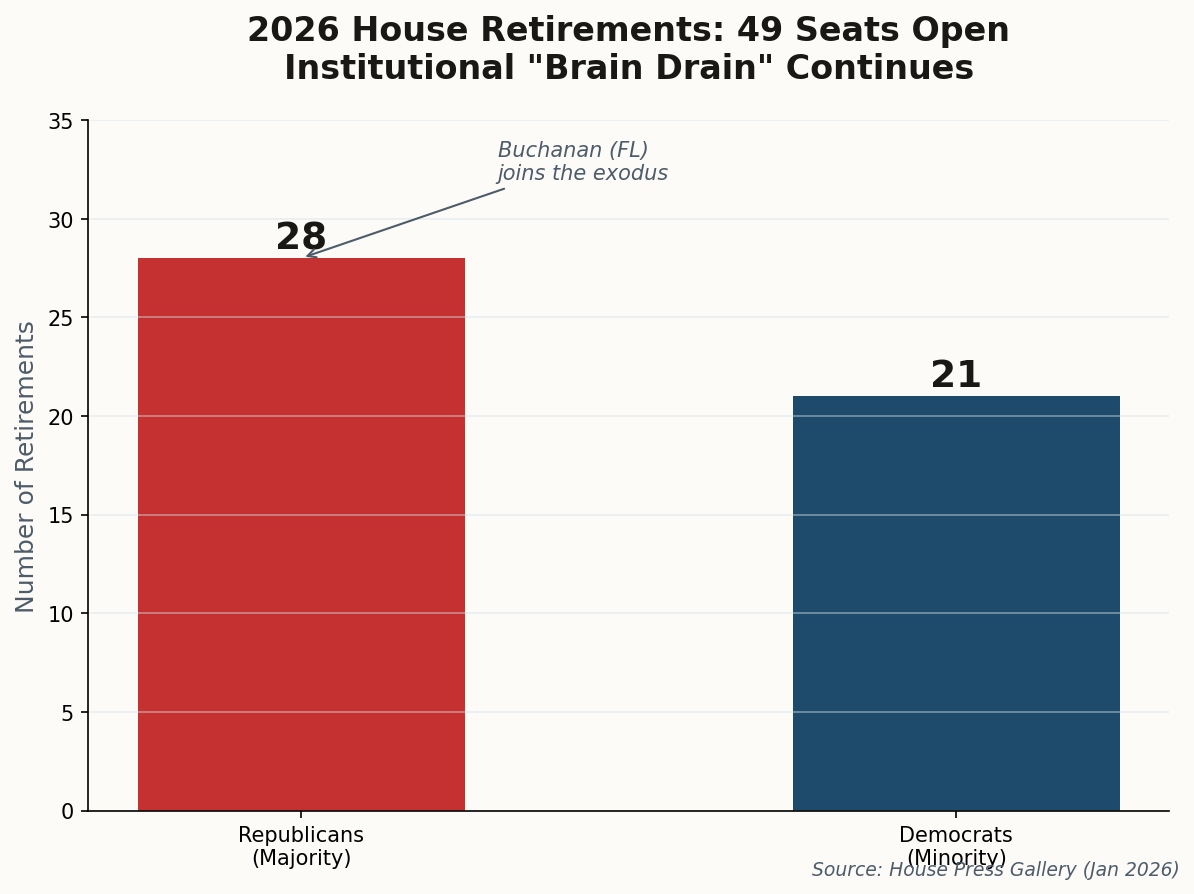
Bar chart showing 28 Republican and 21 Democratic retirements in the 2026 cycle
The institutional "brain drain" continues as nearly 50 House members head for the exits. Source: House Press Gallery, Jan 2026.

Buchanan's departure adds to a growing exodus—nearly 50 members now, from both parties—signaling a profound "brain drain" in the House. These aren't backbenchers; they're committee chairs, subcommittee leaders, and institutional memory walking out the door.

The Florida seat will almost certainly stay Republican. But the larger pattern should concern anyone who values congressional expertise: the people who know how legislation actually works are leaving faster than they can be replaced. Whatever your politics, that's not healthy for democracy.

The November Question

Nine months out, the contours are emerging: a Democratic environment, an open California brawl, and a Congress losing its elders. The midterm map is being redrawn—both literally, in Maryland's cartographic schemes, and figuratively, in the polling averages and retirement announcements. What remains to be seen is whether today's momentum survives the long slog to November. Stay vigilant.