Presentations

The Struggle Is the Feature

Why the value of creating presentations lives in the messy, cognitive work of the journey—not the polished deck that emerges at the end.

Listen
An architect's desk mid-process: rough sketches, crumpled paper, half-built models—the beautiful chaos of thinking made visible
01

AI's Beautiful Slides Might Be Making You Dumber
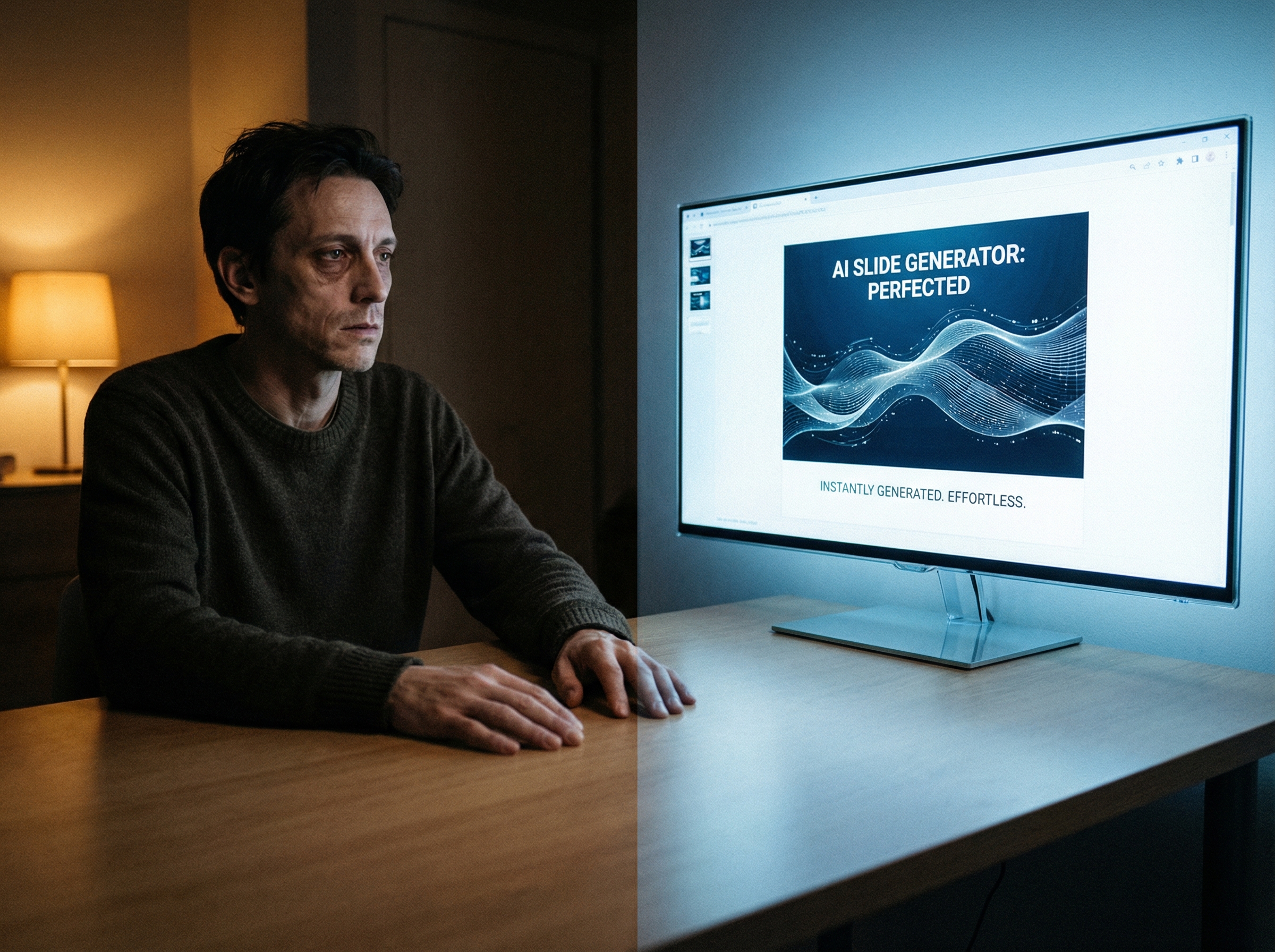
A polished AI interface generating perfect slides while the human operator sits disconnected, hands idle

When Gamma can generate a deck in 30 seconds that would take you three hours to create manually, what exactly have you gained? According to a growing body of research, you may have gained a pretty artifact while losing something far more valuable: the cognitive workout that makes you actually understand your material.

The review of Beautiful.ai and similar tools is glowing on surface metrics—"swift and pleasant," "democratizing design"—but buried in the praise is a critical observation: these tools remove the "friction" that forces authors to refine their logic. When AI layouts prevent you from making "bad" design choices, they also prevent the visual thinking required to map complex relationships spatially.

This is the "competence trap" in action. The output looks professional, but the user never grappled with the hard question: What is the one thing I need this audience to understand? That struggle, it turns out, is where understanding crystallizes.

The trade-off: AI removes the drudgery of formatting, but arguably shortcuts the "synthesis struggle" that leads to breakthrough insights. You can have a beautiful deck or a deep understanding—increasingly, the tools are optimizing for the former.
02

The Illusion of Competence: When Having a Deck Feels Like Knowing

Psychologists have a term for what happens when you let AI summarize your thoughts into slides: "metacognitive laziness." It's the cognitive equivalent of having GPS tell you every turn versus learning the route yourself. You arrive at the destination, but you couldn't get there again without help.

When you use Tome or Gamma to instantly structure your thoughts, the output is coherent—but you've outsourced the determination of what's essential versus what's noise. The psychological research is stark: this bypass of struggle creates "illusions of competence." You think you know the material because you have a polished deck. But stand up without it, and the knowledge evaporates.

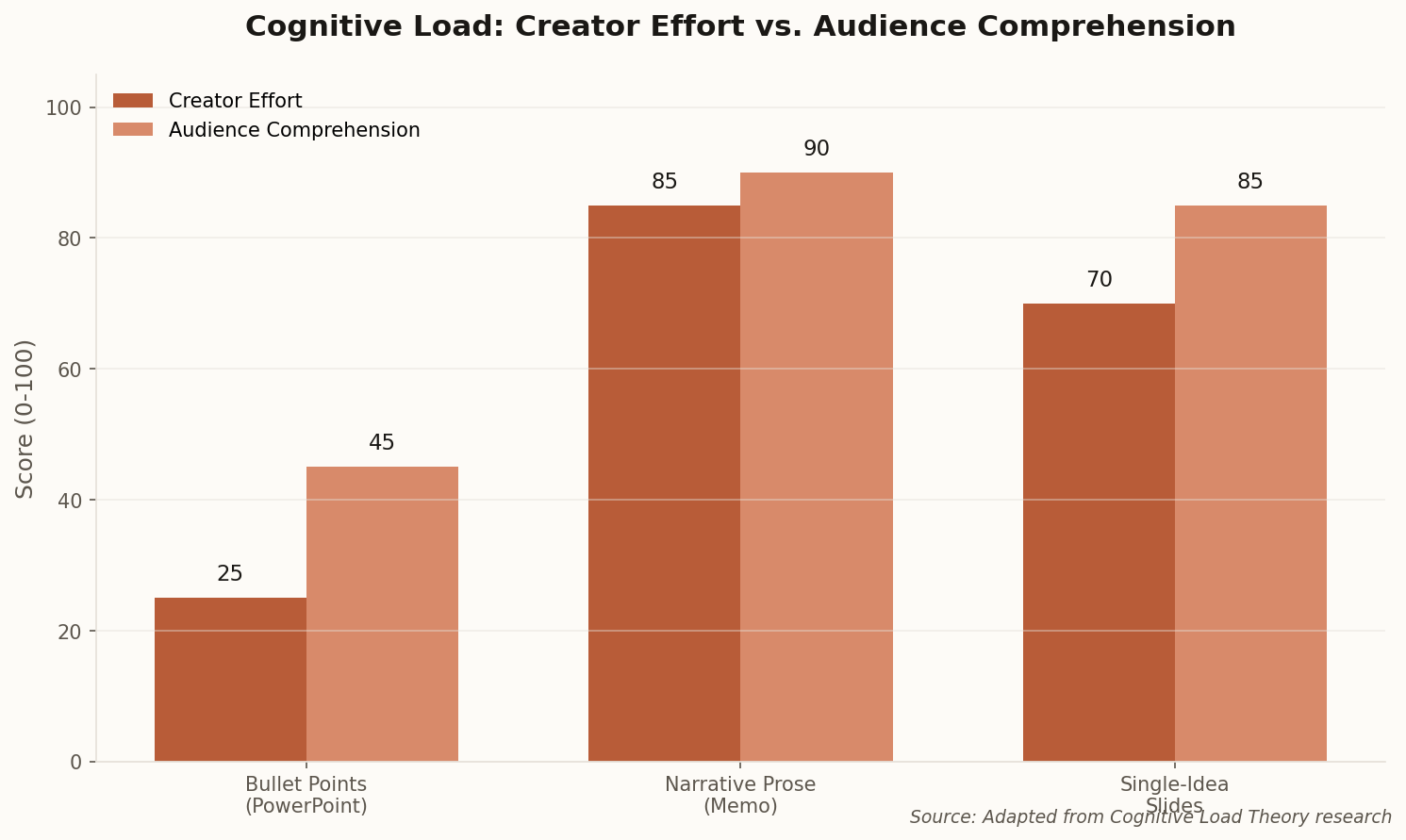
Bar chart comparing creator effort and audience comprehension across bullet points, narrative prose, and single-idea slides
Cognitive effort during creation correlates strongly with resulting comprehension—for both creator and audience.

The ease with which AI generates coherent content bypasses the discomfort and struggle that are crucial for deep thinking, insight, and cognitive growth. The inefficiency of manual creation isn't a bug to be fixed—it's a feature to be preserved.

03

Making the Deck Is the Learning

Abstract visualization of knowledge construction—translucent blocks assembling into crystalline structure

Educational research classifies "creating a presentation" alongside summarizing and teaching as a generative learning strategy. The distinction from passive consumption isn't academic—it's neurological. When you select relevant information, organize it into a coherent structure, and integrate it with existing knowledge, you're literally building neural pathways that wouldn't exist from just reading the material.

This is the "Protégé Effect" in action: preparing to explain materials to others boosts your own mastery. The deck you're making isn't just for your audience—it's rewiring your brain. Every decision about what to include, what to cut, how to sequence ideas, which metaphor captures the concept—each of these is an act of comprehension, not just communication.

Here's the uncomfortable implication: the presentation that was "a pain to make" probably taught you more than the one that flowed easily. And the one AI generated in 30 seconds? You learned almost nothing.

04

The 65% Advantage: Why Finding the Right Image Matters

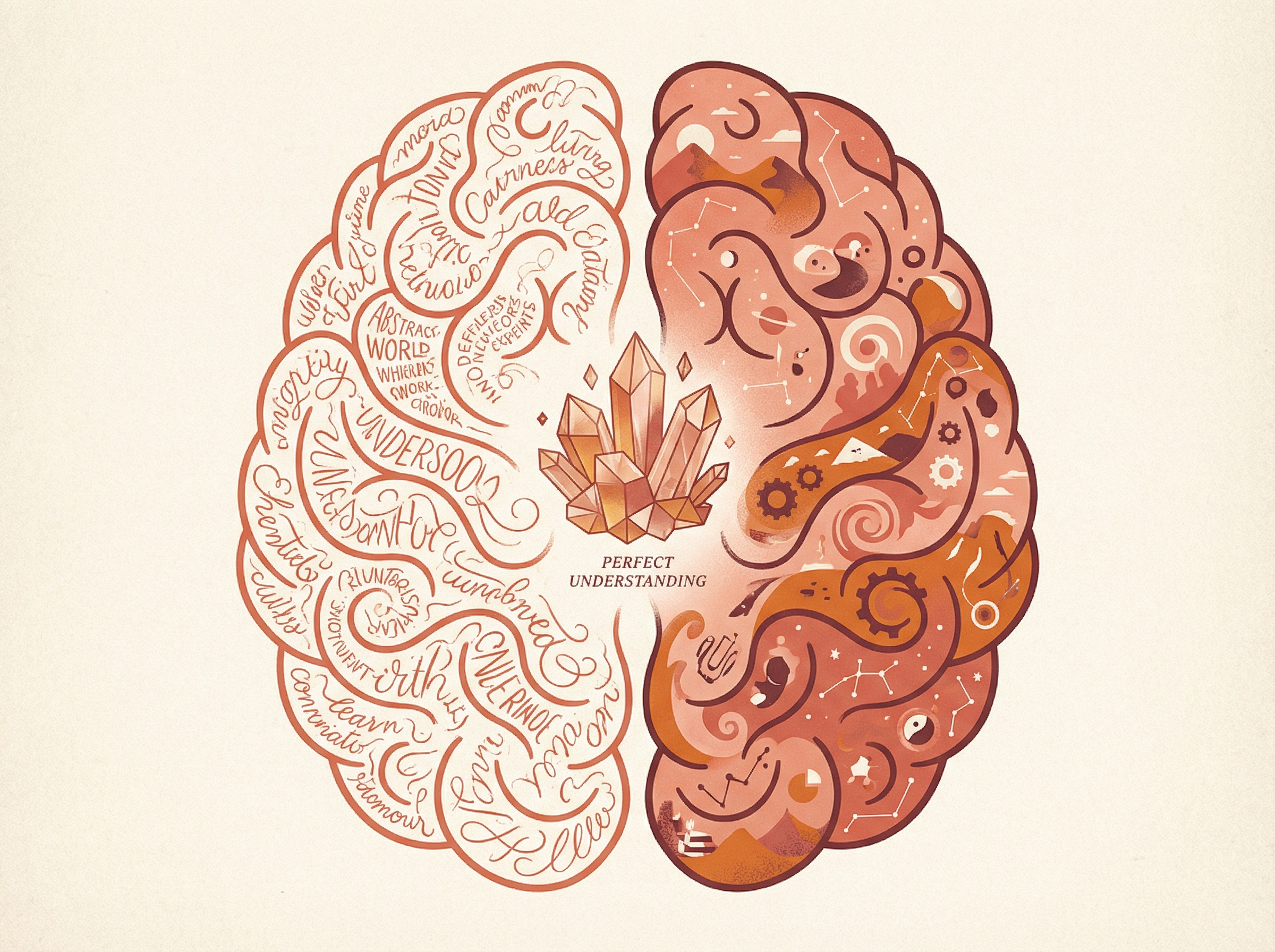
Split brain visualization—text and words on one side, vivid imagery on the other, crystallizing where they meet

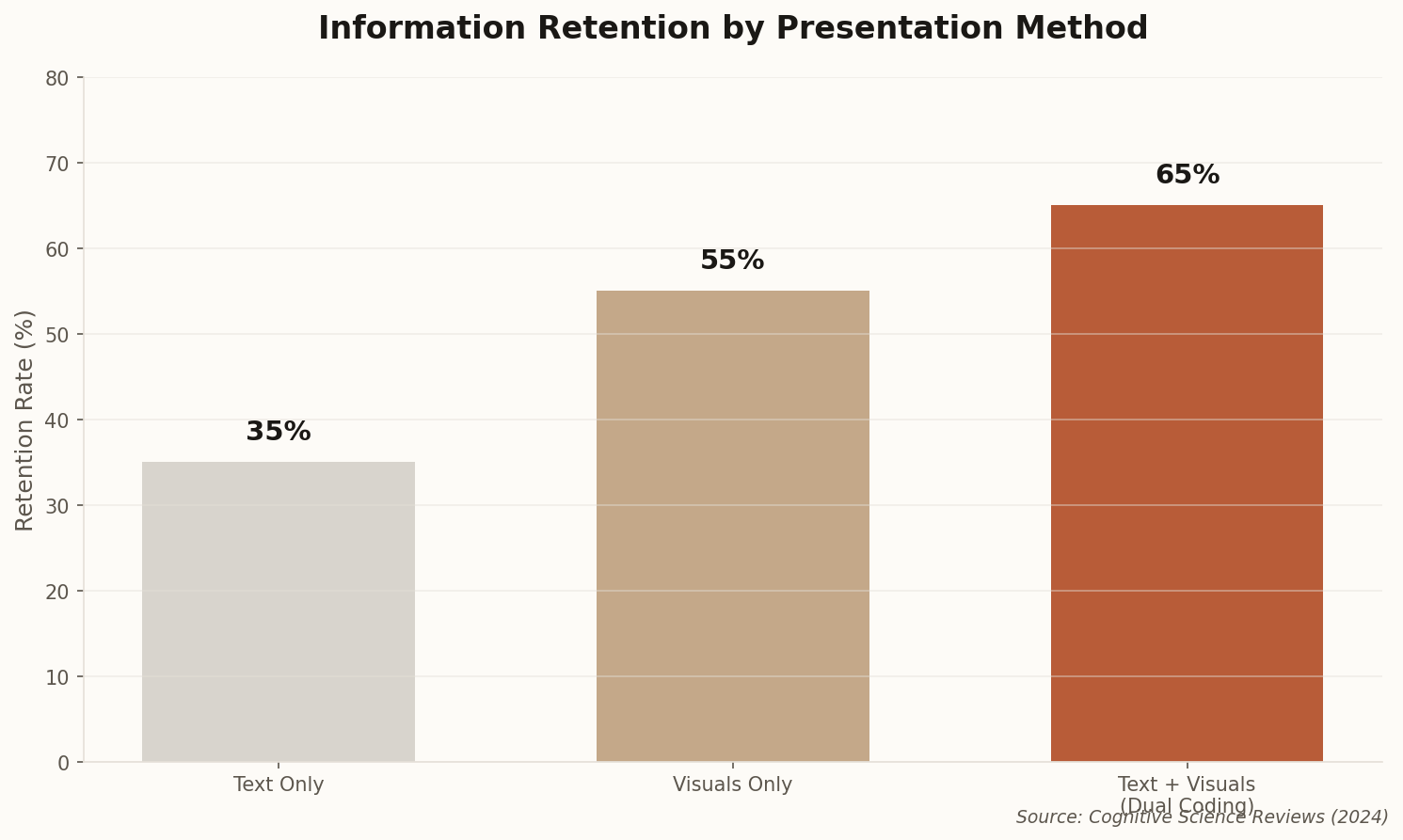
"Dual Coding Theory" isn't just jargon—it's a biological reality. Your brain processes visual and verbal information through separate channels, and when you combine text with relevant visuals, retention jumps by up to 65%. But here's what the research doesn't emphasize enough: the effort to translate an abstract concept into a concrete visual metaphor is itself a profound act of clarification.

Bar chart showing information retention rates: text only 35%, visuals only 55%, text + visuals 65%
Dual Coding Theory shows dramatic retention improvements when combining text with relevant visuals.

When you're hunting for the right image—not just any image—you're forced to answer: What is this concept actually about? If you can't find a visual that works, it often means your understanding is fuzzy. The constraint of "one idea per slide" isn't just an aesthetic choice; it's a cognitive load principle. Simplicity isn't decoration—it's biological necessity for comprehension.

The search for that perfect visual metaphor? That's not wasted time. That's thinking.

05

Structure as Logic Test: The Sparkline Method

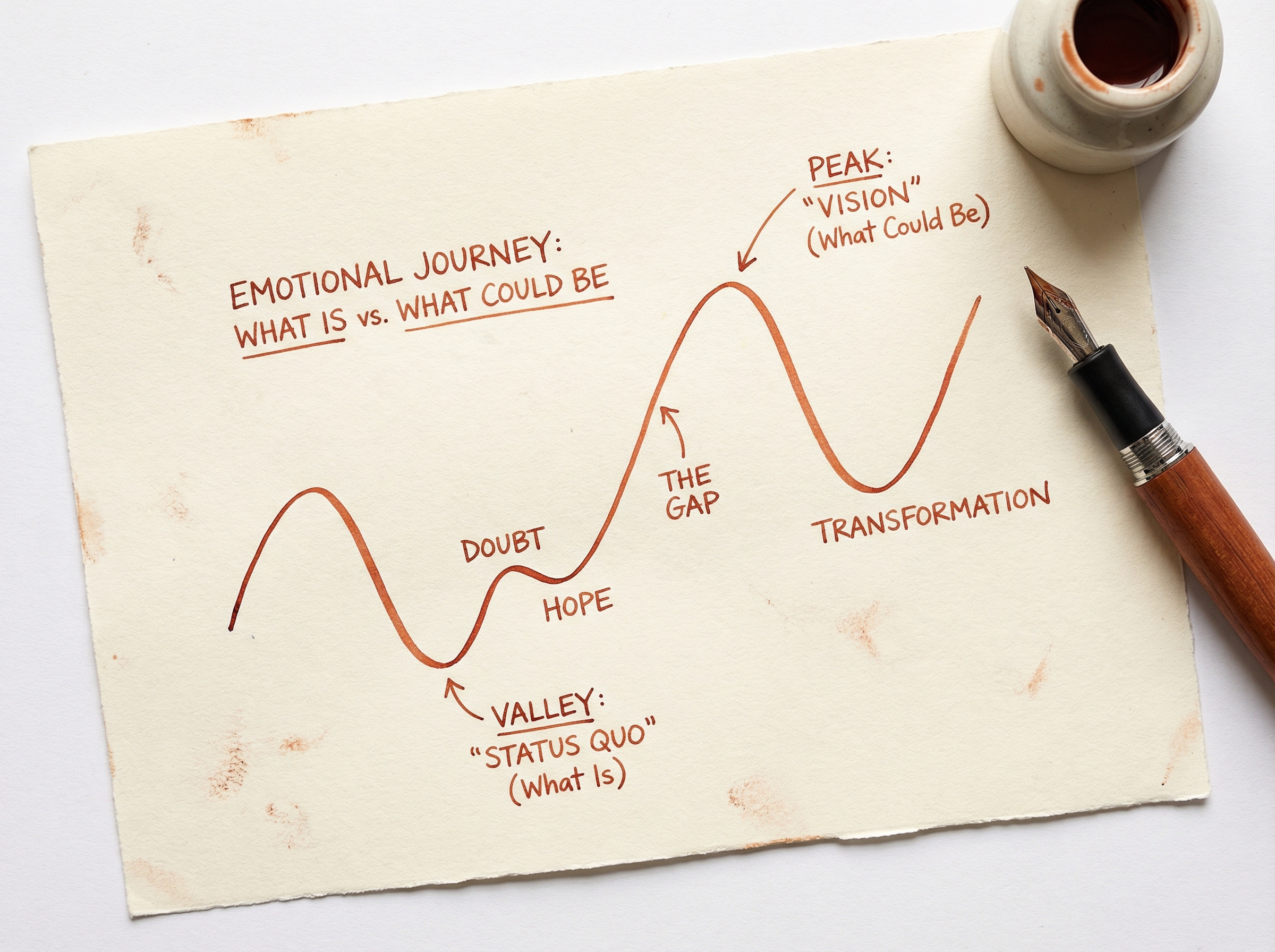
Hand-drawn sparkline chart showing the emotional journey of what is versus what could be, with annotations

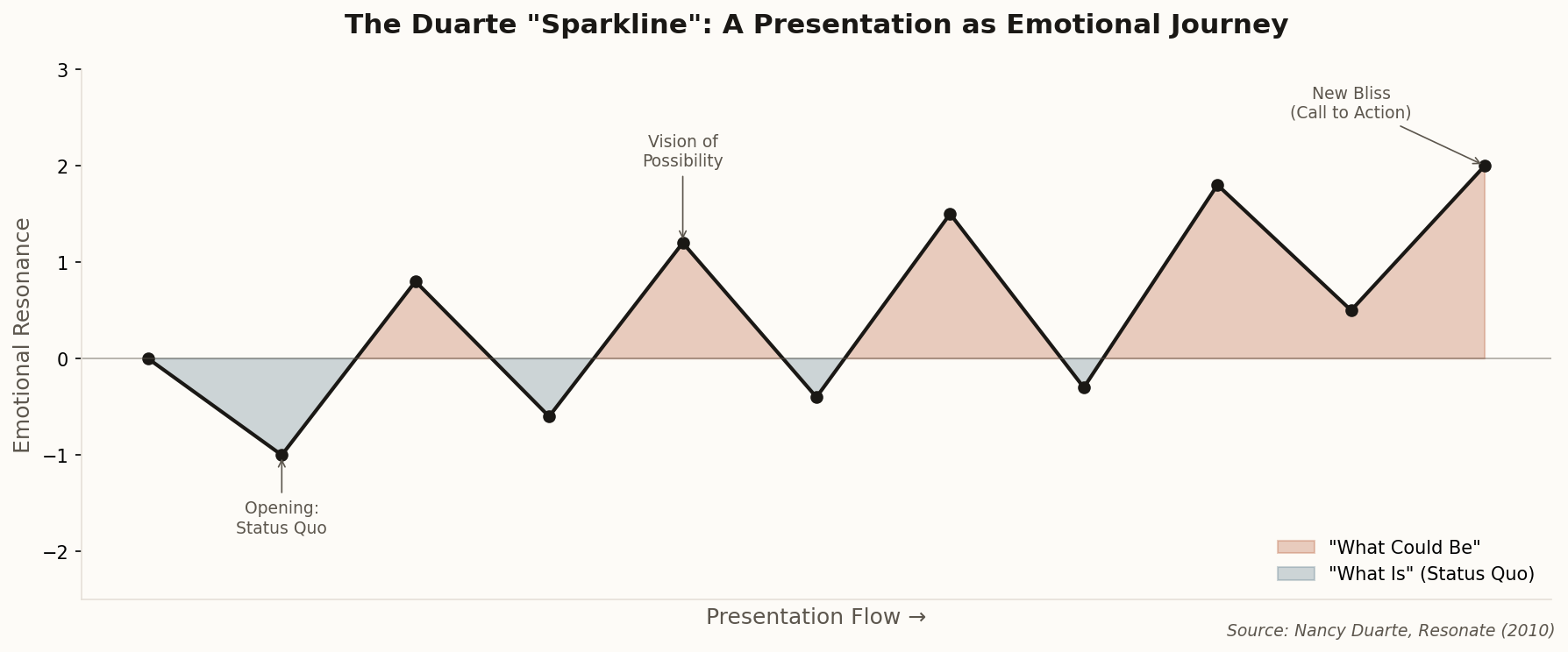
Nancy Duarte's methodology treats presentation structure not as a sequence of facts, but as a visual "shape"—the Sparkline. The process requires mapping the gap between "What is" (status quo) and "What could be" (future state) repeatedly throughout your narrative. If you can't articulate that gap clearly, you don't have a presentation.

The Duarte Sparkline showing alternating emotional resonance between status quo and vision throughout a presentation
The Sparkline maps the emotional journey from status quo pain to transformative vision—each dip and rise is intentional.

This reframes the deck entirely. You're not making slides pretty—you're architecting a persuasive argument. The structural planning phase becomes the highest-value cognitive work because it forces you to find the holes in your logic before your audience does.

"You are not the hero who saves the audience," Duarte writes. "The audience is your hero." That shift—from presenter-centric to audience-centric—only happens when you've done the hard work of mapping their journey from resistance to acceptance. No AI tool does this for you.

06

Why Amazon Banned PowerPoint

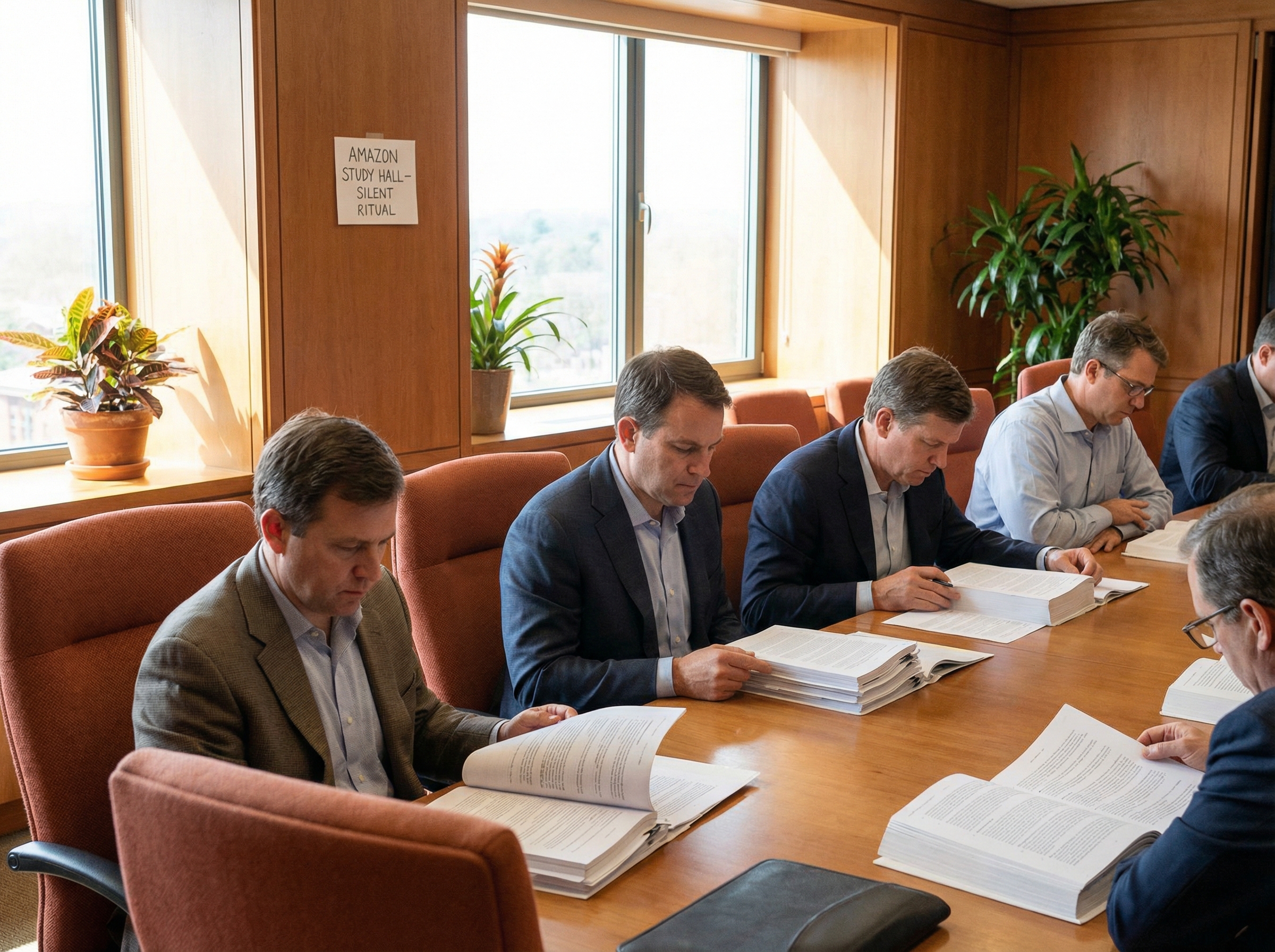
Corporate meeting room transformed: executives in silent concentration reading printed memos, no screens visible

In 2004, Jeff Bezos sent an email that would become legendary in business circles: no more PowerPoint in senior executive meetings. Instead, six-page narrative memos. Meetings begin with "Study Hall"—30 minutes of silent reading before discussion begins.

The philosophy is deceptively simple: bullet points allow for "lazy thinking" where relationships between ideas get glossed over. Narrative writing forces the author to explicitly link cause and effect, requiring deeper synthesis. "The reason writing a good 4 page memo is harder than 'writing' a 20 page powerpoint is because the narrative structure of a good memo forces better thought and better understanding of what's more important than what."

But here's the twist: Amazon's rejection of slides isn't really about the format—it's about the cognitive work required to produce coherent prose. The same principle applies whether you're writing sentences or designing slides. The question isn't "slides or memos?" The question is: "Did the creator do the hard thinking, or did they hide behind bullet points and formatting?"

The common thread: Whether you're constrained by prose paragraphs or one-idea-per-slide, the forcing function is the same—you must understand your material deeply enough to simplify it honestly. The artifact is evidence of thinking, not a substitute for it.

The Deck Is the Receipt

The most valuable presentation you'll ever create is the one that forces you to think differently by the end than you did at the beginning. The slides are just the receipt—proof that cognitive work occurred. Optimize for the struggle, not the output.