Robotics

The Robot Race Has a Leader

This week, the humanoid robot industry stopped being a science fair and started being a business. One company proved it. Another bet the farm on it.

Listen
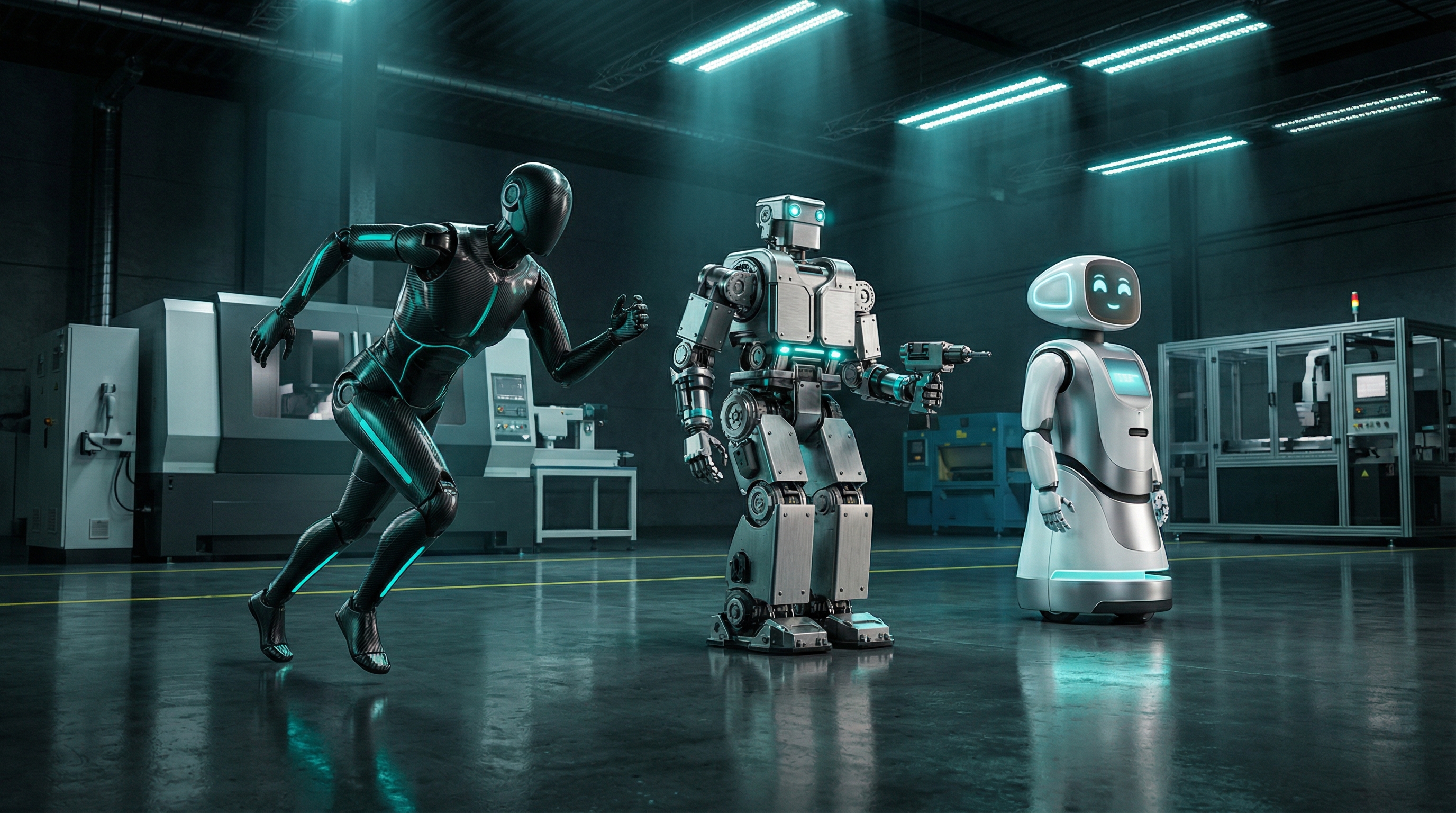
Humanoid robots working in a modern factory with teal accent lighting
01

100,000 Totes: Agility Proves Robots Can Do the Job
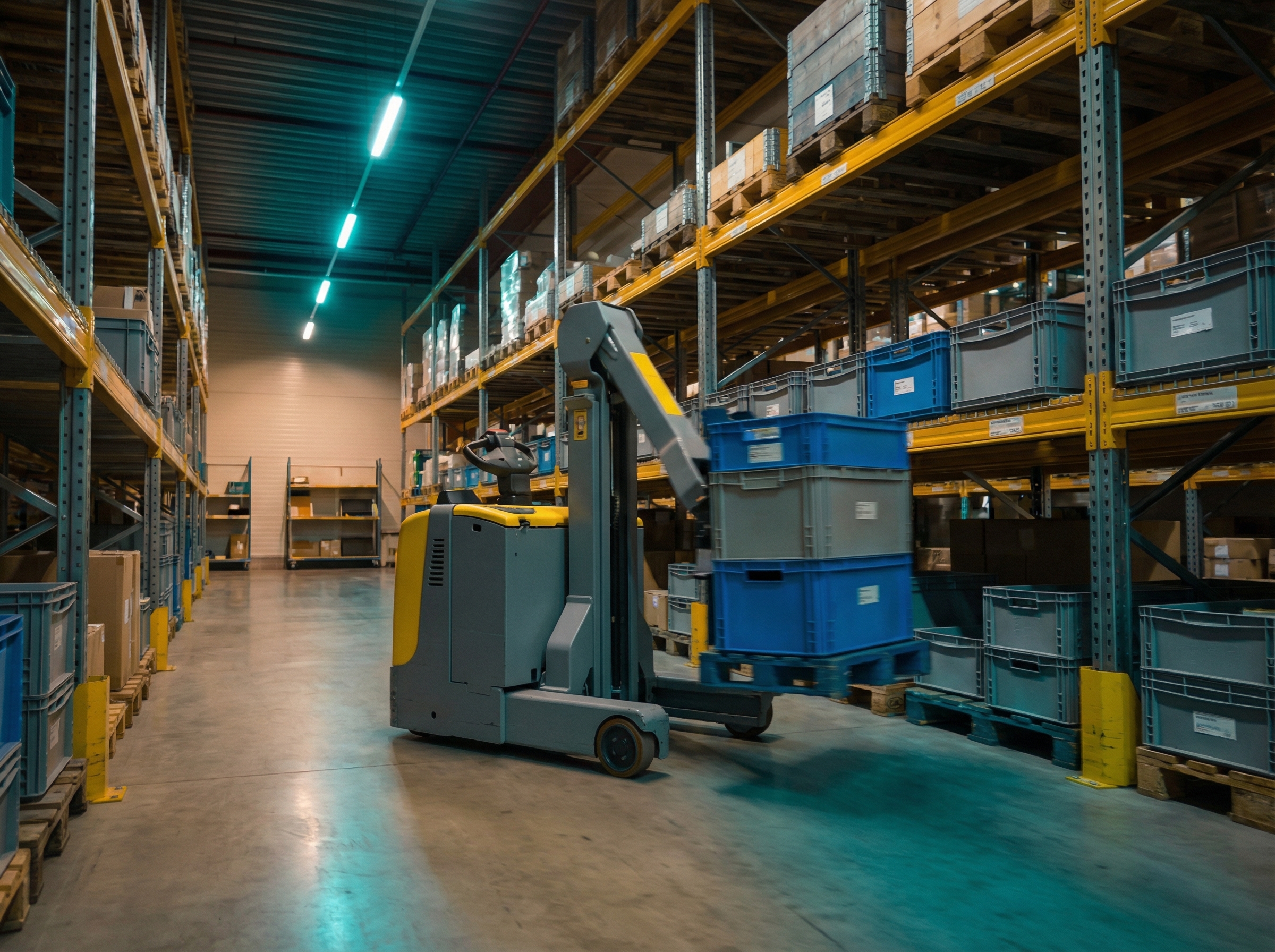
Warehouse robot carrying totes through industrial shelving

Here's a number that matters more than any demo video: 100,000. That's how many totes Agility Robotics' Digit robots have moved in actual production at a GXO Logistics facility in Georgia. Not in a lab. Not for a trade show. In a real warehouse, doing real work, every day.

While competitors are still unveiling prototypes on conference stages, Agility just announced a new deployment deal with Mercado Libre—Latin America's e-commerce giant—to put Digit robots in fulfillment centers in San Antonio. They're also ramping up production at their "RoboFab" facility from hundreds to thousands of units per year.

The significance isn't the robot's capabilities (though walking, carrying, and sorting are impressive). It's that someone signed a purchase order, deployed it, and kept it running long enough to hit six figures on the tote count. That's the difference between technology and product.
02

Tesla Bets the Factory: Model S/X Dies for Optimus

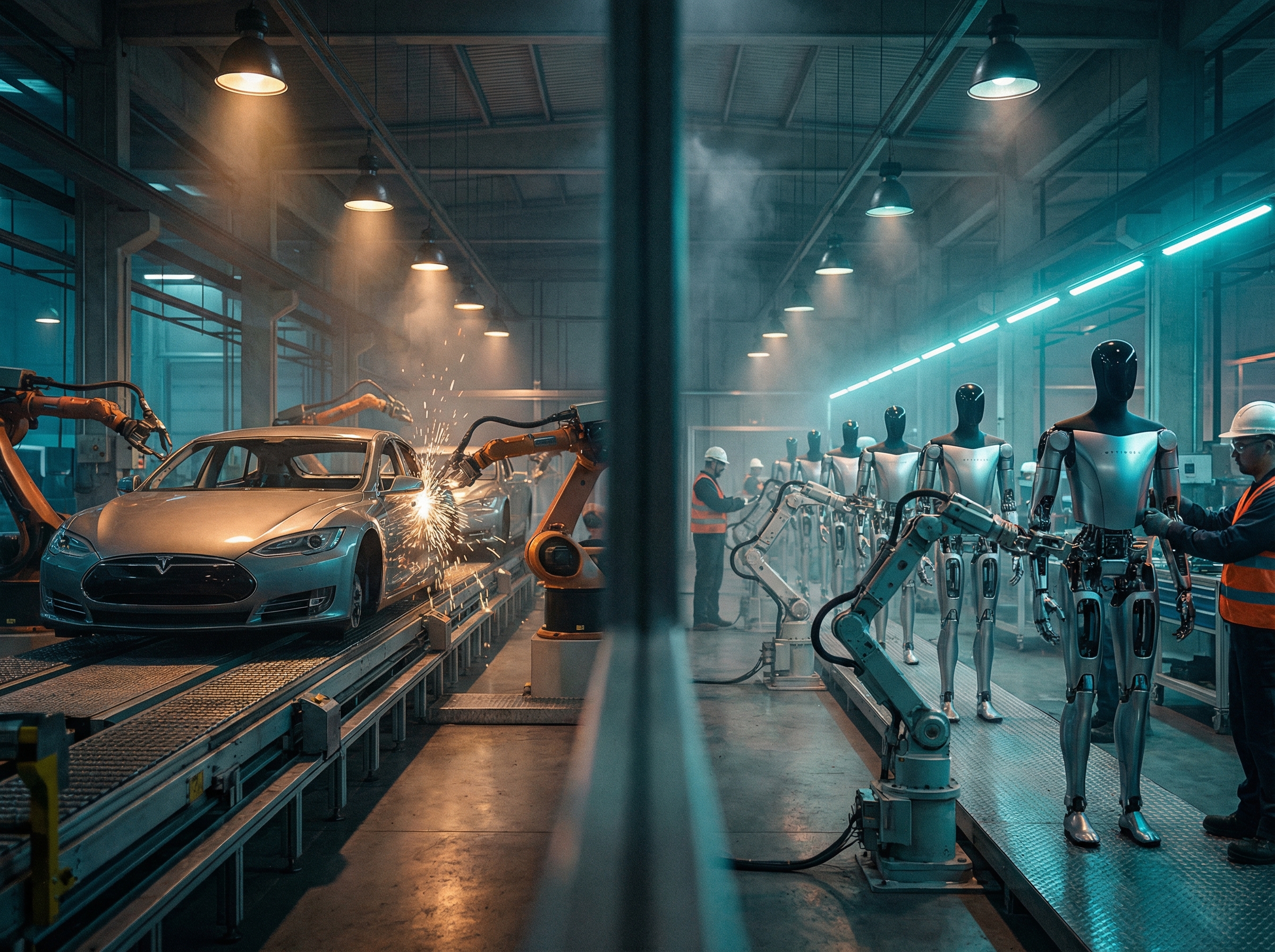
Tesla factory transitioning from car to robot production

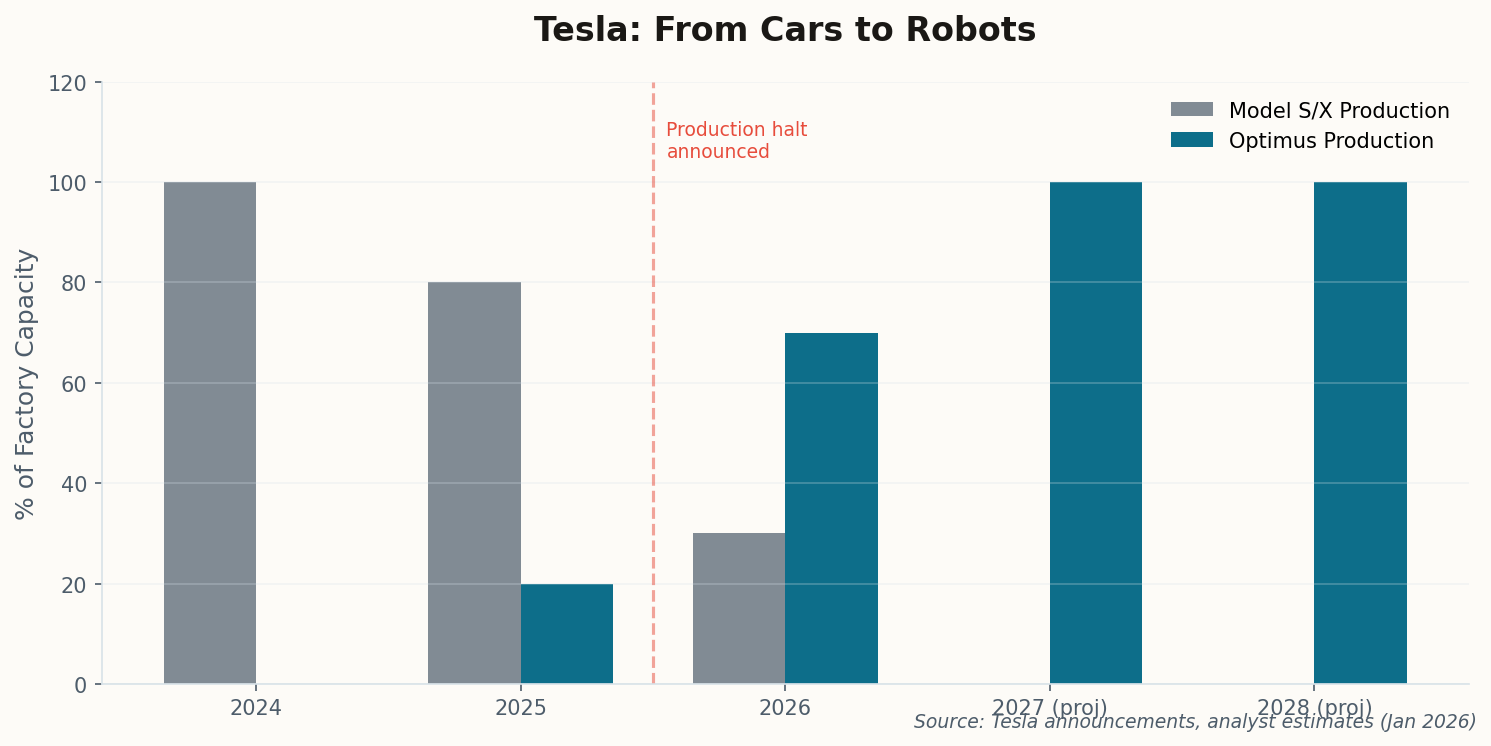
Tesla is discontinuing the Model S and Model X. Let that sink in: the cars that built the Tesla brand, that proved electric vehicles could be desirable, are being sacrificed on the altar of Optimus.

The factory space and resources are being reallocated to produce one million humanoid robots annually. Mass production of the "Gen 3" Optimus is scheduled to begin by the end of 2026, with public sales targeted for late 2027 at a price point between $20,000 and $30,000.

Chart showing Tesla's production shift from Model S/X to Optimus robots from 2024 to 2028
Tesla is reallocating 100% of Model S/X production capacity to Optimus by 2027

Elon Musk expressed confidence that Optimus would surpass Chinese competitors "in real-world intelligence and dexterity." That's fighting words, given Unitree's aggressive pricing (see below). But Musk has never shied away from bold claims—and occasionally, he delivers on them.

This is the strongest signal yet that Tesla views humanoid robots—not cars—as its primary future revenue driver. Whether that's visionary or delusional depends entirely on execution.

03

Figure's Helix 02: 61 Actions, Zero Human Help

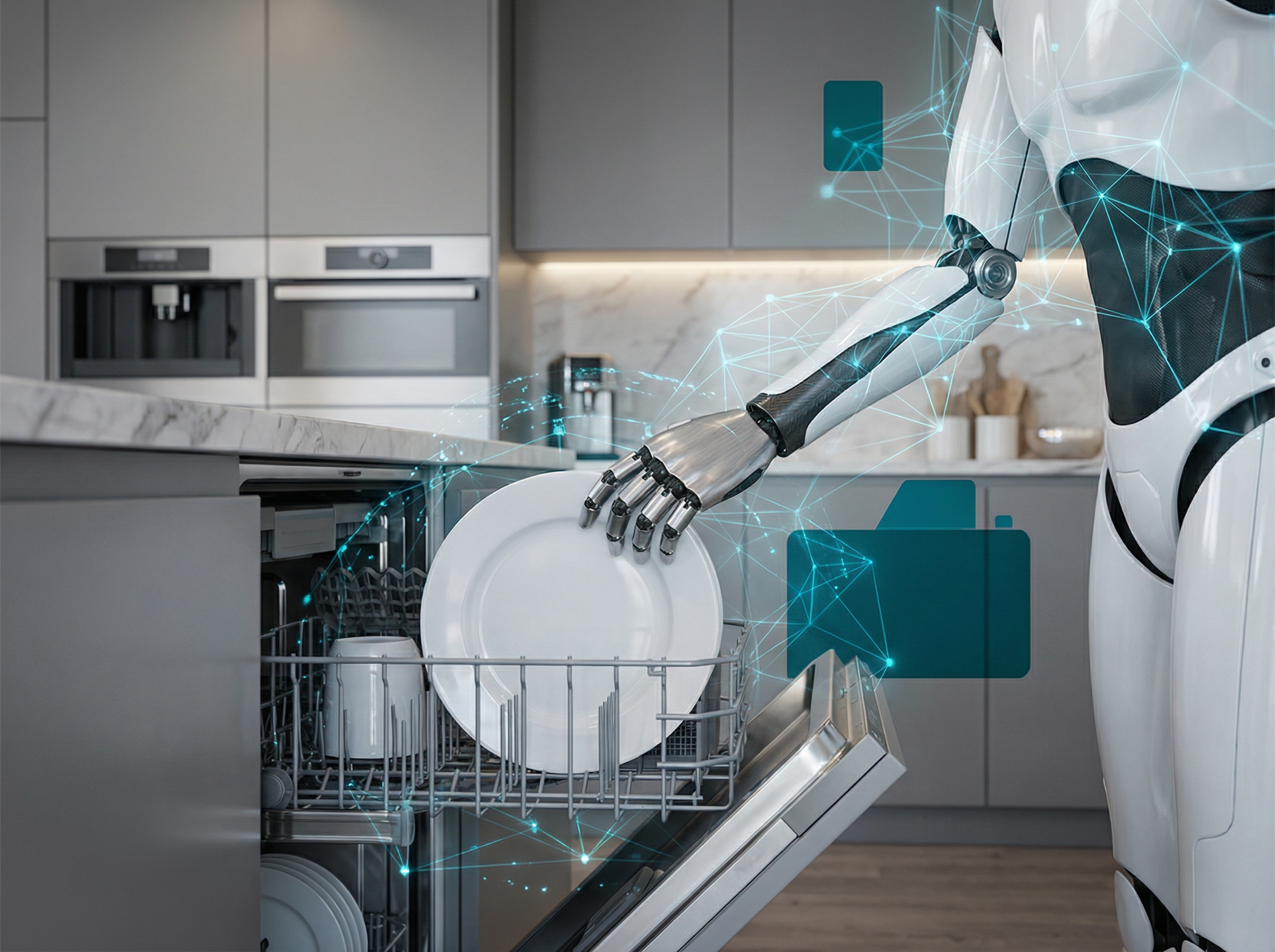
Humanoid robot performing autonomous kitchen tasks

Most humanoid robot demos are elaborate magic tricks: teleoperated by humans off-camera, or running pre-scripted movements. Figure AI's latest demonstration is neither.

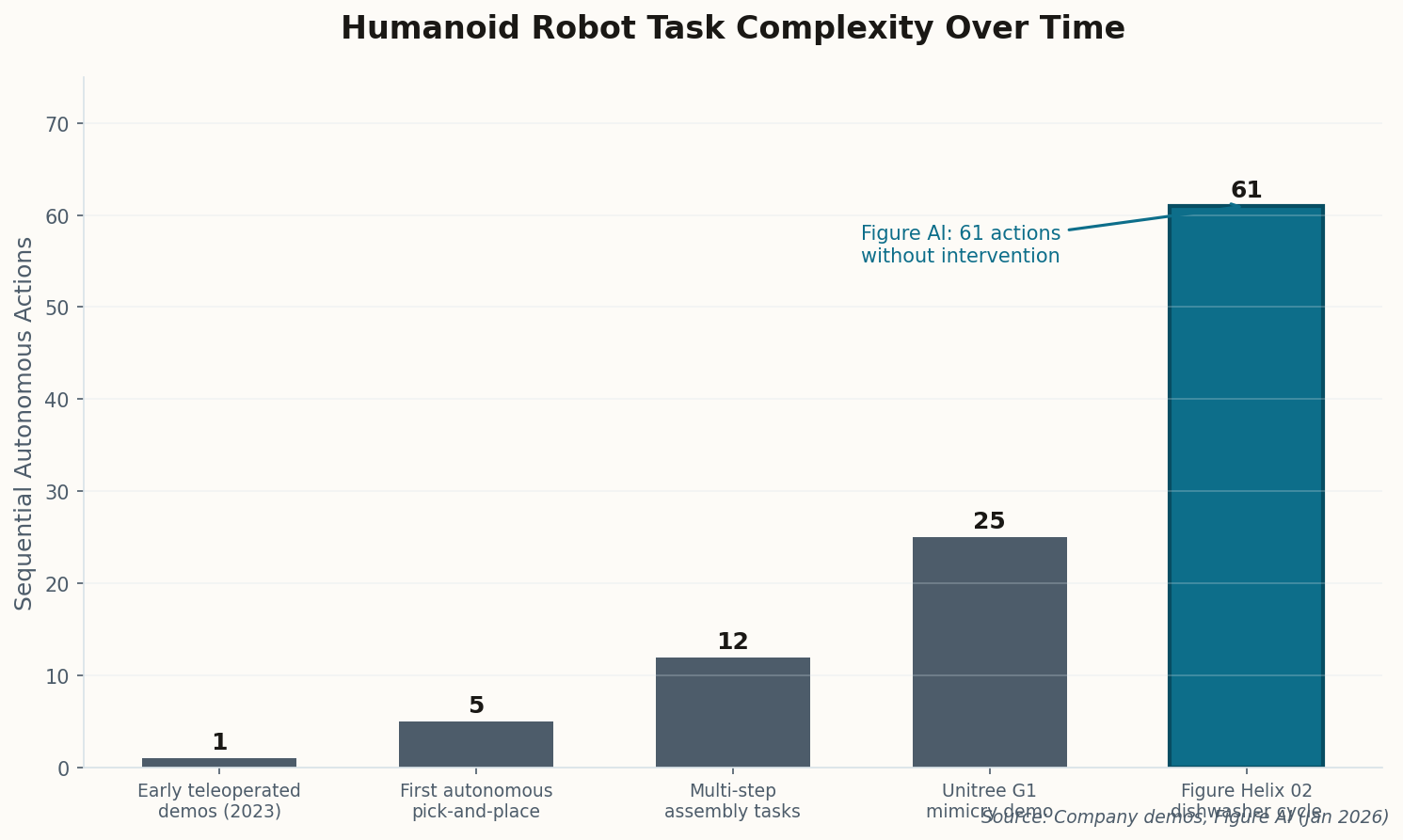
Their "Helix 02" vision-language-action AI model powered the Figure 02 robot through a complete dishwasher cycle: opening the door, loading dirty dishes, adding detergent, and starting the machine. That's 61 separate loco-manipulation actions over 4 minutes, controlled by a single neural system, with zero human intervention.

Bar chart showing humanoid robot task complexity evolution from 1 action in 2023 to 61 actions with Figure AI in 2026
Task complexity has grown exponentially; Figure AI's 61-action demo represents a step change

Why does loading a dishwasher matter? Because it requires everything: navigation, object recognition, manipulation, sequencing, and adaptation. A dish in the wrong spot means adjusting grip. A full rack means finding another slot. The robot handled these decisions autonomously.

This is claimed to be the longest and most complex autonomous task completed by a humanoid robot to date. If true—and Figure's track record suggests it is—this demo moves the needle on what "autonomous robot" actually means.

04

The $13,500 Robot That Changes Everything

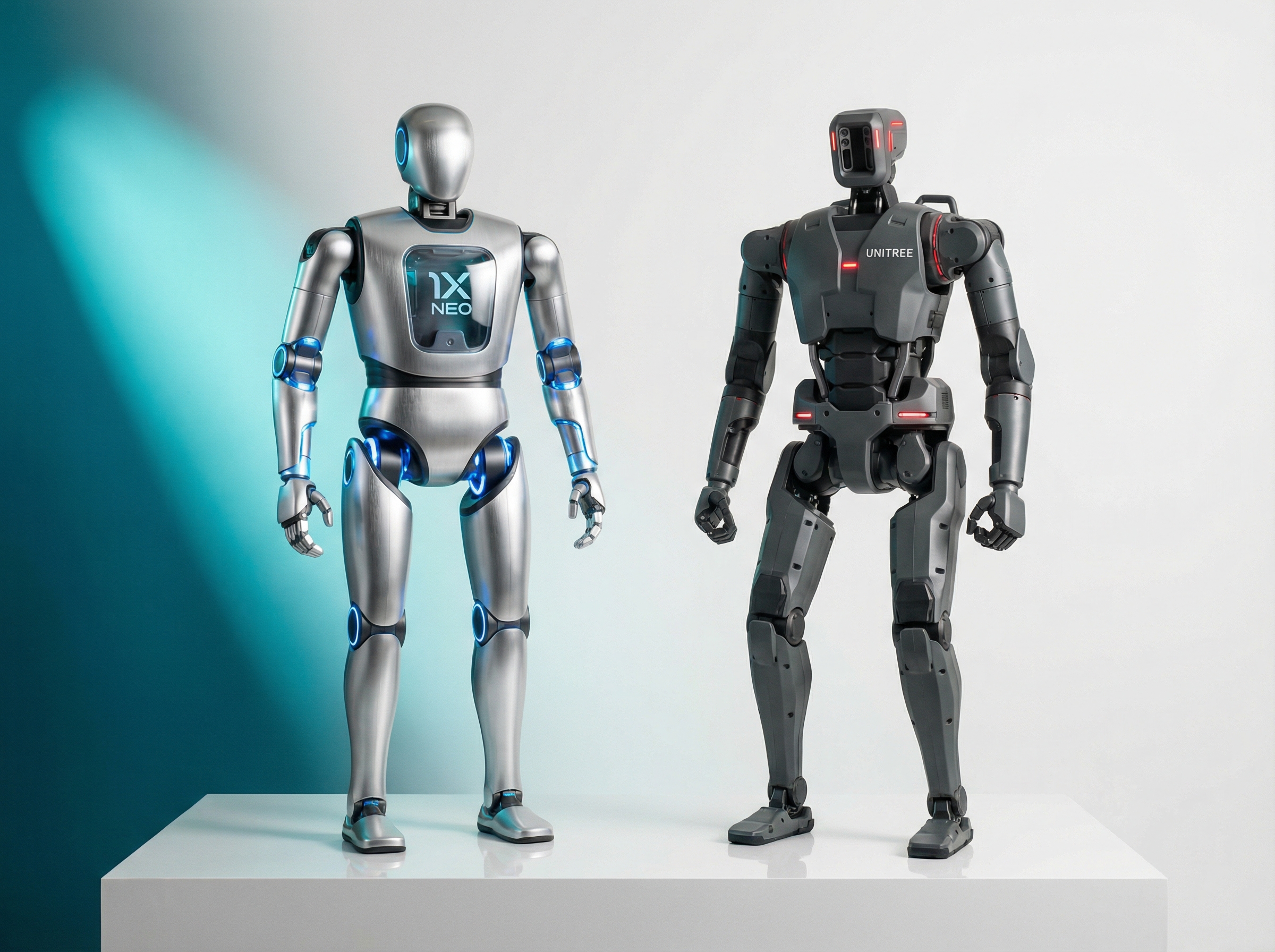
Two humanoid robots representing US and China competition

Two announcements on the same day tell you where the humanoid robot market is heading: one company is solving the intelligence problem, the other is solving the cost problem.

1X Technologies unveiled their "1X World Model"—an AI system that lets their NEO robot learn physical skills by watching internet-scale videos. The robot can simulate outcomes and handle novel objects it's never physically encountered. Think of it as giving the robot imagination. Deliveries to US consumers are confirmed for later in 2026.

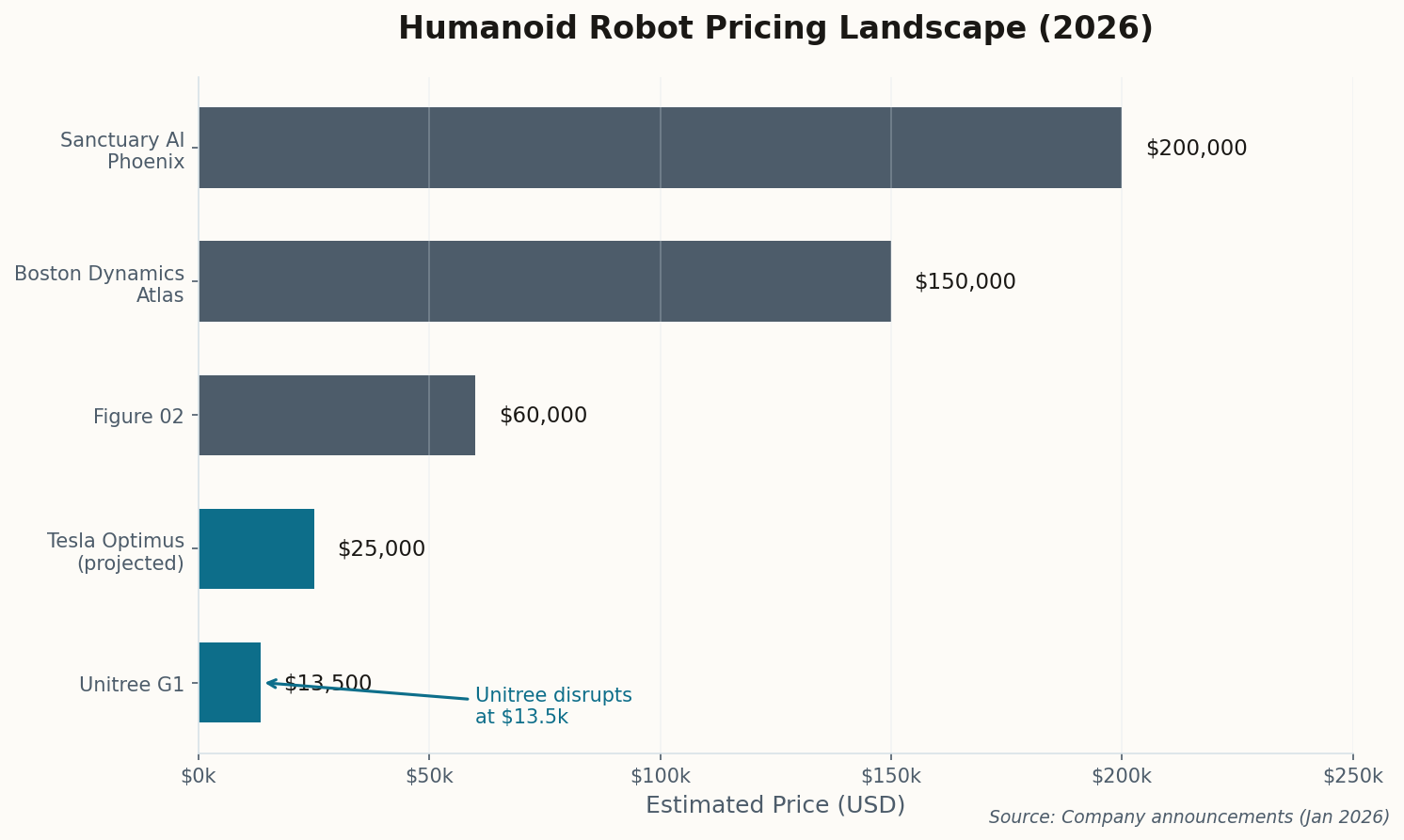
Horizontal bar chart comparing humanoid robot prices from $13,500 to $200,000
Unitree's G1 at $13,500 undercuts Western competitors by 50-90%

Meanwhile, China's Unitree launched the G1 humanoid at $13,500. For context, that's less than a used Honda Accord. The robot weighs 80 lbs, stands over 4 feet tall, includes 3D LiDAR and Intel RealSense cameras, and can mimic human motions with surprising fluidity. Unitree was also named a partner for China's 2026 Spring Festival Gala—a signal of massive domestic political support.

At this price point, every university robotics lab, every ambitious startup, and every curious manufacturer can afford to experiment. That's how ecosystems form. The question isn't whether Unitree's robot is as capable as Figure or Boston Dynamics—it isn't. The question is whether good-enough-for-cheap beats better-but-expensive.

05

Electric Atlas Goes to Work at Hyundai

Boston Dynamics invented the humanoid robot demo. Their hydraulic Atlas doing backflips, navigating obstacle courses, and dancing to pop music defined what these machines could become. But a YouTube sensation isn't a business.

The new fully electric Atlas is now actively operating inside Hyundai's automotive plant in Georgia. This version features human-scale hands with tactile sensing, 56 degrees of freedom, and can lift up to 110 lbs. Unlike the previous hydraulic show-bot, this electric model was designed specifically for mass production and factory integration.

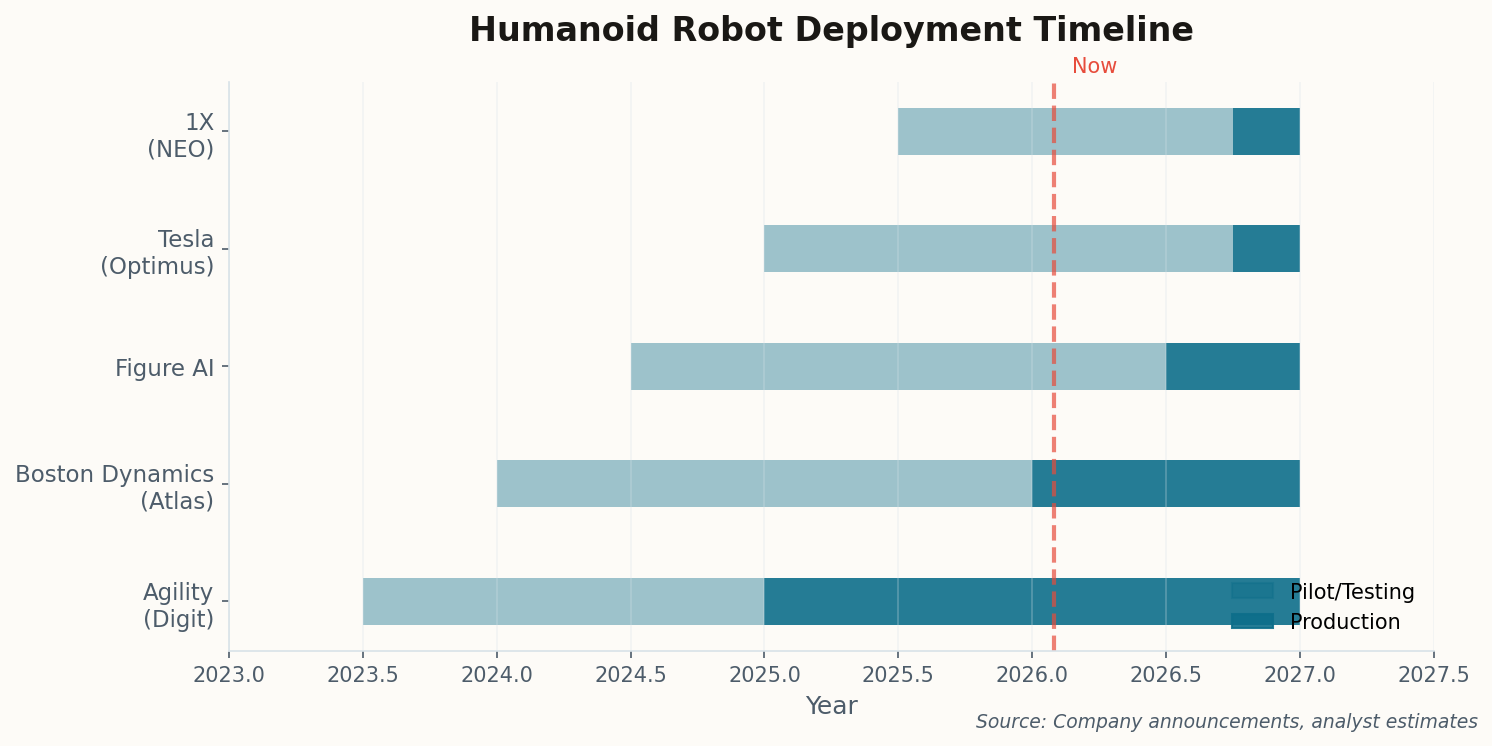
Timeline chart showing humanoid robot deployments from 2023 to 2027 across major companies
Agility leads in production deployments; Atlas and Optimus are scaling in 2026

A 60 Minutes feature showed Atlas autonomously sorting automotive parts—roof racks—using machine learning rather than pre-programmed movements. That's the transition: from research project to industrial tool. With Hyundai's manufacturing footprint, Boston Dynamics finally has a path to scale.

The irony is rich: the company that made robots famous for parkour is proving its value by sorting car parts. But that's exactly where the money is.

The Answer to "Who's Winning?"

Right now, Agility Robotics is winning—not because their robot is the most impressive, but because it's actually working. Tesla is making the boldest bet. Figure AI is pushing the frontier of autonomy. And Unitree is making the whole category affordable. The real story isn't which robot is best; it's that by the end of 2026, humanoid robots will be mundane. That's the disruption.