Education + AI

The $200K Question

Is a four-year degree still worth it when AI is eating the entry-level jobs you're supposed to get after graduation? The answer is more complicated—and more urgent—than anyone wants to admit.

Listen
Young graduate at a crossroads between traditional university and AI-powered future
01

The Class of 2026 Isn't Buying What Universities Are Selling

Anxious student surrounded by AI neural networks and question marks

Here's a number that should terrify every university president in America: 59% of young Americans now believe AI poses a direct threat to their specific career prospects. Not "technology in general." Not "the economy." Their careers. Their futures. Their ability to justify the six-figure debt they're taking on.

The College Recruiter survey landed like a grenade this week, revealing that a significant chunk of the Class of 2026 now views their degree as a "financial burden" rather than a career asset. The kicker? 44% expect AI will eliminate more jobs than it creates. These aren't technophobes—they're digital natives who grew up with ChatGPT and watched it write their classmates' essays.
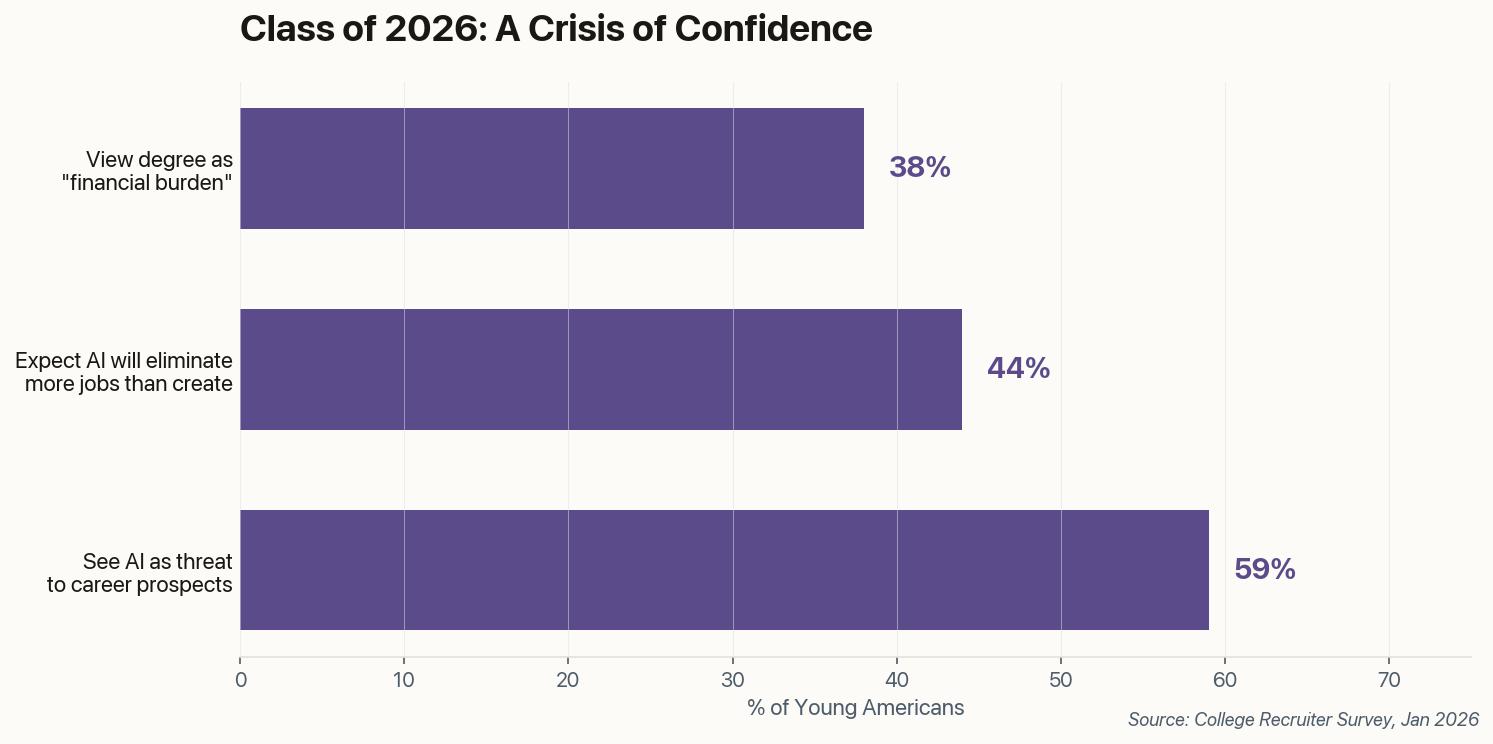
Bar chart showing 59% of young Americans see AI as career threat
Student confidence in their degree's value is collapsing faster than universities can update their curricula.

What's particularly striking is the disconnect: universities are still selling the same "invest in yourself" narrative from 2010, while students are watching AI demos that can do junior-level work faster than they can draft a cover letter. Someone's going to blink first. My bet is it won't be the students.

02

Entry-Level Jobs Are Disappearing—And It's Not a Blip

Empty office cubicles with AI robots and fading Now Hiring sign

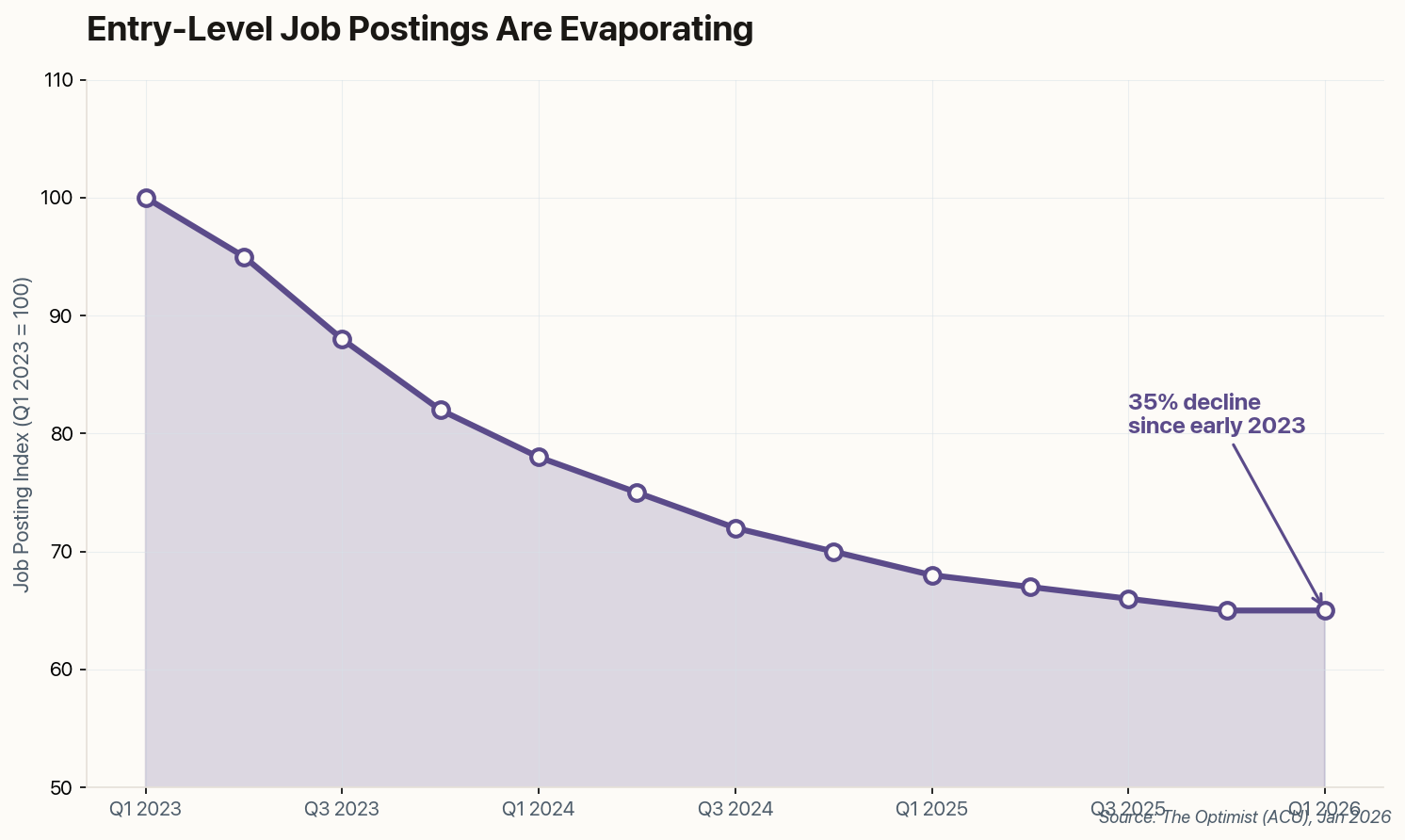
Entry-level job postings have dropped 35% since early 2023. That's not a recession dip. That's not a "market correction." That's a structural shift in what companies need humans to do.

The sectors hit hardest? Marketing, HR, and engineering—precisely the fields that require "knowledge work" that AI handles with increasing competence. What used to be a new grad's first rung on the ladder—sorting applications, drafting press releases, writing boilerplate code—is now a prompt away from being automated.

Line chart showing 35% decline in entry-level job postings since 2023
The traditional "foot in the door" roles are being automated before new graduates can get their foot in.

Here's the uncomfortable truth: the college-to-career pipeline was always built on the assumption that companies needed junior employees to do grunt work while they learned. AI broke that assumption. Now recruiters are using AI screening tools that filter for demonstrated skills rather than credentials—which creates a brutal catch-22. You need experience to prove skills, but you can't get experience without the entry-level job that no longer exists.

What should graduates do? Build a portfolio of AI-augmented work that demonstrates what you can do with the tools, not despite them. The ones who figure this out first will leapfrog their credential-clutching peers.

03

Universities Are Fighting Back With AI Degrees—Is It Enough?

Classical university building with holographic AI visualizations glowing from windows

The University of Kentucky just announced the state's first Bachelor of Science in Artificial Intelligence, launching Fall 2026. It's a significant move—and it signals that higher education is finally waking up to the existential threat it faces.

What's notable about UK's approach: the curriculum is explicitly "embedded" with industry needs, focusing on ethics and real-world application rather than abstract theory. That's a departure from the traditional "teach concepts, figure out application later" model that has dominated computer science education for decades.

The key quote: "Universities are beginning to integrate AI literacy... emphasizing analytical judgment, creativity, and empathy." Translation: we're trying to teach the things AI can't do. Yet.

But here's my concern: by the time these students graduate in 2030, the AI landscape will look completely different. Anthropic, OpenAI, and Google DeepMind are shipping capabilities on a quarterly basis that would have seemed like science fiction two years ago. A four-year program is an eternity in AI time. The universities that survive will be the ones that can pivot curriculum in semesters, not years.

04

The Rise of the AI Generalist: What Employers Actually Want

Professional conducting orchestra of AI interfaces and holographic dashboards

PwC's latest workforce analysis reveals something counterintuitive: the hottest job category isn't "AI engineer." It's "AI Generalist"—people who combine business acumen with the ability to direct and quality-check AI outputs. Think of them as AI conductors rather than AI builders.

This is a crucial distinction. Companies don't just need people who can build models—they need people who can figure out what to build and whether the output is actually good. That requires domain expertise, critical thinking, and a skill that's hard to automate: judgment.

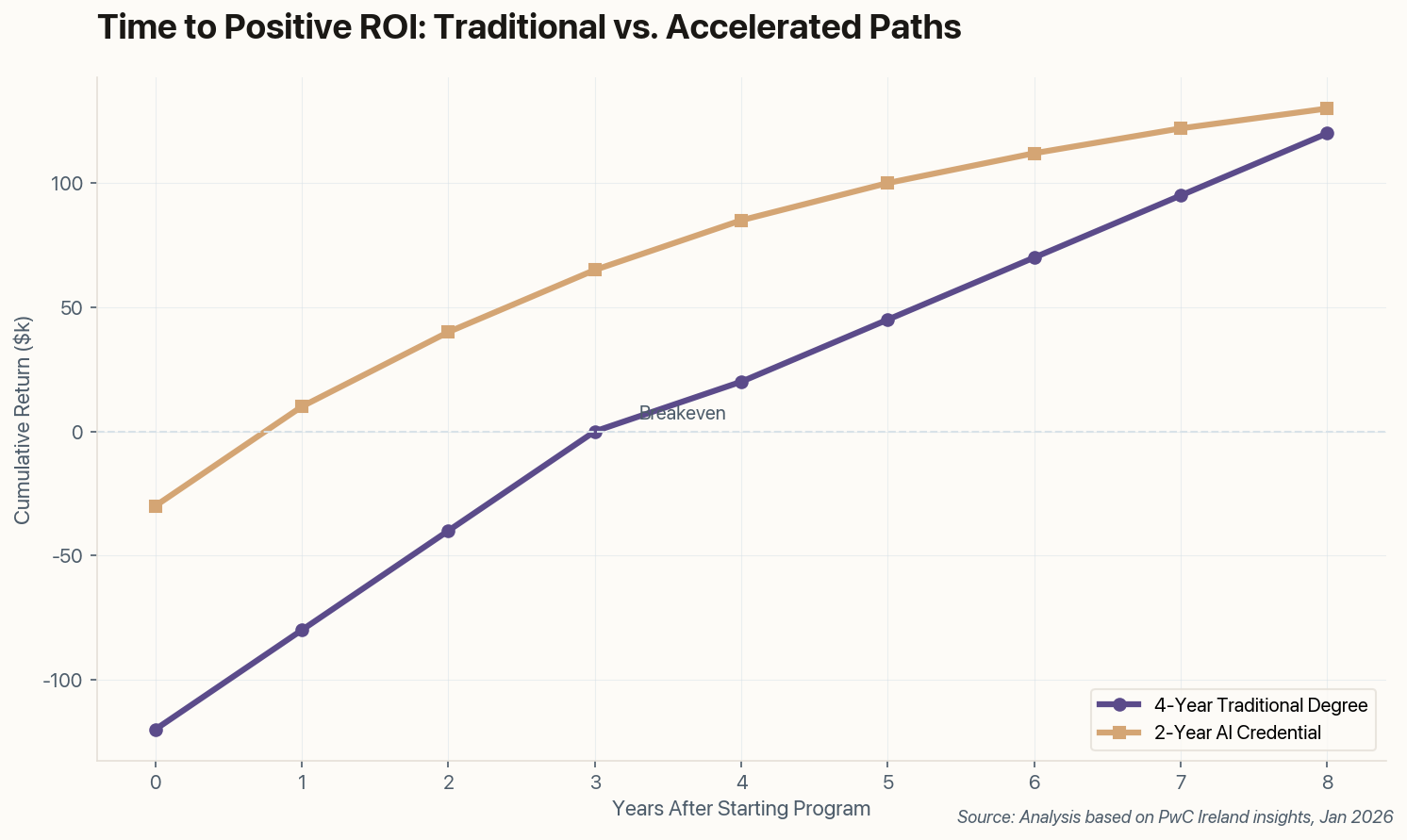
Line chart comparing ROI of 4-year degree vs 2-year AI credential
Specialized 2-year credentials are showing faster time-to-positive-ROI than traditional 4-year degrees.

The data also shows something uncomfortable for traditional universities: specialized, accelerated two-year AI programs are showing faster positive ROI than generalist four-year liberal arts degrees. That doesn't mean liberal arts are worthless—the critical thinking and communication skills still matter. But they're no longer sufficient on their own. The winners are students who stack both.

05

The Credential Is Dead, Long Live the Skill

Diploma with fading Required stamp while skills badges glow brightly

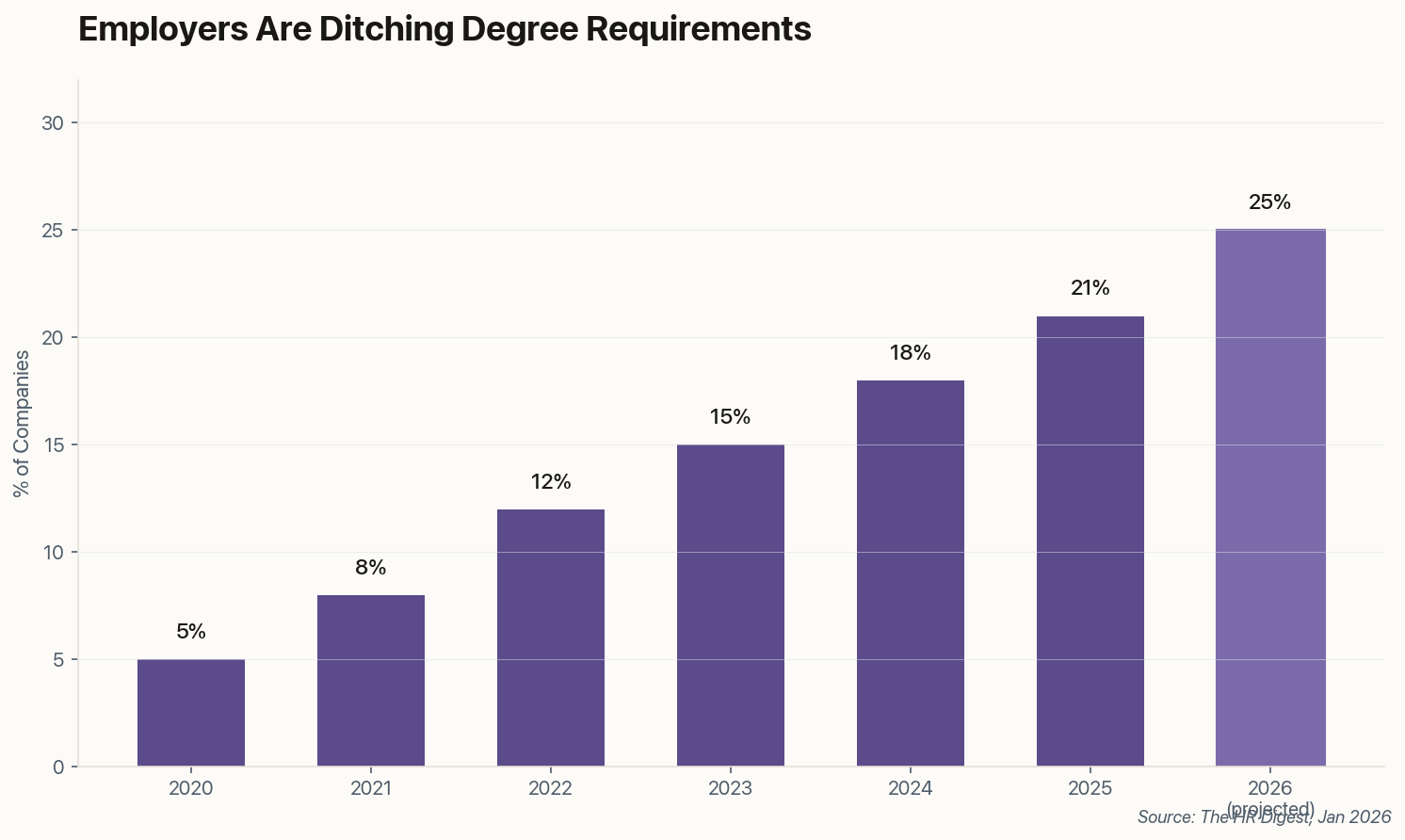
21% of companies have already removed bachelor's degree requirements. By year's end, The HR Digest projects that number will hit 25%. Google, Bank of America, and a growing list of Fortune 500s are publicly pivoting to "skills-based hiring."

Bar chart showing companies dropping degree requirements from 5% in 2020 to 25% projected in 2026
The trend is accelerating: from 5% of companies in 2020 to 25% by end of 2026.

What's driving this? Two things. First, AI competency is becoming a "non-negotiable" skill that's often valued higher than the degree itself. Someone who can ship a product using Cursor and Claude is more valuable than someone who studied Python in 2023 and hasn't touched an AI tool since.

Second, companies are realizing that four years of college doesn't necessarily mean four years of useful learning. A motivated self-learner with a portfolio of real projects often outperforms a credentialed candidate with only coursework to show. The degree was always a proxy for ability—and now employers have better signals.

This doesn't mean college is worthless. It means it's no longer a guaranteed ticket to the white-collar middle class. That's a profound shift in the social contract Americans have believed in since the GI Bill.

06

The Wage Premium Cracks: Trades vs. Degrees

Two diverging paths: hard hat leading to bright future, graduation cap leading into fog

For the first time in 50 years, the employment advantage of college graduates is noticeably diminishing relative to skilled trades. The Washington Post analysis is stark: high tuition costs combined with AI displacement of "knowledge worker" tasks are eroding the traditional ROI of a four-year degree.

Consider this: an electrician or HVAC technician can't be replaced by a chatbot. They work with physical reality. They solve problems that require hands and presence. And they're not taking on $120K in debt to do it.

Meanwhile, a freshly minted marketing graduate is competing with Claude for their first job writing social media copy. The math is starting to look very different than it did a decade ago.

The uncomfortable question: If you're advising an 18-year-old today, is "go to a good college" still the right advice? Or should it be "figure out what you want to do, and pick the fastest path to demonstrable competence"?

The answer probably depends on the field—medicine and law still require credentials, at least for now. But for a huge swath of careers that used to reliably pay back a four-year investment, the calculus has changed. Young adults need to think harder about whether they're buying an education or buying a signal—and whether that signal still means what it used to.

The Bottom Line

The $200K question doesn't have a simple answer. College isn't dead, but its automatic value is. The students who thrive will be the ones who treat education as a tool for building demonstrable skills—not a four-year waiting room before adulthood. The ones who learn to work with AI, not around it. And maybe the ones who ask whether they need the degree at all, or whether a faster path to competence makes more sense. That's a harder conversation than "just go to college." But it's the honest one.