Literature & Culture

The Dead Authors Are Winning

Hollywood adaptations are making classics cool again. Education boards are fighting over Homer. And universities are betting millions that Plato still matters. The canon wars have a new front.

Listen
Stacked leather-bound classic books with candlelight casting golden shadows
01

Margot Robbie Just Sold More Brontë Than Amazon Could

Windswept moorland with Gothic manor silhouette on the horizon

Here's a thought experiment: What's the most effective tool for getting Gen Z to read a 179-year-old novel about a vengeful orphan on the Yorkshire moors? Not assigned reading lists. Not TikTok BookTok influencers. Not even that beloved English teacher with the infectious enthusiasm for Romantic literature.

It's Margot Robbie and Jacob Elordi in a moody trailer.

Emerald Fennell's adaptation of Wuthering Heights premiered January 28th, and within 48 hours, sales of Emily Brontë's novel surged over 500% according to Nielsen BookScan. The Puffin in Bloom edition—that's the pretty one with the illustrated cover—crashed onto the YA fiction bestseller list. "It is a story of a monster," Fennell told interviewers, "and I think that is something we are all ready to see."
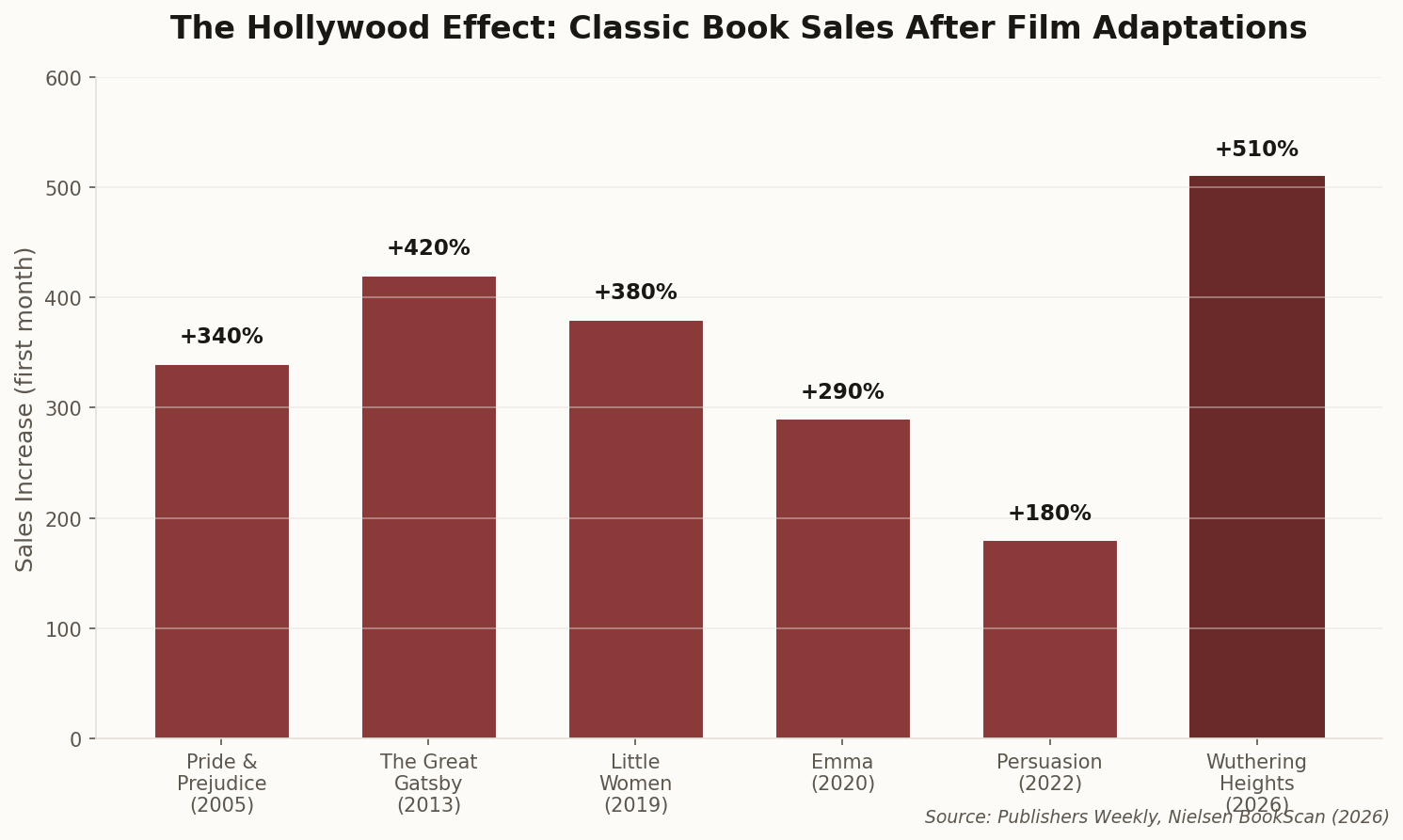
Bar chart showing book sales increases following major film adaptations from 2005-2026
The Hollywood effect remains the most powerful driver of classic literature sales. Wuthering Heights (2026) is tracking to be the biggest adaptation-driven spike in two decades.

The cynical take: kids aren't actually reading classics—they're buying pretty editions to photograph for Instagram. The data tells a more interesting story. Post-adaptation sales tend to sustain for 6-8 months, and readers who pick up the source material after seeing an adaptation are more likely to read a second classic within the year. Hollywood isn't replacing the literary canon. It's the most effective gateway we have.


02

The "Boring Books" Manifesto That Has English Teachers Fighting

Hands holding open a thick classic novel with aged yellowed pages

Robert Pondiscio is not known for pulling punches. The education commentator and senior fellow at the American Enterprise Institute published an essay this week that landed like a grenade in teacher Slack channels: "Start Assigning Great Books in English Class."

His thesis: the "student choice" model of reading instruction—where kids pick whatever engages them—has failed catastrophically. The result isn't empowered readers. It's students who lack the stamina to work through difficult texts and the cultural literacy to understand allusions in anything from Supreme Court decisions to SNL sketches.

"We have confused engagement with entertainment. A great book doesn't always start with a hook; it starts with a demand on your attention."

Pondiscio cites new data suggesting that reading stamina—the ability to sustain focus on long-form text—has declined 40% among high schoolers since 2010. The culprit, he argues, isn't smartphones alone. It's a pedagogy that treats student preference as sacred and challenge as cruel. "Boring" isn't a property of the book. It's what happens when a student meets a text that requires a teacher's mediation to unlock.

The essay has predictably split educators. Progressives call it elitist nostalgia. Traditionalists are forwarding it with "finally someone said it" energy. What's striking is the silence from the middle—teachers who privately agree but won't say so when "student voice" is the shibboleth of every professional development session.

03

Britain's Curriculum Review Has a "Both/And" Answer for the Canon Wars

British library reading room with ornate arched windows and green reading lamps

When the UK Department for Education announced its ongoing curriculum review, conservatives braced for classics to be thrown overboard. The prediction: Austen out, contemporary YA in. Shakespeare sacrificed on the altar of "relevance."

That's not what happened. Officials this week clarified that while the new curriculum aims to include more diverse voices, it will explicitly "allow space" and actively encourage the teaching of classic English literature. "We can have a curriculum that looks like modern Britain without losing the texts that built it," a department spokesperson stated.

This is a centrist tack that's harder to execute than either extreme. You can't simply add new voices without subtracting something—there are only so many hours in a school year. The question becomes: which classics are load-bearing, and which can be rotated into a "recommended but not required" category? Early signals suggest Shakespeare and one 19th-century novel will remain mandatory. Everything else is negotiable.

The practical effect for UK teachers: more flexibility, more judgment calls, and—inevitably—more inconsistency between schools. What a student reads at a comprehensive in Manchester may diverge sharply from a grammar school in Kent. Whether that's liberation or fragmentation depends on whom you ask.

04

Can a Grieving Father Make Shakespeare Feel Human Again?

Elizabethan quill pen resting on handwritten manuscript pages illuminated by candlelight

The film adaptation of Maggie O'Farrell's Hamnet swept the BAFTAs with 11 nominations and a Golden Globe win. Paul Mescal plays Shakespeare—but this isn't the Bard as marble statue or celebrity genius. It's a father who loses his 11-year-old son to plague and pours his grief into a play.

The critical response has been rapturous, but the more interesting phenomenon is happening in classrooms. Educational non-profits launched the "2026 Great Books Challenge" timed to the film's release, focusing on Shakespeare specifically. The pitch to students: forget the poet on the pedestal. Start with the father who wrote Hamlet while burying Hamnet.

This reframing matters because Shakespeare sits at the center of the "dead white male" critique. If the canon is merely a power structure, why privilege one 16th-century playwright above all others? Hamnet offers an answer that sidesteps the culture war entirely: not because of his identity, but because his grief is universal. A child dies. A father can't stop writing. That's not a curriculum decision. That's a human story.

Watch for Shakespeare units in English classes to shift emphasis from textual analysis to biographical context. The path to understanding Hamlet may now start with Agnes, the wife who stayed in Stratford and kept the family together while her husband became immortal.

05

Texas Blinks on the Great Books—For Now

Formal legislative chamber with classic literature books stacked on presentation table

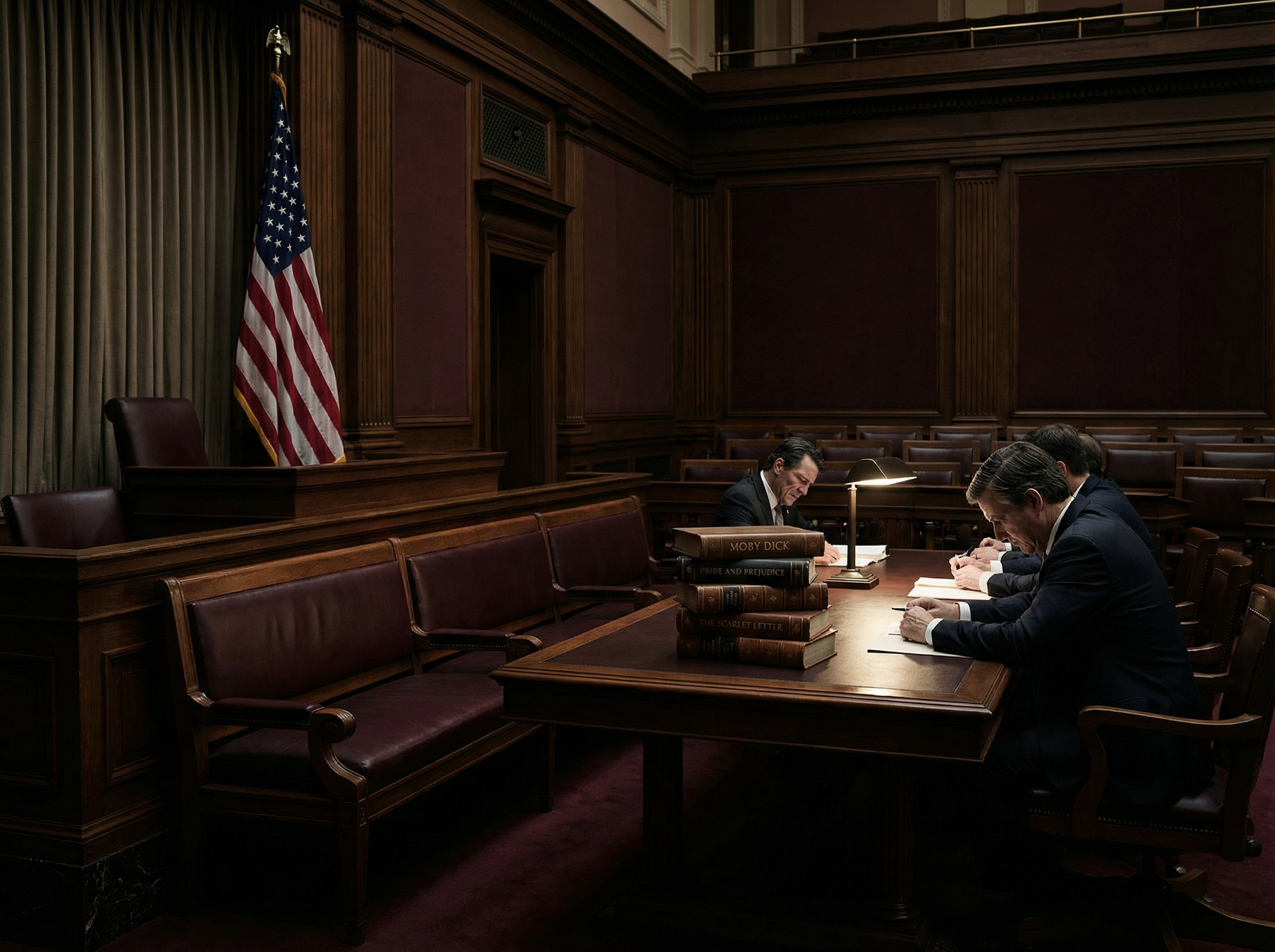
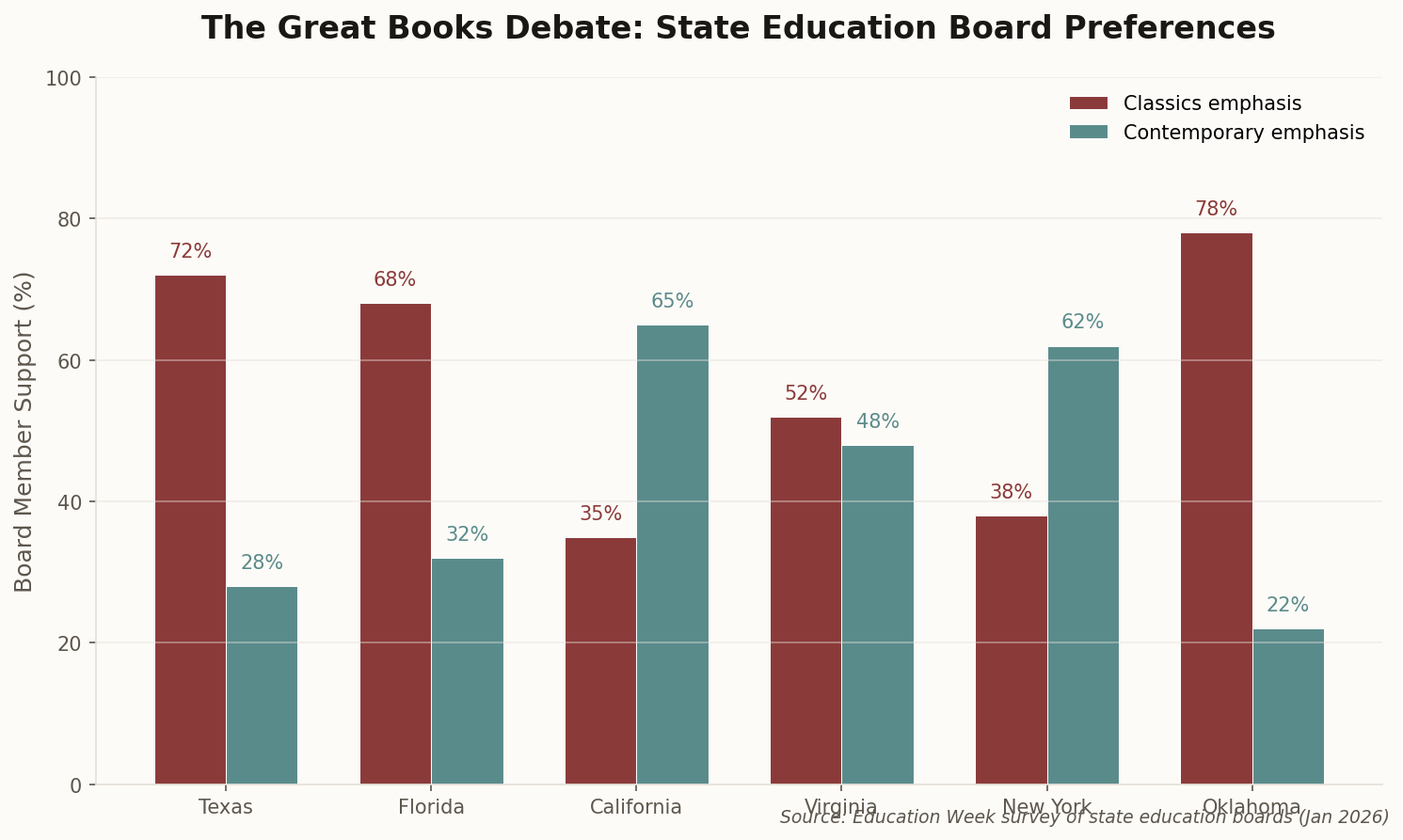
The Texas State Board of Education voted 13-1 to delay approval of the "Bluebonnet Learning" curriculum until April. That curriculum—heavy on Homer, Hamlet, and the Hebrew Bible—had become a proxy battle in the state's ongoing education wars.

Grouped bar chart comparing state education board preferences for classics vs contemporary emphasis
The curriculum debate breaks along predictable regional lines, but the specifics vary: Texas debates which classics, while California debates whether to require any at all.

Critics argued the proposed reading list marginalized contemporary and minority voices—too much Odyssey, not enough Octavia Butler. Supporters countered that canonical literacy is precisely what students from underserved communities need to compete in elite spaces. "The great books aren't an enemy of equity," one board member argued. "They're the price of admission."

The delay signals hesitation, not defeat. Texas has a unique role in national textbook markets—publishers optimize for the state's standards—so what passes in Austin ripples outward. "We need to get this right. The eyes of the nation are on Texas," a board member noted during deliberation.

April will be contentious. The vote will likely pass, but with amendments that add contemporary texts as companion readings. The compromise is emerging: teach the canon, but don't pretend it's the whole conversation.

06

$10 Million Says Plato Still Has Something to Teach

University campus tower at golden hour with students carrying classic literature books

While K-12 battles over whether to teach the classics, higher education is betting big that students want to study them. The University of Texas at Austin announced a new undergraduate major in "Great Books" within its School of Civic Leadership, backed by a $10 million grant from the National Endowment for the Humanities and private donors.

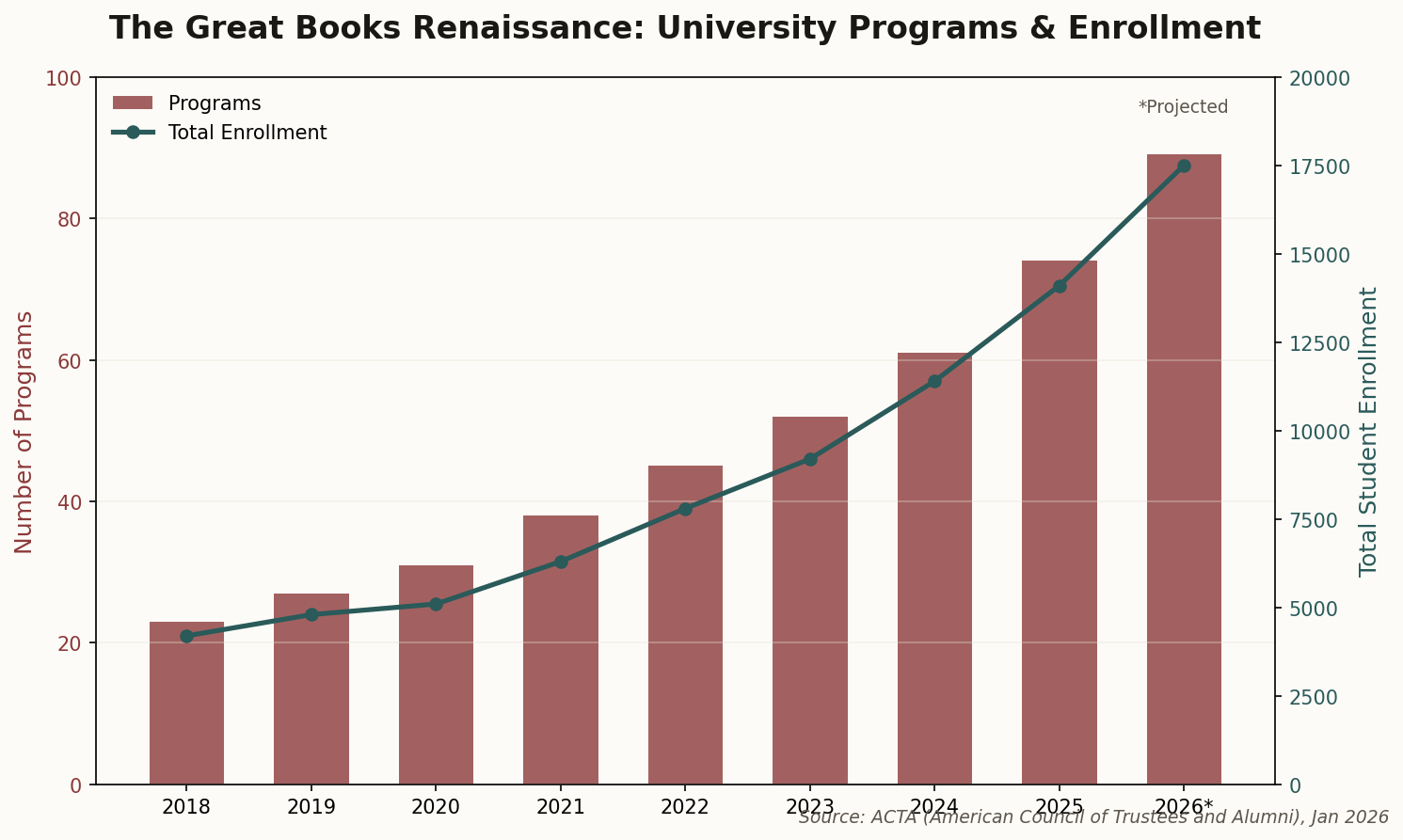
Combined bar and line chart showing growth in Great Books programs and enrollment from 2018-2026
The Great Books renaissance isn't just vibes—program growth and enrollment are tracking exponentially. UT Austin's program could be the inflection point for flagship public universities.

The program launches in Fall 2027, but recruitment has already begun. The pitch is unapologetically traditional: a deep dive into the texts that shaped Western civilization. "We are doubling down on the texts that shaped Western civilization at a time when others are retreating," a university spokesperson stated.

This isn't unique—Great Books programs have proliferated at smaller institutions—but it's notable at a flagship public university. UT Austin isn't a religious school or a boutique liberal arts college. It's a major research university in a politically contested state, making a bet that there's a market for classical education among students who could study anything.

The implicit argument: if you want to understand power, study the texts that shaped it. Plato, Augustine, Locke—these aren't museum pieces. They're the operating system running beneath the surface of modern institutions. Students who understand the source code have an advantage those who only see the interface don't.

The Canon Isn't Finished

The question isn't whether to read the classics. It's which ones, taught by whom, in service of what vision of human flourishing. Hollywood will keep making adaptations. Educators will keep fighting over reading lists. And somewhere, a teenager will pick up a 179-year-old novel because Margot Robbie made it look interesting—and discover that the dead authors still have something to say.