Photography

The Flaw Is the Feature

In a world where AI autofocus makes missing the shot nearly impossible, the Leica M's stubborn manual focus isn't a limitation—it's the entire point.

Listen
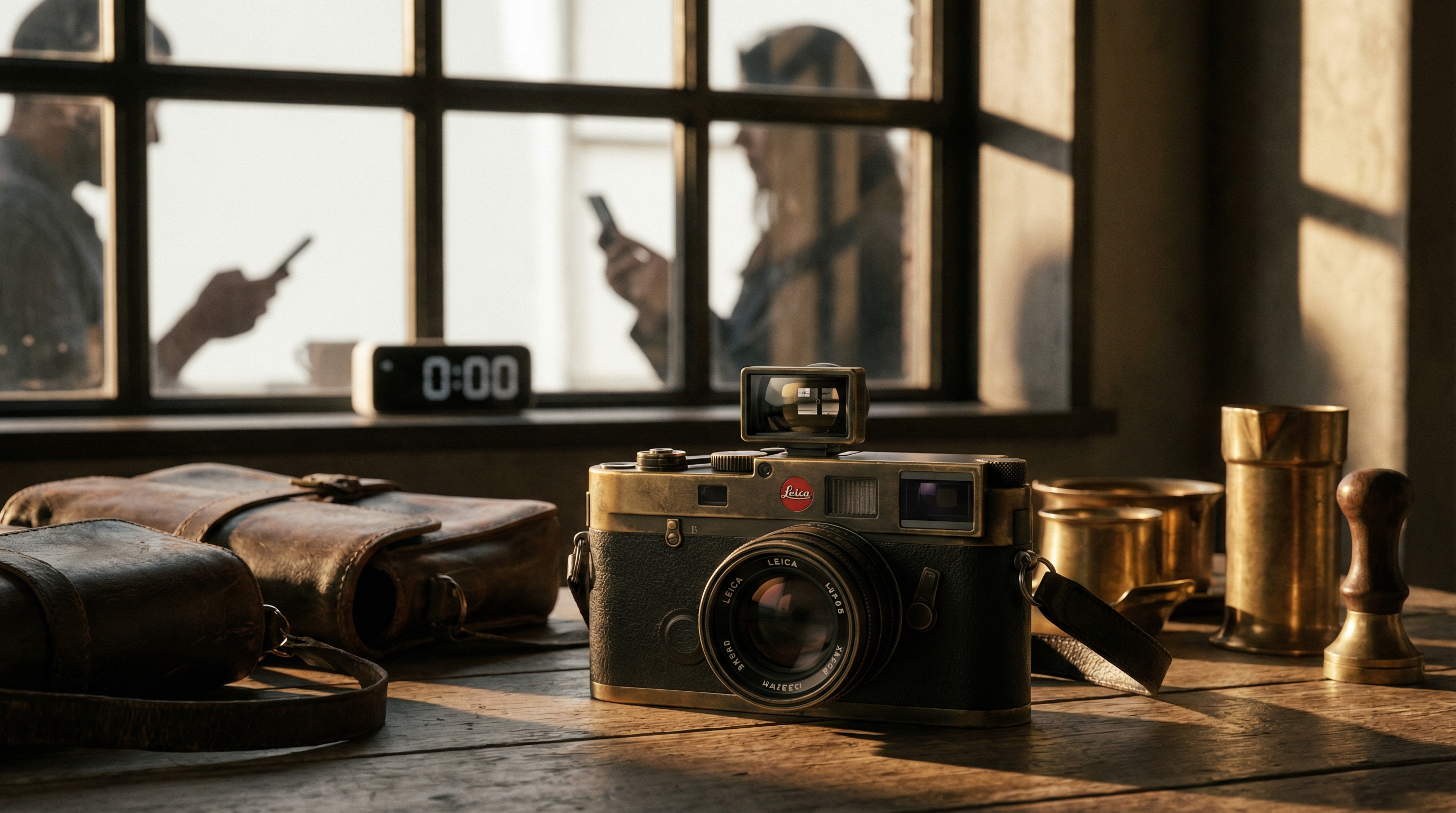
A Leica M camera bathed in morning light, its mechanical elegance contrasting with the blur of the modern world
01

We Have Reached Peak Perfection. Now, the Flaw Is the Feature.

Abstract visualization of perfect AI images versus authentic film grain texture

Something strange is happening in the used camera market. Prices for Leica M10 and M11 bodies are climbing—not because of scarcity, but because photographers are actively seeking out cameras that don't do everything for them. After a decade of chasing computational perfection, a growing subset of professionals is experiencing what The Phoblographer calls "algorithm fatigue."

The symptoms are predictable: AI-denoised images that look eerily similar regardless of who took them. Bokeh rendered with mathematical precision that somehow lacks character. Subject detection so aggressive that every shot feels like the camera's work, not the photographer's. Street photographers are pivoting back to zone focusing—a technique where you pre-set focus distance and trust your instincts—specifically to avoid the "algorithmic look" of modern computational bokeh.
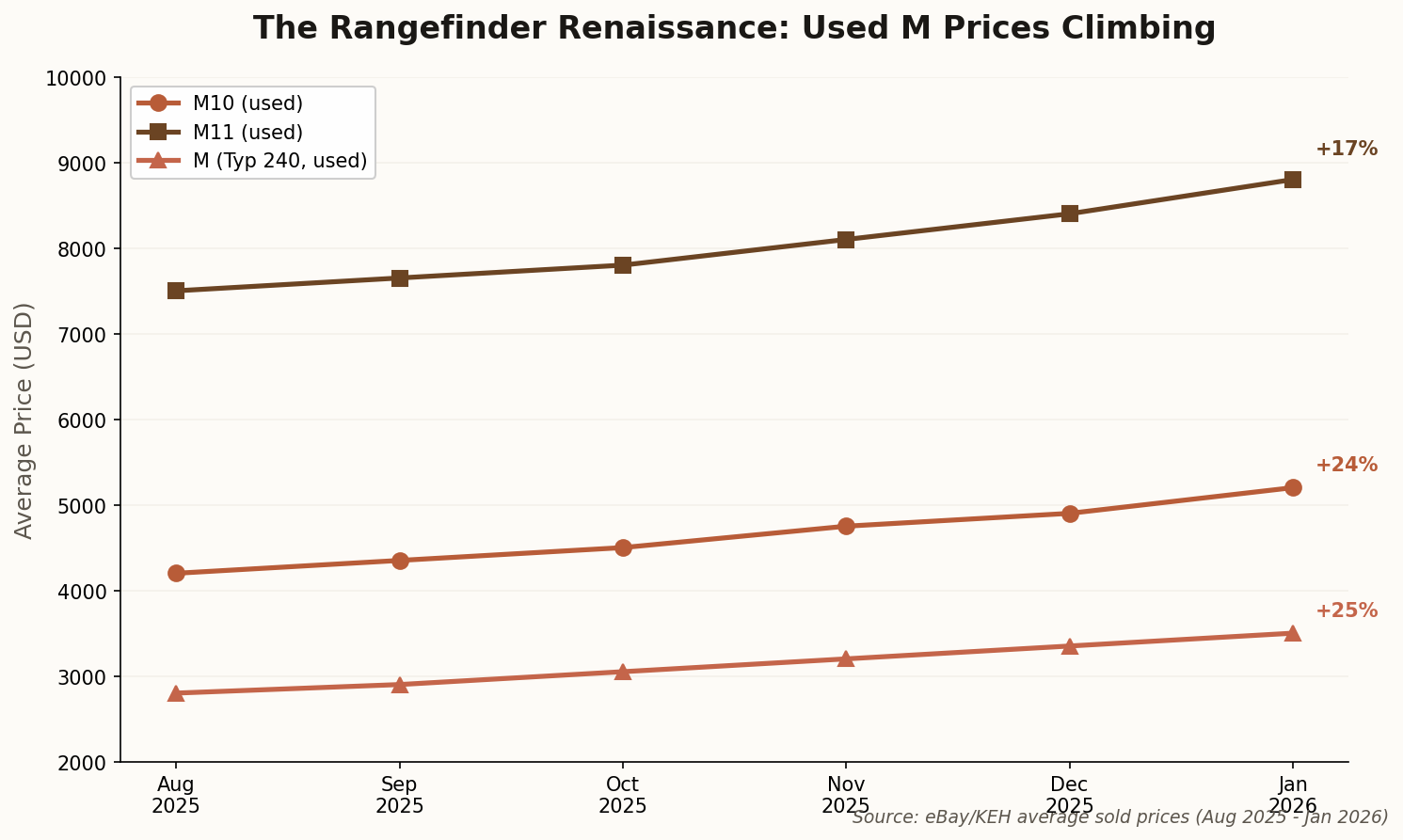
Line chart showing used Leica M prices climbing from August 2025 to January 2026
Used M-series prices have climbed 17-25% since August 2025, driven by photographers seeking "authentic" imperfection.

The prediction for 2026? "Hybrid Film-Digital" workflows where photographers deliberately introduce analog artifacts into their process. The irony is thick: we built cameras that never miss, and now we miss the missing.
02

Leica's First 35mm Noctilux: The Dream Widens

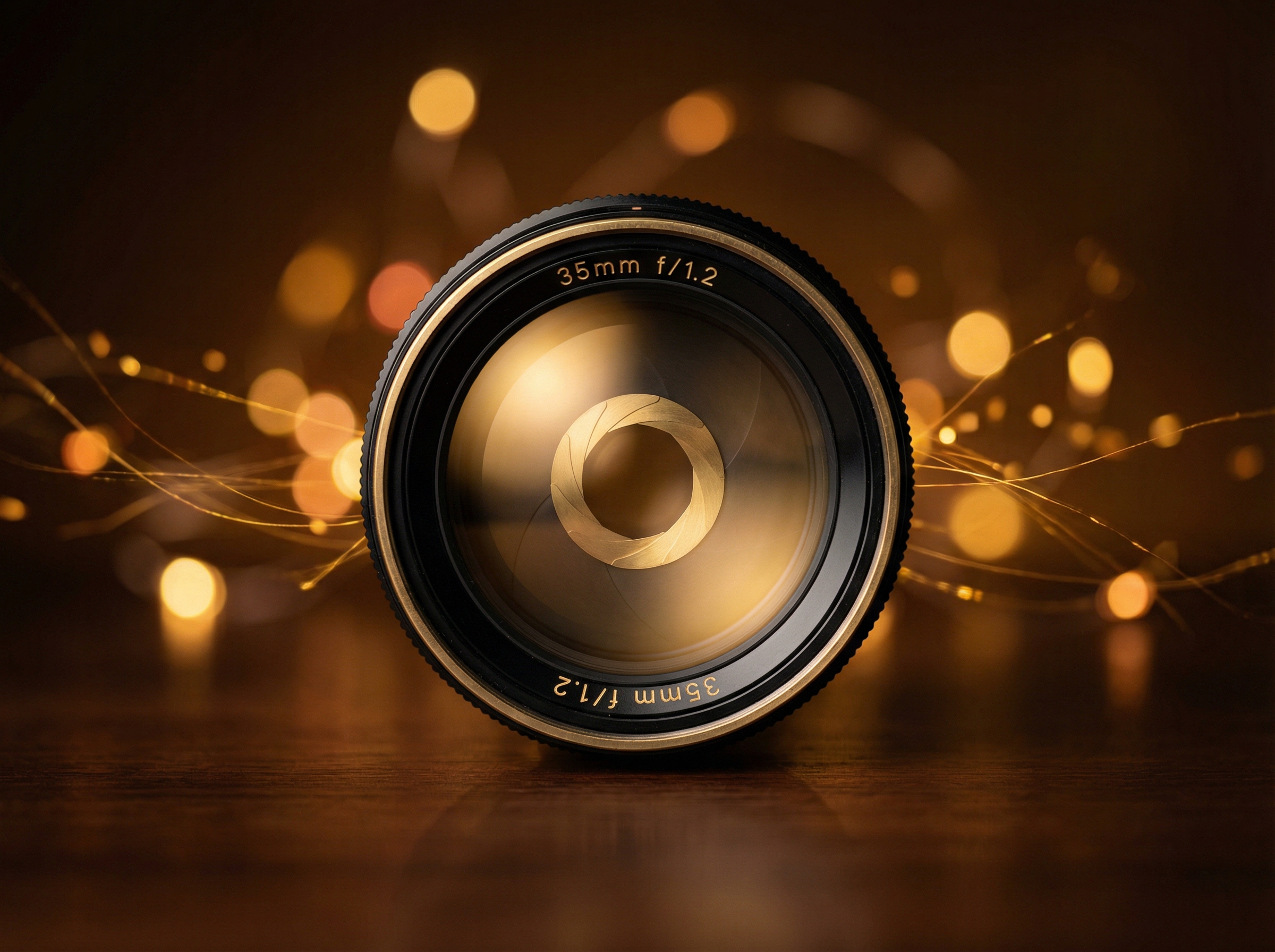
Noctilux lens with ethereal f/1.2 aperture glow and dreamlike bokeh

The Leica Noctilux name has always carried a specific promise: glass so fast it can see in the dark, with a rendering so distinctive it's immediately recognizable. For decades, that promise came exclusively in 50mm. No longer.

The new Noctilux-M 35mm f/1.2 ASPH represents the first-ever 35mm Noctilux, filling a gap that street and reportage photographers have been begging for since the M system went digital. The 50mm Noctilux is legendary, but it's tight for documentary work—you're always a step too close. The 35mm focal length lets you work within conversational distance while maintaining that dreamlike, shallow-focus rendering.

Perhaps more significant: the lens features extended close-focusing capabilities that break traditional rangefinder limits. This matters because rangefinder focusing has always imposed a minimum distance penalty—you couldn't focus as close as an SLR. Leica is quietly erasing those constraints while keeping the optical and ergonomic essence intact.

The subtext: At a rumored price north of $13,000, this lens isn't competing with Sony's autofocus zooms. It's competing with jewelry, art, and experience. And that's exactly the market position Leica needs to defend.

03

M12 Rumors: IBIS, Hybrid Viewfinder, and the Sacred Geometry

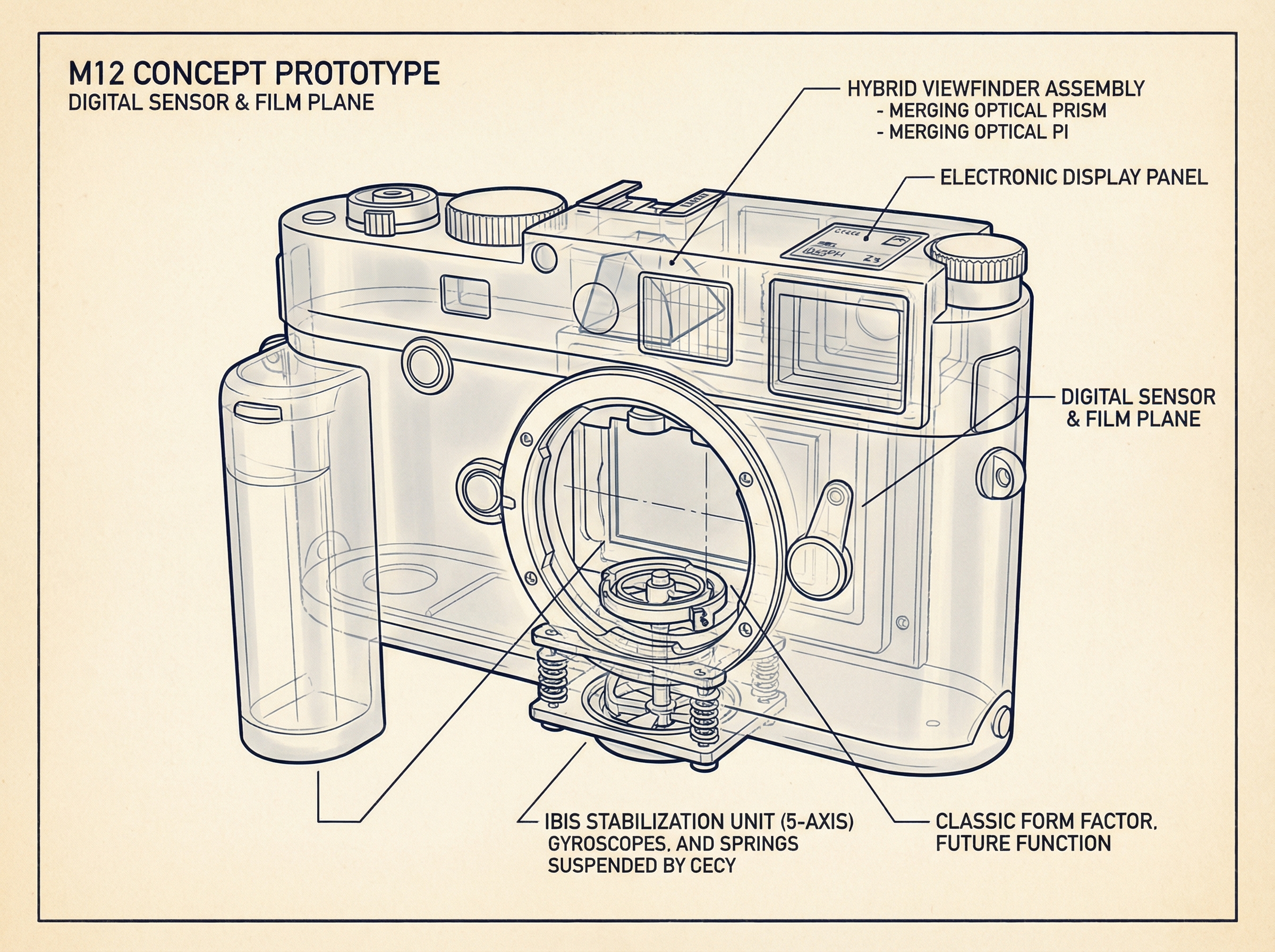
Blueprint-style visualization of M12 camera with hybrid viewfinder and IBIS concepts

The rumor mill is grinding with unusual specificity: the next Leica M—whether it's called the M12 or something else (trademark issues may force a naming change)—is testing features that would have been heresy five years ago.

First, the body may shrink to M6-like dimensions, reversing the slight bloat that accumulated as sensors and electronics grew. More provocatively, Leica is reportedly testing in-body image stabilization (IBIS) for the first time in an M-mount body. This addresses the elephant in the rangefinder room: at 60 megapixels, camera shake becomes visible at shutter speeds that would have been perfectly safe on a 24MP sensor. The physics are unforgiving.

The most speculative rumor? A hybrid optical/electronic viewfinder—optical for the traditional rangefinder experience, electronic overlay for focus confirmation or exposure preview. It would be the first time Leica acknowledged that pure optical viewing has ergonomic limits on high-resolution digital sensors.

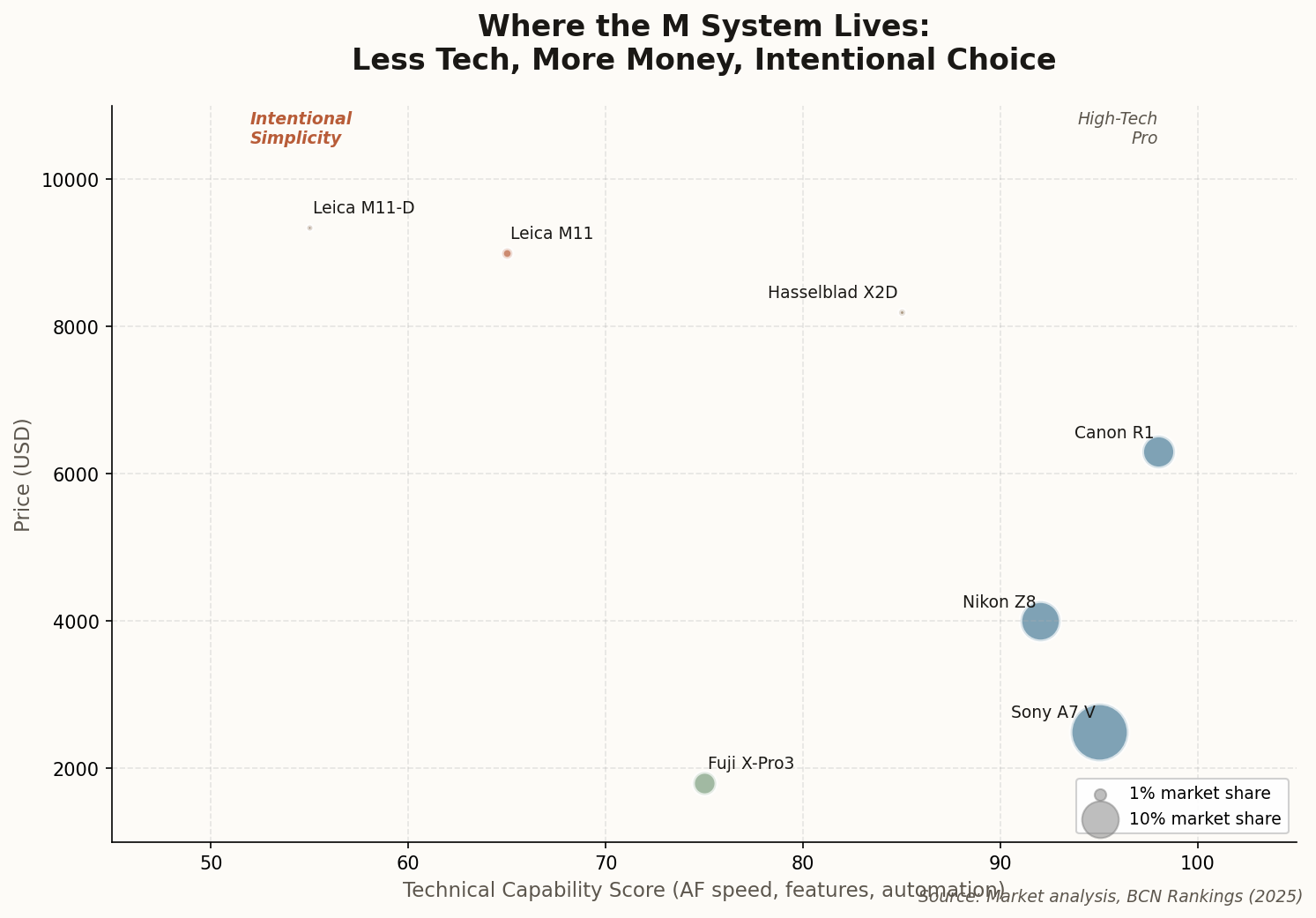
Bubble chart showing Leica M's unique market position: lower tech capability, higher price, intentional simplicity
The M system occupies a unique quadrant: intentional simplicity at premium prices. Competitors cluster in "high-tech pro" territory.

The question Leica must answer: how much technology can you hide inside the M without breaking the soul of the thing? The M is defined by what it lacks—no autofocus, no EVF, no video autofocus, no phase-detect. Adding IBIS is functional. Adding an EVF overlay is existential.

04

Six Months with the Screenless M11-D: Digital Asceticism as Luxury

Photographer holding M11-D from behind, no LCD visible, looking through optical viewfinder

"In 2026, removing features is the ultimate luxury."

That's the thesis from PetaPixel's six-month revisit of the Leica M11-D, the $9,350 camera that ships without a rear LCD screen. Where the M11 offers a beautiful touchscreen for chimping, menu navigation, and settings changes, the M11-D offers... a brass ISO dial and faith.

The review finds what you'd expect: the M11-D forces you to trust your exposures, check your work later, and stay present in the shooting moment rather than constantly reviewing. What's surprising is how the 60MP sensor mitigates the traditional risks of screenless shooting—the resolution is high enough that moderate crops can rescue framing mistakes, and the dynamic range is forgiving enough that "close enough" exposure usually works.

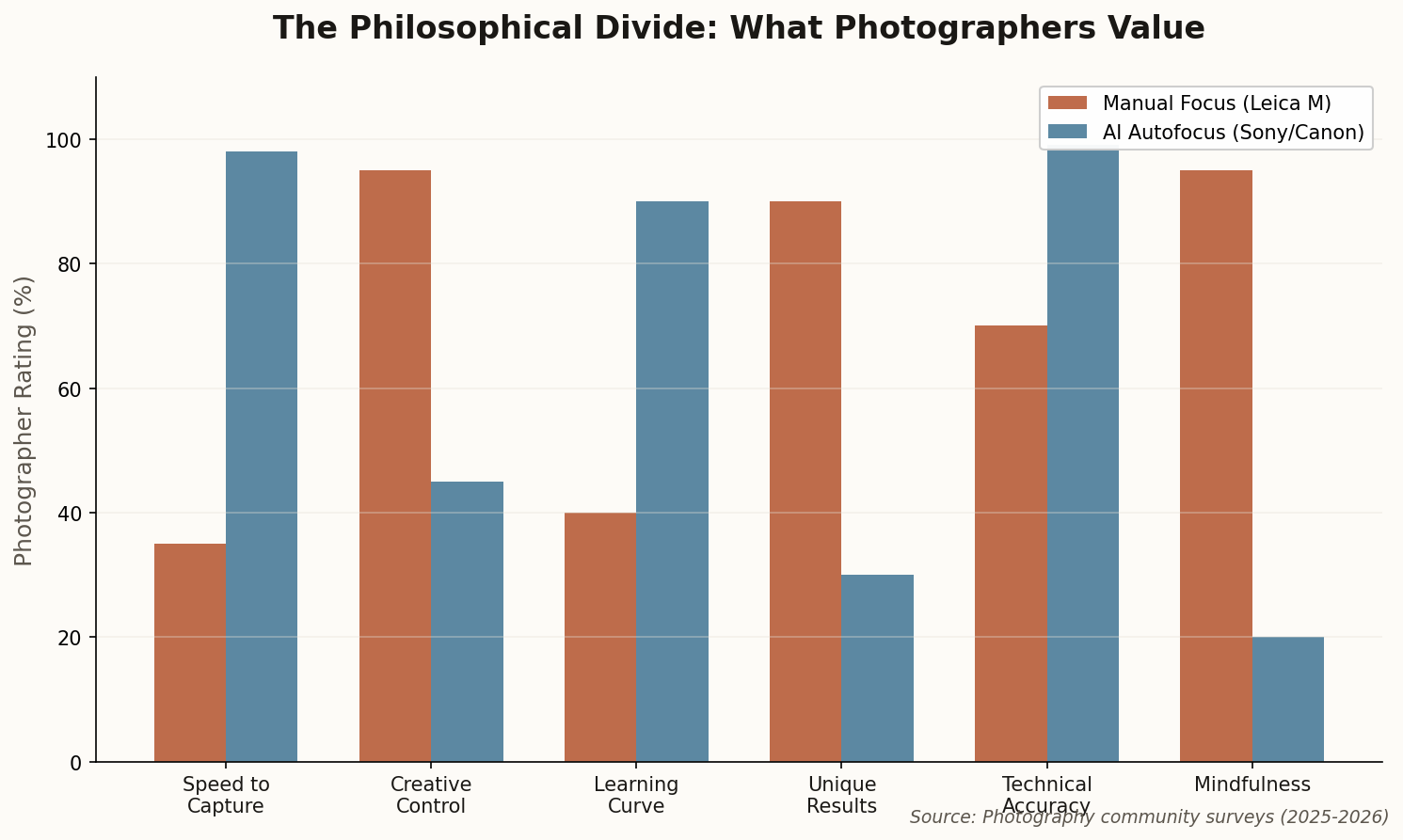
Bar chart comparing photographer values between manual focus and AI autofocus
Photographers rate manual focus systems higher for creative control, unique results, and mindfulness—exactly the qualities that automation optimizes away.

But here's the insight that matters: the M11-D isn't about what it can do—it's about what it stops you from doing. In a world of infinite distraction, paying nearly ten thousand dollars for a camera that removes distractions is, apparently, a value proposition.

05

Meanwhile, in Robot Camera Land: The Competition Gets Smarter

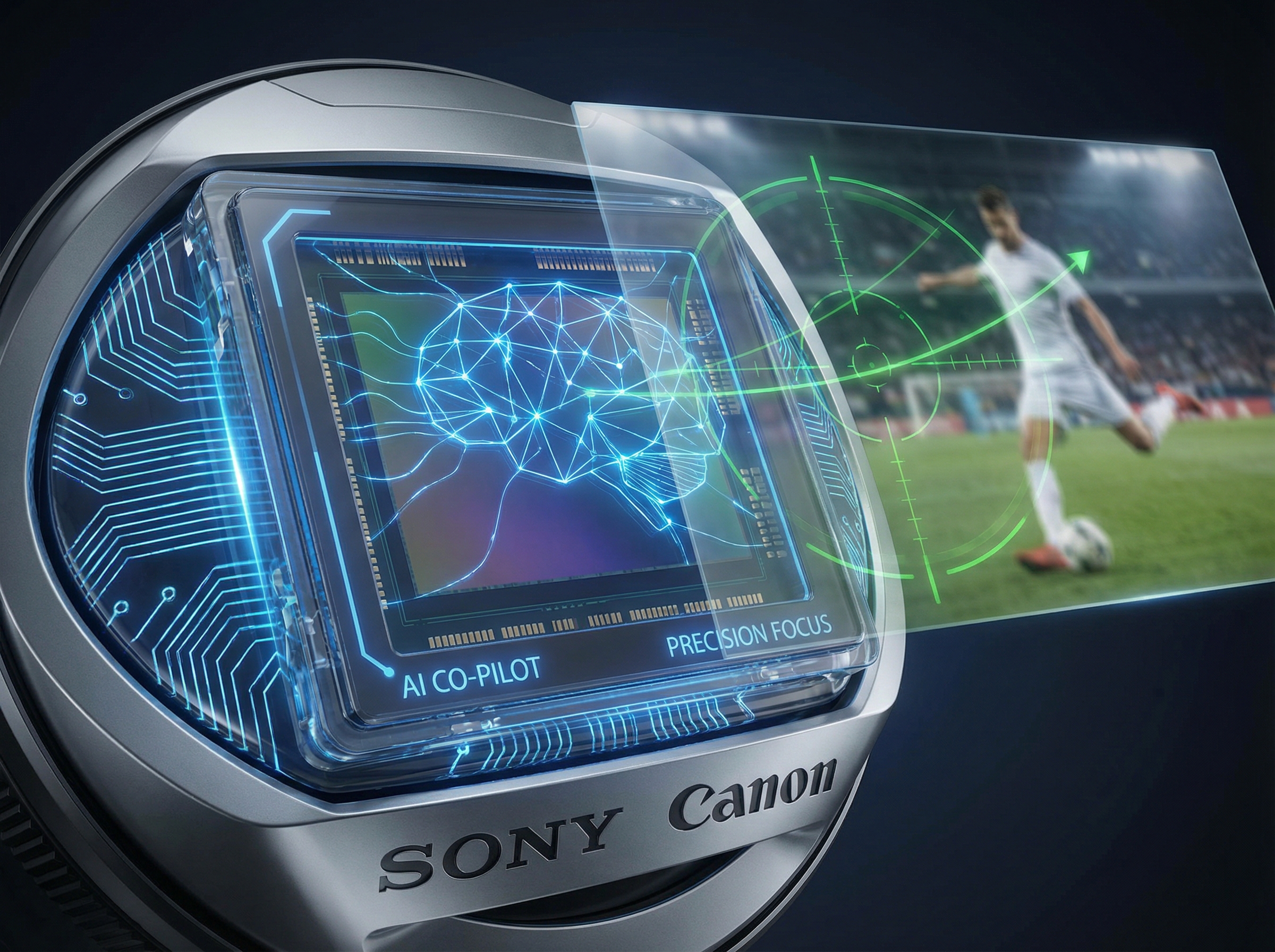
Futuristic AI autofocus visualization with neural network patterns and eye-tracking

Any honest assessment of the Leica M's relevance must acknowledge what it's competing against. And right now, it's competing against cameras that have essentially solved the technical act of taking a picture.

The Sony A7 V (late December 2025) introduces "intent prediction"—the camera doesn't just track a subject, it predicts where erratic subjects will move based on body language analysis. Blackout-free 30fps burst shooting means you never lose sight of the moment. The Canon R1 goes further with "Neural Focus" and eye-control AF—you literally look at what you want in focus, and the camera handles the rest. In sports scenarios, the R1 can identify specific actions (a slide tackle, a pitch release) and prioritize the relevant subjects automatically.

A quote from the TechRadar review lands like a hammer: "The A7 V makes missing focus nearly impossible, raising the question of whether the photographer is even needed for the technical act of capturing an image."

This is the existential backdrop against which the Leica M operates. Sony and Canon are building cameras where the machine is a "co-pilot." Leica is building cameras where the machine is... a box with a hole. And increasingly, that's exactly what a certain kind of photographer wants.

06

The Safari Collection: Photography as Heritage Object

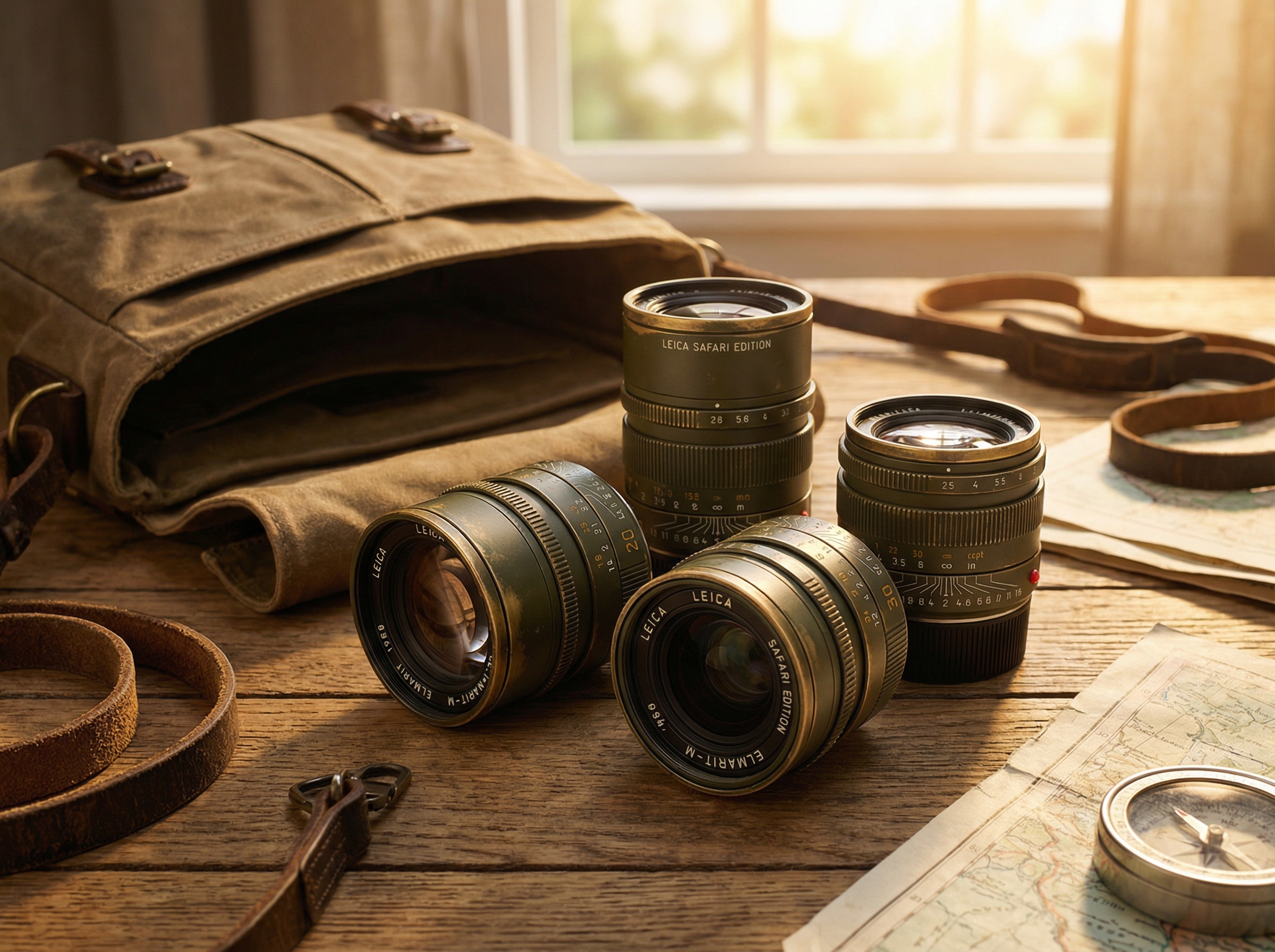
Four Leica Safari edition lenses in olive green military finish with beautiful patina

Leica released four new limited-run lenses in olive green "Safari" finish—the Summilux-M 35 f/1.4 ASPH, Summilux-M 50 f/1.4 ASPH, and a new Summicron-M 28 f/2 ASPH, all matching the M10-P and M11-P Safari editions. The press release includes a line that says everything about Leica's market position: "The enameling is designed to wear beautifully with heavy use, much like the black paint models."

This is a camera company explicitly selling patina—the visible marks of use over time—as a feature. They're selling the promise that your camera will look better after years of work, not worse. In an industry obsessed with mint-condition resale value, Leica is saying: use these hard, and they'll reward you with character.

The Safari editions also reinforce the M-series status as collectible asset, a market segment that simply doesn't exist for utilitarian Sony/Canon/Nikon glass. Nobody collects Sony G-Masters for their beauty. People absolutely collect Leica lenses like watches—displaying them, trading them, passing them down.

The real question: Is Leica a camera company that happens to sell luxury goods, or a luxury goods company that happens to make cameras? In 2026, the distinction may no longer matter.

The Verdict: More Relevant Than Ever

Is the Leica M series still relevant in 2026? The answer is yes—but not because it competes on features. It's relevant because it refuses to compete on features. As AI autofocus approaches perfection, the M's manual focus becomes a deliberate creative constraint. As screens proliferate, the M11-D's screenless back becomes a statement. As computational photography homogenizes output, the M's optical rendering becomes distinctive again. The Leica M isn't surviving despite the AI revolution—it's thriving because of it. When every camera can take a perfect picture, the imperfect becomes interesting.