Listen
Communication Design

The Answer First

Barbara Minto's pyramid principle transformed corporate communication fifty years ago. In 2026, AI presentation tools are baking her logic directly into the software.

Abstract visualization of hierarchical communication structure with crystalline pyramid forms
01

The Machines Have Learned to Structure
AI-powered presentation interface with hierarchical structure

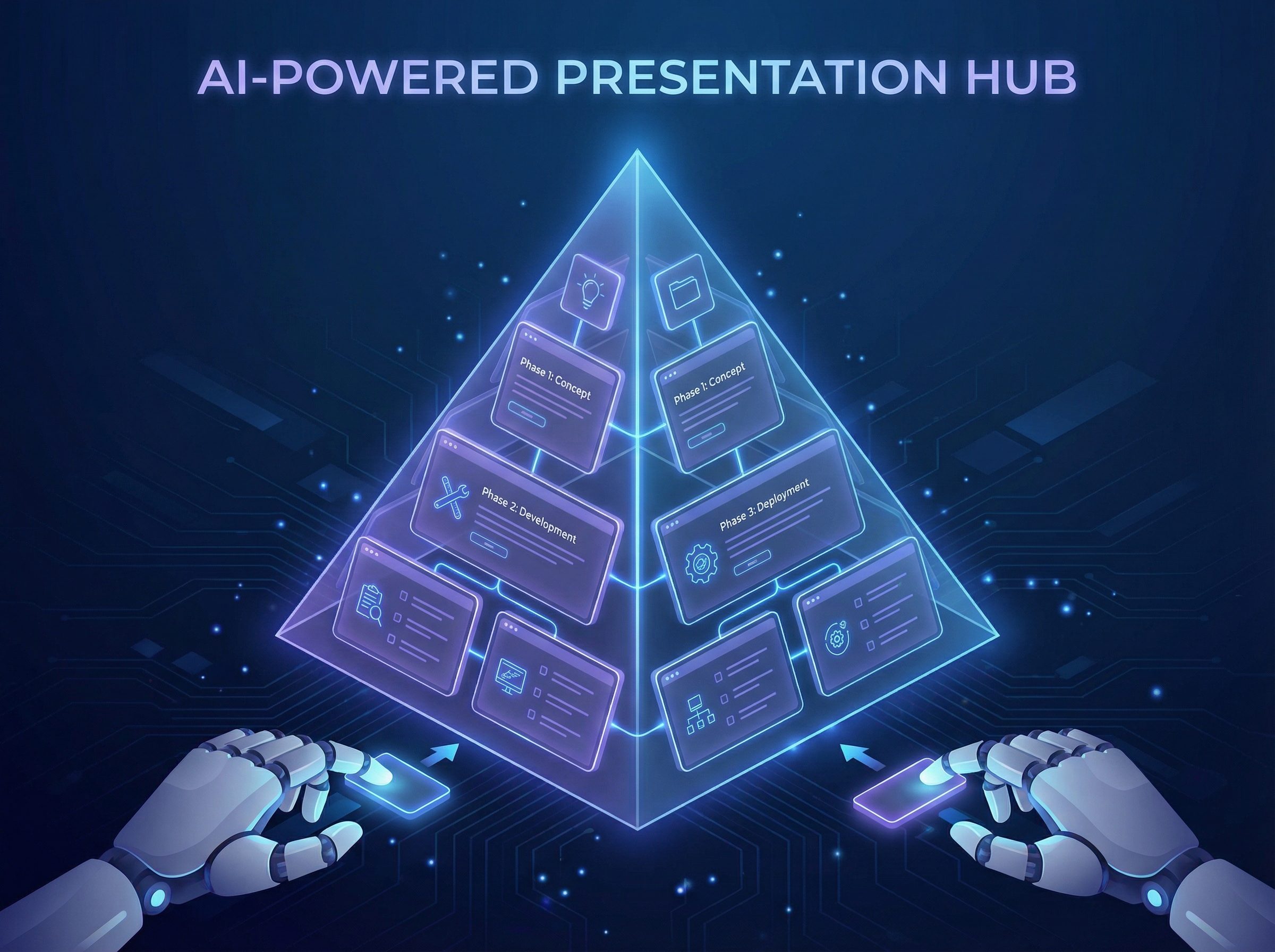
Something peculiar happened to presentation software. Tools like Gamma, Tome, and Beautiful.ai don't just help you make slides prettier. They enforce structure.

Gamma's card-based system forces you to articulate your hierarchy before generating visuals. Tome defaults to SCQA-style narrative arcs. Beautiful.ai's design constraints prevent cluttered slides by limiting grouped arguments to three or four points.

The Pattern: AI tools are "enforced logic" engines. You can't easily create a meandering deck because the software requires your outline first. The pyramid is no longer a skill—it's a constraint built into the interface.

This represents something significant: the democratization of high-end consulting structure. What McKinsey partners once spent years teaching associates, software now enforces in milliseconds. The barrier to clear communication has shifted from knowing the framework to having access to the tool.

02

When Data Became the Bottom Layer

Interactive data dashboard with hierarchical information architecture

In 1973, the evidence layer of Minto's pyramid was a printed appendix. In 2026, it's a live link to a Tableau dashboard. The structure remains; the bottom layer has become infinite and interactive.

Modern adaptations focus on "audience-centric design"—adjusting the pyramid's depth based on who's receiving it. Executives get a top-heavy structure; technical teams get explorable evidence. Same logic, different resolution.

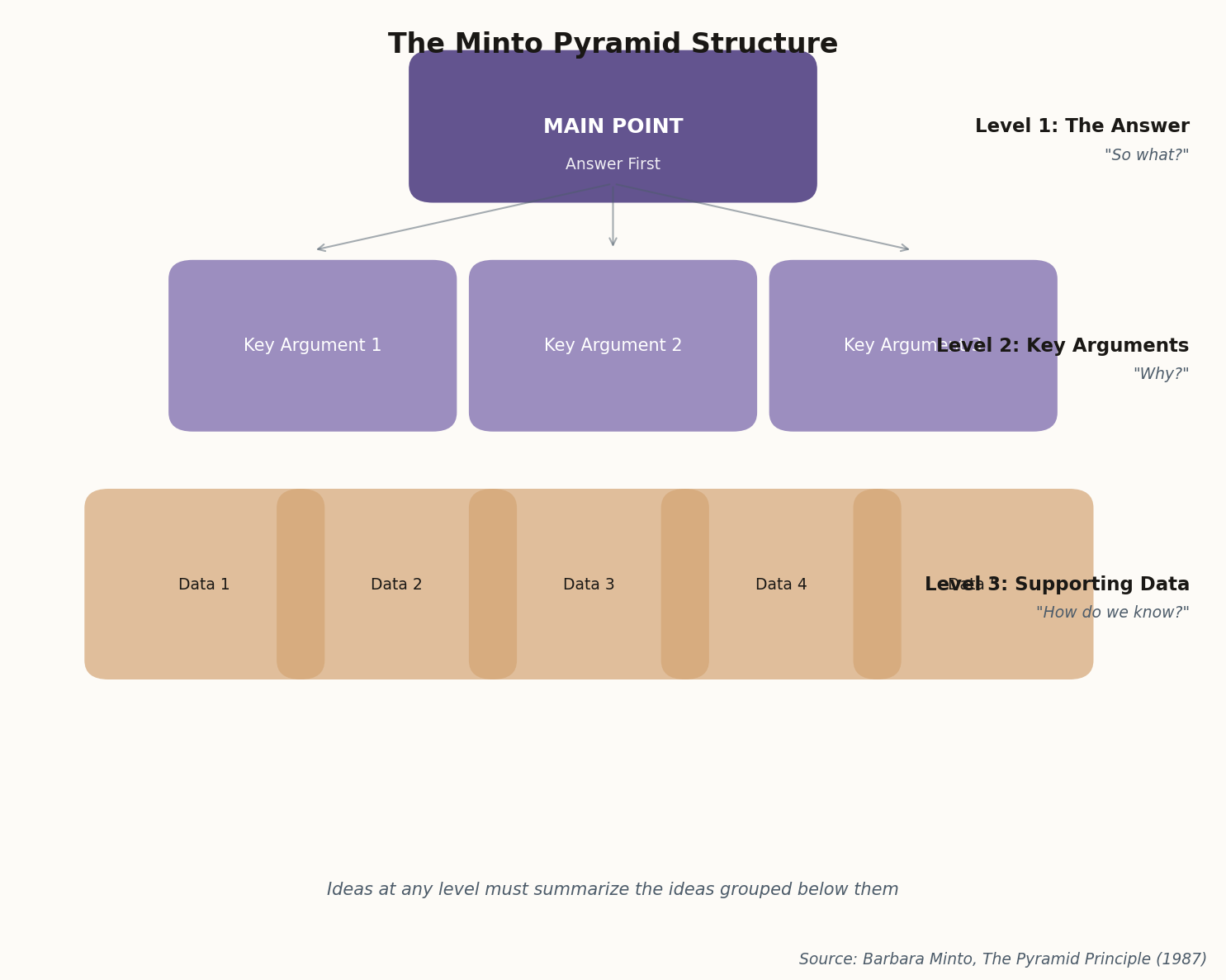
Diagram showing the three-layer pyramid: Answer at top, Arguments in middle, Evidence at bottom
The classic three-layer pyramid: answer first, supporting arguments, then evidence. Modern practice makes the evidence layer dynamic.

The shift from "linear slides to dashboard-style pyramid structures" marks a fundamental change in how we think about presentations. The top of the pyramid stays fixed; the bottom becomes a portal to infinite depth.

03

The Billion-Dollar Slide Deck

Stylized pitch deck presentation with clear visual hierarchy

Airbnb's 2008 seed deck remains the most analyzed pitch in startup history. Not because of its design—the slides are borderline ugly by 2026 standards. Because of its structure.

The first three slides execute SCQA with surgical precision: Problem (hotel prices are disconnected from traveler needs) → Complication (the web could solve this) → Solution (a platform connecting travelers to spare rooms). No preamble. No throat-clearing. Answer first.

The Sequence: Slides 1-3 deliver the answer. Middle slides (4-8) provide supporting arguments: market size, product mechanics, business model. Final slides offer evidence: testimonials, early metrics. Perfect top-down flow.

"The deck doesn't bury the lead," notes Slidebean's analysis. "It states the solution immediately after the problem, adhering strictly to a top-down logical flow." Three slides in, investors understood the thesis. The remaining eleven validated it.

04

The Narrative Arc That Precedes the Pyramid

Visual representation of storytelling framework with rising tension

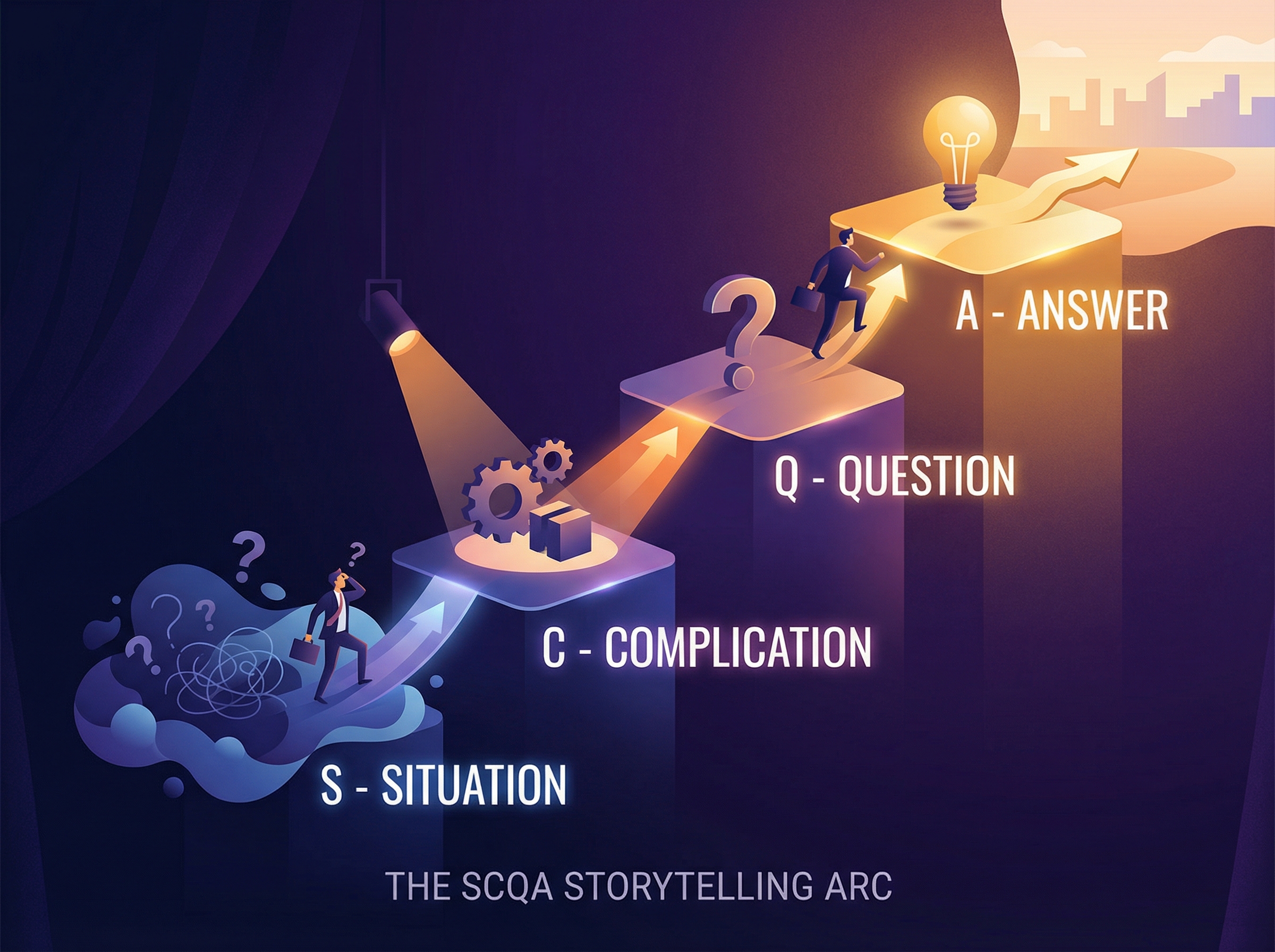
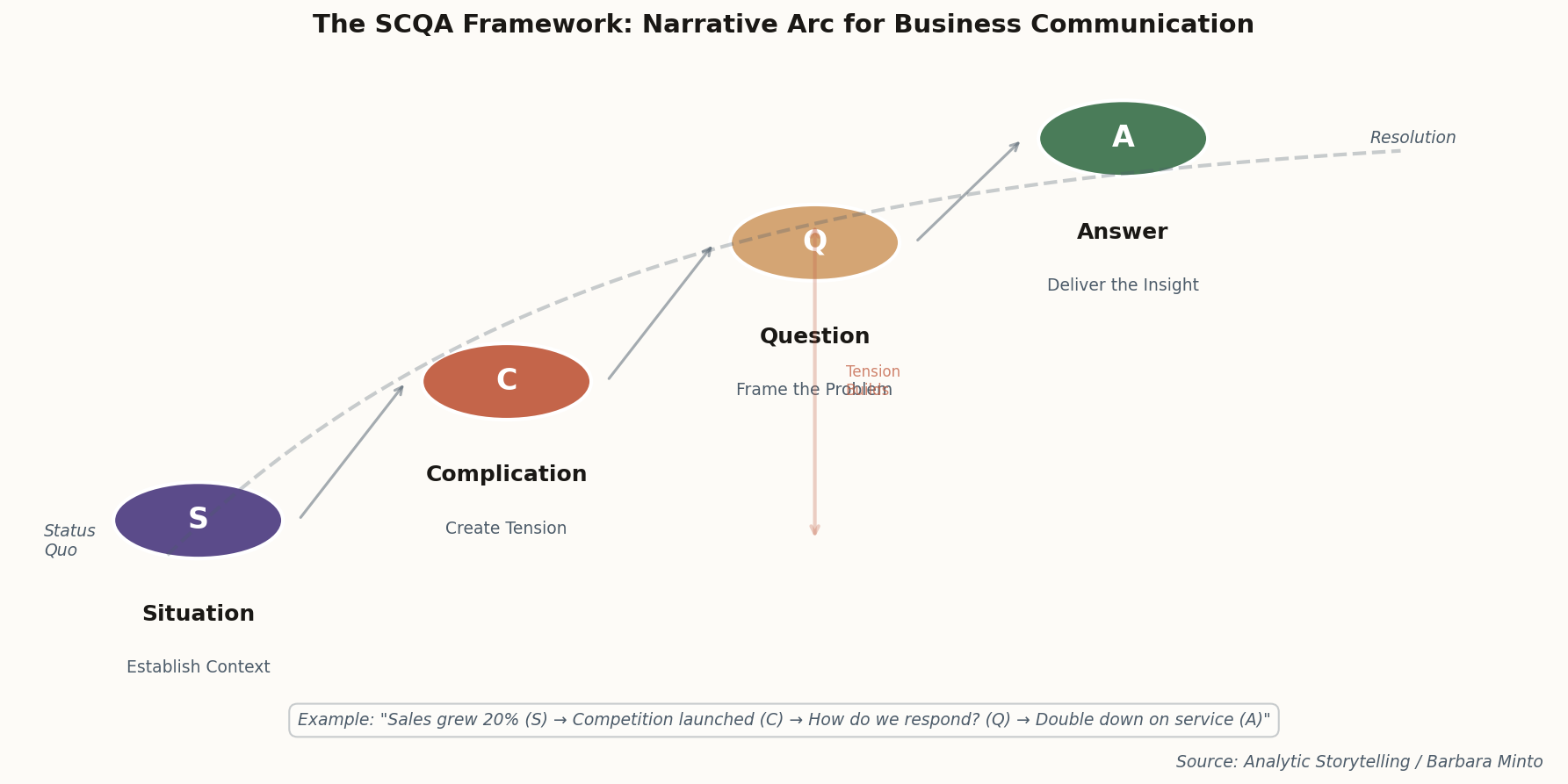
Before the pyramid, there's a problem to solve. SCQA—Situation, Complication, Question, Answer—is the narrative engine that generates the pyramid's apex.

SCQA framework diagram showing rising tension from Situation through Answer
The SCQA arc: stable situation, disrupting complication, implicit question, decisive answer. The answer becomes the pyramid's top.

Situation establishes context everyone agrees on. Complication introduces the tension—something changed, something's wrong, something's at stake. Question is often implicit: what do we do about this? Answer is your recommendation, and it becomes the top of your pyramid.

The sequence matters because human attention follows tension. "A good story captures attention by creating tension," the framework notes. "The Complication is the trigger that upsets the status quo." Without tension, there's no urgency. Without urgency, there's no attention.

05

When the Answer First Can Alienate

Abstract visualization of different communication approaches in contrast

The pyramid principle has limits. Its most thoughtful critics point out that leading with the answer can feel aggressive, even confrontational, when the audience isn't ready to receive it.

The framework works best when delivering good news to busy executives who want efficiency. It works less well when delivering bad news to stakeholders who need emotional preparation, or in cultures that prioritize consensus-building over directive communication.

The Alternative: Inductive approaches—building up to a conclusion—remain preferred in situations where the answer might be controversial. Give audiences time to arrive at the same conclusion themselves, and they're more likely to accept it.

"While the Pyramid Principle is efficient, it risks alienation if the 'Answer' at the top is controversial and delivered without sufficient emotional context." The 7 Cs of Communication (Clear, Concise, Concrete, Correct, Coherent, Complete, Courteous) offer a reminder: structure without empathy is just efficient disregard.

06

The Woman Who Taught McKinsey to Think

Portrait of professional woman in 1970s office setting with organizational charts

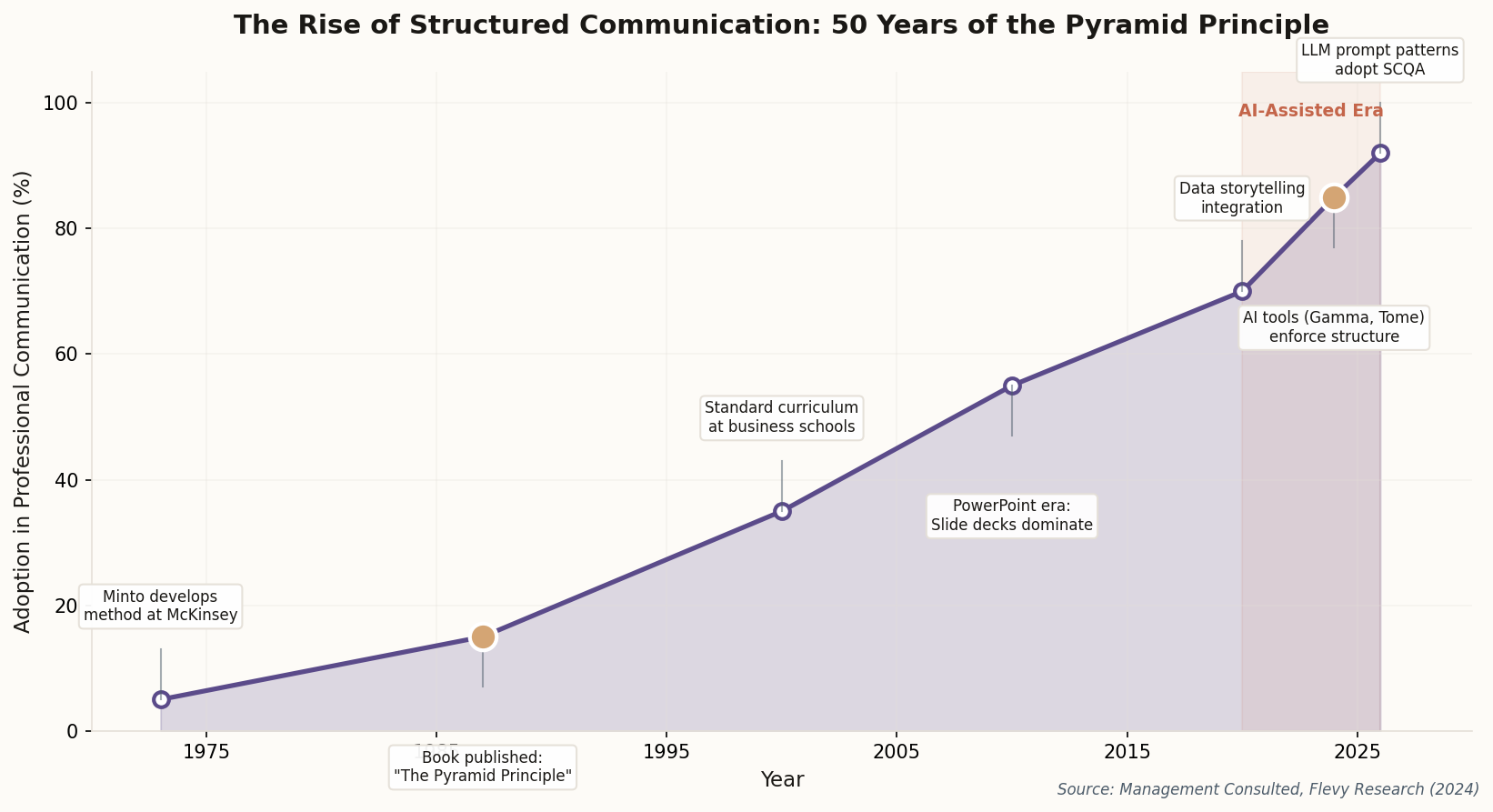
Barbara Minto arrived at McKinsey in 1963 as the firm's first female MBA hire. She was assigned to teach associates how to write. By the 1970s, she had developed a framework that would standardize how an entire industry communicates.

Timeline showing 50-year adoption of the Pyramid Principle from McKinsey to AI tools
Fifty years of adoption: from one consultant's insight to software-enforced structure.

The insight was psychological, not stylistic. Executives are pattern-matchers who need the answer first to validate the supporting data. They're not reading for discovery; they're reading for confirmation. Give them the conclusion upfront, and they can immediately assess whether your evidence matters.

"Ideas at any level in the pyramid must always be summaries of the ideas grouped below them." This single rule—summary up, detail down—transformed not just McKinsey but the entire practice of business communication. Fifty years later, it's being encoded into the software that generates our presentations automatically.

The Legacy: The Pyramid Principle forces "ruthless logic." It prevents burying the lead not through willpower but through structure. From a teaching tool for junior consultants to an architecture embedded in AI, Minto's framework continues to shape how we organize thought for others.

Structure Is Freedom

The pyramid principle endures because it solves a permanent problem: human attention is scarce, and logic is expensive. Start with the answer, prove it with evidence, and get out. The rest is decoration.