Go Programming Language

The Gopher Awakens

A week of security patches, AI integrations, and a reminder that Go can run an entire Linux system with just go run.

Listen
Abstract illustration of the Go gopher mascot emerging from geometric code patterns in teal tones
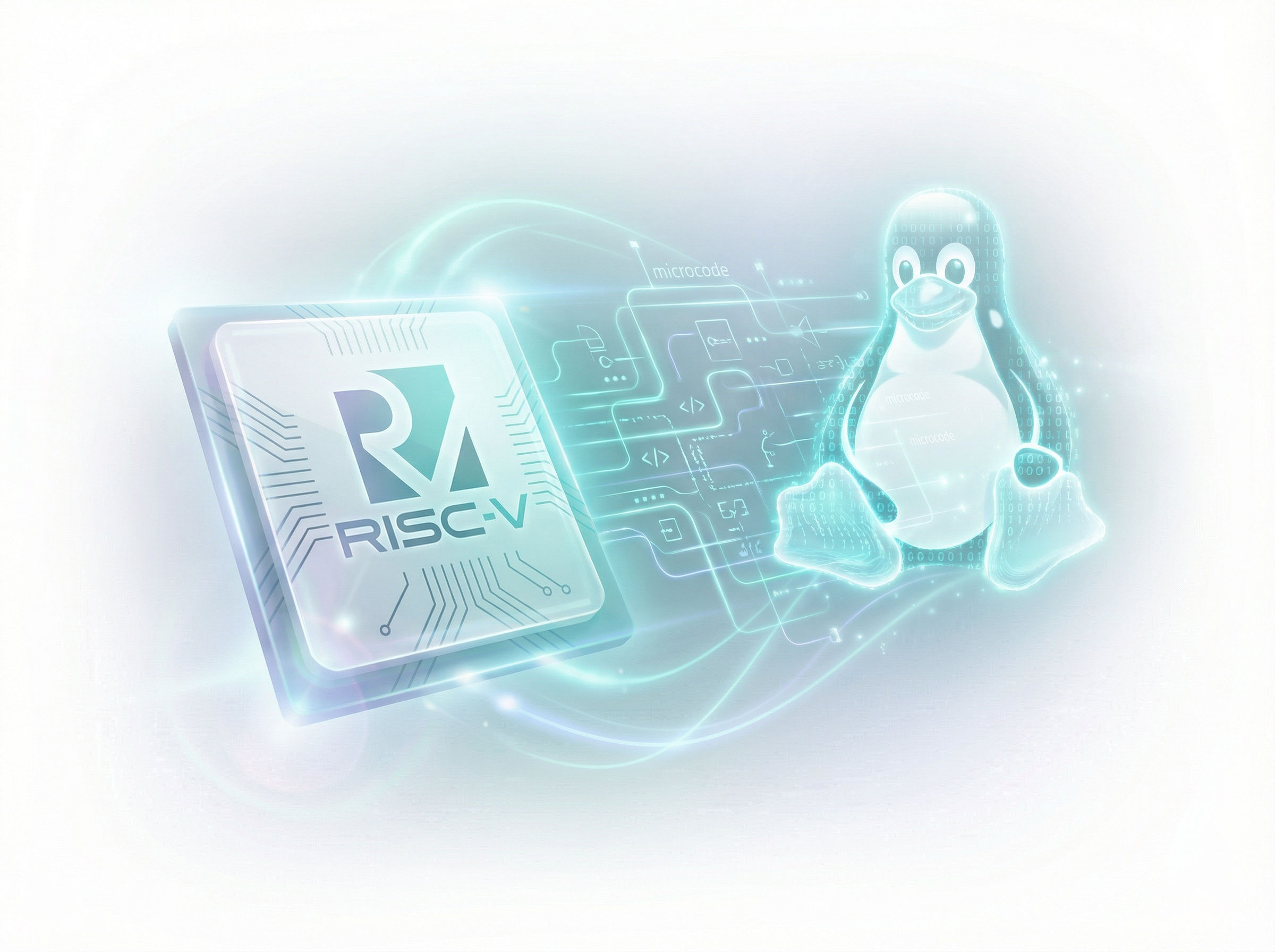
RISC-V processor chip with Linux penguin emerging from microcode patterns
01

A Full Linux Kernel, Powered by go run

Sometimes the best way to prove a language's capabilities is to do something completely absurd with it. Developer JT did exactly that by porting Fabrice Bellard's RISC-V system emulator to Go, creating a full Linux environment that runs with nothing more than go run main.go.

The project showcases something Go skeptics have long questioned: can a garbage-collected language with no manual memory management really handle low-level systems programming? The answer, apparently, is yes. The emulator runs without CGO (Go's mechanism for calling C code), meaning it's pure Go all the way down. LLMs assisted with the translation, though the real engineering was in making the result actually work.

This isn't just a party trick. The demonstration reinforces Go's position in the systems programming space—a domain traditionally dominated by C, C++, and lately Rust. When you can emulate an entire computer architecture in a language known for its simplicity, the "Go is just for web services" narrative looks increasingly outdated.

Terminal interface with glowing AI magic and retro CRT aesthetic
02

Charm's "Crush" Gets Smarter

Charm, the company that made terminal UIs beautiful again with libraries like Bubble Tea and Lip Gloss, just shipped v0.36 of their agentic development tool "Crush." The update brings GPT-5.2 support alongside improved project tracking and to-do management features.

The significance here isn't just another AI tool update—it's what this signals about Go's role in the AI-assisted development space. Charm has become the de facto standard for building polished CLI applications in Go, and their expansion into AI tooling means Go developers get first-class access to these capabilities without leaving their preferred ecosystem.

For those tracking the broader developer tools landscape, Charm's move mirrors what we're seeing across the industry: AI features are becoming table stakes, not differentiators. The question is no longer whether to integrate AI, but how deeply. Crush's approach—treating AI as a project management companion rather than a code replacement—feels like the more sustainable path forward.

Abstract conference stage with Seattle skyline and speaker spotlight
03

GopherCon 2026: The CFP Is Open

GopherCon US returns to Seattle this August 3-6, and the Call for Proposals just opened. Deadline: March 4, 2026. If you've been sitting on a talk idea about error handling patterns, generics best practices, or that time you ran Linux on a Go emulator (see above), now's the moment.

GopherCon remains the flagship event for the Go community, and the talks selected here tend to define the discourse for the following year. Last year's focus on generics adoption and security practices set the tone for much of 2025's library development. What themes emerge in 2026 will likely shape how the ecosystem evolves through 2027.

The Seattle venue is notable too—it's become something of a home for the conference, with the Pacific Northwest's strong cloud infrastructure presence (AWS, Microsoft, Google all have major presences nearby) creating a natural audience for Go's strengths in that space.

Stylized chess pieces on circuit board representing algorithmic thinking
04

Chess 3: Go Plays the Long Game

A new UCI-compatible chess engine called Chess 3 just dropped, written entirely in Go. The project prioritizes code readability while maintaining high performance—a balance that chess engine developers typically sacrifice at the altar of raw speed.

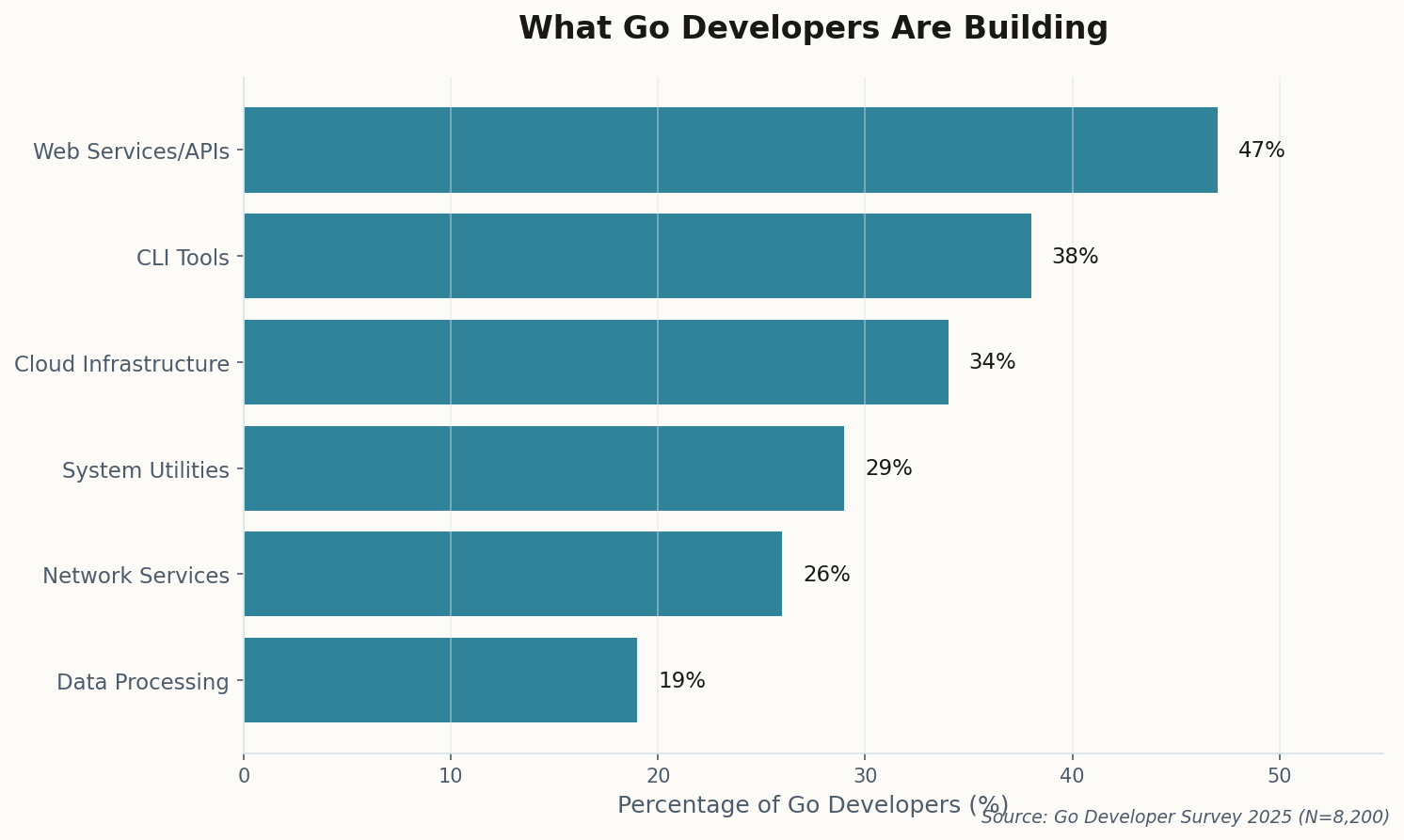
Horizontal bar chart showing Go usage by category: Web Services 47%, CLI Tools 38%, Cloud Infrastructure 34%, System Utilities 29%, Network Services 26%, Data Processing 19%
Go developers build primarily for the web and CLI, but systems work is growing steadily.

Chess engines are interesting benchmarks because they're compute-bound in ways that expose garbage collection pauses and memory allocation overhead. Achieving competitive performance in Go means working within and around these constraints rather than pretending they don't exist.

The broader implication: Go's suitability for high-performance computing continues to improve. Between this chess engine, the Linux emulator from earlier, and the ongoing work on Go's compiler and runtime, the "Go is slow" meme is looking increasingly dated. Not every problem needs Rust-level control, and Go's productivity advantages remain substantial.

Shield breaking apart revealing vulnerable code, security alert visualization
05

Five CVEs Walk Into a Standard Library

The Go Vulnerability Database disclosed five new CVEs this week, affecting core standard library packages that essentially every Go application uses. If you're running Go in production, this is your cue to run govulncheck immediately.

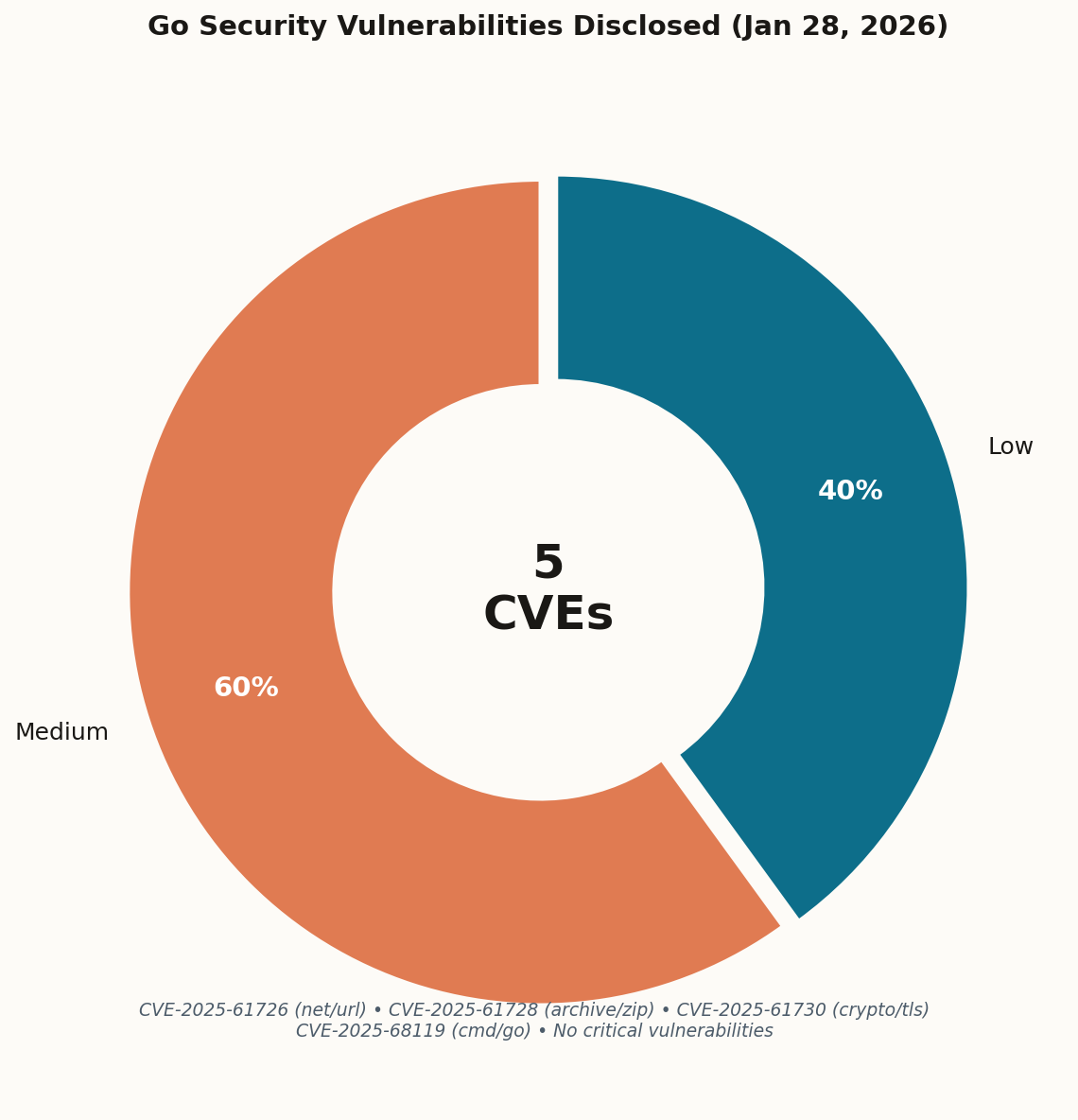
Donut chart showing 5 CVEs: 3 Medium severity (60%), 2 Low severity (40%)
All five vulnerabilities are Medium or Low severity—no critical issues, but prompt patching remains advisable.

The specifics: CVE-2025-61728 in archive/zip allows denial of service via malformed ZIP files. CVE-2025-61726 in net/url enables memory exhaustion when parsing URL-encoded forms with many unique keys. CVE-2025-61730 affects crypto/tls with a minor information disclosure in TLS 1.3 handshakes. And CVE-2025-68119 in cmd/go allows local code execution when building malicious modules on systems with Mercurial installed.

None of these are critical, but that's almost beside the point. The Go team's approach to security—proactive disclosure, integrated vulnerability checking, and fast patch cycles—sets a standard the rest of the industry should emulate. The fact that govulncheck exists and works well means most Go shops can audit their exposure in minutes, not days.

ChatGPT logo transforming into Go gopher with code flowing between them
06

ChatGPT Now Speaks Go

OpenAI's ChatGPT containers environment—previously limited to Python—now supports Go. Users can write, run, and debug Go code directly within the chat interface, with full package installation and file I/O support.

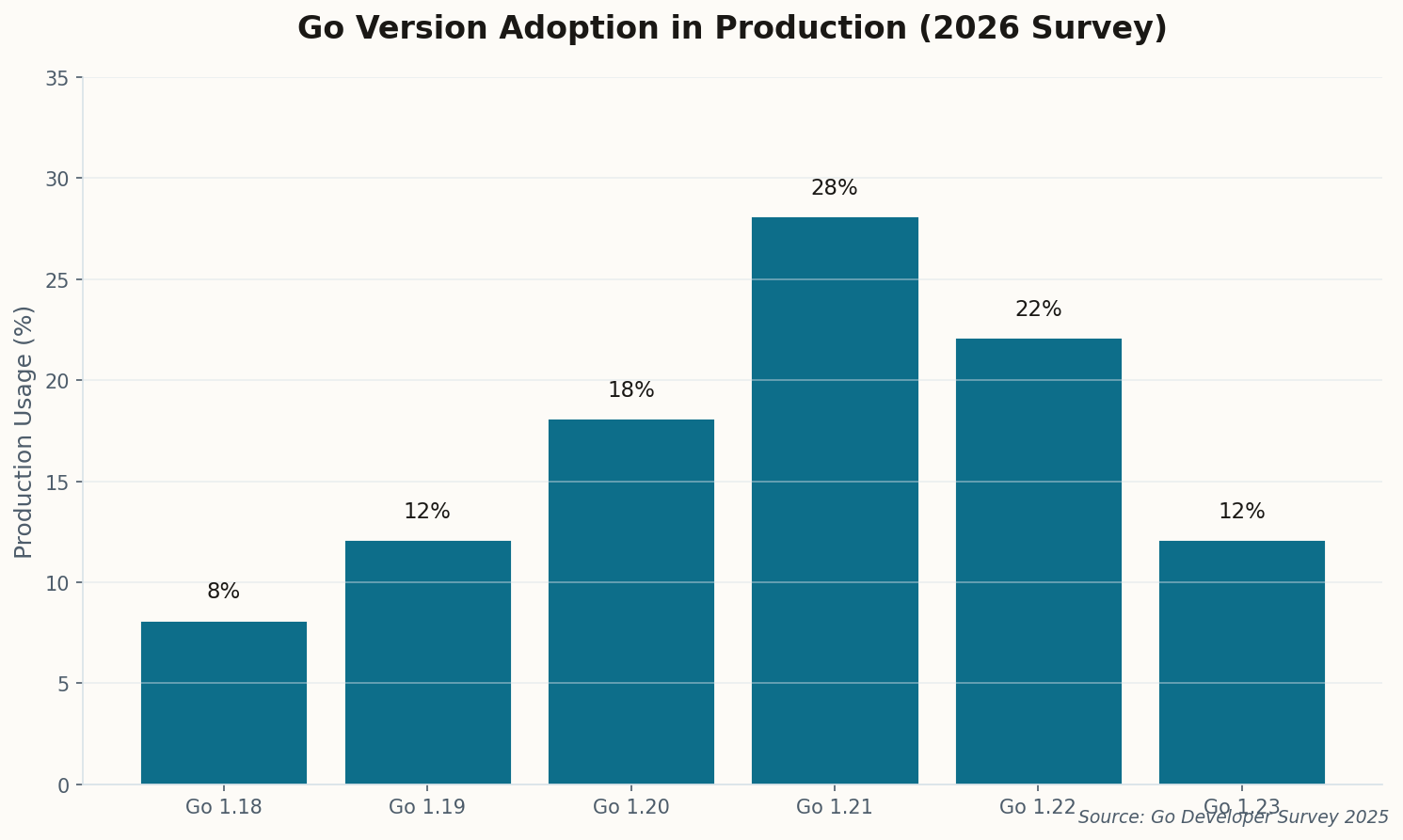
Bar chart showing Go version adoption: Go 1.21 leads at 28%, followed by Go 1.22 at 22%
Go 1.21 remains the dominant production version, with rapid adoption of 1.22 and 1.23.

This is significant for Go's adoption curve. The ability to prototype Go code without any local setup dramatically lowers the barrier for developers curious about the language. You can now ask ChatGPT to write a concurrent web scraper, run it, iterate on the bugs, and have working code—all in your browser.

The integration also signals how AI assistants view language ecosystems. Python was always going to be first (it's the lingua franca of data science and machine learning). Go being second suggests OpenAI sees significant demand from developers building the kind of infrastructure-heavy, reliability-focused systems Go excels at. The cloud is being built on Go, and now the AI assistants know it too.

Until Next Week

Go continues to quietly dominate infrastructure while loudly proving itself in new domains. From running Linux to running chess engines to running inside ChatGPT—the gopher gets around. Run govulncheck, consider submitting to GopherCon, and keep building.