
Workflow Automation

The 230K Question

n8n just crossed 230,000 monthly active users. In a market dominated by Zapier's brand and Make's flexibility, how did an open-source upstart from Berlin become the fastest-growing workflow platform on the planet?

Listen
Abstract network visualization of interconnected workflow nodes glowing with electric teal
Futuristic AI agent orchestrating multiple workflow threads
01

n8n 2.0 Turns Workflow Automation Into AI Orchestration

When n8n shipped version 2.0 earlier this month, they didn't just add features—they repositioned the entire product. The headline addition: native LangChain integration and an AI Agent Tool Node that lets you orchestrate autonomous agents directly within your workflows.

This isn't incremental. While competitors are still treating AI as "one more integration," n8n is betting that the future of automation isn't connecting apps—it's coordinating intelligent agents. Think of it as the difference between building a pipeline and building a team.

The timing matters. Enterprise customers are drowning in fragmented AI experiments: an agent here for customer service, another there for data extraction, a third for document processing. n8n 2.0 gives them a unified control plane. The question isn't whether AI agents are useful—it's who becomes the orchestration layer between them.

The real competitive threat: This move puts n8n in direct competition with custom Python stacks and LangChain itself, not just Zapier and Make. They're playing a different game now.

Growth chart with glowing particles representing 230,000 users
02

230,000 Users and Counting: The Numbers Behind the Hype

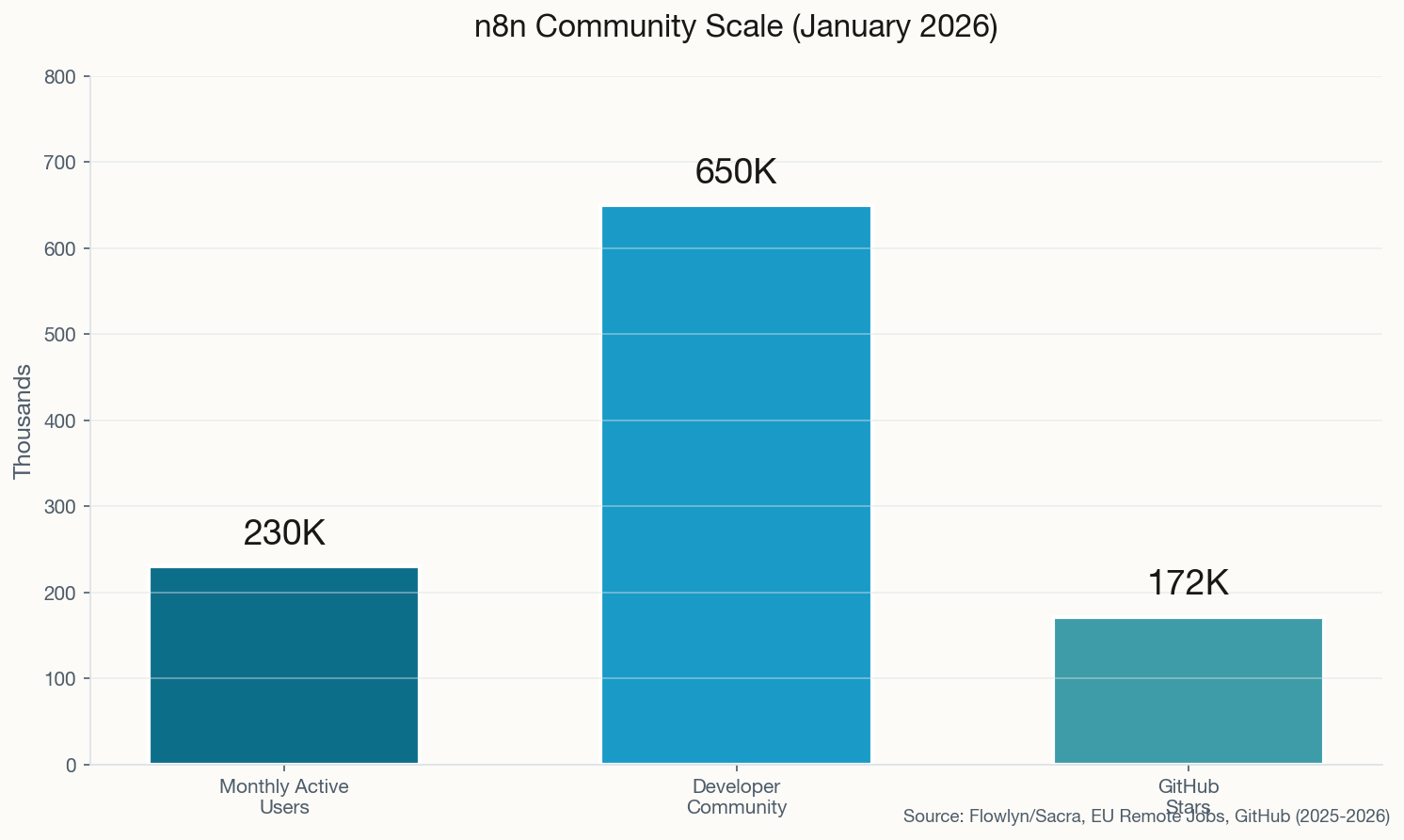
The headline number—230,000 monthly active users—is impressive on its own. But here's what makes it remarkable: n8n is primarily self-hosted. That 230K figure only counts deployments that phone home for telemetry. The actual number of active n8n installations is almost certainly higher, possibly significantly so.

n8n community scale showing 230K MAU, 650K developers, and 172K GitHub stars
n8n's community spans three tiers: active platform users, the broader developer community, and GitHub contributors.

Beyond active users, n8n reports a developer community of 650,000+ builders. This is the "shadow IT" funnel that enterprise sales teams dream about: developers discover n8n, build internal tools, and eventually convince their companies to adopt it officially. It's the Slack playbook, applied to automation.

With 172,000 GitHub stars as of January 2026, n8n has become one of the most popular open-source projects in the productivity space. That's not just vanity metrics—it's organic reach that no amount of paid marketing can replicate.

Revenue growth visualization with stacked golden coins
03

From $4M to $40M ARR: The 10x Growth Story

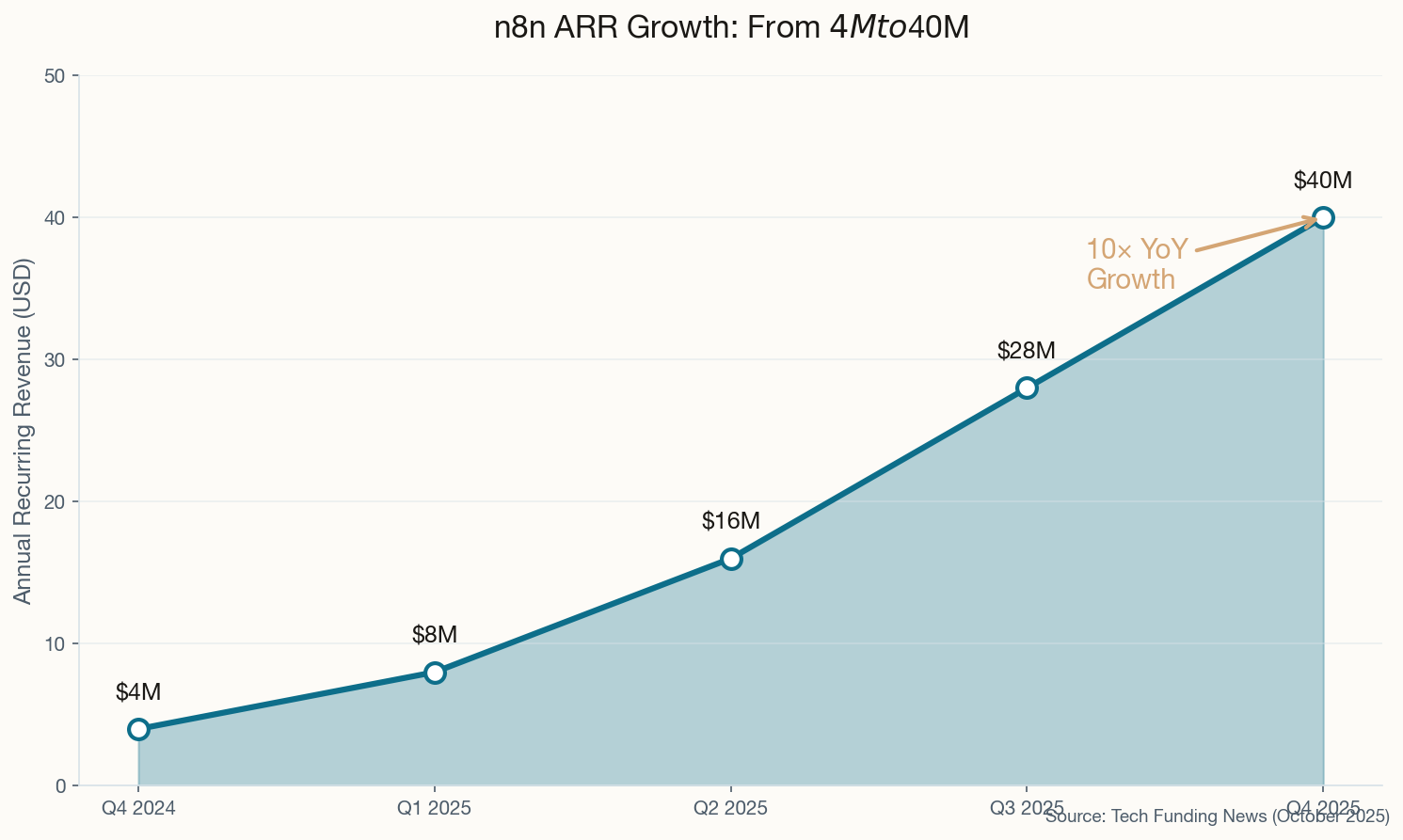
In October 2025, n8n reported something investors rarely see: 10x revenue growth in a single year. Annual recurring revenue surged from approximately $4 million to $40 million, putting them on a trajectory that most SaaS companies only dream about.

n8n ARR growth from $4M to $40M showing 10x year-over-year growth
n8n's revenue trajectory accelerated dramatically through 2025, driven by enterprise adoption and the AI pivot.

What's driving this? Three factors converging: First, enterprises burned by Zapier's pricing realized they could self-host n8n for a fraction of the cost. Second, the developer-first motion created bottom-up adoption that sales teams could convert. Third—and most critically—the AI orchestration pivot arrived at exactly the right moment.

The funding follows the revenue. With this growth rate, expect n8n to announce a significant Series C in 2026, likely at a valuation that makes early investors very happy.

Digital fortress with shield protection and code fragments
04

Growing Pains: Critical Vulnerabilities Patched

With great adoption comes great scrutiny. Earlier this month, n8n patched CVE-2026-1470, a critical vulnerability that could have allowed remote code execution through sandbox escapes. The patch (v2.5.1) also addressed several high-severity issues.

This is the uncomfortable reality of open-source enterprise software: transparency cuts both ways. Security researchers can (and do) find vulnerabilities faster than in closed-source products. The saving grace? So can the maintainers. n8n's response time—from disclosure to patch—was measured in days, not weeks.

For enterprises evaluating n8n, this is actually reassuring. A company that ships fast patches and communicates transparently about vulnerabilities is demonstrating maturity. The alternative—security through obscurity—doesn't age well.

Action required: If you're running n8n in production, update to v2.5.1 immediately. This isn't one to defer.

Hybrid cloud architecture with data sovereignty visualization
05

Data Sovereignty Is n8n's Secret Weapon

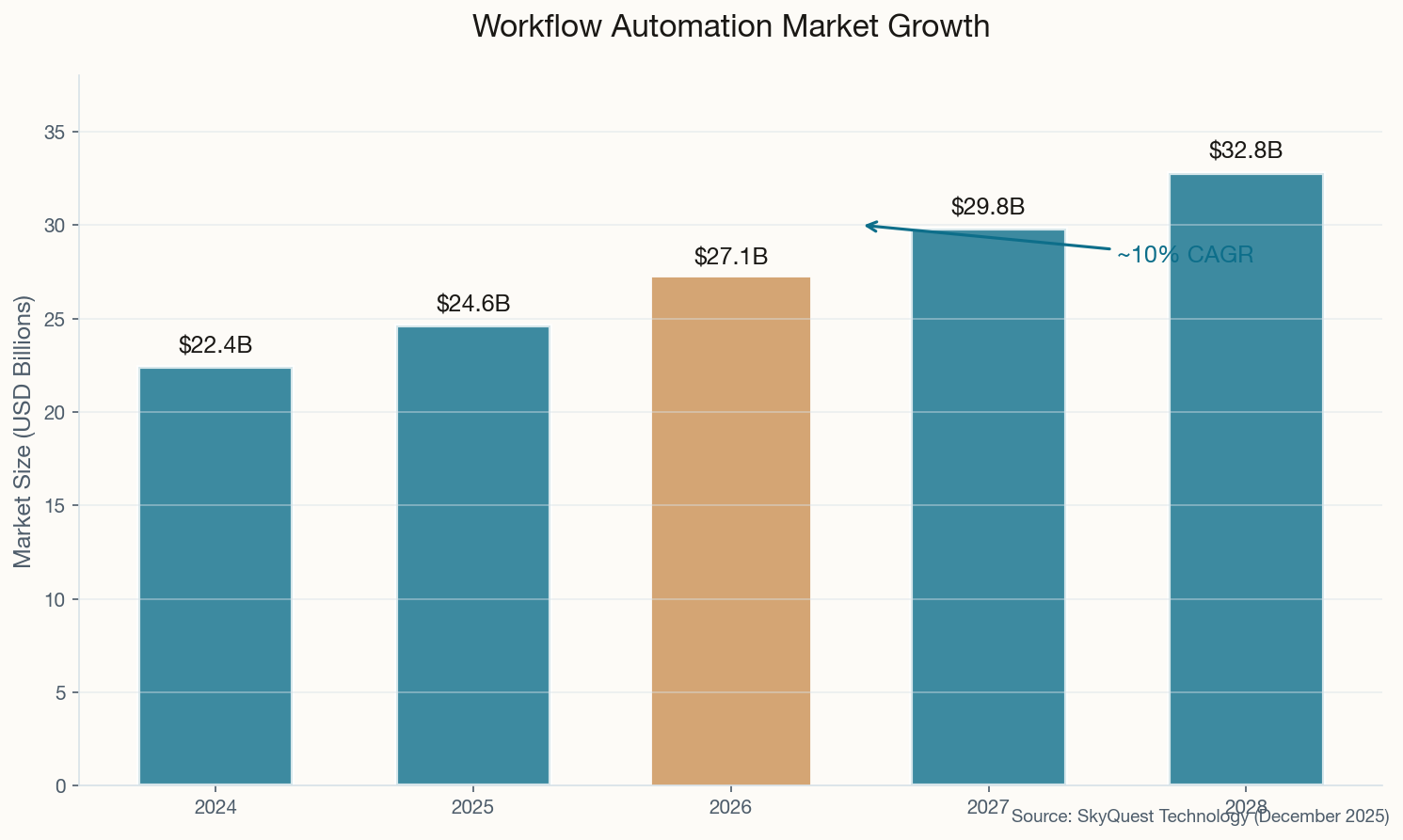
The workflow automation market is projected to hit $27 billion in 2026, growing at roughly 10% CAGR. But the more interesting trend is beneath the surface: enterprises are increasingly choosing hybrid approaches over pure cloud solutions.

Workflow automation market growing from $22B to $33B between 2024-2028
The workflow automation market continues steady growth, but the composition is shifting toward self-hosted and hybrid deployments.

Why? Data sovereignty regulations are tightening globally. GDPR was just the beginning. When your automation workflows handle customer data, processing it on third-party cloud infrastructure creates compliance headaches that no one wants. n8n's self-hostable architecture suddenly looks less like a quirky open-source choice and more like a strategic advantage.

This explains why n8n is winning enterprise deals against Zapier and Make. It's not just cost (though that helps). It's that enterprises can run n8n inside their own security perimeter, with their own data policies, audited by their own teams.

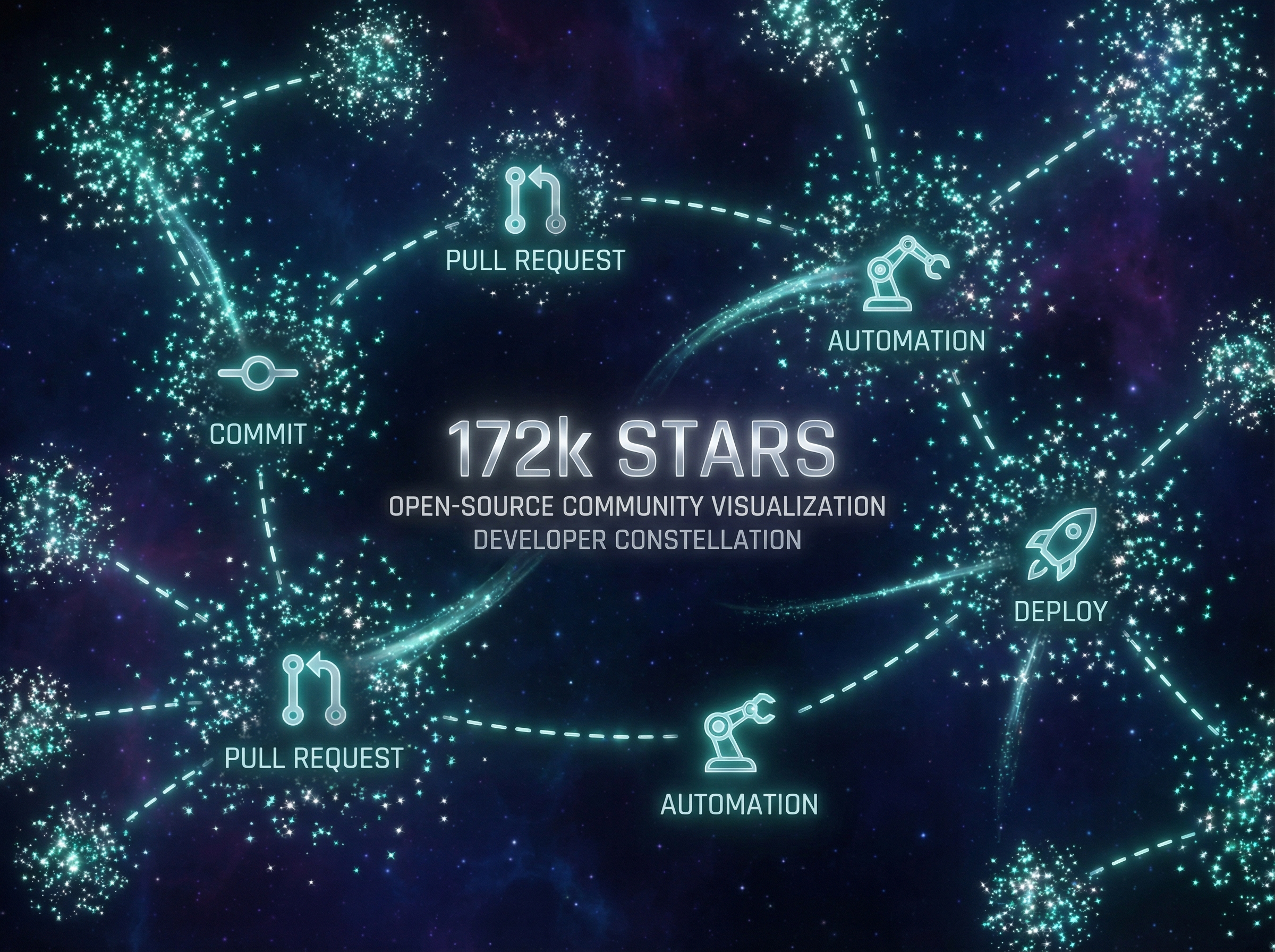
GitHub stars forming a cosmic constellation in the shape of an automation workflow
06

172,000 Stars: The Open-Source Moat

GitHub stars are often dismissed as vanity metrics, but at 172,000 they represent something more: an organic distribution channel that competitors cannot buy. Every star is a developer who bookmarked the project, who might recommend it to colleagues, who could become a future enterprise champion.

Compare this to the traditional SaaS go-to-market motion: paid ads, SDR outreach, demo requests, endless qualification calls. n8n gets discovered organically by the people who actually build things. By the time a company formally evaluates n8n, there's often already an internal advocate who's been using it for months.

The community momentum creates a flywheel. More users mean more integrations (n8n now supports 400+ apps). More integrations attract more users. More users contribute code, documentation, and templates. The whole thing compounds in ways that closed-source products can't replicate.

The Orchestration Layer

n8n's bet is clear: the future of automation isn't connecting apps—it's coordinating intelligence. As AI agents proliferate across every enterprise function, someone needs to be the control plane. With 230K users, 10x revenue growth, and a strategic pivot to AI orchestration, n8n is positioning itself to be exactly that. The question now is whether incumbents can adapt fast enough.