Creator Business

From Screen to Print: Your Comic Book POD Partner Guide

The indie comic landscape has quietly revolutionized. Print-on-demand isn't just viable anymore—it's the backbone of a new creator economy. Here's how to navigate it.

Listen
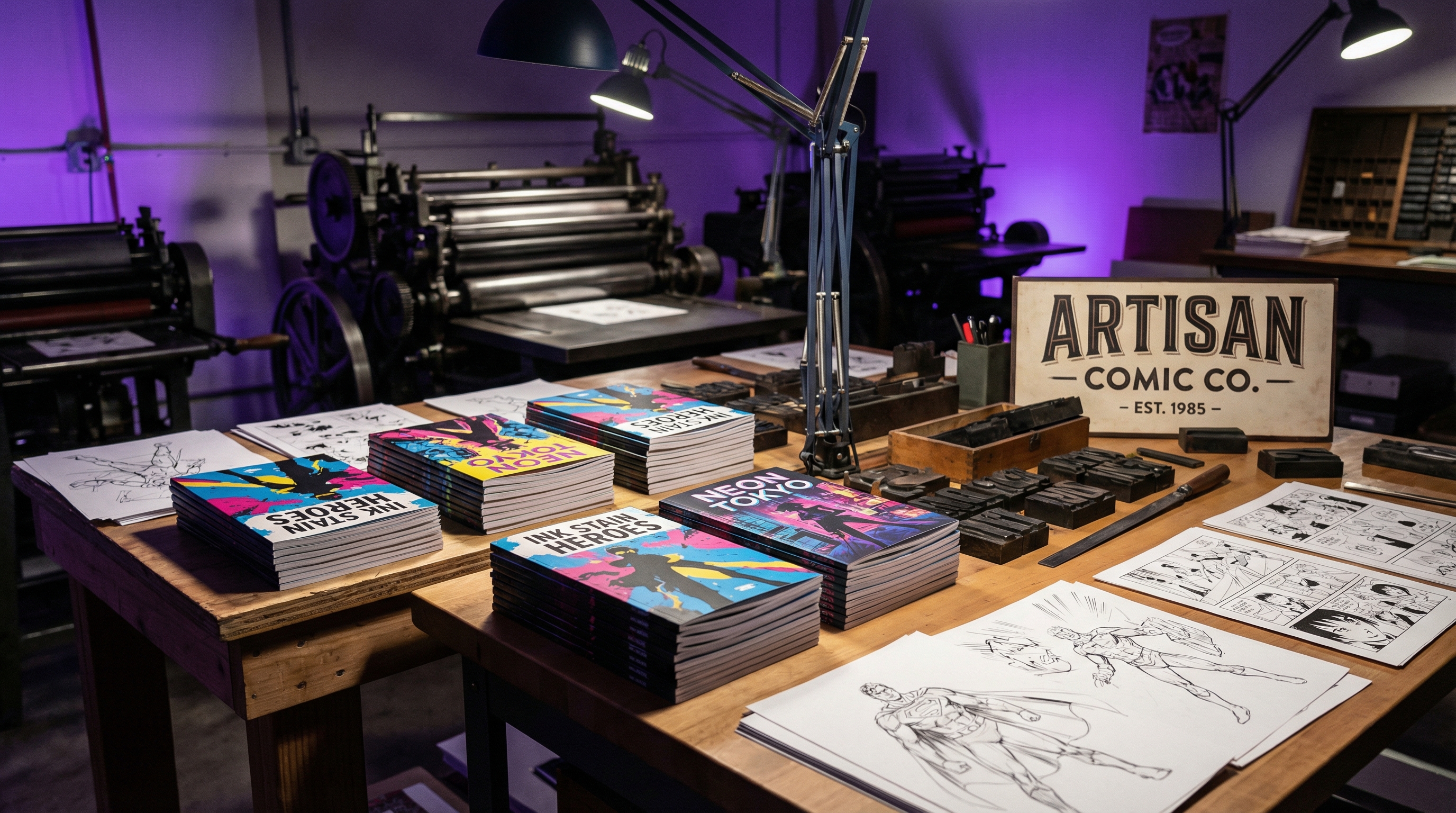
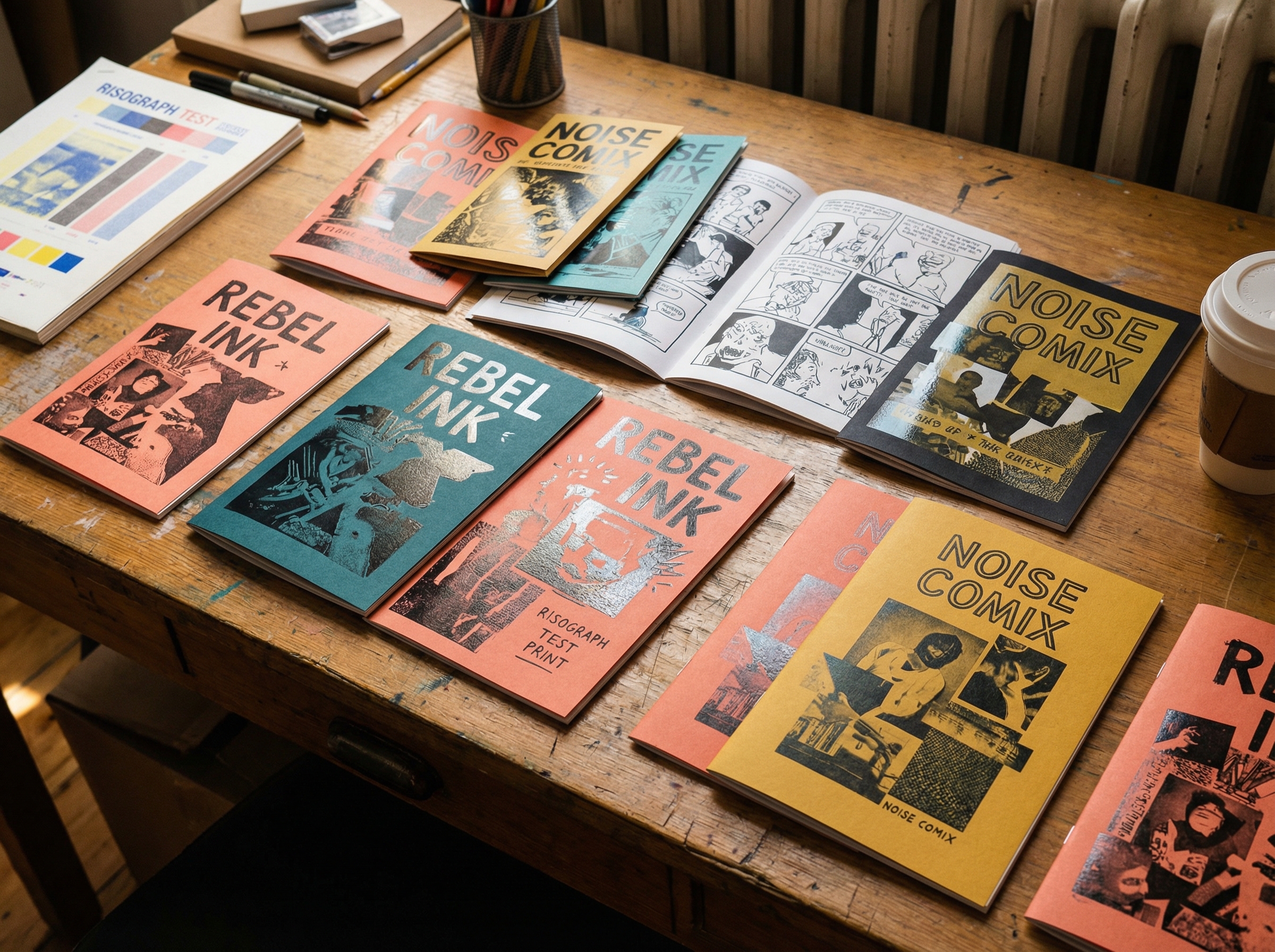
A vibrant comic book printing workshop with stacks of freshly printed indie comics
01

The POD Revolution: Why 2026 Is Different
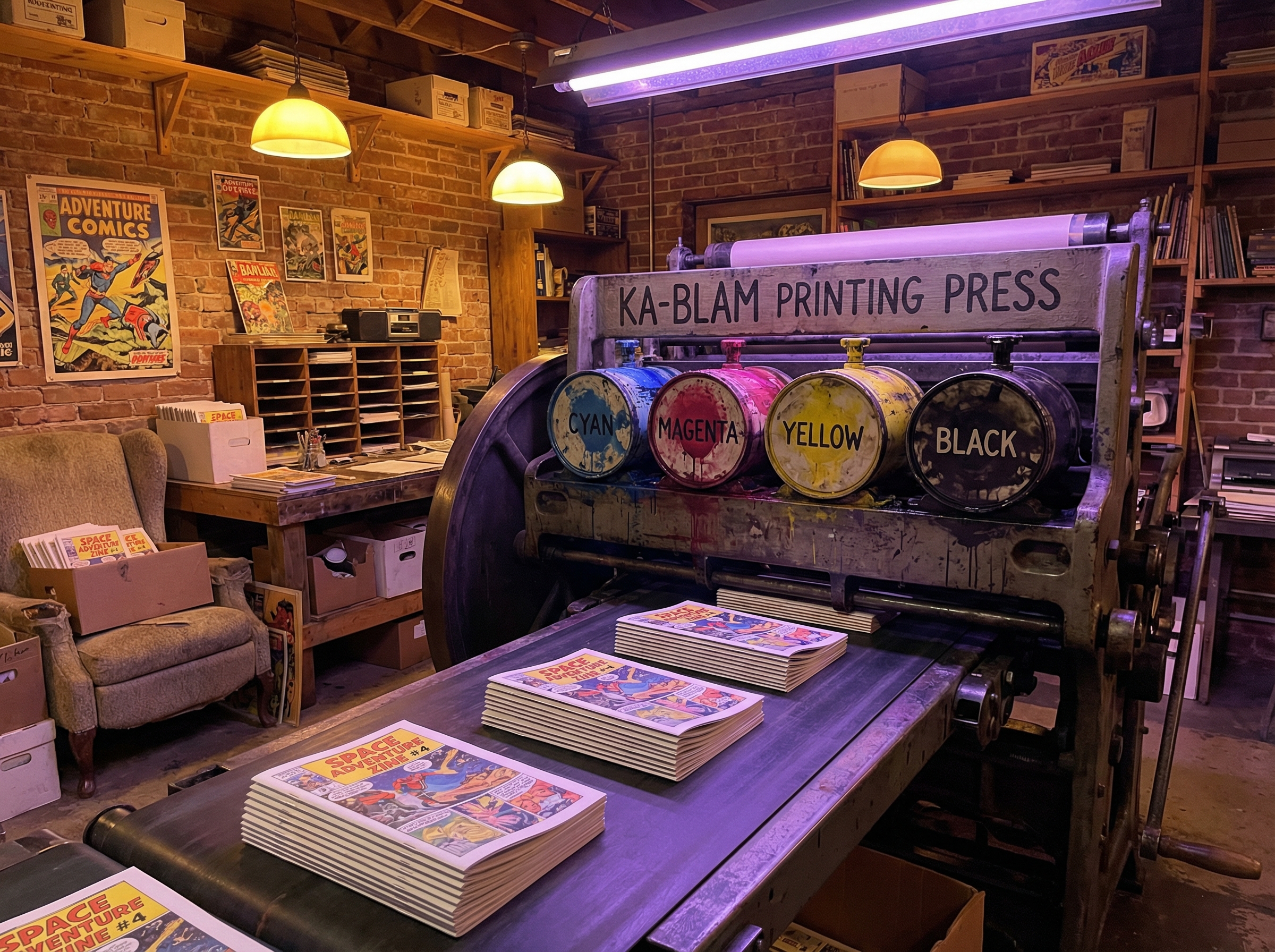
Vintage-style comic book printing press with CMYK ink drums

Forget what you knew about self-publishing comics five years ago. The divide between "generalist" book printers like Amazon KDP and "specialist" comic printers like Ka-Blam has widened into a genuine strategic choice—not just a quality difference.

The specialists have doubled down on what matters: paper stock that doesn't bleed through, saddle-stitch binding that feels like a proper floppy, and color reproduction that doesn't turn your carefully calibrated CMYK into muddy approximations. Meanwhile, the generalists have unrivaled reach but continue to struggle with the heavy ink coverage that comic art demands.

The 2026 Meta: Smart creators are running a "hybrid model"—using specialists for convention stock and Kickstarter fulfillment where quality sells copies in person, then switching to generalists for passive online sales where discoverability matters more than paper weight.

This isn't about finding the "best" service. It's about understanding which service best fits which part of your publishing strategy.
02

The Specialist Tier: Ka-Blam, Mixam, and Comix Well Spring

Modern digital printing facility with vibrant comic pages emerging

Ka-Blam remains the old guard—the "original" POD service built exclusively for indie comics. Their interface looks like it's from 2008 because it is, but they understand the medium better than almost anyone. A 32-page saddle-stitched comic runs about $2.80 per unit with no minimums. That's not nothing. They'll print you a single copy to hold in your hands before you commit to anything.

Their IndyPlanet storefront handles fulfillment and pays you the profit—a genuine one-stop solution for creators who don't want to become shipping logistics experts. The catch? No Amazon distribution. No bookstore reach. You're selling within their ecosystem.

Bar chart comparing per-unit costs across POD services for single issues and graphic novels
Per-unit printing costs vary significantly between services and formats. Specialists like Ka-Blam and Mixam offer competitive pricing for single issues, while generalists like Amazon KDP become cost-effective at higher page counts.

Mixam is the disruptor. Their instant quote calculator is genuinely good—you'll know exactly what 50 copies of your 48-page perfect-bound book costs before you create an account. Their color reproduction pops in ways that make digital artists weep with joy. They're particularly strong for short runs (25-100 copies) heading to conventions.

Comix Well Spring rounds out the specialist tier with a "by creators, for creators" ethos. Their minimum order of 25 copies means this isn't for zero-budget experiments, but for creators ready to invest in inventory, the quality-to-price ratio is excellent.

03

The Distribution Giants: Amazon KDP and IngramSpark

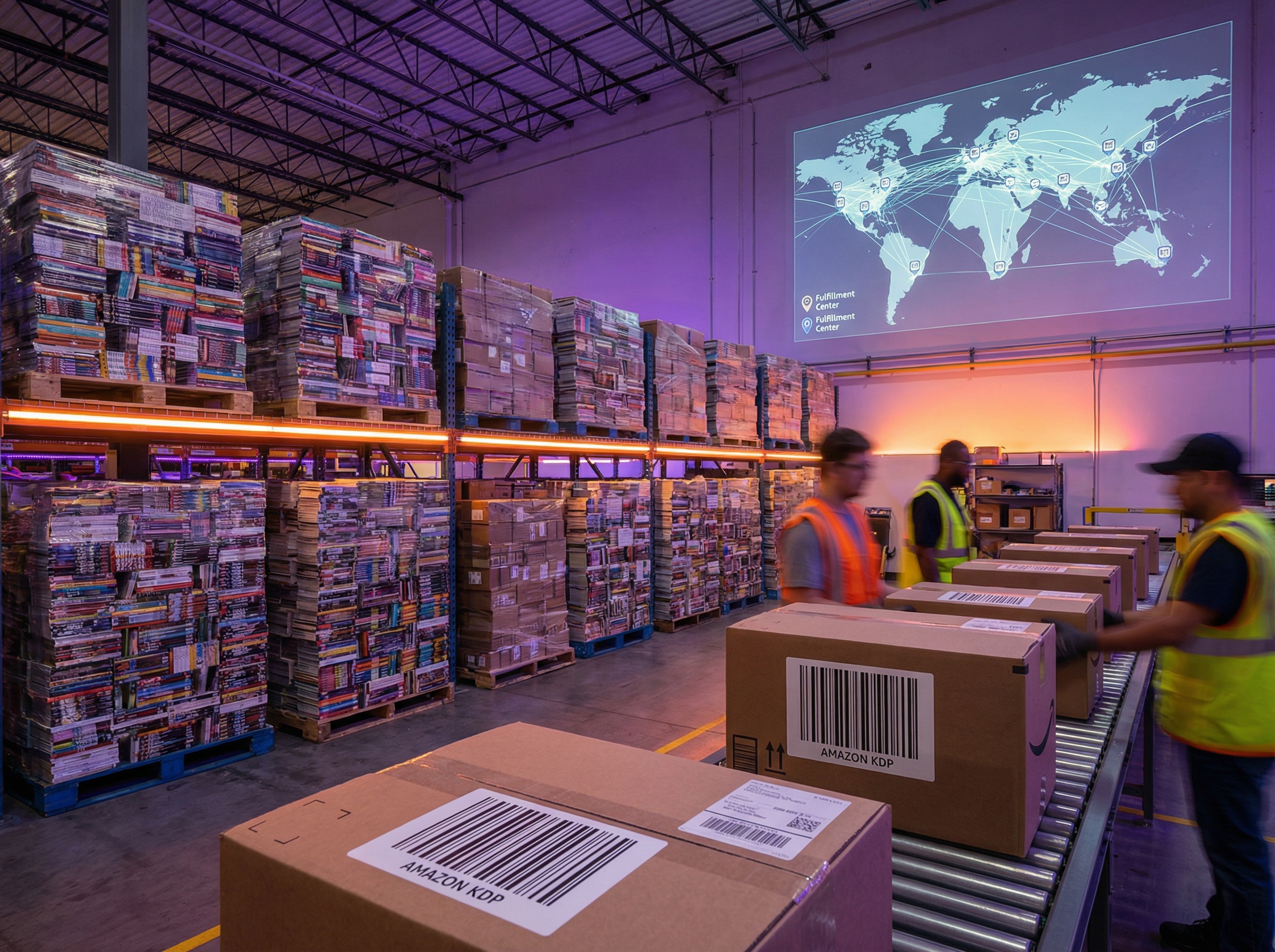
Towering stacks of graphic novels in a vast distribution warehouse

Here's the uncomfortable truth about Amazon KDP: it can't do saddle-stitch binding. Period. No staples. If your comic is under 48 pages—and most single issues are—you cannot make it feel like a comic book through Amazon. It will be a perfect-bound booklet, which reads "weird indie art book" rather than "comic."

For graphic novels and collected editions over 100 pages? Different story. Amazon's "Premium Color" option on 60# coated stock is decent (not great, decent), and the distribution reach is unmatched. You appear on Amazon Prime. People who've never heard of you can discover you. That's worth something.

The 40% royalty cut plus print costs means your margins are thinner than specialist routes, but passive discoverability can outweigh per-unit profit for certain publishing strategies.

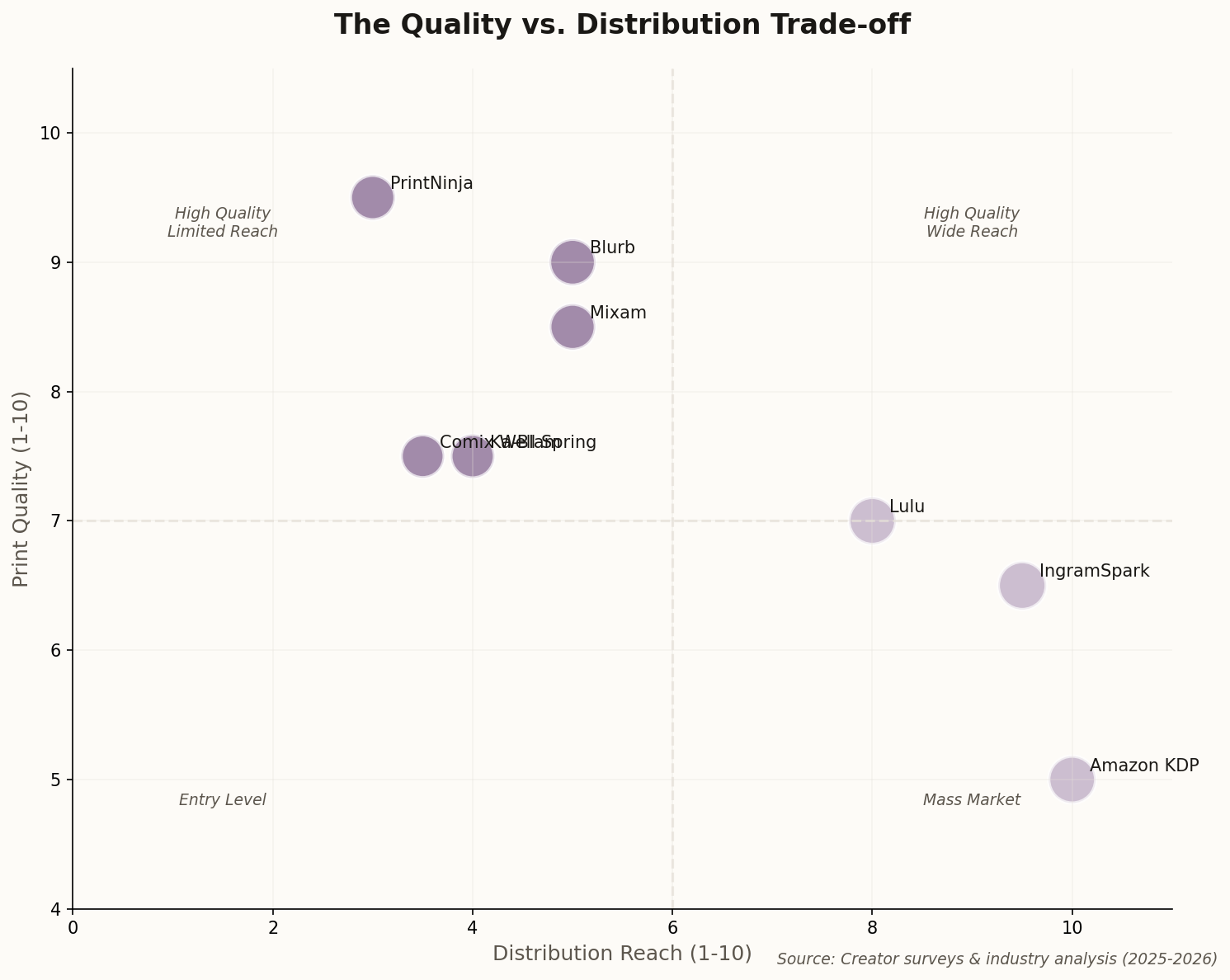
Scatter plot showing quality vs distribution reach for different POD services
The quality vs. distribution trade-off visualized. Note how PrintNinja and Blurb occupy the "high quality, limited reach" quadrant, while Amazon KDP dominates distribution reach despite lower quality scores.

IngramSpark is your gateway to bookstores and libraries—the only real path to getting a POD comic ordered by your local shop or library system. Their catalog is the industry standard for book ordering. The interface is notoriously difficult ("user-hostile" is the common refrain), and they've traditionally charged $49 per title setup, though 2025 saw frequent fee waivers and membership deals.

The Bookstore Reality: Getting listed in IngramSpark's catalog doesn't mean bookstores will stock you. It means they can order you. You still need to do the sales work—but at least the infrastructure exists.

04

When Quality Is Non-Negotiable: PrintNinja and Blurb

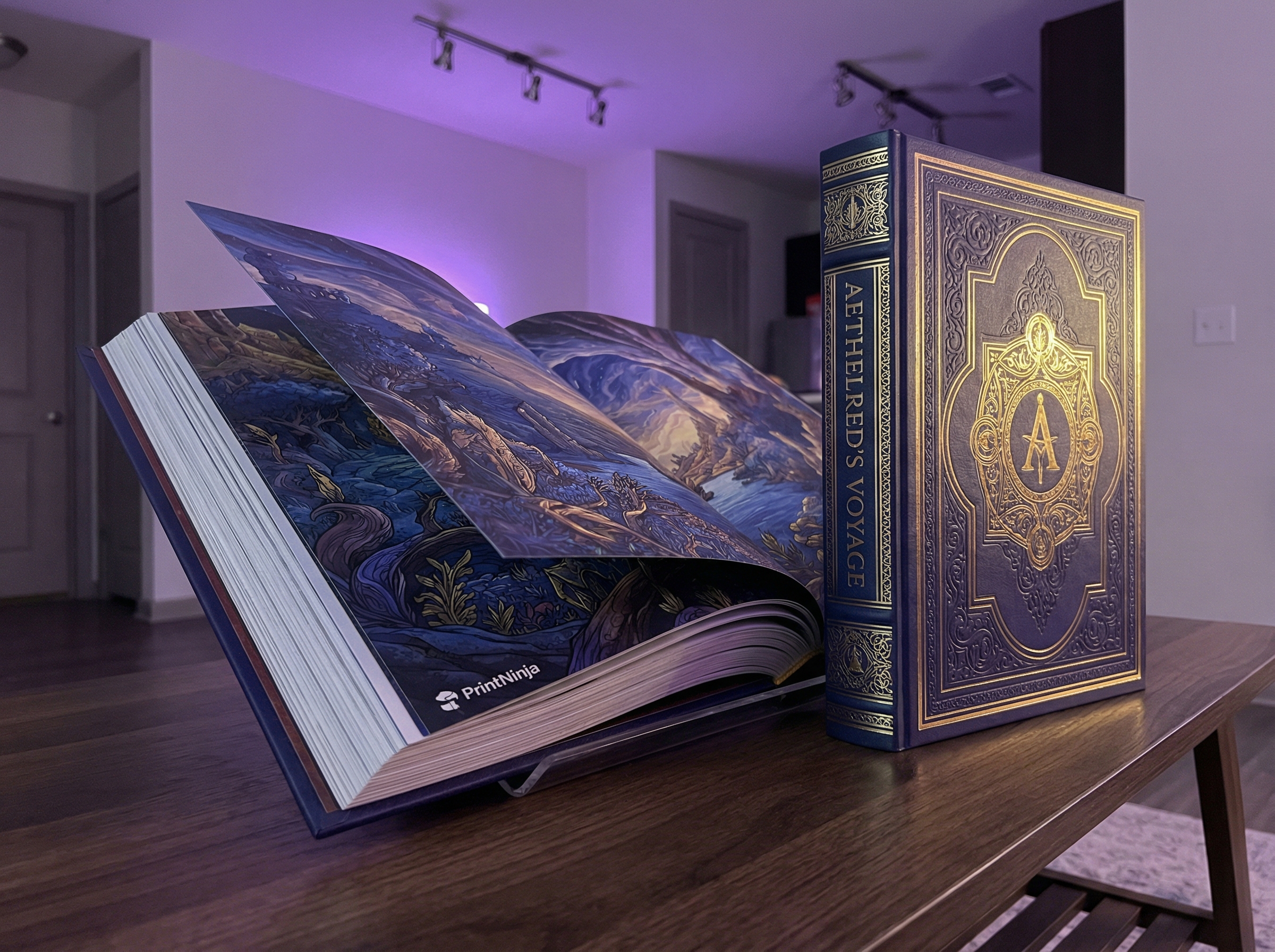
Luxury hardcover graphic novel with foil stamping and embossing

PrintNinja isn't technically POD—they're offset printing with minimum orders around 250 copies. But if you're running a Kickstarter or have the capital to invest in inventory, they're the gold standard for indie graphic novels. Deep blacks, crisp lines, paper that feels substantial in your hands.

Spot UV, foil stamping, embossing, french flaps—these are options most POD services can't touch. At volume, you're looking at roughly $2 per unit, which gives you margin room for retail pricing that matches your production value. The catch is upfront cost ($1000+ minimum) and lead times measured in months rather than days.

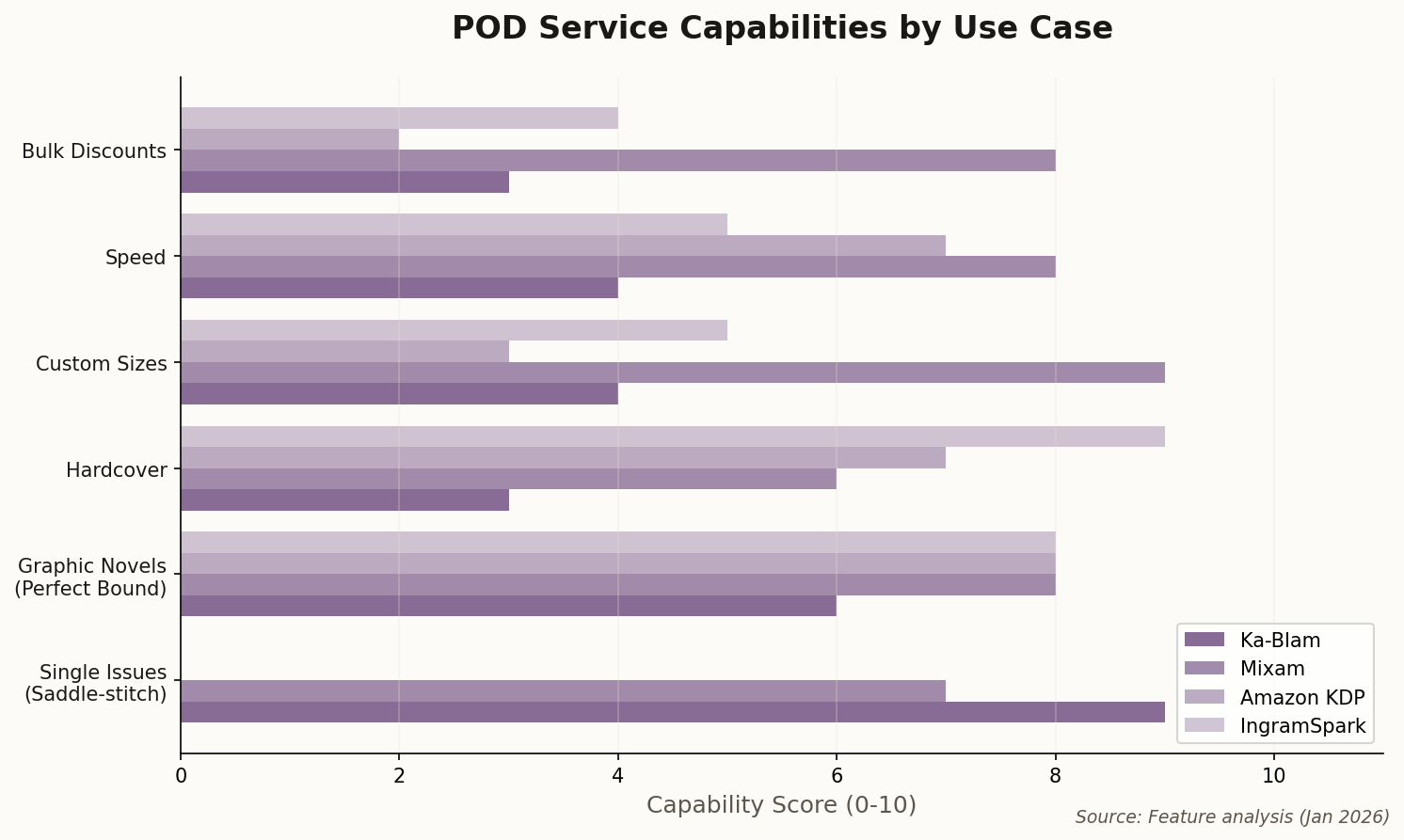
Horizontal bar chart comparing POD service capabilities across different use cases
Service capabilities vary dramatically by use case. Ka-Blam excels at single issues, while Amazon KDP and IngramSpark lead for hardcover graphic novels and distribution.

Blurb occupies a strange niche—stunning quality on premium paper stocks (Mohawk Superfine is chef's-kiss), but prohibitively expensive for standard comic pricing. A book that should retail at $15 might cost you $12 to print. The math doesn't work for serialized comics.

Where Blurb shines: pitch bibles, portfolios, and limited-edition collector's versions where you can charge $50+ and customers expect it. Think "coffee table art book" rather than "monthly floppy."

05

The Hybrid Strategy: Matching Service to Channel

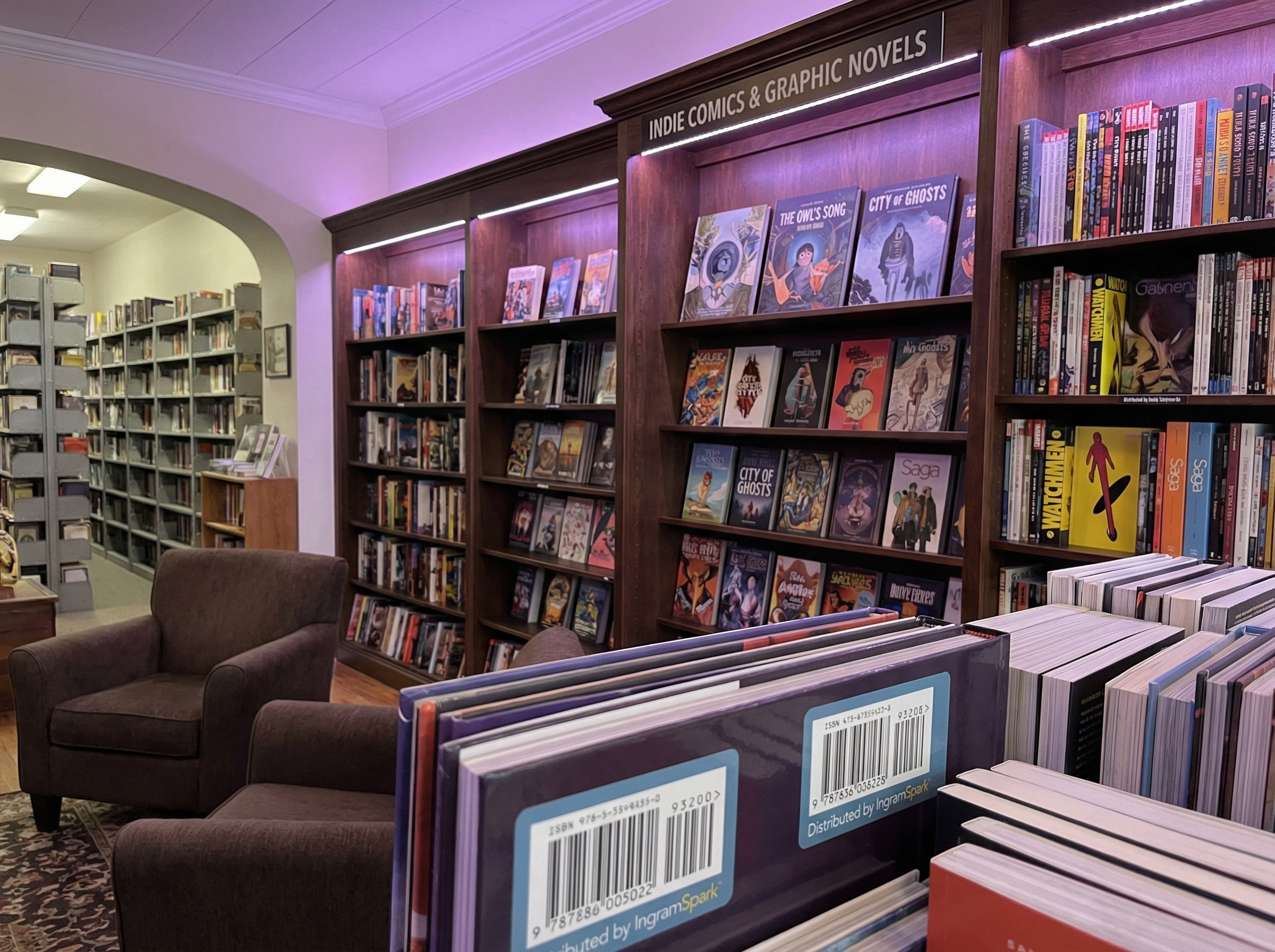
Indie comics displayed on bookstore shelves alongside mainstream titles

The creators crushing it in 2026 aren't loyal to any single POD service. They're running parallel operations:

For conventions and direct sales: Mixam or Comix Well Spring. Order 50-100 copies of your best sellers. The quality sells itself when people can flip through pages. You keep the full margin minus printing cost.

For Kickstarter fulfillment: PrintNinja if you've hit stretch goals and can justify the volume. Mixam for smaller campaigns where 100-250 copies is the sweet spot.

For passive online discovery: Amazon KDP for collected editions and graphic novels. Accept the quality compromises in exchange for Prime badges and algorithm visibility.

For bookstore/library placement: IngramSpark with realistic expectations. Being orderable is different from being stocked, but it opens doors that stay closed otherwise.

The File Prep Reality: Always export PDF/X-1a. Convert RGB to CMYK yourself—don't let the printer's software make those decisions or your neon highlights become muddy approximations. Include 0.125" bleed on all sides. Every printer is unforgiving about this.

06

Where to Start: Decision Framework

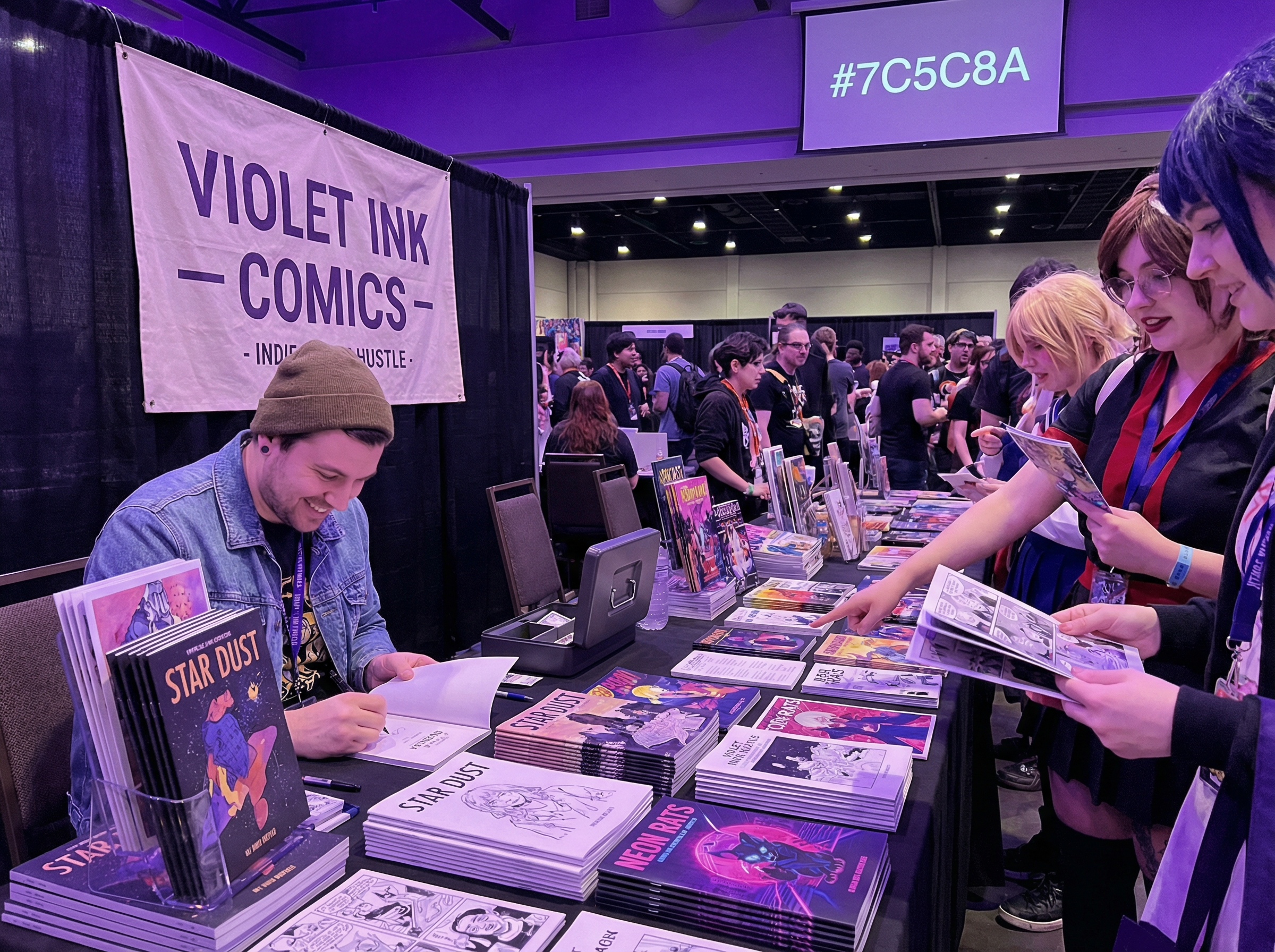
Artist alley booth at comic convention with stacked indie comics

Just starting out? Ka-Blam. Print one copy. Hold it. See if it matches what you imagined. Their IndyPlanet integration means you can list it for sale without inventory risk.

Ready for conventions? Get quotes from Mixam and Comix Well Spring for 25-50 copies. Compare quality samples if possible—both offer them. The few dollars per unit difference matters less than which one reproduces your specific art style better.

Building a backlist? Set up IngramSpark for your collected editions. Endure the interface. The bookstore/library ordering capability is worth the frustration.

Going big on Kickstarter? PrintNinja is your partner. Build their lead times into your fulfillment estimates. Your backers will forgive slower shipping for noticeably premium quality.

The print-on-demand landscape has matured into genuine options rather than compromises. The infrastructure for indie comic publishing has never been stronger. What remains, as always, is making something worth printing in the first place.

The Page Awaits

Print-on-demand democratized access. The gatekeepers are gone. What you make—and how you bring it to readers—is entirely up to you now.