NVIDIA DGX Spark

A Petaflop in Your Living Room

The $4,000 box that finally makes "personal AI supercomputer" more than marketing speak. Here's what people are actually doing with it.

Listen
NVIDIA DGX Spark - compact AI supercomputer with glowing neural network patterns
01

Andrej Karpathy Trains a ChatGPT Clone for $100

Person training AI model at home with glowing neural computation

When Andrej Karpathy posts a project, the AI community pays attention. His latest experiment cuts to the heart of what DGX Spark actually means: he trained a functional, ChatGPT-style language model entirely on one box, for about $100 in electricity.

The implications are harder to ignore than the specs. This isn't running inference on someone else's model—it's training from scratch. Karpathy released the full stack: training code, inference server, and a web UI. Everything runs locally. No cloud. No API keys. No monthly bills.

"The barrier to entry for training your own specialized models has never been this low."

The project immediately spawned forks. Researchers are adapting it for domain-specific models. Hobbyists are experimenting with fine-tuning variants. The Spark isn't just democratizing inference—it's making training accessible to anyone with the skill to use it and a few hundred dollars for power.

What this signals: the era of "API-only" AI development has a serious competitor. If you can train a useful model at home, the economics of building AI applications shift dramatically.

02

The LocalLLaMA Crowd Discovers 128GB Is Actually Enough

Developer community collaborating on AI projects with multiple screens

The r/LocalLLaMA subreddit—ground zero for the local AI movement—has been running benchmarks on the Spark since it hit retail. The consensus is forming: this thing actually delivers on the unified memory promise.

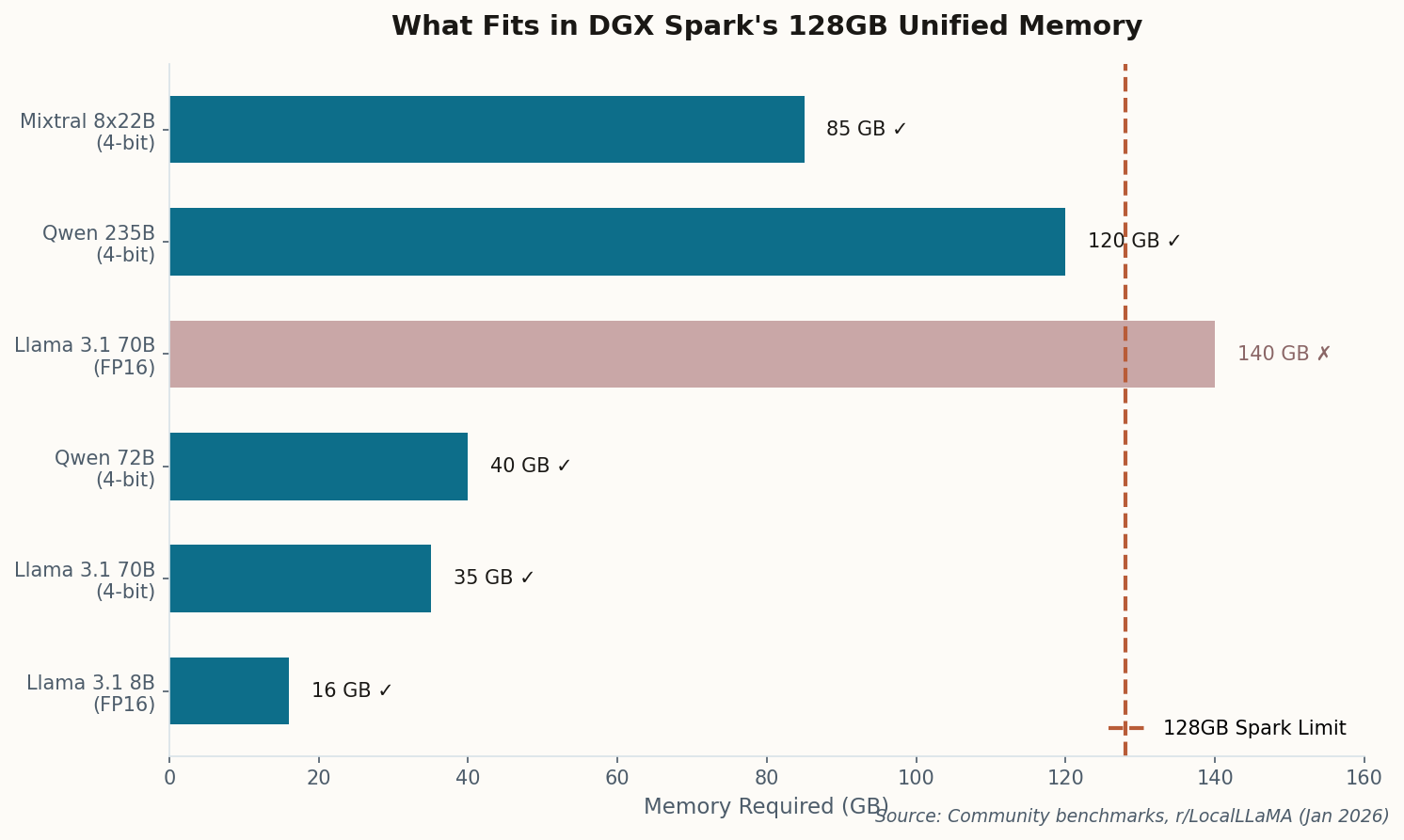
The key numbers: Llama 3.1 70B fine-tunes successfully using QLoRA. Qwen 72B runs at full context without offloading to CPU RAM. Users report handling 120B+ parameter models for inference at acceptable speeds. One commenter summarized it: "Finally running Qwen-72B at full context without offloading to CPU RAM is a game changer."

Chart showing which models fit in DGX Spark's 128GB unified memory
Model capacity comparison: what fits in 128GB unified memory with and without quantization

More interesting than the benchmarks: what people are building. Several users mention they're developing "Social Determinants of Health" (SDOH) startups using just one or two Spark units. Medical AI that runs entirely on-premise, meeting data privacy requirements that would make cloud deployment impossible.

The thread reveals a pattern: the Spark isn't competing with the cloud for scale. It's winning where the cloud can't legally or practically go.

03

Tom's Hardware Declares It a "Mac Studio Killer" for AI

Technical reviewer examining compact computing device with holographic benchmark displays

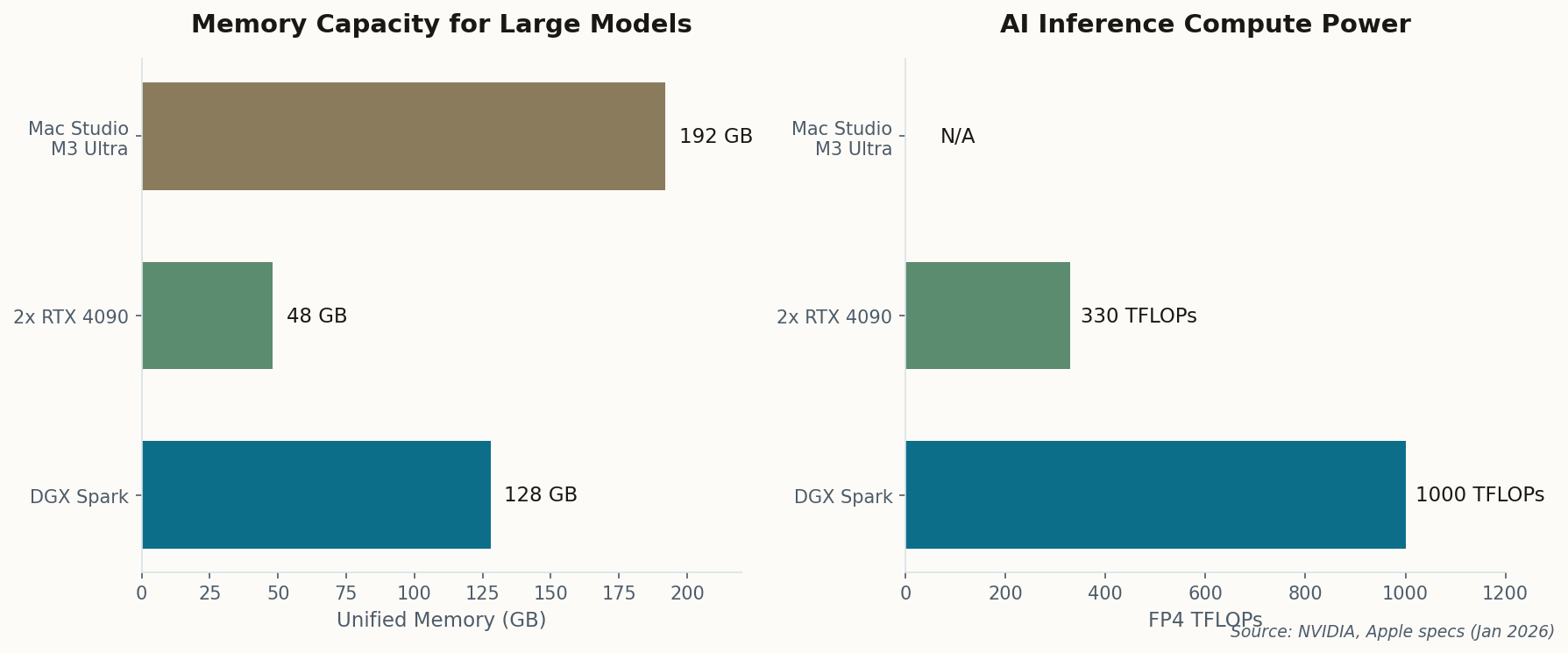
The detailed specs are now confirmed: 20-core Arm CPU, Blackwell GPU, 128GB unified memory, approximately 1 petaFLOP at FP4 precision. Weight: 1.2kg. The Founders Edition ships at $3,999, with partner models from ASUS, Dell, and others varying slightly in price and configuration.

Tom's Hardware's review lands on a sharp verdict: this is a "Mac Studio Killer" for AI-specific workloads. The reasoning is simple—CUDA dominance means the software ecosystem is already there. Every PyTorch script, every Hugging Face model, every ComfyUI workflow just works.

Chart comparing DGX Spark memory and compute to alternatives
DGX Spark vs. alternatives: unified memory and FP4 compute power comparison

The review praises the build quality as "industrial and compact" and notes the most surprising aspect: it's a turn-key system. No driver hunting, no compatibility matrices, no prayers to the CUDA gods. Plug it in, run nvidia-smi, and you're off.

The comparison to Mac Studio is telling. Apple's unified memory architecture pioneered this approach for creative pros. NVIDIA just did the same for AI practitioners—with the software ecosystem already mature.

04

Native Ollama and ComfyUI Support Changes the Game

Abstract visualization of open source tools connecting to enterprise hardware

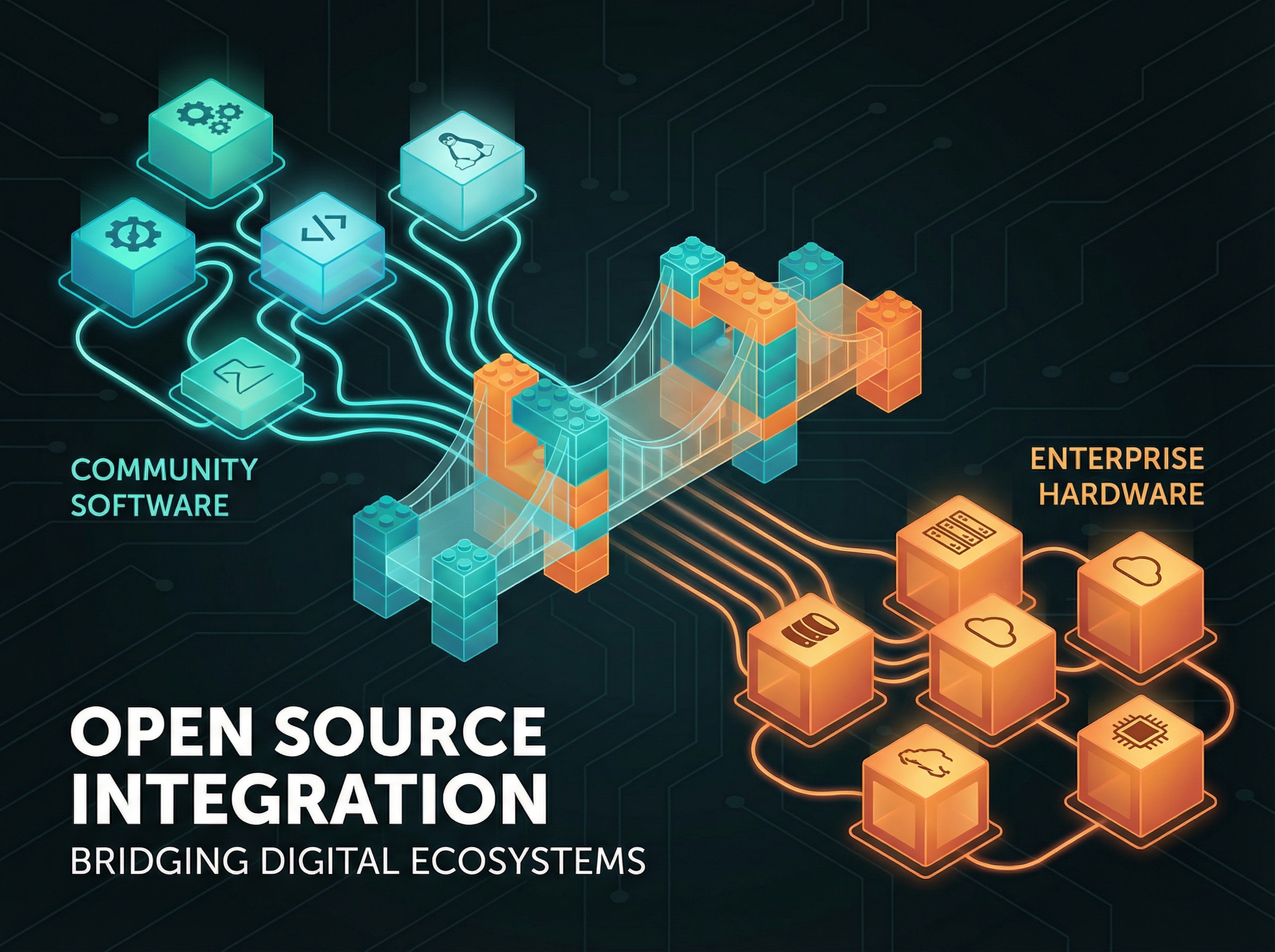
NVIDIA's announcement might sound like routine compatibility news, but it's a strategic tell. They officially highlighted support for Ollama (the LLM runner that's become synonymous with local AI) and ComfyUI (the node-based image generation tool that's eaten the Stable Diffusion ecosystem).

More significantly, NVIDIA released optimized "deployment playbooks"—preconfigured environments with CUDA acceleration ready to go. The message is unmistakable: we're not just tolerating the open-source community; we're courting it.

"Bridging the gap between enterprise hardware and the vibrant open-source AI community."

The benchmarks show ComfyUI image generation significantly outpacing high-end consumer GPUs. The difference isn't just raw compute—it's memory bandwidth. When your model and all its intermediate states fit in unified memory, you're not waiting on transfers.

This is NVIDIA acknowledging reality: the value of hardware depends on compatibility with the tools people actually use. And those tools increasingly come from GitHub, not enterprise software vendors.

05

From "Project Digits" to Micro Center Shelves

Product boxes on retail shelves representing wide distribution

Remember when this was a concept called "Project Digits" at CES 2025? One year later, you can walk into Micro Center and buy one. Amazon has them. Newegg has them. OEM versions from Acer, ASUS, Dell, HP, Lenovo, and MSI are all shipping.

NVIDIA also teased a larger sibling—the "DGX Station"—for Spring 2026 availability. But the real story is the Spark's transition from niche B2B offering to commodity item. Sales started in October 2025, but January marks what PCMag calls "the floodgate opening for retail availability."

The pricing tells the story. At $3,999 to $4,500 depending on configuration, this slots in where serious enthusiasts and small businesses make buying decisions without committee approval. It's a Mac Studio price point. It's a gaming PC price point. It's impulse-buy territory for any funded startup.

The shift from "enterprise AI hardware" to "professional tool at consumer scale" happened faster than anyone predicted. NVIDIA learned from the GPU mining era: if people want your hardware, make it available before a gray market does it for you.

06

NVFP4: The Driver Update That Doubled Everything

Abstract speedometer visualization showing dramatic performance breakthrough

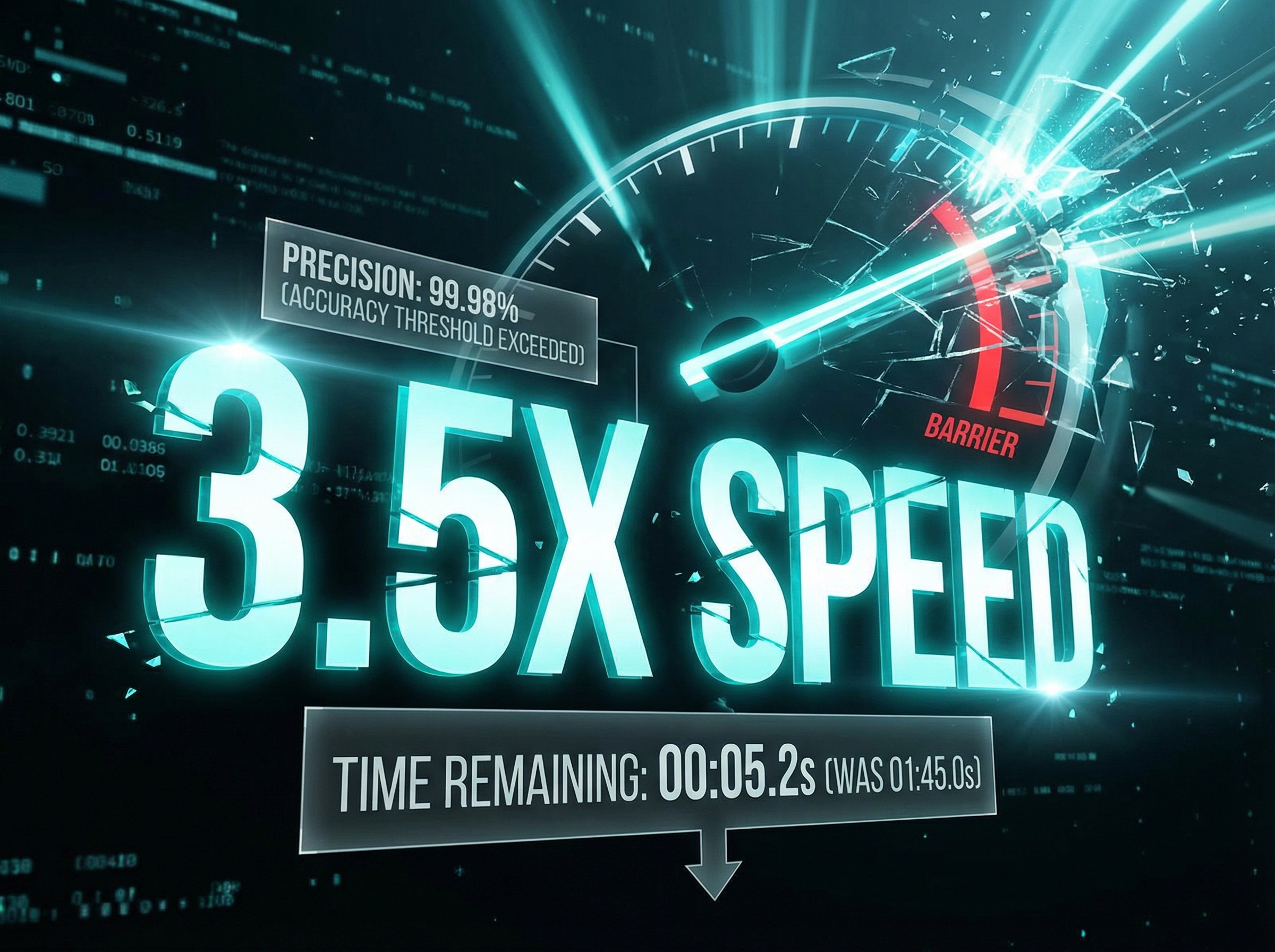
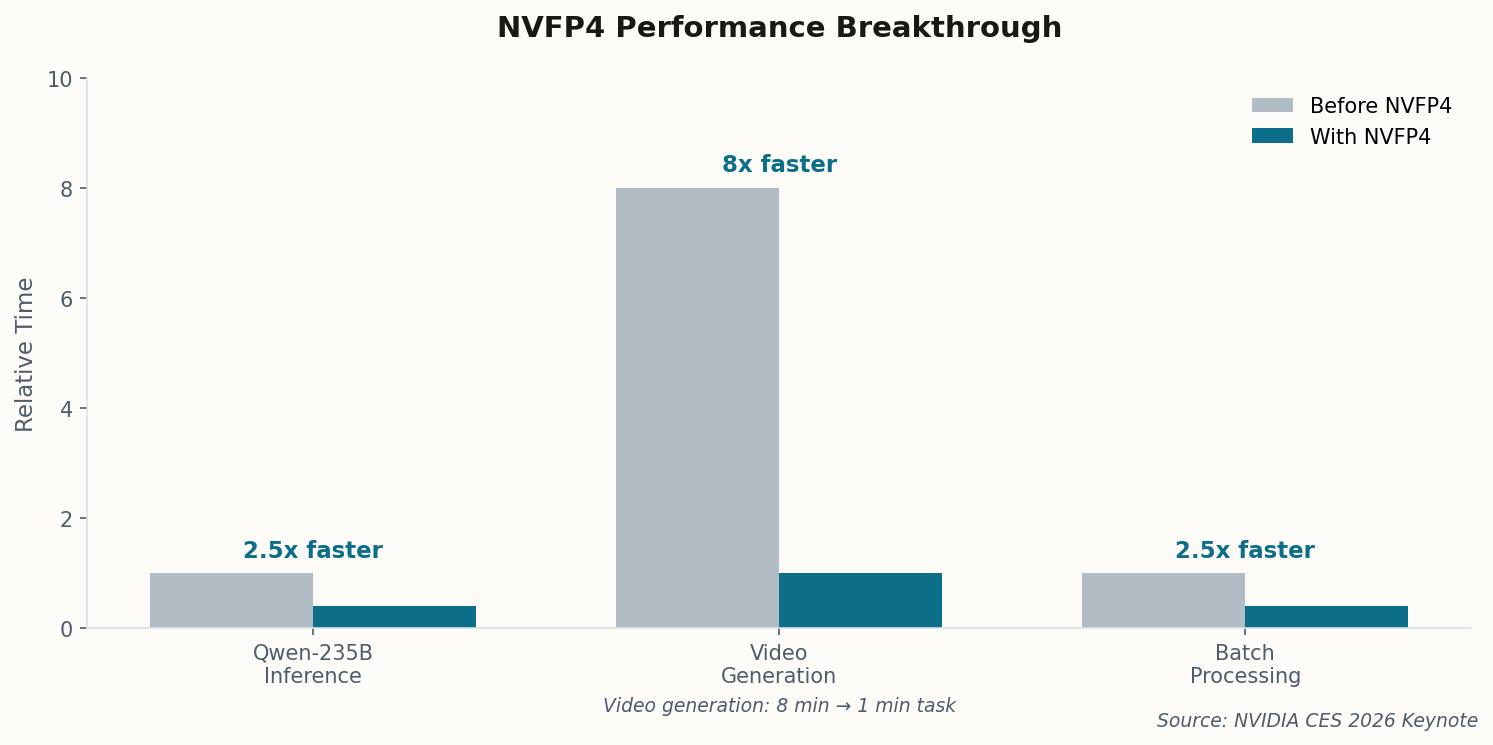
The Grace Blackwell GB10 chip in the Spark now supports NVFP4—4-bit floating point—via a driver update announced at CES. The impact is staggering: inference speeds for complex models like Qwen-235B improved by 2.5x. Memory usage dropped proportionally, meaning larger batches or bigger models fit in the same 128GB.

Chart showing NVFP4 performance improvements across different tasks
NVFP4 performance gains: 2.5x faster inference, 8x faster video generation

The headline demo: an eight-minute video generation task reduced to one minute. That's not incremental improvement—that's a different workflow category.

"An eight-minute video generation task was reduced to just one minute."

What makes this significant beyond the benchmarks: NVFP4 makes the Spark viable for "heavy" production workloads that previously required rack-mounted servers. The use cases that seemed like marketing fantasies—running enterprise-scale inference on your desk—are now plausible.

The meta-lesson: NVIDIA's software investment means the hardware you buy keeps getting faster. That's unusual for compute devices and changes the value calculus considerably.

The Desktop AI Era Arrives

A year ago, "personal AI supercomputer" was marketing hype. Now it's a retail product with an ecosystem. The question isn't whether local AI is viable—it's what you'll build when you have a petaflop under your desk.