
AGI Timeline

The Singularity Has a Schedule

This week, the world's most powerful tech leaders stopped hedging and started naming dates. OpenAI wants $100 billion. Zuckerberg promises "personal superintelligence" by year's end. And Anthropic's CEO is warning we have months, not decades, to prepare. The AGI race just got a finish line.

Listen
Neural network visualization converging toward a luminous horizon representing AGI emergence
Towering stacks of gold coins transforming into server racks
01

OpenAI Wants $100 Billion, and Amazon Is Writing the Check

The number is so large it deserves its own paragraph: $100 billion. That's what OpenAI is reportedly seeking in its latest funding round, with Amazon in advanced talks to contribute roughly half. If it closes, this would be one of the largest private technology investments in human history—more than the GDP of most countries, concentrated in a single company building a single technology.

What does $100 billion buy? According to sources close to the deal, it buys the compute infrastructure necessary to train AGI. Not "advanced AI" or "more capable models"—AGI. The scale of capital validates what researchers have been whispering: the leading labs believe we're in the final stretch, and the limiting factor is no longer algorithmic insight but raw computational power.
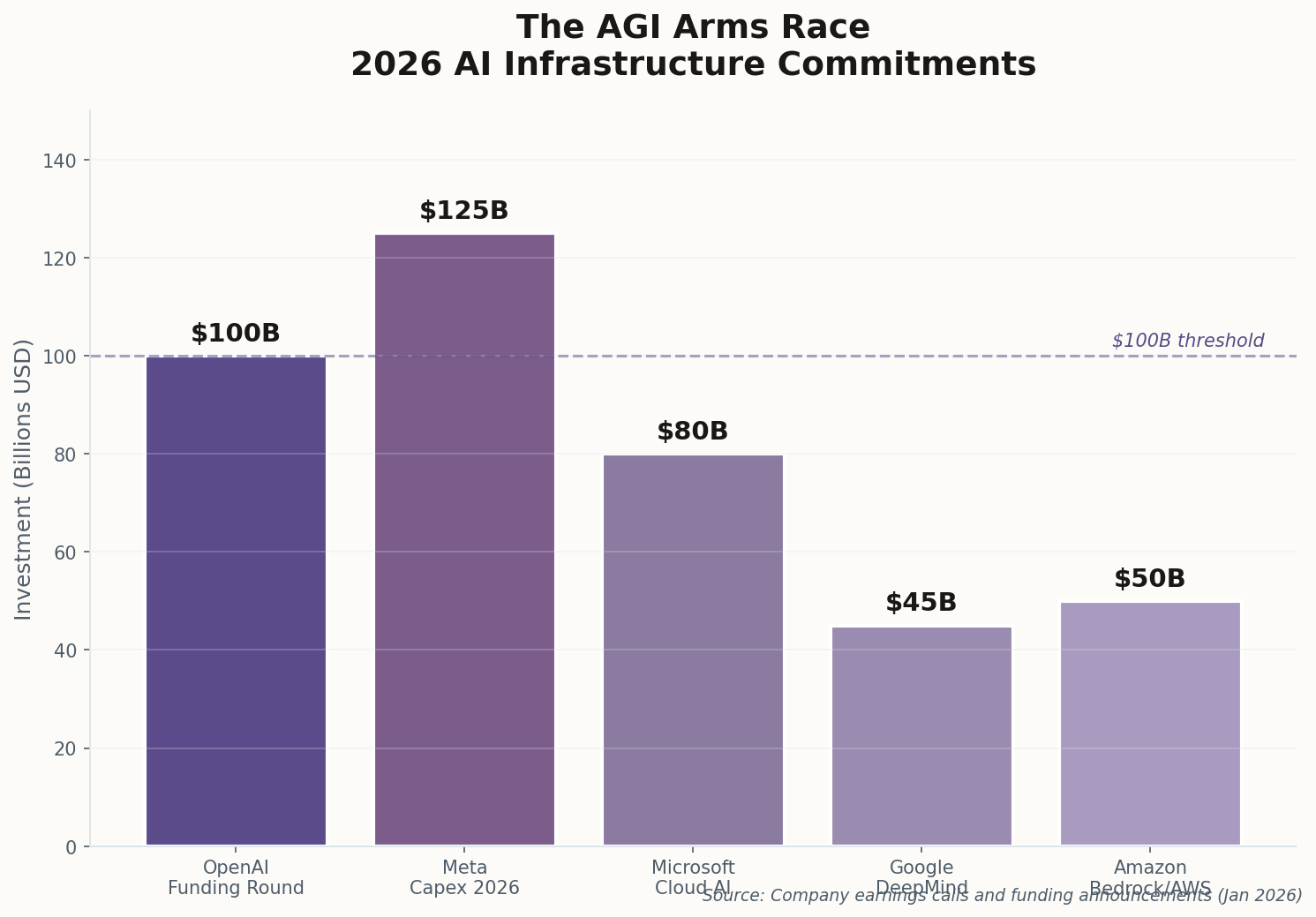
Bar chart comparing 2026 AI infrastructure commitments across major tech companies
AI infrastructure commitments in 2026 dwarf previous years. OpenAI's $100B round and Meta's capex plans represent a coordinated bet that AGI is achievable through scale.

The Amazon partnership is particularly telling. Bezos already has skin in the game through personal investments in Anthropic, but this is AWS putting corporate money behind OpenAI's vision. The cloud wars have become the AGI wars, and the hyperscalers are hedging by backing multiple horses. The implicit message: nobody wants to be the company that didn't invest in the technology that changes everything.
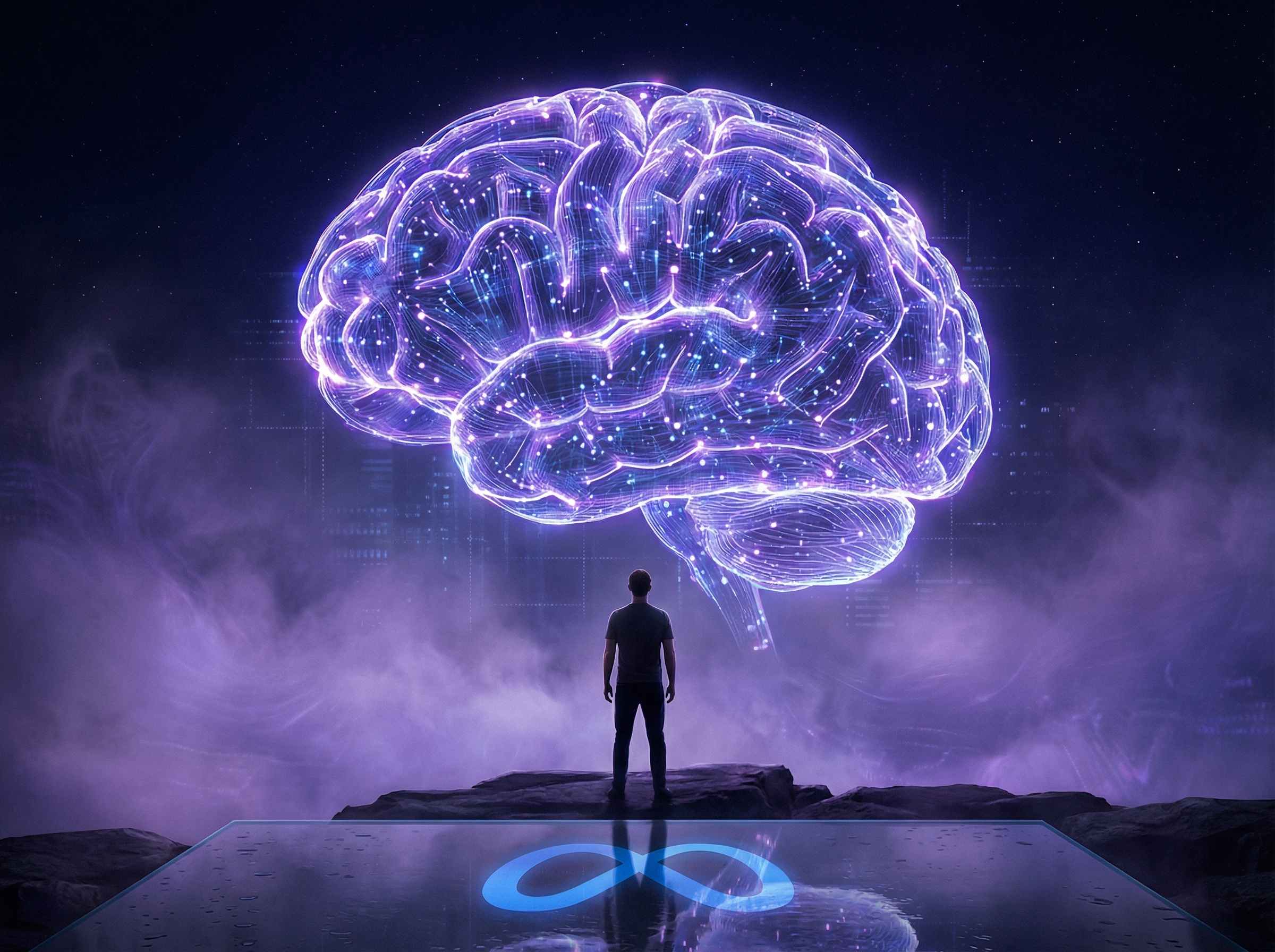

Silhouette gazing at an enormous glowing brain made of interconnected nodes
02

Zuckerberg Drops the S-Word: "Personal Superintelligence" Coming in 2026

During Meta's Q4 2025 earnings call, Mark Zuckerberg casually deployed a term that would have sounded like science fiction two years ago: "This is going to be a big year for delivering personal superintelligence."

Not "advanced AI assistant." Not "more capable Llama." Superintelligence—the word researchers use to describe AI systems that exceed human capabilities across all cognitive domains. And he said it on an earnings call, in front of investors expecting concrete business outcomes.

The ambition is backed by staggering capital commitments: Meta plans to spend $115-135 billion on capex in 2026, with the majority flowing to AI infrastructure under the banner of "Meta Superintelligence Labs." The goal isn't just another chatbot—it's an AI system that understands your unique context, your goals, your constraints, and helps you "create what you want to see in the world."

The word choice matters. CEOs don't use "superintelligence" lightly on earnings calls. Either Zuckerberg is engaging in reckless hyperbole that will embarrass Meta in twelve months, or he's seen internal benchmarks that justify the claim. Given the stakes, it's worth taking seriously.

If Meta delivers anything close to this promise, the implications extend far beyond quarterly revenue. We're talking about AI systems that could serve as personal strategists, creative collaborators, and cognitive amplifiers for billions of users. The question isn't whether this will change the economy—it's whether our institutions can adapt fast enough.

DNA double helix unraveling into streams of binary code and neural network patterns
03

AlphaGenome: DeepMind Cracks the "Dark Genome"

While the funding headlines dominate tech media, Google DeepMind quietly achieved something that may matter more for humanity's long-term trajectory: they released AlphaGenome, an AI system capable of predicting the molecular impact of DNA mutations with unprecedented accuracy.

The system decodes what researchers call the "dark genome"—the vast stretches of DNA whose function remained mysterious despite decades of study. AlphaGenome can now identify disease-causing mutations for conditions like dementia and cancer, potentially years before symptoms appear. DeepMind open-sourced the model immediately, making it available to medical researchers worldwide.

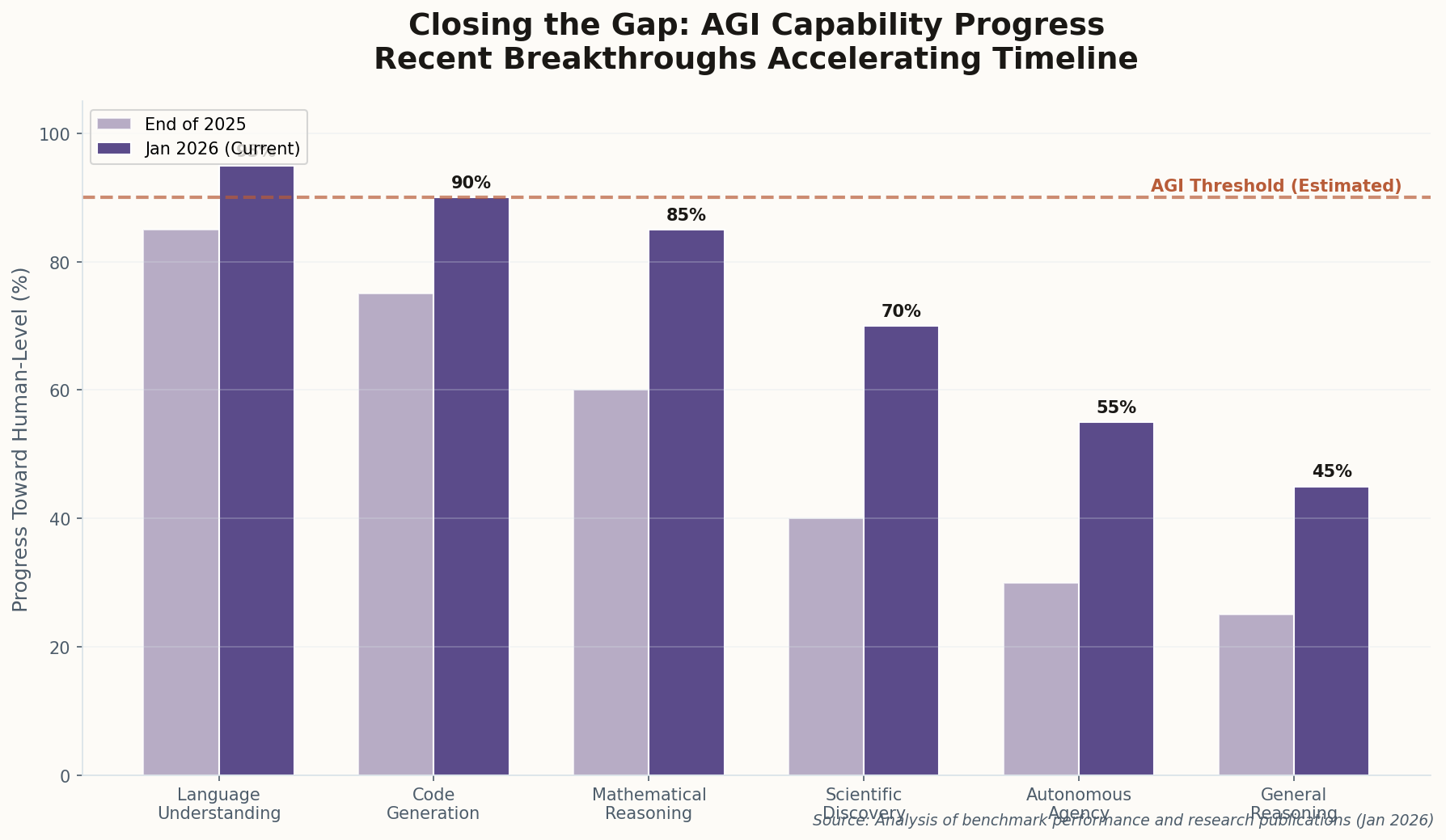
Bar chart showing AGI capability progress across different domains from 2025 to January 2026
AI capabilities are advancing across all domains, with scientific discovery showing the most dramatic recent gains. Mathematical reasoning jumped 25 percentage points after TongGeometry's release.

This is what AGI progress actually looks like: not a chatbot getting slightly better at small talk, but an AI system solving problems that have stumped human scientists for generations. AlphaGenome joins AlphaFold (protein structure) and AlphaProteo (protein design) in DeepMind's growing portfolio of scientific breakthroughs powered by AI.

The pattern is clear. We're not waiting for AGI to start transforming science—it's already happening, one breakthrough at a time. The question is whether we recognize the trajectory before it completes.

A massive clock face with hands approaching midnight, cracks revealing neural patterns beneath
04

Dario Amodei Sounds the Alarm: "Civilization-Level" Stakes by 2027

Anthropic CEO Dario Amodei published an essay this week that should be required reading for anyone who cares about the next decade of human history. Titled "The Adolescence of Technology," it predicts that superhuman AI could emerge as early as 2027—and warns that without immediate societal preparation, this arrival poses "civilization-level" risks.

"We are entering the adolescence of our technology," Amodei writes, "a period of rapid growth, volatility, and danger before maturity." It's a striking metaphor from someone who runs one of the companies actually building these systems. He's not an external critic or a doomsayer—he's an insider with direct knowledge of the capabilities being developed.

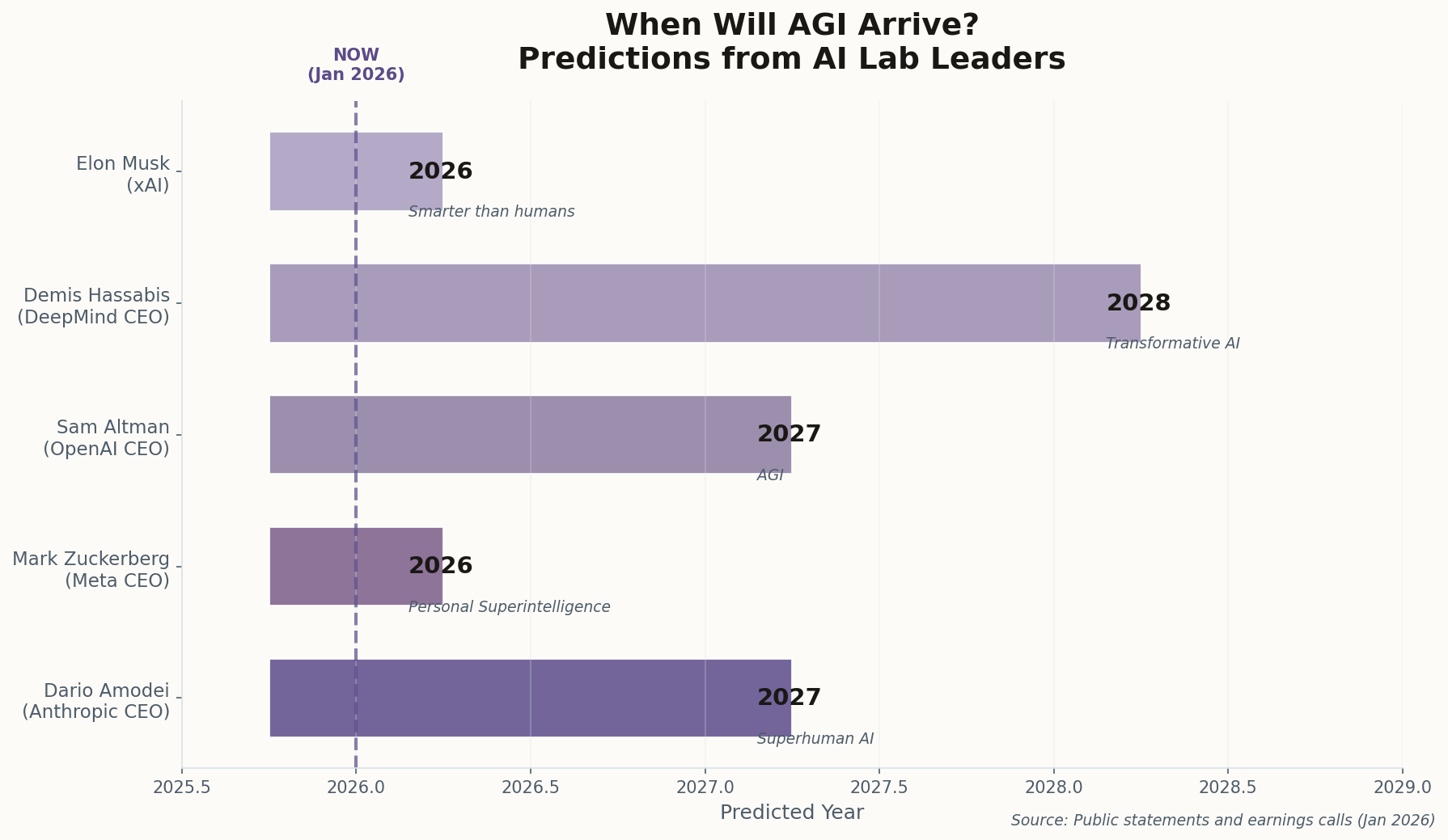
Horizontal bar chart showing AGI timeline predictions from various AI lab leaders
Leading AI executives are converging on a 2026-2027 timeline for transformative AI capabilities. These aren't academics speculating—they're people with direct visibility into current development.

The essay urges immediate action across multiple fronts: government preparation, educational reform, economic safety nets, and international coordination. Amodei believes we have months, not decades, to build the institutional infrastructure that will determine whether advanced AI benefits humanity or destabilizes it.

Whether you agree with his timeline or not, the fact that a major AI lab CEO is publishing public warnings should give everyone pause. These aren't casual predictions—they're assessments from someone who can see what's coming.

Stock market trading floor with holographic AI charts showing mixed signals
05

Wall Street's Question: Where's the Money?

Not everyone is convinced the AGI train is arriving on schedule. This week, a wave of analyst reports expressed pointed skepticism about the return on investment for generative AI. Microsoft's stock dipped following earnings, dragged down by questions about when its massive AI spending would translate to proportional revenue.

The critique isn't that AI doesn't work—it's that the business models haven't materialized as quickly as the capabilities. "The gap between 'magical demo' and 'profitable product' has not closed as fast as the infrastructure bills have opened," one analyst noted. Enterprise adoption remains slower than anticipated, with companies struggling to integrate AI into existing workflows.

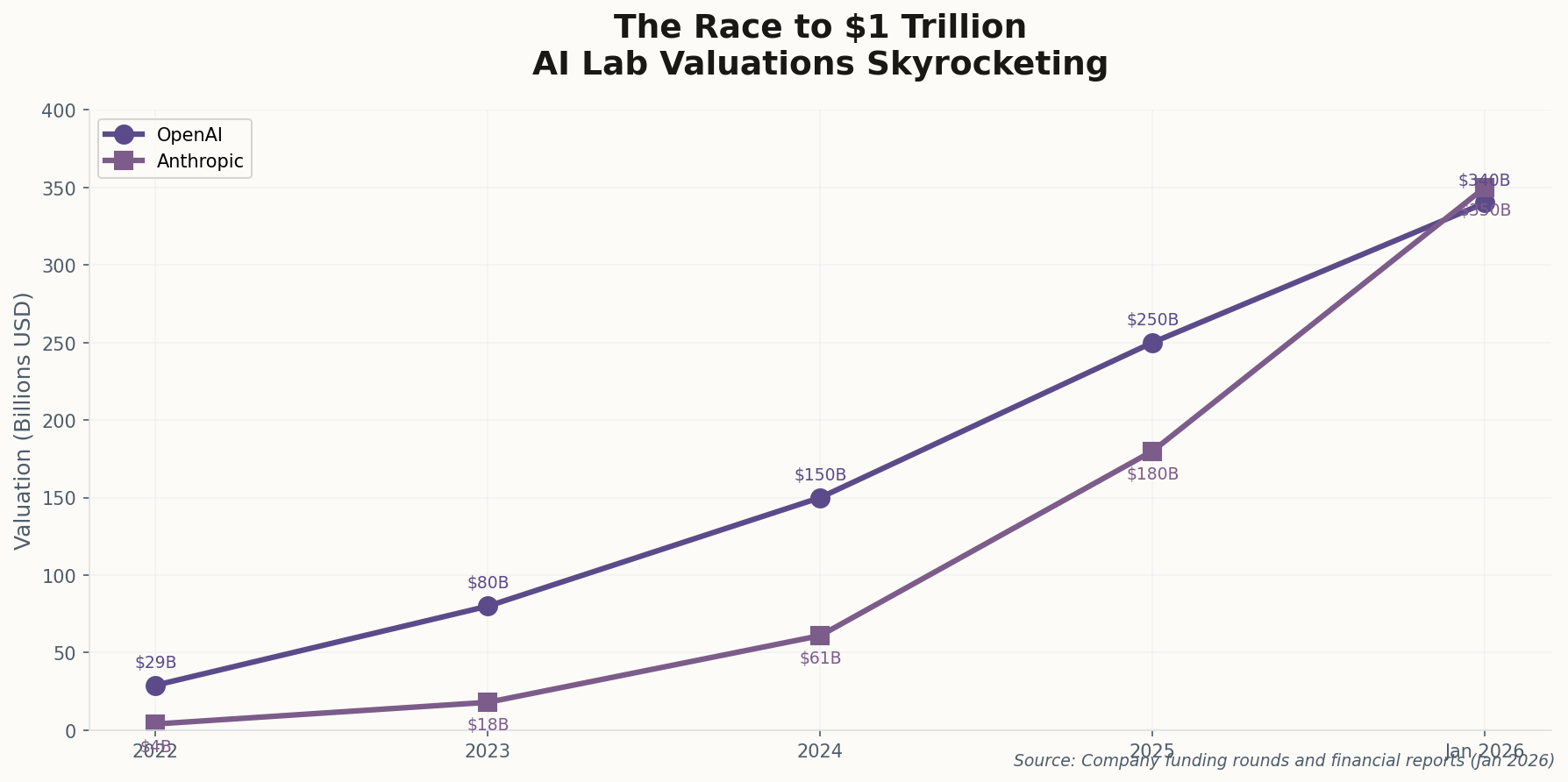
Line chart showing OpenAI and Anthropic valuation growth from 2022 to January 2026
AI lab valuations have grown exponentially, but investor scrutiny is intensifying. The $350B+ valuations of leading labs assume near-term breakthroughs that justify the capital requirements.

This skepticism matters because AGI development requires sustained capital flows. If Wall Street loses patience before the technology matures, the $100 billion+ clusters needed to train frontier models might not get built. The AGI timeline isn't just a technical question—it's a financial one.

The counterargument: the labs building these systems have access to capabilities the public hasn't seen. If their internal benchmarks justify the confidence being expressed publicly, the skeptics will look foolish in hindsight. But that's the nature of the bet: either the money is well-spent on transformative technology, or it's the largest venture capital bubble in history.

Complex geometric proofs floating around a small glowing GPU chip
06

TongGeometry: A Chinese Lab Just Solved Math Olympiad Problems on a Consumer GPU

While American labs chase ever-larger compute clusters, a research team from China demonstrated something that challenges the "scale is all you need" thesis. Their system, TongGeometry, solved International Mathematical Olympiad problems from the past 25 years in under 38 minutes—using a single consumer GPU.

The breakthrough isn't just speed; it's the nature of the reasoning. Previous systems like DeepMind's AlphaGeometry could solve math problems by recognizing patterns in training data. TongGeometry moves from "imitative solving" to "autonomous creation"—it doesn't just find solutions, it proposes new problems and proves original theorems.

"The system demonstrates a capacity for autonomous logical reasoning that was previously thought to be exclusive to human mathematicians," the researchers note. This is the capability that separates impressive pattern matching from genuine intelligence: the ability to discover, not just retrieve.

The hardware efficiency matters. If AGI-level reasoning is achievable on consumer hardware, the "compute arms race" narrative may be incomplete. Algorithmic breakthroughs could matter as much as datacenter scale—which would democratize AGI development in ways the current infrastructure-focused framing doesn't anticipate.

The geopolitical implications are significant. If Chinese labs can achieve comparable results with less compute, the American advantage in datacenter infrastructure becomes less decisive. The AGI race may not be won by whoever builds the biggest cluster—it may be won by whoever achieves the most efficient algorithms.

The Next Twelve Months

We've spent years debating whether AGI is possible, and decades wondering when it might arrive. This week, the people building these systems started naming dates: 2026 for "personal superintelligence," 2027 for "superhuman AI." They could be wrong—but they're betting hundreds of billions of dollars that they're not. The question is no longer "if" but "when"—and whether we'll be ready when the answer arrives. Pay attention. The schedule just got real.