Investigation

The Grift That Keeps On Giving

One year into his second term, Trump has transformed the presidency into a profit center unlike anything in American history. Here's how the money flows.

Listen
Presidential seal transforming into gold coins, symbolizing the monetization of the presidency
01

Trump Media's Wild Ride: From $34 to $10 to... Fusion Energy?
Stock chart volatility visualization with Truth Social branding

Here's a question for the ages: What happens when a social media company with negligible revenue proposes a $6 billion merger with a fusion energy startup? If you're Trump Media & Technology Group, you issue a press release and watch the stock jump.

The numbers tell a brutal story. DJT stock opened Trump's second term at $34.32. By December, it had cratered to $10.51—a 69% decline that would normally signal a company in crisis. But Trump still holds 52.1% of the company, including 36 million "earnout shares" that vest based on stock performance thresholds. The proposed merger with TAE Technologies sent shares rebounding to $14.10, though analysts remain skeptical about the strategic rationale of combining a struggling social network with experimental fusion research.
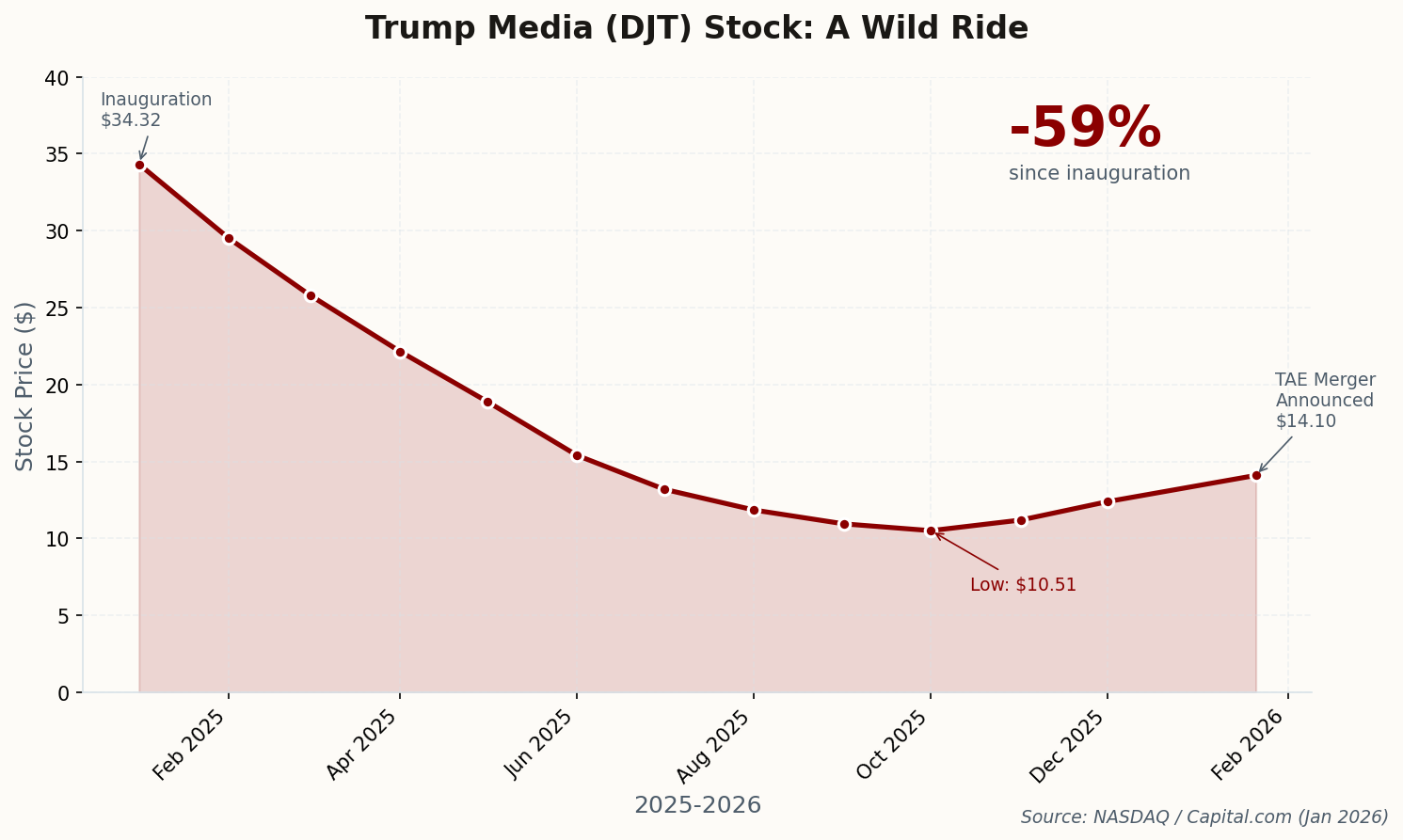
DJT stock price chart showing 59% decline from January 2025 to January 2026
DJT stock fell 59% from inauguration to January 2026, though the TAE merger announcement triggered a partial recovery.

The insider trading data is particularly telling. Corporate insiders sold 1.43 million shares while purchasing 2.05 million in 2025, giving the company a negative "Insider Power Score" of -55.83. In plain English: the people who know the company best aren't exactly betting the farm on its future.

Why it matters: Whether DJT's valuation reflects business fundamentals or simply the betting market on Trump's political fortunes is a question the SEC seems uninterested in asking. The merger proposal, if approved, would value a company with $4 million in quarterly revenue at $6 billion—a multiple that only makes sense if you're pricing in something other than software.
02

$6 Million for a Get-Out-of-Jail Card

Presidential pardon document with price tag, symbolizing pay-to-play clemency

The pardon power is the most absolute authority a president holds. No courts can review it. No appeals are possible. And apparently, no payment is too large.

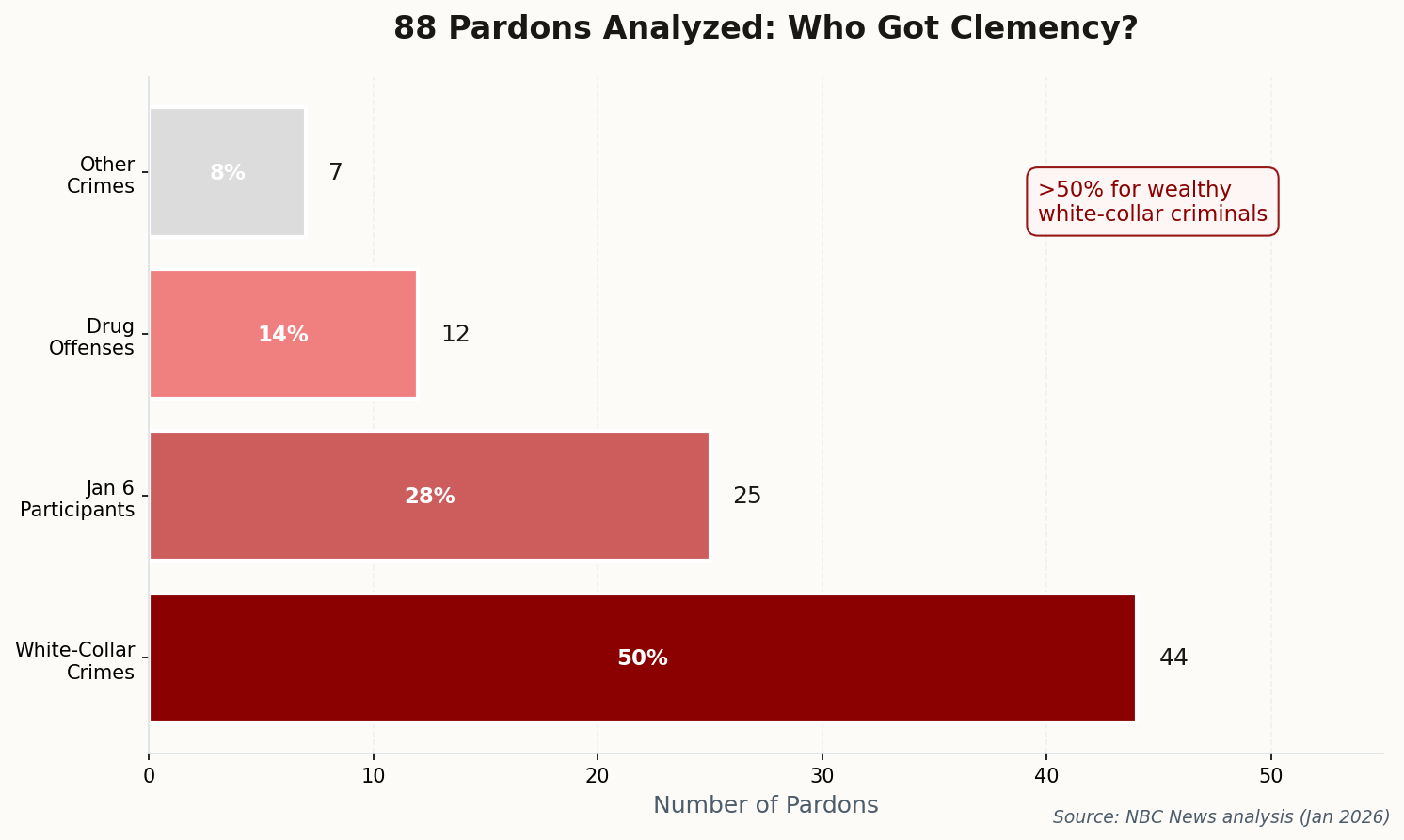
An NBC News analysis of Trump's 88 pardons through January 2026 reveals a striking pattern: over 50% went to wealthy white-collar criminals—money launderers, tax evaders, and fraudsters whose crimes specifically involved extracting wealth from ordinary Americans. The administration created a "Pardon Czar" role in February 2025, explicitly bypassing the Justice Department's Office of the Pardon Attorney, which had traditionally vetted clemency requests.

Horizontal bar chart showing 88 pardons analyzed, with 50% going to white-collar criminals
Analysis of 88 pardons shows a clear preference for wealthy defendants with resources to navigate the unofficial process.

The mechanics are crude but effective. Lobbyists Jacob Wohl and Jack Burkman allegedly accepted $960,000 to lobby for the pardon of Joseph Schwartz, a nursing home operator convicted of fraud—a pardon that was granted on November 14, 2025. Other lobbyists have reportedly charged up to $6 million in "success fees" for securing clemency.

"Lobbyists with access to the West Wing are effectively selling 'get out of jail free' cards." — Former DOJ official

Why it matters: The commercialization of presidential mercy creates a two-tier justice system in the most literal sense: those who can afford lobbyists get clemency; those who can't stay in prison. It's corruption so brazen it barely needs investigation—just accounting.

03

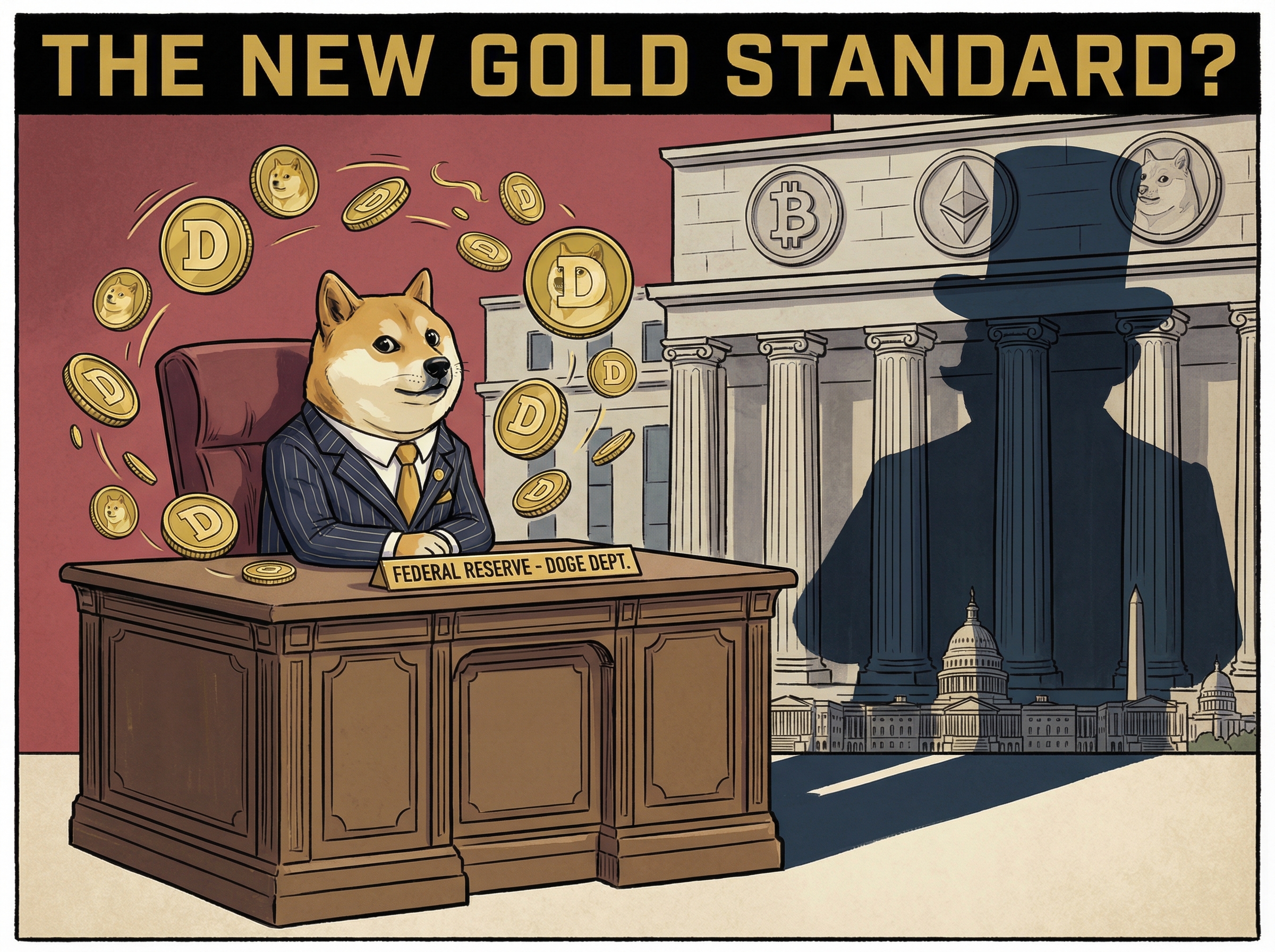
DOGE: When a Government Agency Becomes a Meme Coin Pump

Satirical illustration of Shiba Inu dog in government office with crypto symbols

There's a reason we don't usually name government agencies after cryptocurrency tokens. Elon Musk's "Department of Government Efficiency" was either a spectacular failure of imagination or a deliberate market manipulation scheme. Either way, Dogecoin holders were grateful.

The department's official website featured the Dogecoin logo—a Shiba Inu dog that has become synonymous with speculative crypto gambling. The moment of appointment sent Dogecoin prices spiking, a pattern that repeated each time Musk tweeted about DOGE's "efficiency initiatives." This from a man who donated an estimated $290 million to pro-Trump causes during the 2024 campaign.

Reports have circulated of a "Doge dividend" proposal that would distribute government savings to taxpayers via cryptocurrency wallets—a scheme that would require Americans to create crypto accounts and further entangle federal policy with the volatile digital asset markets where Musk has substantial holdings.

Why it matters: The blurring of lines between federal administration, a major donor's investment portfolio, and speculative meme currencies represents a new frontier in conflict of interest. The acronym itself is now a market mover—a government agency that doubles as a pump signal for retail crypto traders.

04

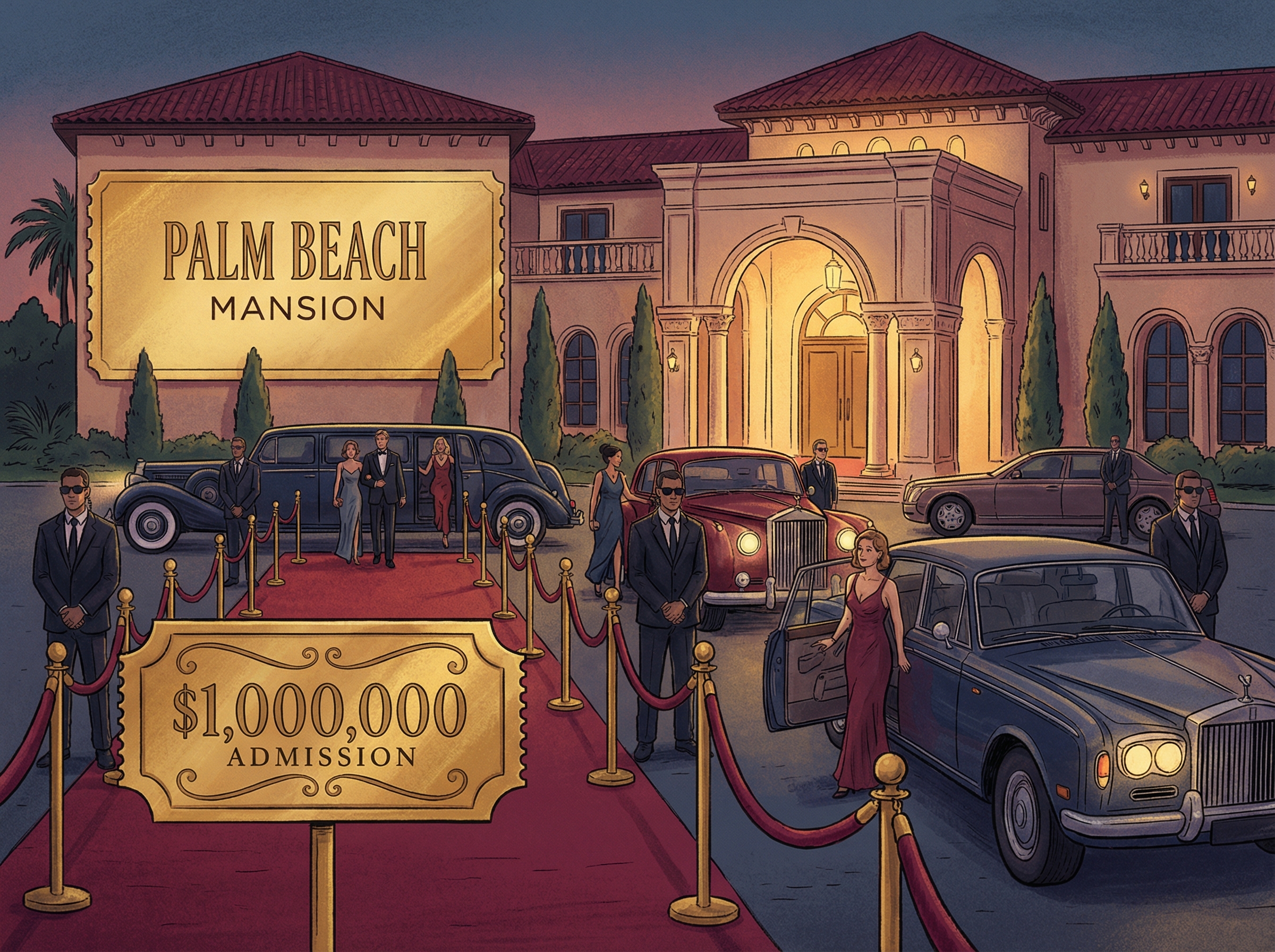
$1 Million to Join the Winter White House

Luxury Palm Beach mansion with velvet rope and million-dollar ticket

Access to the president used to be priceless—or at least, officially free. At Mar-a-Lago, it now costs exactly $1,000,000, with annual dues of $20,000 thereafter.

The fee hike from $700,000 represents a 43% premium on what was already the most expensive club membership in American politics. What do members get for their million? The chance to dine in the same room as the leader of the free world, to whisper policy suggestions over the chocolate cake, to be seen at the intersection of wealth and power.

Meanwhile, taxpayers are footing the bill for the infrastructure that makes this access valuable. The "Big Beautiful Bill" signed in July 2025 allocated $300 million for protecting Trump properties, while the Secret Service issued a $1.8 million purchase order specifically for "security enhancements" at Mar-a-Lago. Luxury real estate prices in Palm Beach have surged accordingly, with new listings near the club reaching $45-97.5 million.

"Membership at the winter White House is now a seven-figure investment." — Club observer

Why it matters: The transaction is elegant in its directness. Public money improves the property; private fees capture the value. The president's business profits from his presidency, with taxpayers subsidizing the security that makes membership desirable.

05

$650 a Night: The Taxpayer Tab at Trump Properties

When the president travels to his own properties, the Secret Service travels with him. And when the Secret Service needs rooms, they pay whatever the president's company charges.

According to Citizens for Ethics analysis, the Secret Service has been charged up to $650 per night for rooms at Mar-a-Lago and $17,000 per month for cottages at Bedminster. These rates are sometimes five times the normal government per diem, with total spending at Trump properties exceeding records set during his first term.

The $300 million allocation from the "Big Beautiful Bill" has only accelerated the flow. Trump-partnered projects in Indonesia and India have proceeded despite regulatory concerns, with partners openly leveraging their connection to the U.S. President in marketing materials.

Why it matters: This is the cleanest grift in the portfolio—a direct transfer of taxpayer funds to the president's personal business accounts, with no middleman and no pretense of arms-length dealing. Every presidential golf weekend is a revenue event.

06

$2 Trillion in Foreign Money: The Emoluments Nightmare

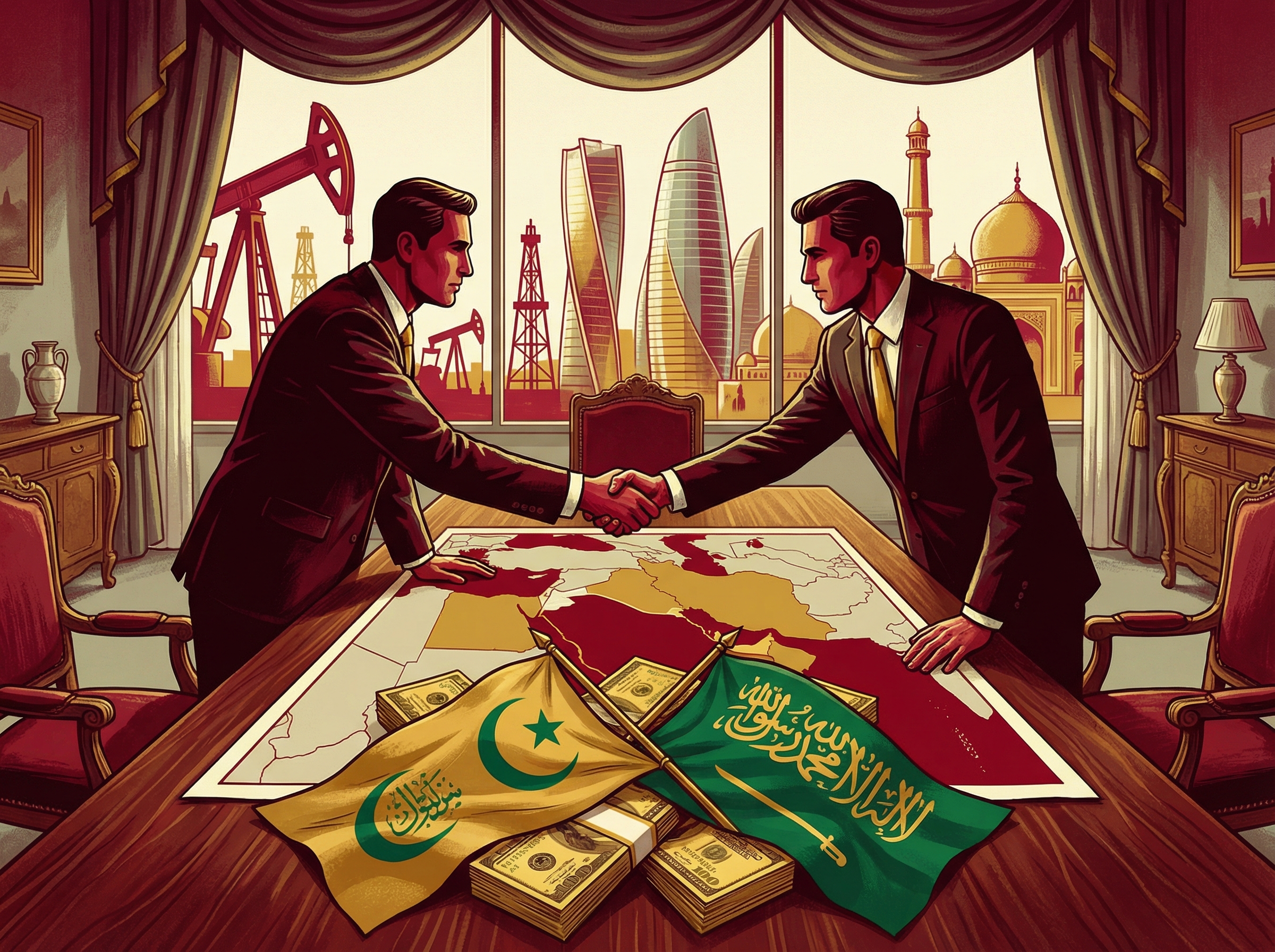
Golden handshake over Middle East map with currency flowing

The Constitution's Foreign Emoluments Clause was written to prevent exactly this scenario: a president whose personal financial interests could be leveraged by foreign powers. In May 2025, that clause met the Gulf Cooperation Council.

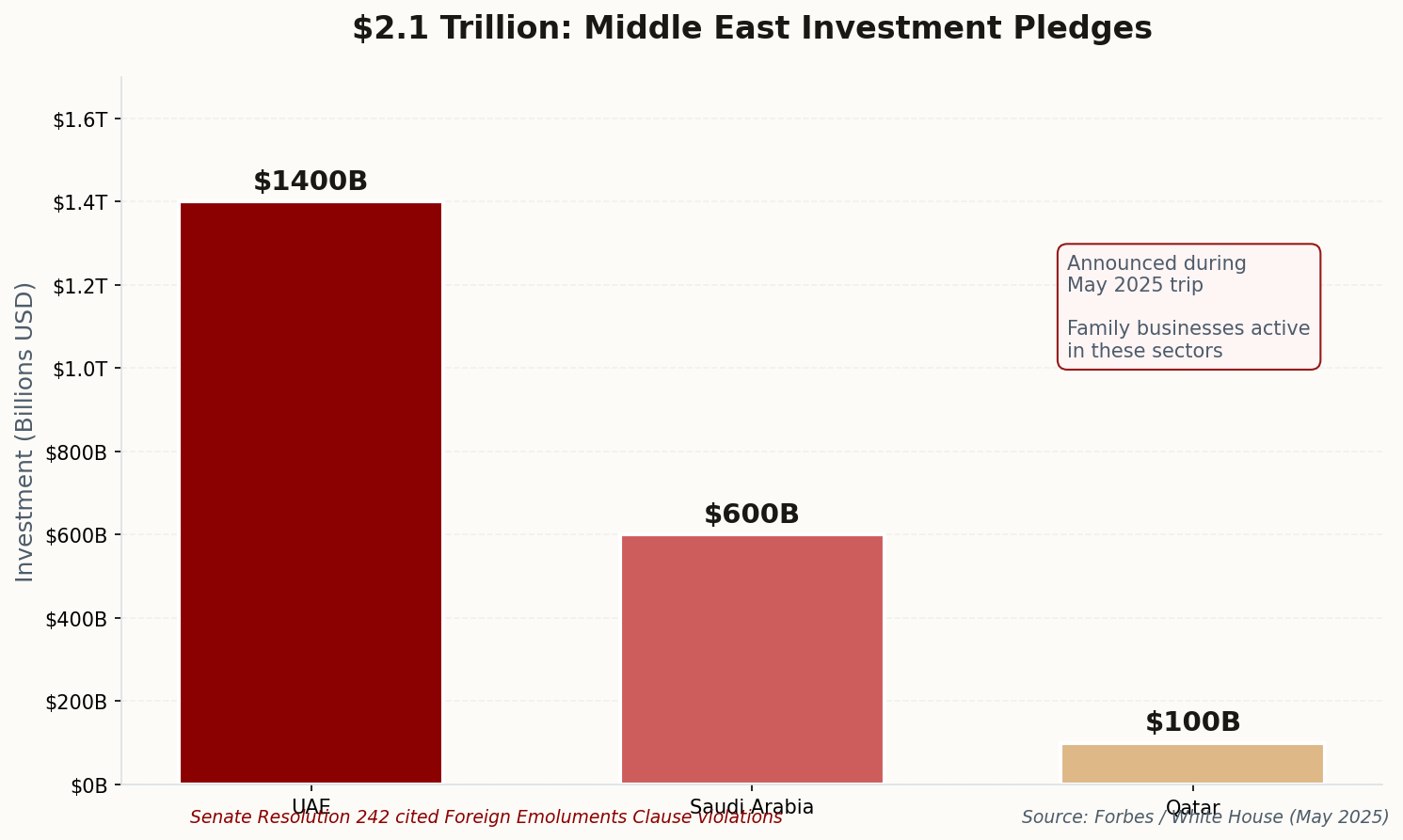
During his Middle East trip, Trump announced investment agreements totaling over $2 trillion. Saudi Arabia pledged an initial $600 billion; the UAE committed to $1.4 trillion. The deals cover AI infrastructure, energy, and aerospace—precisely the sectors where Trump family businesses, including son-in-law Jared Kushner's Affinity Partners, are actively investing.

Bar chart showing $2.1 trillion in Middle East investment pledges from UAE, Saudi Arabia, and Qatar
The May 2025 Middle East trip produced investment pledges exceeding $2 trillion, prompting Senate emoluments concerns.

Senate Resolution 242 was introduced to condemn these agreements as violations of the Foreign Emoluments Clause—though with Republicans controlling the chamber, the resolution went nowhere. A Forbes headline captured it perfectly: "A business-first foreign policy that intertwines national interests with private equity."

Why it matters: When foreign governments pledge trillions in investments to sectors where the president's family has business interests, foreign policy becomes a subsidiary of the family office. The leverage this creates—the implicit ability for Saudi Arabia or the UAE to threaten disinvestment if U.S. policy displeases them—is precisely what the founders tried to prevent.

07

$TRUMP Coin: When the President Becomes a Meme Stock

Golden meme coin with presidential portrait above smartphone showing crypto wallet

Three days before his inauguration, Donald Trump launched an official cryptocurrency. Let that sink in: a sitting president-elect, with full knowledge of what policies he would pursue, created a speculative digital asset that he personally profits from.

The $TRUMP meme coin launched on the Solana blockchain on January 17, 2025. Of the one billion total tokens, 800 million (80%) are held by Trump-affiliated entities—CIC Digital LLC and Fight Fight Fight LLC—with a three-year vesting schedule. Trump himself called it "the only official Trump meme" on Truth Social.

The family hasn't stopped there. World Liberty Financial, co-founded with sons Don Jr. and Eric, launched the USD1 stablecoin in March 2025. In January 2026, the venture applied to the Office of the Comptroller of the Currency to form a "trust bank" to manage stablecoin reserves—essentially seeking federal approval for a Trump-branded bank.

Why it matters: The president has created multiple financial instruments whose value directly correlates with his political success. Every policy decision, every tweet, every public statement now moves markets that enrich his family. The conflicts of interest aren't hidden—they're the business model.

The Sum of the Parts

Crypto coins, pardon fees, membership dues, government contracts, foreign investments, family deals. Each revenue stream flows to the same destination. The presidency hasn't been captured by business interests—it has become a business interest. And unlike any business you've ever seen, this one has the power to write its own regulations, appoint its own judges, and pardon its own associates. The question isn't whether this is corruption. The question is whether anyone with power to stop it has the will to try.