Constitutional Law

The Corruption Clause They Couldn't Enforce

The Founders wrote two provisions to prevent foreign and domestic bribery of the President. 237 years later, we still don't know if they work.

Listen
Scales of justice against constitutional parchment with foreign crowns and gold coins
01

$800 Million and Counting: The Crypto Test Case

Cryptocurrency coins with American eagle emblems floating above government buildings

Here's a thought experiment: What if a sitting president launched a cryptocurrency, and foreign nationals—including those connected to foreign governments—bought hundreds of millions of dollars worth within weeks of inauguration?

That's not hypothetical. According to a House Judiciary Committee report from late 2025, the Trump family's crypto ventures—including the $TRUMP and $MELANIA meme coins and a stake in World Liberty Financial—generated over $800 million in the first half of 2025 alone. Senators Jeff Merkley and Elizabeth Warren have called out a specific deal involving an Emirati investment firm and Binance as a "staggering conflict of interest."
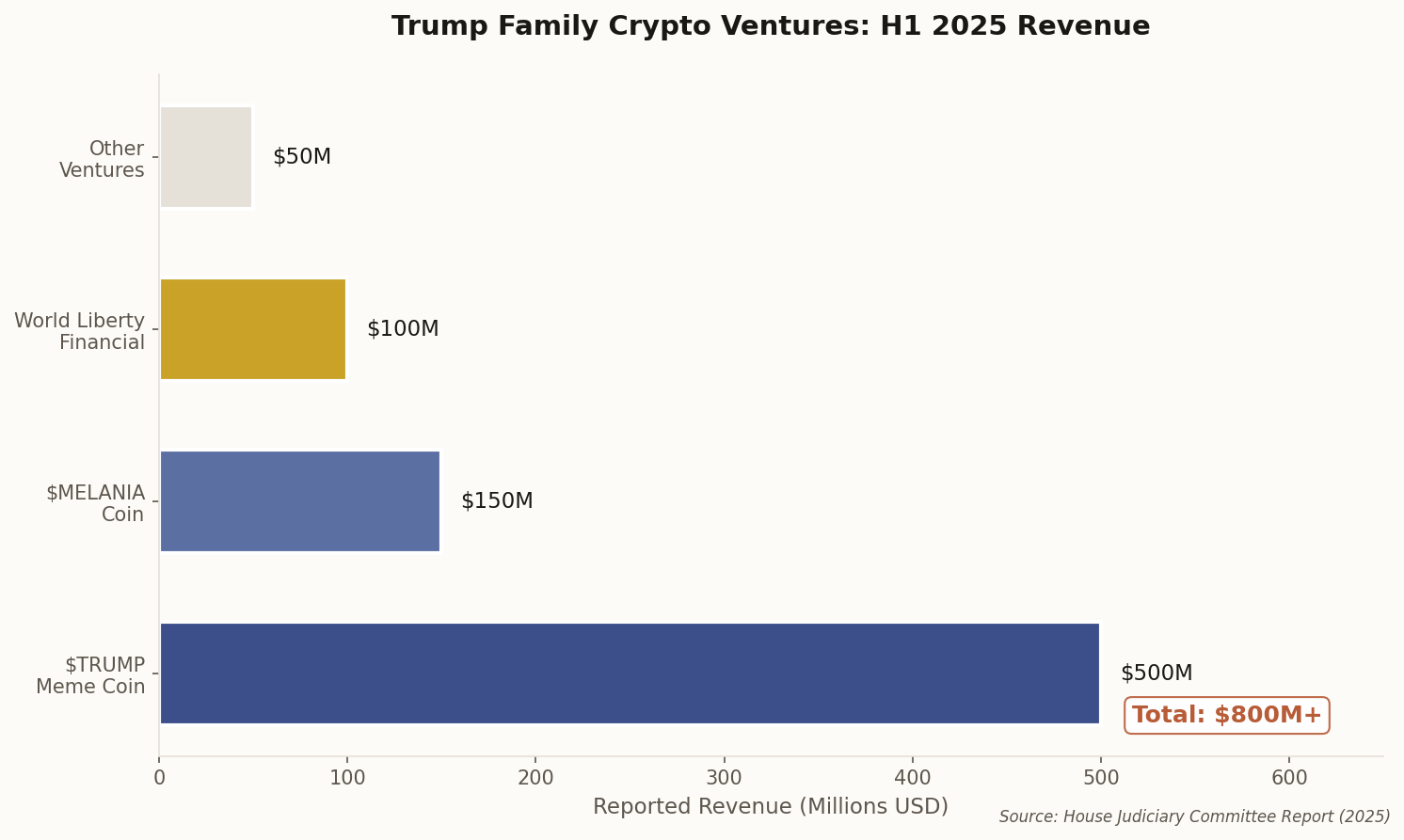
Bar chart showing Trump family crypto venture revenues in H1 2025
Reported revenues from Trump family cryptocurrency ventures, first half of 2025. Source: House Judiciary Committee.

The legal question is straightforward: Does money flowing from foreign sources to a president's business ventures constitute a prohibited "emolument" under the Constitution? The practical question is harder: Who can actually enforce these constitutional provisions, and what happens if nobody can?

To understand why this remains unresolved after 237 years, we need to start with what the Founders actually wrote—and what they were afraid of.

02

The Text: Two Clauses, Two Different Problems

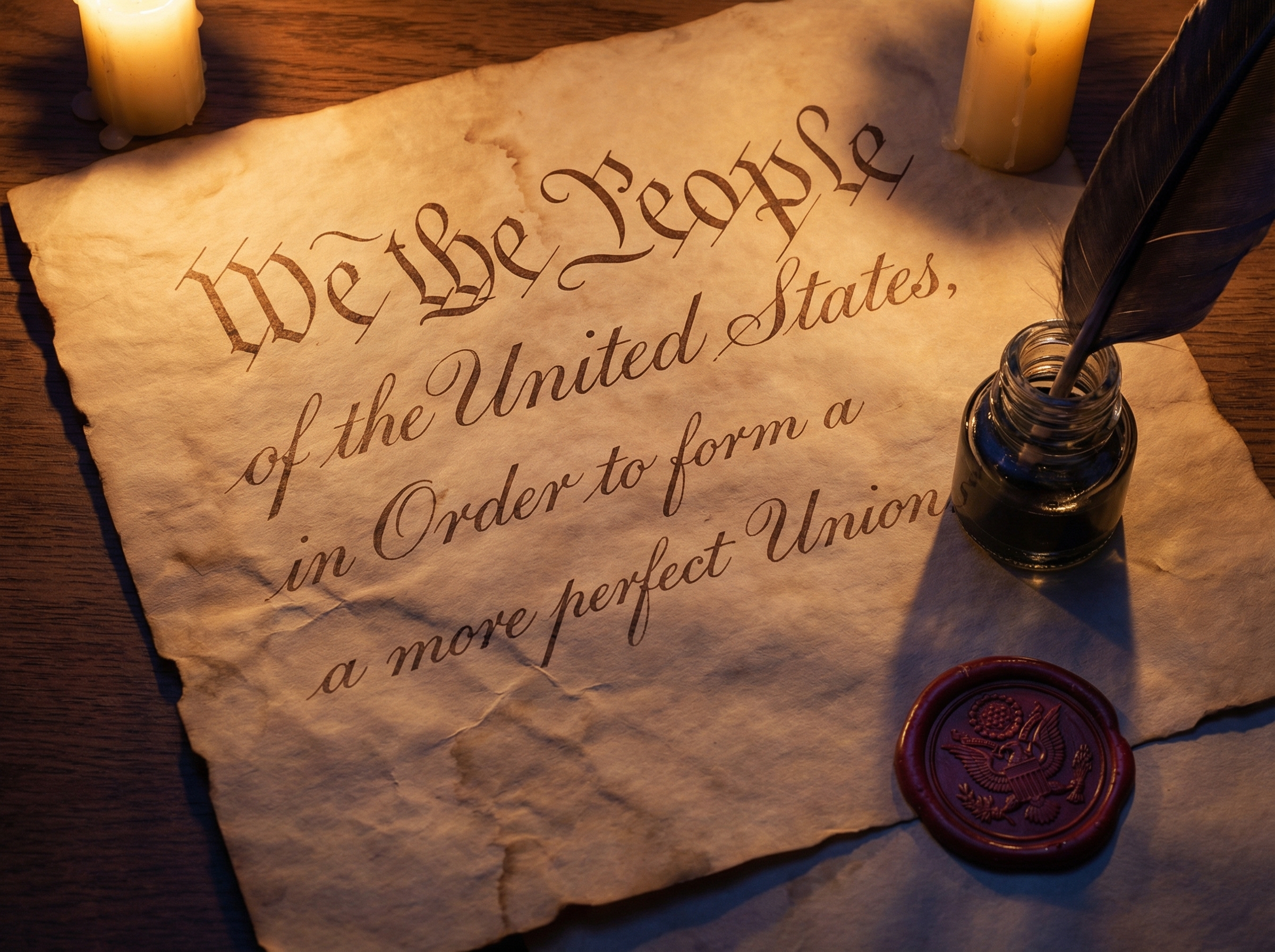
Aged constitutional parchment with elegant 18th century calligraphy

The Constitution contains not one but two Emoluments Clauses, and they solve different problems.

"No Person holding any Office of Profit or Trust under [the United States], shall, without the Consent of the Congress, accept of any present, Emolument, Office, or Title, of any kind whatever, from any King, Prince, or foreign State."

— Article I, Section 9, Clause 8 (Foreign Emoluments Clause)

The Foreign Emoluments Clause applies to all federal officials, including the President. It prohibits accepting anything of value from foreign governments—unless Congress explicitly consents. The Founders, having watched European republics corrupted by foreign gold, wanted to firewall American officials from external influence.

"The President shall, at stated Times, receive for his Services, a Compensation, which shall neither be encreased nor diminished during the Period for which he shall have been elected, and he shall not receive within that Period any other Emolument from the United States, or any of them."

— Article II, Section 1, Clause 7 (Domestic Emoluments Clause)

The Domestic Emoluments Clause applies only to the President and is absolute—no Congressional waiver possible. It prevents Congress or individual states from financially manipulating the executive through rewards or punishments. The President's salary is fixed. That's it. No bonuses from grateful governors, no "consulting fees" from federal agencies.

Federalist No. 22: Alexander Hamilton warned that republics were uniquely vulnerable to "foreign corruption" and that foreign powers would inevitably try to gain "an improper ascendant in our councils." The clauses were designed to make that structurally impossible.

03

What Exactly Is an "Emolument"?

Split composition showing American map and globe with foreign nations

This is where constitutional law meets dictionary definitions—and where the fights begin.

The word "emolument" comes from the Latin emolumentum, meaning "profit" or "gain." Historically, it's been interpreted broadly: any profit, gain, benefit, or advantage arising from employment or position. It's not limited to salary. The Department of Justice Office of Legal Counsel has, over decades, interpreted the term to include gifts, honors, and anything of economic value.

But here's the contested question that courts have never definitively answered: Does it include market-rate business transactions?

Consider: A foreign diplomat stays at a hotel owned by the President and pays the going rate. Is that an "emolument"? One view says yes—any money flowing from a foreign government to a president's pocket is the problem the clause addresses, regardless of whether fair value was exchanged. The opposing view says no—an emolument requires something beyond market value, an actual gift or benefit.

The Trump-era lawsuits raised this question directly. The answer? We still don't have one. Every major case was dismissed on procedural grounds before courts ruled on the merits.

04

From Washington's Gifts to Carter's Peanuts

Line of presidential silhouettes from Washington to modern era

For most of American history, the Emoluments Clauses operated through norms rather than litigation. Presidents simply avoided conflicts—or at least maintained the appearance of avoiding them.

George Washington set the template. When foreign allies sent gifts, he either kept them as state property or sought Congressional guidance. He purchased land publicly, ensuring no perception of special treatment. Thomas Jefferson followed suit, reporting foreign gifts to Congress and awaiting instruction.

The modern standard-setter was Jimmy Carter. In 1977, Carter placed his peanut farm—the family business—into a genuinely blind trust managed by an independent trustee. He had no information about its operations during his presidency. The farm actually lost money while he was in office. Carter's approach became the gold standard for presidential ethics, though it was never legally required.

Lyndon Johnson took a different path. His family's radio station (KTBC) grew significantly more profitable during his political career, raising questions about regulatory favoritism. He placed assets in a trust, but critics noted he knew exactly what was in it—hardly "blind."

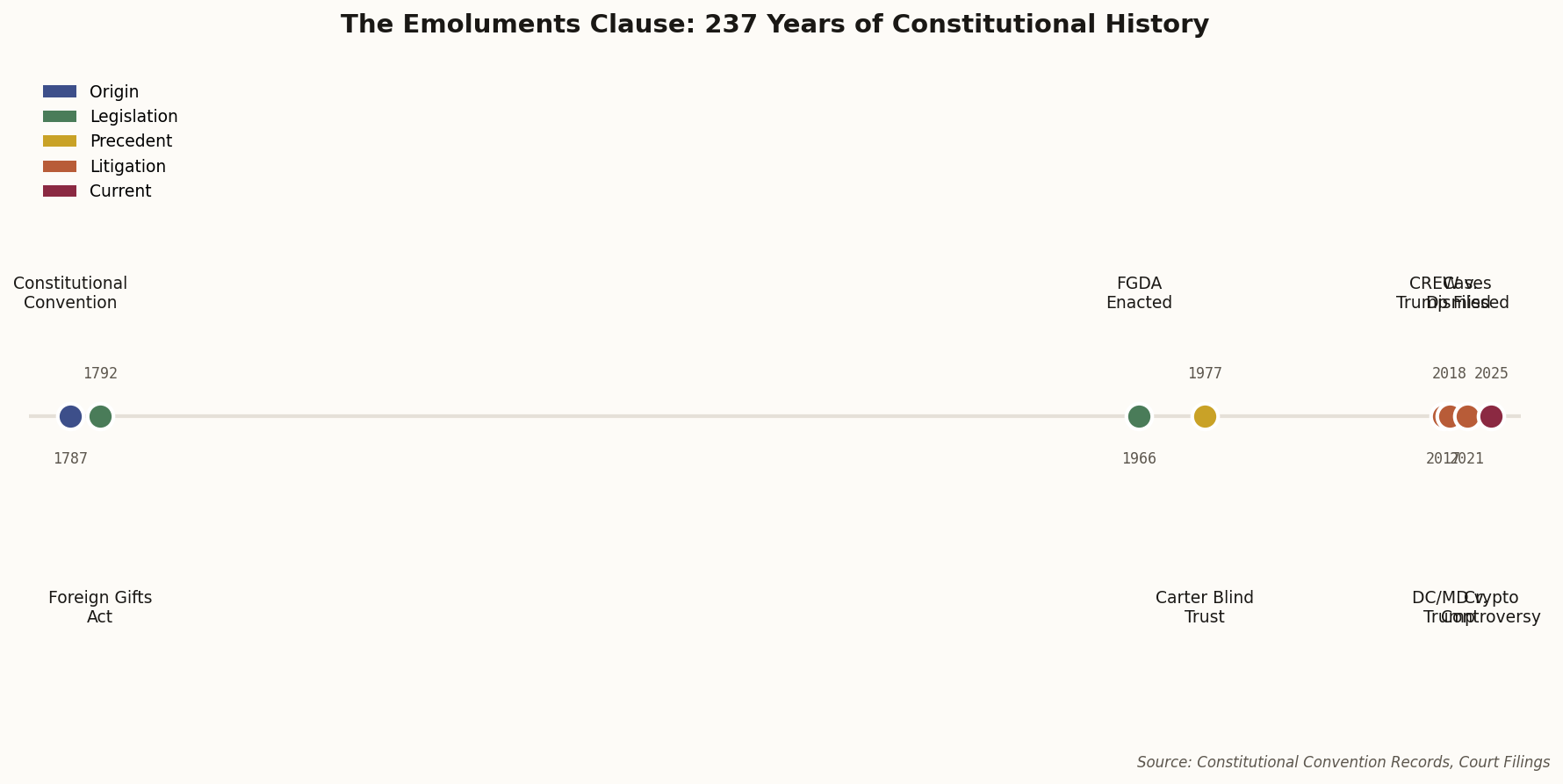
Timeline of major emoluments events from 1787 to 2026
Key moments in Emoluments Clause history, from constitutional ratification to current cryptocurrency controversies.

The pattern: Presidents either divested, created blind trusts, or accepted reputational costs for not doing so. But until 2017, nobody seriously litigated the question. The norms held without judicial enforcement.

05

The Cases That Never Decided Anything

Courthouse pillars with scattered legal documents and hotel silhouette

Donald Trump's decision to retain ownership of his business empire—including the Trump International Hotel in Washington, D.C.—triggered an unprecedented wave of Emoluments Clause litigation. Three major cases were filed:

CREW v. Trump: Citizens for Responsibility and Ethics in Washington alleged that payments from foreign diplomats for hotel stays violated the Foreign Emoluments Clause. The case advanced further than many expected, with discovery ordered before it was ultimately dismissed.

DC and Maryland v. Trump: The attorneys general of Washington, D.C. and Maryland argued that Trump's hotel ownership created unfair competition against local businesses (a domestic emoluments theory) and that he received prohibited foreign payments. This case also made significant procedural progress.

Blumenthal v. Trump: Over 200 members of Congress sued, arguing they had standing because Trump denied them their constitutional right to vote on whether to consent to foreign emoluments.

The outcomes were uniformly frustrating for those seeking legal clarity:

In January 2021, the Supreme Court vacated lower court rulings in CREW and DC/Maryland, ordering the cases dismissed as moot—Trump was no longer in office. This wiped away the favorable precedents plaintiffs had won. In Blumenthal, the D.C. Circuit ruled that individual members of Congress lacked standing; only Congress as an institution could sue.

The bottom line: After four years and millions of dollars in litigation, courts never ruled on the core question: Does a president's private business profit from foreign or state governments constitute a prohibited emolument?

06

A Constitutional Provision Nobody Can Enforce

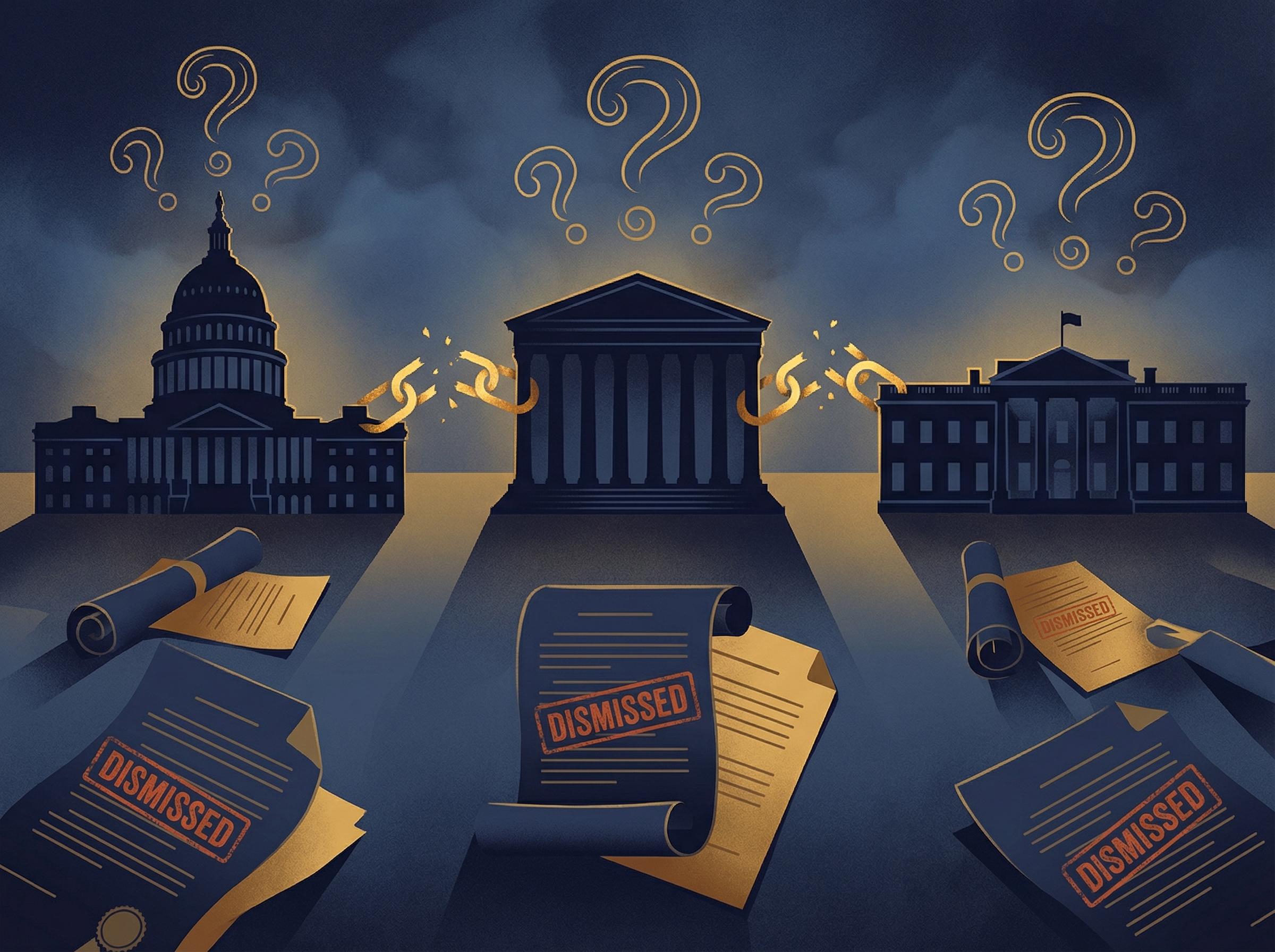
Broken chain links between three branches of government

The Emoluments Clauses may be the Constitution's most elegant anti-corruption provisions. They're also, arguably, unenforceable—at least through the courts.

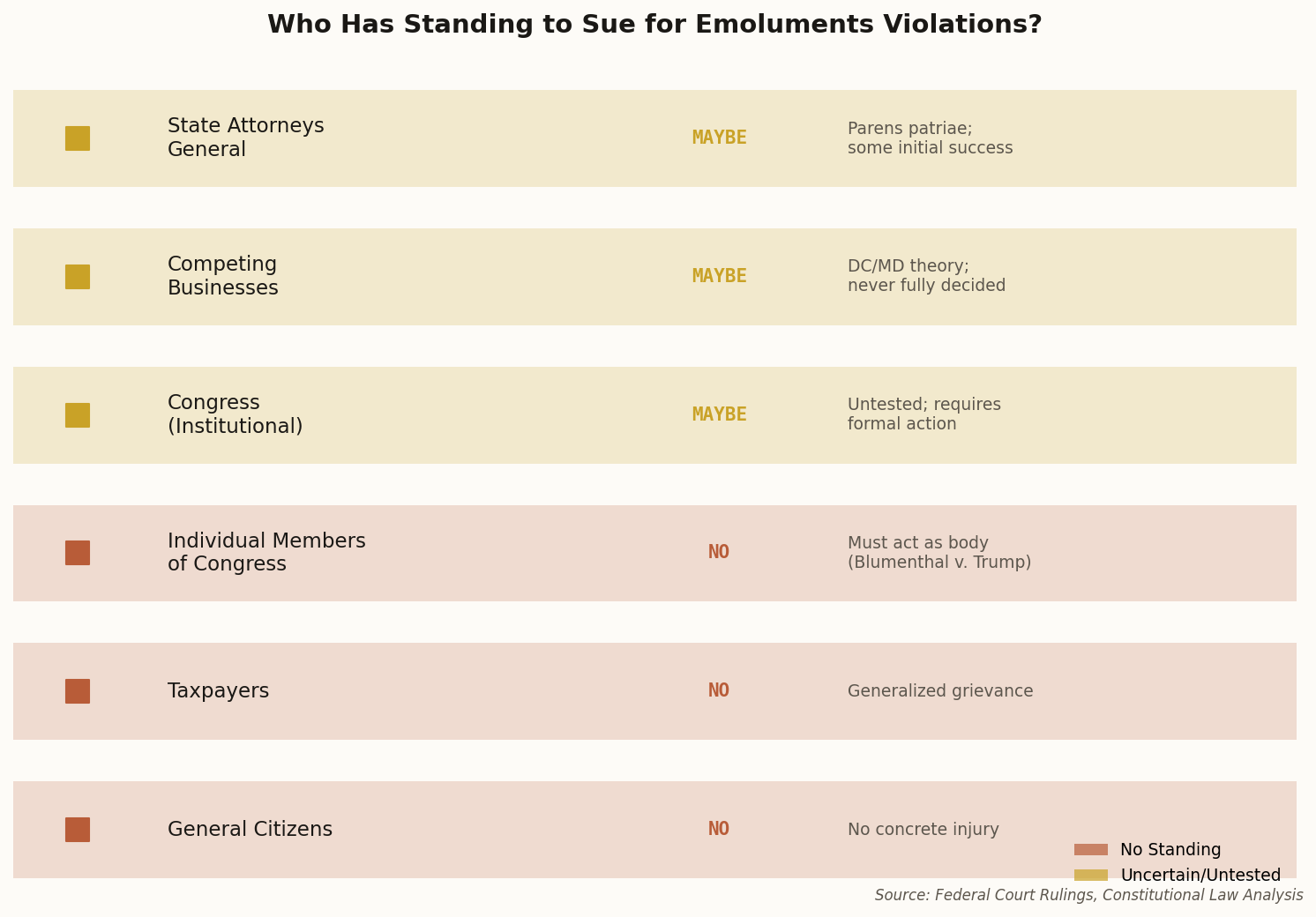
The standing problem: Federal courts require plaintiffs to show specific, concrete injury. General citizens and taxpayers don't qualify—their injury is too diffuse. Competitors might have standing (the DC/Maryland theory), but that's never been definitively tested. Individual members of Congress lack standing to vindicate institutional interests.

Chart showing who can and cannot sue for emoluments violations
The standing puzzle: Most potential plaintiffs lack the legal injury required to bring suit.

Congressional options: Congress could consent to foreign emoluments (making them constitutional) or refuse consent (making them violations). Congress could also pass legislation codifying enforcement mechanisms. In 2025, the Brennan Center published a report arguing for exactly this: a federal statute explicitly defining "emolument" to include commercial transactions and granting Congress clear standing to sue.

The ultimate remedy: Most constitutional scholars agree that the primary enforcement mechanism for Emoluments Clause violations is political, not judicial: impeachment. The House can impeach for "high crimes and misdemeanors," which the Founders understood to include corruption and abuse of power. But impeachment requires a majority in the House and a two-thirds supermajority in the Senate—a bar that's been cleared exactly zero times in American history for conviction.

The irony is sharp: The Founders wrote provisions specifically to prevent foreign corruption of the presidency, then created a system where enforcing those provisions requires the very political consensus that corruption tends to undermine.

07

The Questions Courts Never Answered

Open book with question marks rising like smoke, scales of justice in background

After the Trump-era litigation and the current cryptocurrency controversies, we're left with a remarkable list of unanswered constitutional questions:

Does "emolument" include fair-value business transactions? If a foreign government books 100 hotel rooms at market rate, is that constitutionally different from a direct cash payment? The Office of Legal Counsel has historically said yes, but courts haven't ruled.

What counts as a "foreign State"? Obviously, an ambassador represents a foreign state. But what about a sovereign wealth fund? A state-owned enterprise? A cryptocurrency exchange with ties to foreign governments? The boundaries are genuinely unclear.

Must a president divest all business interests? Carter's blind trust was voluntary, not constitutionally required. Is there a constitutional obligation to sell assets, or just to not receive prohibited payments? Nobody knows.

Can indirect benefits violate the clause? If a foreign government rents office space in a building owned by a trust that benefits the president's family, is that different from a direct payment to the president? What about buying cryptocurrency that enriches the president's relatives?

The 2025 S.Res. 219 and S.Res. 242 attempted to address some of these questions through Senate resolutions—condemning certain business arrangements and directing legal action. Both remain stalled in committee.

The pattern is consistent: When Emoluments Clause questions arise, they get litigated until they become moot, legislated until they stall, or debated until the political moment passes. The Constitution's anti-corruption provisions remain powerful in theory and largely untested in practice.

The Test That's Always Coming

The Emoluments Clauses embody a clear Founding principle: American officials should be immune to foreign influence and domestic manipulation. But 237 years of deference, norm-following, and procedural dismissals have left us without a working enforcement mechanism. Each new controversy—from hotels to cryptocurrencies—asks the same unanswered question: Who guards the guardians? Until courts rule on the merits, or Congress acts, or a supermajority convicts, we're left with a constitutional provision that describes what shouldn't happen but can't stop it from happening.