Precious Metals

The Markets Are Screaming

Gold swings $400 in a single session. Silver nearly triples in twelve months. This isn't normal price discovery—it's a market losing its mind.

Listen
Gold bars and silver coins caught in turbulent market waves
01

Gold's $400 Rollercoaster: Blow-Off Top or Just Getting Started?

Gold bars fracturing with price volatility

In the early hours of Asian trading, gold did something extraordinary: it ripped from $5,500 to nearly $5,600 in minutes, then crashed $400 in what traders described as "rapid and disorderly." The metal now sits below $5,200, having given back weeks of gains in a single session.

This kind of intraday violence has a name: blow-off top. It's what happens when a parabolic move—gold has nearly doubled in twelve months—finally exhausts the last wave of momentum buyers. The question isn't whether this is volatility. The question is whether it's the end or merely a pause before the next leg.
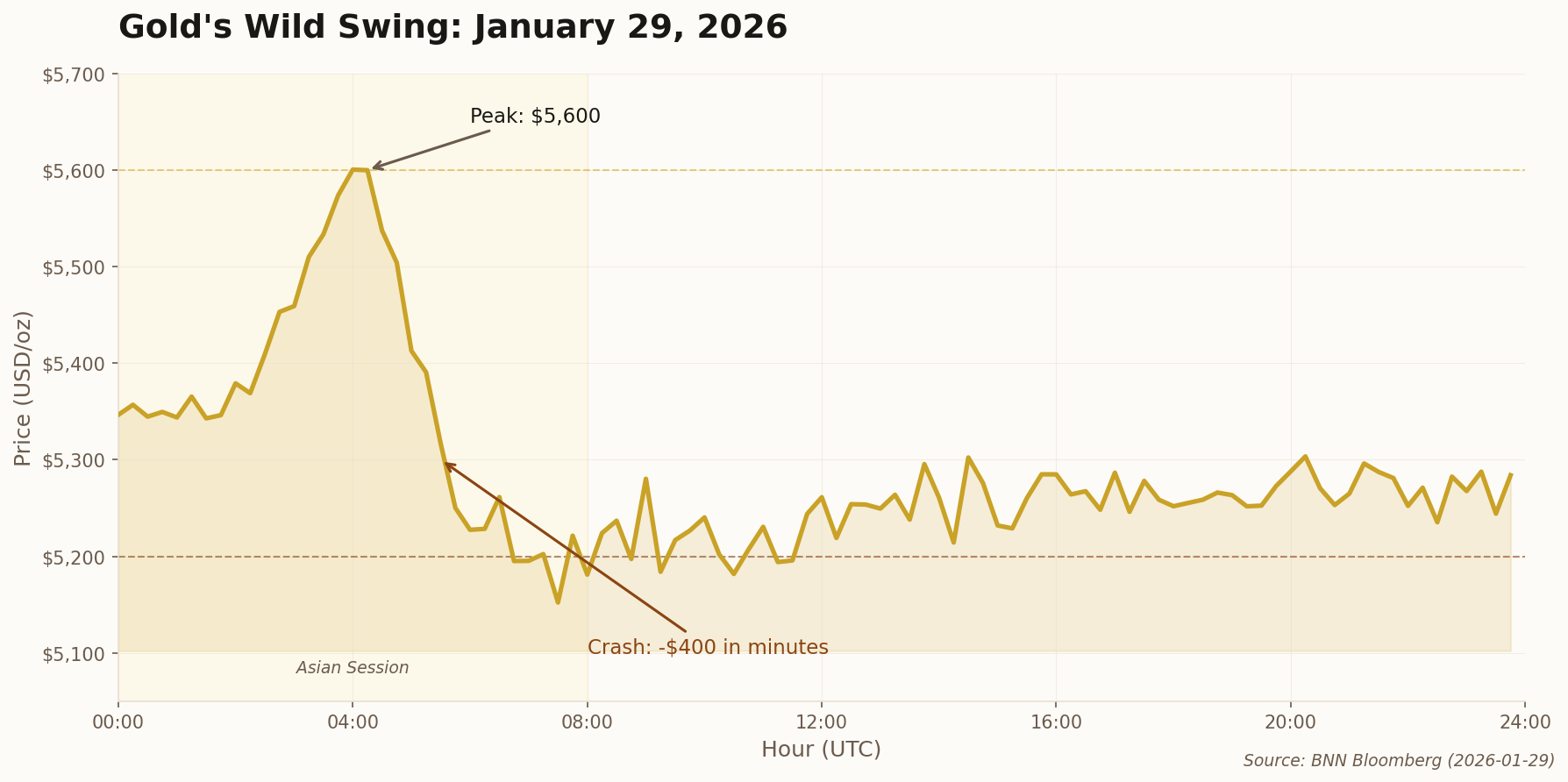
Gold price intraday chart showing $5600 spike and crash
Gold's wild swing on January 29, 2026: a $400 reversal in hours.

The fundamentals remain unchanged: central banks are still buying. World Gold Council data shows sovereign purchases running at near-record pace, driven by diversification away from dollar reserves. Safe-haven demand amid geopolitical uncertainty hasn't evaporated. But technical traders see a market that's overshot, and profit-taking at these levels is entirely rational.

Watch the $5,000 level. If gold can hold there, this is consolidation before the next move higher. If it breaks, the air below is thin.

02

Silver's Perfect Storm: 298% Gains and Bubble Warnings

Silver coins stacked with solar panels and AI servers

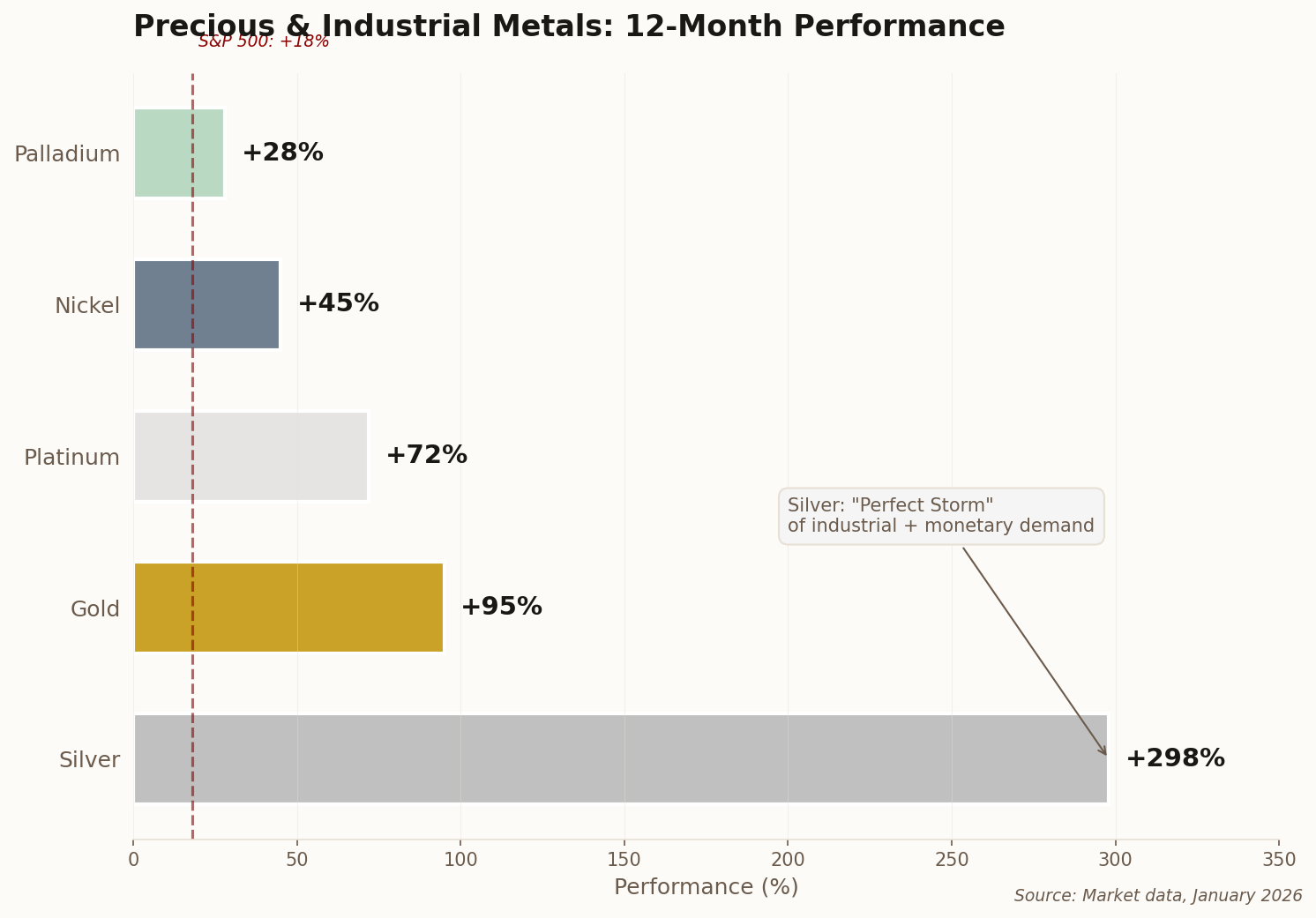
Silver hit a fresh all-time high above $120 per ounce. If that number doesn't shock you, consider this: twelve months ago it traded around $30. That's a 298% gain—absolutely crushing gold, the S&P 500, and virtually every other asset class.

What's driving this? Call it the "perfect storm" of monetary and industrial demand. On the monetary side, silver follows gold but with more leverage. When gold moves 10%, silver historically moves 20-30%. On the industrial side, solar panel demand continues to surge, and the AI infrastructure buildout requires silver for high-performance electrical contacts. Supply can't keep pace.

12-month performance comparison of precious metals
Silver's stunning outperformance: nearly 300% vs gold's 95%.

But analysts are sounding alarms about "bubble-like dynamics" and an "overheated" market. The pullback from $120 to $117 suggests some air is coming out. The silver market is notoriously thin—small in comparison to gold—which makes these explosive moves possible but also means the downside can be just as violent.

For investors: this is not the time to chase. If you're in, consider trimming. If you're out, wait for the dust to settle.

03

Platinum Finally Gets Its Moment

Platinum transforming into catalytic converters and fuel cells

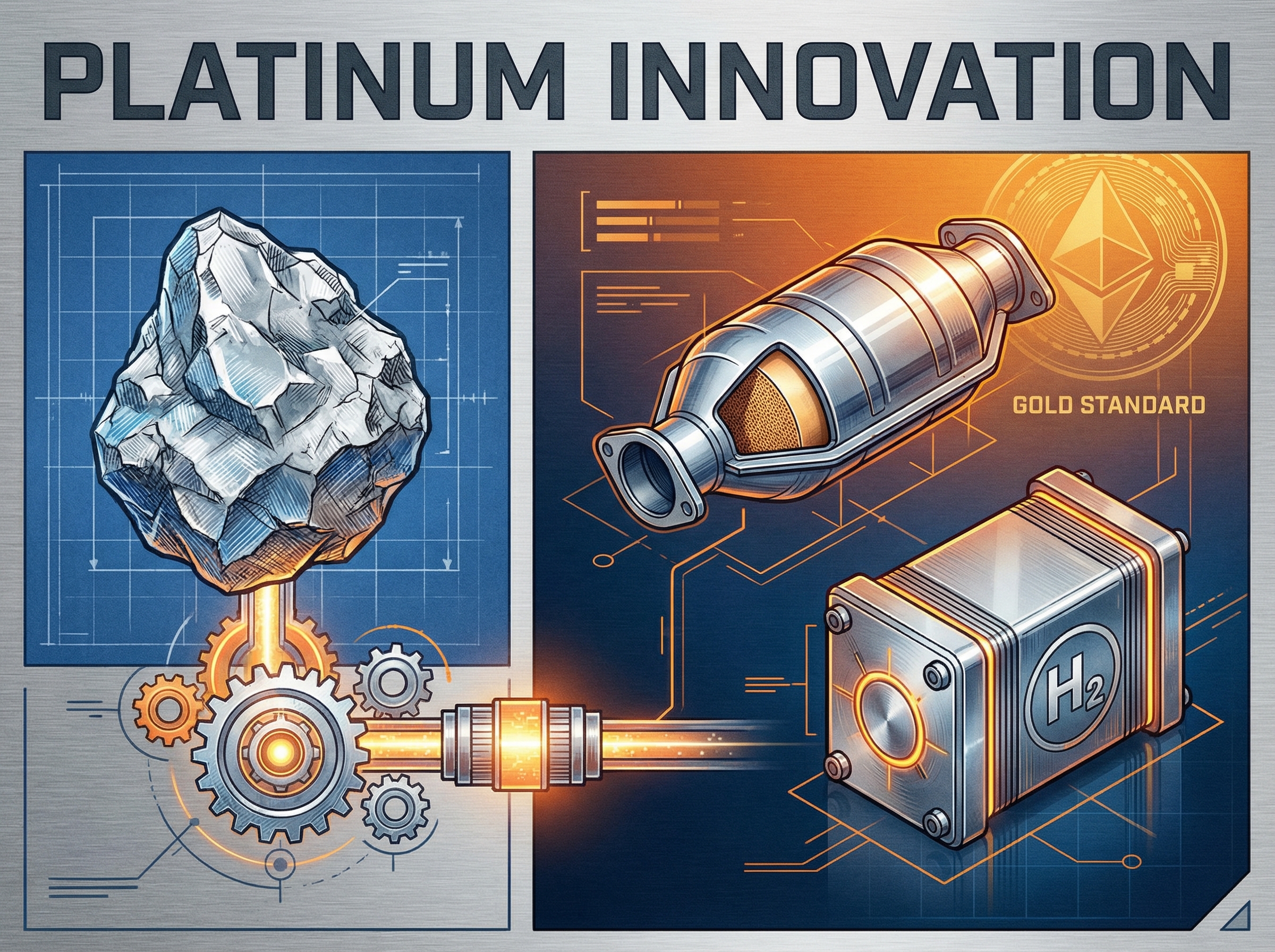
For years, platinum was the forgotten precious metal—unloved, underperforming, trading at a discount to gold despite being thirty times rarer. That narrative just died. Platinum hit a record $2,918.80 earlier this week before consolidating around $2,735.

Two forces are driving the move. First, the "catch-up trade": with gold and silver both at stratospheric levels, investors are rotating into the laggard. Second, real industrial demand. Hydrogen fuel cells require platinum as a catalyst, and the hydrogen economy is finally moving from PowerPoint to reality. Auto catalysts remain a steady demand source.

Palladium, platinum's sister metal, has rallied too but shows weaker momentum. The gold/platinum ratio, which historically sat around 1:1, had blown out to 2:1—that gap is now closing fast. Some analysts see platinum reaching parity with gold within the year.

The contrarian play that seemed crazy six months ago is suddenly consensus. That's usually when things get interesting.

04

Jakarta Closes the Gate: Nickel Surges on Indonesia Quota Cuts

Indonesian flag behind gate of nickel ore with batteries behind

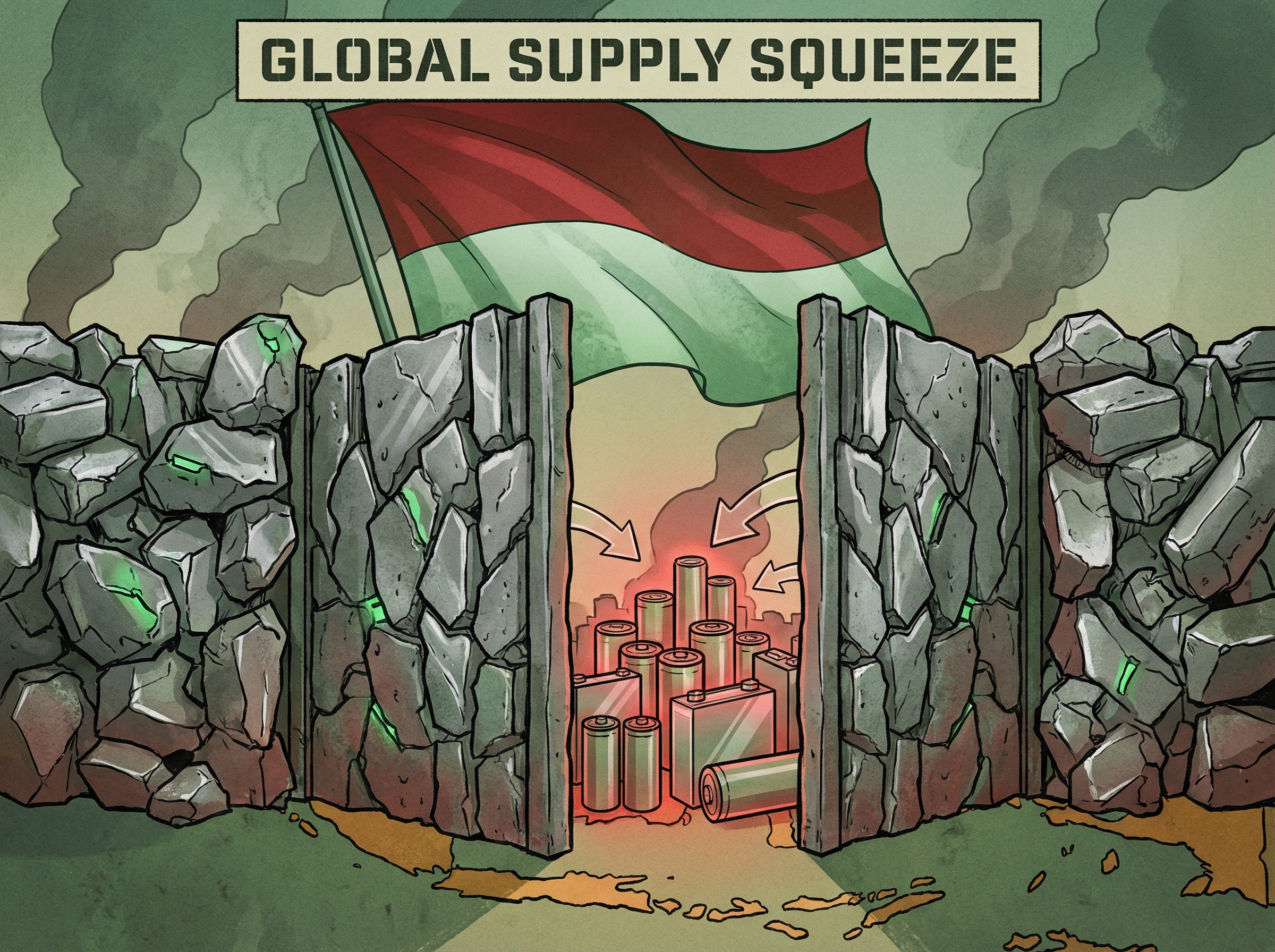
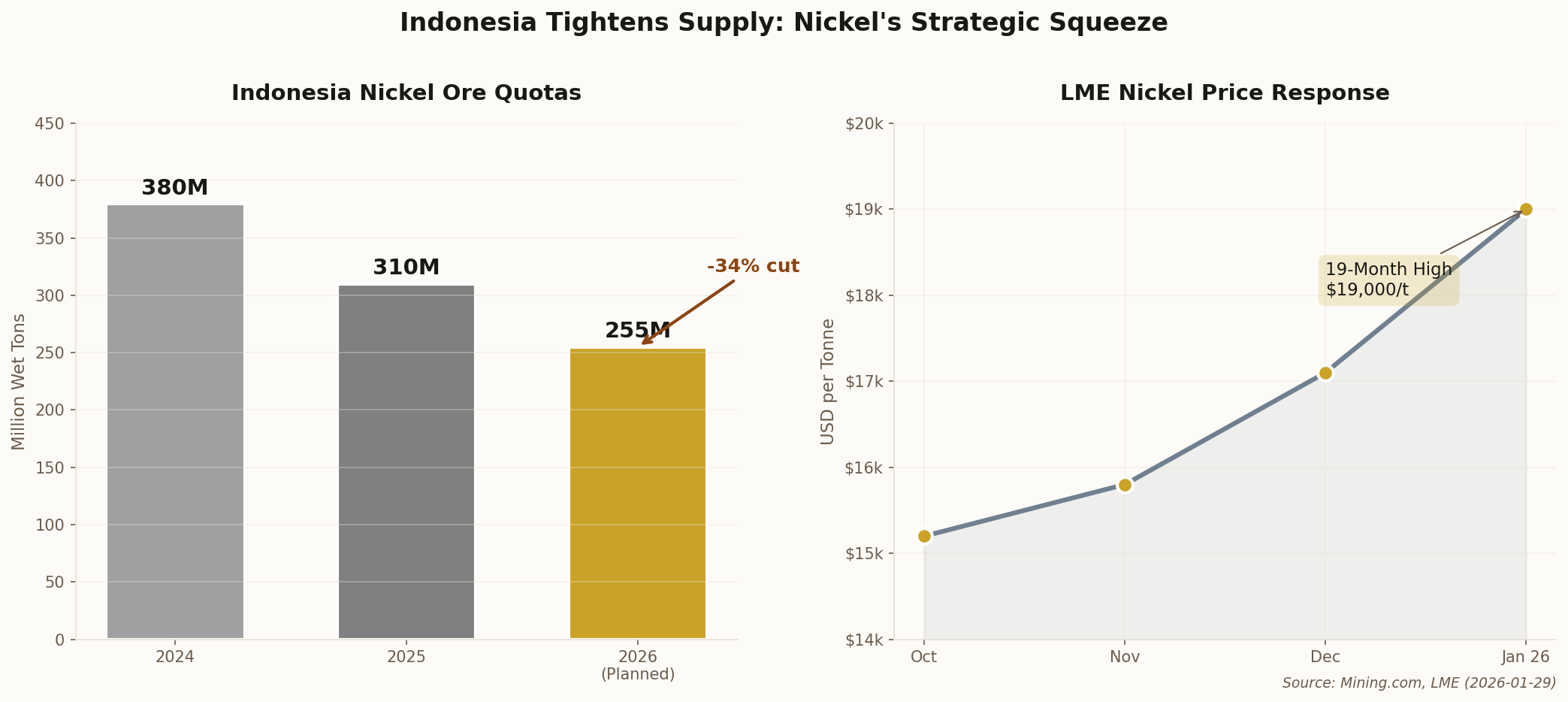
Nickel prices hit a 19-month high at $19,000 per tonne, and the reason has a name: Indonesia. The world's largest nickel producer just announced it will slash 2026 ore production quotas by approximately 34%, down to 250-260 million wet tons.

This isn't an accident. It's deliberate market manipulation by a sovereign producer—and it's working exactly as intended. Jakarta watched nickel prices collapse under a glut of Indonesian supply and decided to drain the oversupply. The move mirrors OPEC's playbook with oil.

Indonesia nickel quota cuts and LME price response
Indonesia's strategic squeeze: 34% quota cut drives nickel to 19-month highs.

The implications ripple through the entire EV supply chain. Tesla, CATL, and every other battery maker just saw their input costs rise significantly. Stainless steel producers face the same squeeze. The era of cheap nickel appears to be over.

For miners outside Indonesia, this is a lifeline. For battery makers, it's another cost headwind in an already margin-pressured business.

05

Policy Whiplash: Rare Earth Stocks Plunge on Subsidy Fears

Rare earth magnets scattered with policy documents

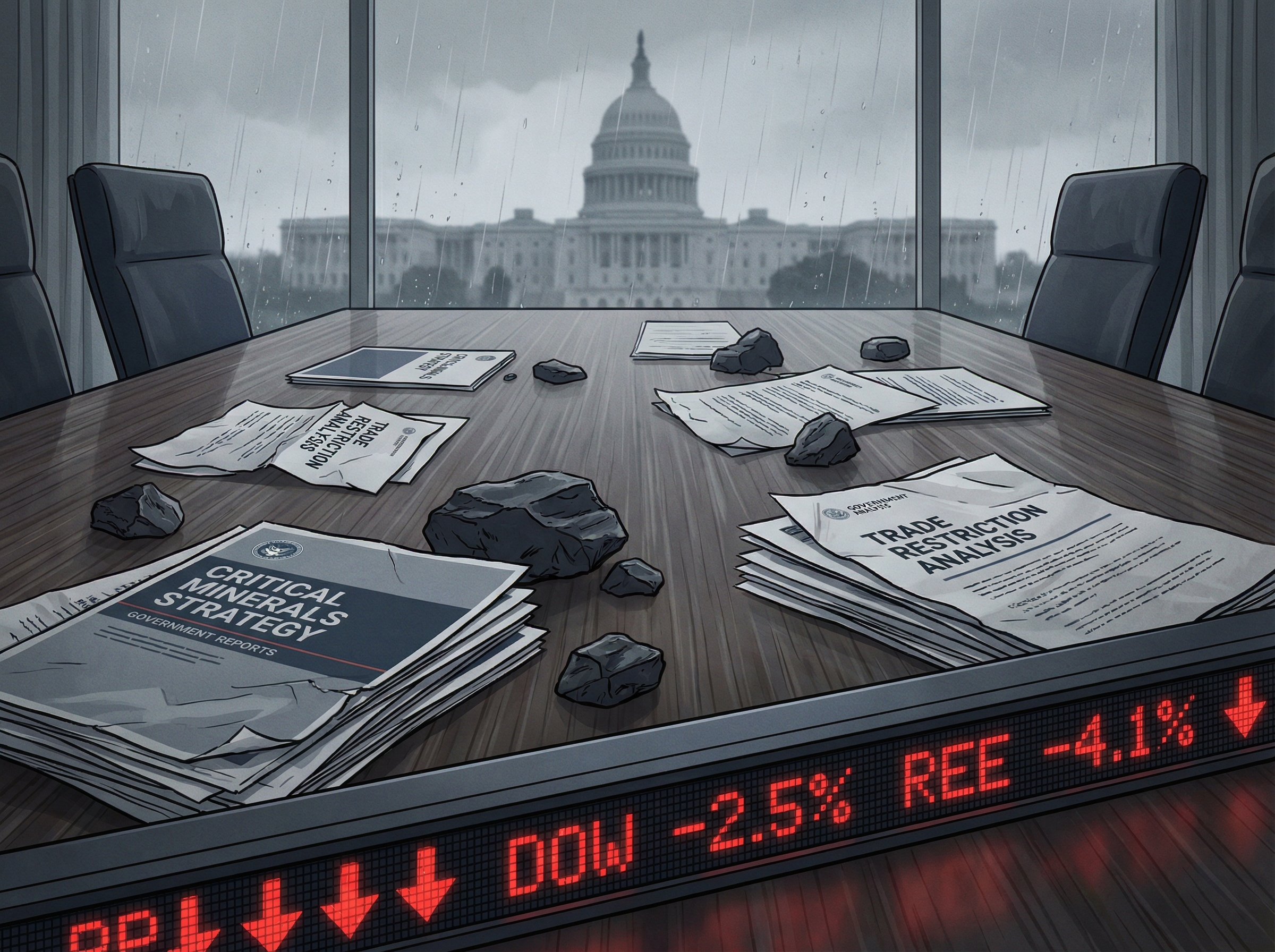
A single Reuters report sent MP Materials down more than 11% and dragged the entire rare earth sector with it. The story: the Trump administration may scrap price floors for critical minerals that have been keeping Western miners alive.

MP Materials quickly issued a statement calling the report misleading, clarifying that their existing contract with a $110/kg price floor "remains fully intact and legally binding." The policy shift, if it happens, would apply only to new applicants. But the damage was done—investors fled first and read the fine print later.

This episode reveals an uncomfortable truth about the Western critical minerals supply chain: it exists largely because of government subsidies. Strip away the price floors, and economics tilt immediately back toward Chinese producers who dominate processing capacity.

The policy question isn't whether to subsidize—it's how much and for how long. Strategic independence has a price. The market clearly wasn't prepared for any uncertainty around that commitment.

06

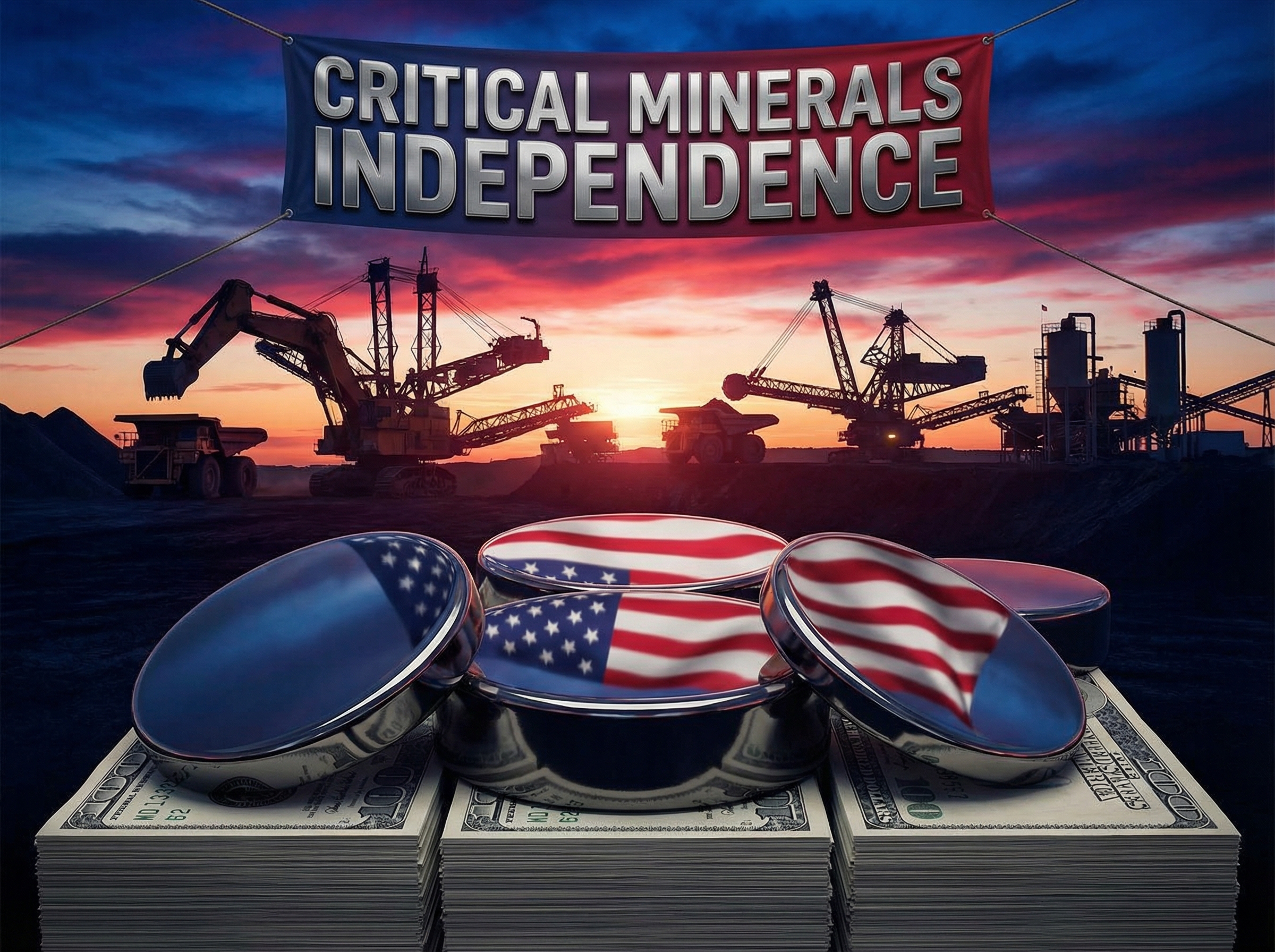
$1.5 Billion Bet: USA Rare Earth Goes All-In on Independence

American flag reflected in rare earth magnets with mining equipment

While MP Materials absorbed the policy uncertainty, USA Rare Earth Inc. just closed one of the largest private capital raises in the sector's history: $1.5 billion at $21.50 per share. This comes on top of a separate $1.6 billion letter of intent from the U.S. Commerce Department's CHIPS Program.

The money will fund an integrated "mine-to-magnet" strategy—rare earth extraction, processing, and permanent magnet manufacturing all within U.S. borders. The goal: a complete domestic supply chain that doesn't touch China at any point.

The stakes: Rare earth magnets are essential for EVs, wind turbines, missiles, and smartphones. Today, China controls roughly 60% of mining and 90% of processing. One export restriction and the West has a serious problem.

This capital injection validates the thesis that strategic materials independence isn't just good policy—it's a massive business opportunity. Private investors aren't putting $1.5 billion into a company because they're patriots. They're doing it because they see returns.

The contrast with today's policy panic is stark. One company just raised nearly $2 billion from private and public sources. Another got hammered because Reuters mentioned the word "scrap." The critical minerals sector remains a high-conviction, high-volatility trade.

What Comes Next

The precious and rare metals markets are flashing warning signs and opportunity signals in equal measure. Gold's volatility suggests a market at an inflection point. Silver's parabolic move screams caution. Industrial metals like nickel and rare earths reveal how quickly policy can reshape entire sectors. The common thread: uncertainty is the new normal. Position accordingly—and don't mistake motion for progress.