
Health & Fitness

The 10,000 Step Myth

That magic number on your fitness tracker? It came from a 1965 Japanese marketing campaign, not medical science. Here's what the research actually says—and why fewer steps might be plenty.

Listen
Morning sunlight on a path, feet mid-stride, fitness tracker visible
Abstract hourglass with glowing footprint particles
01

Five Extra Minutes Changes Everything

Here's the headline that should reshape how you think about exercise: a University College London study of 135,000 adults found that adding just five extra minutes of moderate activity—like brisk walking—reduces blood pressure and cuts mortality risk by nearly 10%.

Not thirty minutes. Not an hour. Five minutes.

The study also found that swapping 30 minutes of sitting for standing, sleeping, or walking showed measurable cardiovascular benefits. This isn't about marathon training or CrossFit obsession. It's about what researchers call "micro-movements"—tiny interventions that stack up over time.

The implication is profound: the barrier to meaningful health improvement isn't finding an hour for the gym. It's taking the stairs instead of the elevator, walking to a colleague's desk instead of sending Slack, or parking at the far end of the lot. The returns on these small investments are surprisingly large.

Golden podium with the number 7000 and laurel wreaths
02

The New Gold Standard: 7,000 Steps

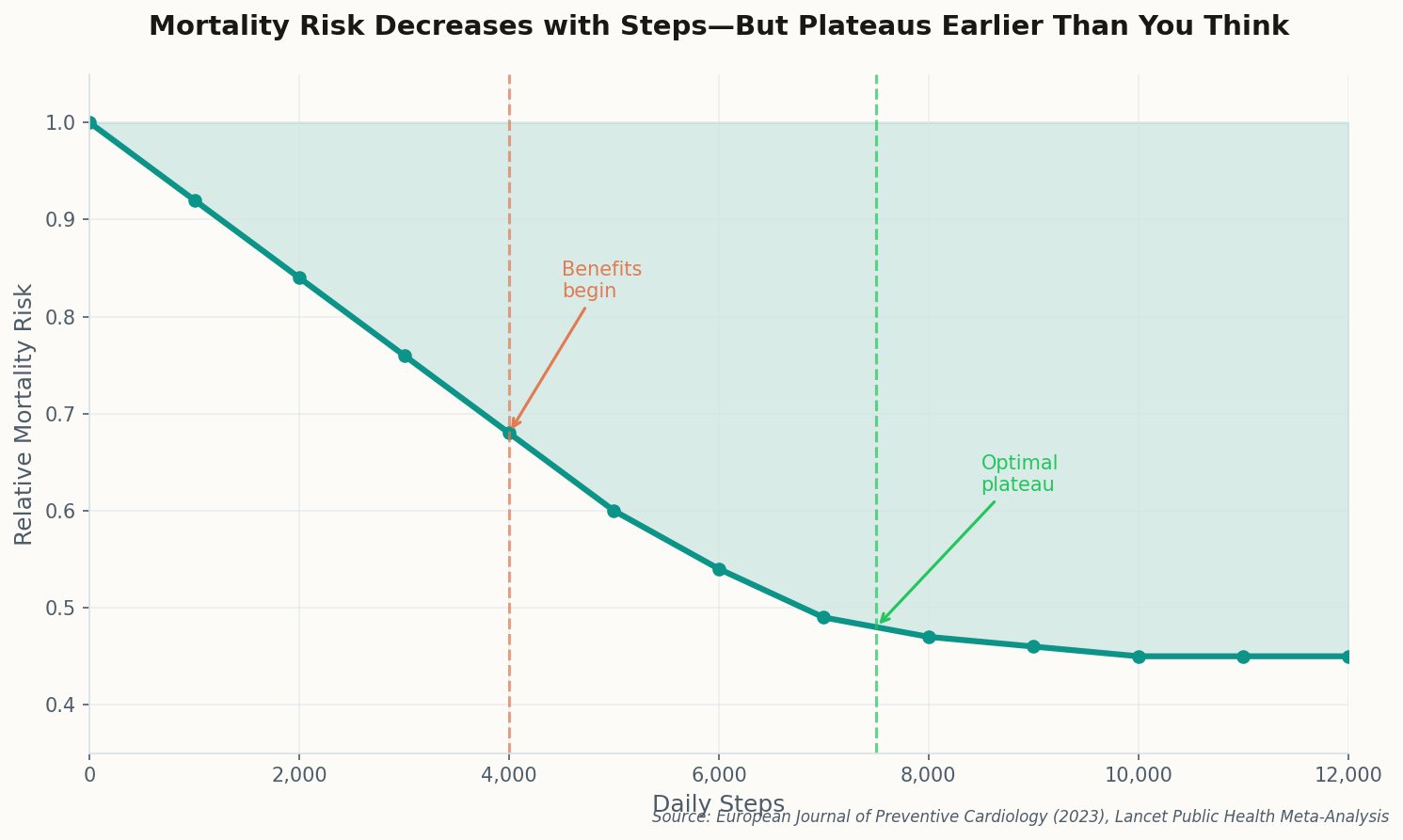
A definitive meta-analysis of 15 studies involving nearly 50,000 people has finally given us a science-backed number to replace the marketing-invented 10,000. The answer? 7,000 to 8,000 steps.

The research shows that mortality risk decreases progressively as daily steps increase—but the curve flattens dramatically around the 7,500 mark. After that, you're getting diminishing returns. The difference between 8,000 and 12,000 steps? Statistically negligible for longevity purposes.

Chart showing mortality risk decreasing with steps, plateauing around 7,500
Mortality risk decreases sharply up to ~7,500 steps, then levels off. Source: European Journal of Preventive Cardiology, Lancet meta-analysis.

This matters because 10,000 steps feels aspirational for most people with desk jobs. Seven thousand? That's lunch break walks and evening strolls. It's achievable without restructuring your entire life. The gap between "what works" and "what people can actually do" just narrowed considerably.

Motion blur of walking shoes showing speed and energy
03

Pace Matters More Than You Think

Counting steps is only half the equation. Research from the University of Sydney demonstrates that walking pace is independently associated with lower mortality risk—regardless of total steps.

The magic threshold? About 100 steps per minute, or what most people would describe as a "brisk" pace—walking like you're late for something. At this intensity, 30 minutes of walking provides health benefits equivalent to a much longer slow meander.

This has practical implications for time-crunched people. If you can only carve out 20 minutes, make them count. A purposeful power walk beats a leisurely stroll for cardiovascular return on investment. The step counter on your wrist doesn't know the difference, but your heart does.

The shortcut: If you're breathing noticeably harder but can still hold a conversation, you're in the sweet spot. This "talk test" has been validated as a reliable indicator of moderate-intensity activity.

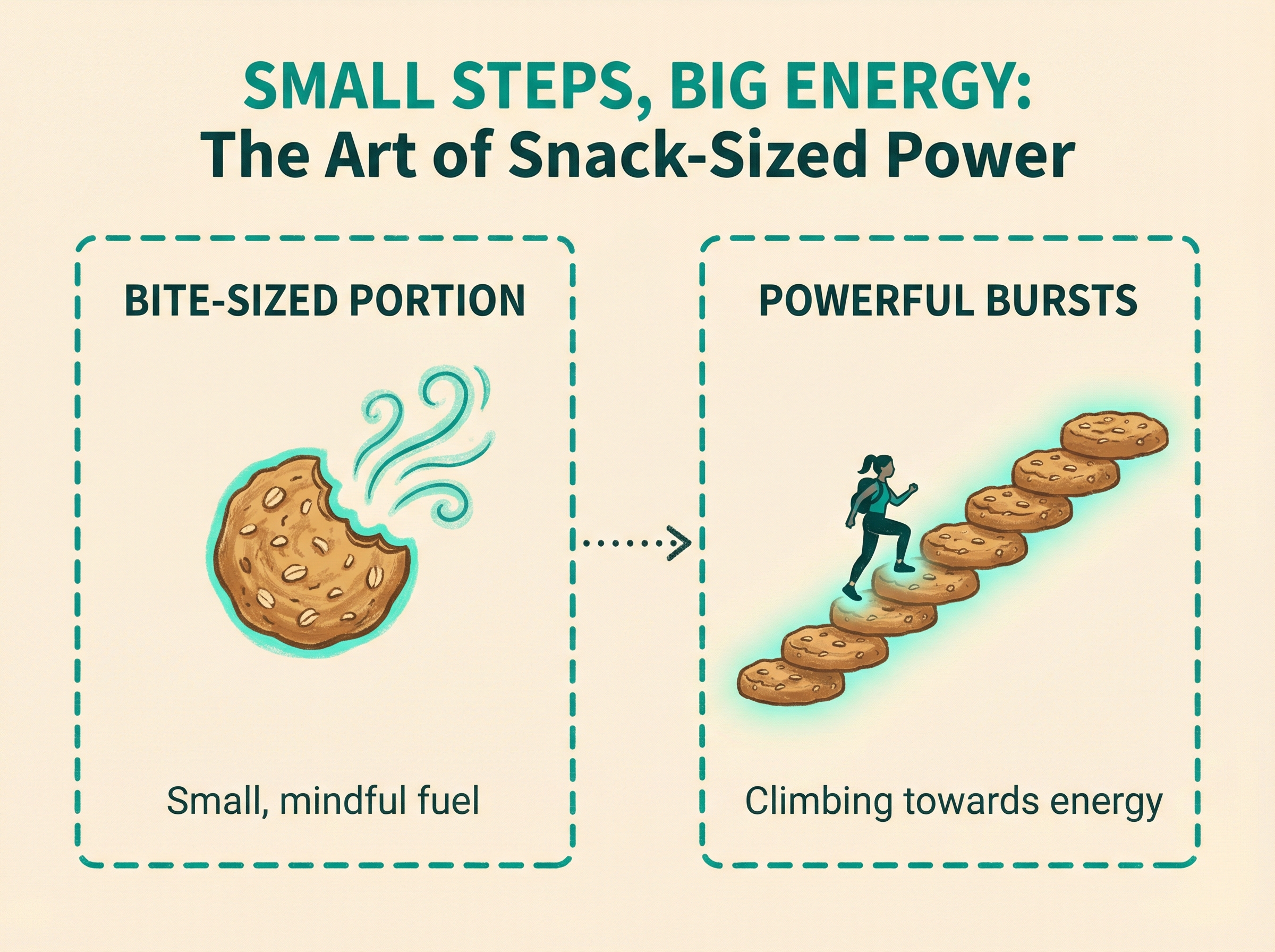
Conceptual image of stairs emerging from a cookie, representing exercise snacks
04

The Exercise Snack Revolution

Forget step counts entirely. The most exciting development in exercise science might be what researchers call "VILPA"—Vigorous Intermittent Lifestyle Physical Activity. Translation: brief, intense bursts of activity scattered throughout your day.

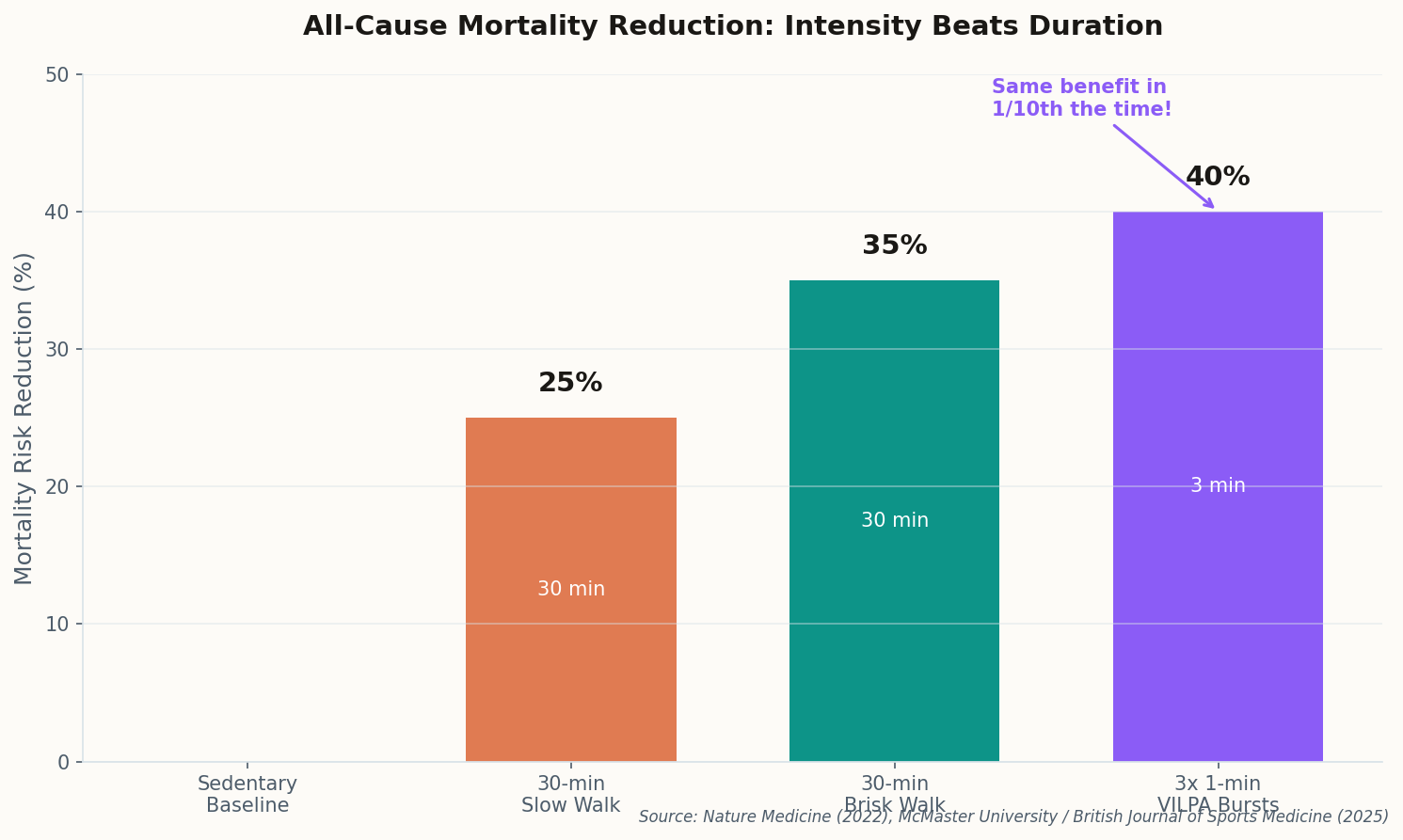
The data is striking. Three 1-to-2 minute bouts of vigorous activity per day—rushing up stairs, sprinting to catch a bus, hauling groceries up a flight—are associated with a 38-40% reduction in all-cause mortality. That's comparable to hitting step goals, achieved in a fraction of the time.

Bar chart comparing mortality reduction across different activity approaches
Three 1-minute vigorous "exercise snacks" achieve similar mortality reduction to 30 minutes of brisk walking—in 1/10th the time.

This reframes the entire conversation. The question isn't "Did I hit 10,000 steps?" but "Did I get my heart rate up a few times today?" For people who genuinely cannot find 30 contiguous minutes, exercise snacks offer a legitimate alternative with equivalent outcomes.

Two paths diverging, showing different figures walking toward the same sunrise
05

Your Optimal Steps Depend on Your Age

One-size-fits-all guidance was never going to be accurate, and the research bears this out. The optimal step count for maximum longevity benefit varies significantly by age.

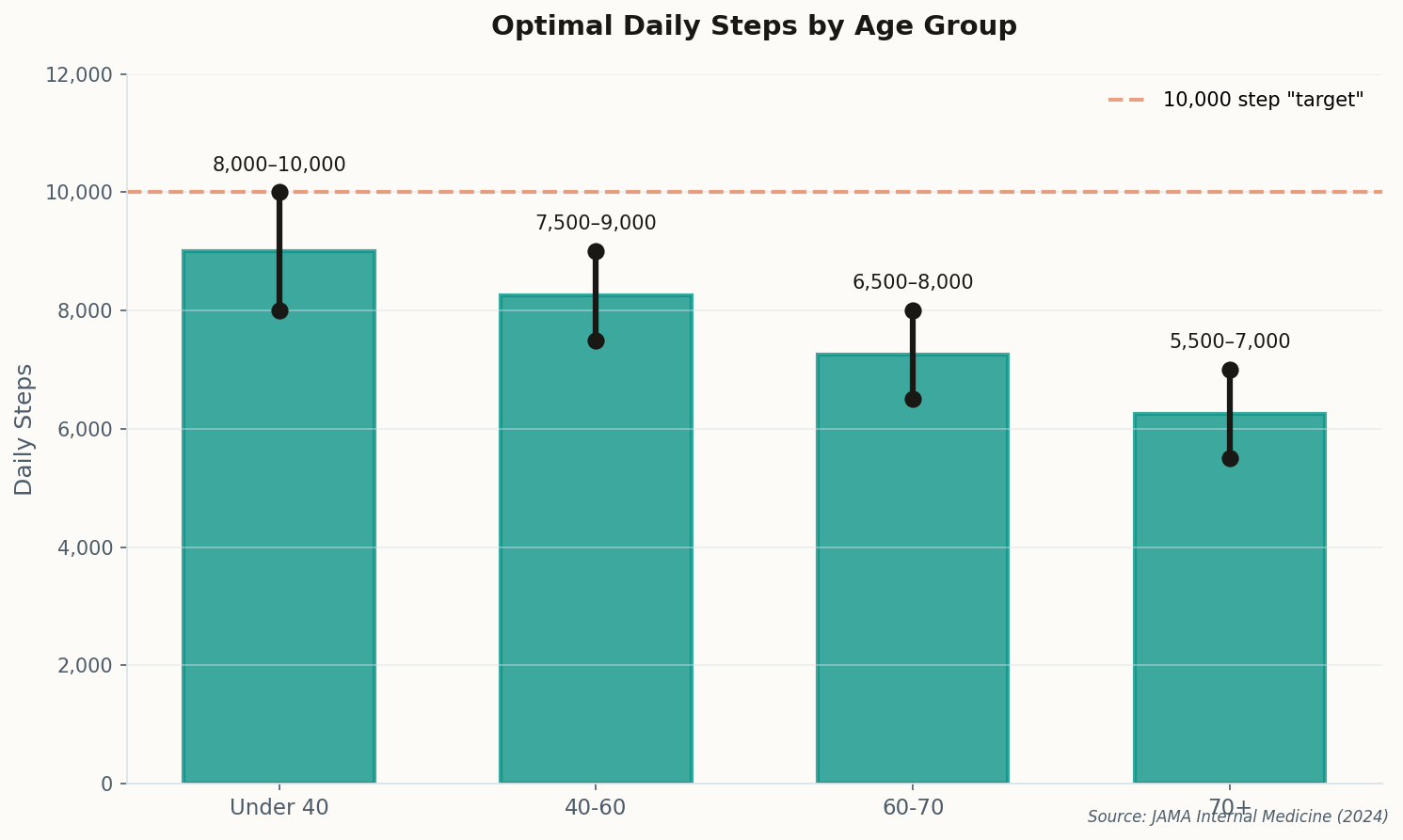
Under 60: Benefits plateau around 8,000-10,000 steps.
Over 60: Benefits plateau significantly earlier, at 6,000-8,000 steps.

Chart showing optimal step ranges by age group
Optimal daily step ranges by age group. Note how the target decreases with age—and how 10,000 exceeds the optimal range for most age groups.

This has important implications for older adults. Chasing 10,000 steps when you're 70 doesn't add statistical survival benefit over 8,000—but it might add injury risk. Joint strain, fall risk, and overuse injuries all increase with excessive activity in older populations. The science gives permission to stop stressing about arbitrary targets.

Vintage 1960s Japanese pedometer with the kanji character for 10,000
06

The Marketing Myth That Conquered the World

So where did 10,000 steps come from? Not a lab. Not a clinical trial. A marketing department.

In 1965, following the Tokyo Olympics, Yamasa Clock Company released a pedometer called the Manpo-kei—which translates literally to "10,000 steps meter." The number wasn't derived from health research. It was chosen because the Japanese character for 10,000 (万) looks vaguely like a person walking, and the number sounded aspirational.

As Dr. I-Min Lee of Harvard has noted: "The figure wasn't based on scientific evidence... they just chose a nice round number that sounded like a good goal."

Sixty years later, that marketing slogan has become global health gospel—baked into fitness trackers, recommended by doctors, and internalized by millions of people who feel guilty when they fall short. The irony is that the actual science, when it finally arrived, showed the arbitrary target was both higher than necessary and missing the point entirely.

The real lesson: When a round number becomes conventional wisdom, it's worth asking who invented it and why. In this case, the answer is "advertisers selling pedometers." The science came later—and told a different story.

Walk Your Own Path

The research is clear: movement matters, but the 10,000-step target was invented by marketers, not scientists. Whether it's 5,000 steps, three flights of stairs, or a brisk 20-minute walk—what counts is consistency over perfection. Your body doesn't care about round numbers.