
Leadership

The Genius-Jerk Paradox

Fifteen years after his death, Steve Jobs remains the most divisive figure in tech leadership. Did his brilliance justify his brutality, or was the abuse simply unnecessary cruelty dressed up in a turtleneck?

Listen
Black turtleneck sweater in dramatic split lighting, representing the duality of Steve Jobs' legacy
Minimalist workspace with single device, representing Jobs' focus philosophy
01

Fifteen Years Dead, His Playbook Still Dominates

Here's the uncomfortable truth about Steve Jobs: in 2026, his operational tactics remain the gold standard for productivity advice. Cut 70% of your product line. Ban PowerPoint. Cap meetings at 30 minutes. "Focusing is about saying no." The man who made grown engineers cry is still the primary reference point for how to get things done.

This piece from Self-Manager catalogs ten specific Jobs tactics that modern productivity systems have adopted wholesale. The uncomfortable implication? Either his harsh methods genuinely produced superior results, or we're all cargo-culting a management style that happened to coincide with talent and timing.
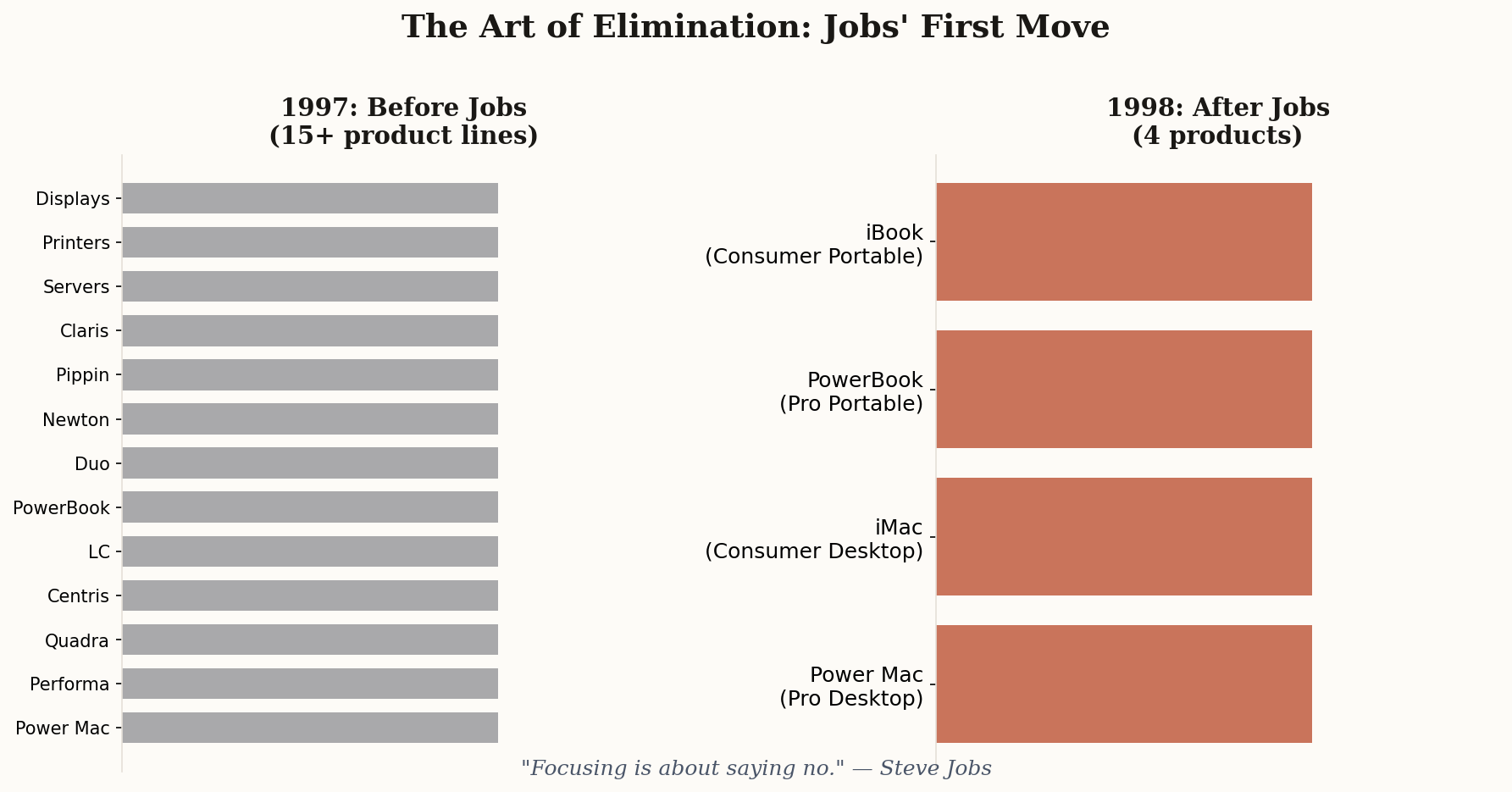
Chart showing Apple's product line reduction from 15+ to 4 under Jobs
Jobs' first move on returning to Apple: eliminate 70% of products. The remaining four defined a decade.

What strikes me is the specificity of the advice that survives. Not vague "think different" platitudes, but granular operational choices. No status update meetings. Whiteboard debates instead of slideshows. The A-team works on fewer things with total ownership. These weren't personality quirks—they were deliberate system design. And they still outperform the alternatives.

Small elite team casting giant shadows, representing the A-player philosophy
02

The 50:1 Talent Differential That Justified Everything

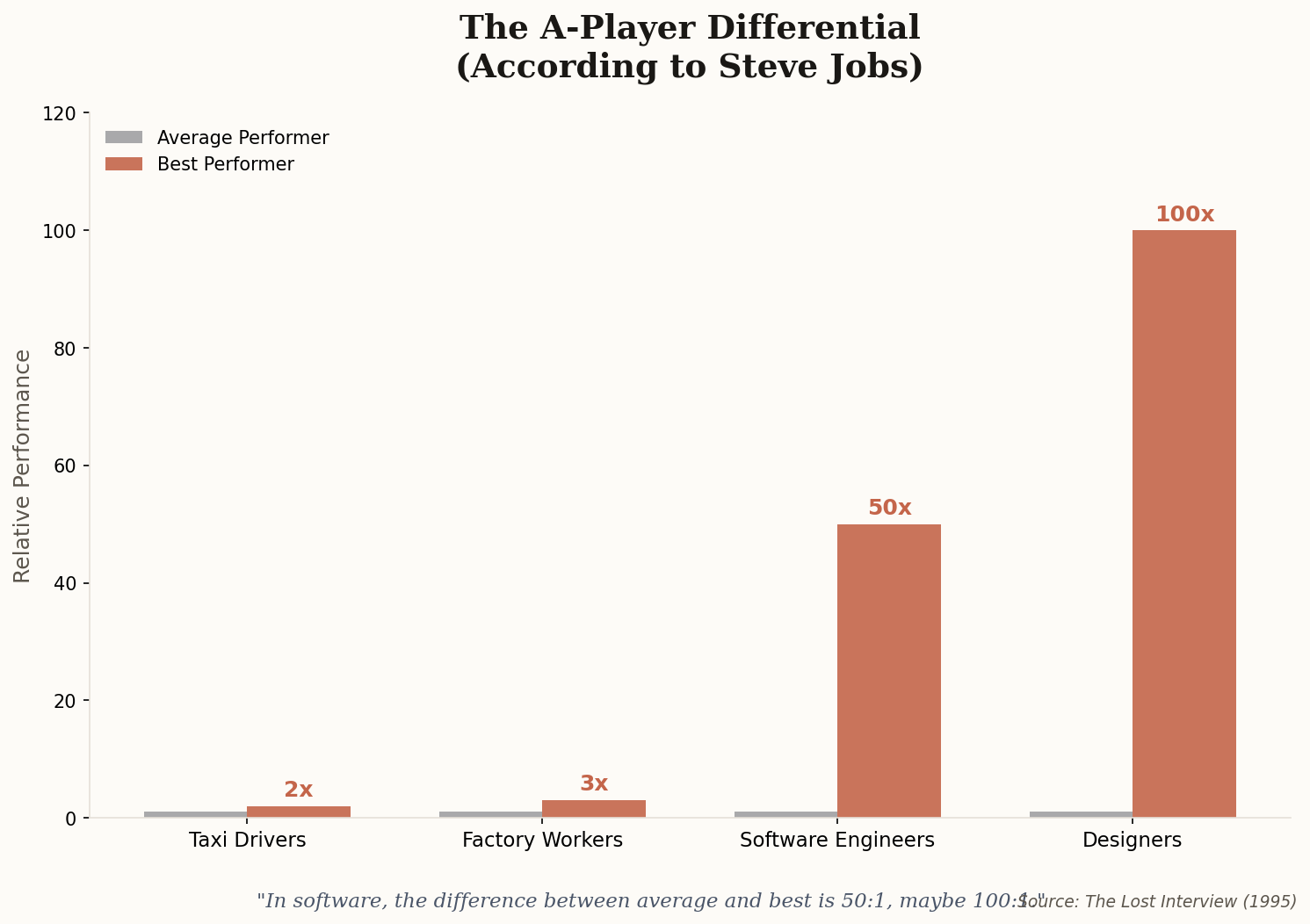
In a mid-2025 retrospective, Leaders Podcast examined why Jobs' "A-player" philosophy has become the dominant hiring strategy for elite tech companies. The argument goes back to a 1995 interview where Jobs made a claim that sounds outrageous until you think about it: "In software, the difference between average and best is 50:1, maybe 100:1."

His logic was ruthless and arithmetic. A taxi driver who's twice as good gets you there faster. A software engineer who's 50x better creates entirely different outcomes. Under this framework, the only moral imperative is preventing what Jobs called "the bozo explosion"—B players hiring C players until mediocrity becomes institutionalized.

Bar chart comparing talent differentials across professions
Jobs' hierarchy of talent differentials: the higher the ceiling, the more ruthless the filtering needs to be.

"My job is not to be easy on people. My job is to take these great people and push them and make them even better."

The 2025 trend toward "leaner, higher-density" engineering teams is a direct descendant of this philosophy. But here's what the podcast doesn't interrogate: did Jobs' cruelty actually select for better people, or did it simply traumatize the ones who stayed? The survivorship bias is immense. We hear from those who thrived. The ones who broke quietly exit the narrative.

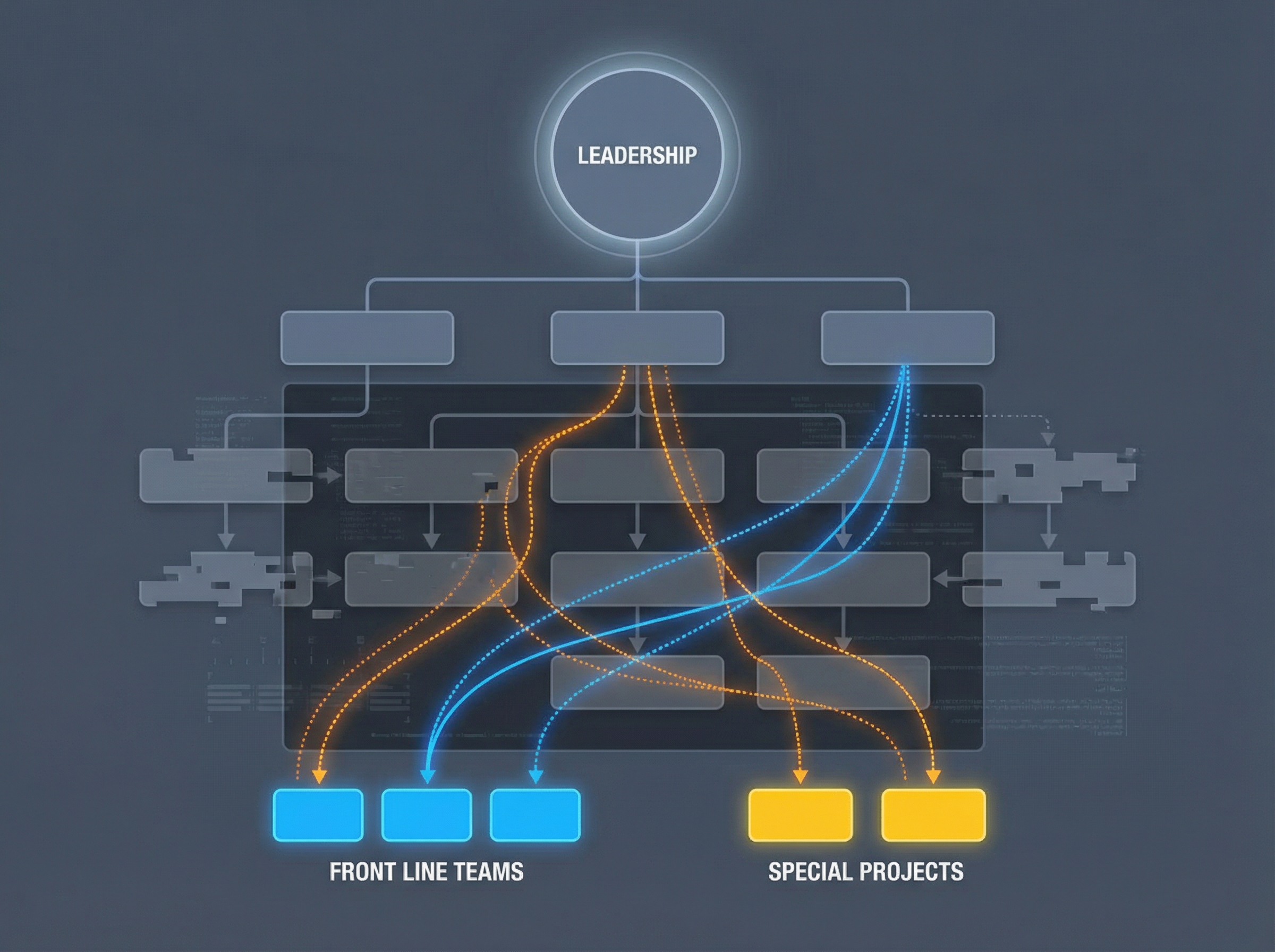
Organizational hierarchy being bypassed by direct connections
03

"Founder Mode" Was Always Just "Jobs Mode"

Paul Graham's 2024 essay "Founder Mode" sparked the tech industry's most heated leadership debate in years. The core argument: there are things founders can do that professional managers cannot, and the conventional wisdom to "hire great people and get out of their way" destroys founder-led companies.

Graham's explicit archetype for founder mode? Steve Jobs. The essay recounts how Brian Chesky saved Airbnb by abandoning manager mode and running it "like Steve Jobs ran Apple." Skip-level meetings. Direct engagement with product details. Refusing to be buffered from reality by middle management.

What makes this essay consequential is how it reframes Jobs' notorious micromanagement as structurally necessary rather than pathological. The Isaacson biography portrayed his attention to detail—obsessing over the curve of a corner, the exact shade of a button—as evidence of perfectionism bordering on madness. Graham repositions it as the defining feature that separates founders who build lasting companies from those who get managed into mediocrity.

The subtext that electrified Silicon Valley: the abuse was a feature, not a bug. And founders who won't embrace that intensity are destined for "manager mode" failure.

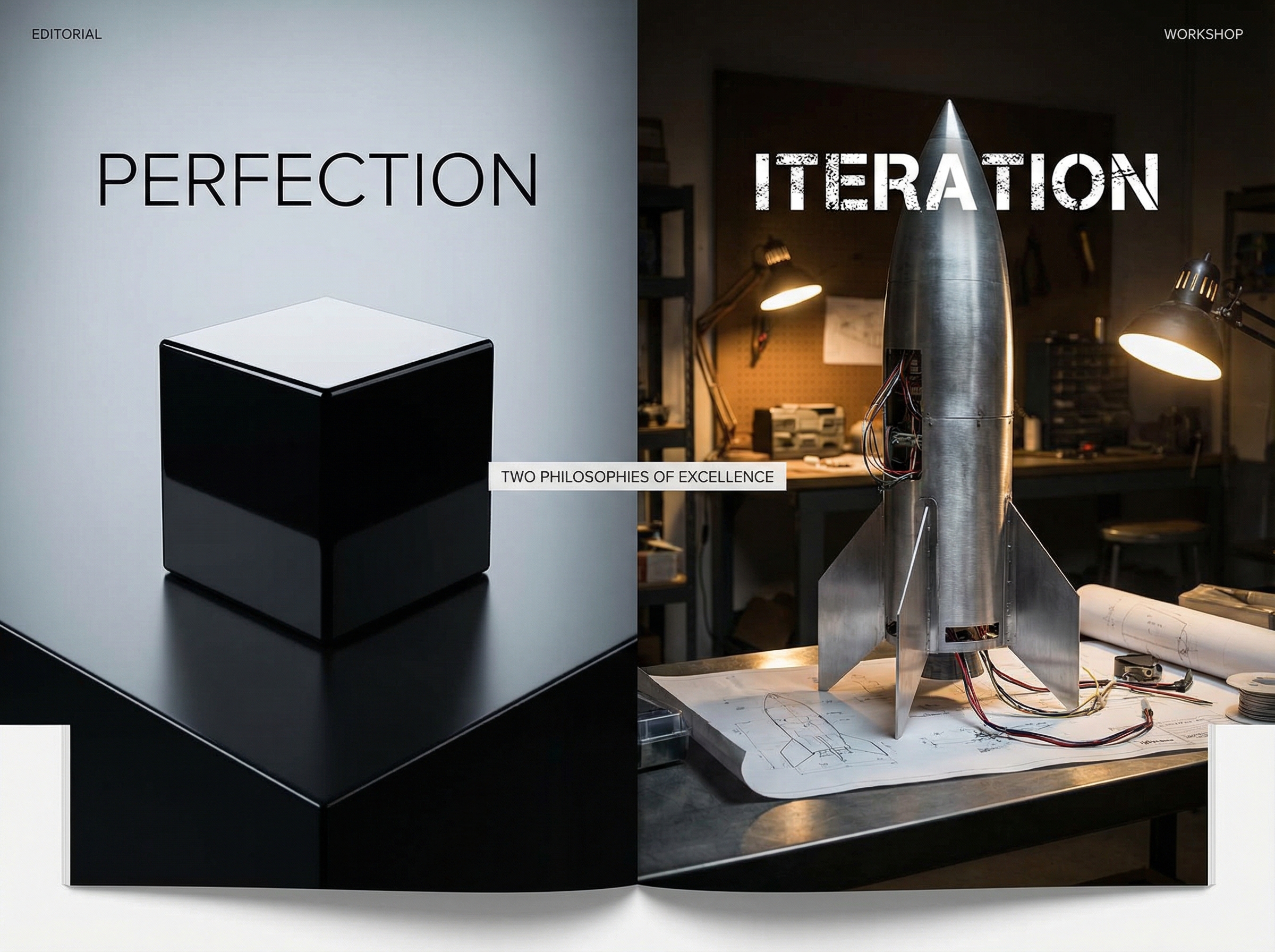
Split composition showing polished cube versus rough rocket prototype
04

Jobs vs. Musk: The Same DNA, Different Expression

The most revealing comparison of Jobs' leadership style comes from Inc.'s analysis of him alongside Elon Musk. Both embody the "difficult genius" archetype. Both deployed reality distortion fields—Mars timelines and product deadlines equally detached from physical constraints. Both proved you can be brutal to work for and still inspire people to do career-defining work.

But the differences illuminate what made Jobs unique:

Secrecy vs. Spectacle: Jobs was pathologically secretive, polishing products until they were perfect before anyone saw them. Musk tweets his stream of consciousness and ships "beta" products to fix in public. Jobs would have considered Twitter chaos to be a failure of discipline.

Empathy vs. First Principles: Jobs' design philosophy centered on empathy for the user experience—imagining what a customer who'd never seen a computer would need. Musk works from first principles engineering—what's physically possible, regardless of whether users understand it. Jobs made technology disappear; Musk makes technology visible and impressive.

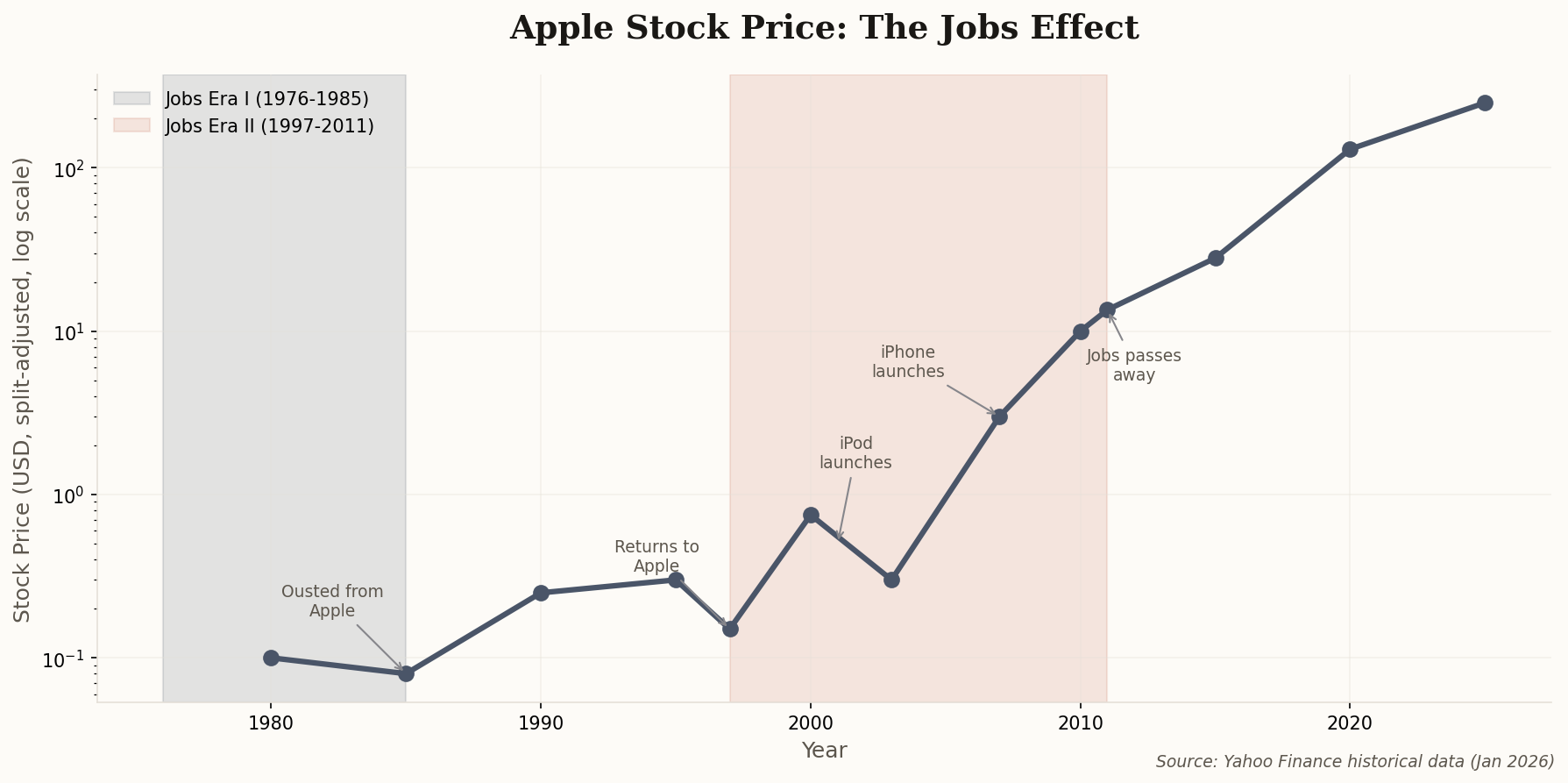
Apple stock price timeline showing Jobs' two tenures
The Jobs effect: two separate tenures, two separate resurrections. The stock price tracks his influence with uncomfortable precision.

The uncomfortable conclusion: there may be multiple viable paths to "great jerk founder," but none of them are nice. The archetype survives because it produces results that nicer approaches haven't replicated.

Empty child's room with light through window, representing absence
05

The Cruelty Wasn't Just Professional

Before celebrating Jobs as the patron saint of founder mode, we should read Lisa Brennan-Jobs' memoir Small Fry. Her father—this visionary who allegedly couldn't accept anything less than excellence—refused to pay child support despite being a multimillionaire, claiming he was "sterile" while a paternity test proved otherwise.

This wasn't demanding excellence from his team. This was denying his daughter's existence while building the most valuable company in history. The memoir documents him telling her she "wasn't getting anything" regarding his fortune. The perfectionist who obsessed over corner radii couldn't be bothered to be a parent.

"You know who I am? I'm your father. I'm one of the most important people you will ever know."

The Jobs hagiography depends on separating his professional intensity from his personal cruelty. Lisa's account makes that impossible. The same man who screamed "this is shit!" at engineers who'd worked 80-hour weeks also abandoned his child. The "reality distortion field" wasn't just for products—it was for rewriting his own history as a father.

You can admire the iPhone and acknowledge that its creator was capable of extraordinary pettiness toward the people who needed him most. The question is whether we should still hold him up as a model to emulate.

Two hands collaborating over design prototype in sunlight
06

The Defense: Childlike Purity, Not Malice

The most credible defense of Jobs comes from Jony Ive, his closest creative partner for over a decade. In this Vanity Fair remembrance, Ive pushes back on the "cruel tyrant" narrative with a reframing that's either profound or convenient: Jobs had a "childlike" purity in his focus. The harshness wasn't malice—it was an overwhelming burden of responsibility to the product.

Ive describes their daily lunches, the genuine joy Jobs felt when a design problem cracked open. "He didn't have a grand plan to win... He just wanted to make something beautiful and great." In this telling, Jobs wasn't cruel for cruelty's sake. He simply couldn't tolerate anything less than the vision in his head, and that intolerance felt like assault to people who'd produced merely excellent work.

There's truth here. Many former employees describe the same pattern: devastating criticism followed by profound appreciation when you finally met the standard. The problem is that this framework makes the abuse a price worth paying for those who survived. It doesn't account for those who didn't thrive under terror—the ones who left broken, burned out, or never got a chance to prove themselves because one bad presentation ended their career.

Ive's defense is the most sympathetic possible read of Jobs' behavior. But even he can't make it sound kind. The best he can offer is that the cruelty served a higher purpose. Whether that purpose justifies the human cost is the question that defines how you feel about Steve Jobs' legacy.

The Verdict That Never Comes

The genius-jerk paradox has no clean resolution. Jobs built products that genuinely improved millions of lives while inflicting real damage on the people closest to him. Maybe the lesson isn't that his methods were right or wrong, but that we should stop seeking permission from his example—and build our own definition of excellence that doesn't require cruelty to function.