Fitness & Longevity

The Forty-Year Reckoning

What happens when your body starts billing you for twenty years of neglect? The science of reclaiming mobility and muscle after forty isn't about turning back the clock. It's about rewriting the terms of decline.

Listen
Middle-aged man performing a mindful stretch in golden morning light, demonstrating the intersection of strength and mobility
01

The Quiet Defection from Powerlifting Culture

Pilates reformer in morning light, representing the shift toward low-impact functional training

Something unexpected is happening in gyms across America: men in their forties and fifties are abandoning the bench press and discovering Pilates. Not as a punchline—as a strategy.

The 2025 fitness trend reports confirm what savvy trainers have whispered for years: the machismo of heavy lifting makes terrible long-term sense. Accio and other wellness platforms are documenting a migration toward "low-impact, high-reward" training—Pilates, barre, and functional mobility work that prioritizes joint health and core stability over raw tonnage.

The shift isn't about going soft. It's about going smart. Modified HIIT is replacing standard HIIT to reduce cortisol spikes that sabotage recovery. Men are learning that "moving beyond solely aesthetic goals to prioritize long-term health, functional capacity, and mental well-being" isn't a retreat—it's a reframe.

The question for the forty-plus crowd isn't whether you can still deadlift 400 pounds. It's whether your hips will thank you in 2036. The emerging consensus: they won't.
02

The Three-Phase Blueprint for Men Over Forty

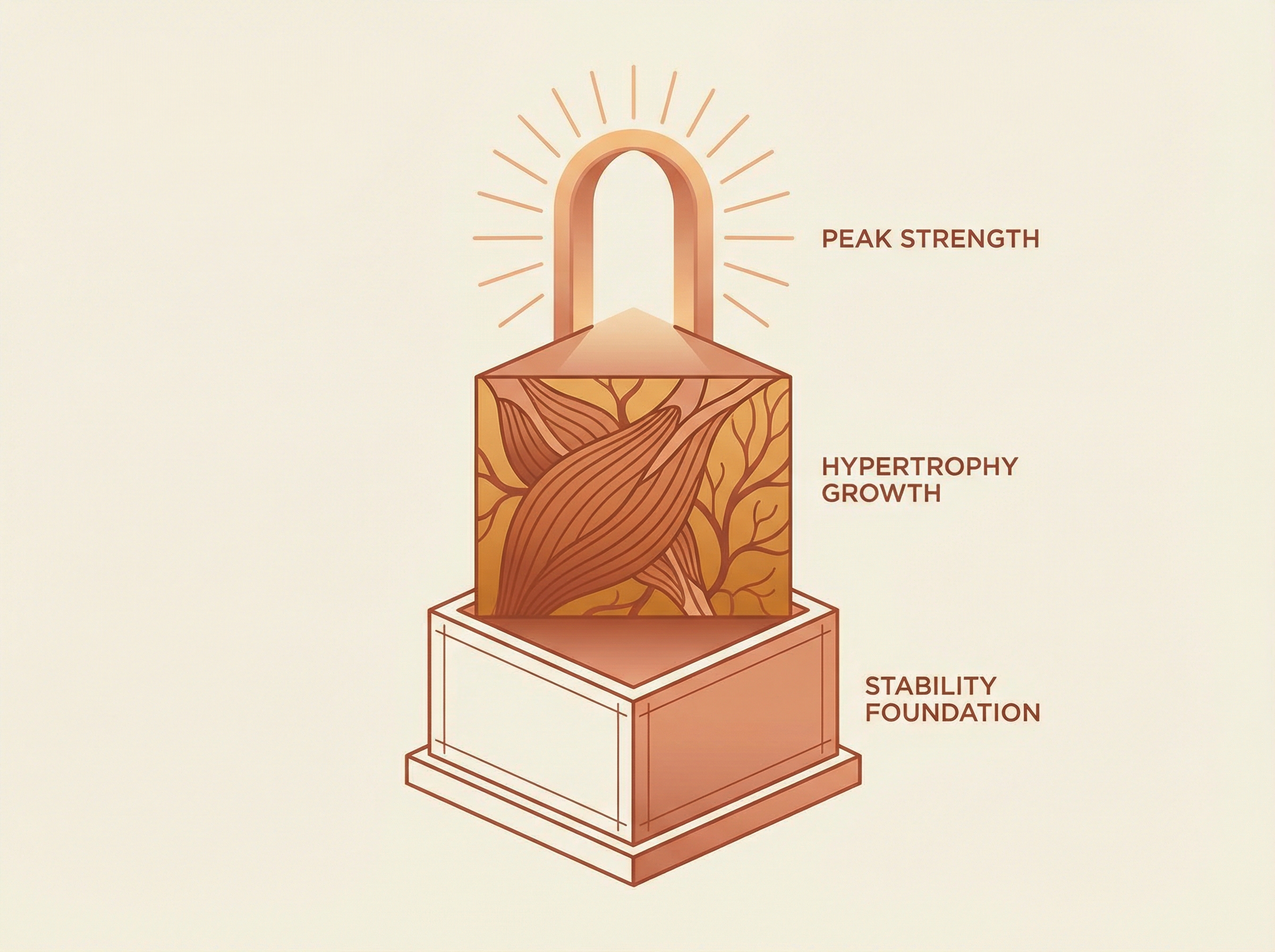
Abstract visualization of three progressive training phases building from stability to strength

If you're going to rebuild, you need a blueprint that respects biology. Era Fit's 3-month transformation protocol for men over forty does exactly that: it phases intensity around what your endocrine system can actually handle.

The structure matters: Stability comes first—rebuilding movement patterns and joint integrity before adding load. Then Hypertrophy—focused muscle-building with managed volume. Finally, Strength—consolidating gains into functional power. Skip to phase three prematurely and you're inviting the injuries that derailed you in the first place.

Compound movements remain king—squats, deadlifts, presses—but with a critical caveat: fatigue management trumps progressive overload. "A science-backed roadmap to build muscle, burn fat, and enhance vitality" sounds like marketing, but the underlying principle is sound. Your forty-year-old body responds to stress differently than your twenty-five-year-old body did. Train like you understand that.

The implication for gym programming: periodization isn't optional anymore. It's survival.

03

The Case for Training Less (But Smarter)

Single dumbbell casting a dramatic shadow, representing the minimal-dose training philosophy

Here's a counterintuitive finding from ongoing clinical research: you might be working out too much. WithPower and DePaul University are investigating what they call "minimal dose" resistance training—lower volume, lower frequency, but with a focus on eccentric contractions.

Eccentric training—the controlled lowering phase of a lift—turns out to be disproportionately effective for older trainees. The muscle fibers tear just as effectively, but the joint stress is reduced. You get the stimulus without the wear. Preliminary data suggests these abbreviated protocols can "enhance strength and functional ability" while "overcoming barriers to participation" like time constraints and injury anxiety.

This isn't permission to be lazy. It's permission to be efficient. Two or three focused sessions per week, emphasizing the negative portion of each rep, may deliver 80% of the benefit at 40% of the volume. For men juggling careers, families, and the accumulated aches of four decades, that's not a compromise—it's a revelation.

Watch this research. If the findings hold, they'll reshape how we prescribe resistance training for aging populations.

04

The Clock Starts Earlier Than You Think

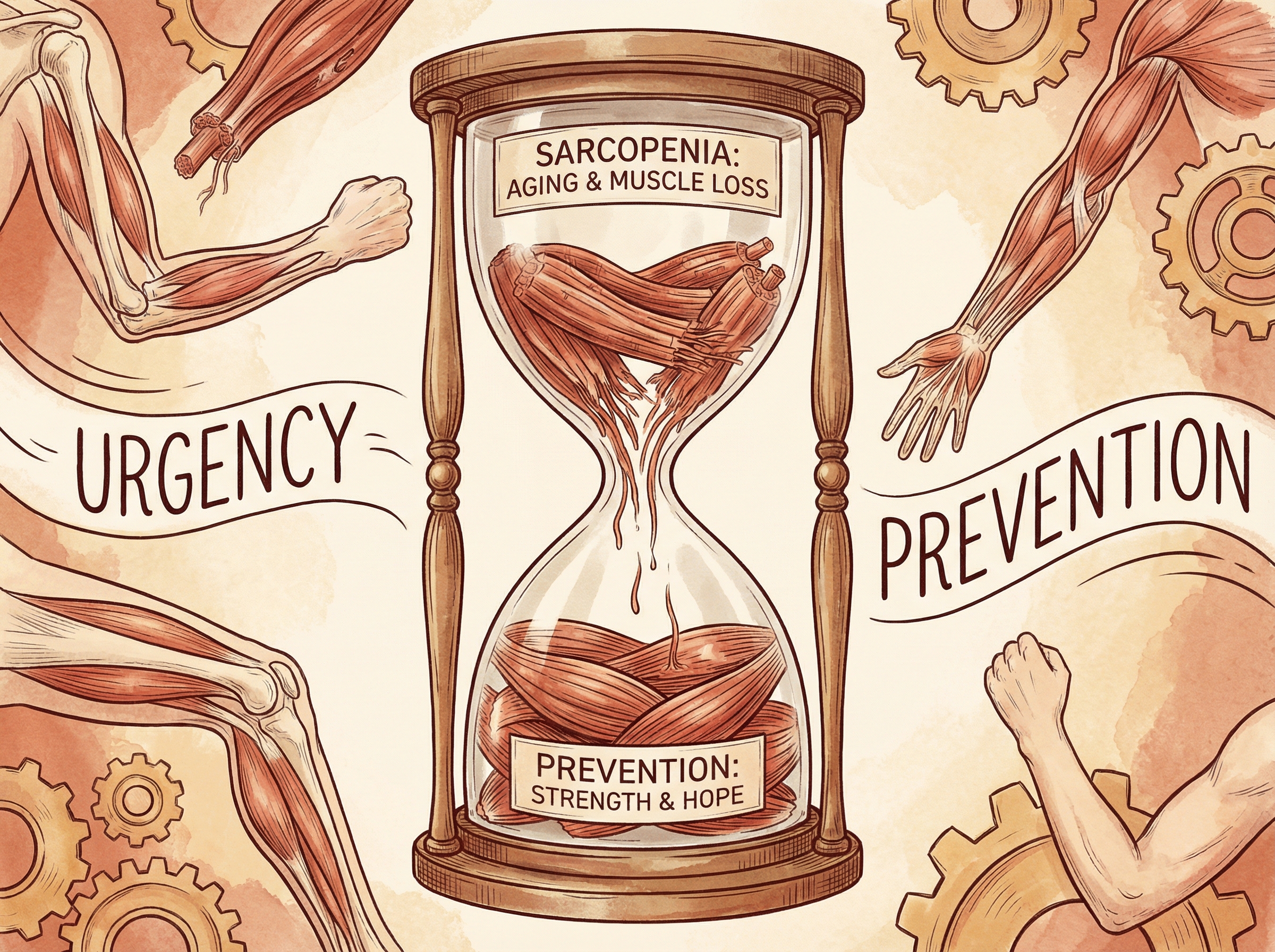
Hourglass with muscle fibers representing the passage of time and muscle loss

The AWGS 2025 Consensus drops an uncomfortable truth: sarcopenia—age-related muscle loss—isn't a problem for your seventies. The screening window now opens at fifty. And the decline begins even earlier.

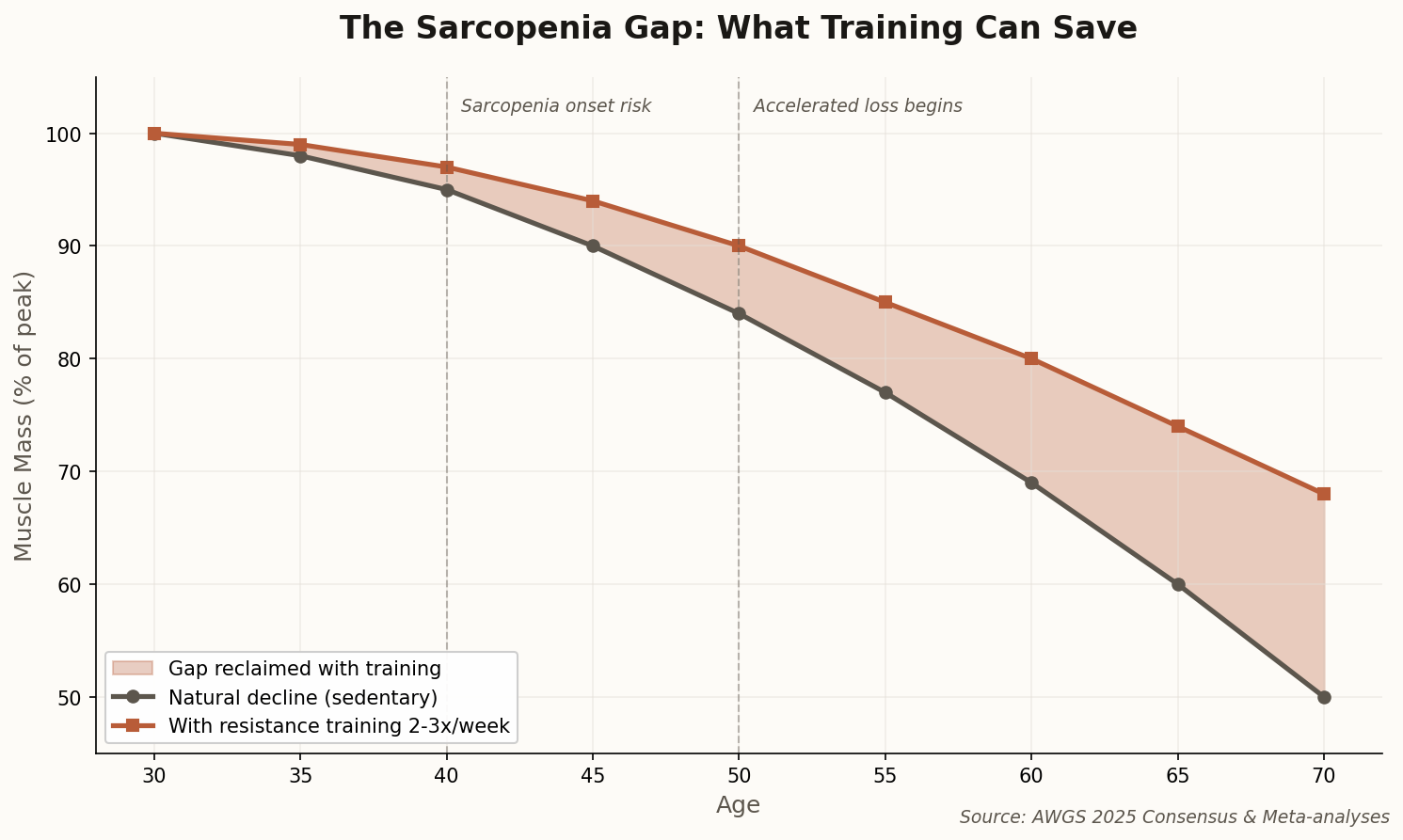
"Early identification of low muscle mass and strength in middle-aged adults is crucial to prevent functional decline." That's not alarmism. That's the consensus statement from researchers who've spent careers measuring the trajectory. Physical decline can begin as early as age 35, with acceleration kicking in after 60.

Chart showing muscle mass decline trajectories with and without resistance training, highlighting the gap that training can preserve
The "sarcopenia gap" represents muscle mass you can preserve through consistent resistance training. Without intervention, the average man loses 30-50% of his peak muscle mass by age 70.

The prescription is familiar: resistance training 2-3 times per week, combined with aerobic activity. But the reframing matters. This isn't vanity training. This is functional preservation. The muscle you maintain at 55 determines whether you can climb stairs at 75—or whether you'll need someone to help you.

If you're reading this in your forties: the intervention window is now. Not when you retire. Not when you "have more time." Now.

05

No, Testosterone Won't Save You From Doing the Work

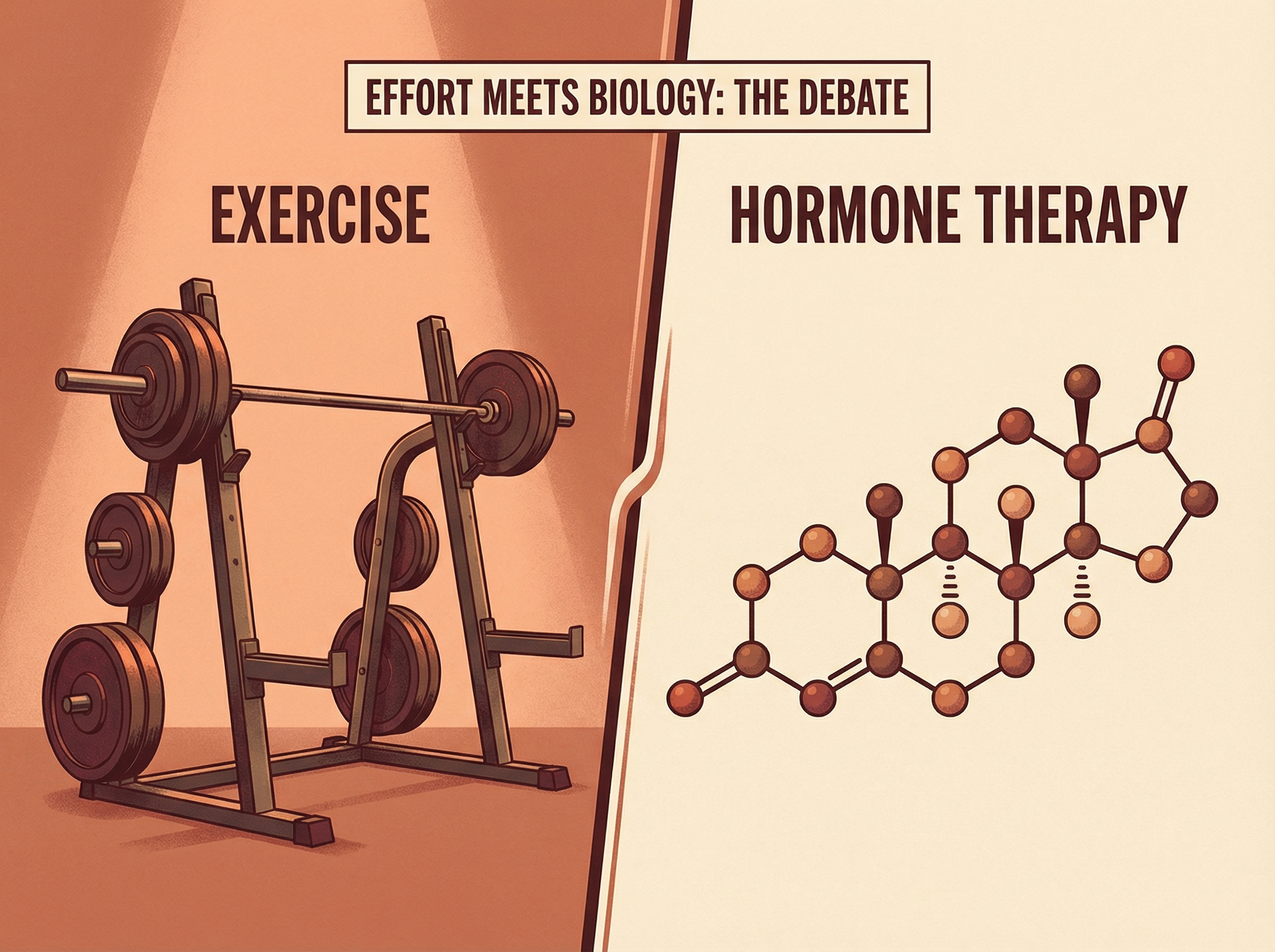
Split composition showing weights versus molecular structure, representing the TRT versus exercise debate

The testosterone replacement therapy (TRT) industry would love you to believe a prescription can substitute for a gym membership. The research disagrees—emphatically.

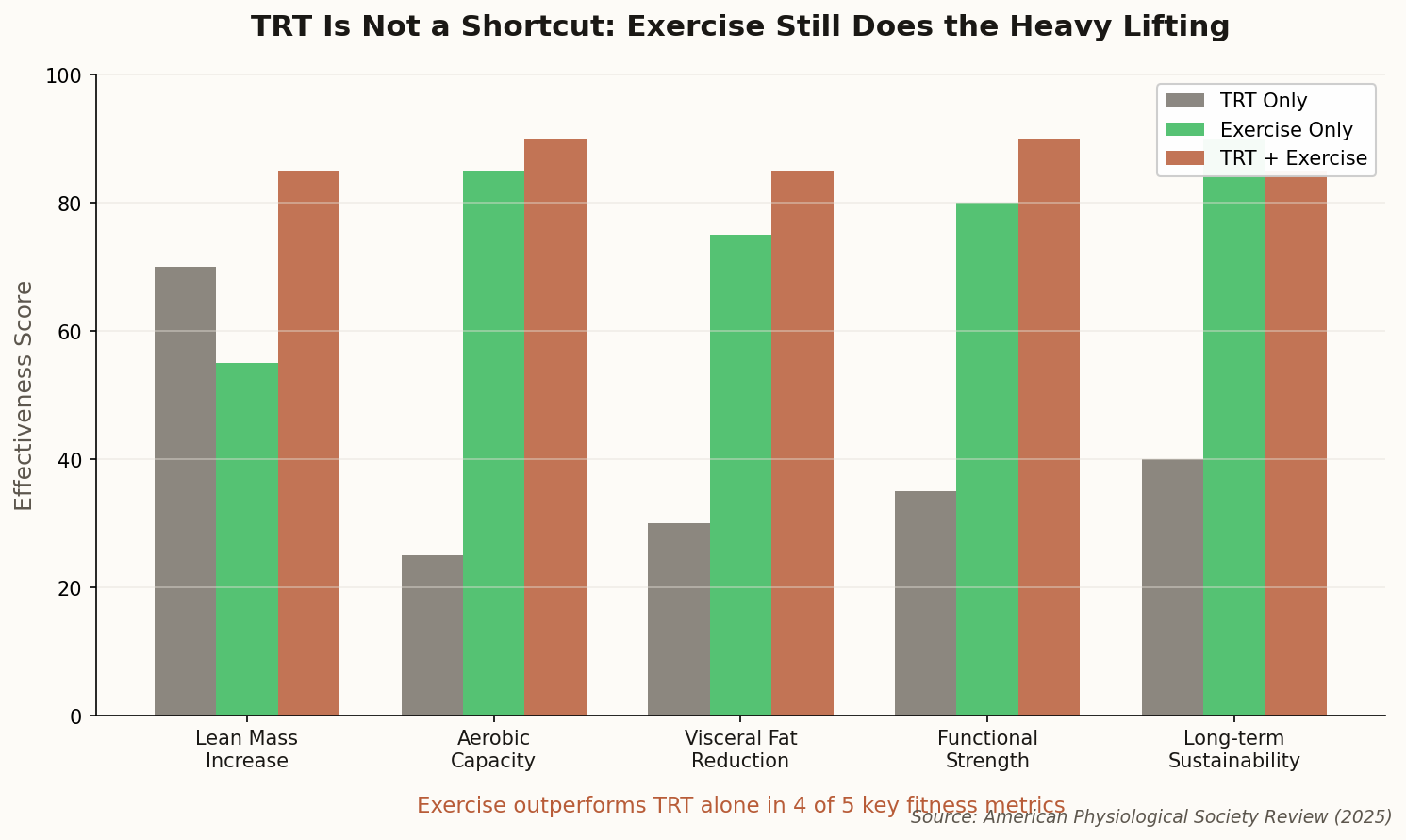
A 2025 review from the American Physiological Society confirms what exercise physiologists have long suspected: exercise outperforms TRT alone on nearly every metric that matters. Aerobic capacity? Exercise wins. Visceral fat reduction? Exercise wins. Functional strength? Exercise wins.

Comparison chart showing effectiveness of TRT alone versus exercise versus combined therapy across key fitness metrics
Exercise alone outperforms TRT alone in 4 of 5 key fitness outcomes. The combination offers marginal additional benefit—mostly in lean mass—but requires ongoing medical supervision.

TRT does increase lean mass—that part is real. But "lean mass" without the neural adaptations and functional capacity that come from actual training is a hollow victory. You'll look slightly better but move no better. For men with medically diagnosed hypogonadism, the combination of TRT plus resistance training offers the highest benefit. But TRT without exercise? That's expensive theater.

"Exercise training is more effective than TRT in increasing aerobic capacity and decreasing total and visceral fat mass." The shortcuts don't work. They never did.

06

Your Muscles Have Become Harder to Convince

Strategic breakfast plate with high-protein foods arranged to emphasize meal timing concepts

Here's a concept that should change how you eat: anabolic resistance. After forty, your muscles require a stronger signal to trigger protein synthesis. The same meal that built muscle at twenty-five now barely registers.

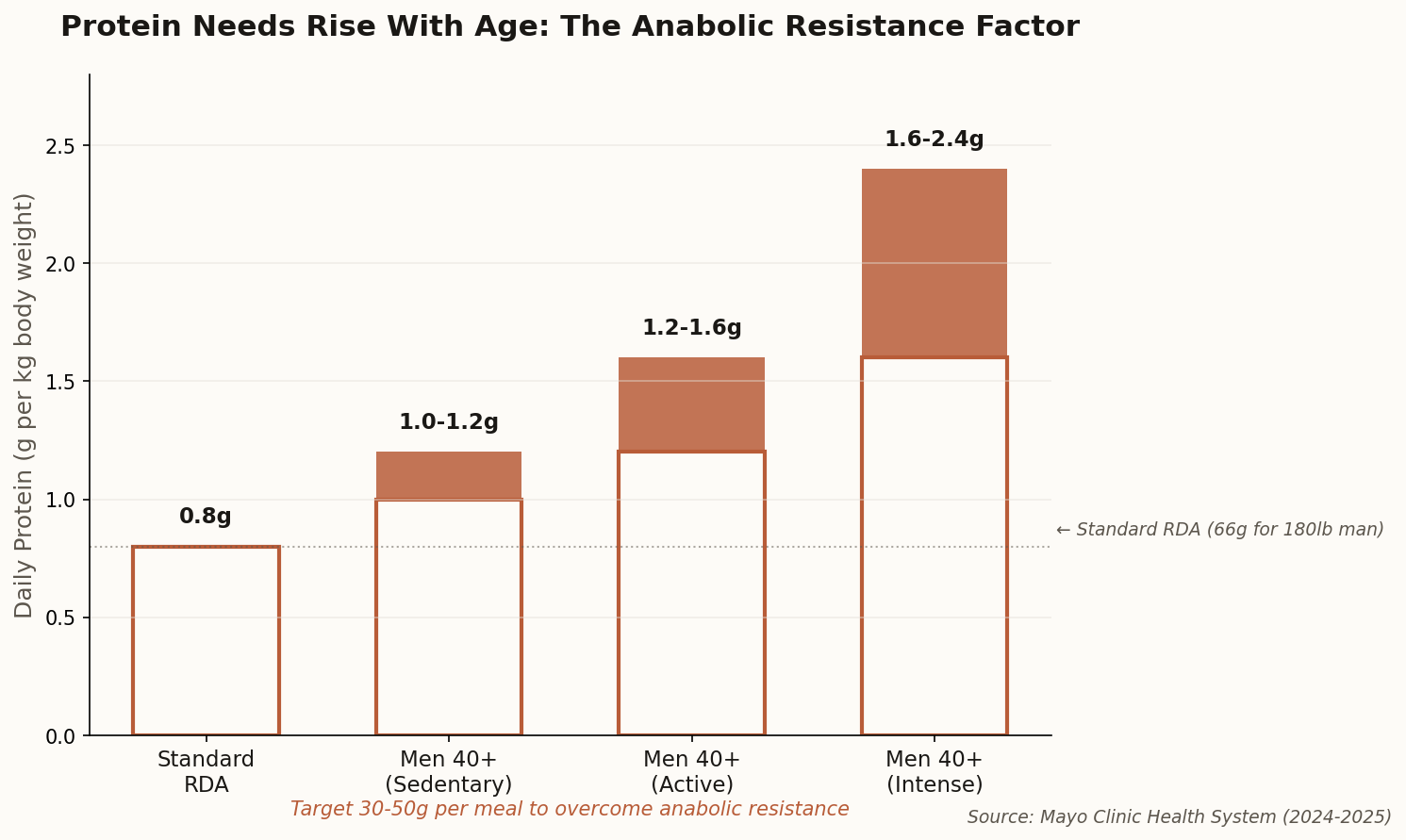
The Mayo Clinic's guidance is specific: men over forty should target 1.2-1.6g of protein per kilogram of body weight daily—scaling up to 2.4g for highly active individuals. That's nearly double the standard RDA for a sedentary adult. But the bigger insight is about distribution.

Chart showing protein requirements increasing with age and activity level, demonstrating anabolic resistance
Standard protein recommendations (0.8g/kg) fail men over 40. Hitting 30-50g per meal—especially at breakfast—is critical for overcoming anabolic resistance.

"Spreading protein intake throughout the day is crucial for optimal muscle protein synthesis." Translation: that protein shake after your workout isn't enough. You need 30-50g at breakfast to kickstart muscle repair. You need it again at lunch. And again at dinner. The all-or-nothing approach—light meals then a protein bomb post-gym—leaves muscle-building potential on the table.

For a 180-pound man, that means roughly 100-130g of protein daily, split across meals. Eggs at breakfast. Greek yogurt as a snack. Chicken at lunch. Fish at dinner. It's not complicated, but it is intentional. Your muscles have become skeptics. Convince them with evidence.

The Forty-Year Reckoning Isn't a Sentence

The science is clear: the decline that begins in your forties isn't destiny—it's a default setting you can override. The tools are unglamorous: compound movements, adequate protein, intelligent periodization, and the humility to train for the body you have rather than the body you remember. Start today. Your seventy-year-old self will know the difference.