AI · Geopolitics · Forecasting

Who Wins the AI War?

Seven companies are spending hundreds of billions to own intelligence itself. In January 2026, the scoreboard shifted in ways nobody predicted.

Listen
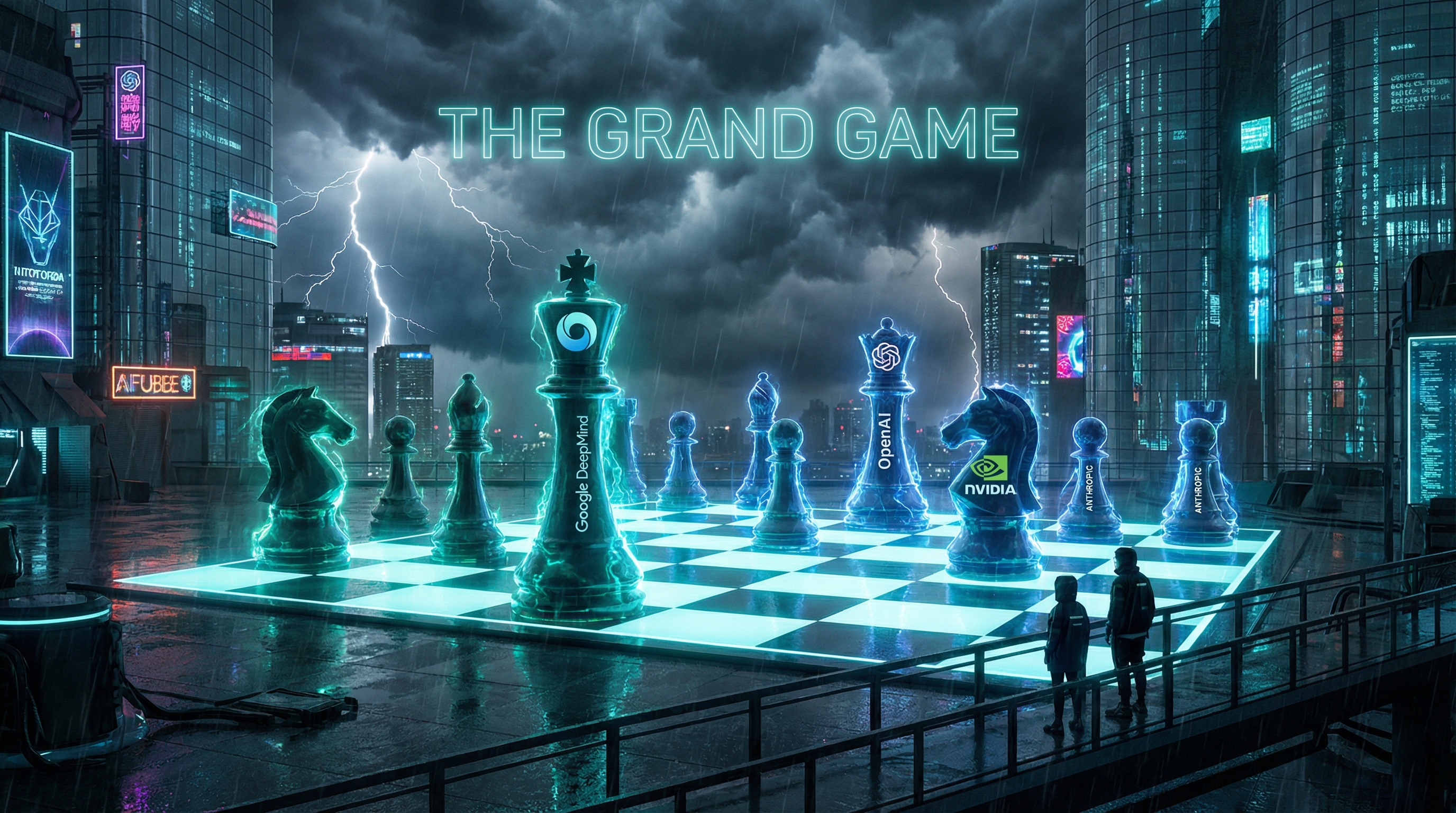
Epic chess board with AI company logos as pieces, teal and electric blue energy crackling between them
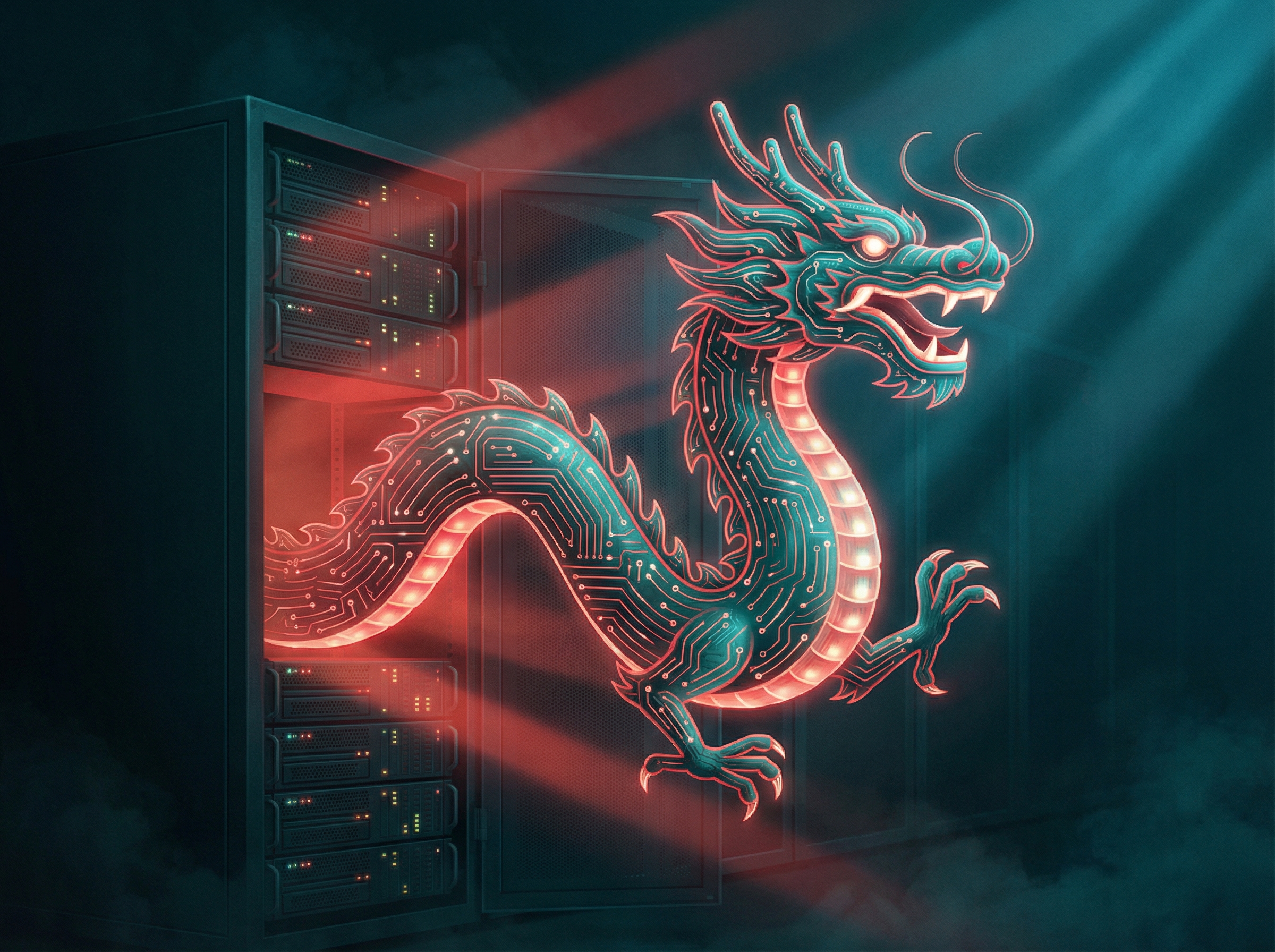
Chinese dragon made of circuit boards emerging from a server rack
01

The $25 Billion Dragon That Broke the Scoreboard

Here's the thing about the AI "war" — everyone assumed it was an arms race that only money could win. Then DeepSeek showed up with a fraction of the compute budget and a model that beats OpenAI's GPT-4.5 Turbo on coding and math benchmarks. At 40% of the inference cost. Running on consumer hardware you can buy at Best Buy.

DeepSeek-V4 is an open-weight Mixture-of-Experts model with "Silent Reasoning" — an internal chain of thought that operates without the verbose step-by-step output that makes other reasoning models slow and expensive. It handles over a million tokens of context. And it emerged from a Chinese lab operating under US chip export controls that were specifically designed to prevent exactly this outcome.

"The first fully sovereign reasoning model in terms of architecture and operation." That's how analysts described it. The chip ban strategy is cracking — not because China acquired banned chips, but because algorithmic efficiency turned out to be a potent counter to raw compute supremacy.

By January 27, the DeepSeek app had become a top download globally, and US officials were already scrambling to discuss new export controls targeting "reasoning model architectures" — a concept that barely existed in policy circles six months ago. The uncomfortable truth: you can't embargo math.

Fortress of safety shields with glowing brain at center, dollar signs floating upward
02

Safety Pays: Anthropic Hits $350 Billion

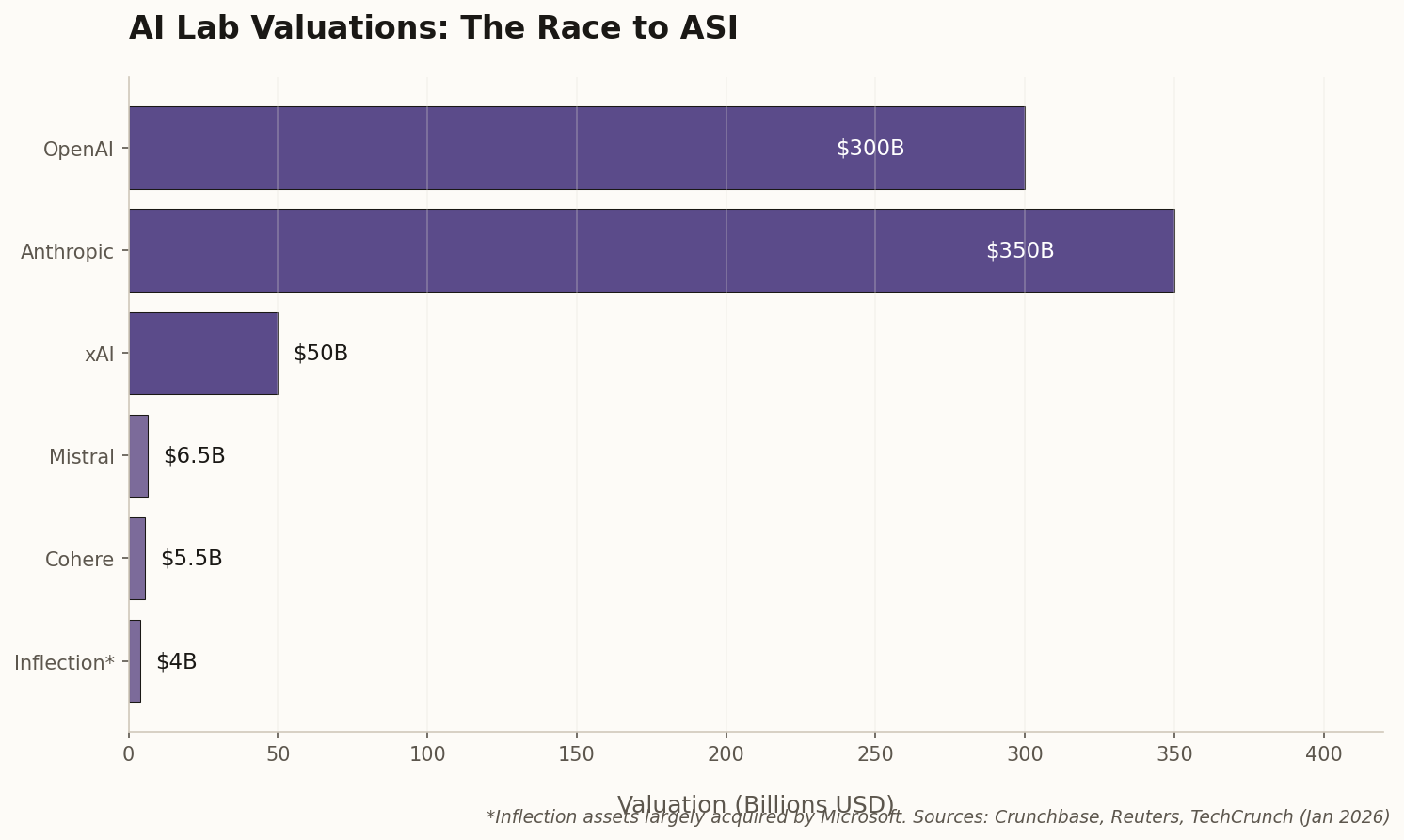
Remember when "AI safety" was dismissed as a handbrake on innovation? Anthropic just valued itself at $350 billion — nearly double the $183 billion from five months ago — and is projecting $18 billion in 2026 revenue. Some analysts see $55 billion by 2027. The "responsible AI" company is printing money faster than the "move fast and break things" crowd.

The secret isn't the safety research itself — it's what that research unlocked. Regulated industries like healthcare, finance, and government don't want the fastest model. They want the model their compliance team will sign off on. Claude for Healthcare, launched January 11, targets enterprise hospital systems where a hallucination isn't an amusing quirk but a potential liability.

Then there's Claude Cowork — an autonomous agent for complex desktop tasks that positions Anthropic not just as a chatbot vendor but as an operating system layer for knowledge work. The enterprise "safe harbor" positioning is a genuine competitive moat, and the revenue numbers prove the market agrees.

Bar chart comparing AI company valuations in January 2026
AI company valuations as of January 2026. OpenAI's IPO target leads at $1T, followed by Anthropic's $350B fundraise. Data: Economic Times, TechBuzz, analyst estimates.
Giant green chip absorbing smaller glowing speed chip
03

NVIDIA Swallows Its Fastest Rival for $20 Billion

NVIDIA didn't just win the training compute race — it decided to buy the inference race too. The $20 billion acquisition of Groq brings the Language Processing Unit (LPU) technology in-house, the same chips famous for generating tokens faster than you can read them.

This is a consolidation play with teeth. NVIDIA already dominates GPU-based training. Now by integrating Groq's inference-optimized architecture, they're positioning to own both sides of the compute equation. The message to competitors building custom inference chips: the incumbent just absorbed your most visible champion.

But here's the tension — every time NVIDIA consolidates further, it strengthens the case for DeepSeek-style algorithmic efficiency. Why pay NVIDIA's premium if a clever architecture can run on commodity hardware? The hardware moat and the software moat are locked in a race that neither can definitively win.

Vast web connecting billions of devices to a central multicolored gemstone
04

Google's Quiet Victory: Distribution Eats Benchmarks

While everyone argues about benchmark scores, Google DeepMind is playing a fundamentally different game. Gemini 3 Flash became the default model powering Google Search — which means it's now the most-used AI model on the planet, and most people using it don't even know.

Add to that: a multi-year deal to power Apple's Siri, Samsung committing to double Galaxy AI devices to 800 million using Gemini, and the open-weight release of MedGemma 1.5 for medical imaging. Google isn't trying to win the AI war by having the smartest model. It's trying to win by being the AI running inside every device you already own.

And then there's the elephant in the room: Gemini 4. Rumored to be a 100 trillion parameter model, Google is maintaining what one analyst called "a loud silence." If even half the rumors are true, the current benchmark leaderboard is about to become irrelevant.

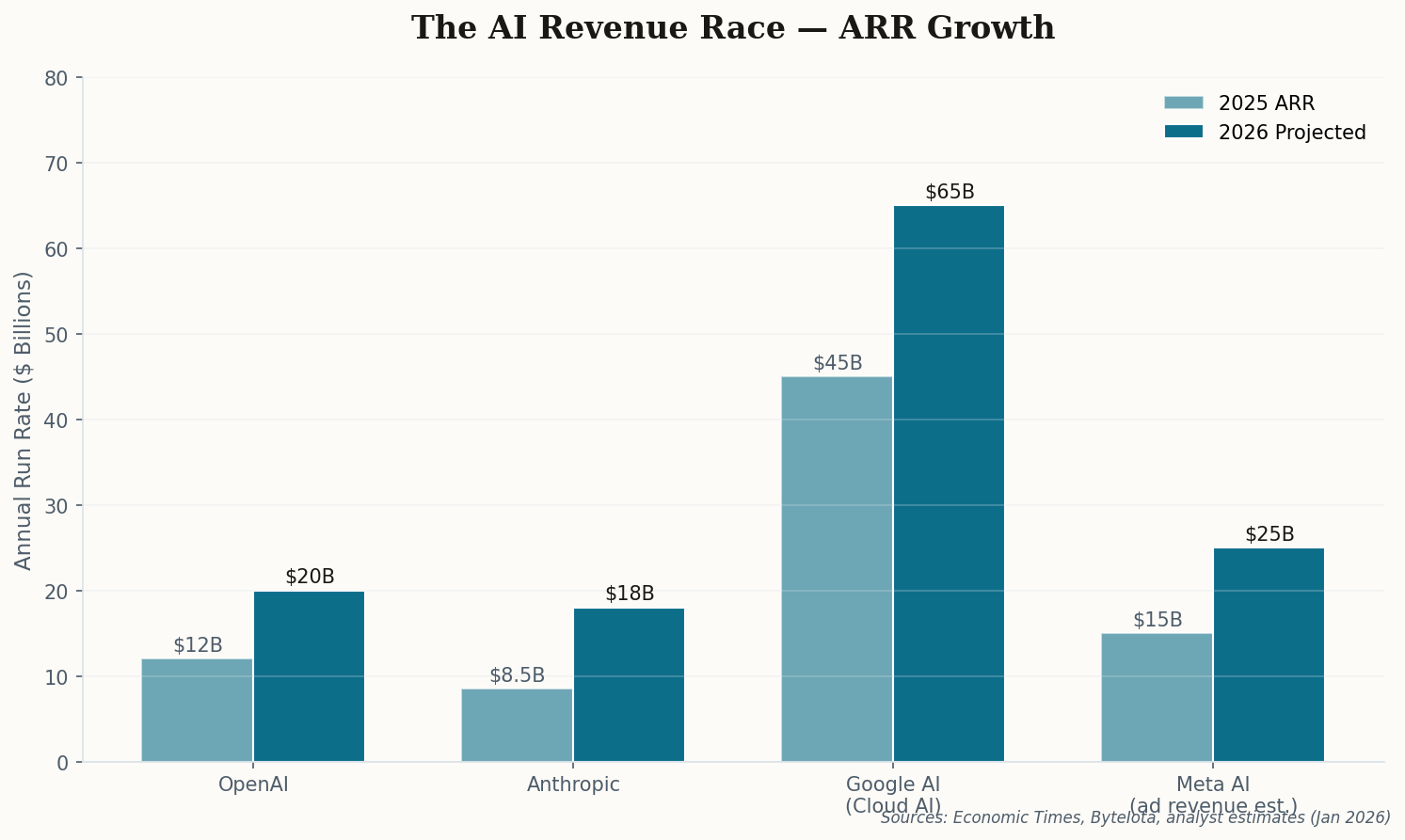
Grouped bar chart showing AI revenue race
Annual Run Rate comparison across leading AI companies, 2025 vs. 2026 projections. Google's Cloud AI division dwarfs pure-play AI labs in raw revenue. Data: analyst estimates, Economic Times, ByteIota.
Stethoscope with AI neural network wires, futuristic medical concept
05

OpenAI Wants to Be Your Doctor, Your Coder, and Your IPO of the Decade

OpenAI kicked off 2026 by launching ChatGPT Health — a consumer platform that integrates medical records and wellness apps — and then followed up with GPT-5.2-Codex going generally available in IDEs on January 26. They're simultaneously attacking healthcare, coding, and apparently consumer hardware (AI earbuds codenamed "Sweetpea" are reportedly coming later this year).

The numbers tell one story: $20 billion annual recurring revenue. Eyeing a $1 trillion valuation IPO in late 2026. But the body language tells another. Sam Altman reportedly issued a "code red" to refocus efforts against Google's Gemini, suggesting internal anxiety that distribution advantages are starting to matter more than model quality.

OpenAI's strategy is clear: go vertical, go consumer, go public. The question is whether spreading across healthcare, coding, hardware, and an IPO simultaneously is ambition or distraction. History suggests that trying to be everything to everyone usually means being best at nothing — but then again, that's what people said about Google in 2005.

Nuclear cooling tower glowing with blue energy, connected to server racks
06

Meta Buys 6.6 Gigawatts of Nuclear Power (Yes, Nuclear)

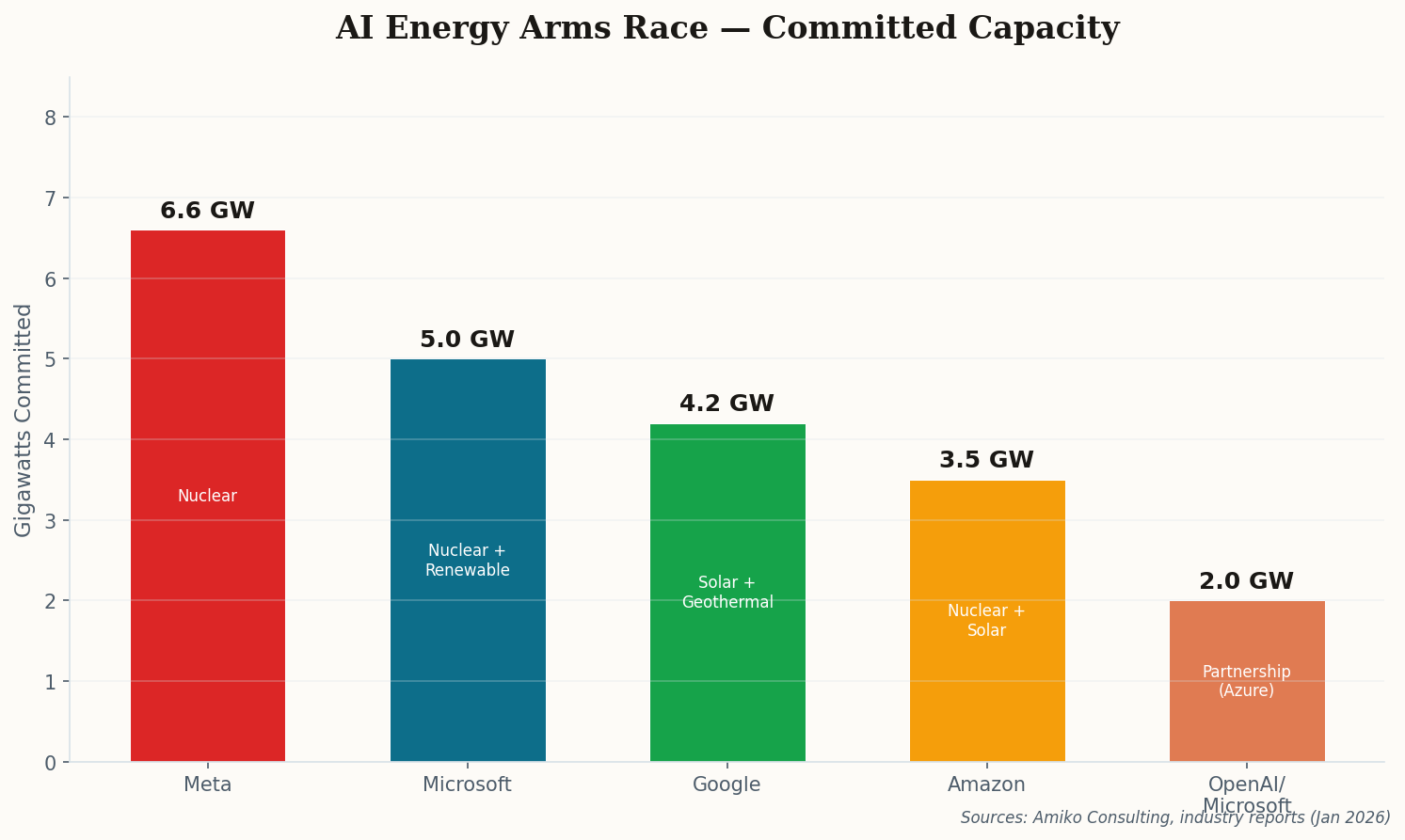
Forget model architectures for a moment. The AI war's actual bottleneck in 2026 isn't parameters or data — it's watts. Meta signed contracts for 6.6 gigawatts of nuclear energy from Vistra, TerraPower, and Oklo. That's enough to power a mid-sized city, and it's all earmarked for the Prometheus AI Supercluster in Ohio.

This is one of the largest corporate energy deals in history — and it's specifically for AI compute. The implicit admission: Meta's open-source AI strategy (Llama models) requires compute-at-scale that the existing energy grid simply cannot guarantee. So they're building their own.

Bar chart showing AI company energy commitments in gigawatts
Energy infrastructure commitments by major AI companies. Meta leads with 6.6 GW nuclear, followed by Microsoft and Google with diversified portfolios. The AI industry is becoming an energy industry. Data: Amiko Consulting, industry reports.

When tech companies start building nuclear power plants, you know the stakes have changed. The AI war isn't just about who has the best algorithm — it's about who can physically power the compute required to train and serve next-generation models. The companies that secured energy deals in 2025-2026 may have the most durable competitive advantage of all.

Robot hand reaching from laptop to shake human hand, floating task cards around
07

The Chatbot Is Dead. Long Live the Agent.

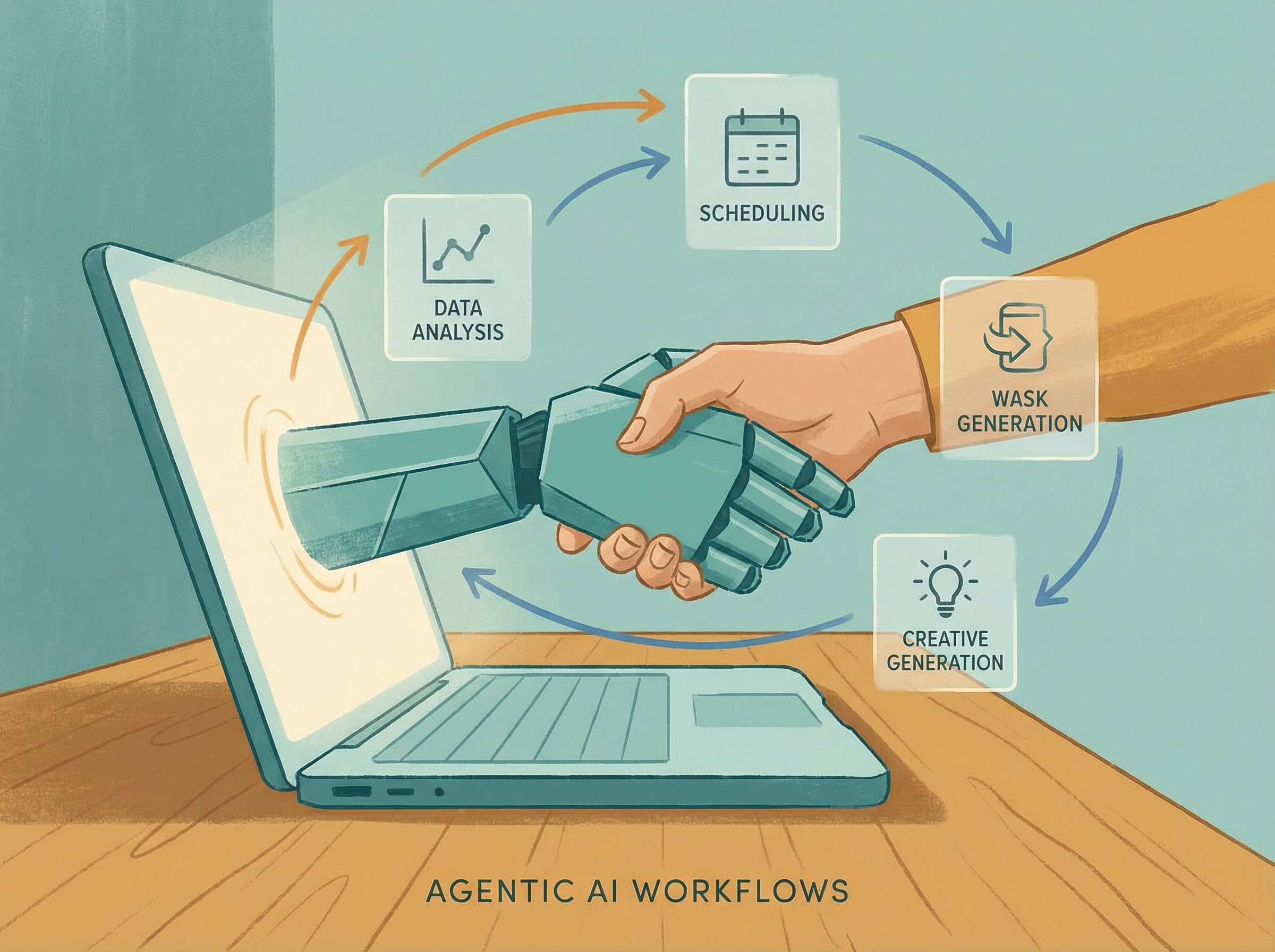
If 2025 was the year of "reasoning models," 2026 is the year of "agentic AI" — systems that don't just answer your questions but plan, act, and coordinate on your behalf. The shift isn't incremental. It's a category change in what AI products actually do.

Google launched GenTabs (internally "Disco"), a browser agent that navigates websites and completes tasks. Anthropic shipped Claude Cowork for autonomous desktop operations. NVIDIA dropped Cosmos at CES 2026 — foundation models specifically for "physical AI" meaning robots that can navigate and manipulate the real world.

The implication for the AI war is profound. When AI shifts from "ask and receive" to "assign and forget," the winner isn't necessarily the company with the best language model. It's the company with the best execution framework — the one whose agents can reliably complete 50-step workflows without hallucinating in step 23. That's an entirely different engineering challenge, and the leaderboard is wide open.

So Who's Winning?

Everyone and no one. Google has distribution. OpenAI has brand. Anthropic has enterprise trust. DeepSeek has efficiency. Meta has energy. NVIDIA has the hardware layer. The uncomfortable answer is that the AI war in 2026 doesn't have a single front — it has six. And the company that wins the final battle may be the one nobody's talking about yet, because the real moat isn't intelligence. It's infrastructure, distribution, and the ability to ship agents that don't break. The scoreboard will look completely different in six months. Set your watch.