
History · Pandemic · 1918

The World Forgot

In 1918, a virus killed more people in 24 weeks than HIV/AIDS killed in 24 years. Then humanity did something even more remarkable: it pretended nothing happened.

Listen
A haunting, atmospheric scene of an empty 1918 city street at dusk, abandoned storefronts with gauze masks visible, fog rolling through deserted streets
Massive crowd gathered on a wide city boulevard for the 1918 Liberty Loans parade in Philadelphia
01

The Parade That Killed a City

On the morning of September 28, 1918, Philadelphia's public health director Dr. Wilmer Krusen faced one of history's most consequential judgment calls. Influenza was already circulating in the city. Navy doctors at the Philadelphia Navy Yard had warned him. And 200,000 people were about to line Broad Street for the Liberty Loans Parade — the largest parade in the city's history.

He let it proceed. Patriotic duty, he reasoned, outweighed unconfirmed risk.

Within 72 hours, every bed in Philadelphia's 31 hospitals was full. Within one week, 2,600 were dead. By the end of October, more than 12,000 Philadelphians had perished. Morgues overflowed. Bodies were stacked on porches because families had nowhere to put them. Priests drove horse-drawn carts through neighborhoods, calling for the dead like medieval plague collectors. The city dug mass graves with steam shovels.

Philadelphia's peak death rate hit 257 per 100,000 per week. Compare that to St. Louis, where health commissioner Dr. Max Starkloff closed schools, theaters, and churches within two days of the first civilian cases. St. Louis peaked at 31 per 100,000 — roughly one-eighth of Philadelphia.
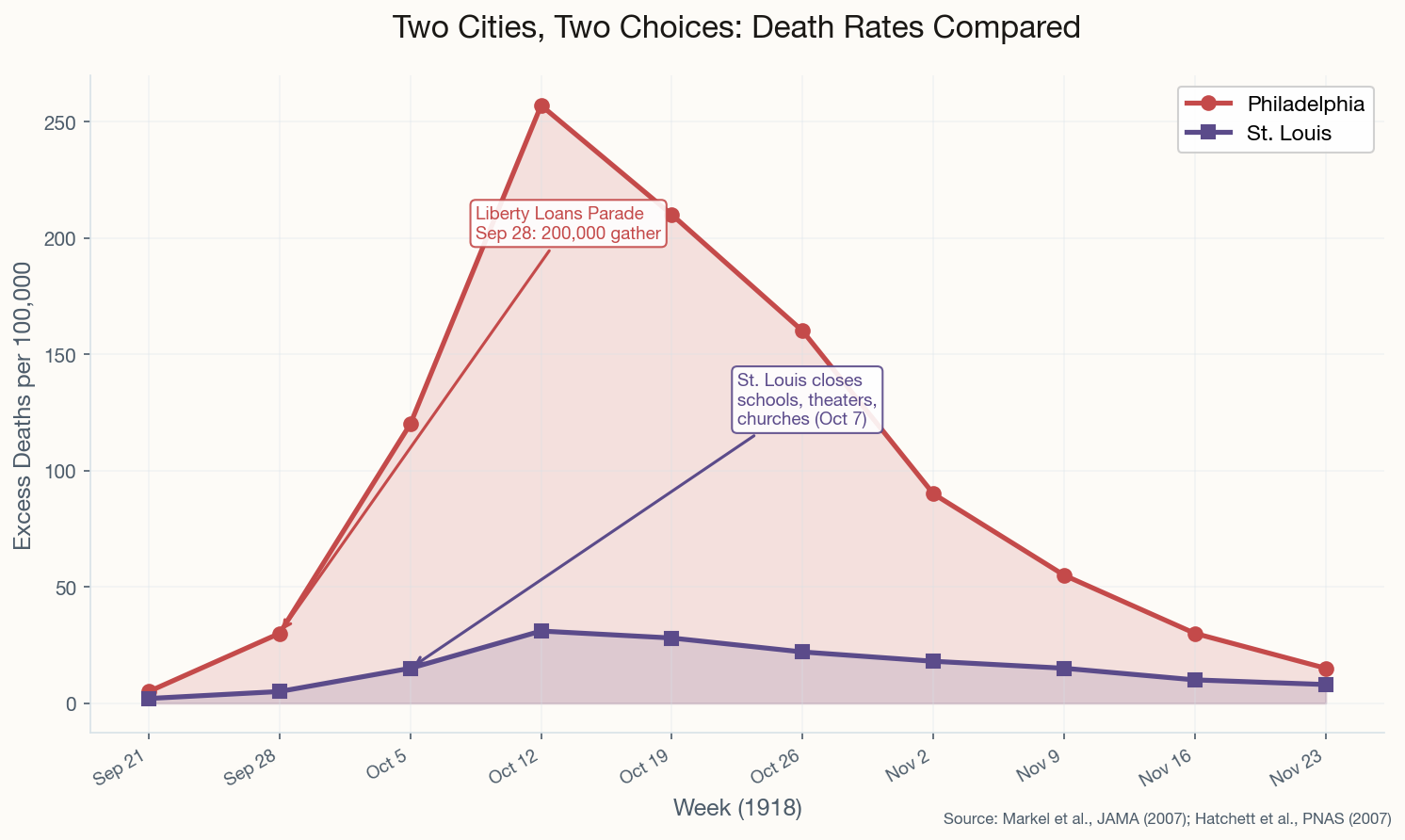
Chart comparing weekly death rates between Philadelphia and St. Louis during the 1918 pandemic, showing Philadelphia's dramatic spike after the Liberty Loans Parade
Two cities, two choices. Philadelphia allowed its Liberty Loans Parade on September 28; St. Louis closed public gathering places within days of the first cases. The death rates tell the story. Source: Markel et al., JAMA (2007).

This wasn't a tragedy of ignorance. It was a tragedy of priorities. Krusen had the information. He chose war bond sales over public health. A landmark 2007 study by Howard Markel et al. in JAMA later confirmed the pattern across 43 cities: early, sustained interventions saved lives. Period. This case study became the foundation for "flatten the curve" a century later during COVID-19. The lesson was always there. We just had to relearn it.


Military barracks at Camp Funston Kansas 1918, rows of army cots stretching into the distance
02

Patient Zero and the Mystery of Origins

On the morning of March 11, 1918, a company cook named Albert Gitchell reported to the infirmary at Camp Funston, Fort Riley, Kansas, complaining of a "bad cold." Sore throat, fever, headache. By noon, 107 soldiers were sick. By the end of the week, 522. Gitchell is conventionally cited as the first recorded case of the pandemic — though that label is almost certainly wrong.

Historian John Barry has argued convincingly that the virus likely originated weeks earlier in Haskell County, Kansas, a rural farming community 300 miles to the southwest. There, a country doctor named Dr. Loring Miner encountered influenza cases severe enough that he took the extraordinary step of alerting the U.S. Public Health Service — "the first recorded instance anywhere in the world of influenza so unusual that a physician reported it to public health authorities," Barry writes. Young men from Haskell County then reported to Camp Funston for military training, carrying the virus with them.

But the origin question runs deeper. Virologist John Oxford of Queen Mary University has pointed to the massive British military base at Étaples, France, where soldiers, horses, pigs, and poultry lived in close quarters — a potential breeding ground for interspecies viral recombination. Historian Mark Humphries documented a respiratory illness among the 96,000 Chinese laborers (the Chinese Labour Corps) transported to the Western Front. The honest answer is that we don't know where it started. What we do know is that World War I — with its troop ships, trenches, and global movement of millions — was the accelerant that turned a local outbreak into a planetary catastrophe.

Emergency hospital ward during 1918 influenza pandemic, dozens of beds in a converted gymnasium
03

When the Virus Learned to Kill

The spring wave was a rehearsal. Most patients recovered in three to five days. It was remarkably contagious but not especially lethal. Then summer came and the virus seemed to vanish. And then — in September 1918 — it returned as something entirely different.

On August 27, 1918, severe influenza cases appeared simultaneously at three port cities on three continents: Boston (Commonwealth Pier), Freetown, Sierra Leone, and Brest, France. This near-simultaneous emergence meant the mutated virus was already in global circulation before anyone recognized it. By September 14, Camp Devens — 30 miles outside Boston — saw 1,543 soldiers report sick in a single day. The camp hospital, built for 1,200, held 8,000.

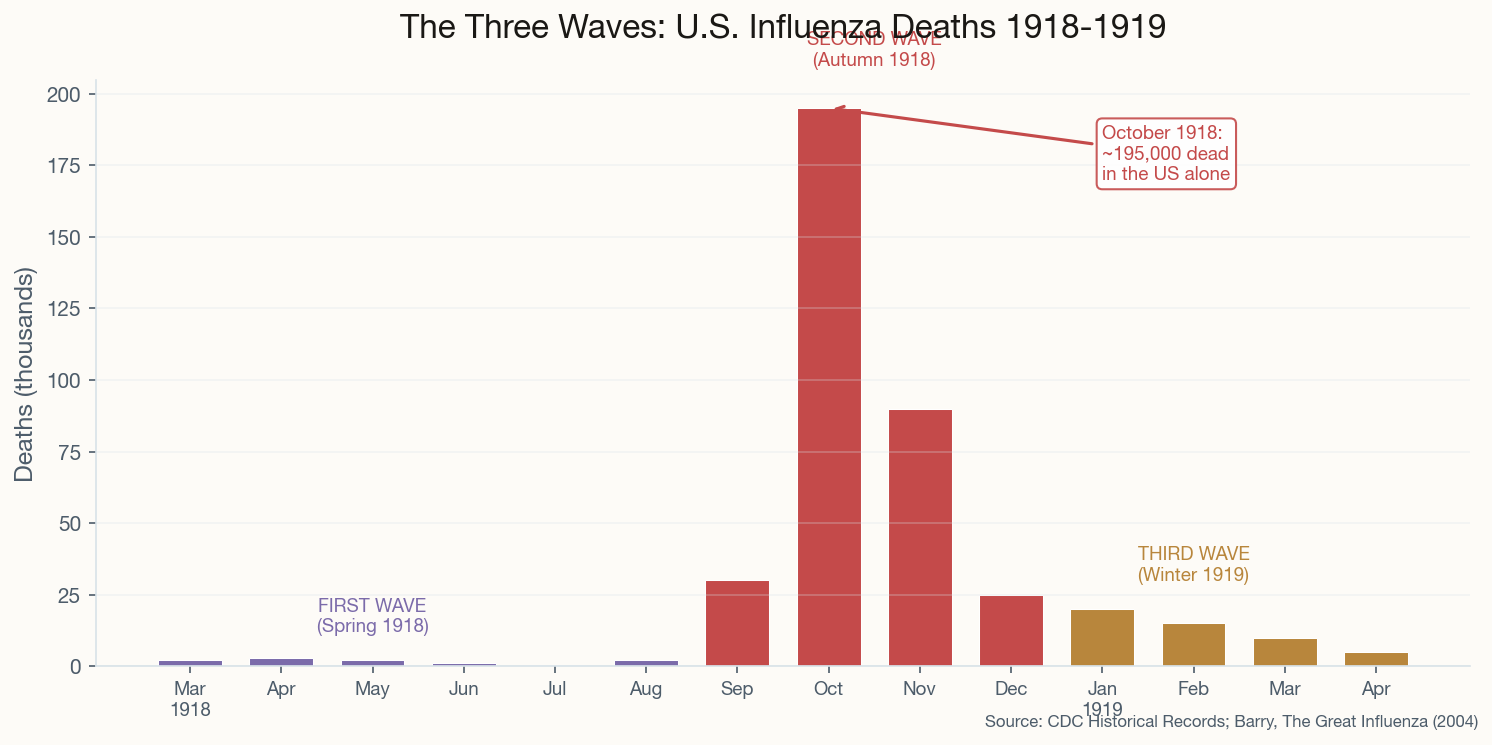
Bar chart showing the three waves of the 1918 pandemic: mild spring wave, catastrophic autumn wave with 195,000 US deaths in October alone, and moderate winter wave
The three waves of the 1918 pandemic. The second wave, September-November 1918, killed more Americans in a single month (October: ~195,000) than any month in the nation's history. Source: CDC Historical Records; Barry, The Great Influenza (2004).

What happened? The prevailing theory is viral mutation through "passage". Under normal evolutionary pressure, a virus that kills its host too quickly can't spread efficiently. But World War I inverted that logic: soldiers too sick to fight were evacuated from trenches to crowded field hospitals, then to rear-area hospitals, then to home-country hospitals. The sickest soldiers got the most transport and exposure to new hosts. The virus was rewarded for being lethal. Jeffery Taubenberger later confirmed the second-wave virus was genetically distinct — mutations in the hemagglutinin protein enhanced its ability to invade deep lung tissue.

October 1918 was the deadliest month in American history. An estimated 195,000 Americans died of influenza in that single month. The Armistice ending World War I came on November 11 — by which point the virus had already claimed far more lives than four years of industrial warfare.

Abstract medical illustration of immune system overdrive, white blood cells flooding lung tissue like a tidal wave
04

Your Immune System Was the Weapon

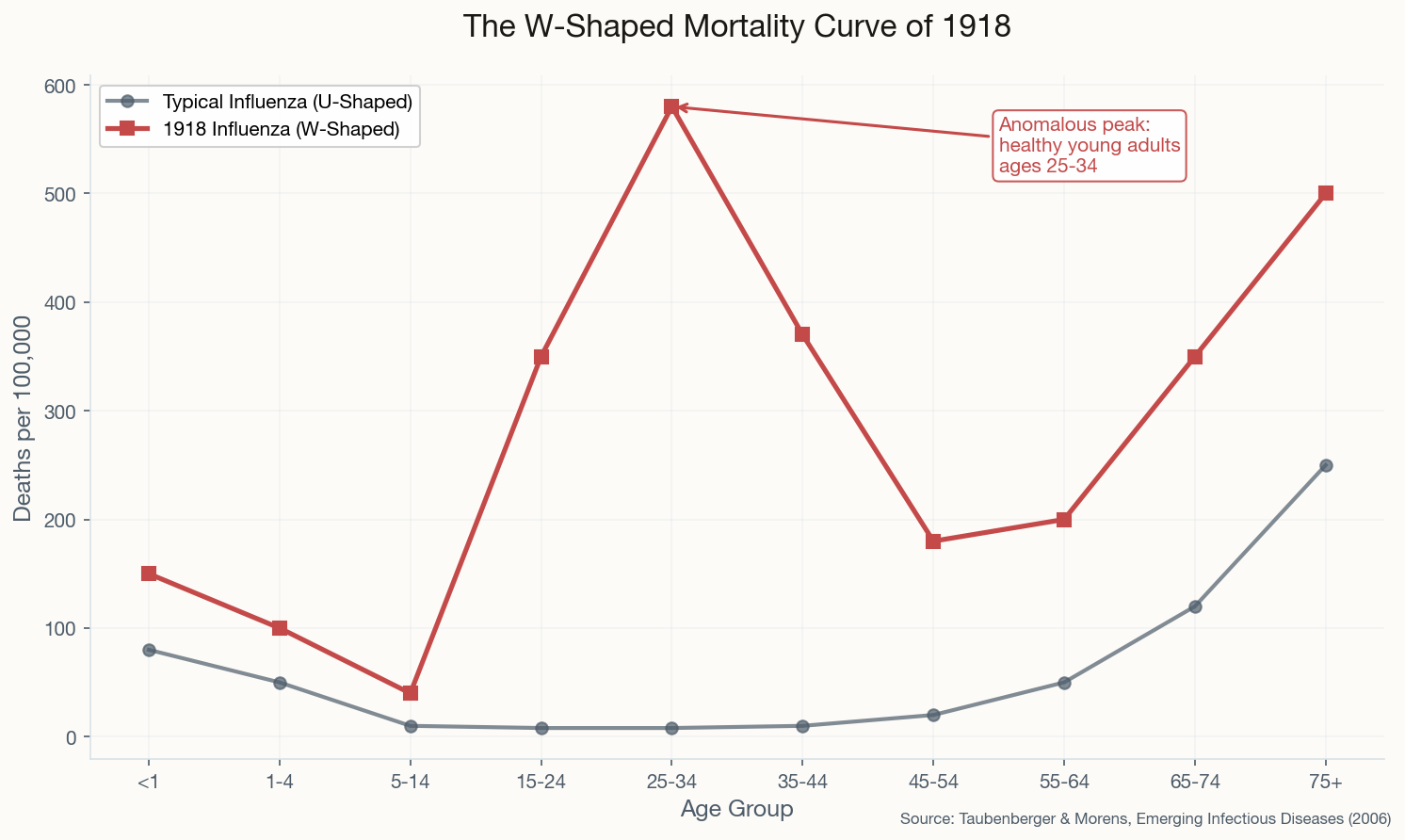
Typical influenza kills at the extremes: the very young and the very old, tracing a U-shaped curve on a mortality graph. The 1918 pandemic drew a W — with a massive, anomalous peak among adults aged 25 to 34. The healthiest, strongest people in the population were dying at the highest rate. This was, and remains, the most medically baffling feature of the pandemic.

Chart comparing the W-shaped mortality curve of the 1918 pandemic with the typical U-shaped curve of seasonal influenza, showing the anomalous spike in deaths among 25-34 year olds
The signature of the 1918 pandemic: a W-shaped mortality curve with a devastating peak among healthy young adults. Normal influenza (gray) kills the very young and very old. The 1918 virus (red) added an enormous spike in the demographic that should have been safest. Source: Taubenberger & Morens, Emerging Infectious Diseases (2006).

The leading explanation is the cytokine storm hypothesis. The 1918 virus triggered a massive overreaction of the immune system. The body's defense mechanisms flooded the lungs with fluid and inflammatory cells, drowning the patient from within. The stronger the immune system, the more violent the self-attack. Young adults — with the most robust immune responses — mounted the most devastating reactions. Their own biology was the murder weapon.

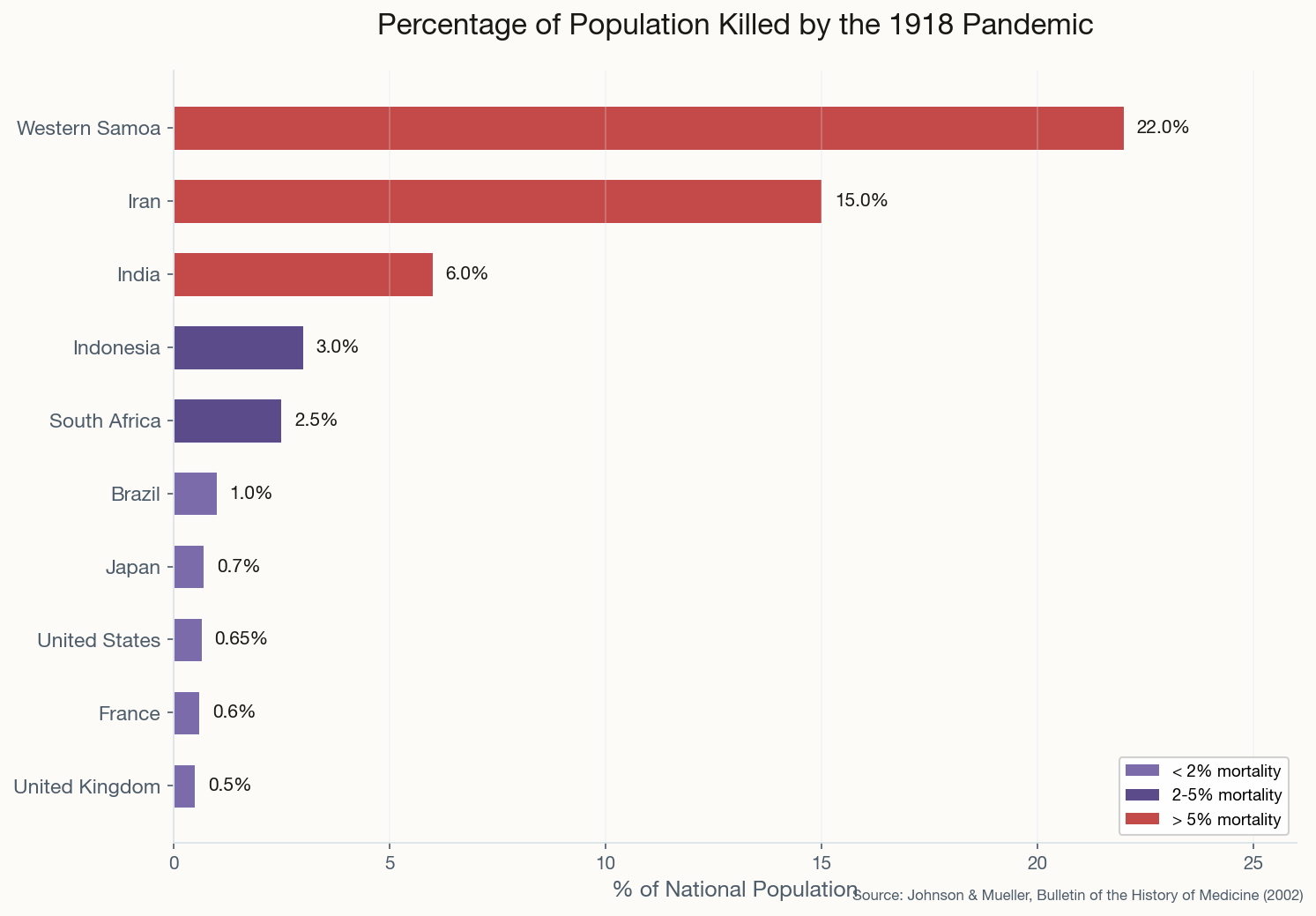
The numbers are staggering. In the United States, average life expectancy dropped by 12 years in 1918, from 51 to 39. Globally, the pandemic killed between 50 and 100 million people — at a time when the world's total population was 1.8 billion. India alone lost 17–18 million. Western Samoa lost 22% of its entire population. More people died of influenza in 1918–1919 than died in combat in all four years of World War I.

Horizontal bar chart showing percentage of national population killed by the 1918 pandemic across different countries, with Western Samoa at 22% and Iran at 15%
The pandemic's reach was global but wildly uneven. Western Samoa lost nearly a quarter of its people. India lost 6% — which, given its population, translated to 17–18 million dead. Source: Johnson & Müller, Bulletin of the History of Medicine (2002).
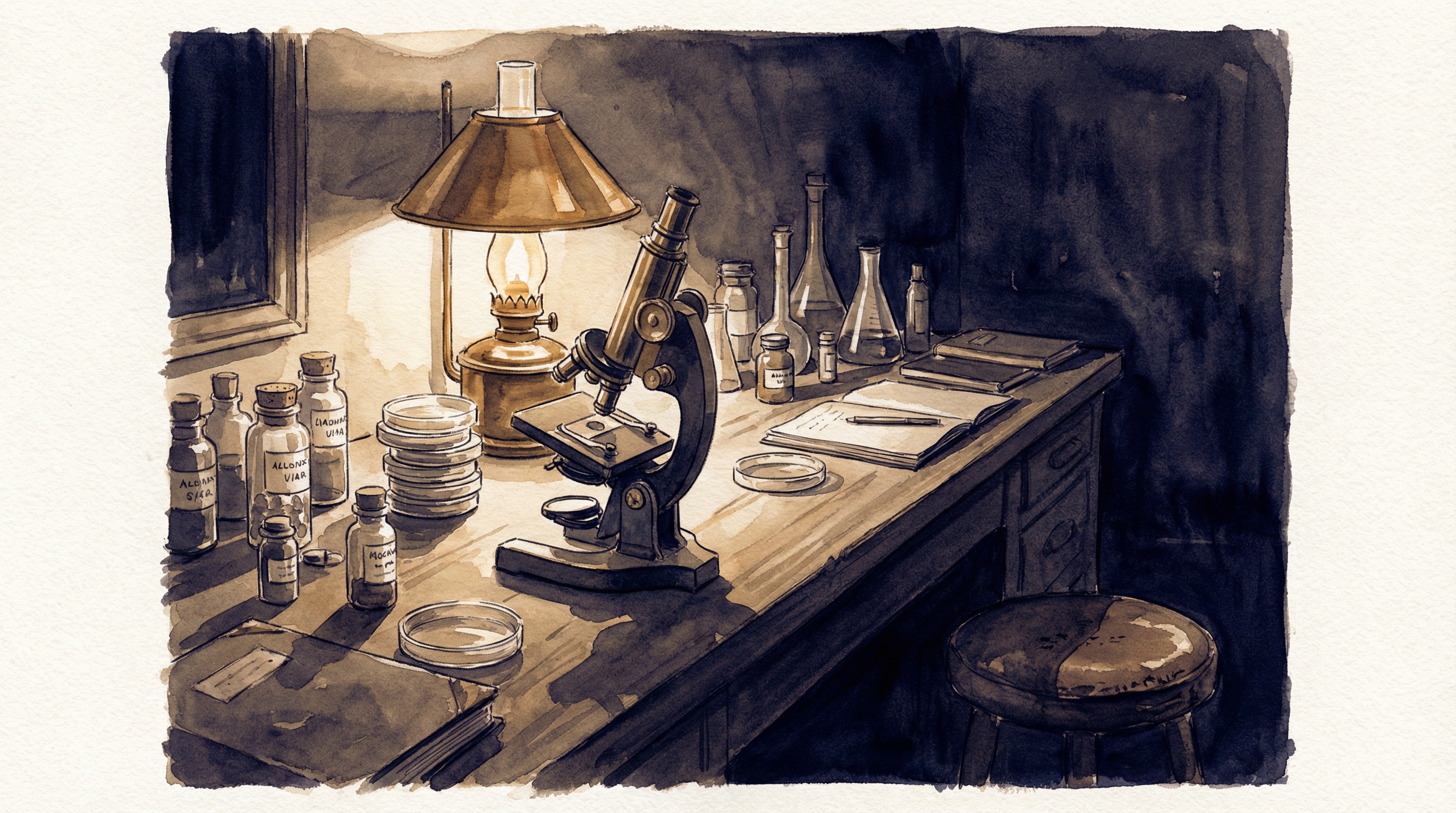
A 1918 laboratory bench with brass microscope, petri dishes, and glass vials, warm lamplight against deep shadows
05

The Science That Couldn't Save Them

In September 1918, the most respected doctor in America — William Henry Welch, dean of Johns Hopkins School of Medicine, founding member of the Rockefeller Institute — performed autopsies at Camp Devens on soldiers killed by influenza. He found lungs unlike anything in medical literature: "gruesome, swollen, filled with a thin, bloody fluid." Welch, a man who had spent his career projecting calm authority, turned to his colleague and said: "This must be some new kind of infection, or plague." By all accounts, he was visibly frightened.

Victor Vaughan, Acting Surgeon General of the Army, would later write: "If the epidemic continues its mathematical rate of acceleration, civilization could easily disappear from the face of the earth within a matter of a few more weeks."

These men weren't fools. They were the best scientists of their era, working within the limits of their tools. Germ theory was established. Bacteriology was well-developed. But virology essentially didn't exist. The influenza virus was invisible under existing microscopes — the electron microscope wouldn't arrive until the 1930s. The scientific consensus held that influenza was caused by Pfeiffer's bacillus (Haemophilus influenzae), a bacterium identified during an earlier pandemic. It was, in fact, a secondary invader, not the cause. The actual virus would not be isolated until 1933, when Wilson Smith, Christopher Andrewes, and Patrick Laidlaw finally identified it in London.

The medical toolkit was barren: no antibiotics (penicillin discovered 1928, available 1940s), no antivirals, no flu vaccine (first developed 1940s), no mechanical ventilators. Most deaths came from secondary bacterial pneumonia — the virus destroyed respiratory tissue, letting bacteria pour in. Had antibiotics existed, millions might have been saved. As it was, the most critical intervention available was basic nursing care: keeping patients hydrated, warm, and clean. Nurses were the true heroes — and they died at alarming rates.

An old photograph fading at the edges, faces becoming indistinct, memory dissolving into the roaring twenties
06

The Pandemic the World Chose to Forget

This is perhaps the most extraordinary part of the story. A catastrophe that killed 50–100 million people — more than any single event in human history short of World War II — was almost completely erased from public memory within a decade.

No major national memorials were erected. No great novels of the era centered on it. (Contrast this with the flood of WWI literature: Hemingway, Remarque, Owen, Sassoon.) History textbooks barely mentioned it until the late 20th century. When historian Alfred Crosby published his groundbreaking study in 1989, he titled it America's Forgotten Pandemic — and the title was accurate. The pandemic had fallen into a historical blind spot.

Why? Several factors converged. The Armistice ended WWI on November 11, 1918 — exactly when the pandemic was peaking. Celebration overwhelmed mourning. The virus killed quickly, randomly, and without a visible enemy, which defied the narrative structures that help societies process trauma. (Wars have villains; plagues just have math.) And the 1920s arrived with a deliberate cultural turn toward optimism — jazz, prosperity, forgetting. Historian Laura Spinney argues in Pale Rider that the pandemic was also overshadowed by shame: the medical establishment had failed spectacularly, and no one wanted to dwell on it.

It took until 2004 — 86 years — for John Barry's The Great Influenza to restore the pandemic to mainstream historical consciousness. And it took another pandemic, COVID-19, to make people actually read it.

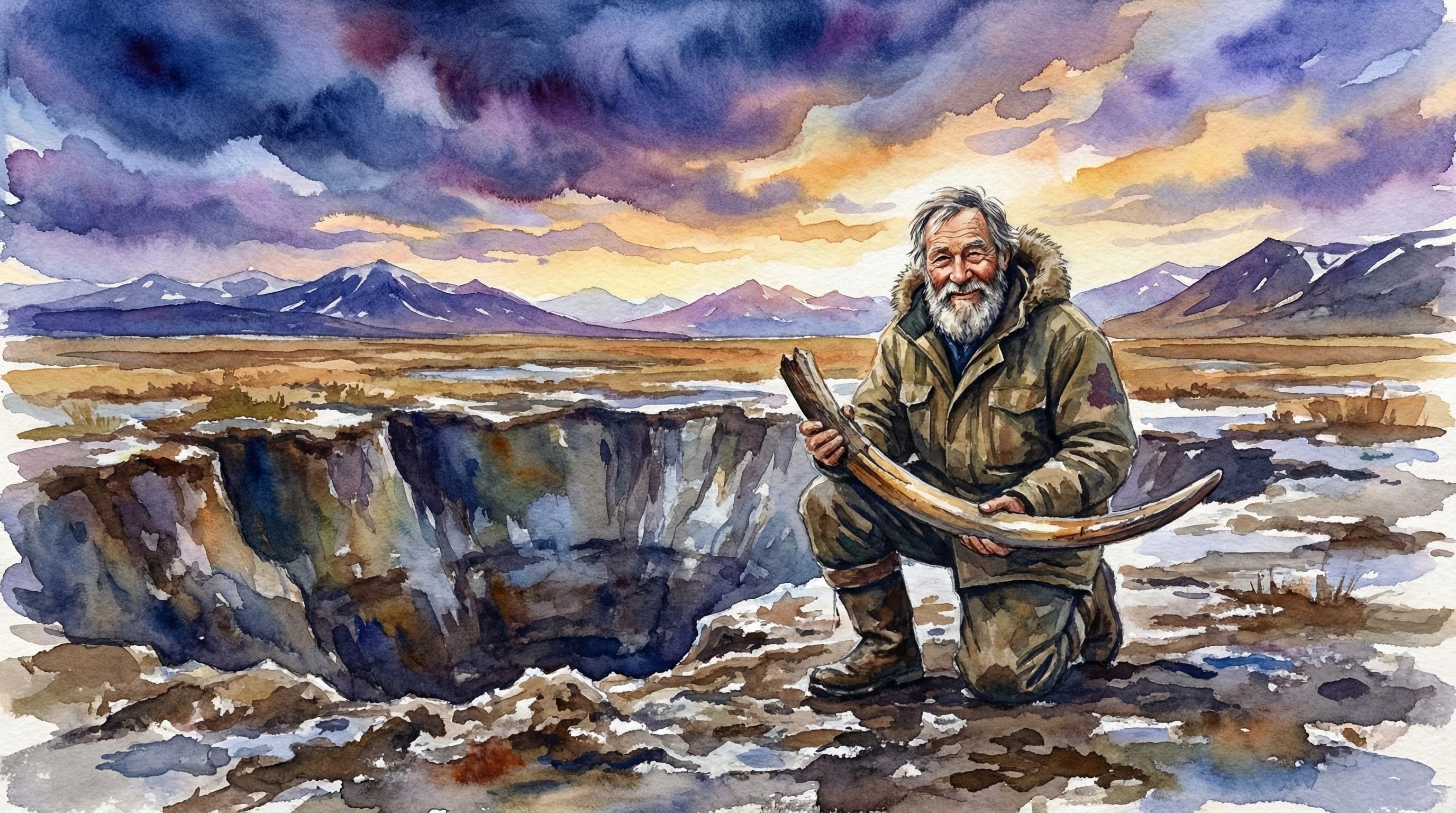
An elderly man standing at the edge of an Alaskan permafrost excavation site, vast tundra stretching behind him
07

The Virus Hunter of Brevig Mission

In 1951, a 25-year-old Swedish-American graduate student named Johan Hultin traveled to Brevig Mission, Alaska — a tiny village where, in November 1918, 72 of approximately 80 adult residents had died in a single week. A 90% mortality rate. The dead were buried in a mass grave in the permafrost, and Hultin had an audacious idea: excavate the grave, recover preserved lung tissue, and isolate the 1918 virus.

He dug into the frozen earth. He found tissue. He tried to culture the virus in fertilized hen eggs, the standard technique. It didn't work. The technology to work with degraded RNA simply didn't exist. Hultin went home, became a pathologist in San Francisco, and waited.

For 46 years.

In 1997, molecular pathologist Jeffery Taubenberger at the Armed Forces Institute of Pathology published a paper in Science announcing that he and colleague Ann Reid had extracted partial viral RNA from preserved lung tissue of soldiers who died in 1918. Johan Hultin, now 72 years old, read the paper. He immediately wrote to Taubenberger. He would go back to Alaska.

With $3,200 of his own money, Hultin returned to Brevig Mission and re-opened the mass grave. This time, he found what he needed: a woman — he named her "Lucy" — whose body fat had protected her organs in the permafrost. Her lung tissue contained intact viral RNA. Hultin shipped the samples to Taubenberger. By 2005, the complete genome of the 1918 virus was published simultaneously in Science and Nature. Terrence Tumpey at the CDC then did what some called unthinkable: he reconstructed the live 1918 virus in a biosafety level 3+ laboratory, confirming it was an H1N1 avian influenza that had adapted directly to humans.

The persistence is what gets you. A 25-year-old failing, waiting nearly half a century, then — at 72 — spending his own money to finish what he started. Science is not always a sprint. Sometimes it's a life's work that pays off on someone else's timeline.

The Final Lesson

John Barry wrote the sentence that should be carved above the door of every public health agency on Earth: "The final lesson of 1918, a simple one yet the most difficult to execute, is that those in authority must retain the public's trust. The way to do that is to distort nothing, to put the best face on nothing, to try to manipulate no one." The 1918 pandemic killed tens of millions. The lies told about it killed more. A century later, we're still learning that lesson.