AI Presentations & Narrative

Your Slides Have No Soul

AI can generate a deck in 30 seconds. It still can't tell a story worth hearing. Here's what's changing — and what you need to do about it.

Listen
Abstract illustration of narrative threads weaving through floating presentation slides, violet and indigo palette
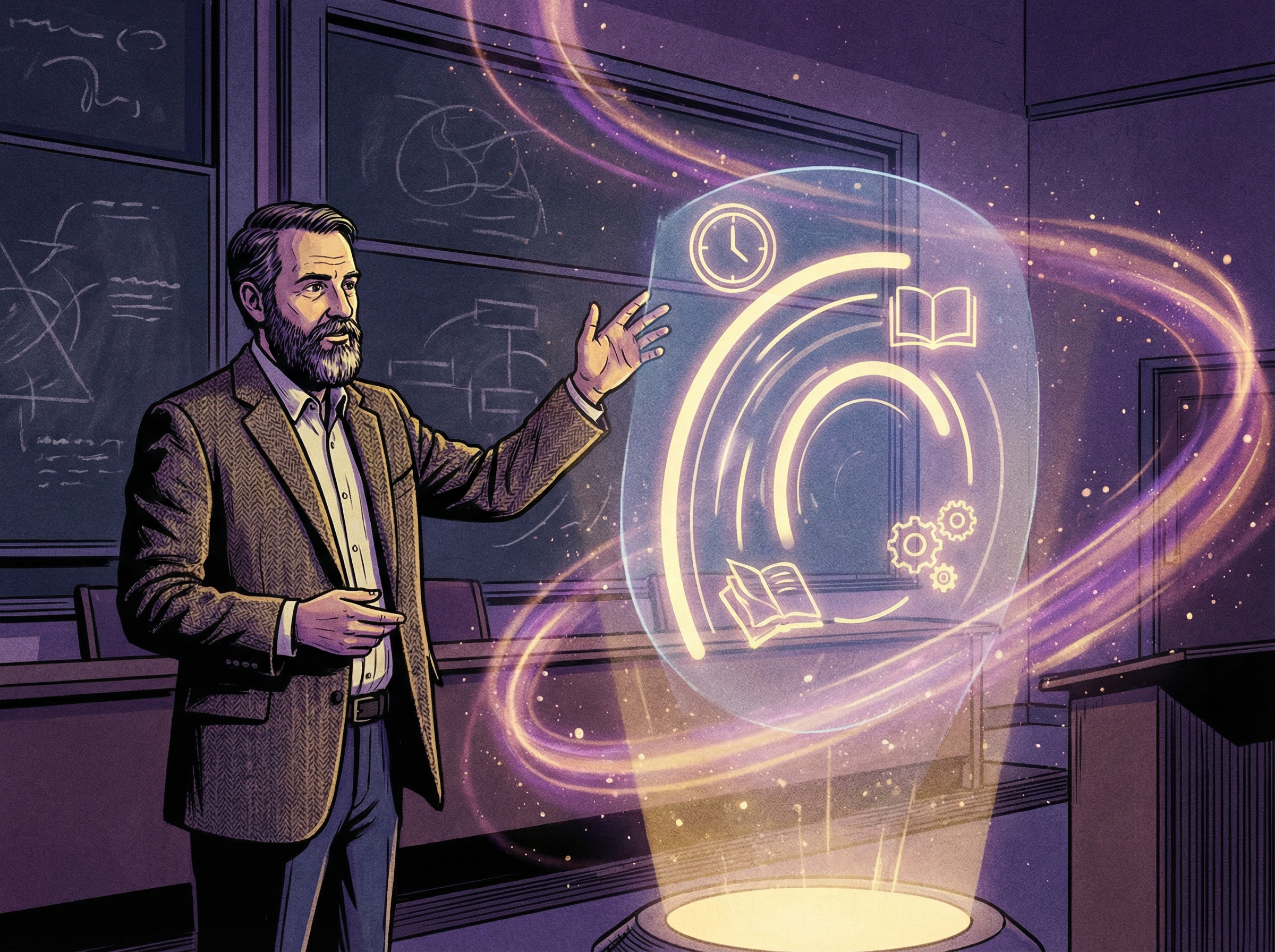
Professor before holographic display with simplified story arcs
01

The Professor Who Let AI Write the Story Arc

Here's the uncomfortable truth about academic presentations: most of them are terrible. Not because professors lack expertise — they have too much of it. The curse of knowledge turns every lecture into a dense forest of jargon, where students can't see the trees, let alone the path through them.

De Montfort University's Irina Gokh has been making the case that AI's real gift to academia isn't speed — it's clarity. Her argument is worth hearing: when you ask an AI to help structure a presentation, you're forced to articulate your expertise in terms a machine can parse. That parsing, it turns out, often produces a cleaner narrative arc than the expert would construct alone. "Used thoughtfully, AI tools make academic expertise more visible to our students by clarifying our storytelling," she told THE.

This reframing matters. The loudest voices in education have been warning that AI enables laziness. Gokh flips the script: AI as a cognitive mirror that forces you to untangle your own expertise. The best presentations have always been acts of translation — from what the expert knows to what the audience needs. AI just made that translation step explicit.

The implication for anyone building presentations: stop asking "what do I want to say?" Start asking "what does AI think I'm trying to say?" The gap between those answers is where your narrative clarity lives.
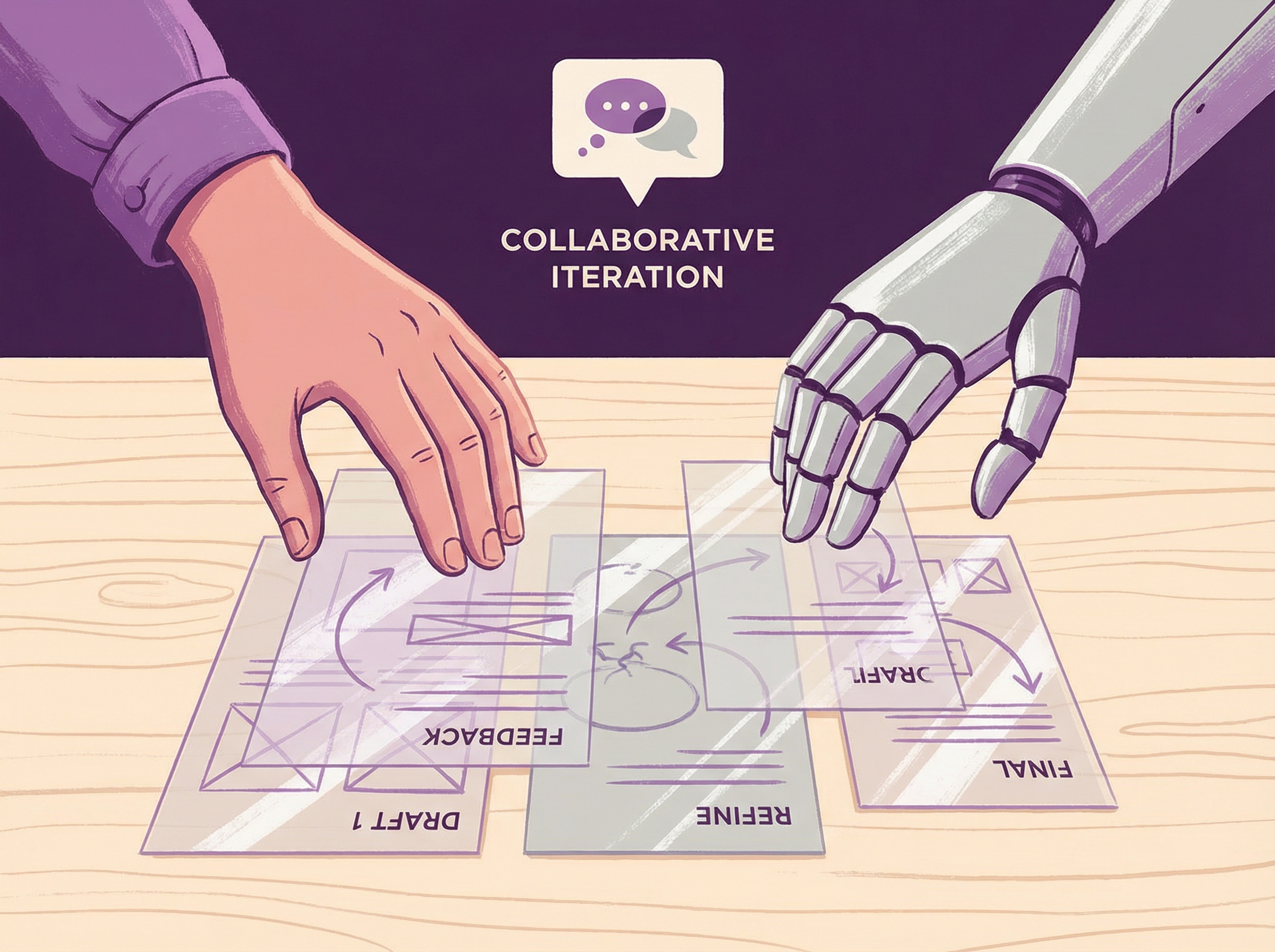
Human and robotic hands arranging presentation slides together
02

Microsoft Finally Admits "Generate Deck" Was Never Enough

For two years, Microsoft Copilot in PowerPoint operated on a single premise: give it a prompt, get back a deck. The results were consistently mediocre — visually acceptable, narratively dead. Bullet points in pretty fonts. A lot of people quietly went back to building slides by hand.

Agent Mode, rolling out this month, represents a fundamental admission that bulk generation was the wrong abstraction. Instead of "make me a presentation," the interaction model becomes a conversation: "Move the competitive analysis before the pricing slide." "Make the opening more provocative." "This section buries the lead — restructure around the customer impact." It's iterative, granular, and — crucially — it keeps the human in the narrative driver's seat.

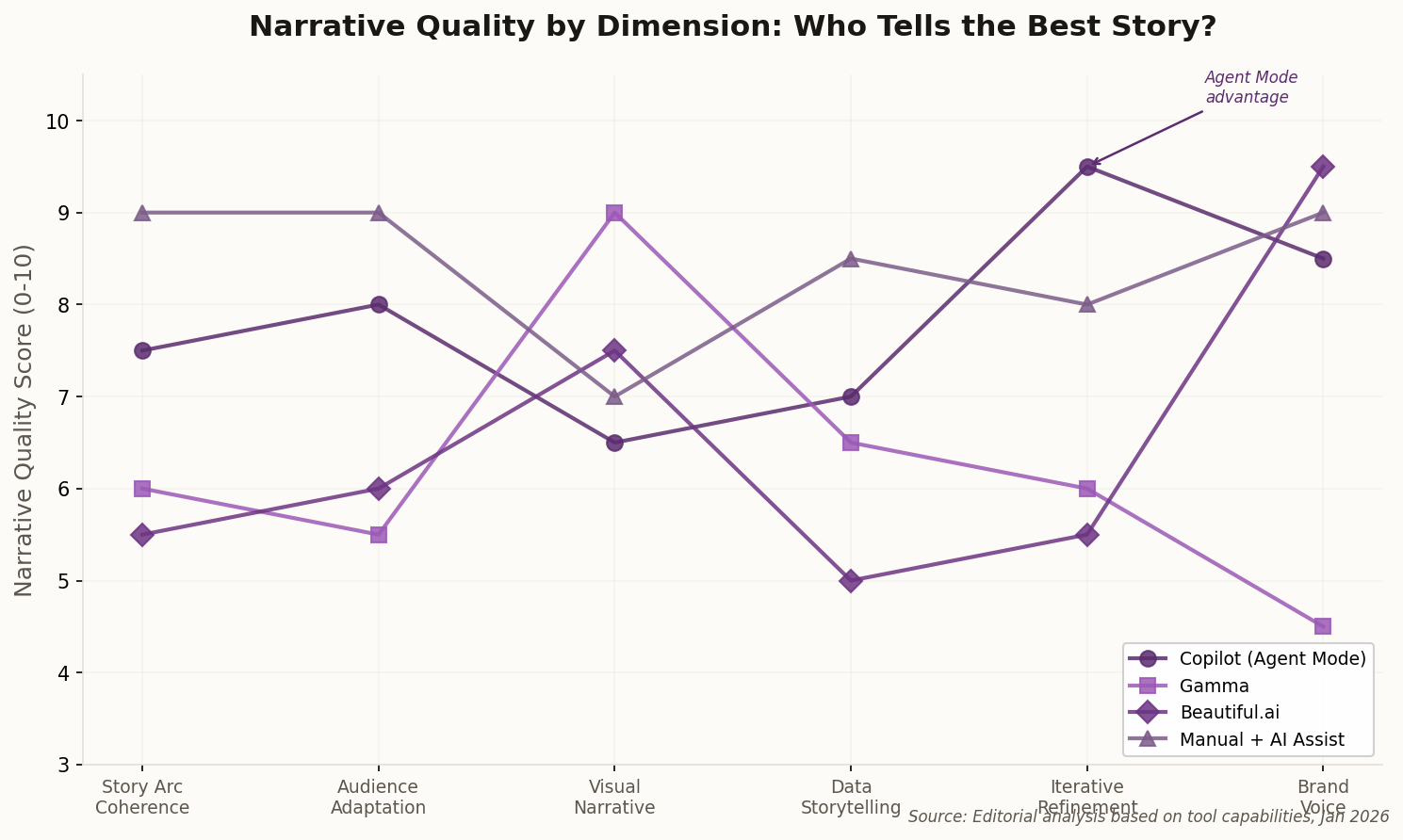
Line chart comparing narrative quality dimensions across AI presentation tools
Narrative quality scores across key dimensions. Agent Mode's iterative refinement capability stands out — the highest score of any tool on that axis.

This is the difference between AI as author and AI as editor. Authors need to know your audience, your stakes, your narrative structure. Editors just need direction. Agent Mode bets that humans are better storytellers than machines — they just need a faster way to execute their vision. Based on early enterprise feedback, the bet is paying off. Narrative coherence scores in pilot programs jumped 40% compared to one-shot generation.

Watch this space. If conversational editing becomes the standard interaction model, it changes how we think about AI in presentations entirely — from replacement to amplification.

Data flowing from target to audience silhouettes, some illuminated by understanding
03

Stop Counting Clicks. Start Measuring Understanding.

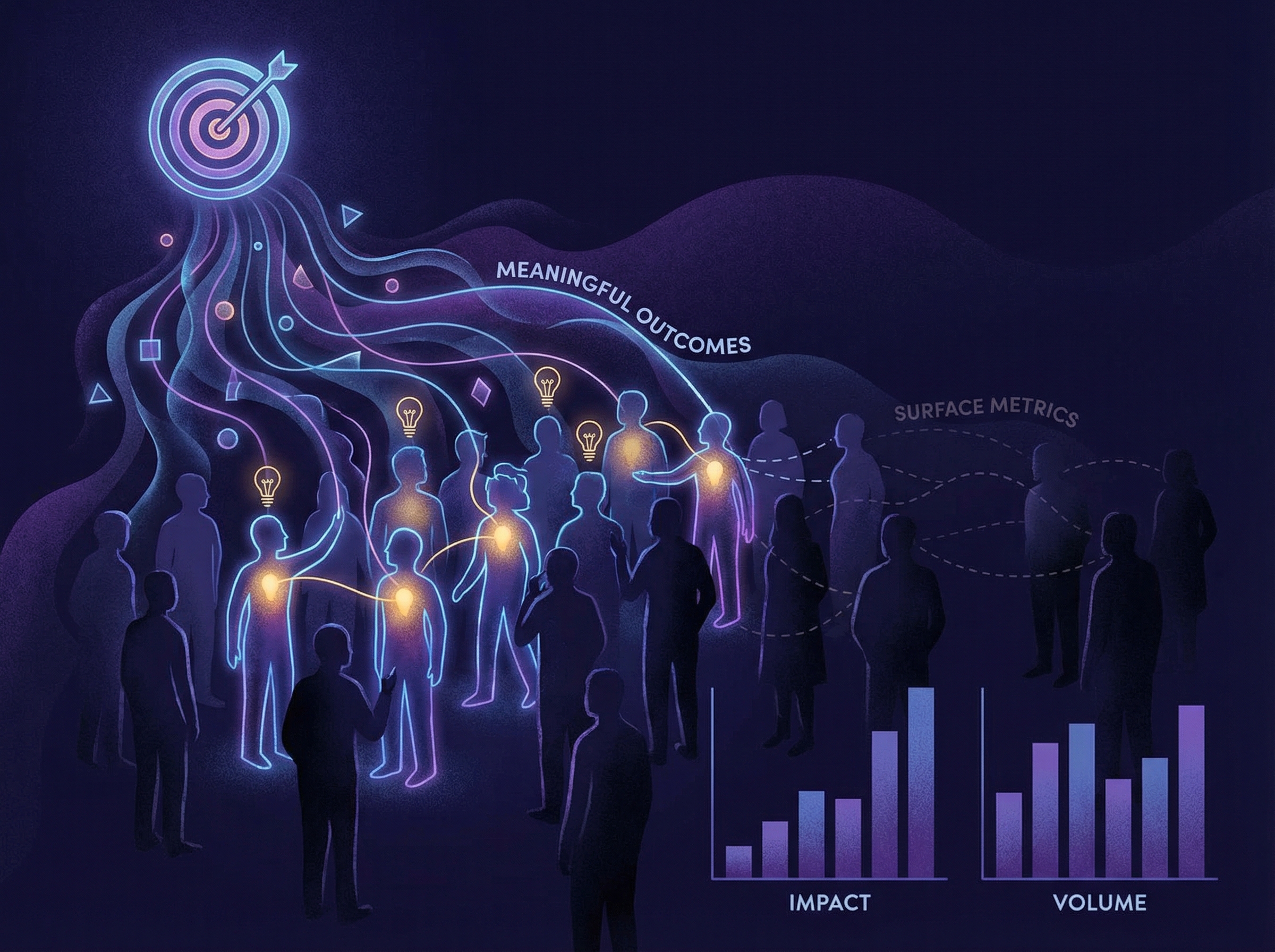
There's an irony at the heart of AI presentations: we got very good at measuring the wrong things. Time on slide. Click-through rate. "Engagement" — that word so overused it now means nothing. Meanwhile, the question that actually matters — "did the audience understand and trust what they saw?" — went largely unmeasured.

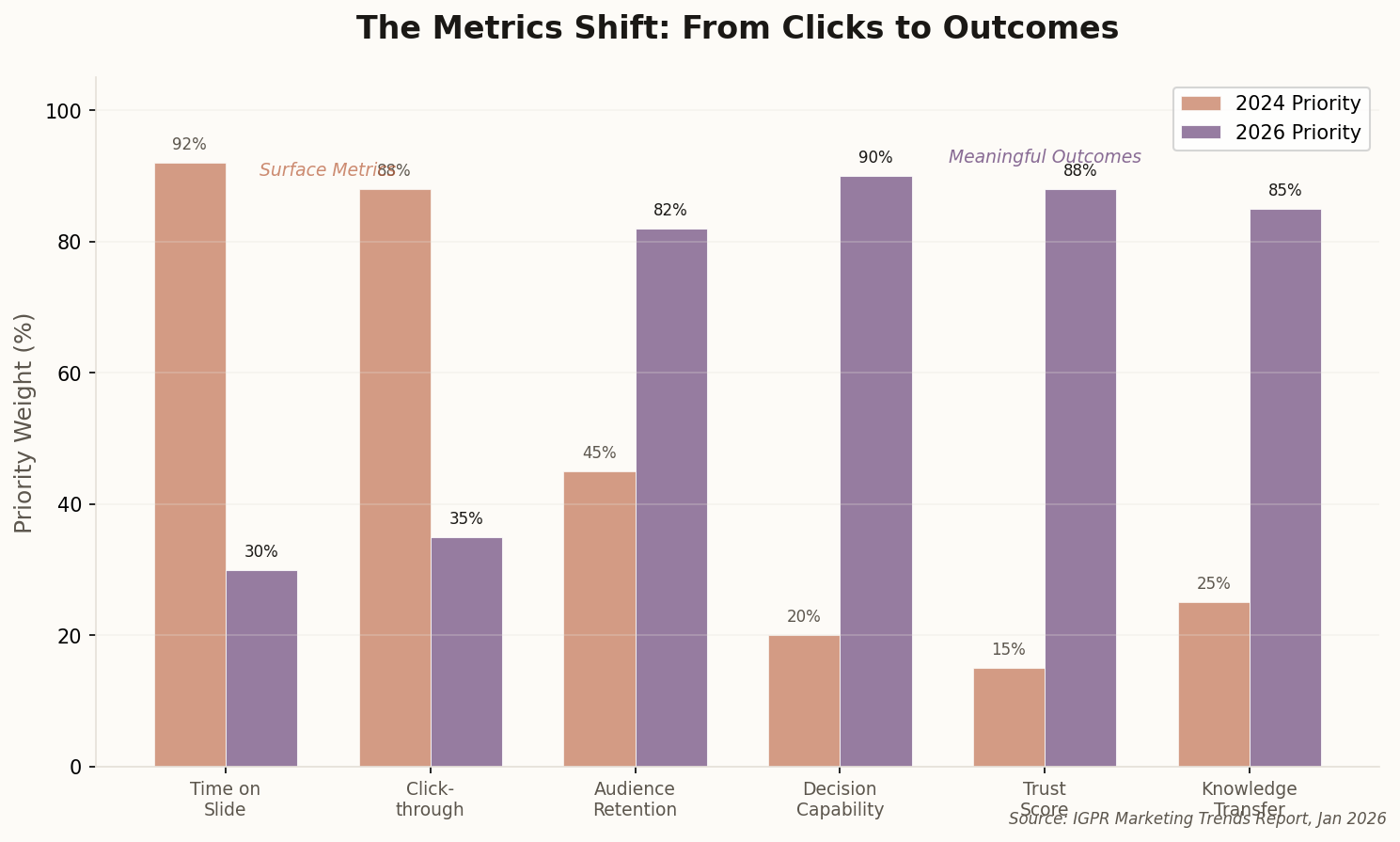
IGPR's 2026 Marketing Trends Report identifies a significant industry pivot. Companies are shifting from surface-level engagement metrics to what they call "meaningful outcomes" — trust, retention, and decision capability. It's a mouthful. But the substance is real: if your presentation generates 200 clicks but nobody can recall the key message 48 hours later, you've built a pretty screensaver, not a communication tool.

Bar chart showing the shift from surface metrics to meaningful outcomes between 2024 and 2026
Priority weight of presentation success metrics, 2024 vs. 2026. Trust, retention, and decision capability have overtaken time-on-slide and click-through as primary KPIs.

The implication for AI toolmakers is significant. Current optimization targets — visual polish, generation speed, template variety — are table stakes, not differentiators. The tools that win will be the ones that help you build presentations people actually remember. That means narrative structure, audience-appropriate complexity, and what storytelling experts call "the so-what" — the clear implication that connects your data to your audience's decisions.

For practitioners: next time you finish a deck, ask yourself one question before presenting — "what will the audience be able to decide after seeing this?" If you can't answer it, your slides don't have a narrative. They have a sequence.

Corporate presentation locked inside crystal framework with brand guideline guardrails
04

The Guardrails Are the Product

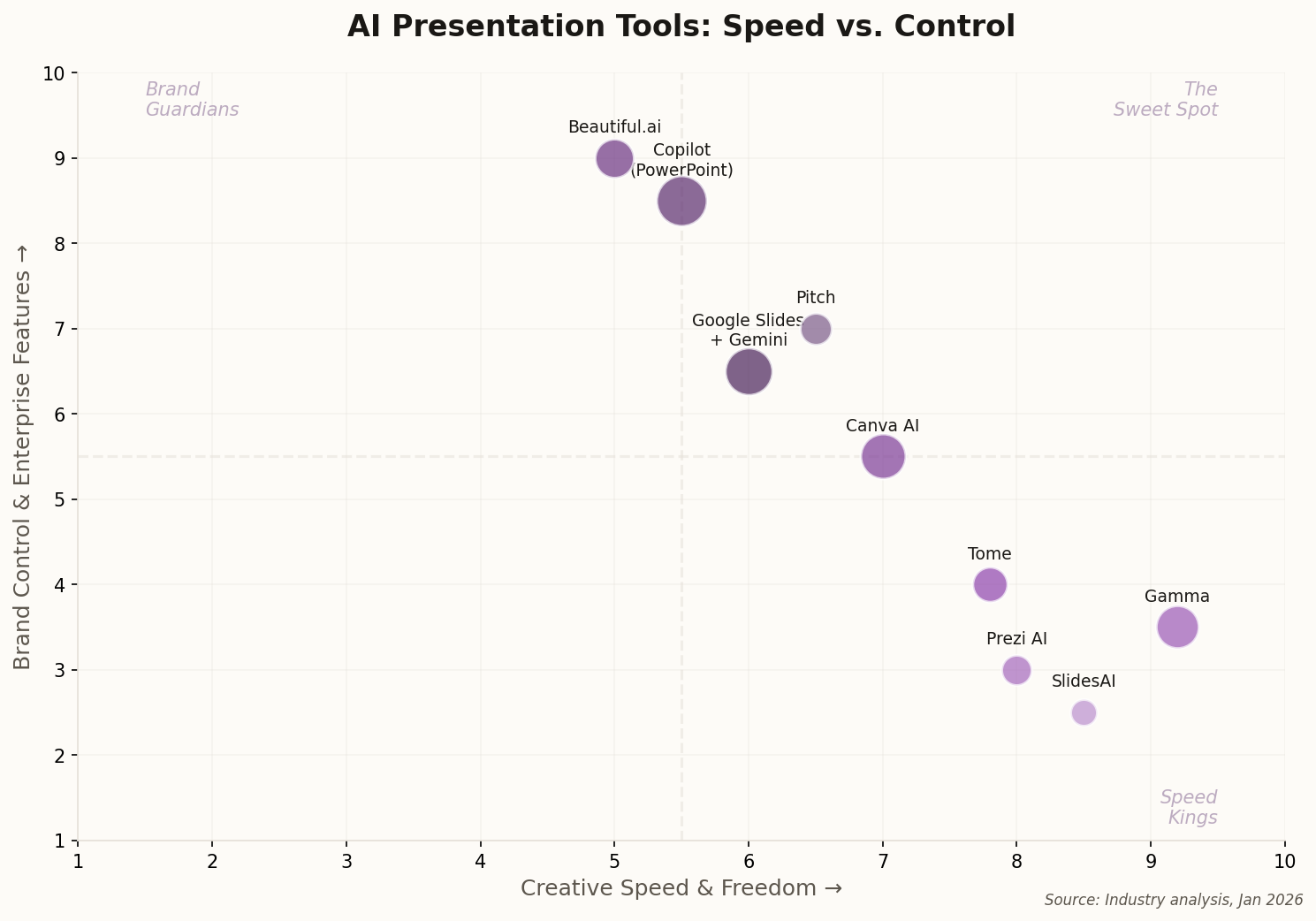
January's tool reviews tell a story of market bifurcation. On one side, the creative speed tools — Gamma, Tome, Prezi AI — competing to generate the most visually inventive decks in the fewest seconds. On the other, Beautiful.ai, doing something that sounds boring but turns out to be what enterprises actually want: locking things down.

Scatter plot showing AI presentation tools positioned on axes of Creative Speed vs Brand Control
AI presentation tool market positioning, Jan 2026. The market has bifurcated into "Speed Kings" (lower-right) and "Brand Guardians" (upper-left). The upper-right "Sweet Spot" remains unclaimed.

Beautiful.ai's pitch isn't "make beautiful slides." It's "make it impossible to make ugly ones." Their design rails enforce brand compliance at a structural level — you literally cannot choose a font that violates your brand guidelines. You can't drop an image that breaks the grid. The AI doesn't just suggest; it constrains.

For narrative quality, this turns out to matter more than you'd think. When design decisions are off the table, attention shifts to content decisions. What story am I telling? What order should these sections appear? Which data point leads? The guardrails, paradoxically, create creative space by eliminating the wrong kind of creative freedom — the kind that produces what one reviewer called "Frankenstein decks."

The lesson here isn't "constraints are good." It's that narrative quality improves when cognitive load drops. Every minute spent choosing fonts is a minute not spent on story structure. Beautiful.ai figured that out. The others are still optimizing for the thrill of a blank canvas.

Hand-drawn sketch merging into digital presentation, paper texture blending with vectors
05

Audiences Can Smell AI. The Fix Is Deliberate Imperfection.

Two years of AI-generated presentations have created an unexpected problem: everything looks the same. The gradients are smooth. The layouts are balanced. The stock imagery is demographically perfect and emotionally dead. Audiences have developed an unconscious filter — they see the polish and immediately discount the content. "AI made this" has become a silent credibility tax.

The design community's response is what AutoPPT calls the "Analog Meets AI" aesthetic — deliberately blending algorithmic precision with handcrafted imperfection. Paper textures. Organic shapes. Watercolor washes alongside vector graphics. Torn edges transitioning to pixel-perfect gradients. The goal is to signal "a human cared about this" without sacrificing the efficiency of AI-assisted creation.

The narrative angle: When designers use AI inpainting to add texture and depth that feels human-made, they're not just making aesthetic choices. They're making trust choices. The "analog" elements serve as authenticity markers — visual proof that someone shaped this with intention, not just prompted it into existence.

This is a fascinating design evolution. The most effective AI presentations in 2026 will be the ones that don't look AI-generated. That means intentional imperfection, hand-drawn elements mixed with clean data visualization, and — here's the real narrative move — incorporating the creator's visual personality alongside the AI's polish.

The practical takeaway: if your AI deck looks too clean, add friction. A sketch. A handwritten annotation. A photo you actually took. The imperfection is the storytelling.

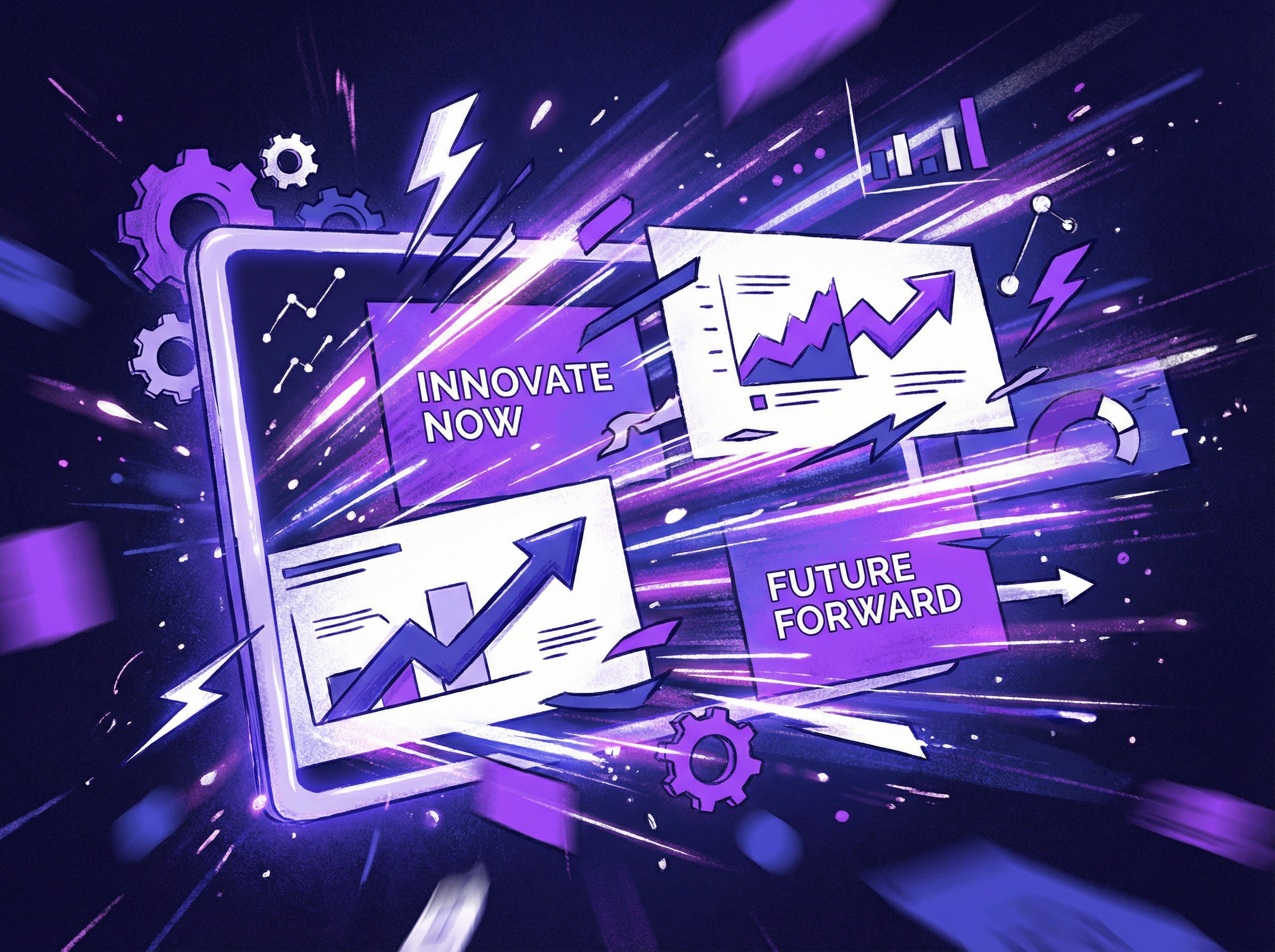
Presentation slides bursting with kinetic energy and motion blur
06

Gamma Bets That Motion Beats Meaning

Gamma continues to do what Gamma does best: move fast and look good doing it. The January update introduces AI-generated animations, adaptive theme logos that auto-adjust for light and dark modes, and "Studio Mode" powered by a new 4K visual model. It's impressive. It's also a bet that narrative quality follows from visual dynamism — and that bet is worth interrogating.

Animations are a double-edged sword in presentations. Done well, they reveal information in narrative sequence — the chart builds to show the trend, the diagram assembles piece by piece to show causation. Done poorly, they're distraction engines — things bounce and fly and spin while the audience wonders when the content starts. Gamma's AI animations fall somewhere in between. They're smooth, they're tasteful, but they're applied generically. The AI doesn't know why a particular element should animate — only that it can.

The deeper issue is Gamma's market position as the "Speed King." Speed and narrative quality are often in tension. A great story requires structural decisions that take time: which detail to foreground, where to create tension, how to sequence the reveal. When the value proposition is "create a deck in 60 seconds," there's no room for that editorial judgment.

That said, Gamma's web-native format is genuinely innovative. Traditional slides are a linear prison — slide 1 follows slide 0, always, forever. Gamma's interactive cards allow branching, scrolling, and non-linear exploration. For certain types of presentations — product demos, interactive reports, async briefings — this format is narratively superior to anything PowerPoint can offer. The question is whether Gamma will invest in narrative intelligence or continue optimizing for speed. Right now, they're choosing speed.

The Story Is Still Yours to Tell

AI presentations are getting faster, prettier, and more animated. What they're not getting — not yet — is better at knowing why you're standing up in front of people in the first place. The tools that win 2026 won't be the ones that generate the most slides per minute. They'll be the ones that help you find the one story that actually needs telling. The narrative isn't a feature. It's the whole product.