AGI Forecasting

The Prophecy Industrial Complex

This week's AGI predictions span from "six months" to "decades away"—and everyone's confident. What the dueling forecasts actually reveal about how we think about transformative AI.

Listen
Neural constellation emerging from binary horizon, geometric nodes connected by light tendrils reaching toward a central singularity
01

The Horizon Keeps Receding
Crystalline forecast timeline with probability curves as luminous ribbons, pivot point at 2030

The influential AI 2027 report just quietly nudged its median AGI forecast from 2027 to approximately 2030. That's a three-year slip in just two years of predictions. If you're keeping score at home: when they launched in early 2024, the name was aspirational. Now it's looking increasingly like a historical artifact.

The rationale? "Slower-than-expected deployment of autonomous agents in 2025." Translation: the demos looked great, but getting AI systems to reliably do useful things in the real world is harder than making them impressive in controlled settings. This is the "last mile" problem that has plagued every previous automation wave, and AI is proving not immune.
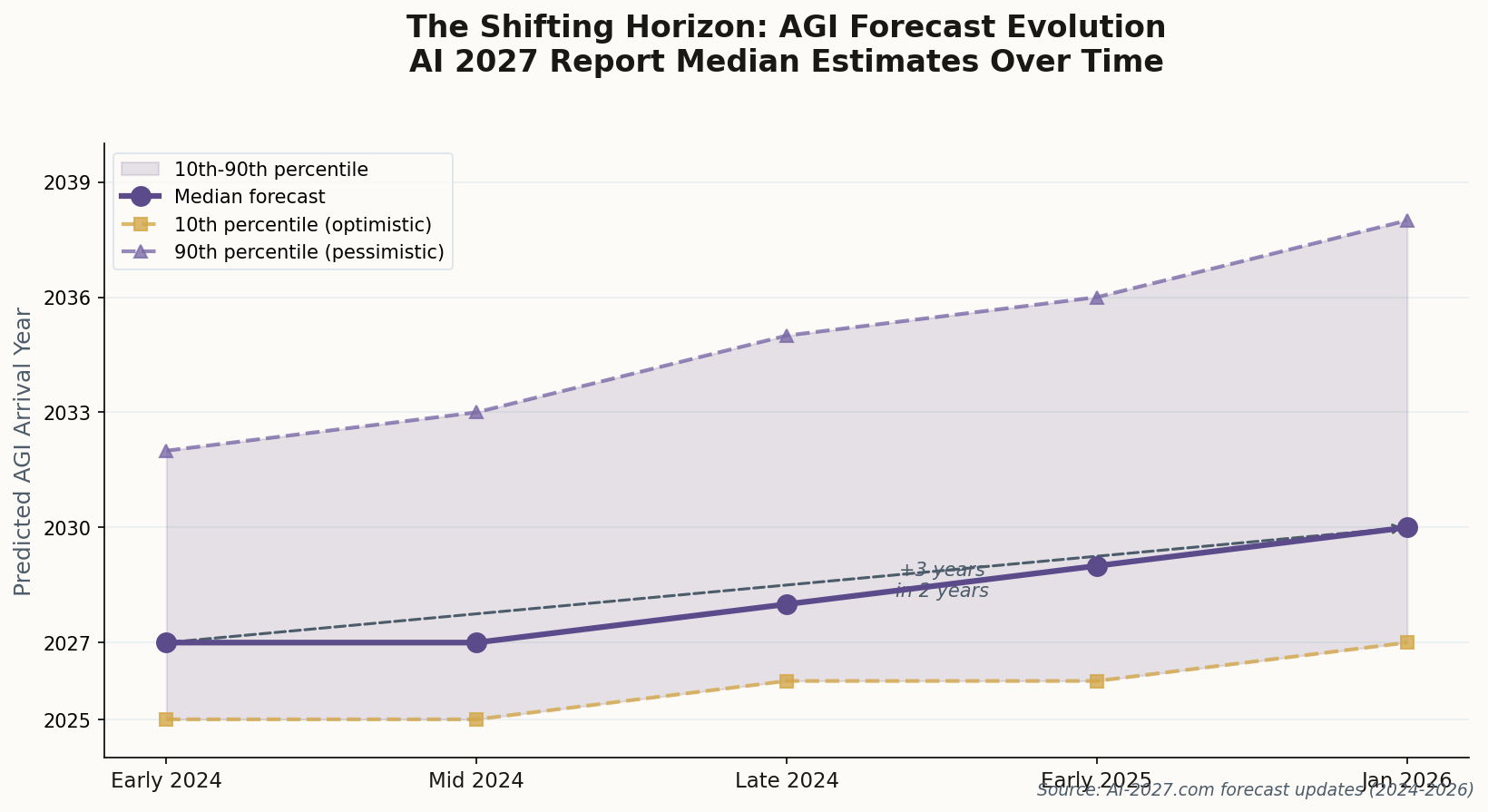
Chart showing AGI forecast evolution from 2024 to 2026, with median estimate shifting from 2027 to 2030
The shifting horizon: AI 2027's median AGI forecast has slipped 3 years in 2 years of updates. Confidence intervals have also widened.

What makes this interesting isn't the specific date—it's the metacognition. The forecasters are adjusting in real-time based on observational data rather than doubling down on their original timeline. That kind of intellectual honesty is rare in prediction markets where reputations are built on boldness. The takeaway: even the most carefully reasoned AGI timelines are built on foundations of uncertainty.

02

The Coin Flip That Matters Most

Contemplative figure in profile looking at distant horizon, abstract 50% probability representation

DeepMind CEO Demis Hassabis is holding firm on his 50% probability of AGI by 2030. That framing tells you everything about how he thinks about this. Not a prediction—a probability. Not certainty—a coin flip. It's the language of someone who's spent his career at the intersection of games and intelligence.

But here's the kicker: Hassabis is setting a much higher bar than his peers. "A true general AI should be able to formulate its own questions, develop hypotheses, and verify them." Current LLMs, in his view, lack "continuous learning"—the ability to keep improving after deployment. They're frozen snapshots of capability, not living systems.

This isn't pessimism; it's precision. Hassabis is essentially arguing that what OpenAI and Anthropic might call AGI by 2027, he'd call a very sophisticated tool. The question isn't who's right—it's whether we're even having the same conversation about what we're building toward.

03

The Cat in the Server Room

Elegant cat walking past abstract server racks, organic intelligence juxtaposed with digital systems

Yann LeCun, Meta's Chief AI Scientist, has a useful provocation: current AI systems don't have "cat-level intelligence." A cat can navigate a physical environment, form internal models of how the world works, remember things, and plan sequences of actions. GPT-4? Not so much.

LeCun's argument is architectural. Transformers—the technology underlying all major language models—have no understanding of physical reality. They're incredibly sophisticated pattern matchers trained on text, but they lack the world model that even simple animals possess. You can make them bigger, but you can't scale your way to genuine understanding.

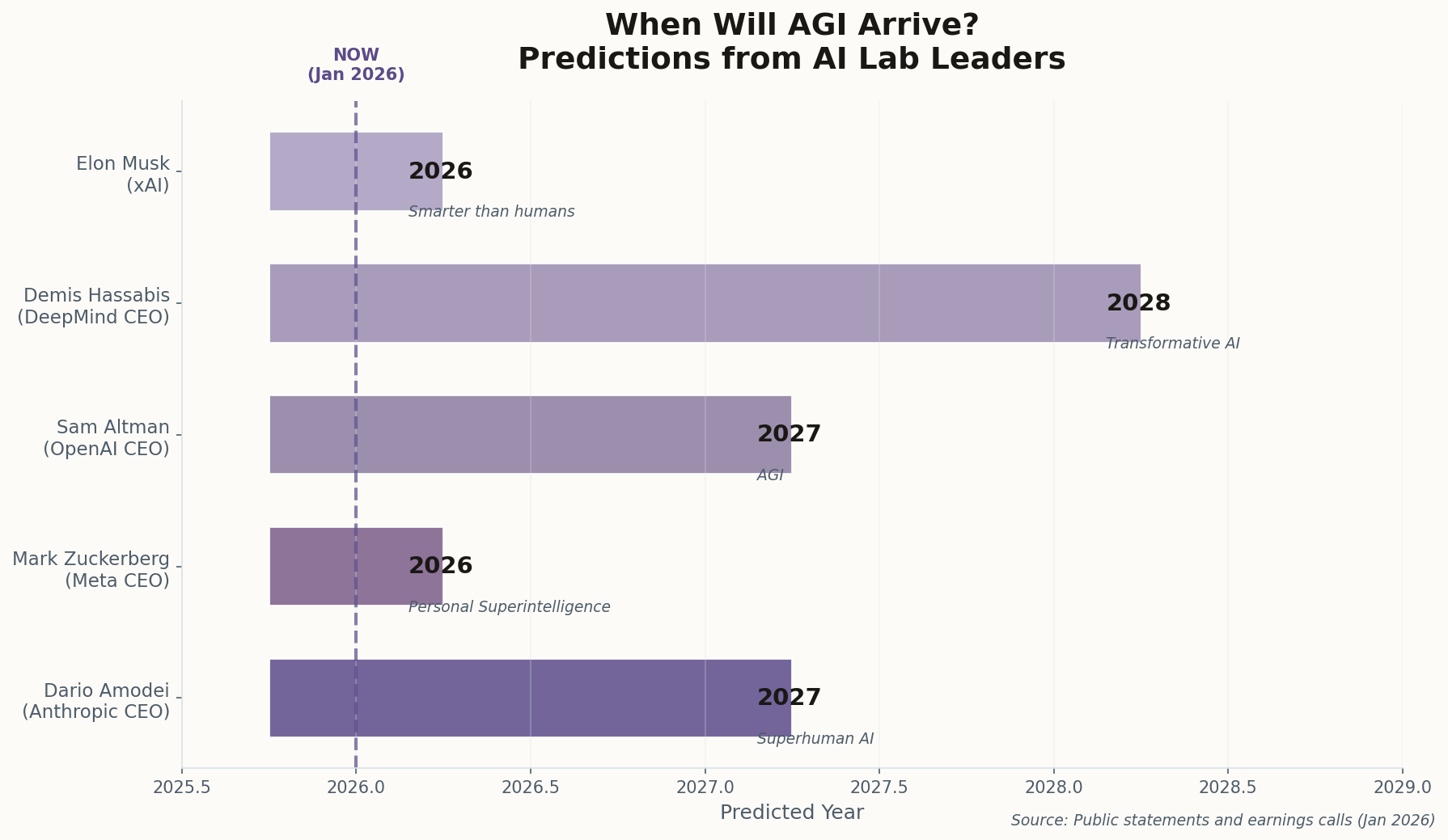
Horizontal bar chart comparing AGI timeline predictions from Amodei, Hassabis, AI 2027 Report, LeCun, and Chollet
The great divide: AGI predictions from leading researchers and forecasters. Ranges represent optimistic to pessimistic estimates; diamonds mark midpoints.

"It almost always takes longer [than predicted]," LeCun told Time. Coming from someone who's seen multiple AI winters, this isn't skepticism—it's pattern recognition. The question for bulls: what makes this wave different from the ones LeCun has watched crash before?

04

When AI Gets Physical

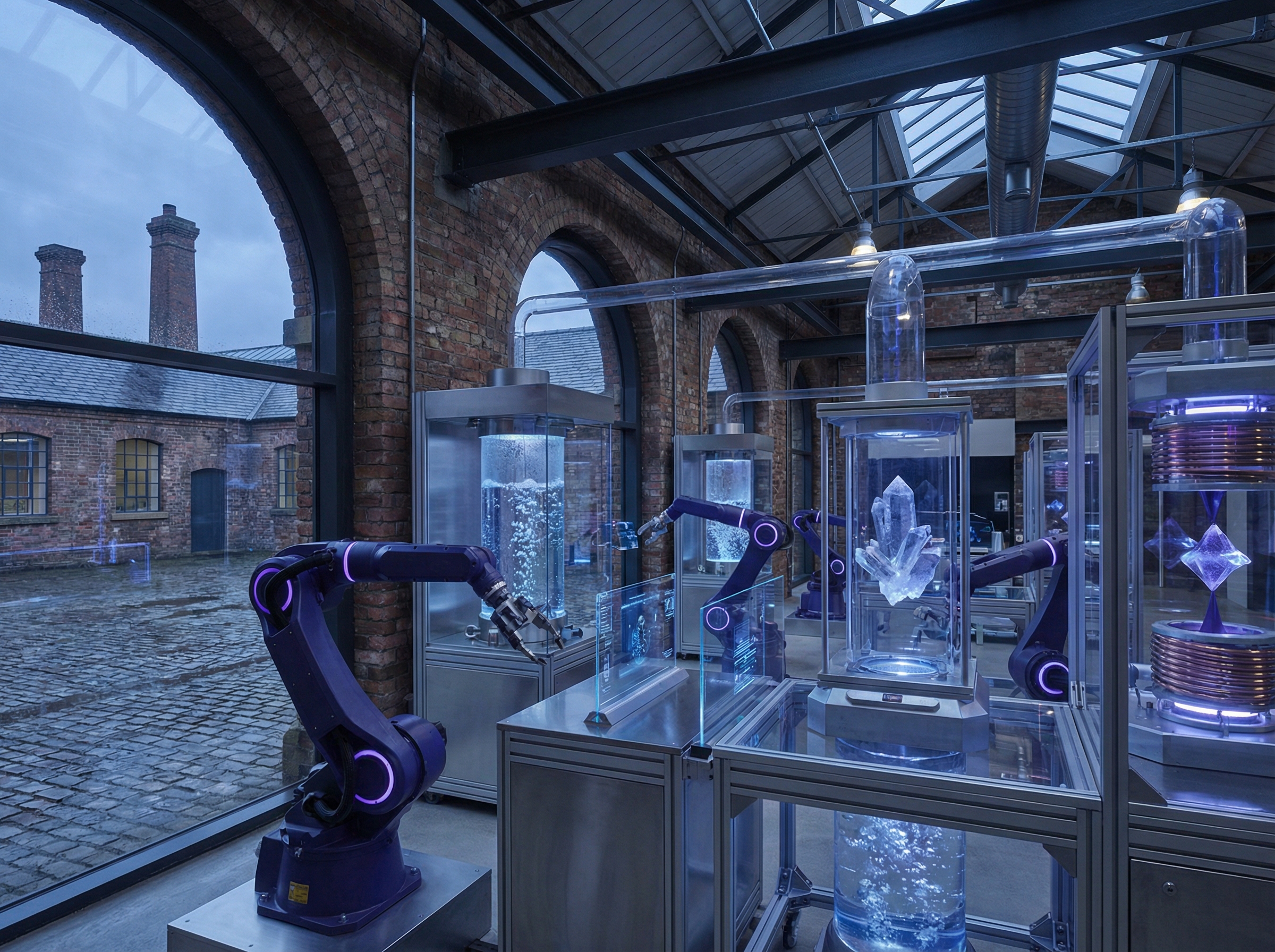
Futuristic autonomous laboratory with robotic arms and glowing superconductors

While the forecasters argue about timelines, DeepMind is doing something more interesting: building a fully autonomous research laboratory in the UK. Not a simulation. Not a demo. An actual facility where Gemini systems will "design recipes, synthesize materials, and analyze results without human intervention."

The focus? Discovering new superconductors and semiconductors for fusion and computing. This is where AGI debates get concrete. It's one thing to argue about whether an AI can "truly understand"—it's another to ask whether it can discover a material that enables room-temperature superconductivity.

The lab plans to conduct "hundreds of materials science experiments daily." If successful, this represents a transition from what we might call "cognitive AI" (chatbots, coding assistants) to "physical AI" that interacts with and changes the material world. That's a different capability entirely—and one that matters for assessing how close we actually are to transformative intelligence.

05

The Test That Tests the Tests

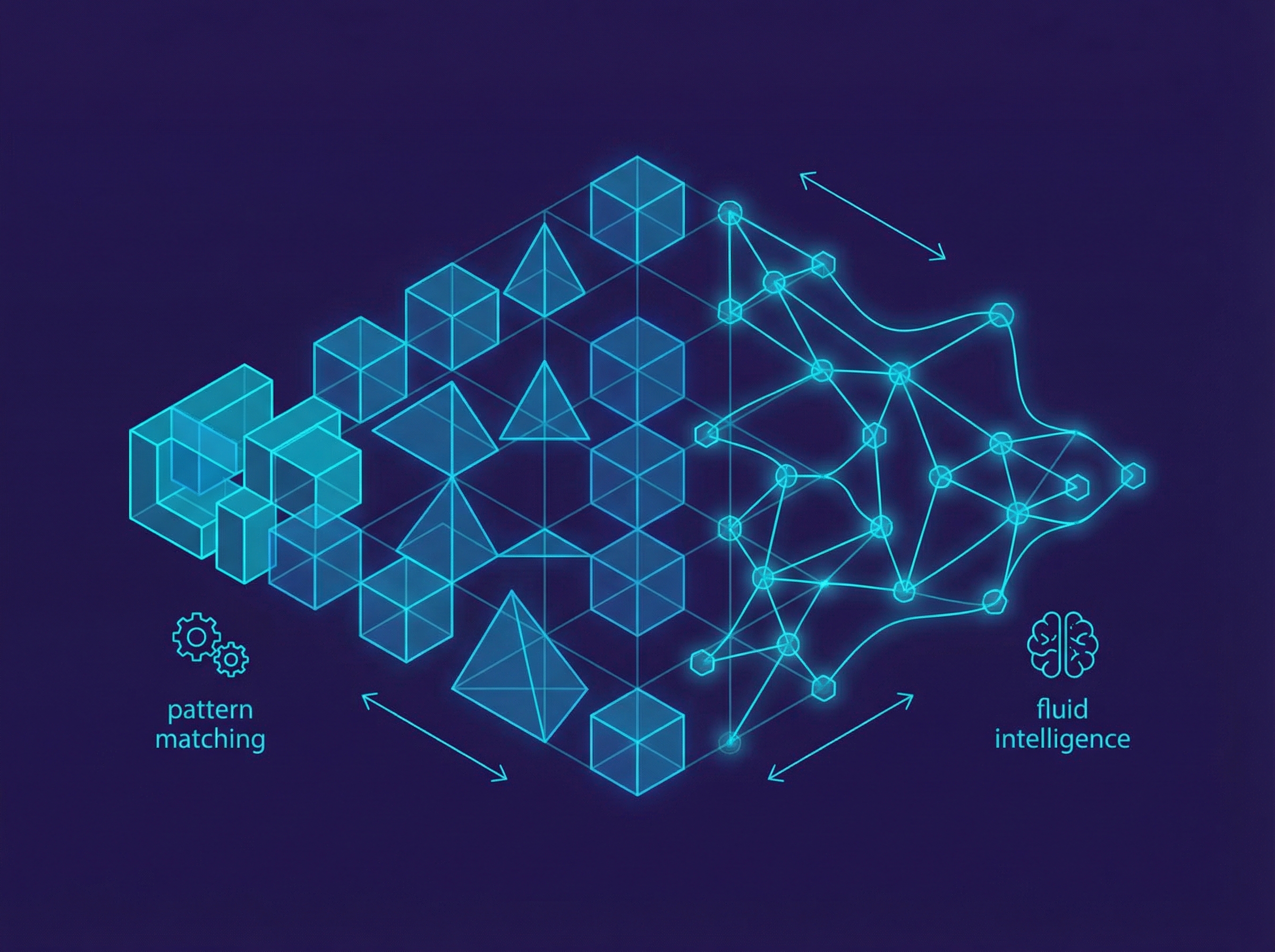
Abstract puzzle grid transforming and adapting, geometric shapes morphing

François Chollet, creator of Keras and the original ARC benchmark, just announced ARC-AGI-3 for March 2026. His thesis is provocative: the industry's focus on scaling LLMs has potentially "set back progress to AGI by five to ten years."

The new benchmark tests "interactive reasoning and planning"—the ability to learn and modify behavior in real-time rather than relying on patterns absorbed during training. Chollet calls this "test-time adaptation" and argues it's the missing link between impressive-looking systems and genuinely intelligent ones.

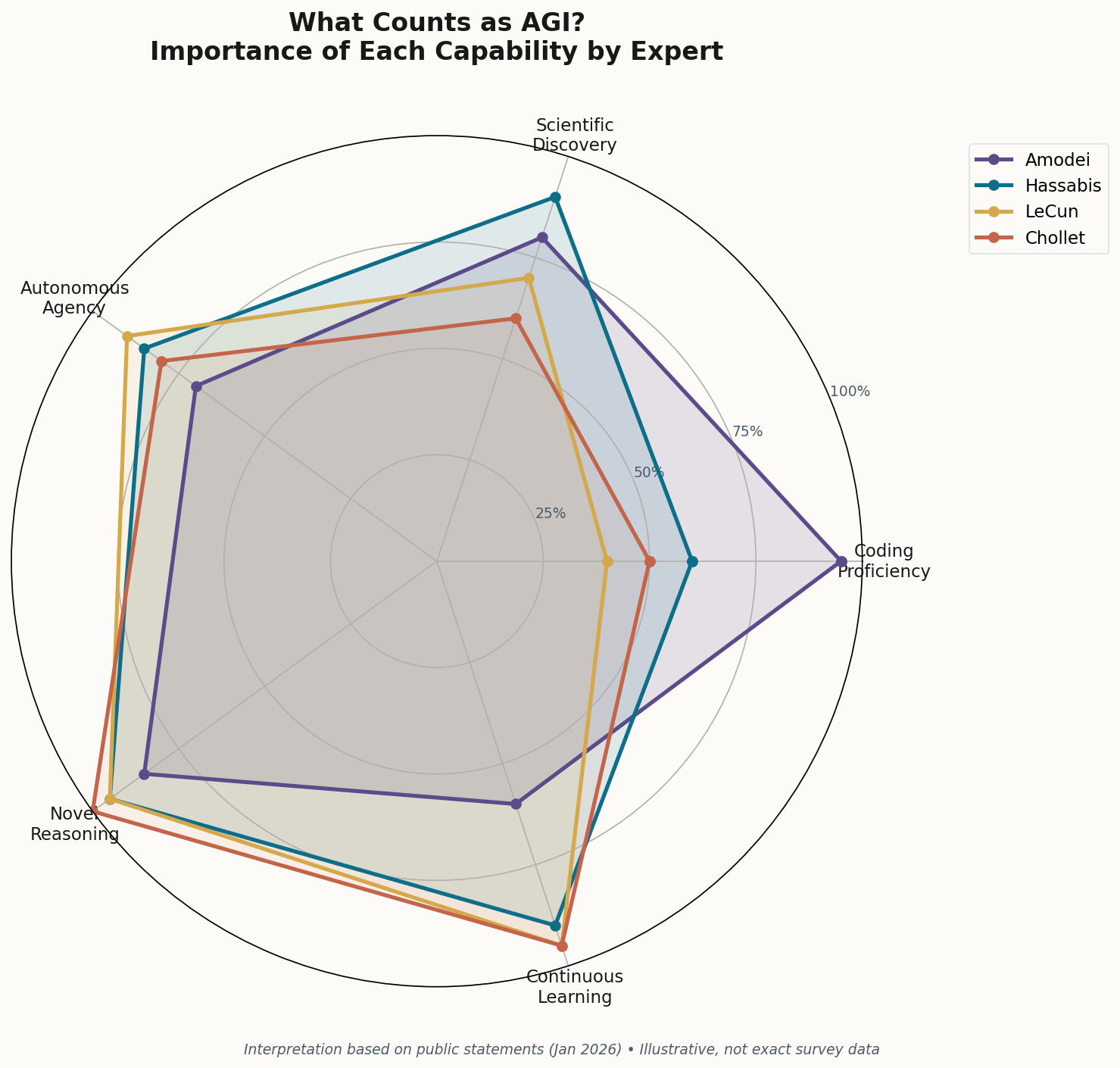
Radar chart showing how different experts weight various AGI capabilities
What counts as AGI? Different experts emphasize different capabilities. Chollet prioritizes novel reasoning; Amodei weights coding proficiency highest.

Here's the uncomfortable implication: every major AI lab is essentially running the same playbook (bigger models, more data, more compute), but Chollet argues this path leads to increasingly sophisticated memorization, not general intelligence. If he's right, we're investing billions in approaches that hit a fundamental ceiling. If he's wrong, the current trajectory should start acing his tests soon. Either way, ARC-AGI-3 becomes a crucial bellwether.

06

The Six-Month Countdown

Software engineer's hands hovering over keyboard while AI-generated code streams above like digital aurora

At Davos, Anthropic CEO Dario Amodei dropped the most aggressive timeline of the week: AI will take over "almost all the work of software engineers end-to-end" in just 6-12 months. Not assist. Not augment. Take over.

Amodei's engineers are apparently already "shifting from writing code to reviewing code written by models." If accurate, this represents a phase transition in how software gets built. The coding assistants become the coders; humans become the reviewers.

This is simultaneously the most testable and most consequential prediction. In 12 months, we'll know whether Anthropic's internal experience generalizes, or whether they're seeing something specific to their highly-optimized AI-development workflow. Meanwhile, Amodei reiterated his forecast for "Nobel laureate-level" AI by 2026-2027—a claim that suggests coding is just the opening act.

The gap between Amodei's 6-month coding timeline and LeCun's "not cat-level" skepticism isn't a matter of degrees—it's a different understanding of what intelligence is and what we're actually building.

The Forecast of Forecasts

Here's what this week reveals: we're not debating when AGI arrives so much as what AGI means. Amodei's "coding AGI" by 2027 is a different creature than Hassabis's "hypothesis-generating AGI" or LeCun's "world-modeling AGI." The predictions aren't converging because the definitions aren't converging. Watch the benchmarks, watch the labs, but mostly—watch what you're actually measuring.