The Life and Times

Stay Hungry. Stay Foolish.

Steve Jobs didn't invent the personal computer, the smartphone, or the animated film. He invented the expectation that technology should be beautiful, intuitive, and worth caring about. Fifty years after Apple's founding, his shadow looms larger than ever.

Listen
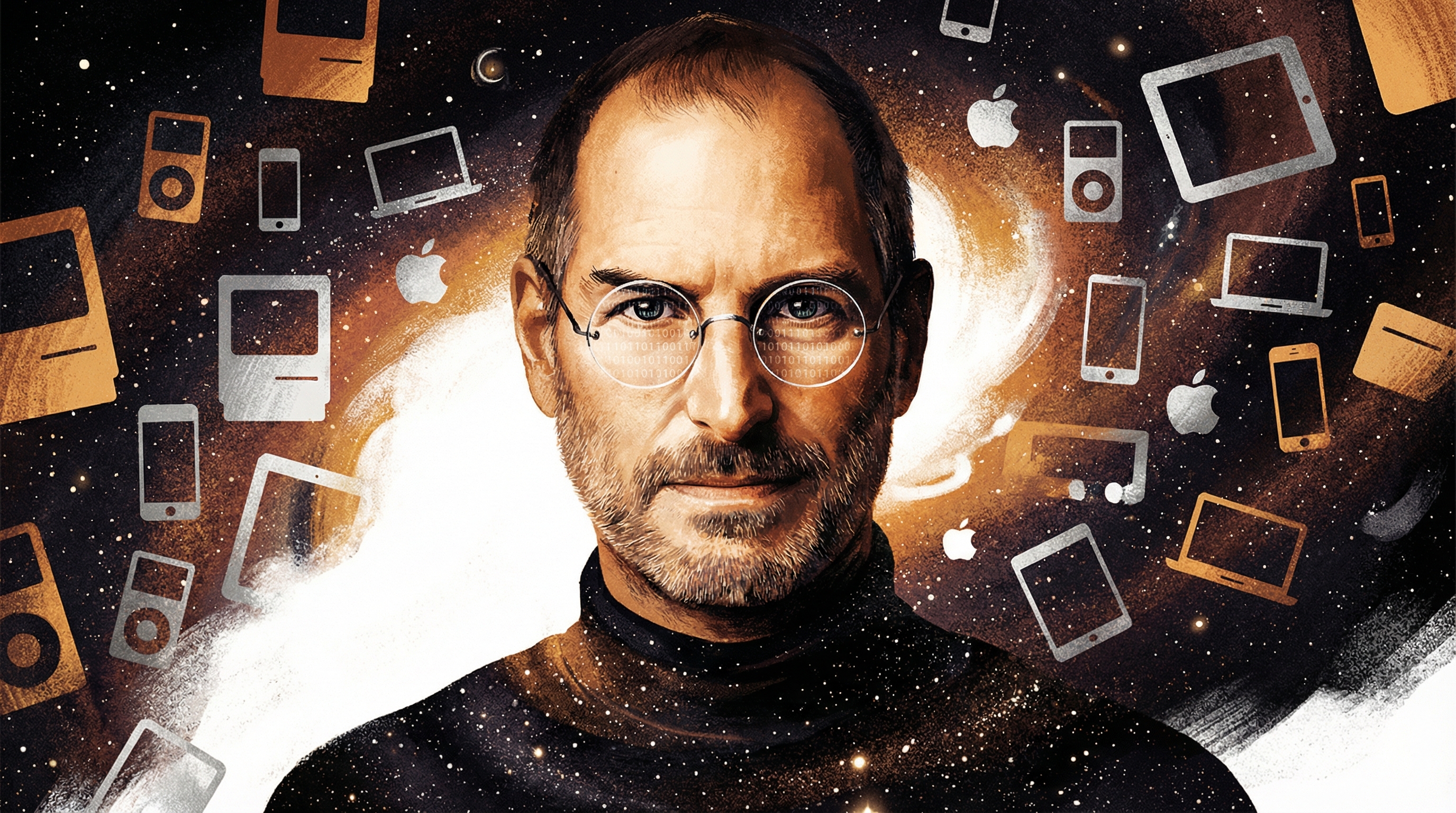
Steve Jobs portrait emerging from a constellation of Apple products floating in cosmic space
01

The Face That Launched a Trillion Dollars—Now on a Dollar
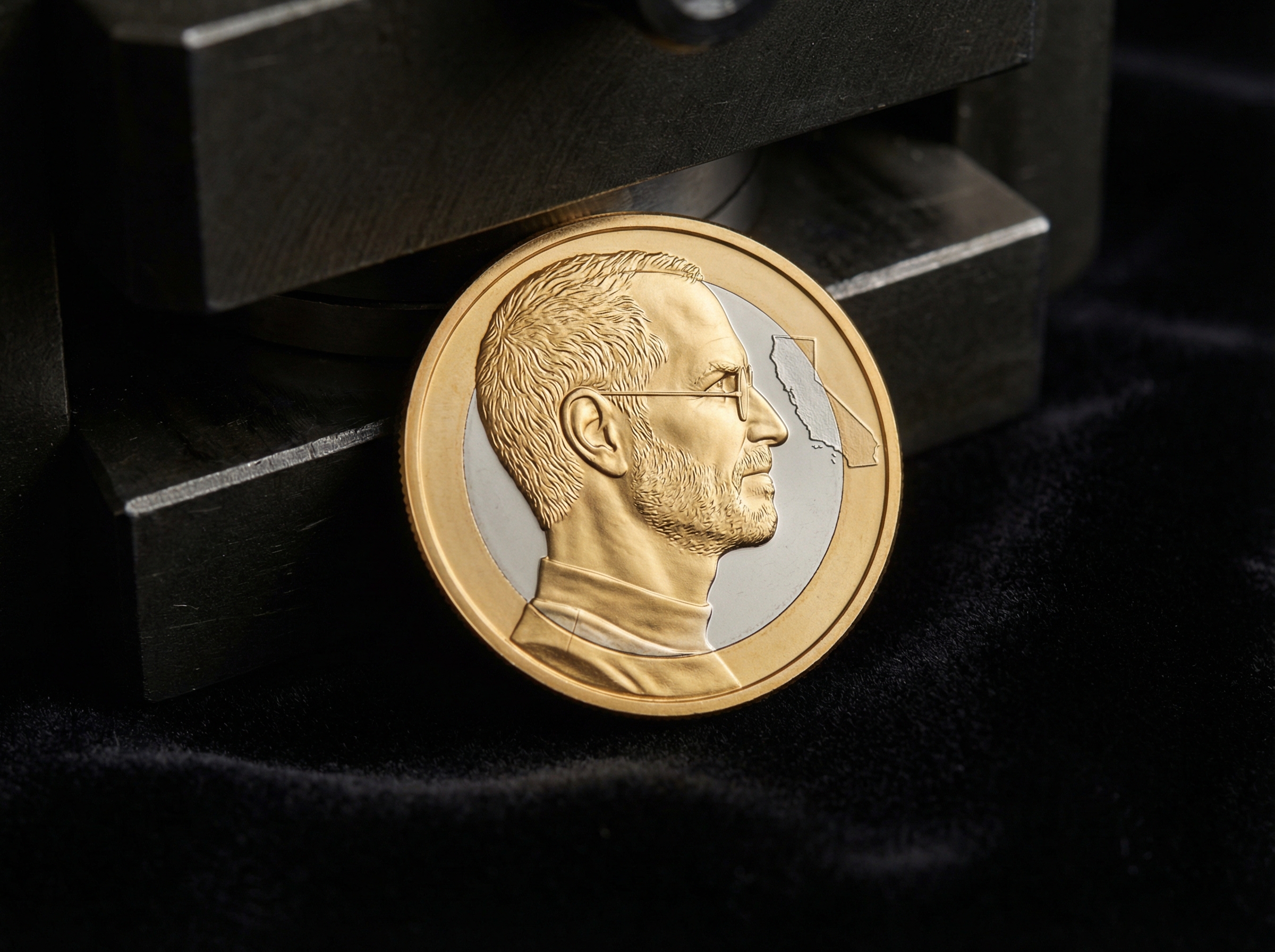
Gleaming US commemorative coin emerging from mint press

When the U.S. Mint announced Steve Jobs would appear on a $1 coin as part of the American Innovation series, the reaction was predictably split: canonization or commercialization? The coin features a young Jobs—turtleneck, round glasses, the whole mythology—with the inscription "Make Something Wonderful."

Here's what's remarkable: Jobs is the California representative for 2026, edging out everyone from Walt Disney to the founders of Google. That the Mint chose a Buddhist who dropped acid, abandoned his daughter, and famously didn't believe in philanthropy says something about how America measures greatness. We don't put saints on our money. We put people who changed things.

The deeper irony: Jobs spent his career eliminating cash. Apple Pay, the digital wallet that made credit cards feel quaint—that was his vision made manifest. Now his face will end up in tip jars and parking meters, a physical relic from a man who worshipped the digital future.

The "Make Something Wonderful" inscription comes from a posthumous collection of Jobs' writings and speeches, curated by his wife Laurene Powell Jobs and the Steve Jobs Archive. It's become the closest thing to an official motto for his legacy.
02

What $500 Bought in 1976—and What It's Worth Now

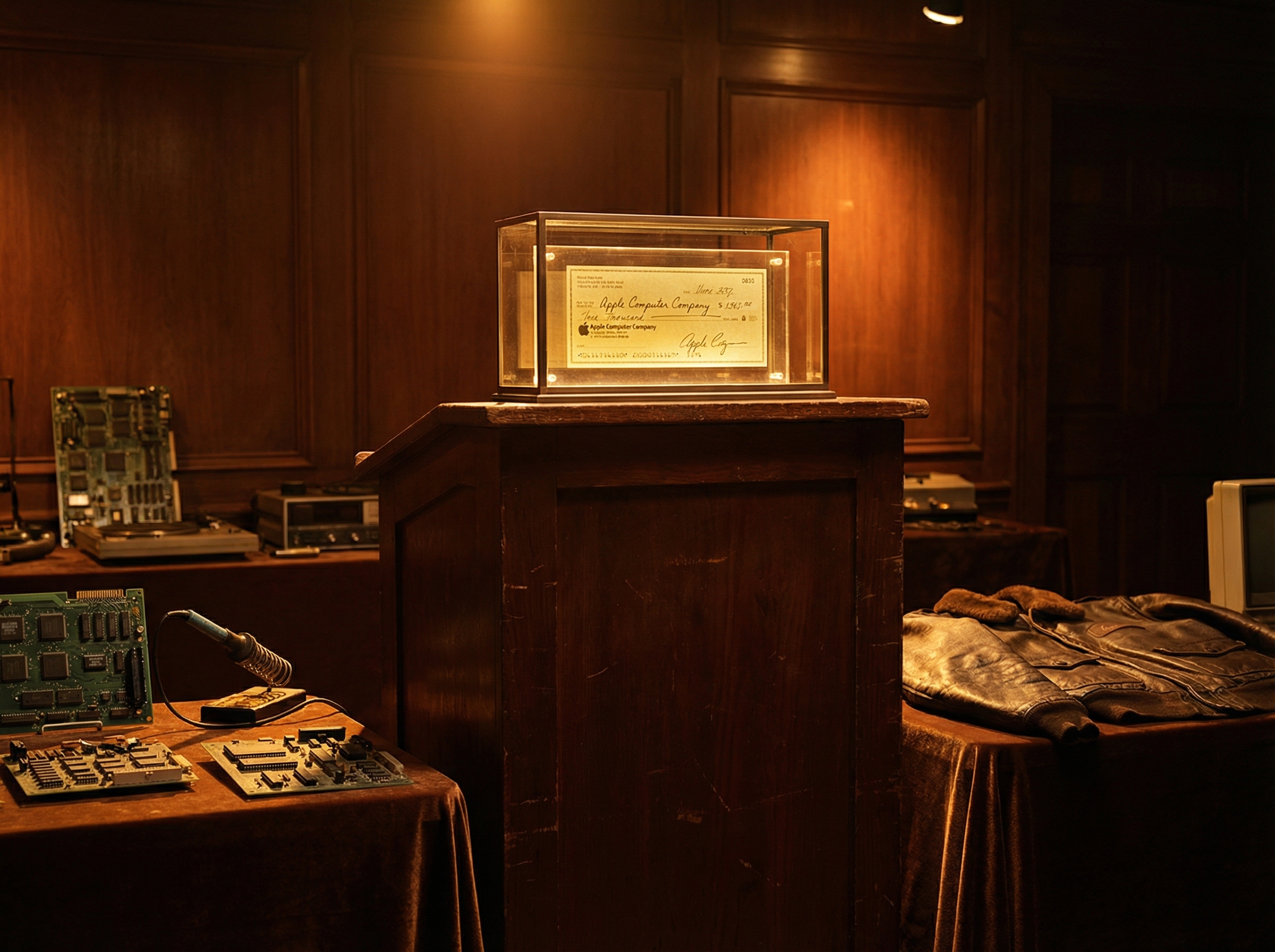
Vintage auction display with Apple Check No. 1 and garage workshop artifacts

The first check ever written on behalf of Apple Computer—Check No. 1, for exactly $500, signed by both Steve Jobs and Steve Wozniak in 1976—is crossing the auction block this month. RR Auction is calling the sale "Steve Jobs & the Computer Revolution," timed to Apple's 50th anniversary on April 1.

That $500 check was written to buy parts for Apple I circuit boards, assembled by hand in the Jobs family garage in Los Altos. Today, Apple's market capitalization hovers around $3 trillion. The return on that original investment, if you could somehow track it, would be approximately 6,000,000,000%.

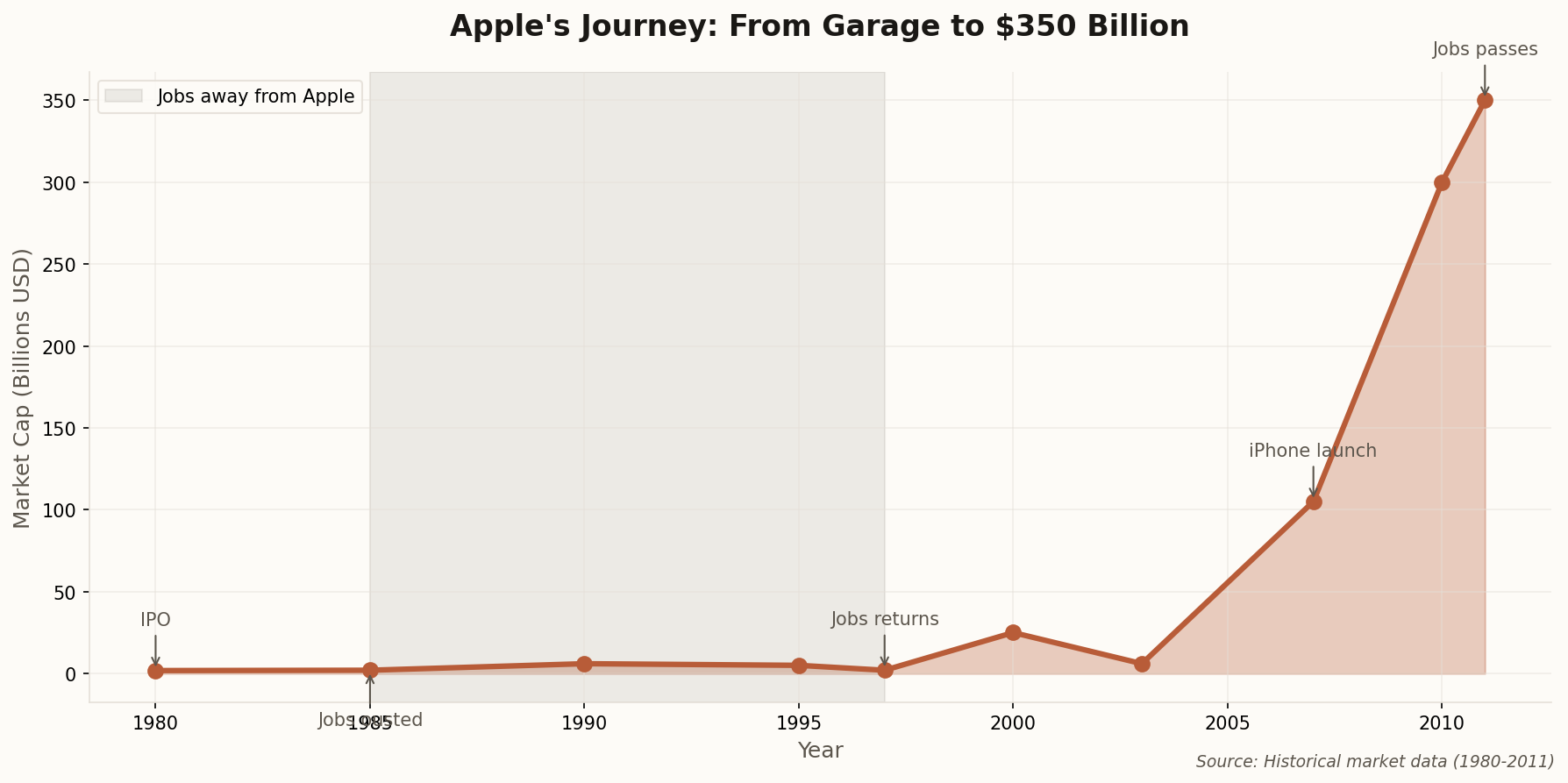
Apple market cap growth from 1980 to 2011 showing the impact of Jobs' return
Apple's market cap trajectory: The "wilderness years" (1985-1997) when Jobs was exiled show how much the company's fate was tied to his presence.

The auction also includes Jobs' iconic bomber jacket, bowties from his pre-turtleneck era, and—tellingly—his collection of Bob Dylan tapes. Dylan mattered to Jobs the way few cultural figures did. Both were artists who refused to give audiences what they expected, who reinvented themselves relentlessly, who understood that staying relevant meant staying dangerous.

The collector market for Apple memorabilia has exploded in the past decade. A working Apple I sold for $905,000 in 2014. The message is clear: we've decided these artifacts are historically significant—not just for tech history, but for American history.

03

The Daughter He Denied, the Story She Finally Told

Open memoir book with pressed wildflowers and childhood drawing casting shadows

Lisa Brennan-Jobs' memoir Small Fry is the book the hagiographers didn't want written. It's not an exposé or a takedown—it's something more uncomfortable: a daughter trying to understand why the man who could envision products millions would love couldn't figure out how to love her.

The facts are damning enough. Jobs initially denied paternity despite DNA evidence, claiming he was "sterile." He named a computer after her—the Lisa—then publicly insisted for years it was an acronym (Local Integrated Software Architecture). When she asked him about it directly, he said, "Nope. Sorry, kid."

What's fascinating is that Brennan-Jobs doesn't let herself off the hook either. She wanted his approval desperately, even when he withheld it cruelly. She moved in with him as a teenager, hoping proximity would create connection. Sometimes it did. More often, it didn't.

"He said I was a blot on his spectacular ascent." This line from the book has become the defining quote about Jobs' personal failures. The juxtaposition with his professional perfectionism is the whole tragedy.

The book matters because it complicates the myth without destroying it. Jobs could be terrible and transformative. The reality distortion field that made impossible deadlines possible also made him unable to acknowledge his own daughter. Same superpower, deployed destructively. Great men leave wreckage.

04

The Day Mobile Computing Really Began

Silhouette of presenter on dark stage with three floating devices merging into one

Watch the 2007 iPhone keynote today and you'll still feel it—the precise moment the audience realizes what's happening. Jobs announces three products: a widescreen iPod with touch controls, a revolutionary mobile phone, and a breakthrough internet device. He repeats it. "An iPod, a phone, and an internet communicator." The crowd starts to catch on. They're laughing, then cheering.

"These are not three separate devices. This is one device."

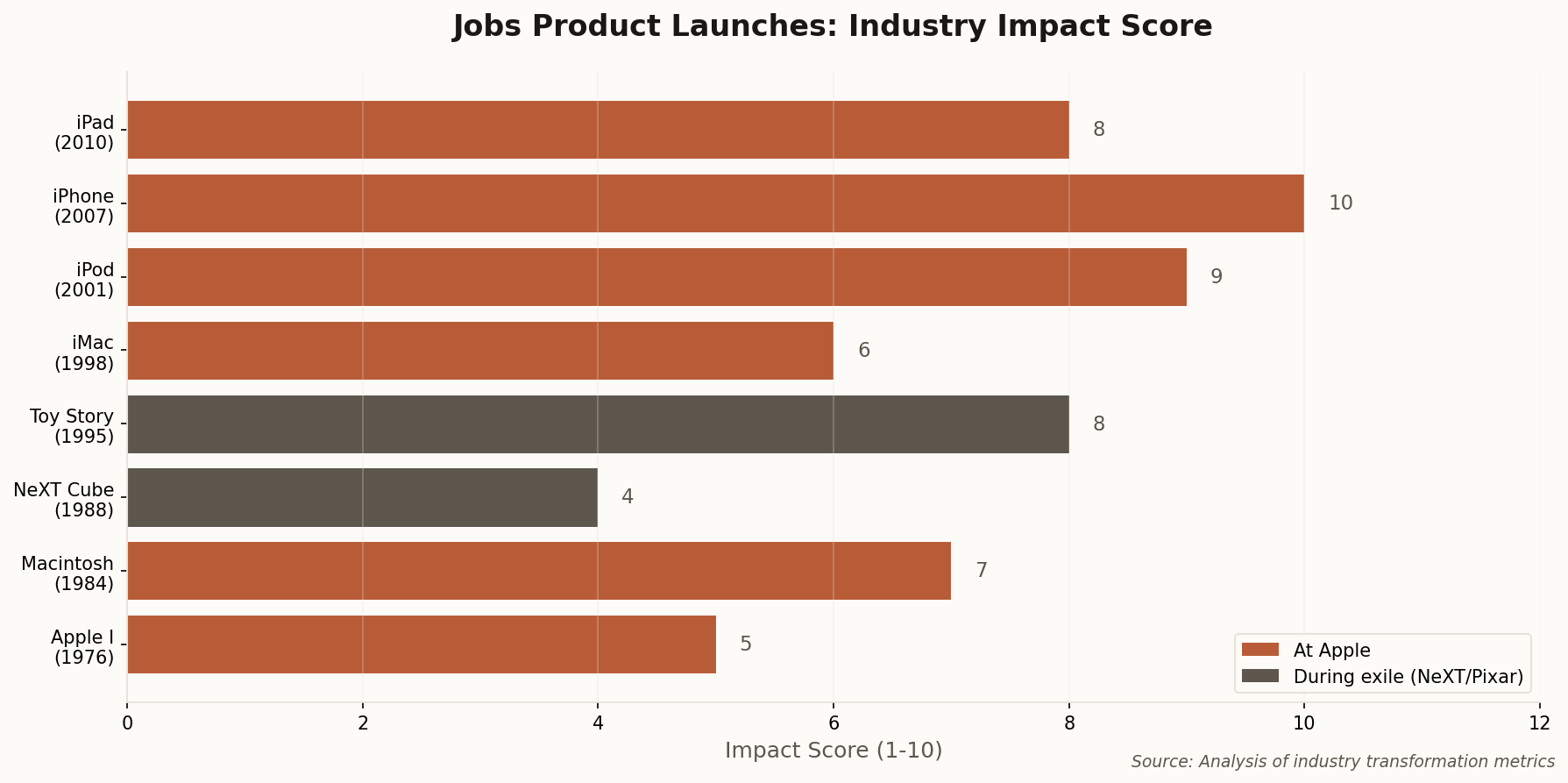
Horizontal bar chart showing industry impact scores of Jobs' major product launches
Jobs' product launches rated by industry transformation impact. The iPhone scores highest, but note that both NeXT and Pixar—products from his exile years—also achieved significant impact.

Macworld 2007 is widely considered the greatest product launch in business history. Not because of the product specs—the original iPhone was underpowered by many measures—but because of the comprehension Jobs created. He didn't just show people a phone with a touchscreen. He showed them their future.

The Multi-Touch interface eliminated physical keyboards forever. BlackBerry executives reportedly watched the keynote in disbelief, then denial. "We'll see if consumers want that," one told colleagues. Within five years, BlackBerry's market share collapsed from 20% to under 1%.

What's underappreciated: the iPhone almost didn't work that day. Engineers had a specific sequence of actions that avoided crashes—Jobs called it "the golden path." Deviate from it, and the demo phone would freeze. He walked the golden path flawlessly. The reality distortion field extended to the hardware itself.

05

Three Stories, One Philosophy, 15 Minutes That Defined a Generation

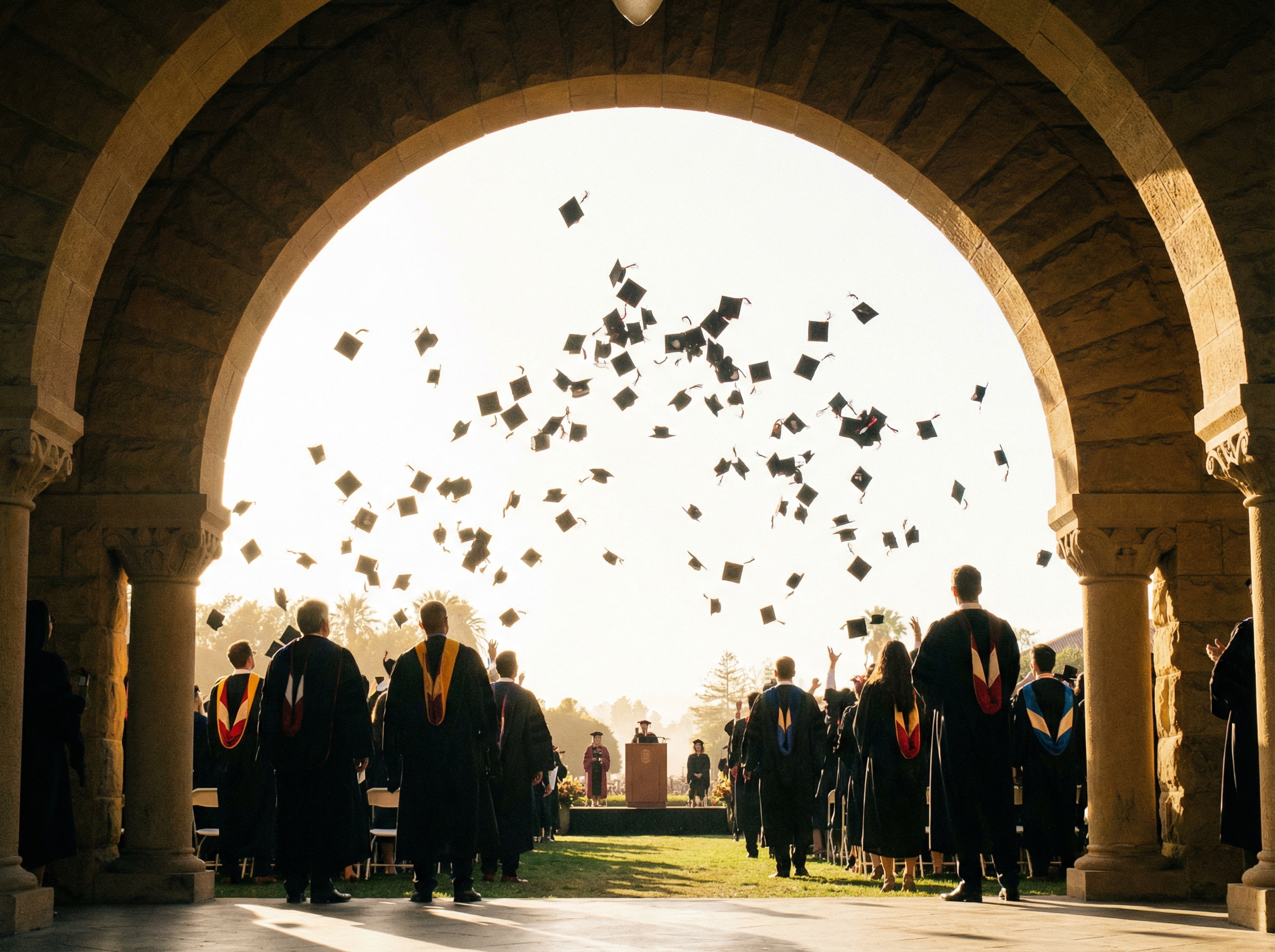
Stanford Memorial Church archway with graduation caps suspended like birds in golden light

Steve Jobs' 2005 Stanford commencement address has been viewed hundreds of millions of times. It's become the secular scripture of Silicon Valley—three parables about connecting dots, losing and finding love, and confronting death. "Stay hungry. Stay foolish."

The speech works because Jobs wasn't performing wisdom—he was processing his own mortality. He'd been diagnosed with pancreatic cancer the year before. The initial prognosis was three to six months. A biopsy revealed a rare, treatable form. He got lucky. But he'd stared into the void, and the void had stared back.

The first story, about dropping out of Reed College and auditing calligraphy classes, contains a genuinely useful insight: you can only connect the dots looking backward. Jobs couldn't have known that learning about serif and sans-serif typefaces would matter until a decade later, when he was designing the Macintosh. Trust that the dots will connect. Do the interesting thing.

"Remembering that I'll be dead soon is the most important tool I've ever encountered to help me make the big choices in life." Jobs delivered this line six years before his death. He knew what was coming.

The speech also contains Jobs at his most self-mythologizing. The story of getting fired from Apple is framed as liberation—"the heaviness of being successful was replaced by the lightness of being a beginner again." This is true and also convenient. Jobs was humiliated by his ouster. The wound never fully healed. But he made the wound into a weapon.

06

The Exile That Made Him a Billionaire

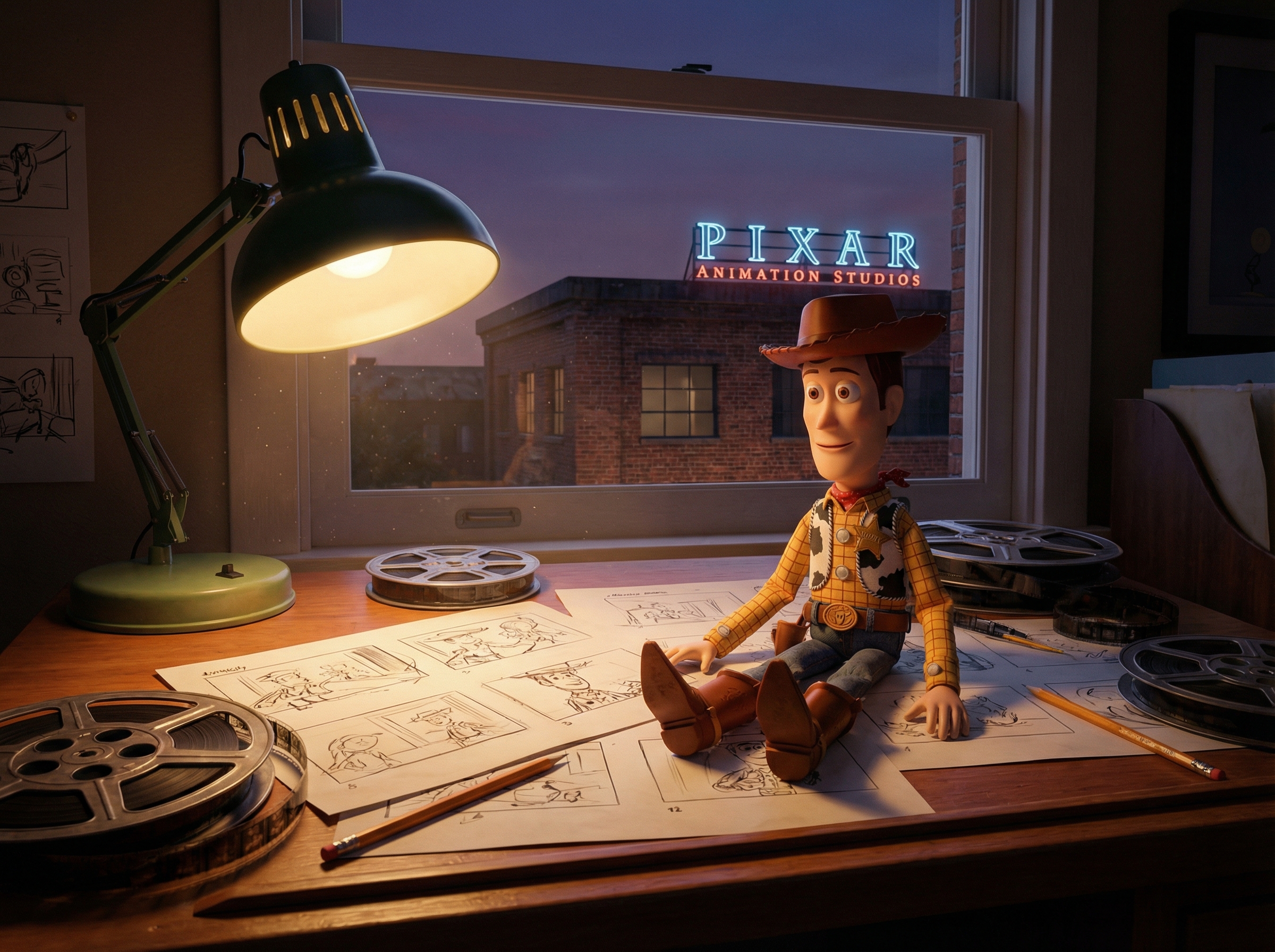
Woody doll on animation desk with storyboards and Pixar building visible through window

When Jobs bought the Graphics Group from Lucasfilm in 1986 for $10 million, he wasn't trying to make movies. He thought he was buying a computer hardware company. The team—Ed Catmull, John Lasseter, and a handful of graphics pioneers—had other ideas.

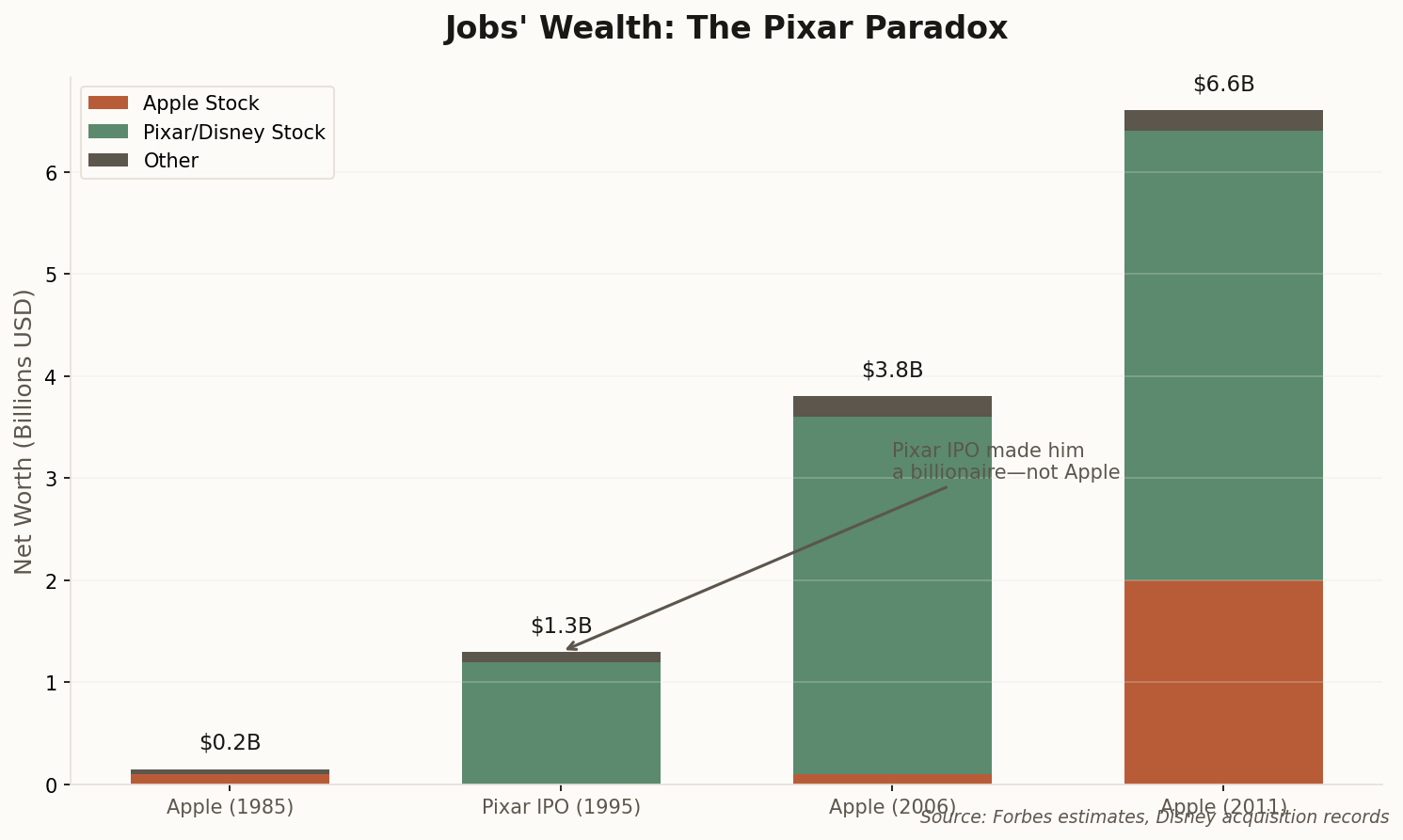
Stacked bar chart showing Jobs' wealth sources over time, with Pixar dominating
The Pixar Paradox: Jobs' Disney stock from the Pixar acquisition made him a billionaire. His Apple holdings at the time were comparatively modest.

Jobs funded Pixar at a loss for nearly a decade. He put in another $50 million beyond the purchase price, essentially keeping the company alive through sheer stubbornness. When Toy Story premiered in 1995 and the company went public, Jobs' stake was suddenly worth $1.5 billion. It was Pixar, not Apple, that first made him a billionaire.

The Pixar story reveals something essential about Jobs' genius: he could recognize greatness in other people even when he couldn't articulate what they were building. He didn't understand animation. He couldn't draw. But he understood that Lasseter was an artist of rare ability, and he protected that ability ferociously. Disney eventually bought Pixar for $7.4 billion. Jobs became Disney's largest individual shareholder.

There's a through-line from Pixar back to Apple: both companies succeeded by refusing to separate technology from art. The Pixar motto—"Art challenges technology, technology inspires art"—could have hung on the wall in Cupertino. Jobs didn't invent this philosophy, but he embodied it so completely that it became inseparable from his identity.

The Dent in the Universe

Jobs famously wanted to "put a dent in the universe." Mission accomplished. But dents aren't always pretty—they're the marks left by impact, by collision, by force meeting resistance. The devices in our pockets, the expectations we carry about how technology should feel, the very idea that consumer products can be objects of beauty: these are his dents. So is the daughter he denied, the employees he berated, the partners he betrayed. Stay hungry. Stay foolish. Stay complicated.