
Soviet History

The Arithmetic of Atrocity

How many people did Stalin actually kill? After decades of ideological warfare over the numbers, historians are finally converging on an answer—and it's more complicated than either side wanted.

Listen
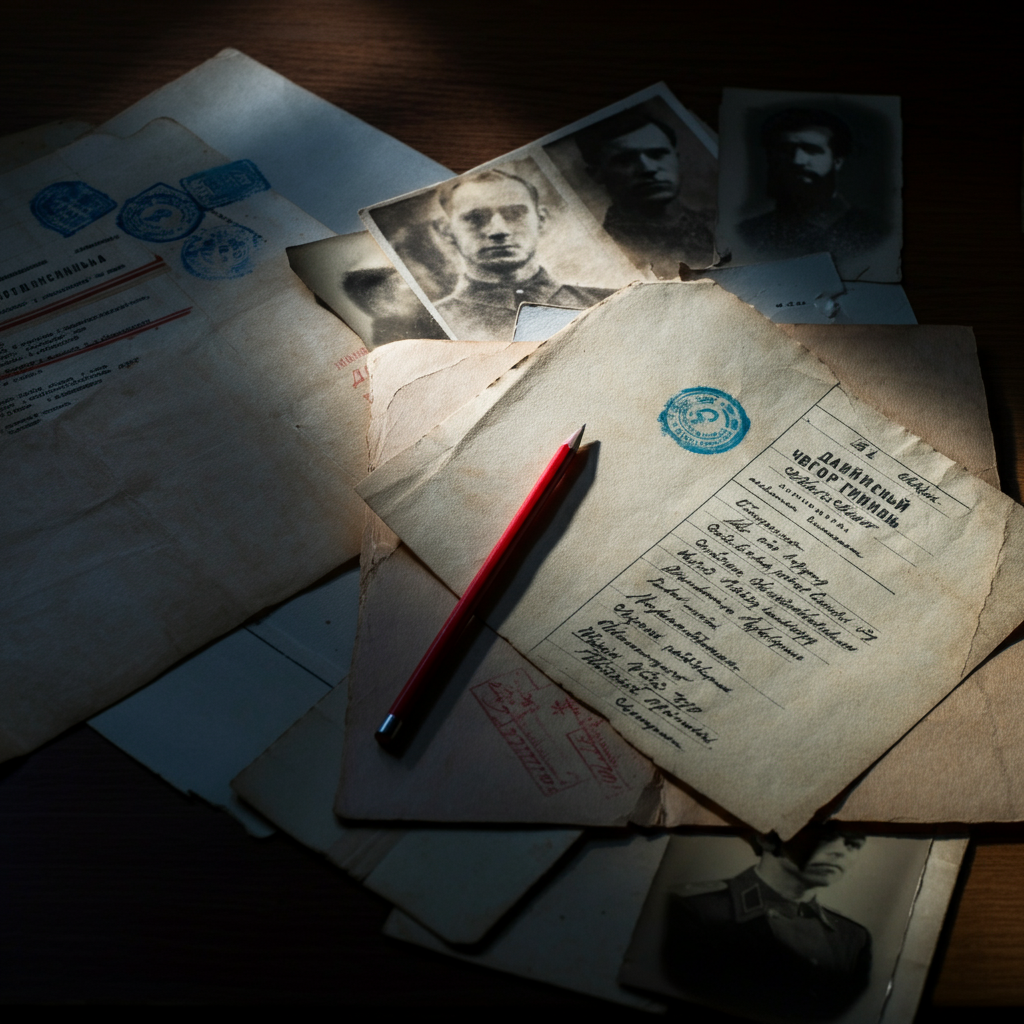
Soviet-era archival documents spread across a desk, with faded photographs and official stamps
Stack of scholarly historical volumes on a desk under warm lamp light
01

The Biography Everyone's Waiting For

The historical community is holding its breath. Stephen Kotkin's third and final volume of his monumental Stalin biography—covering World War II through Stalin's death in 1953—is expected this year, and it will likely reset the entire conversation about Stalinist mortality.

Kotkin's previous two volumes established him as the definitive modern biographer of Stalin, combining exhaustive archival research with a readable narrative style that's rare in academic history. His interpretation is neither apologetic nor hysterical: Stalin was rational (to himself), geopolitically motivated, and intimately involved in the machinery of death. The terror wasn't madness—it was method.

What makes Volume III so anticipated is its scope. The war years and immediate postwar period saw some of Stalin's most consequential decisions: the deportations of entire ethnic groups, the treatment of returning POWs, the postwar purges. Kotkin's archival access has been unprecedented. His conclusions will be hard to ignore.

The working title remains speculative—"Totalitarian Superpower" has been floated—but whatever it's called, this book will likely become the new baseline for serious Stalin scholarship. Everyone else will have to respond to it.
Empty steppe landscape with weathered fence post under grey skies
02

Kazakhstan Breaks Its Silence

President Kassym-Jomart Tokayev did something remarkable last year: he gave the Kazakh famine an official death toll. "Over 1.5 million" Kazakhs died during the collectivization-induced famine of the early 1930s—roughly one-third of the ethnic Kazakh population at the time.

This isn't just demographic bookkeeping. Kazakhstan's official acknowledgment marks a significant break from Moscow's recent trend of rehabilitating Stalin's reputation. While Russian opinion polls show growing nostalgia for the Soviet dictator, post-Soviet states are increasingly asserting their own historical narratives.

The Kazakh famine—sometimes called the Asharshylyk or "Goloshchekin genocide" after the regional party boss who implemented collectivization—has long been overshadowed by the Ukrainian Holodomor. But the proportional death toll was arguably even more catastrophic. The nomadic Kazakh population was forced into sedentary collective farms with no understanding of how to make them work. The result was demographic annihilation.

Tokayev's statement carries political weight precisely because Kazakhstan remains on reasonably good terms with Russia. This isn't anti-Russian posturing—it's historical reckoning, delivered from within the post-Soviet sphere.

Winter Ukrainian wheat field with abandoned farmhouse in distance
03

The Number That Won't Move: 3.9 Million

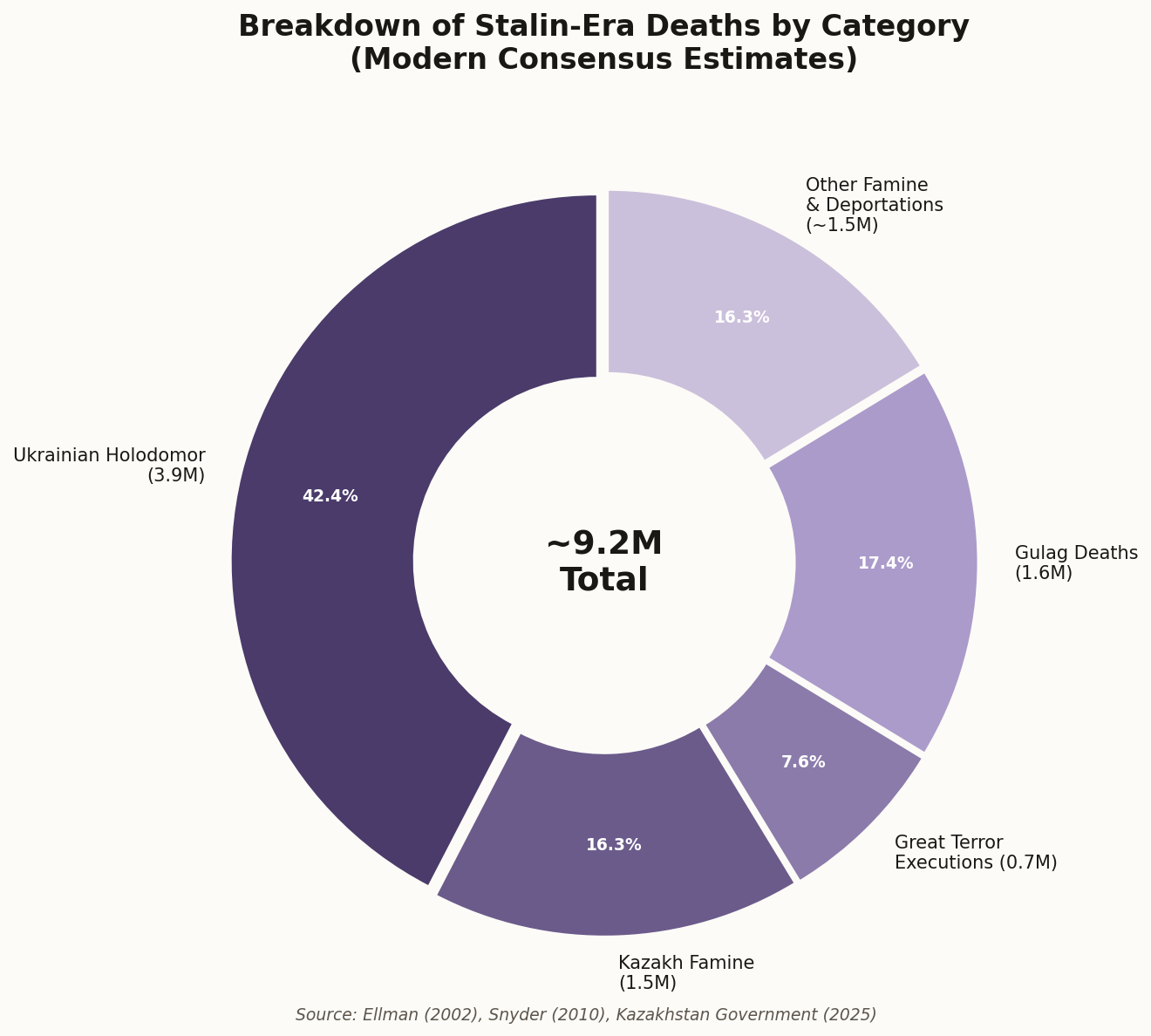
Despite decades of political pressure to inflate or deflate the figures, serious demographers have converged on a remarkably stable number for the Ukrainian Holodomor: approximately 3.9 million direct excess deaths in 1932-33.

Recent scholarship in the Journal of Genocide Research, including articles like "Echoes of the Holodomor," has reinforced this demographic anchor while drawing uncomfortable parallels to current events. The 2024 research explicitly connects Stalin's grain requisition policies to Russian occupation tactics in Ukraine—a comparison that would have seemed inflammatory a decade ago but now reads as historically grounded.

Donut chart showing breakdown of Stalin-era deaths by category
Breakdown of Stalin-era deaths by category, showing the Holodomor as the single largest component of the consensus estimate.

What's significant about the 3.9 million figure isn't just its precision—it's its resistance to manipulation. The number comes from demographic deficit calculations, not from politically convenient estimates. You can argue about whether it constitutes "genocide" (the classification debate remains fierce), but you can't really argue with the bodies.

The research also rejects what scholars call the "All-Union Famine" narrative—the attempt to dilute Ukrainian suffering by emphasizing that other Soviet regions also experienced famine. The data shows clearly that Ukrainian grain-producing regions had mortality rates significantly higher than comparable Russian regions. The targeting was real.

1940s military map of Europe with pins and arrows showing troop movements
04

The Contrarian Who Wants to Blame Stalin for Everything

Sean McMeekin's Stalin's War represents the most audacious recent attempt to radically expand Stalin's "moral body count"—and mainstream historians aren't buying it.

McMeekin's thesis is provocative: Stalin was the primary architect of World War II's escalation, using Hitler as an "icebreaker" for communist expansion, and therefore bears responsibility for war casualties typically attributed to Nazi aggression. If you accept this framing, Stalin's death toll explodes from single-digit millions into the tens of millions.

The problem is that most serious historians don't accept the framing. Reviews have ranged from "brilliantly contrarian" (supporters) to "overwhelmingly unconvincing" (critics). The book has been described as prioritizing "narrative punch over archival rigor" and making claims that require accepting Stalin as somehow more responsible for Operation Barbarossa than Hitler was.

Yet McMeekin's work matters precisely because it reveals the stakes in the numbers game. How you count Stalin's victims isn't just an academic exercise—it shapes how we understand the moral calculus of the twentieth century. Was communism as evil as Nazism? Were they equivalent? The death toll debate is really a proxy for that deeper question.

McMeekin's answer—that Stalin was worse than we thought—hasn't convinced the scholarly consensus. But his book's popular reception shows the appetite for revisionist takes, especially in an era when Cold War binaries are making a comeback.

Snow-covered barbed wire fence stretching into fog with guard tower in distance
05

The Gulag Wasn't Just a Death Camp—But That's No Defense

New scholarship from the Wilson Center and researchers like Steven Barnes is complicating our understanding of the Gulag—and the revisions cut both ways.

The emerging picture challenges the "death camp" monolith while emphasizing forms of suffering that don't show up in mortality statistics. The Gulag was primarily a "corrective" labor institution where release was genuinely possible. Of the estimated 18 million people who passed through the system, roughly 1.5-1.7 million died in custody. That's a horrific number, but it's also a mortality rate far below what we'd expect from a system designed primarily to kill.

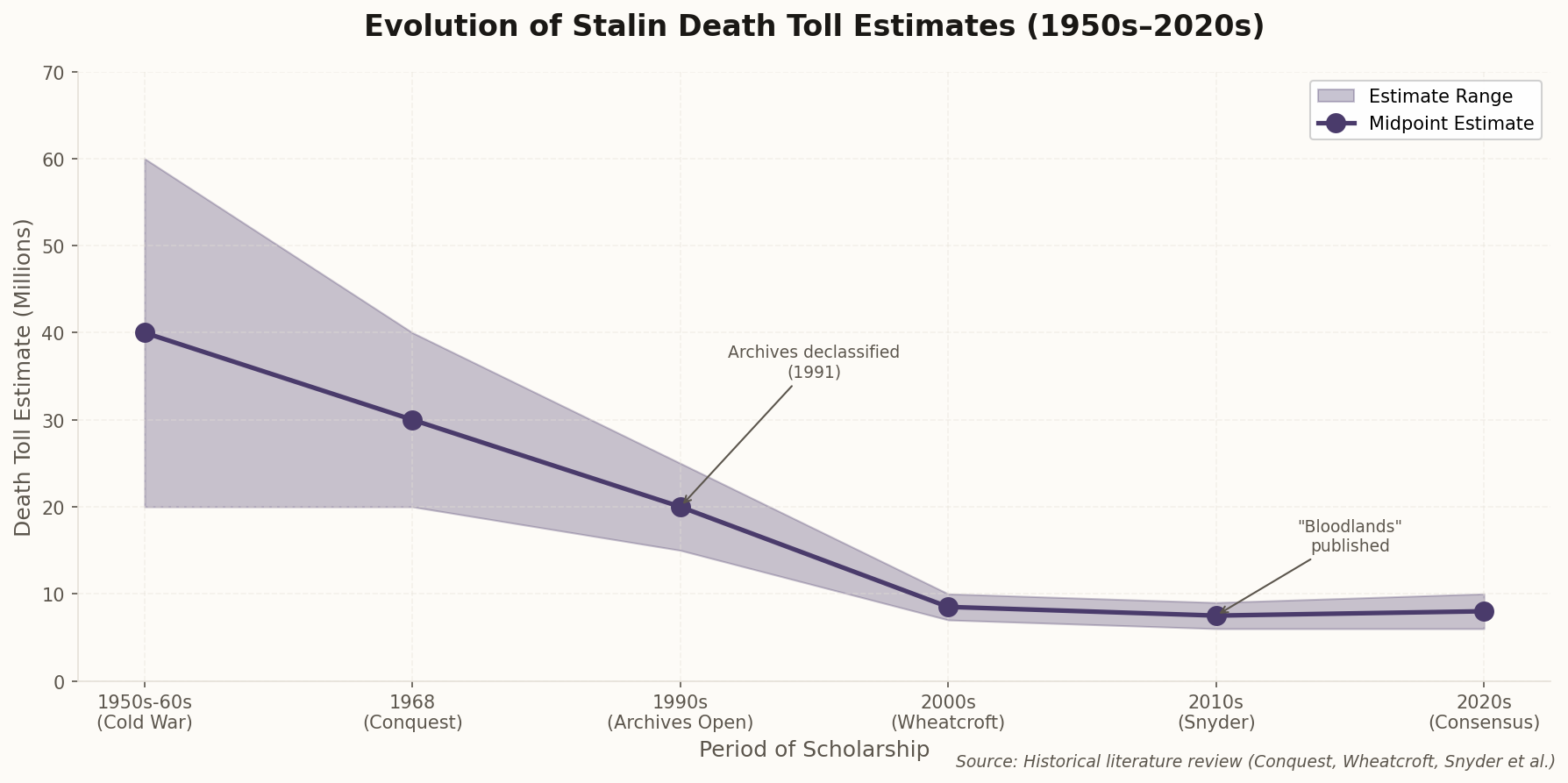
Line chart showing how Stalin death toll estimates have evolved from 1950s to 2020s
Evolution of Stalin death toll estimates, showing the dramatic downward revision from Cold War-era figures as archives opened.

The "revolving door" nature of the camps—high turnover with millions surviving but permanently damaged—shifts the moral calculus. Survival statistics don't exonerate the regime; they just change our understanding of what it was. The Gulag was less Auschwitz than an industrial-scale system of state slavery, breaking people for economic purposes rather than exterminating them for ideological ones.

Anne Applebaum's earlier work noted that many prisoners were released "on the brink of death"—transferred out to die at home, keeping the official mortality statistics artificially low. The new research tries to account for this, but the numbers remain contested.

What's not contested: even by the most conservative estimates, the Gulag represented one of the largest forced labor systems in human history. Whether it killed 1.5 million or 3 million, it enslaved 18 million.

Two academic books facing each other with magnifying glass and handwritten notes
06

The Consensus That Took Seventy Years

After decades of ideological warfare, the scholarly consensus on Stalin's death toll has finally stabilized—and it's a number that satisfies almost no one.

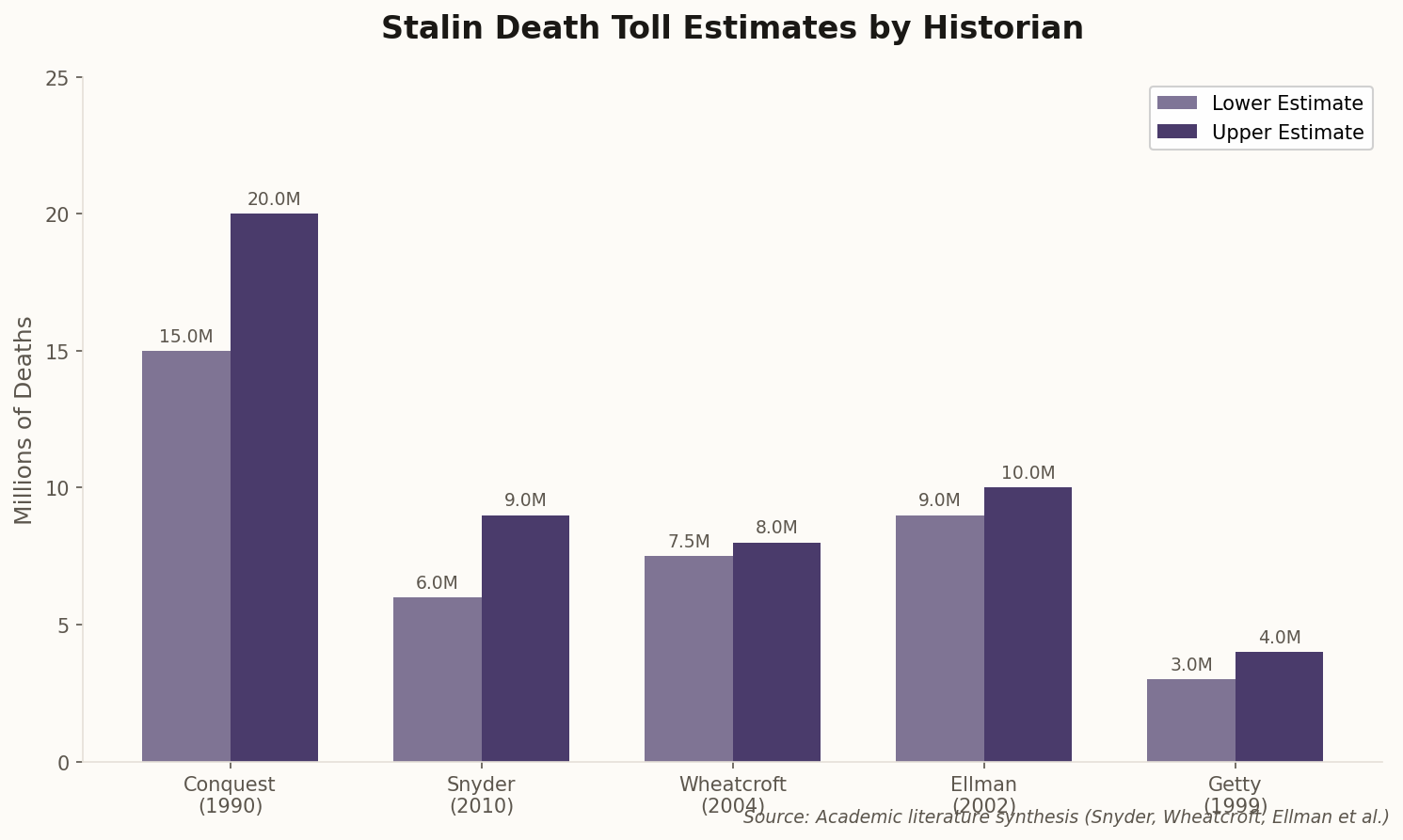
The current estimate: approximately 6-9 million "deliberate" deaths when you include famine and foreseeable policy outcomes. If you count only documented executions and recorded Gulag deaths, the number drops to around 3.3 million. If you use the Cold War-era methodology of "excess mortality," it climbs to 20 million or more.

Bar chart comparing death toll estimates from different historians
Comparison of death toll estimates from major historians, showing the range from Getty's minimalist archival approach to Conquest's broader calculations.

The key intellectual breakthrough came from distinguishing between different categories of death. Timothy Snyder's concept of "foreseeable deaths"—counting the victims of policies where mass death was a predictable outcome, even if not the explicit goal—bridges the gap between strict archival counts and inflated propaganda figures.

This matters because it reframes the moral question. Stephen Wheatcroft, who represents the strictest adherence to archival evidence, argues the 1932-33 famine was caused by "incompetence, environmental factors, and ruthlessness"—but was not an intentional genocide. Snyder counters that intentionality isn't the relevant criterion: when you implement policies that will predictably kill millions, you're responsible for those deaths whether or not you signed an execution order.

The debate isn't really about numbers anymore. It's about what counts as murder when the state is the killer. And on that question, reasonable historians still disagree.

The Numbers Matter—But Not in the Way You Think

Whether Stalin killed 6 million or 20 million, he presided over one of the most murderous regimes in human history. The precision of the count matters for historians, but it shouldn't matter for moral judgment. The question isn't whether Stalin was a monster—it's whether we can understand how ordinary bureaucracies became instruments of mass death, and whether we'd recognize the warning signs if we saw them again.