EV Market 2026

The Electric Pivot

From Tesla's existential mission shift to China's solid-state breakthrough, the EV market enters a new phase where scale meets meaning.

Listen
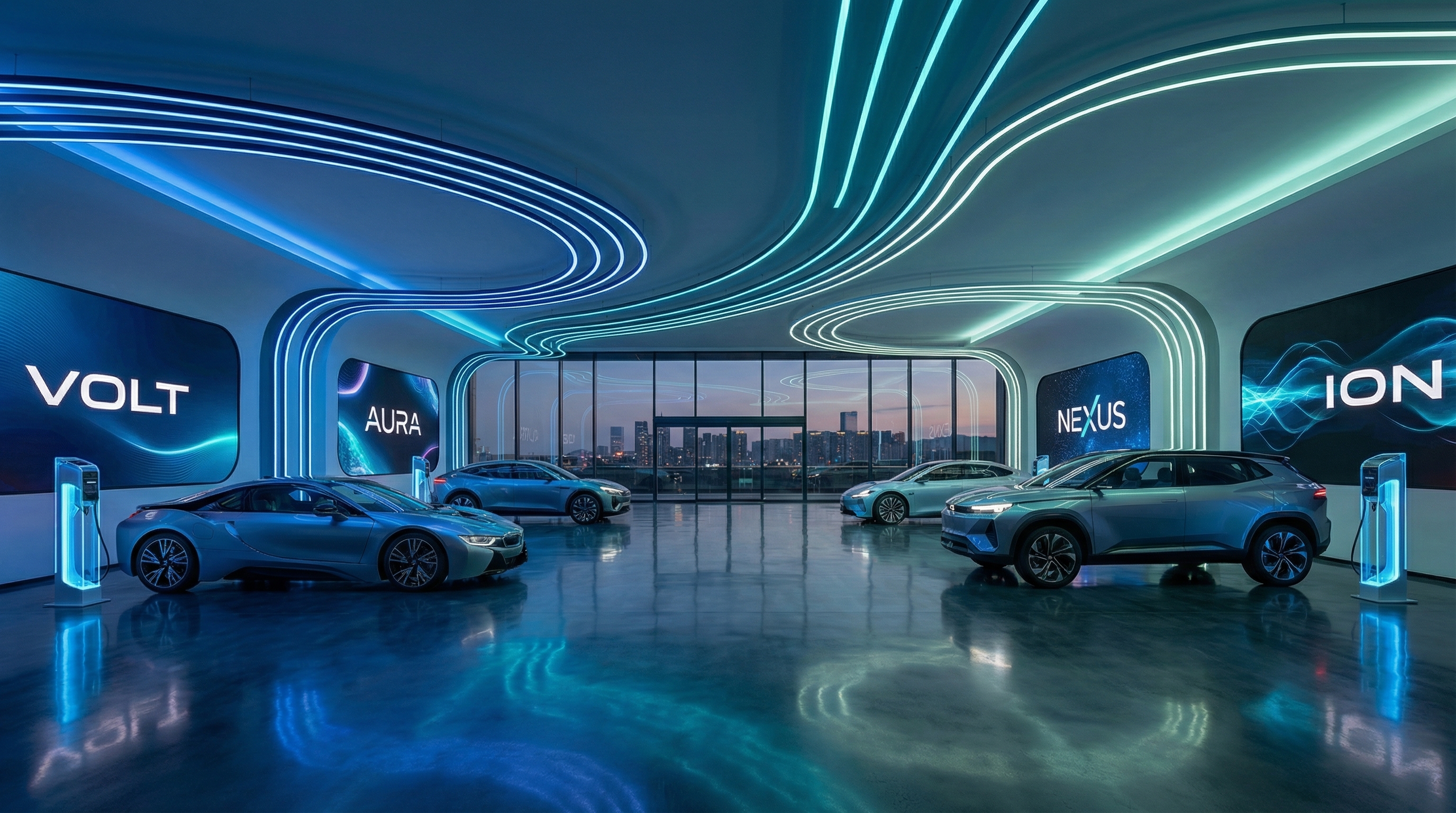
Futuristic electric vehicle showroom with sleek EVs bathed in teal lighting
01

Tesla Abandons "Sustainable Energy" for "Amazing Abundance"

Tesla has officially replaced its founding mission statement. Gone is "accelerating the world's transition to sustainable energy." In its place: "Build a world of amazing abundance."

This isn't just marketing wordsmithing. The change aligns with Elon Musk's "Master Plan Part 4" and reflects the company's increasing focus on AI, robotics, and the Optimus humanoid program. Musk hinted at the shift in December, saying the new phrasing would convey "more joy."

The shift from "sustainable energy" to "amazing abundance" signals Tesla's evolution from an EV company into a broader AI and automation conglomerate. For investors, it's a bet on Optimus and full self-driving; for environmentalists, it might feel like mission drift.

Fifteen years after Tesla's founding, the company no longer sees itself as primarily an automaker. Whether that's visionary or hubristic depends on how the next decade unfolds.
02

Volvo's EX60: The XC60 Goes Electric

Volvo unveiled the EX60, its all-electric successor to the XC60 mid-size SUV that has historically been the brand's best-seller. The stakes couldn't be higher.

The headline numbers: up to 400 miles of claimed range (approximately 640 km), built on a new dedicated EV architecture with advanced core computing, and scheduled for summer 2026 deliveries. That range figure puts it squarely in competition with the Tesla Model Y and BMW iX3.

Volvo's entire brand identity has been staked on safety and Scandinavian design sensibility. The EX60 will test whether those values translate to the electric era, or whether consumers prioritize range, charging speed, and software over traditional automotive virtues.

03

Germany Revives EV Subsidies with 3 Billion Program

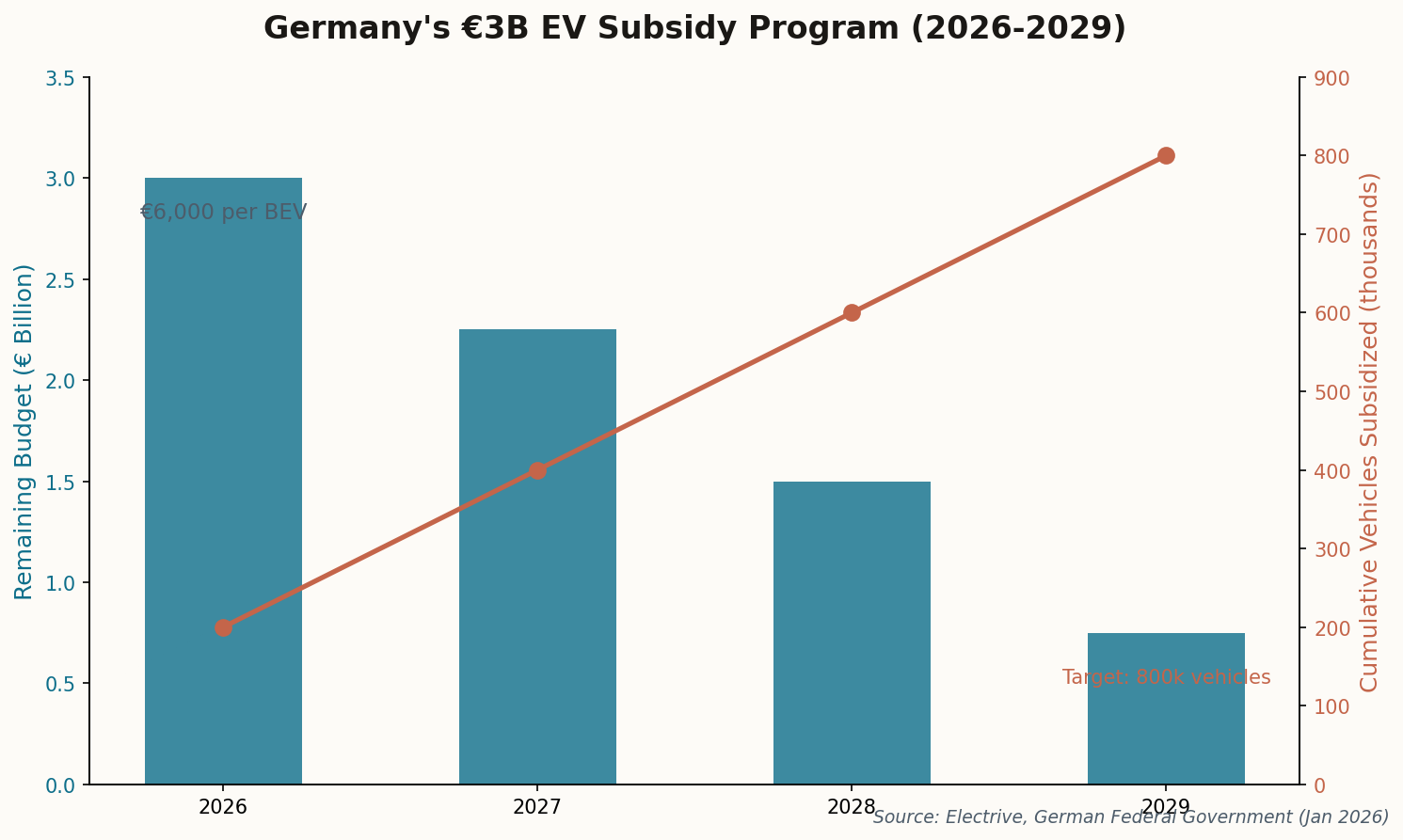
After letting EV incentives expire in late 2025—triggering a sales slump—the German government has announced a 3 billion euro subsidy program offering up to 6,000 euros per battery-electric vehicle.

Germany's 3B EV Subsidy Program 2026-2029
Germany's new program targets 800,000 subsidized vehicles through 2029

Crucially, the program is retroactive to January 1, 2026, covering vehicles already registered this year. The budget comes from the Climate and Transformation Fund, targeting roughly 800,000 vehicles through 2029.

For struggling German automakers like Volkswagen and Mercedes-Benz, this is a lifeline. Europe's largest auto market had become increasingly hostile to EV adoption; this policy U-turn attempts to reverse that trajectory.

04

Chery's Solid-State Battery: 1,500 km on a Single Charge

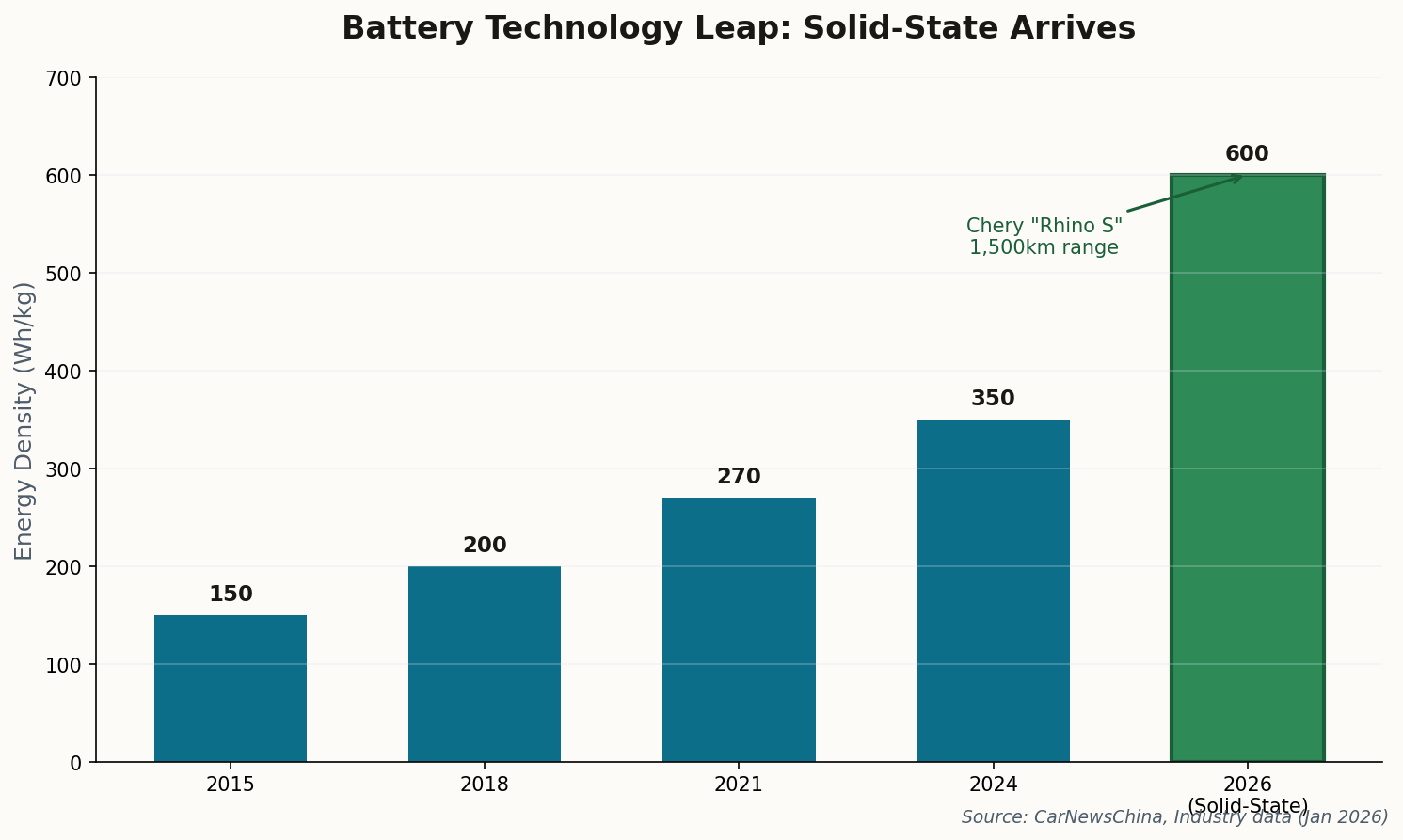
Chery's Exeed brand has confirmed its "Liefeng" shooting brake will launch in 2026 with a solid-state battery claiming 1,500 km (932 miles) of range. If delivered as promised, this would be a monumental breakthrough.

Battery Technology Leap: Solid-State Arrives
Chery's "Rhino S" battery claims 600 Wh/kg—nearly double current lithium-ion technology

The "Rhino S" battery pack claims an energy density of 600 Wh/kg—compared to roughly 300-350 Wh/kg for current lithium-ion cells. That's the kind of leap that could render range anxiety obsolete overnight.

The catch: Chery plans an initial rollout focused on fleet and ride-hailing applications for data collection before mass consumer release. Smart strategy—solid-state technology is notoriously difficult to scale. But if Chery cracks it, the implications for Western automakers are significant.

05

Canada Cracks Open the Door to Chinese EVs

In a significant trade policy shift, Canada has agreed to allow an annual quota of 49,000 Chinese-made EVs at a reduced tariff rate of 6.1%—replacing the prohibitive 100% surtax imposed in 2024.

In exchange, China will lower tariffs on Canadian canola and other agricultural products. The deal represents the first crack in the "protectionist wall" Western nations have erected around their auto industries.

For brands like BYD, this quota could serve as a testing ground before broader North American expansion. 49,000 vehicles isn't market dominance, but it's a foothold. And footholds tend to expand.

06

Rivian R2: The Mass-Market Bet Enters Validation

Rivian has begun building validation prototypes of its R2 SUV at its Normal, Illinois plant. These units are destined for EPA testing and crash certification—the final hurdles before customer deliveries.

The R2 is priced around $45,000 and targets the high-volume segment currently dominated by Tesla. For Rivian, this is existential: the company has built a cult following with its expensive trucks and SUVs, but profitability requires volume.

Customer deliveries are expected "soon" in the first half of 2026. After years of ambitious promises and operational challenges, Rivian's execution on the R2 will determine whether the company becomes a permanent player or a cautionary tale.

07

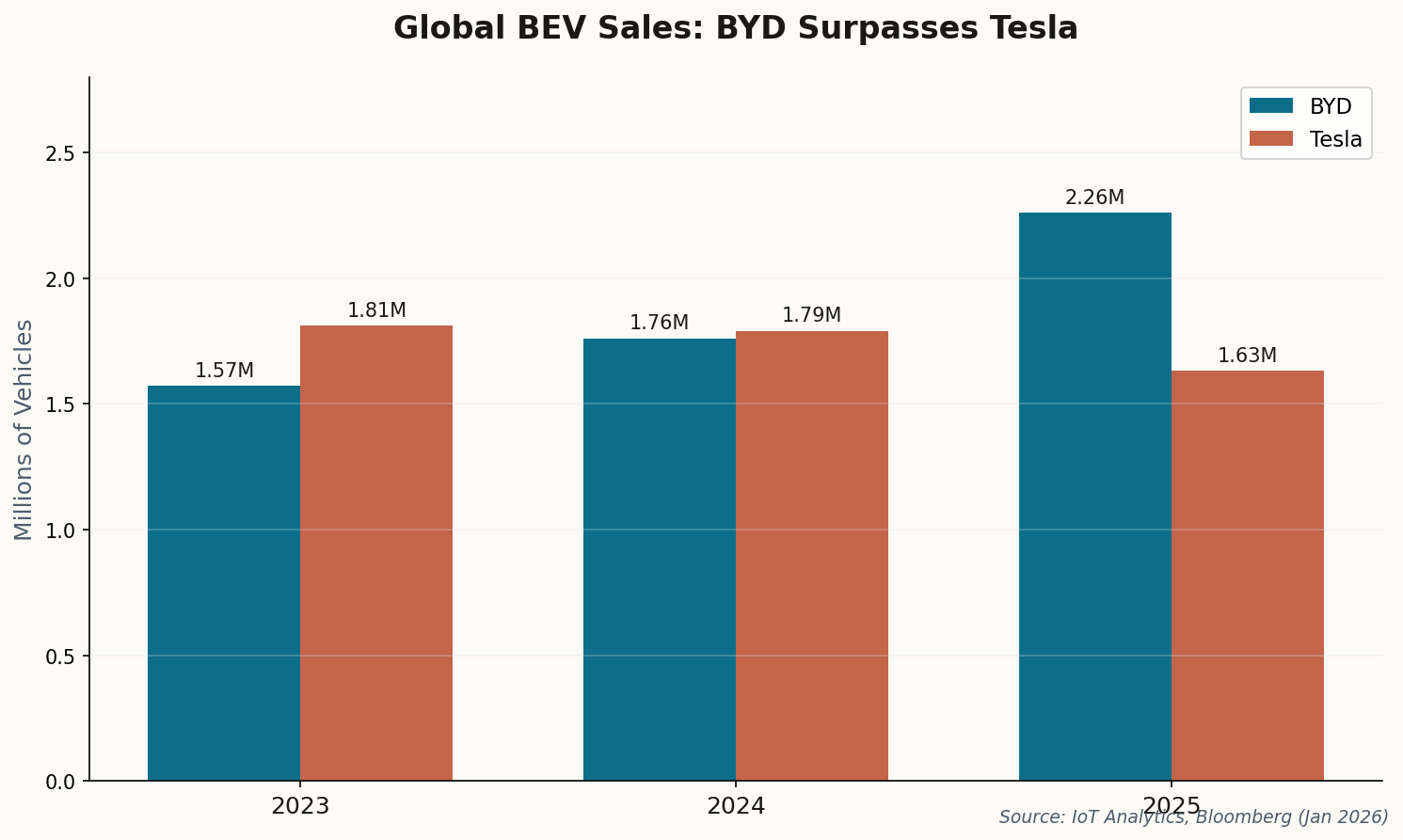
BYD Officially Surpasses Tesla in Global EV Sales

The final 2025 sales figures are in: BYD has definitively outsold Tesla in battery-electric vehicles globally. BYD delivered approximately 2.26 million BEVs compared to Tesla's declining figures—a nearly 9% drop for the American automaker.

Global BEV Sales: BYD Surpasses Tesla
BYD's ascent vs. Tesla's decline: the changing of the guard in global EV sales

This symbolic changing of the guard cements China's dominance in the global EV transition. While Tesla expanded into AI and robotics, BYD focused relentlessly on vertical integration, battery technology, and aggressive pricing.

The narrative has shifted. Tesla is no longer the undisputed leader of the EV revolution—it's one of several major players in a market increasingly shaped by Chinese manufacturing prowess and government industrial policy.

The Next Charge

The EV market in 2026 isn't about whether electric vehicles will win—that question is settled. It's about who controls the transition, which technologies prevail, and whether Western automakers can compete with China's manufacturing machine. Tesla's mission statement change might be the most honest signal of the year: the sustainable energy revolution is becoming something else entirely.