Higher Education

The Great Unraveling

University DEI programs are caught in an accelerating vortex: federal courts checking executive overreach, states building surveillance infrastructure, and administrators scrambling to rebrand their way to survival. This week brought moves on every front.

Listen
A university campus divided by light and shadow, symbolizing the conflict over DEI programs
01

The Feds Blink: DOJ Drops Anti-DEI Appeal
A gavel resting on cracked legal documents, symbolizing the federal court victory

In a move that surprised exactly no one who's been watching the judicial tea leaves, the U.S. Department of Education filed a motion yesterday to dismiss its appeal of Judge Stephanie Gallagher's ruling that blocked the administration's campaign to strip federal funding from schools with DEI programs.

The original ruling was a body blow: Gallagher found the administration's threats violated both the First Amendment and basic procedural rules. Her assessment that "the guidance stifled teachers' free speech" now stands as settled precedent. The administration, reading the room, decided not to double down on a losing hand.

This matters beyond the immediate legal question. The federal government's primary weapon against university DEI has been the threat of funding cuts. With courts now signaling they'll scrutinize such threats carefully, administrators may feel marginally more confident pushing back. But don't expect a celebration in faculty lounges just yet.

The catch: States aren't bound by this ruling. And as we'll see below, they're building their own enforcement machinery that doesn't rely on federal funding threats at all.

02

Virginia Democrats Launch VMI Counterattack

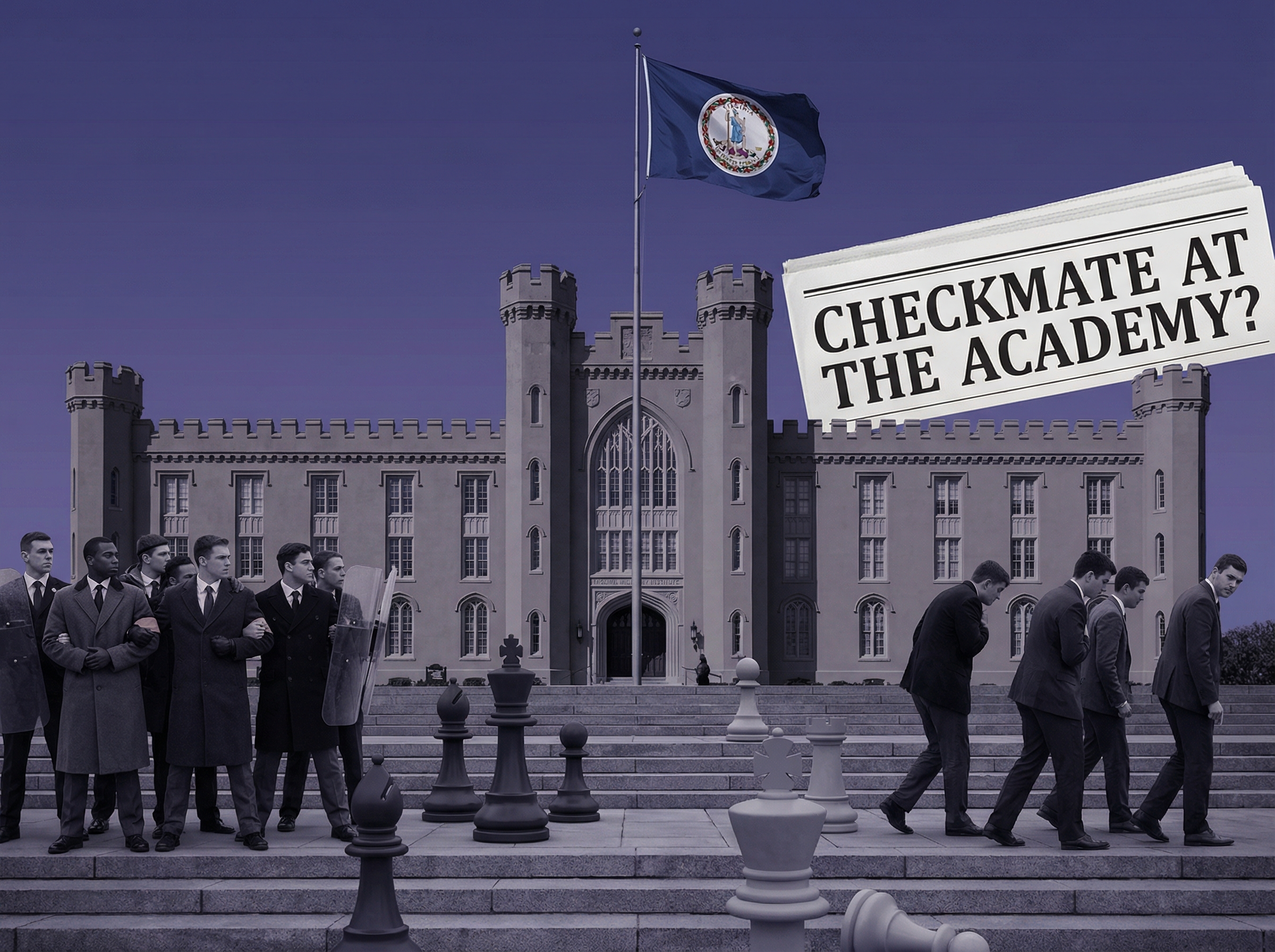
VMI building with chess pieces on steps, symbolizing political strategy

Someone in Richmond decided to play offense. Virginia House Democrats filed a resolution yesterday to establish a task force investigating Virginia Military Institute, examining whether the school has adequately addressed the damning 2021 report on racism and sexism—and whether it should keep receiving state funding if it hasn't.

The irony is thick enough to cut with a ceremonial saber. Conservatives have spent years threatening to defund schools with DEI programs. Now pro-DEI lawmakers are threatening to defund schools without them. The weapon works both ways.

VMI has been a flashpoint since the 2021 investigation revealed a culture that, charitably, hadn't evolved much since the 19th century. The school made some changes. Critics say those changes were cosmetic. Now the General Assembly will decide whether "cosmetic" is good enough for continued public investment.

Watch this one. If Democrats can successfully tie state funding to maintaining diversity efforts, it creates a template for blue states to counter red state rollbacks. The DEI wars may be entering a new phase of explicit state-versus-state policy competition.

03

Texas Builds Its Surveillance Machine

Digital surveillance portal glowing in darkness, representing the Texas whistleblower system

The Texas Higher Education Coordinating Board went live yesterday with "Students First," an online portal allowing anyone—students, staff, concerned citizens, anonymous internet users—to report suspected violations of Senate Bill 17 (the DEI ban) and Senate Bill 37 (faculty senate restrictions).

The interface is sleek. The implications are chilling. Anonymous reporting of "unconstitutional race- and sex-conscious programs" creates a system where any professor discussing systemic inequality, any administrator referencing demographic data, any staff member organizing a heritage month event could find themselves under investigation based on a tip from someone they'll never face.

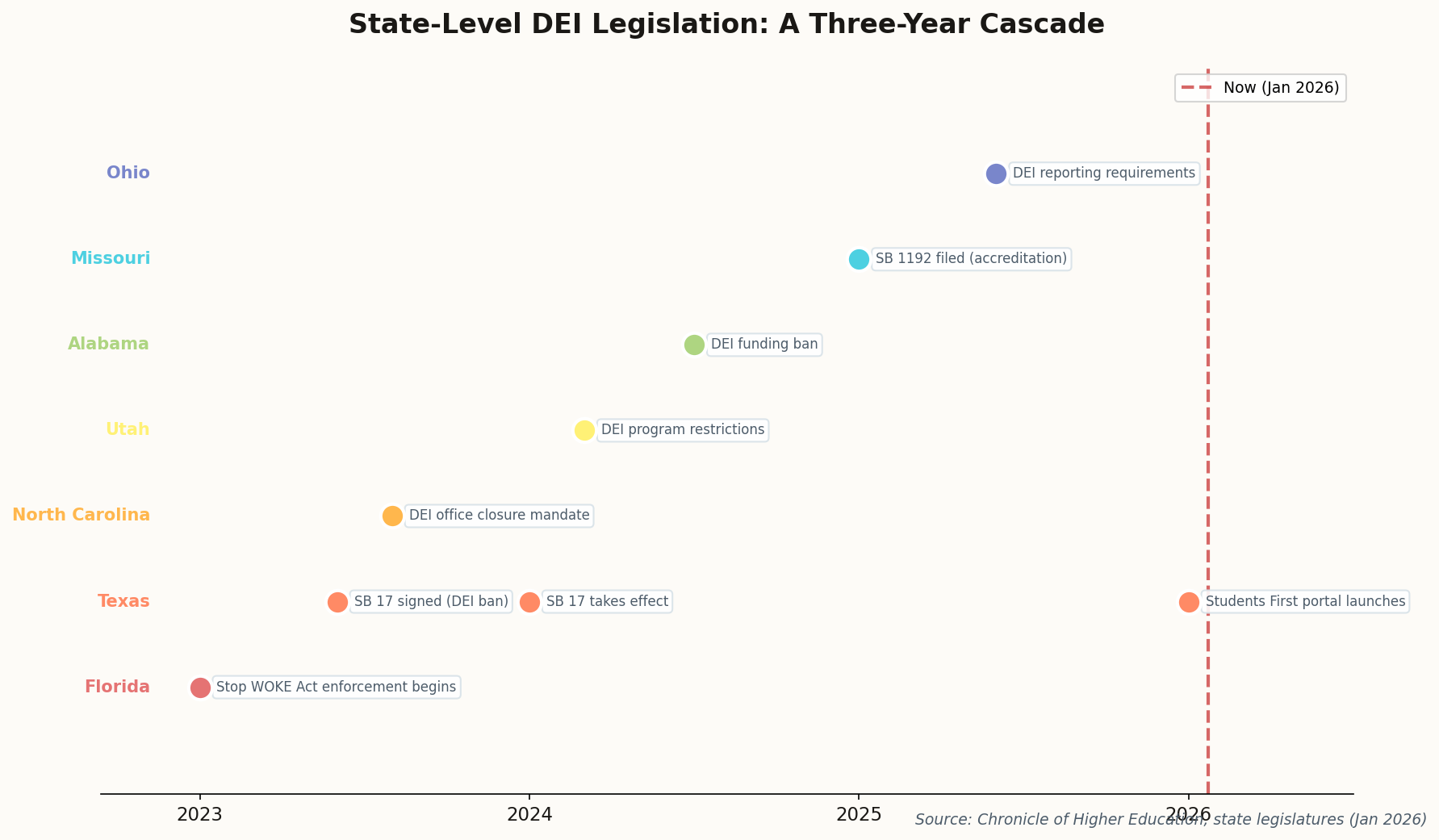
Timeline showing state DEI legislation from 2023-2026
The cascade of state-level DEI restrictions has accelerated dramatically since 2023, with Texas consistently at the vanguard.

The immediate effect will be self-censorship. Faculty will avoid topics that might generate a report. Administrators will shut down programs preemptively rather than defend them. The portal doesn't need to result in actual punishments to achieve its goals—the mere existence of the surveillance mechanism does the work.

History has a word for systems that encourage citizens to report their neighbors for ideological offenses. Texas has given it a modern UX makeover.

04

The Great Rebrand: Cal Poly Drops the D-Word

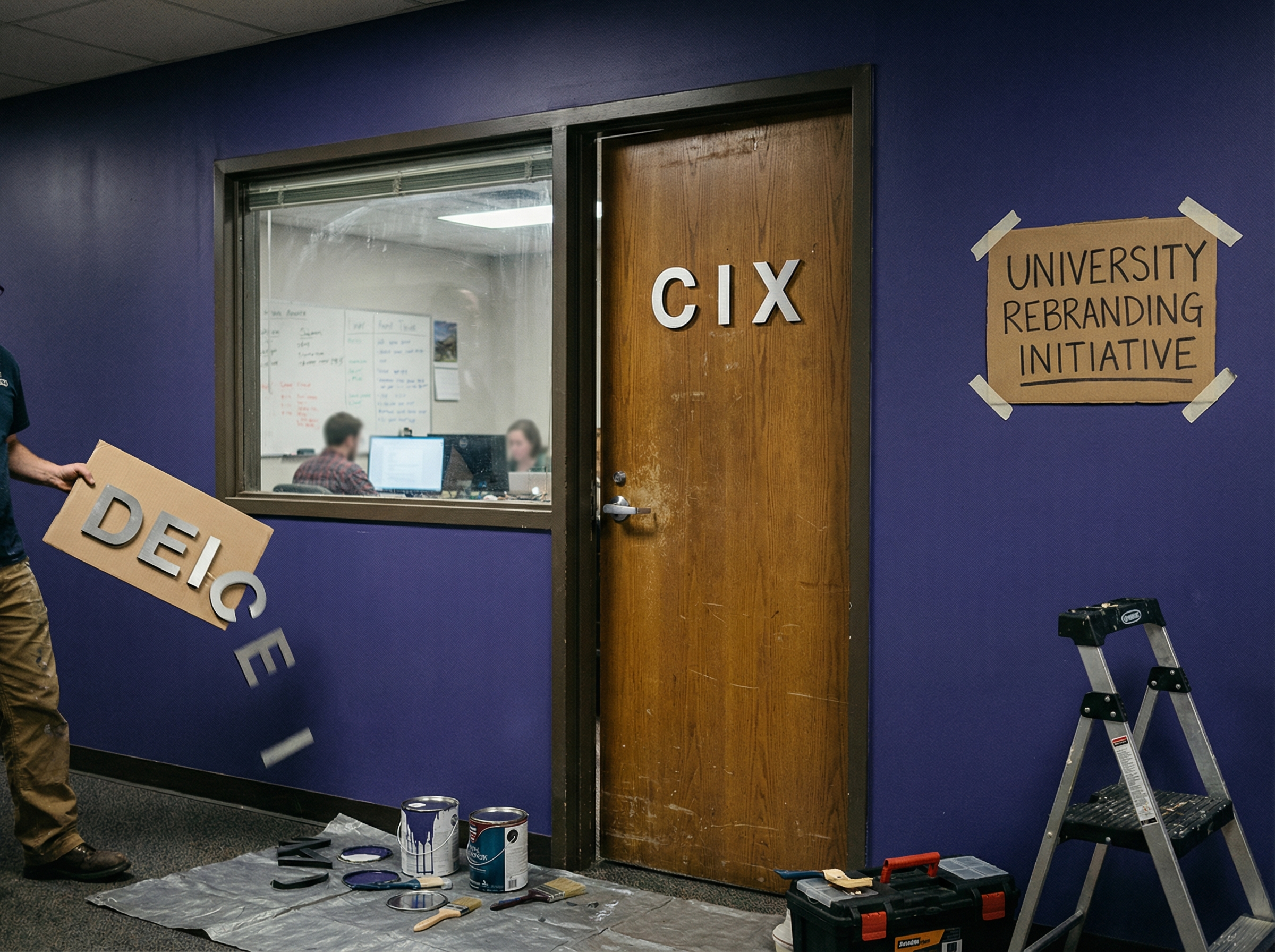
University office door with letters being rearranged, representing the DEI rebrand

Cal Poly San Luis Obispo officially renamed its "Office of University Diversity and Inclusion" to the "Office of Culture and Institutional Excellence" this week. The acronym shifts from OUDI to CIX. The programs inside—including the BEACoN Mentorship Program—remain intact.

This is strategic compliance at its most transparent. University administrators have decided that the political fight over the word "diversity" isn't worth the programs themselves. By scrubbing the terminology while preserving the substance, they're betting they can thread a needle that's getting narrower by the month.

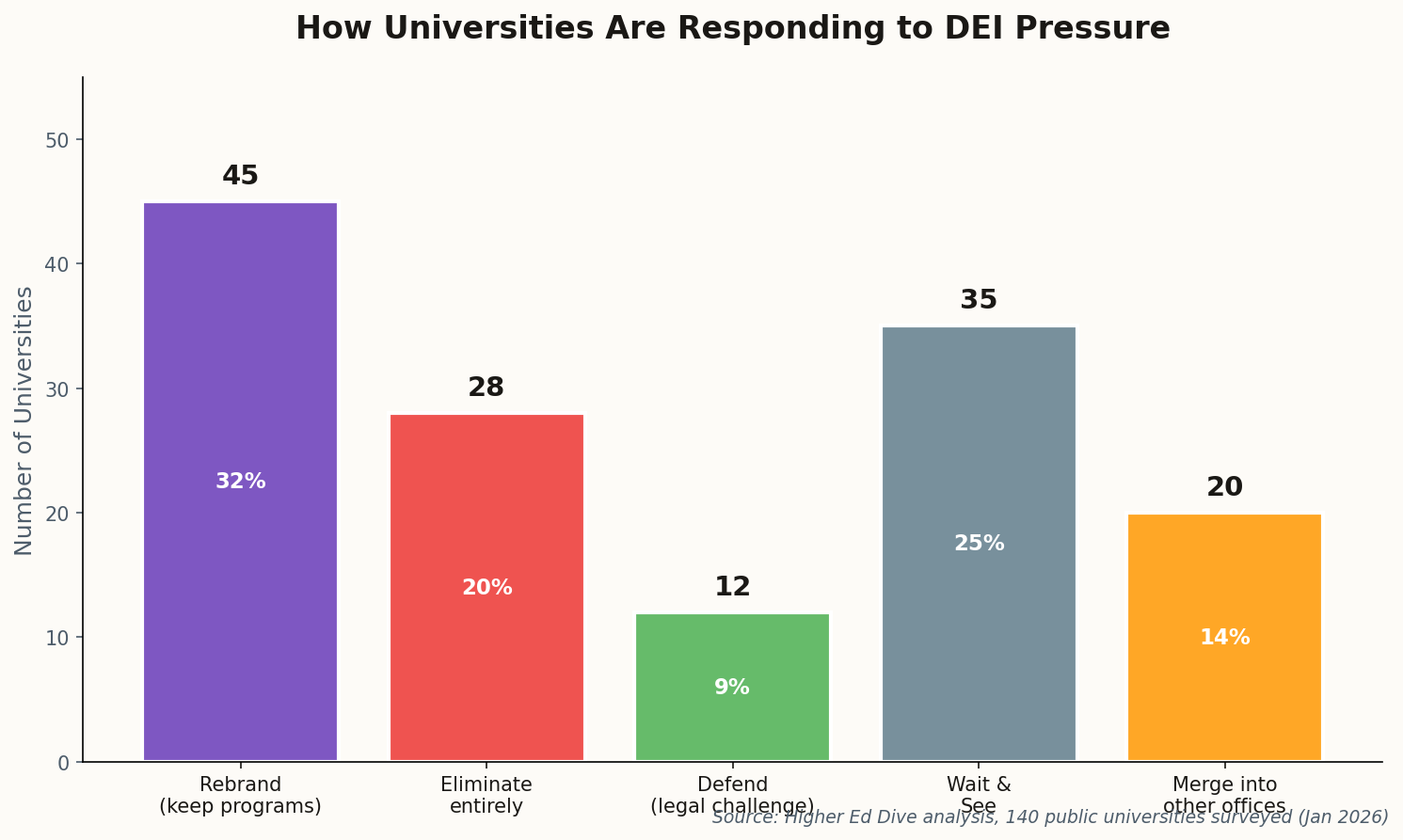
Bar chart showing how universities are responding to DEI pressure
Universities are taking varied approaches to DEI pressure, with "strategic rebranding" emerging as the most common response among public institutions surveyed.

The gamble is whether opponents will be satisfied with symbolic victories or will eventually demand substantive elimination. Early evidence suggests the latter. Missouri's new bills (see below) target not just DEI offices but any program that considers demographic factors—regardless of what you call it.

Still, the rebrand buys time. And in higher education, where institutional change moves at glacial pace, sometimes time is the only currency that matters.

05

Missouri Opens a New Front: Targeting Accreditors

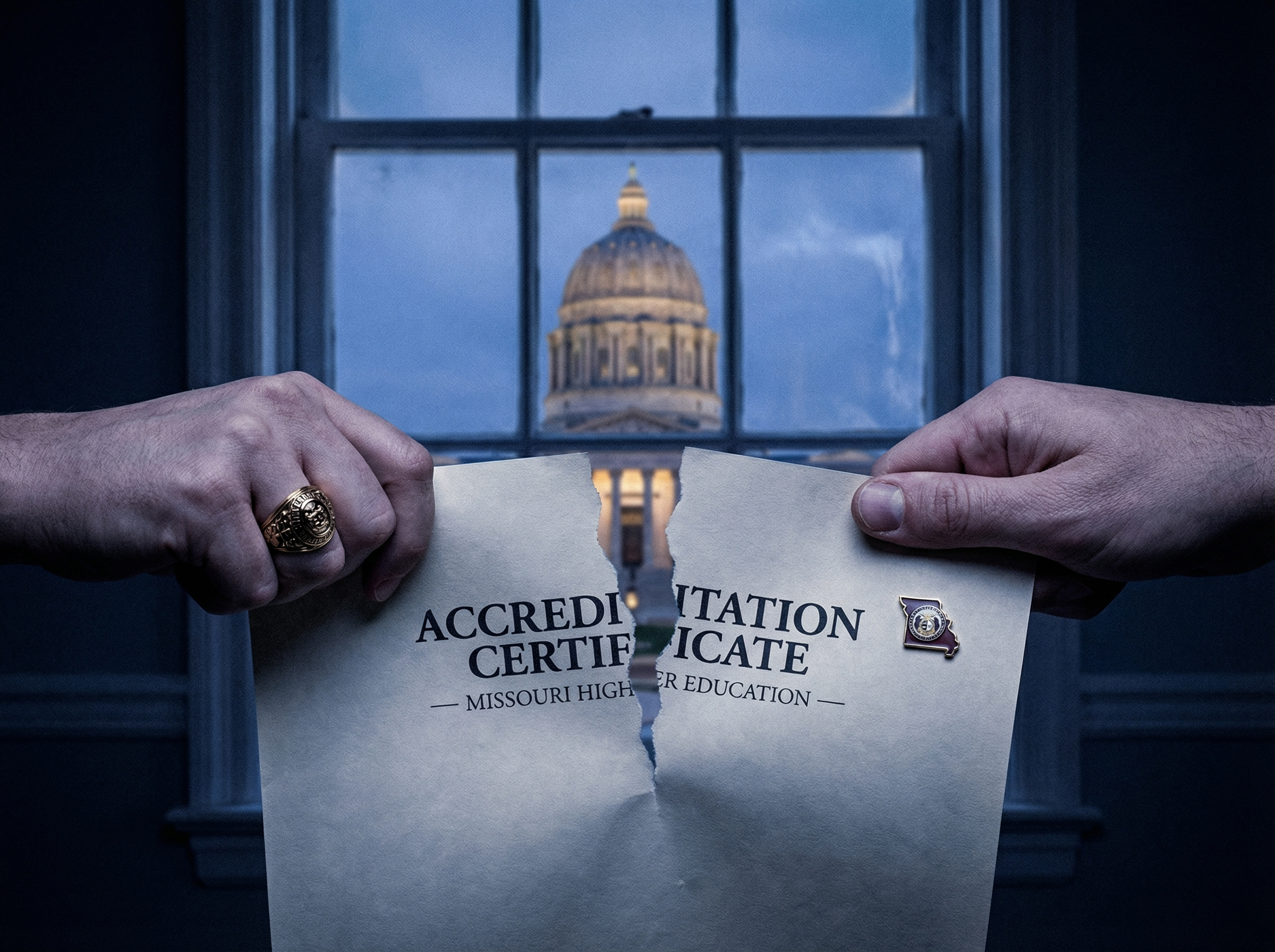
Accreditation certificate being torn between two hands, representing the battle over standards

Missouri legislators aren't just going after universities. They're going after the people who evaluate universities. Senate Bill 1192, filed last week, would prohibit accreditation agencies from considering a school's DEI metrics when granting accreditation status.

This is clever. Universities have long defended diversity efforts by pointing to accreditation requirements—"We have to do this to maintain our standing." By severing that connection, legislators eliminate a key justification. Schools can no longer hide behind external mandates.

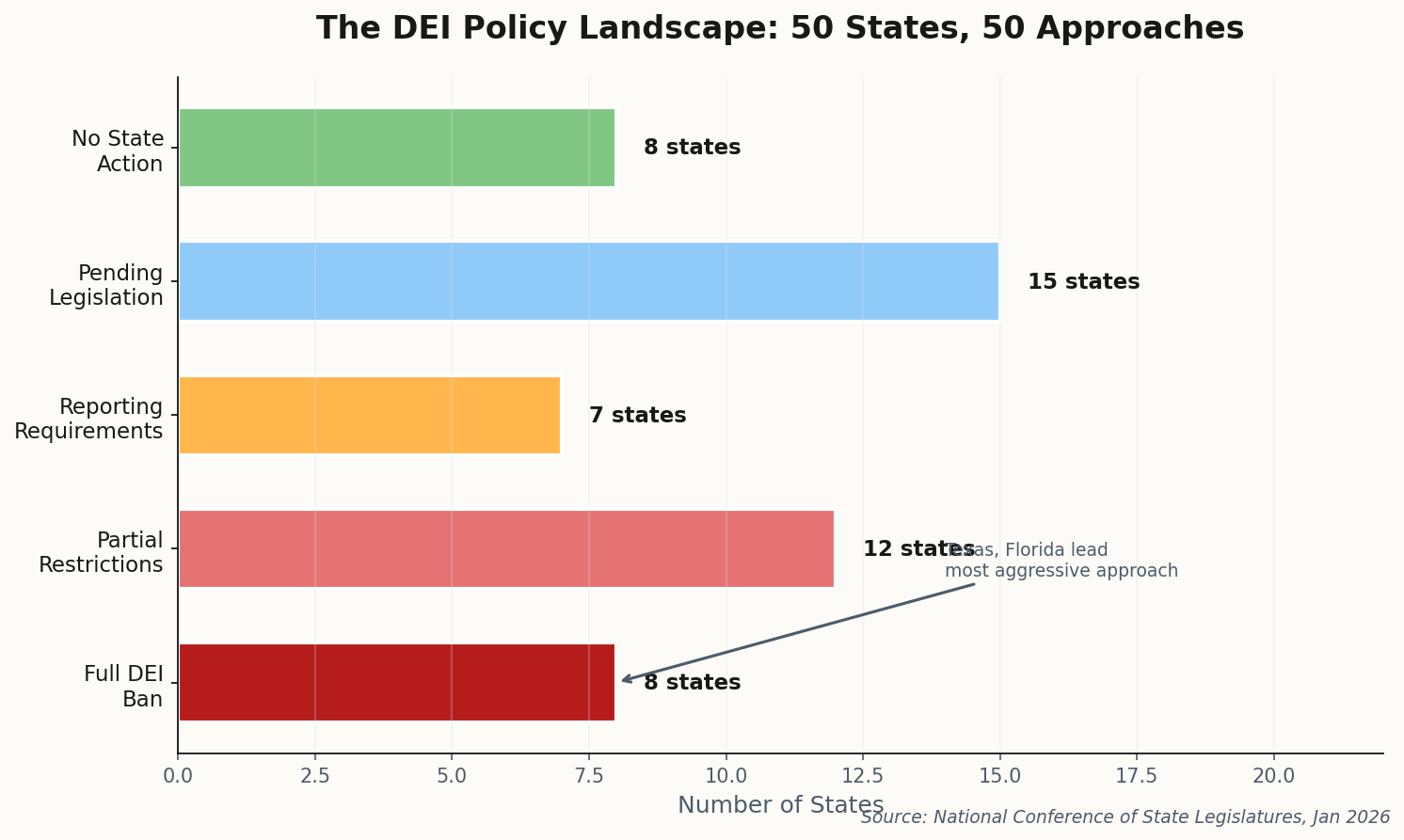
Horizontal bar chart showing state DEI policy landscape
The DEI policy landscape varies dramatically by state, with 8 states now enforcing full bans and 15 more considering legislation.

A companion bill, SB 1276, would mandate public disclosure of all DEI practices and ban "proxy discrimination"—a term vague enough to encompass virtually any demographic-conscious policy. Meanwhile, a Democrat-led bill proposes an official "HBCU DEI Week," highlighting just how partisan this debate has become.

The accreditation angle matters because it closes a loophole. If states can't control what private accreditors require, they can control whether state schools must comply with those requirements. It's a federalist workaround for a national system.

06

GW Puts Diversity Summit on Ice

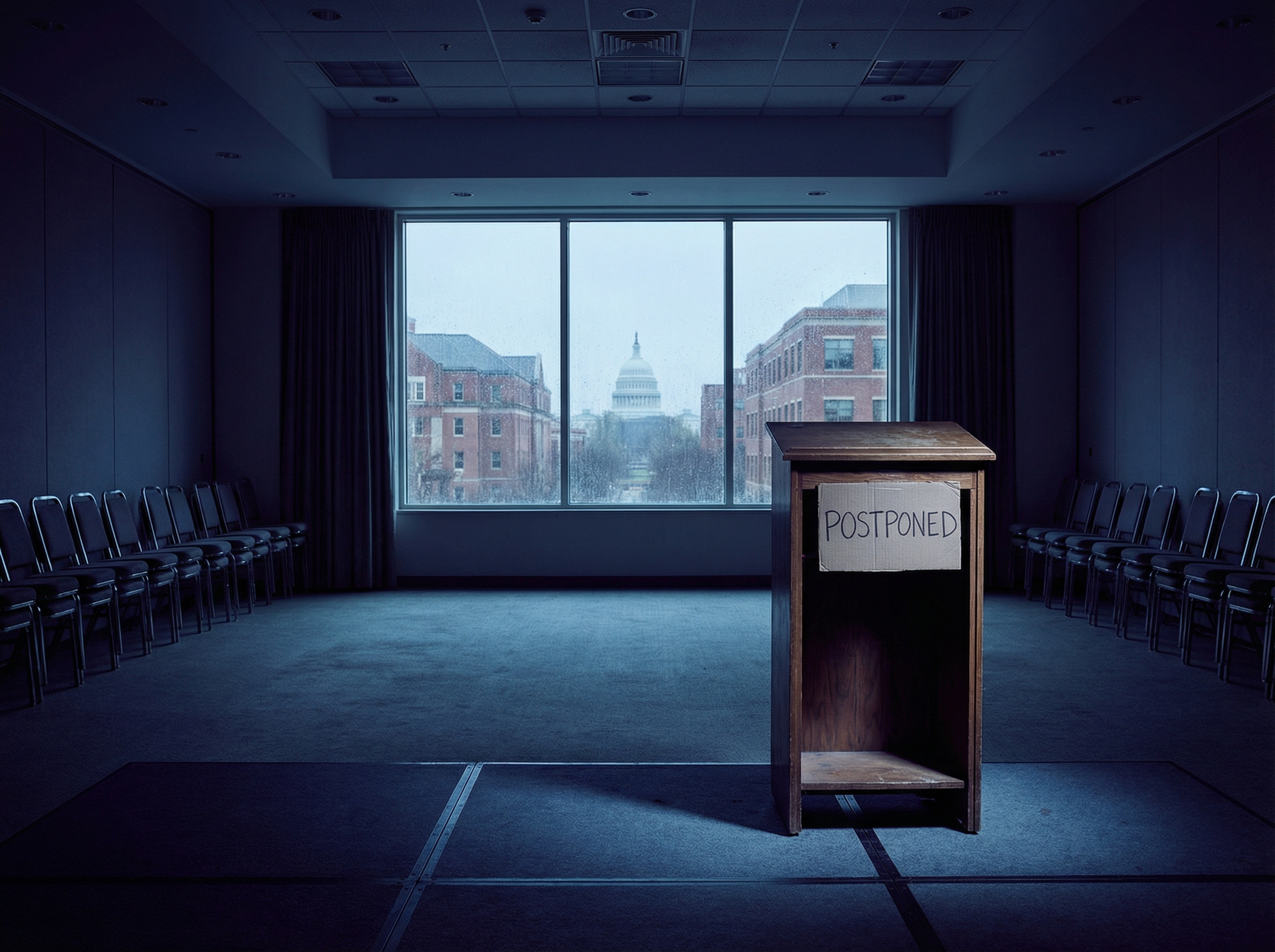
Empty conference room with postponed sign, representing the chilling effect

George Washington University quietly announced it's postponing its annual Diversity Summit from February to "spring 2026"—administrative code for "we'll let you know." The timing isn't coincidental: the school is currently under a Title VI compliance review by the DOJ examining its admissions practices.

It gets worse. The State Department has recommended suspending GW from the "Diplomacy Lab" program over concerns about the school's DEI hiring practices. That's a direct hit to a university whose proximity to federal power is its primary selling point.

The official explanation invokes the need to "reimagine a new opportunity for the community." Translation: holding a high-profile diversity event while under federal investigation for diversity-related practices would be spectacularly bad optics.

This is the chilling effect in action. Not a ban, not a mandate—just enough pressure to make administrators decide that discretion is the better part of valor. The summit isn't cancelled, just indefinitely delayed. Programs aren't eliminated, just put on pause. Rights aren't revoked, just exercised more quietly.

The cumulative effect is the same as prohibition, achieved without the messiness of actually prohibiting anything.

The Board Is Set

What we're witnessing isn't the end of DEI in higher education. It's something more complex: a transformation. The explicit frameworks are being dismantled or driven underground. The surveillance infrastructure is being built. The terminology is shifting. And on both sides, the tactics are evolving. Federal courts have checked one form of overreach, but states are innovating around those limitations. Universities are learning to speak in code. The question isn't whether diversity efforts will survive—it's what form they'll take when they emerge from this pressure cooker.