
Tauri for macOS

The Crab Takes the Crown

Tauri's quiet revolution continues as production apps migrate, the Microsoft Store yields, and industry analysts finally call what developers knew all along: Electron's reign is ending.

Listen
Luminous crab emerging from digital shell with circuit patterns, representing Tauri framework
WSL-UI application on Microsoft Store with tiny 4MB footprint
01

Four Megabytes on the Microsoft Store

When you package a desktop app for the Microsoft Store, you expect friction. MSIX packaging has quirks. Signing requirements abound. Most developers avoid it entirely. But this week, a detailed breakdown of shipping WSL-UI—a Windows Subsystem for Linux management tool—proved something important: Tauri apps can navigate Microsoft's gauntlet and emerge at just 4MB.

That's not a typo. A fully functional system utility, with native Windows integration and proper Store distribution, weighing less than a typical JPEG from your phone's camera. The developer documented custom scripts to work around MSIX limitations, proving that Tauri's small footprint isn't just a demo-day parlor trick—it survives contact with enterprise distribution requirements.

This matters because distribution is where frameworks live or die. Electron apps work everywhere, but they're bloated. Native apps are lean but platform-locked. Tauri threading this needle—tiny binaries that pass Microsoft's certification—removes a major objection from the "we can't ship this" crowd.
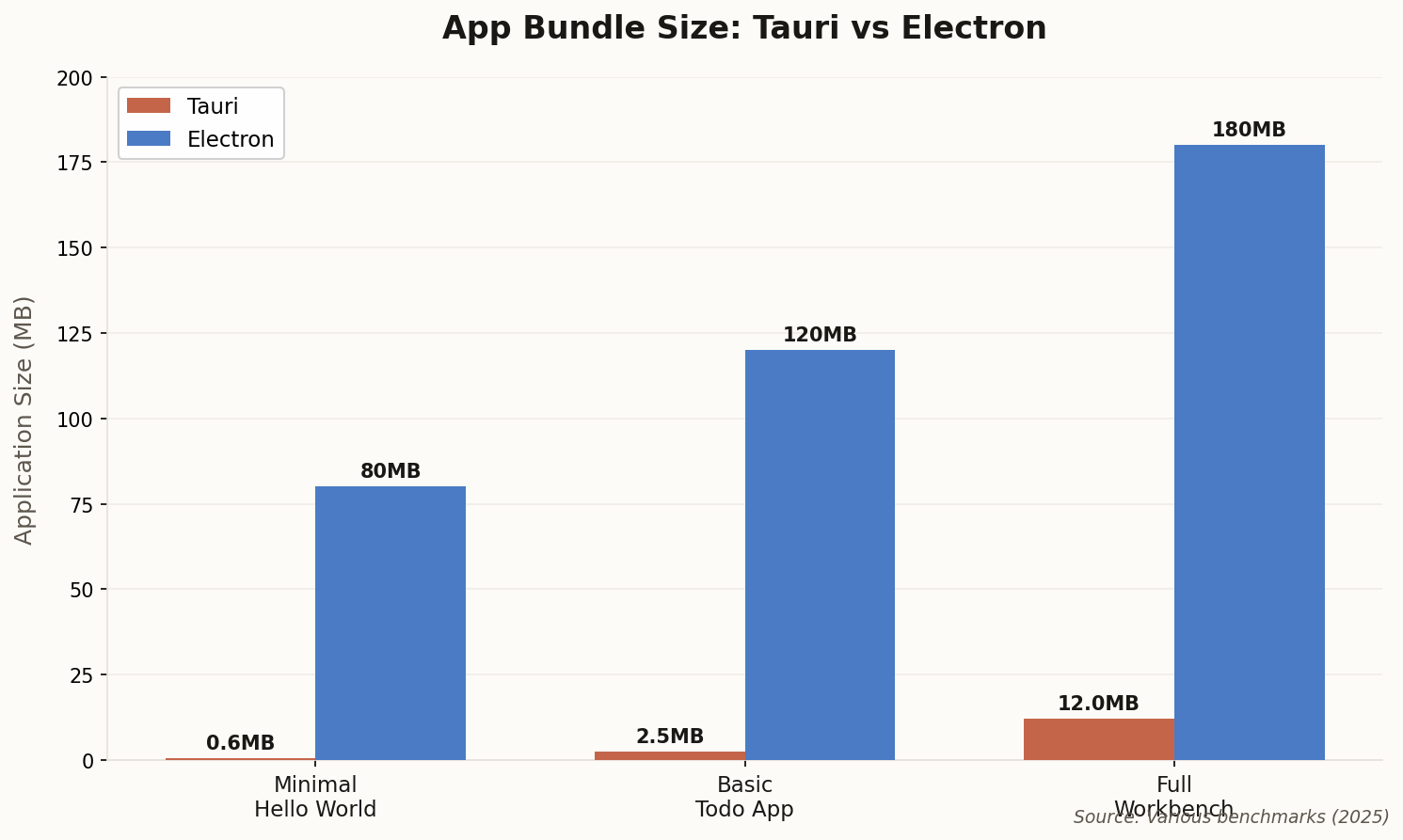
Bundle size comparison between Tauri and Electron apps
Bundle size comparison across app complexity levels. Tauri consistently delivers 90%+ smaller installers.
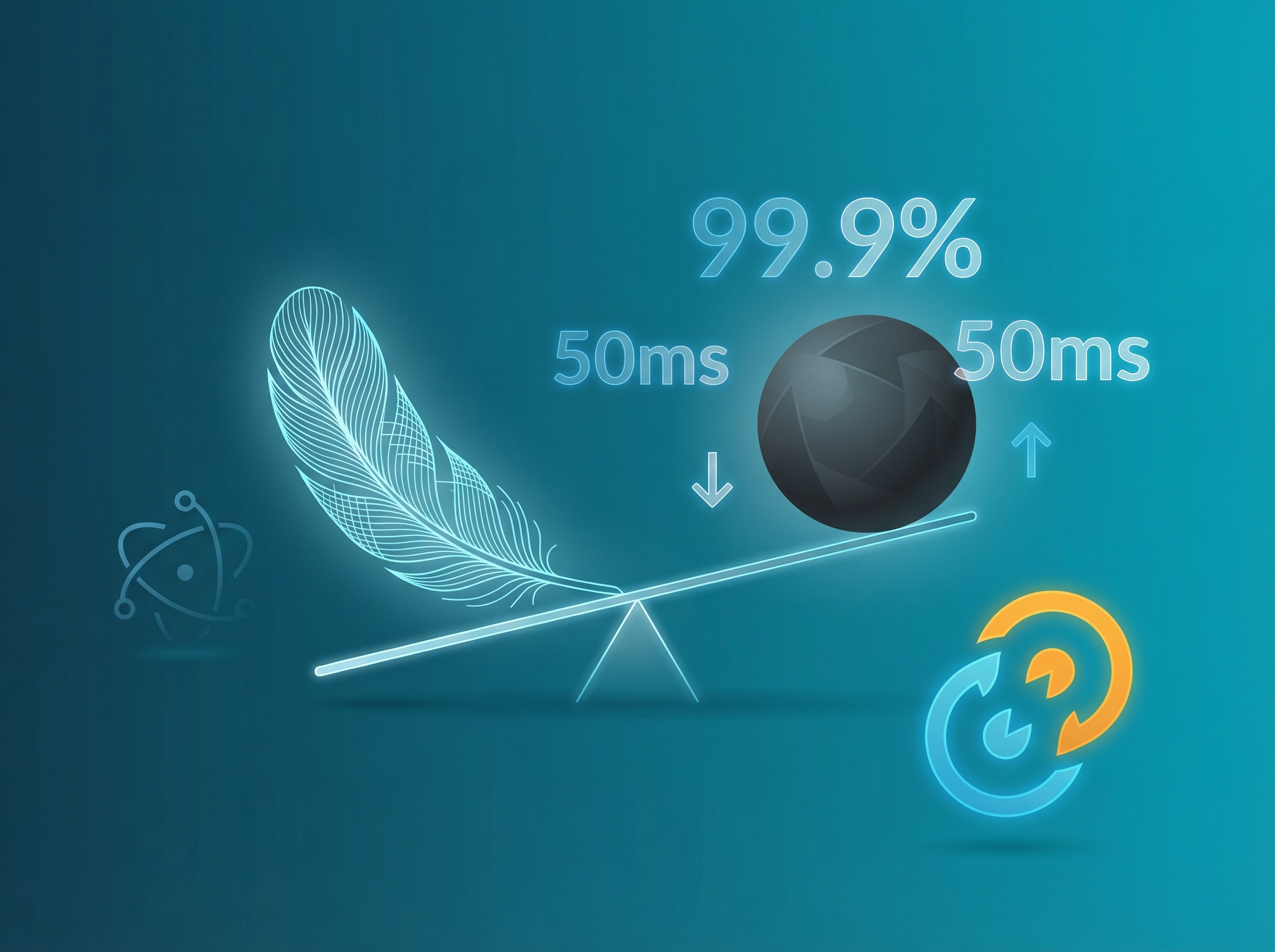
Abstract visualization of efficiency shift from Electron to Tauri
02

The Efficiency Standard

Industry analysts have a tell: when they stop calling something "promising" and start calling it "the standard," the narrative has shifted. This week, multiple publications landed on the same conclusion—Tauri isn't the scrappy alternative anymore. It's the efficiency benchmark against which Electron must justify itself.

The frame has inverted. Three years ago, you chose Tauri if you cared about performance and accepted the tradeoffs. Now you choose Electron if you need its ecosystem and accept the bloat. That's a fundamental reordering of defaults.

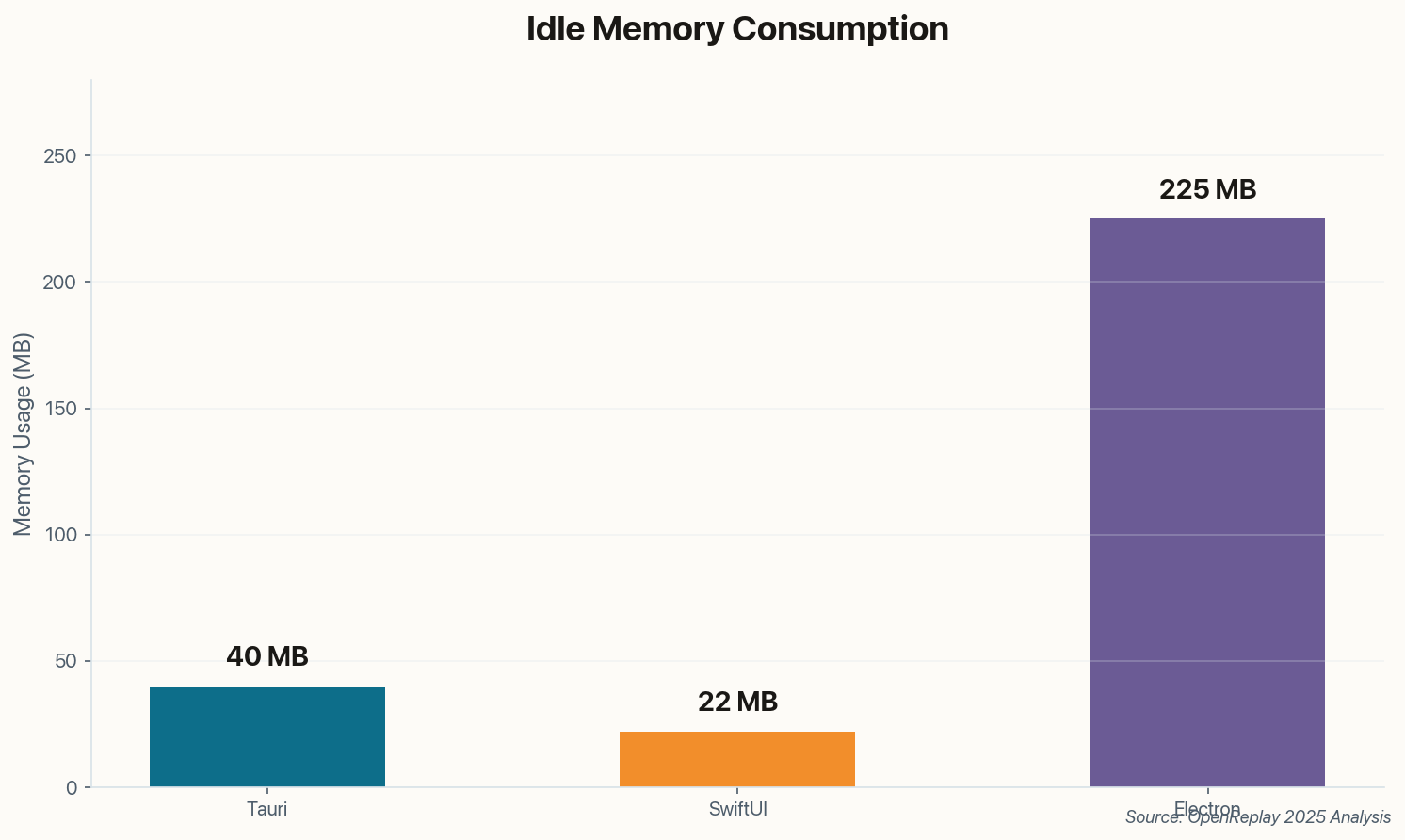
What's driving this? Partly Tauri 2.0's maturation. Partly the v2 plugin ecosystem proving itself. But mostly, developers have gotten tired of explaining why their "hello world" app needs 150MB and 300MB of RAM at idle. The efficiency conversation has shifted from "nice to have" to "table stakes," and Tauri was ready.

Runtime memory comparison between Tauri and Electron
Memory usage at different load states. Tauri's Rust backend consistently uses 70-75% less RAM.
Robotic arm drawing path trajectories on holographic display
03

Robots Don't Care About Your Framework Drama

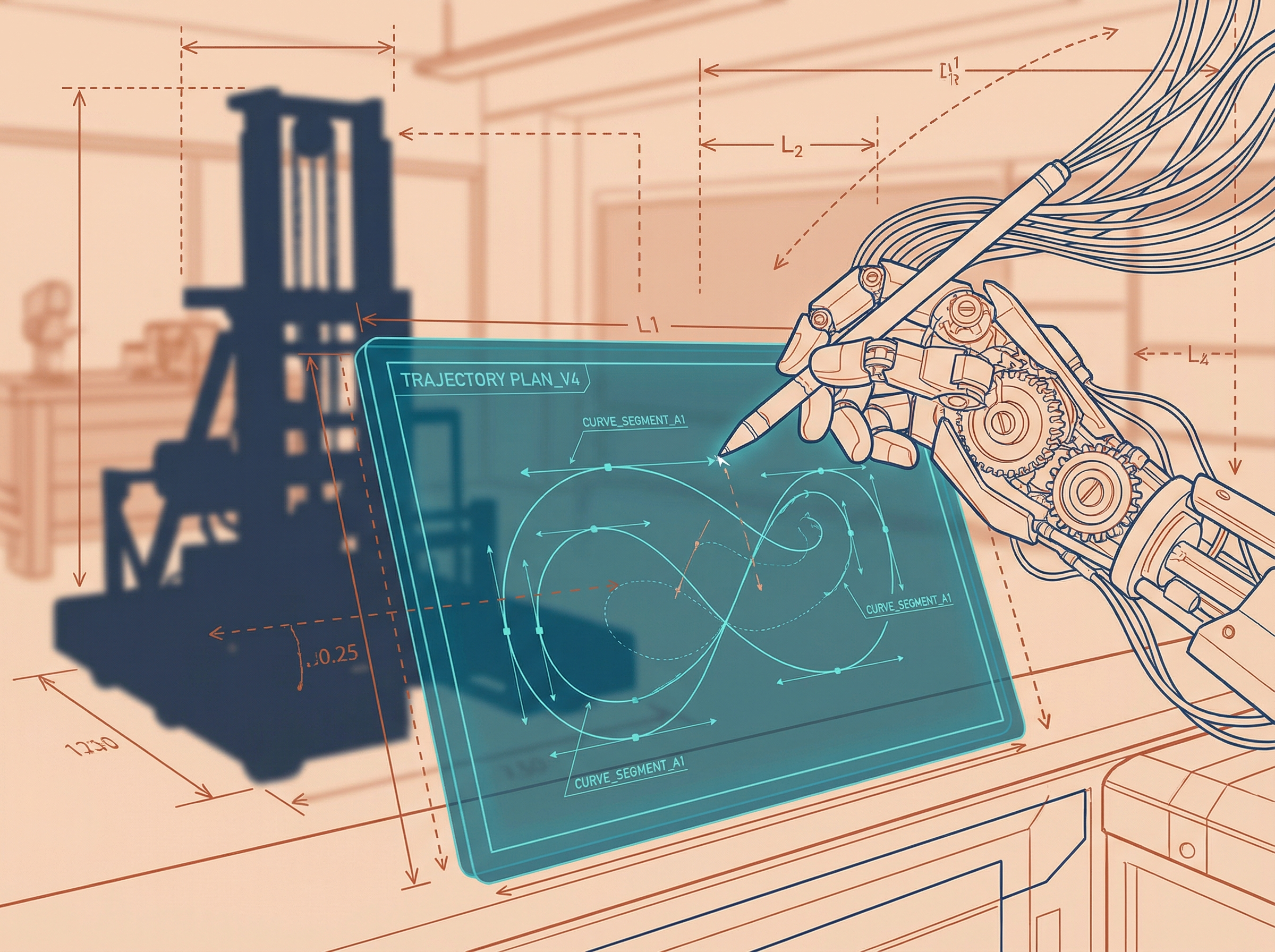
Choreo isn't a Silicon Valley startup's MVP. It's path-planning software for FIRST Robotics Competition teams—high school students building 120-pound robots that compete at international championships. This week, maintainer @calcmogul merged the upgrade to Tauri v2.

This is production migration in the wild. Choreo handles complex mathematical trajectories, file I/O for robot configurations, and needs to run reliably on the laptops of 16-year-olds in competition pits with spotty wifi. It's not a toy, and the team didn't switch frameworks for bragging rights—they switched because Tauri v2 solved actual problems with their 2026 configurations.

When domain-specific tools with demanding users migrate to your framework, you've crossed from "interesting technology" to "reliable infrastructure." FRC teams don't have time for framework churn. They need software that works so they can focus on robots. Tauri passed that test.

Productivity app with kanban board layout and collaboration features
04

The Production-Ready Proof Point

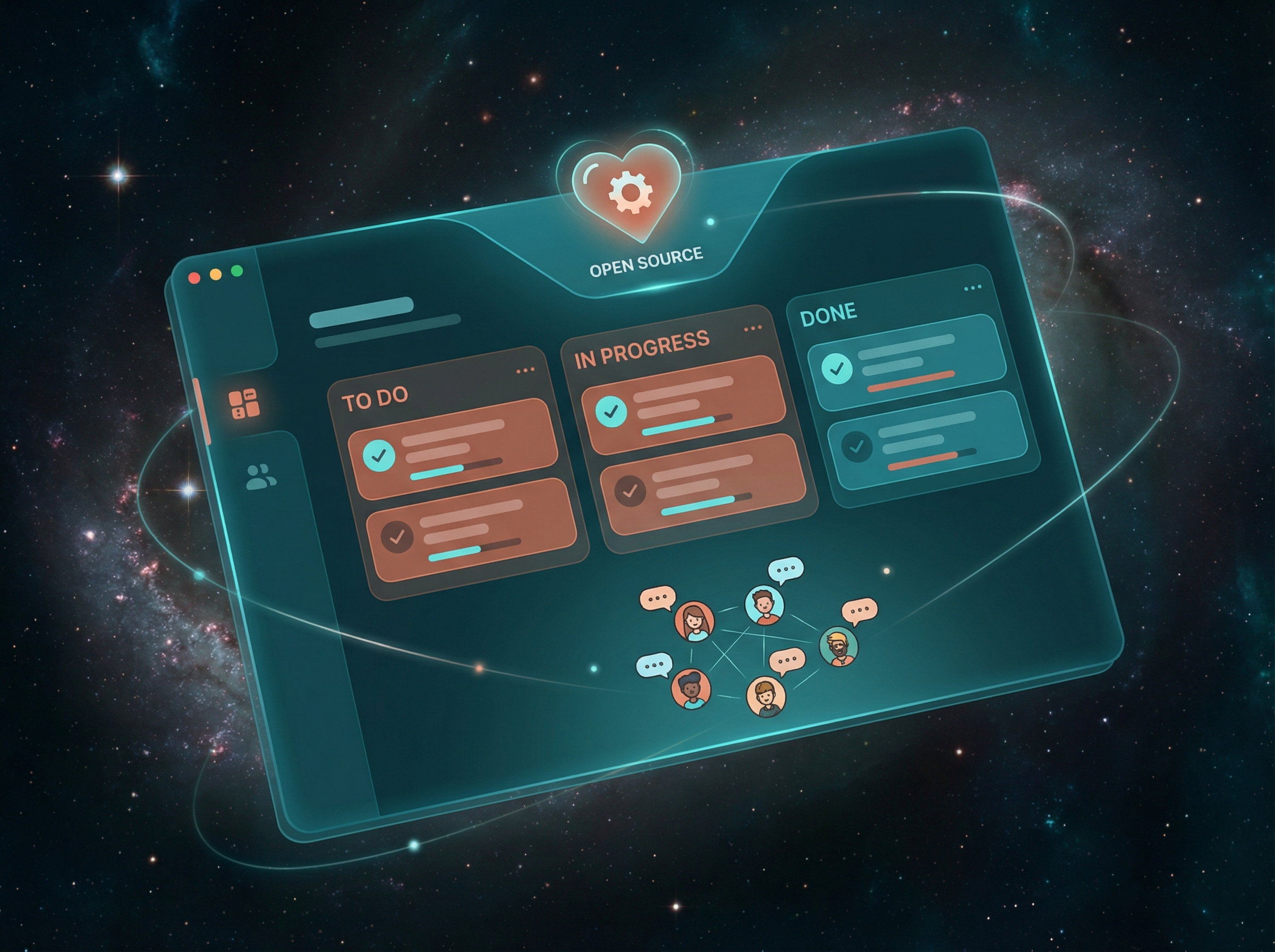
OpenWork hit the Hacker News front page this week, joining Video Maestro in the growing list of open-source Tauri apps that people actually use. It's a productivity tool—nothing revolutionary in concept, but that's precisely the point.

For years, Tauri advocates have answered "show me a real app" with custom one-offs and internal tools. The list of substantial, open-source, community-auditable applications was thin. That's changing. When your framework powers enough "boring" productivity software that users forget what framework it's built on, you've won the mindshare battle.

Open source matters here because it lets skeptics inspect the codebase. How does Tauri handle state management at scale? How do the IPC patterns hold up in complex UIs? With projects like OpenWork, the answers aren't hidden behind corporate NDAs—they're on GitHub for anyone to learn from.

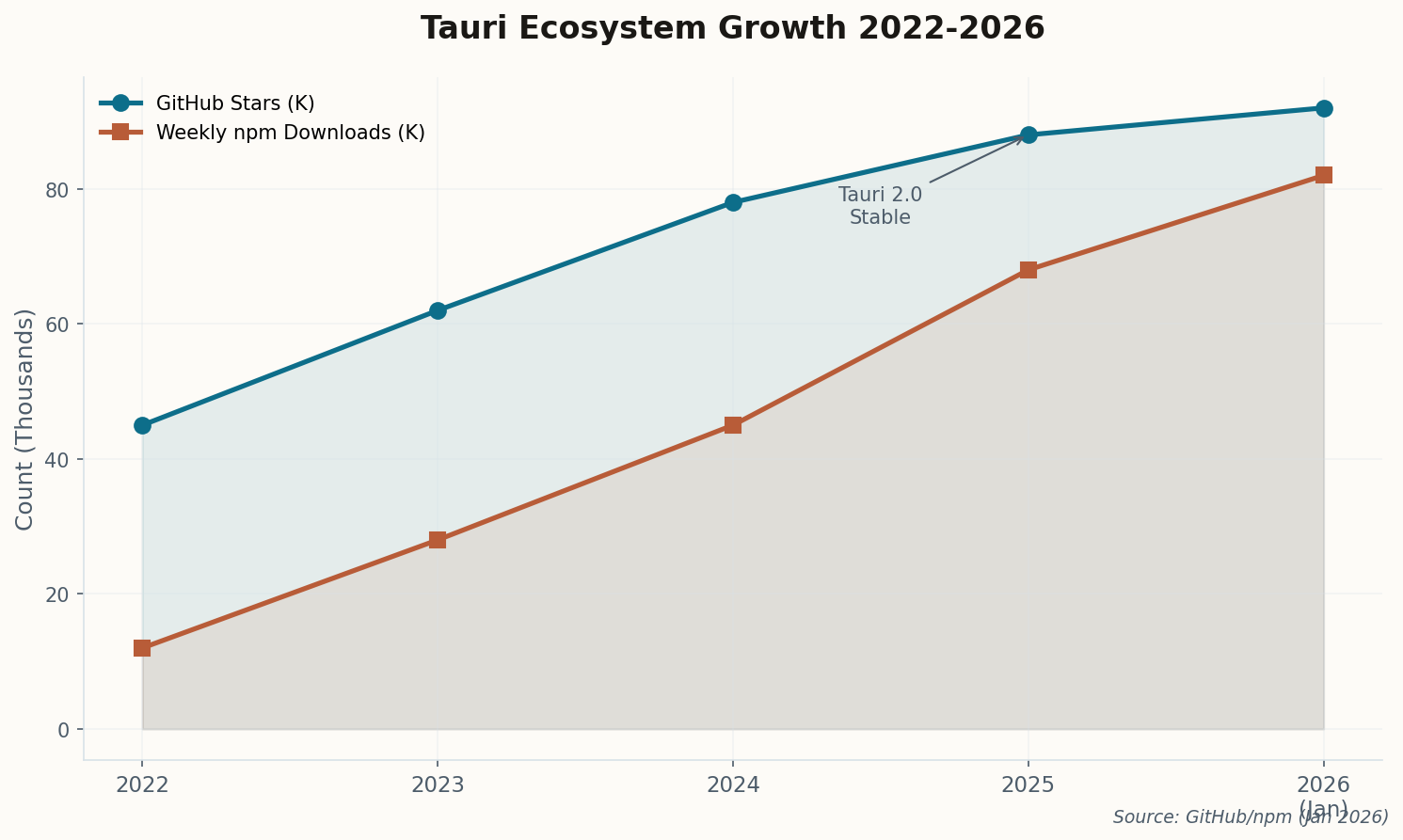
Tauri ecosystem growth 2022-2026
Tauri's growth trajectory: GitHub stars and npm downloads showing sustained momentum since 2.0 stable release.
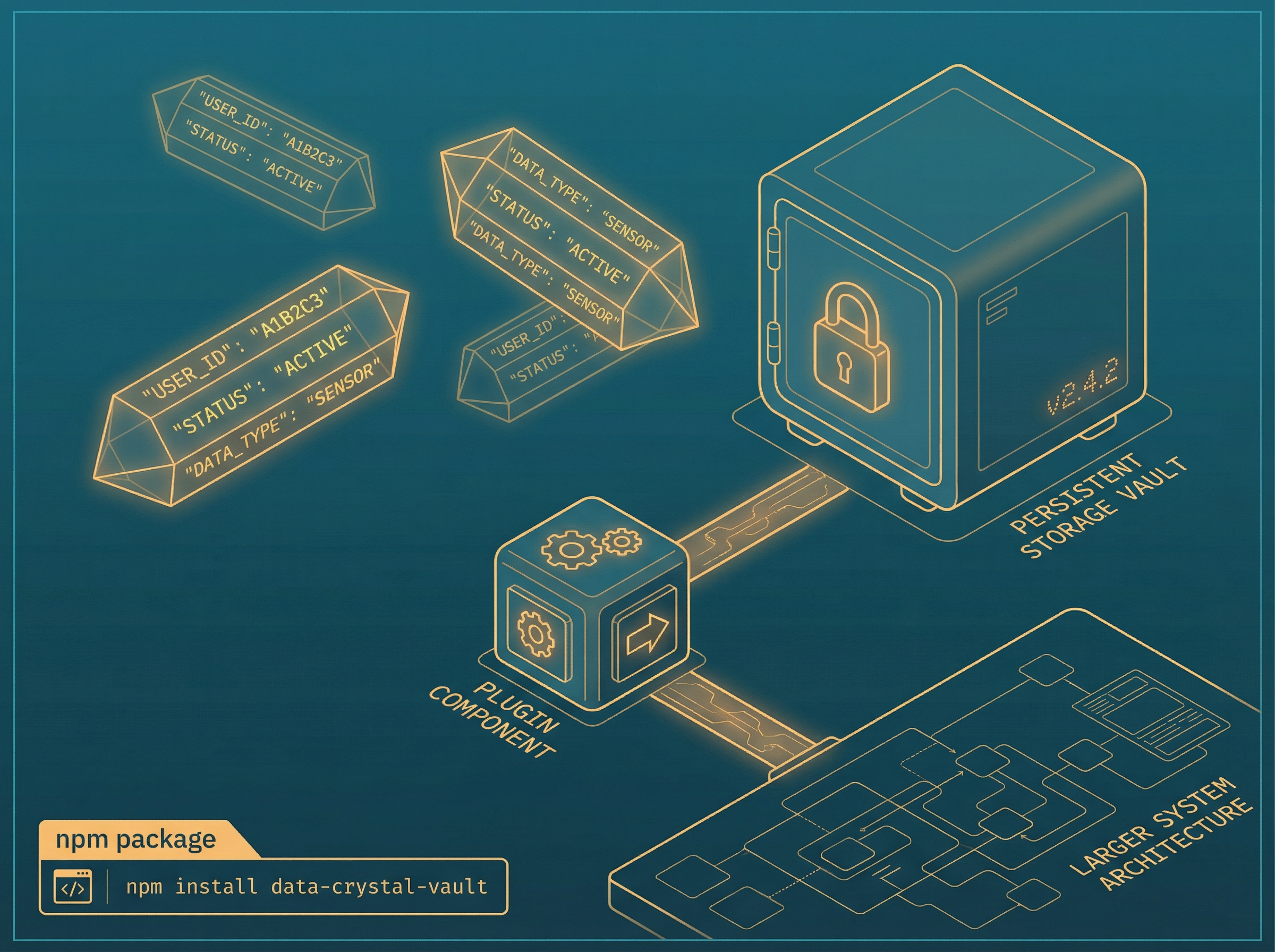
Key-value data crystals representing persistent storage plugin
05

The Boring Work That Makes Frameworks Usable

tauri-plugin-store bumped to 2.4.2 this week. It's a persistent key-value store—the kind of infrastructure so fundamental that you forget it exists until it breaks. This isn't a headline-grabbing feature release. It's maintenance.

And that's exactly what matters. The official plugin workspace receiving regular, incremental updates signals organizational health. Features attract developers; maintenance keeps them. When your storage plugin gets patch releases addressing edge cases, it means someone's actually using it in production and reporting issues.

The v2 plugin ecosystem was Tauri's biggest question mark post-launch. Could the project maintain the ecosystem velocity needed for real-world apps? A steady stream of point releases on core plugins like store, fs, and http answers that question better than any roadmap promise.

Why plugin health matters: Most desktop apps need local storage, file access, and HTTP. If official plugins stagnate, developers fork or build their own, fragmenting the ecosystem. Active maintenance keeps everyone on the same page.

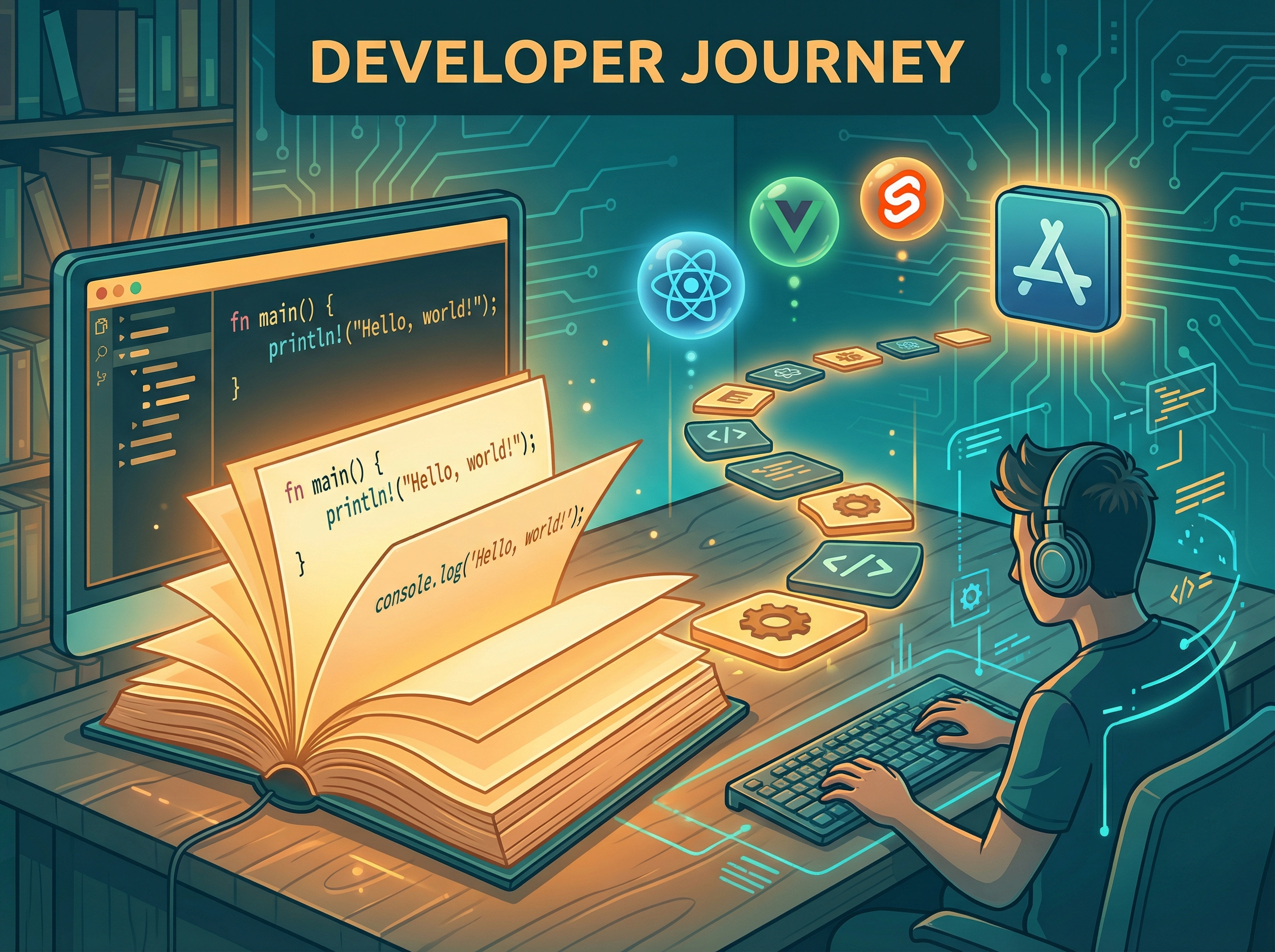
Book transforming into code editor with Rust and JavaScript syntax
06

The Barrier Keeps Lowering

A comprehensive 2026 guide to cross-platform desktop development landed this week, and Tauri features prominently. The focus: integrating Rust backends with modern JavaScript frameworks—React, Vue, Svelte.

Educational content is a lagging indicator. When tutorial writers invest in comprehensive guides, they're betting on sustained interest. Nobody writes detailed onboarding material for frameworks they expect to fade. The steady stream of 2026-dated resources—not just quick starts, but deep dives on architecture patterns—reflects confidence in Tauri's longevity.

The "Rust is hard" objection still surfaces, but guides like this demonstrate the reality: you write your frontend in whatever JavaScript framework you know, and Tauri handles the bridge. Most developers touch minimal Rust unless they want to. That's been true for a while, but it takes repeated education to shift perception.

The Momentum Is Real

No major releases this week. No flashy announcements. Just production migrations, ecosystem maintenance, and industry analysts catching up to what practitioners already knew. That's what framework maturity looks like—steady progress that compounds. The crab keeps crawling forward.