The Myth-Making Engine
Where It All Begins
Every genre has its sacred texts—the works that defined the vocabulary everyone else would use. Space opera has four.
Dune
The "Lord of the Rings" of science fiction. Dune deconstructed the hero's journey before most series had even built one, blending ecology, feudal politics, religion, and consciousness expansion into a dense, hypnotic masterpiece. Every space opera since exists in its shadow.
Foundation
Foundation shifted the focus from individual heroes to the flow of history itself. Asimov invented "Psychohistory"—the mathematical prediction of civilizational behavior—and used it to tell the story of a crumbling galactic empire. Star Wars borrowed the aesthetic. Everything else borrowed the concept.
The Culture Series
A rare utopian space opera where the good guys—The Culture—are post-scarcity, hedonistic anarchists run by benevolent AI Minds. Banks proved you could have both optimism and moral complexity, writing some of the most sophisticated science fiction ever published.
Revelation Space
The defining work of "New Space Opera," marrying gothic scale with hard physics. There is no faster-than-light travel—the vastness of space is terrifyingly, beautifully real. Reynolds was an astrophysicist before he was a novelist, and it shows.
The 21st Century Renaissance
Space opera never died, but it did go quiet for a while—until a new generation of writers reinvented it for an audience that grew up on Battlestar Galactica and Wikipedia.
The Expanse
The gold standard for political sociology in space. The Expanse treats gravity and oxygen as critical plot points, bridging near-future realism with ancient alien mystery. Every character has an agenda. Every faction has a legitimate grievance.
Teixcalaan Series
A recent Hugo winner that revitalized the genre by focusing on linguistics, diplomacy, and the seduction of imperial culture rather than fleet battles. Martine is a historian, and it shows—this is space opera about how empires really work.
Children of Time
A masterclass in "xenofiction"—creating genuinely alien perspectives. Tchaikovsky explores the rise of a spider civilization on a terraformed world and their eventual encounter with the last remnants of humanity. Yes, spiders. It works.
Television's Golden Age
Space opera found its true medium in television—the only format with enough hours to build civilizations properly.
Babylon 5
The pioneer of the "novel for television." Babylon 5 proved a pre-planned, five-year serialized arc with complex politics and character growth could succeed on TV. Every prestige drama since owes it a debt.
Battlestar Galactica
BSG stripped away the lasers and aliens to focus on survival, religion, and post-9/11 paranoia. It's gritty, military space opera at its finest—and it proved science fiction could be prestige television before "prestige television" was a phrase.
The Expanse
Widely considered the best sci-fi show of the modern era. The Expanse TV series respects the intelligence of its audience, delivering high-stakes geopolitics and realistic physics without ever explaining what you should have picked up from context.
Film Franchises
Star Wars
The ultimate space fantasy, blending Kurosawa samurai ethics, WWII dogfights, and Joseph Campbell's mythology. Star Wars defined the visual language of the modern blockbuster. Ignore the prequels; watch Andor for proof the franchise can still surprise.
Star Trek
The optimistic counterweight to dystopian sci-fi. Trek views space not as a battlefield but as a frontier for scientific curiosity and moral evolution. It's been running for sixty years because humanity keeps needing to believe we can be better.
What Makes Great Space Opera
- Scale: The stakes must be galactic. The fate of civilizations, not just individuals, must hang in the balance. A story about one person isn't space opera; a story about one person who changes the fate of billions is.
- Worldbuilding: Deep history. Distinct cultures. Functional economies. Consistent internal logic. The audience should feel they could live there—even if they wouldn't want to.
- The "Sensawunda": The Sense of Wonder. Visuals or concepts that evoke awe at the vastness of the universe. A ringworld. A Dyson sphere. A ship so large it has weather.
- Melodrama: While "hard" sci-fi focuses on technical accuracy, space opera embraces heightened emotion, romance, and tragedy. Characters should feel things intensely. The universe should feel things back.
2026 Releases
Film: Project Hail Mary
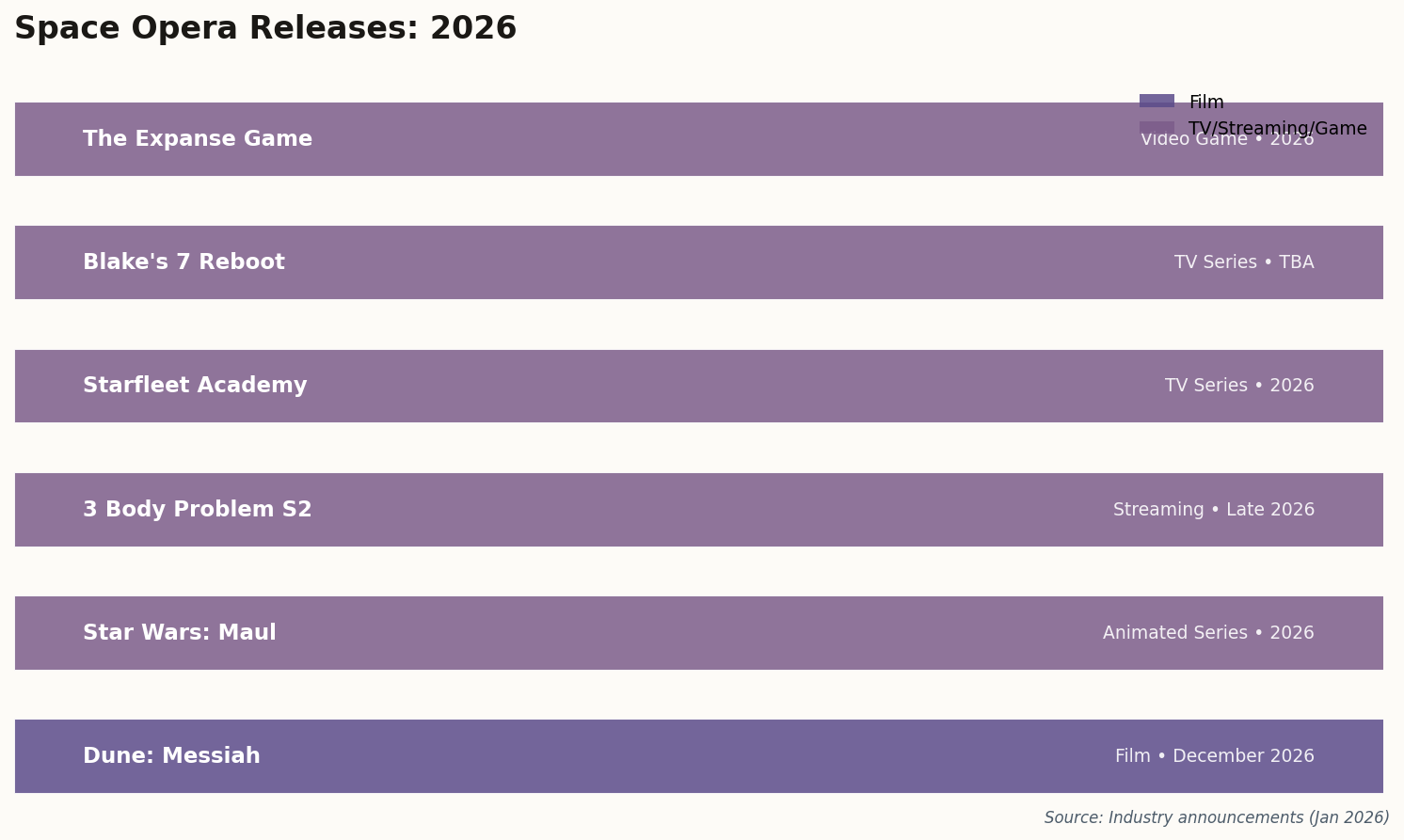
Ryan Gosling stars in the adaptation of Andy Weir's space survival novel, coming Spring 2026. If The Martian was Weir's calling card, this is his opus—a first-contact story disguised as a puzzle box.
TV: Foundation Season 3
Apple TV+'s Foundation continues adapting the un-adaptable, with production updates suggesting a 2026 release window for the Mule arc—arguably the most dramatic section of Asimov's original trilogy.
TV: Blake's 7 Reboot
Announced January 19: a reimagining of the cult classic BBC series (1978–1981), famous for its dark tone and moral ambiguity. The original influenced Firefly and Battlestar; the reboot could define a new era of cynical space opera.
Books: The Faith of Beasts
James S.A. Corey (the Expanse duo) release Book 2 of The Captive's War trilogy in 2026. Meanwhile, Alastair Reynolds drops Halcyon Years this month—more gothic far-future brilliance.
Space opera doesn't predict the future. It rehearses it. Every starship we imagine, every alien civilization we dream up, every galactic war we stage in our fiction—it's all practice. Practice for thinking at scales our ancestors couldn't imagine. Practice for being the kind of species that belongs among the stars. Whether we ever get there or not, the stories matter. They always have.