
Retirement Planning

The Great Retirement Migration

Forget Florida. The best places to retire in 2030 are in Wyoming, Michigan, and Indiana. Here's why the retirement map just got redrawn.

Listen
Serene Midwest sunset over charming small town with Victorian homes and tree-lined streets
Majestic Wyoming landscape with Grand Teton mountains and ranch home
01

Wyoming Takes the Crown as America's Best Retirement State

The cowboy state just lassoed the top spot in Morningstar's 2026 retirement rankings, and it's not because of its beaches. Wyoming won with a triple threat: zero personal income tax, moderate cost of living, and—here's the kicker—the healthiest older adult population in the nation.

That last point matters more than you'd think. Medicare data shows Wyoming retirees have the lowest rates of multiple chronic conditions among beneficiaries. Translation: people who retire there aren't just saving money; they're actually staying healthier longer.

The losers? New Jersey ranked dead last at #50, crushed by high costs and tax burdens. South Dakota, Colorado, and Vermont rounded out the top tier, signaling a clear shift away from traditional "sun and sand" destinations toward tax-efficient, less-crowded states. If your retirement plan still assumes Florida is the default, it's time to recalculate.
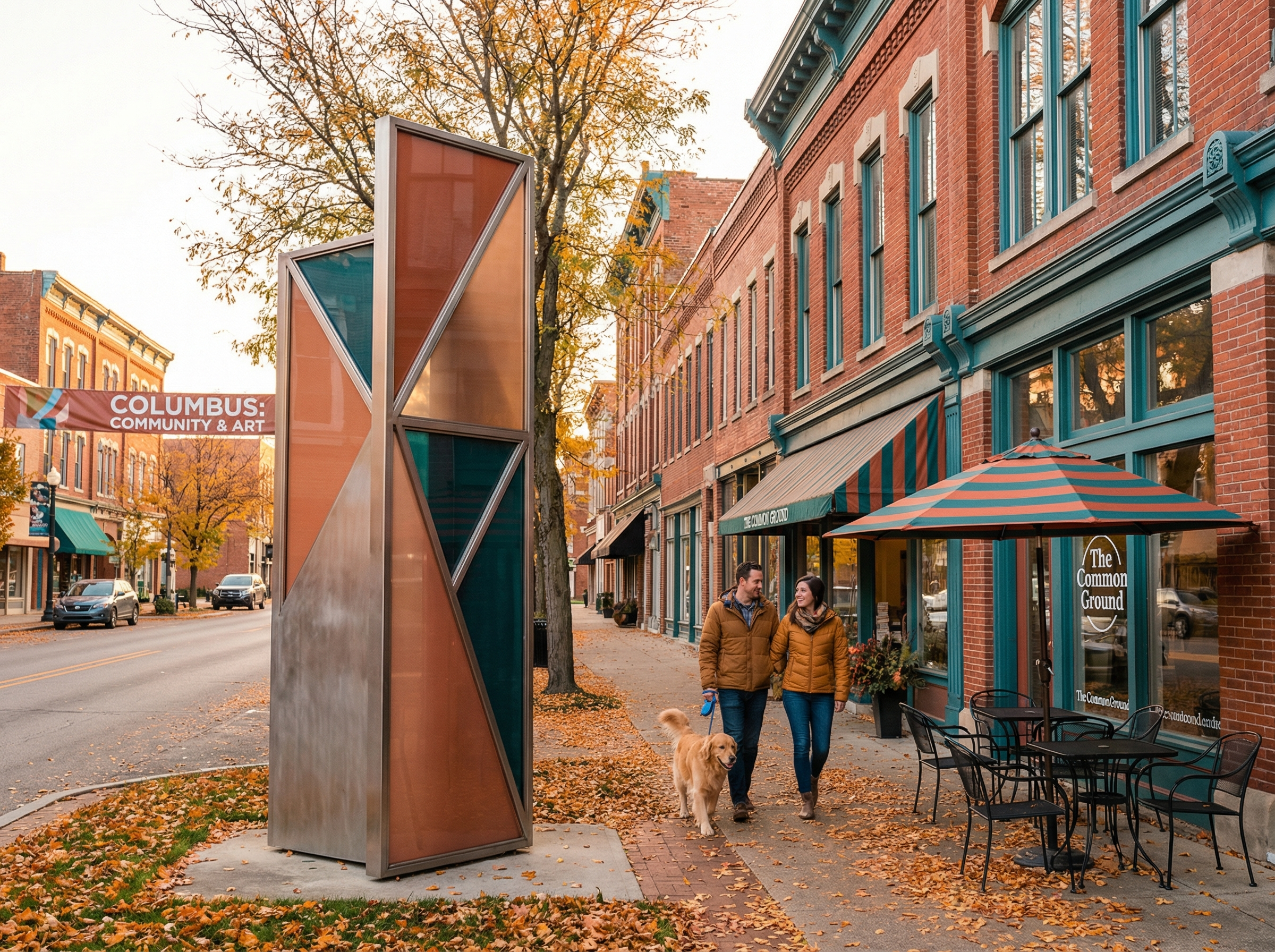
Charming small-town America street scene in Columbus, Indiana
02

Columbus, Indiana: The Safest $39K/Year Retirement You've Never Heard Of

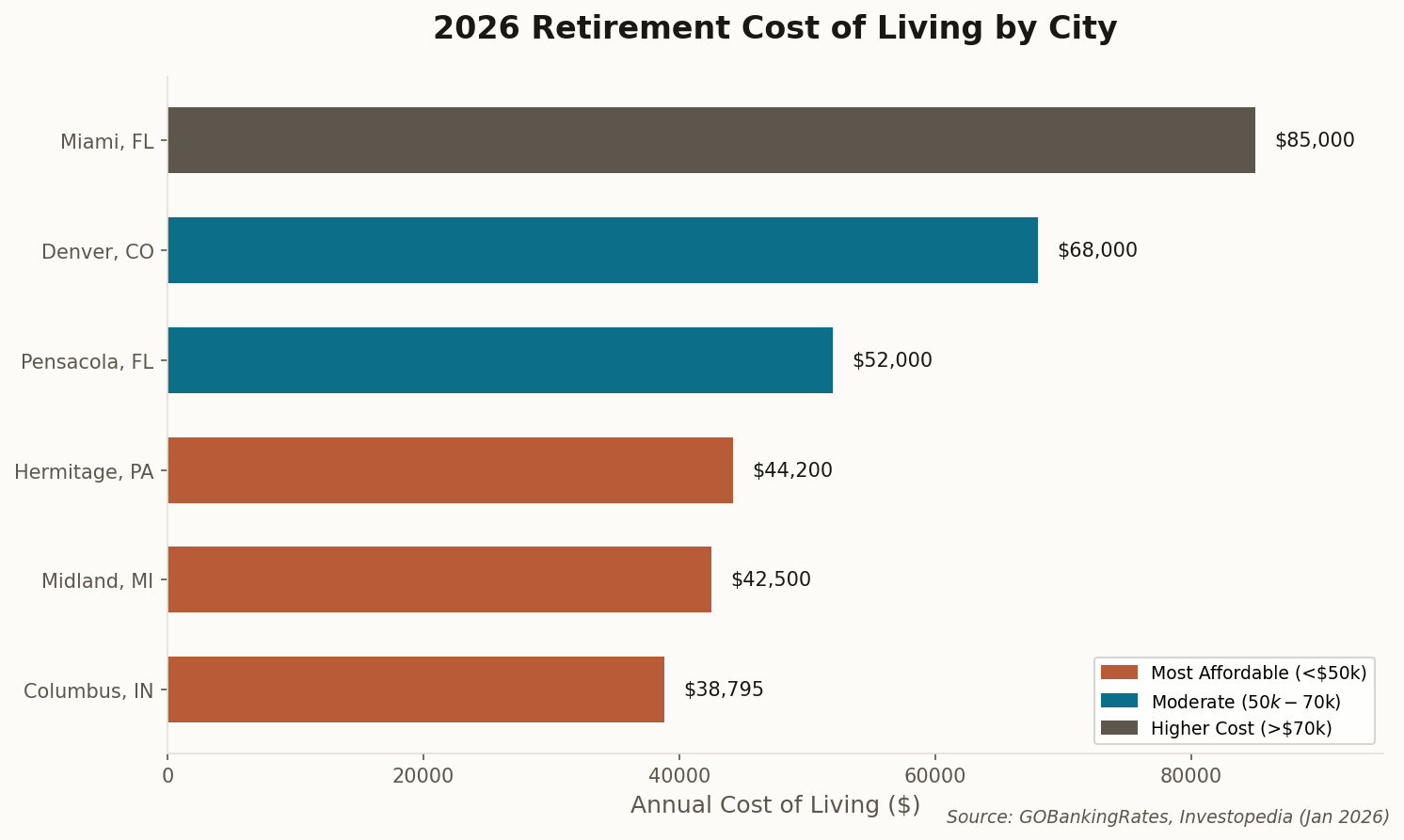
If you're planning retirement on a fixed income, here's your number: $38,795. That's the average annual cost of living in Columbus, Indiana—the city GOBankingRates just named the safest and most affordable retirement destination in America.

The safety stats are almost comically good. Violent crime rate? 0.135 per 1,000 people. For context, that's about one-tenth the national average. Columbus has become a poster child for the new retirement calculus: safety plus affordability trumps proximity to the beach.

Bar chart comparing annual cost of living across retirement cities
Columbus, Indiana leads affordable retirement destinations with annual costs under $40K—roughly half of Florida coastal cities.

The town is also an unexpected architectural gem—famous for modernist buildings by Eero Saarinen and I.M. Pei—giving it cultural heft that defies its Midwest zip code. With inflation still haunting fixed-income retirees, the appeal of sub-$40K living in a genuinely safe environment is becoming impossible to ignore.

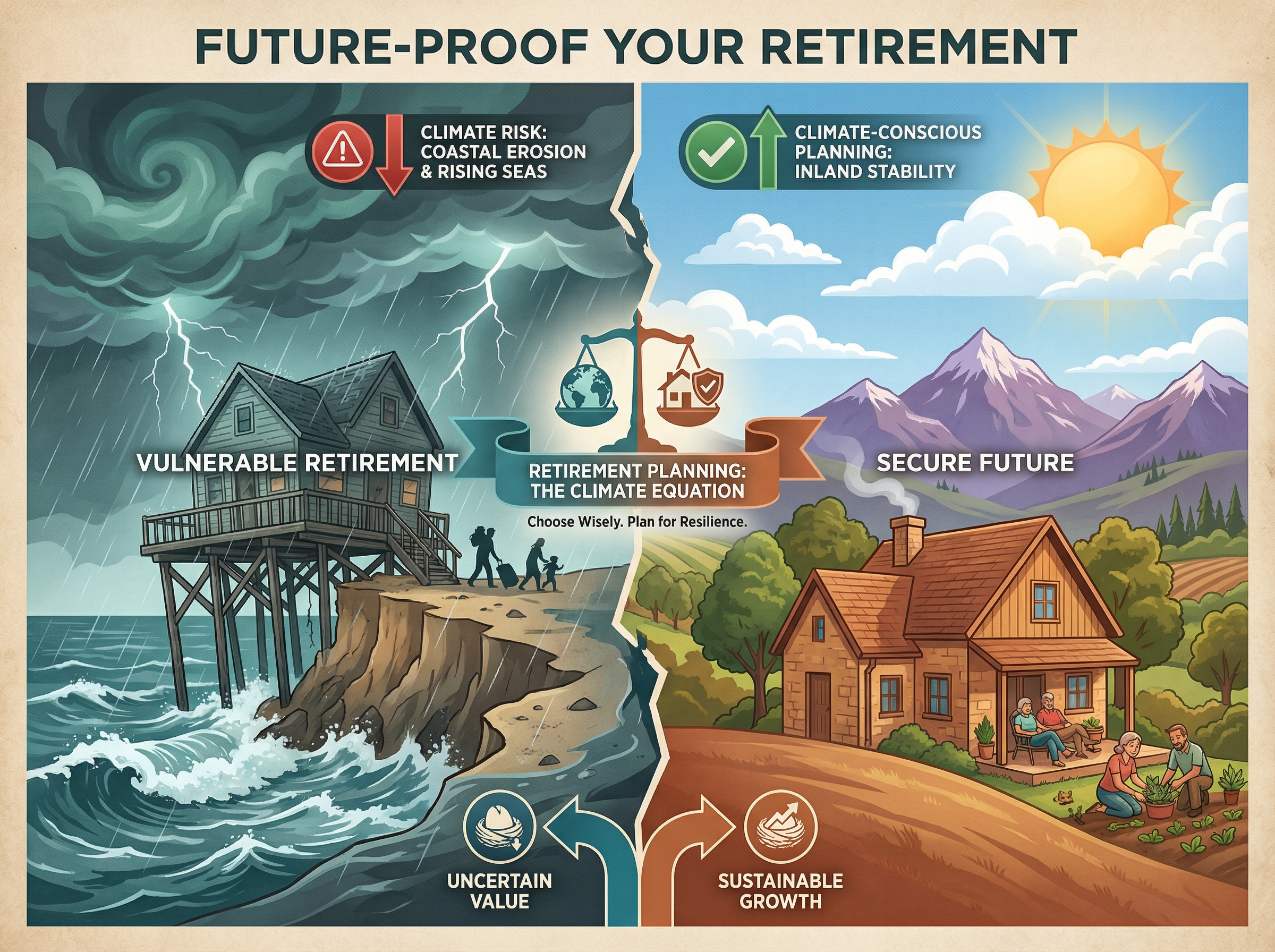
Split composition showing climate risk contrast between coastal and inland homes
03

Climate Risk Just Became a Line Item in Retirement Rankings

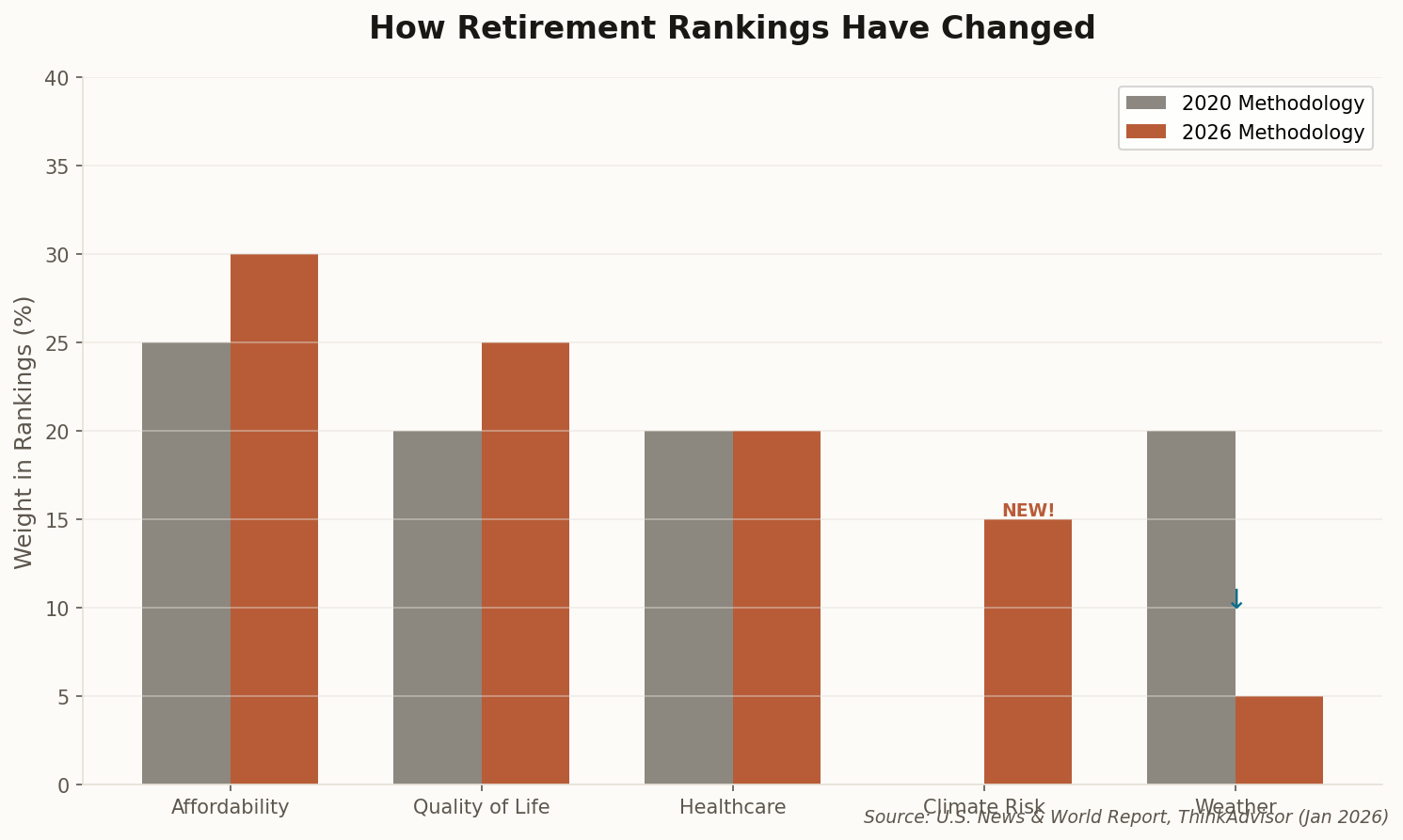
For the first time ever, environmental risk is now a weighted factor in major retirement rankings. U.S. News & World Report added flood, heat, and hurricane exposure as distinct metrics for 2026, and the results reshuffled the deck.

Coastal Florida cities got hammered. Inland locations like Spokane, Washington and Lynchburg, Virginia suddenly look a lot more attractive. The quote that sums it up: "Retirees are asking about flood zones as often as they ask about golf courses."

Bar chart showing how retirement ranking methodology has changed from 2020 to 2026
Weather fell from 20% to just 5% of ranking weight. Climate Risk—non-existent in 2020—now accounts for 15%.

This isn't just philosophical. Insurance premiums tied to disaster risk are now baked into property values and retirement budgets. Climate migration is no longer a fringe theory—it's institutionalized in the very rankings people use to decide where to spend their final decades. If you're buying coastal property for 2030 retirement, you're betting against a trend that just went mainstream.

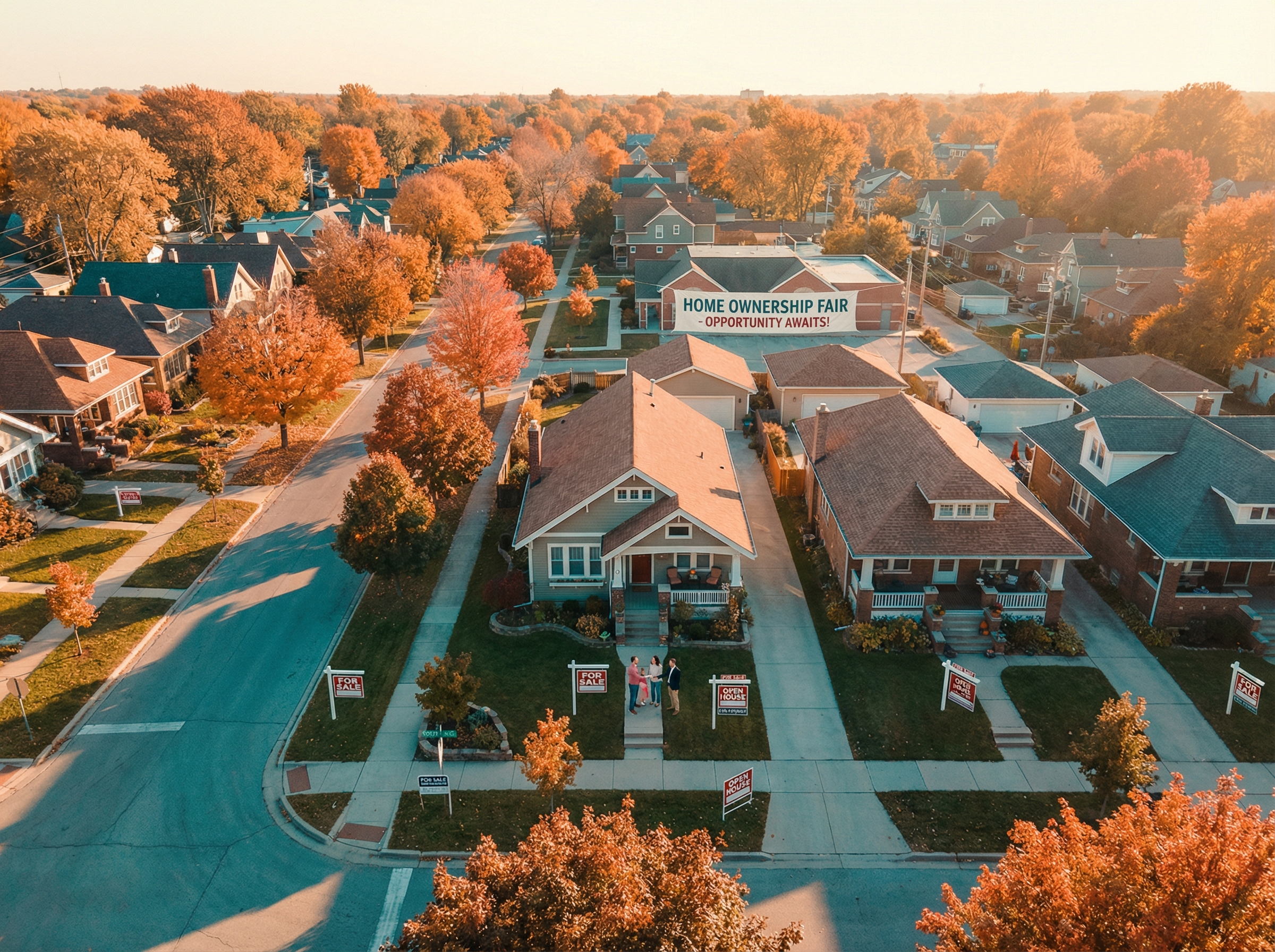
Aerial view of Midwest neighborhood with affordable homes and tree-lined streets
04

The Midwest Housing Market Enters Its "Golden Era" for Retirees

Remember the "lock-in effect"—where homeowners refused to sell because they'd lose their low mortgage rates? It's finally breaking. Realtor.com reports that more existing homes are hitting the market in 2026, and the Midwest is capturing the lion's share of value.

National home price growth is moderating to 1-3%, but the real story is the value gap. Markets like Saginaw and Bay City, Michigan, plus pockets of Ohio, offer homes at a fraction of coastal prices. For retirees looking to downsize, this is the first time in five years they've had genuine choices without facing bidding wars.

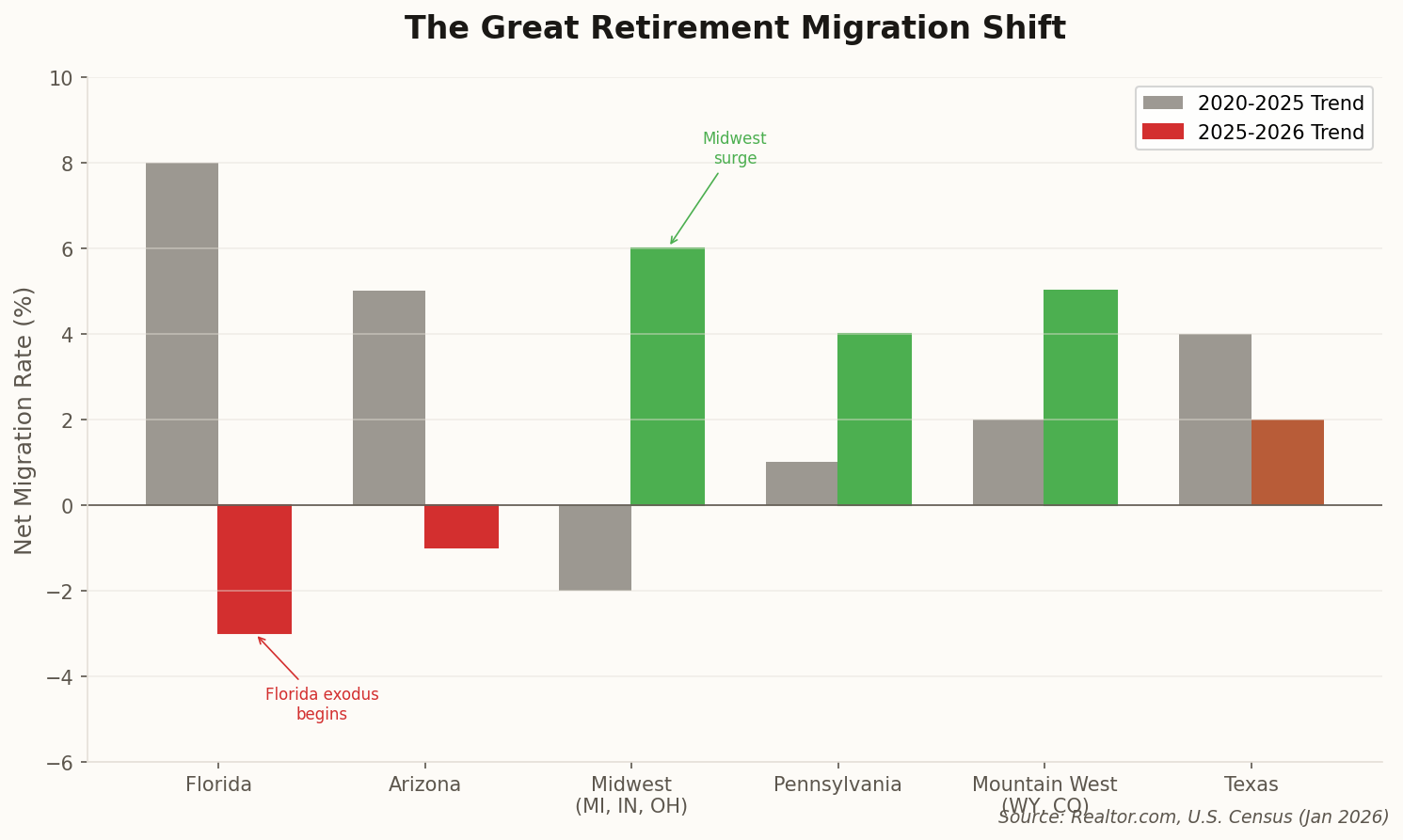
Bar chart showing retirement migration shift away from Florida toward Midwest
The Florida exodus has begun: net migration turned negative in 2025-2026 while Midwest surged to 6% growth.

The "Golden Era" framing isn't hyperbole. For the first time since the pandemic housing craze, supply and demand are realigning in favor of buyers—specifically in regions where retirees can stretch their dollars furthest. If you've been waiting to make a move, the Midwest just put out the welcome mat.

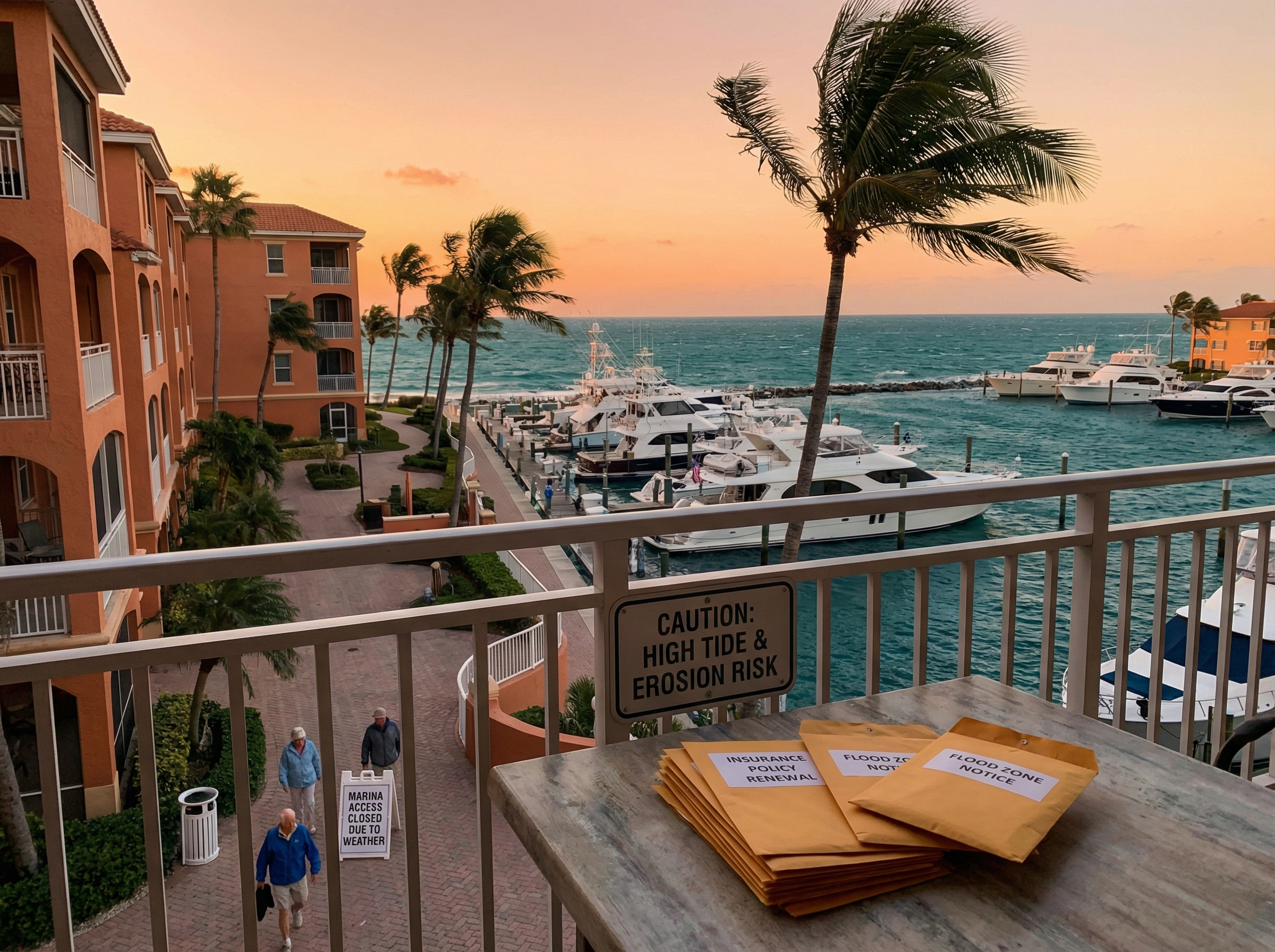
Florida beachfront community with subtle visual tension showing costs
05

Florida's "Reality Check": The Tax Savings May Not Save You

Yes, 21 Florida towns still made the top retirement lists. But Investopedia's 2026 analysis comes with a blunt warning: major hubs like Key West and Miami are now flagged as "wealth-only" retirement zones. The rest of us need to look elsewhere.

The culprit? Rising HOA fees and home insurance are eating into whatever you saved on state income tax. Pensacola and Port St. Lucie remain viable, but only if you're paying close attention to the fine print. Florida is no longer a monolith of affordability—it's a fragmented market where the wrong zip code can blow your budget.

The takeaway: "Florida discount" has largely evaporated in coastal areas. The automatic assumption that Florida equals cheap retirement is officially outdated. If you're still planning on the Sunshine State, granular city-by-city analysis is now mandatory.

Charming Midland Michigan downtown with Dow Gardens
06

Midland, Michigan: The Surprise #1 City You've Probably Never Considered

Midland, Michigan—population 42,000—just topped U.S. News's 2026 "Best Places to Retire" list. Not second. Not honorable mention. Number one in the nation, beating out 849 other cities in an expanded analysis that weighed quality of life and affordability over weather.

The top three tells the story: Midland, MI at #1, Weirton, West Virginia at #2, and Homosassa Springs, Florida at #3. Six of the top ten are in Pennsylvania, Michigan, or Texas. The coastal dominance is over.

Midland isn't flashy, but it delivers: the Dow Gardens, a walkable downtown, and strong community infrastructure built on decades of corporate investment from Dow Chemical. It's the kind of place you'd never put on a retirement vision board—until you run the numbers and realize it checks every box that actually matters. Welcome to the new retirement geography.

The Map Has Changed. Has Your Plan?

The 2026 retirement rankings deliver a clear message: affordability, safety, and climate resilience are now the dominant factors. The Midwest is ascendant. Florida's shine has dulled. Wyoming is having a moment. Whether you're five years or fifteen years from retirement, the assumptions that guided previous generations no longer apply. The question isn't where you always imagined retiring—it's where the data says you should actually look.