
Demographics

The Continent's Quiet Transformation

Western Europe's demographic foundations are shifting beneath its feet. France crosses a threshold not seen since World War II, Germany hits decade-low asylum numbers, and Spain's Canary Islands strategy becomes a blueprint for the bloc.

Listen
Abstract visualization of European demographic transformation showing population silhouettes flowing through an hourglass
Frontex patrol boat at Mediterranean dawn
01

Frontex Confirms the Pivot: Volumes Down, Complexity Up

The numbers tell a reassuring story on the surface: Frontex's preliminary 2025 data shows overall unauthorized border crossings into the EU have declined from the 2024 peak. The Central Mediterranean route remains active, but the aggregate trend is unmistakably downward.

Beneath these figures, however, lies a more complicated reality. Smuggling networks have grown more sophisticated. Routes are shifting faster than policy can adapt. The decline in raw numbers masks an increase in operational complexity that will demand more resources, not fewer.

"The data confirms that while volume has stabilized, the complexity of managing external borders continues to grow," the report notes. Translation: victory laps are premature. This data sets the baseline for the EU Migration Pact's first full year of implementation in 2026, and the numbers will be scrutinized accordingly.


Lisbon cobblestone streets with immigrant families in warm golden light
02

Portugal's Pivot: From Open Door to Integration Focus

Portugal's migration agency AIMA cleared a staggering 500,000 residency files over the past year. This week, it declared 2026 the "Year of Integration" and pivoted from processing arrivals to embedding those already present into Portuguese society.

New digital tools for residence permit renewals aim to prevent future backlogs. The strategic shift signals something important: Portugal has moved from expansion mode to consolidation. The country that was Europe's most welcoming destination is now focused on making that welcome sustainable.

"We have cleared the past; now we must build a future where every resident is fully integrated," AIMA officials stated. This maturation from open-door policy to managed integration may be the template other nations will eventually follow. The question is whether Portugal's approach yields better long-term outcomes than the restrictive postures its neighbors have adopted.

White Cliffs of Dover and French coast split by the English Channel
03

The Channel Remains Europe's Most Sensitive Border

A Westminster Hall debate on UK-France relations this week laid bare the persistent tensions over cross-channel migration. MPs discussed the newly implemented Border Security, Asylum and Immigration Act 2025, legislation that was supposed to settle the matter. It hasn't.

"Cooperation has improved, but the channel remains a dangerous and exploited crossing point," acknowledged one MP. The debate called for more "upstream" interventions in France, a diplomatic euphemism for intercepting people before they reach British shores.

The fundamental tension remains unchanged: Britain wants France to prevent departures; France wants Britain to create legal pathways. Neither side has budged. Despite improved statistics, the practical management of the UK's borders remains hostage to this diplomatic impasse. Until one side moves, the small boats will continue.

Empty ornate Parisian nursery with antique cradle in golden light
04

France Crosses a Historic Threshold

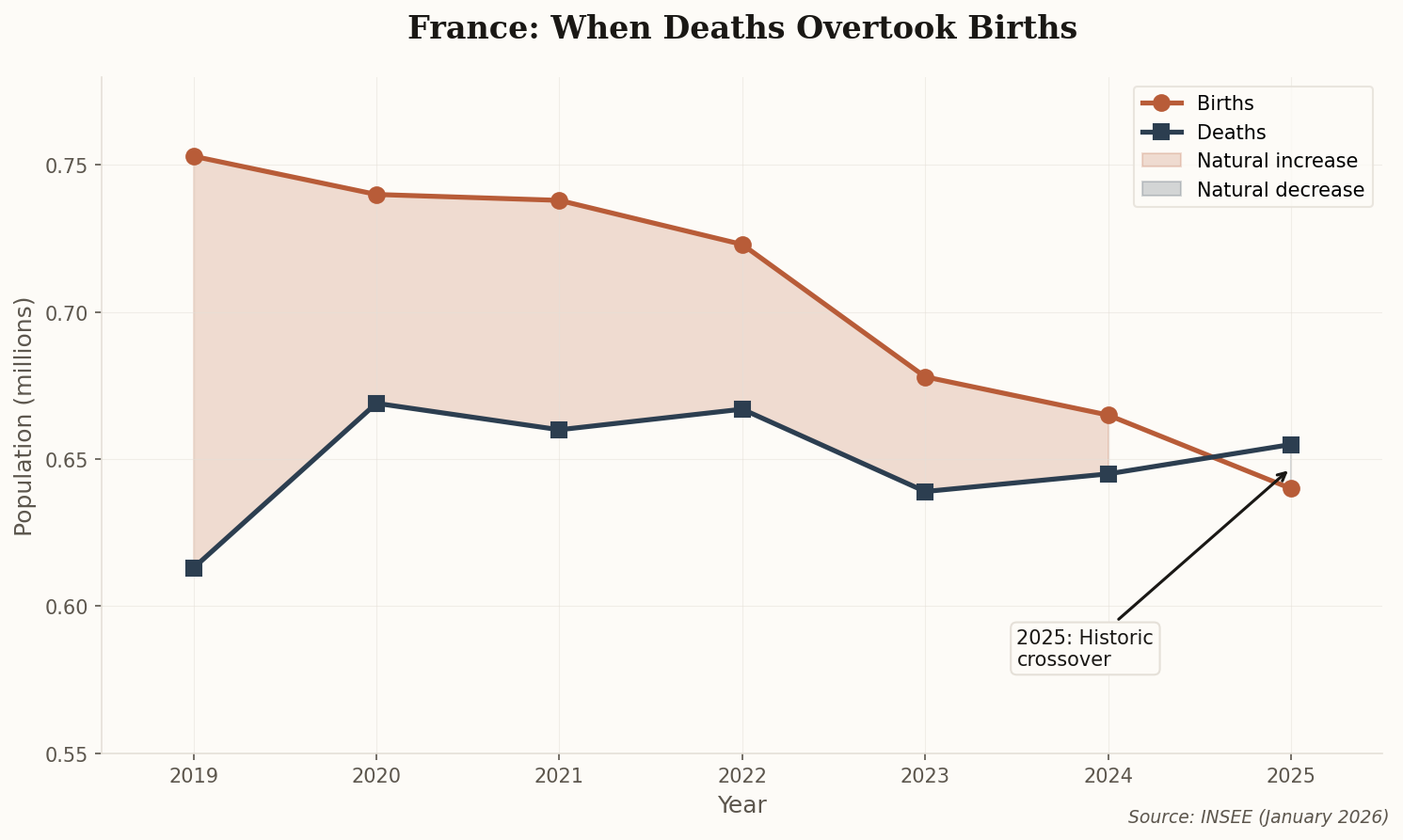
For the first time since World War II (excluding the COVID anomaly of 2020), deaths outnumbered births in France for a full calendar year. INSEE's latest demographic release confirms what demographers have long predicted: France's natural population balance has turned negative.

Line chart showing France births vs deaths crossing in 2025
France's natural population growth turned negative in 2025 for the first time since WWII.

This matters because France was supposed to be different. Its generous family policies and cultural emphasis on childbearing kept fertility rates above replacement level long after Germany, Italy, and Spain slipped below. That French exceptionalism is now over.

"The era of natural population growth in France appears to have ended, leaving net migration as the sole driver of demographic stability," the INSEE report concludes. The implications ripple outward: pension systems designed for population growth, healthcare infrastructure scaled for younger populations, and labor markets dependent on domestic workforce expansion all face recalibration. The demographic crisis that other Western European nations confronted a decade ago has finally arrived at France's door.

German immigration office with declining queue numbers
05

Germany's Asylum Numbers Hit a Decade Low

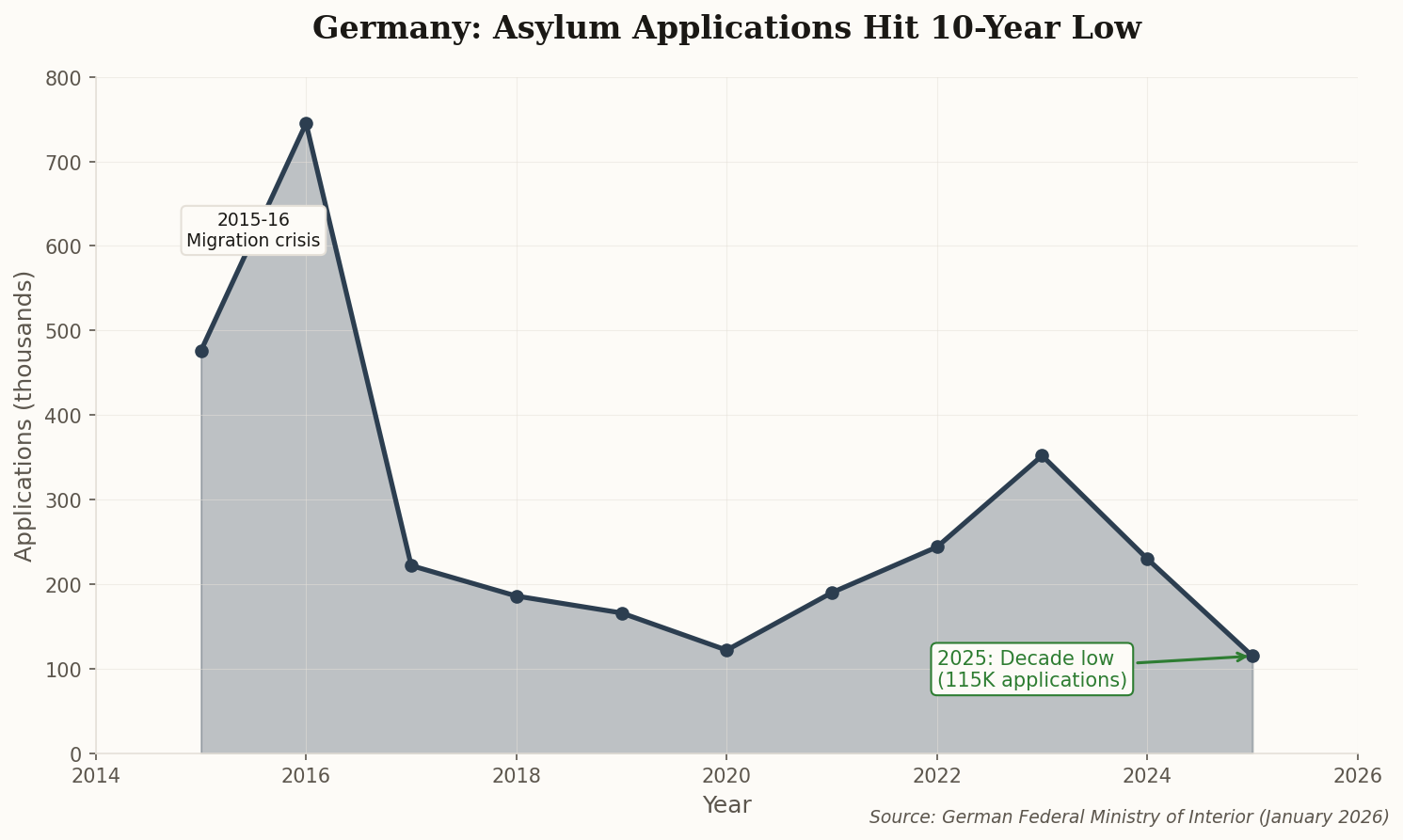
Germany's Federal Ministry of Interior confirmed what political observers expected: asylum applications in 2025 dropped to their lowest level in over ten years. The decline stems from stricter border controls introduced in late 2025 and fast-tracked rejections for "safe country" applicants.

Area chart showing Germany asylum applications from 2015-2025 hitting decade low
German asylum applications fell to approximately 115,000 in 2025, the lowest since before the 2015 migration crisis.

"The measures taken to control irregular migration are showing effect, allowing us to focus on integration," the ministry stated. But the political debate in the Bundestag remains heated. The tension between labor market demands and social integration capacity has not been resolved; it has merely been postponed.

Germany remains Europe's largest economy and its primary migration destination. The country's ability to control numbers without choking its labor pipeline is the continent's most critical demographic experiment. Early returns suggest the controls are working, but the longer-term labor shortage implications remain an open question.

Aerial view of volcanic Canary Islands coastline at sunset
06

Spain's Canary Islands Success Story

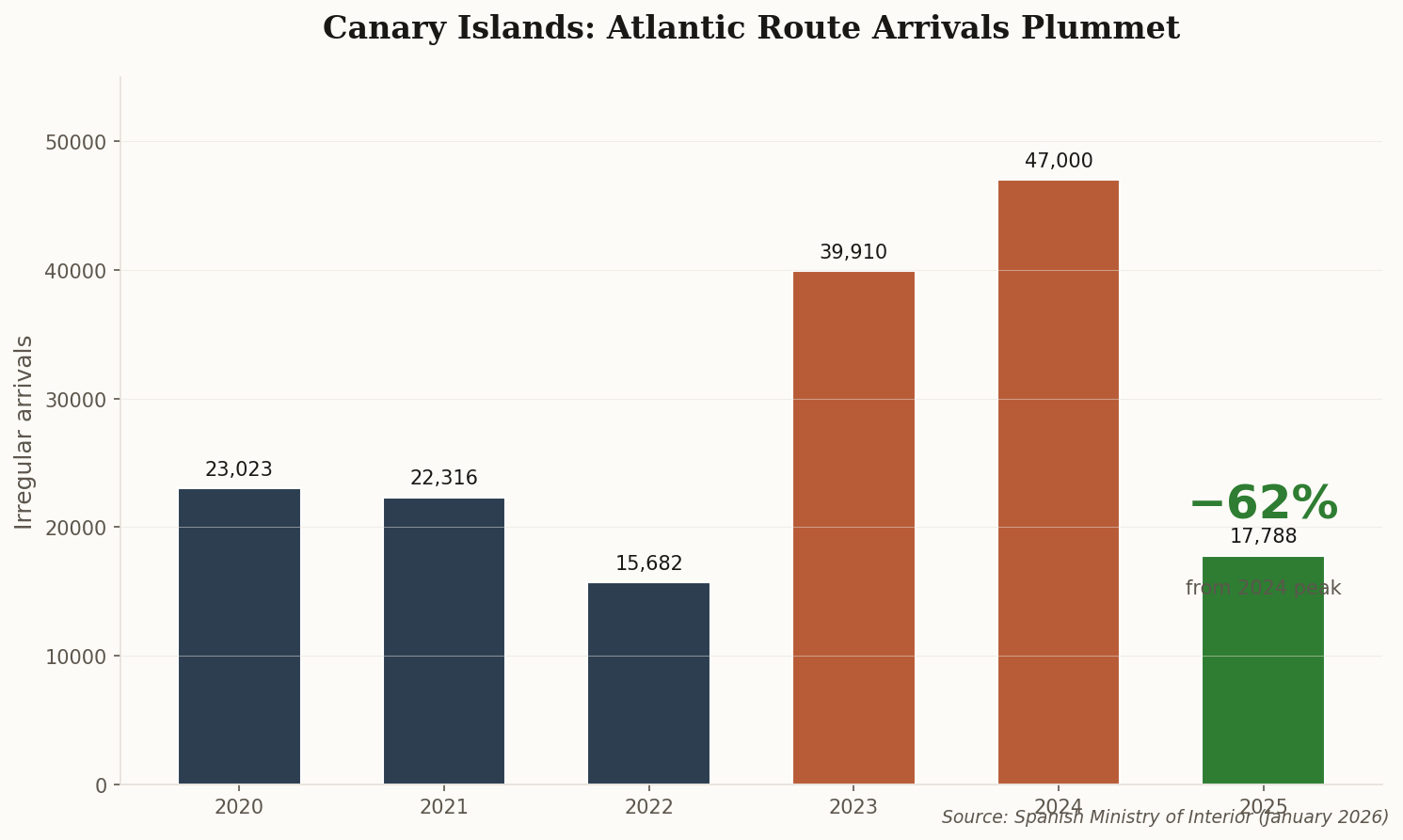
The numbers are striking: irregular migrant arrivals to the Canary Islands fell by 62% in 2025. Total arrivals dropped from over 47,000 in 2024 to just 17,788 last year. Spain's Interior Ministry credits new "talent partnership" schemes and joint maritime patrols with Mauritania and Senegal.

Bar chart showing Canary Islands arrivals plummeting 62% in 2025
Irregular arrivals to the Canary Islands dropped sharply in 2025 following bilateral cooperation agreements.

"The strategy of cooperation and legal pathways is yielding tangible results in securing the Atlantic route," the ministry stated. The approach combines three elements: legal migration channels for skilled workers, joint enforcement operations, and economic development investment in origin countries.

This success is now being studied as a potential blueprint for other EU external borders. The Central Mediterranean and Eastern routes lack equivalent bilateral frameworks, but the Canary Islands model suggests that carrots combined with sticks can work. The critical insight: countries of origin have incentives to cooperate when offered legal pathways and economic benefits in return. Pure enforcement alone has never been sufficient.

The New Calculus

Western Europe's demographic trajectory is no longer a projection; it is unfolding in real time. Birth rates have fallen below replacement everywhere. Migration policy is fracturing between restriction and integration. And the labor markets that drive continental prosperity are caught between political imperatives and economic necessity. The question is no longer whether these forces will reshape Europe, but how fast the institutions built for a different era can adapt.