Microsoft Analysis

The Empire Strikes Out

A week of emergency patches, ambitious AI plays, and the first crack in Microsoft's cloud dominance reveals a company caught between legacy complexity and future ambition.

Listen
Digital corporate architecture with AI neural patterns flowing through Microsoft's structure
01

When Your Cure Is Worse Than the Disease

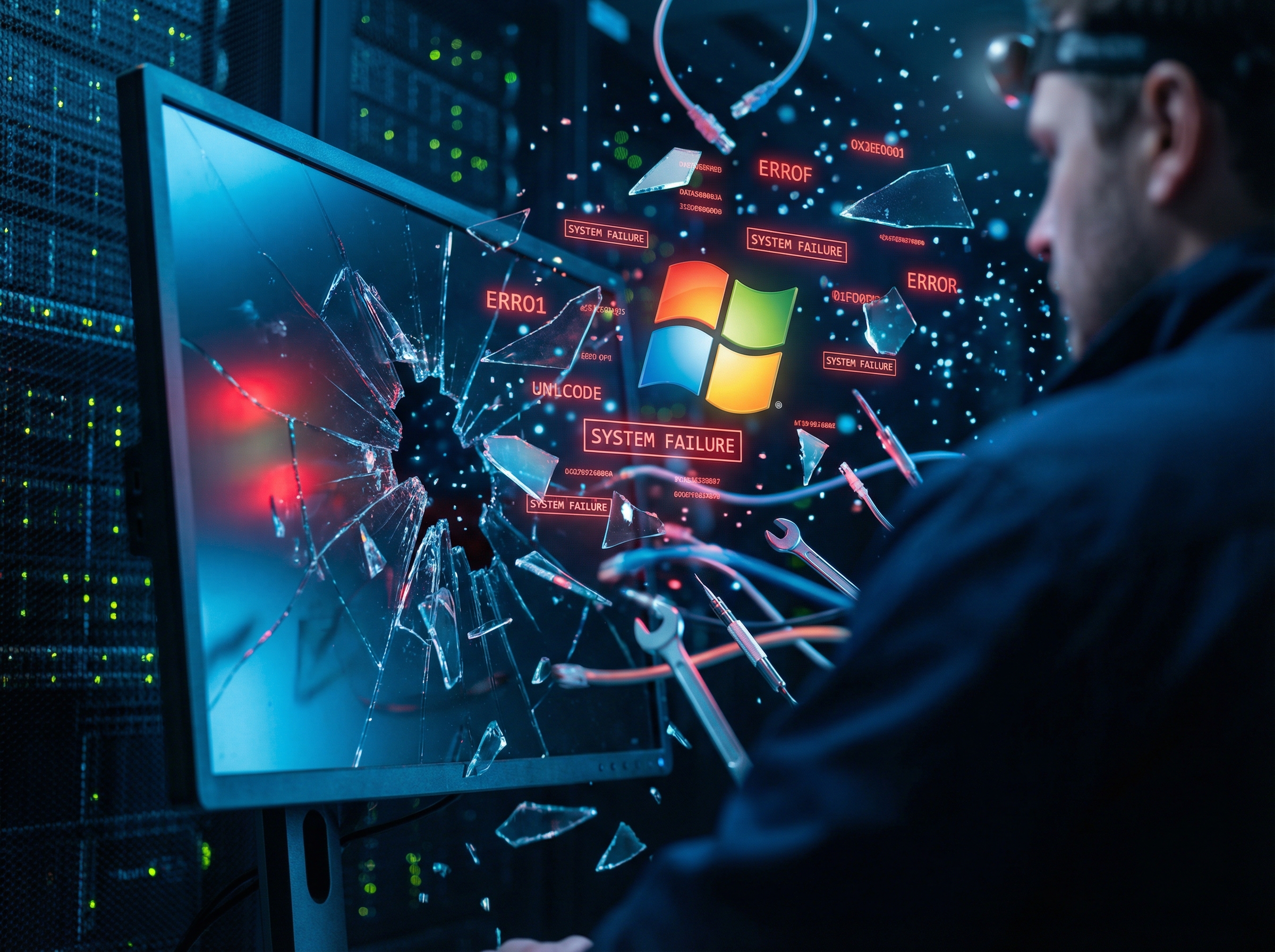
Shattered Windows interface with emergency repair tools emerging from digital chaos

When you're an enterprise IT manager, few things ruin your week like a Tuesday patch that breaks Remote Desktop. That's precisely what happened this week when Microsoft's January 13 "Patch Tuesday" update started causing RDP failures and shutdown loops across Windows 11 installations. By Friday, Redmond was forced to issue emergency out-of-band updates—the security software equivalent of pulling a fire alarm.

The irony cuts deep. These patches were meant to fix 114 security vulnerabilities, including an actively exploited zero-day in the Desktop Window Manager. Instead, they created a new crisis: IT departments had to choose between security exposure and operational disruption. Some issues—Outlook Classic crashes, desktop black screen glitches—remain unpatched as of this writing.

This isn't just a technical hiccup. It's a window (pun intended) into the fundamental tension at Microsoft: the company that wants to be your AI-powered future keeps stumbling over its 40-year-old operating system present. When your foundation is crumbling, your cathedral ambitions look increasingly precarious.
02

Copilot Grows Up: From Chatbot to Colleague

Abstract visualization of AI evolving from simple chatbot to autonomous agent with branching neural pathways

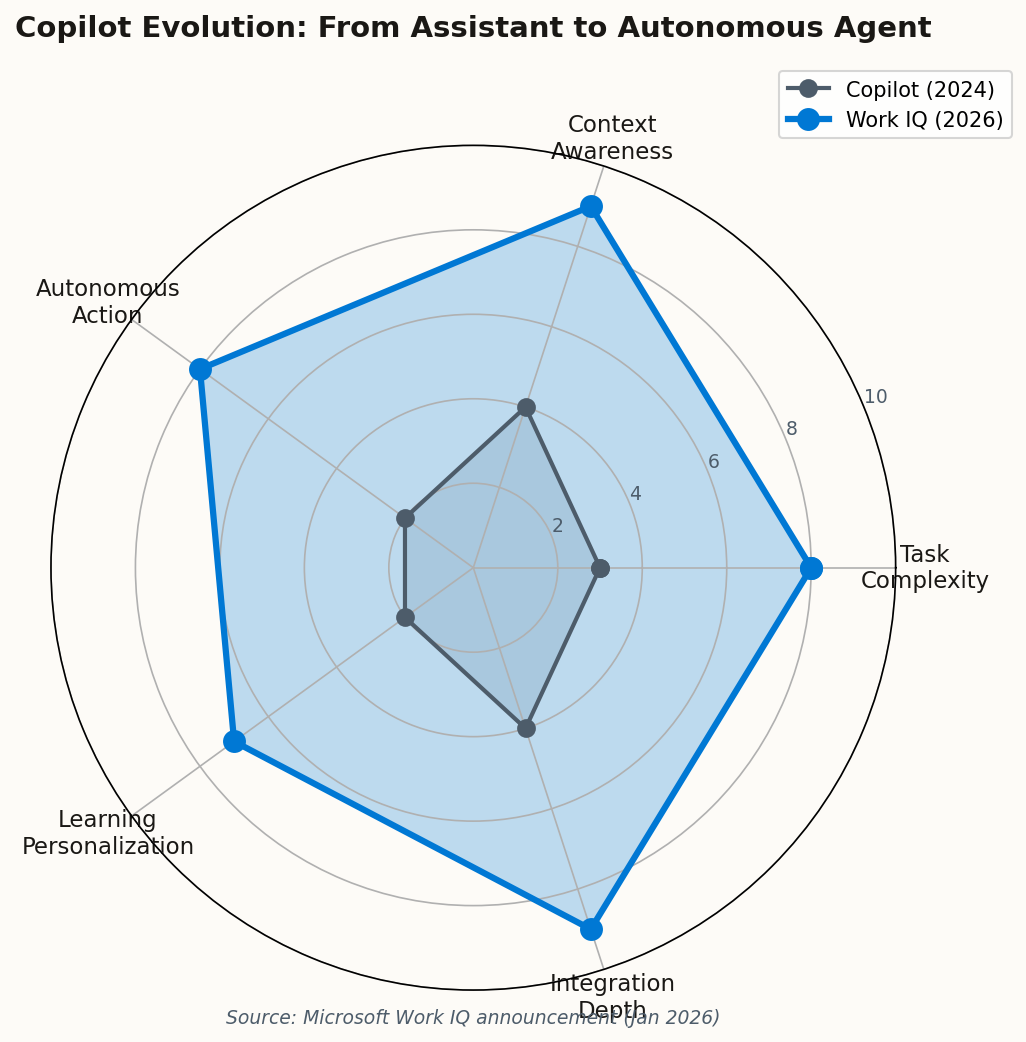
While Windows was melting down, Copilot was getting a major upgrade. Microsoft unveiled "Work IQ," a capability that transforms Copilot from a question-answering assistant into an autonomous agent capable of planning and executing multi-step workflows. Think less "helpful search engine" and more "junior employee who actually follows through."

Radar chart showing Copilot capability improvements from 2024 to 2026 across task complexity, context awareness, autonomous action, learning, and integration
Work IQ dramatically expands Copilot's capabilities across every dimension, particularly in autonomous action and context awareness.

The key innovation is "digital memory"—Copilot now maintains persistent context about your job role, your projects, and your working patterns. This isn't just chat history; it's genuine contextual understanding. When you ask Copilot to "prepare the quarterly report," it actually knows what that means for you: which data sources, which format, which stakeholders need to approve it.

This matters because it directly addresses the single biggest criticism of enterprise AI: the gap between demo magic and daily utility. Microsoft is betting that the path to AI ROI isn't better models—it's better integration. If they're right, every competitor building standalone AI tools is fighting yesterday's war.

03

Nadella's "Pivotal Year" Gambit

Silhouette of visionary CEO at crossroads where AI future meets productivity tools

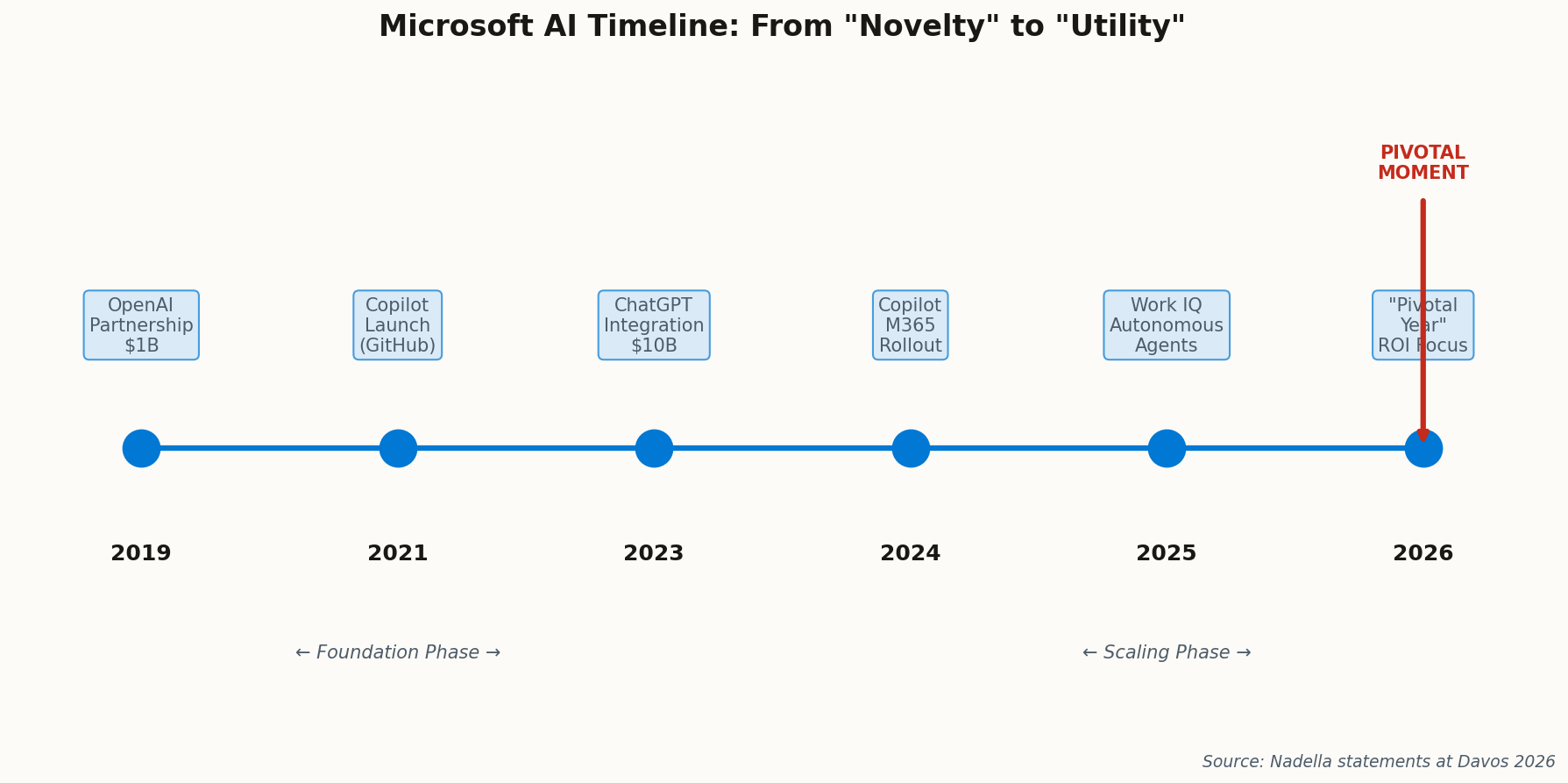
At Davos this week, Satya Nadella delivered a message that should concern Microsoft's AI competitors and reassure its investors: the novelty phase is over. "We need to move past treating AI as a parlor trick," he said, describing the technology as "cognitive scaffolding" and "bicycles for the mind."

Timeline showing Microsoft's AI journey from 2019 OpenAI partnership through 2026's pivotal year
Microsoft's AI journey accelerates: after seven years of building, 2026 is positioned as the year of proving ROI.

The Steve Jobs reference isn't accidental. Nadella is signaling that 2026 is the year Microsoft expects to show tangible productivity gains—not "10% faster email writing" but "fundamentally different workflows." The dismissal of debates about "slop vs. sophistication" is pointed: while competitors argue about benchmark scores, Microsoft is focused on deployment at scale.

Whether this is visionary leadership or elaborate expectation-setting depends on your cynicism level. But the framing is shrewd: by declaring the hype cycle over, Nadella gives himself permission to measure success differently. The question becomes "did you get work done?" not "did the AI impress you?"

04

22,000 Jobs: The AI Pivot Gets Expensive

Abstract corporate transformation with human figures transitioning into AI circuit patterns

Behind Nadella's Davos optimism lies a harder reality: reports this week suggest Microsoft is preparing to cut approximately 22,000 jobs. If confirmed, this would be one of the largest layoffs in the company's history, eclipsing the 18,000 cuts in 2014 and rivaling the post-Nokia restructuring.

The stated rationale is strategic: shifting resources from "legacy areas" to "AI experiences." Translation: the teams that built yesterday's products are being replaced by teams that will build tomorrow's. Whether you view this as visionary transformation or callous restructuring depends largely on whether your job is in the crosshairs.

What's particularly telling is the reported pressure on senior executives to align with the AI-centric direction. This isn't just cost-cutting; it's cultural purging. Microsoft is betting that its future requires not just new skills but new people—a bet that could either accelerate its AI dominance or create an organization that's lost its institutional memory. The market, at least, seems unbothered: the stock barely moved on the news.

05

The Swiss Are Coming for Your Subscriptions

Swiss Alps meeting corporate skyscrapers with legal scales made of pricing tags

If you've noticed your Microsoft 365 bills climbing, you're not alone. The Swiss Competition Commission (COMCO) has launched a preliminary investigation into Microsoft's pricing practices, responding to complaints from businesses and government agencies about "significant price increases" for product licenses.

Switzerland matters here not because of its market size—it doesn't—but because of regulatory precedent. COMCO investigations often foreshadow broader EU action, and Microsoft's pricing power is a key driver of its revenue growth. The company has positioned M365 as essential infrastructure, then steadily raised prices while adding features (like Copilot) that justify the increases. It's a textbook software playbook, but one that's increasingly attracting scrutiny.

The timing is awkward. Microsoft's licensing overhaul (effective July 2026) bundles Copilot into standard enterprise tiers—essentially forcing AI adoption and its associated costs on customers who may not have asked for it. Smart business strategy? Absolutely. Fodder for antitrust complaints? Also yes.

06

The Crown Slips: Google Cloud Takes the Lead

Two massive cloud structures racing in digital sky with Google slightly ahead of Microsoft

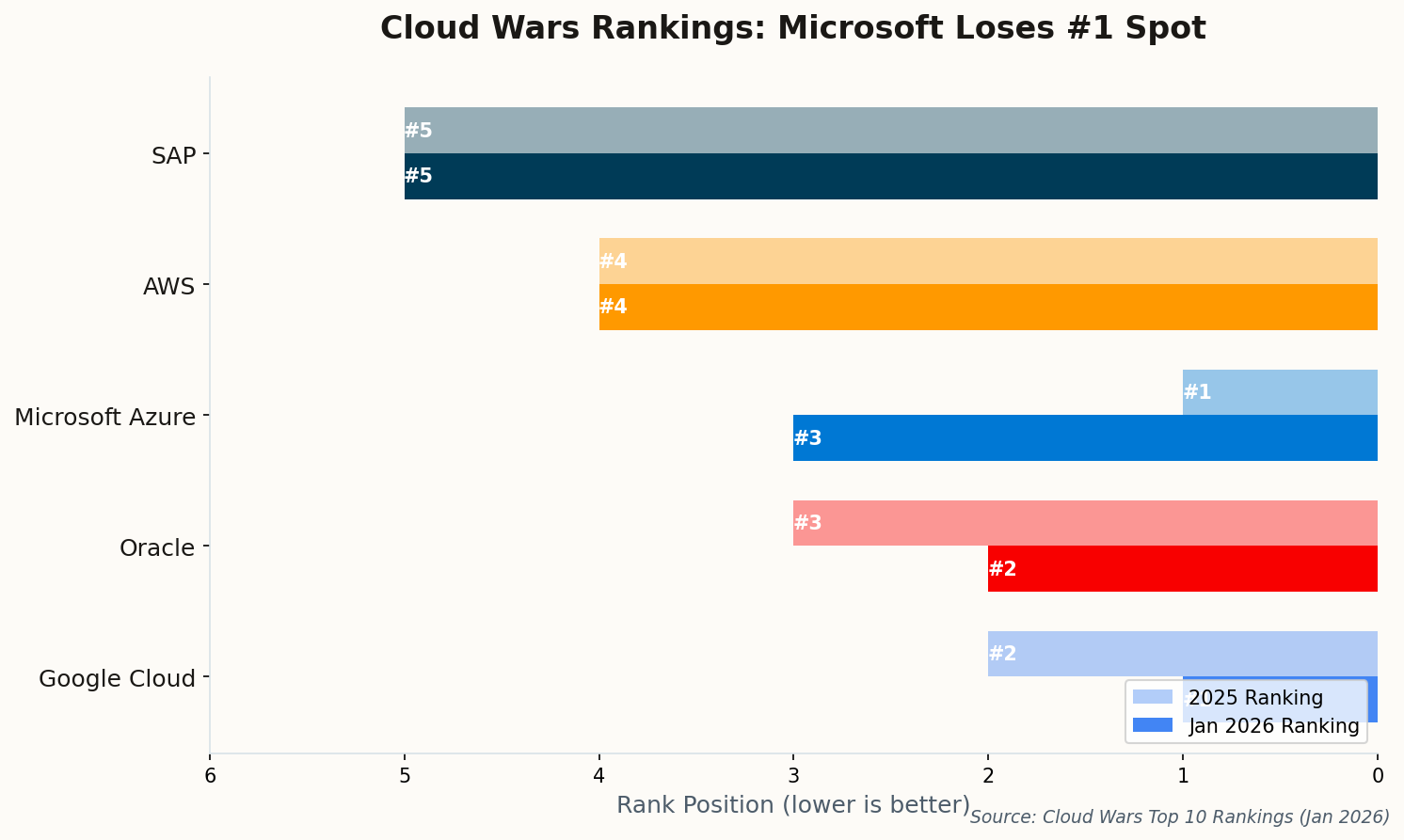
For the first time in four years, Microsoft Azure is no longer the top-ranked cloud platform in Cloud Wars' influential analyst ranking. Google Cloud claimed the #1 spot, with Oracle rising to #2 and Azure falling to #3.

Bar chart showing Cloud Wars rankings shift from 2025 to 2026
The rankings shift reflects perceived momentum rather than revenue—Microsoft still leads in cloud revenue but has lost the narrative.

Before Azure fans storm the comments: this ranking measures perceived momentum and innovation, not raw revenue. Microsoft still generates more cloud revenue than Google. But mindshare matters, especially in enterprise sales cycles where CIOs ask "who's the leader?" before asking "what does it cost?"

The cited reasons for the drop are illuminating: "security shortcomings in 2024/2025" and competitors' "perceived agility in AI." That security criticism stings—it directly references the Exchange and Outlook vulnerabilities that dominated headlines. The AI agility concern is more interesting: despite Microsoft's OpenAI partnership, analysts apparently see Google and Oracle as more nimble. When you're spending $10 billion a year on AI and still losing the innovation perception battle, something's misaligned.

07

Wall Street's Bet: The AI Eventually Pays Off

Financial visualization with stock charts transforming into neural network patterns

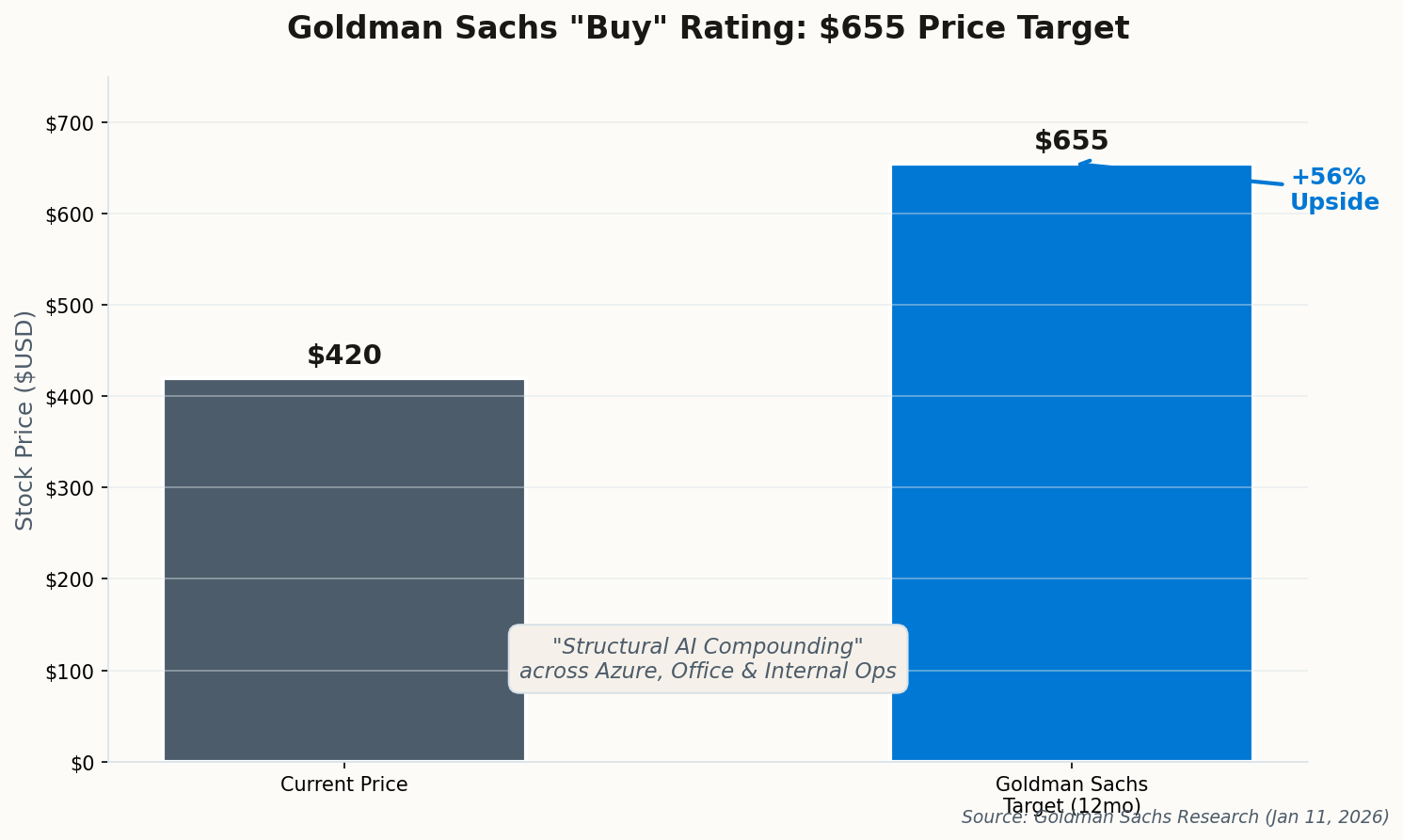
Amid all the turbulence, Goldman Sachs resumed coverage of Microsoft with a "Buy" rating and a $655 price target—roughly 55% upside from current levels. Their reasoning: "structural AI compounding" across Azure, Office, and internal operations.

Bar chart comparing current Microsoft stock price to Goldman Sachs target with 56% upside annotation
Goldman's bullish thesis rests on AI returns materializing across Microsoft's product portfolio over the next 12-18 months.

The "compounding" framing is key. Goldman isn't betting on a single AI breakthrough; they're betting that Microsoft's massive AI investments create accumulating advantages across every product line. Copilot improves Office, which increases M365 stickiness, which drives Azure usage for enterprise workloads, which generates data for better AI training, which improves Copilot. It's a flywheel thesis, and flywheels either spin up beautifully or collapse spectacularly.

What's notable is what Goldman isn't worried about: the patch disasters, the antitrust probes, the ranking slippage. These are, in their view, noise. The signal is the AI integration strategy—and on that dimension, despite this week's chaos, Microsoft remains better positioned than any other incumbent. Whether you agree probably depends on how much you trust flywheels built on foundations that occasionally set themselves on fire.

The Week Ahead

Microsoft enters next week with its AI ambitions intact but its operational credibility dented. Watch for: earnings guidance that addresses security concerns, any official comment on workforce restructuring, and whether the M365 licensing overhaul attracts more regulatory attention. The empire isn't falling—but it's stumbling more than shareholders would like.