
LLM Intelligence

The Intelligence Escalator

GPT-5.2 claims the reasoning crown, Anthropic's valuation explodes past $350B, and the infrastructure race reveals what's really limiting AI progress: electrons, not algorithms.

Listen
Abstract visualization of neural network intelligence scaling with luminous interconnected nodes
01

Gemini 3 Goes Enterprise, Gmail Becomes Your AI Assistant

Google's Gemini 3 Pro is now available for enterprise customers and integrated directly into Gmail. The pitch: "proactive assistance" that drafts responses, surfaces relevant context, and handles conversational search before you ask.

This is Google playing its distribution card. While OpenAI builds standalone products and Anthropic chases enterprise deals, Google is embedding advanced LLMs into the workflows of 3 billion Workspace users. The strategy is clear: don't ask people to change their habits—meet them where they already are.

The "proactive" framing is telling. We're moving from "chatbots you invoke" to "assistants that anticipate." Whether users find this helpful or creepy will determine whether Google's integration play succeeds or triggers a privacy backlash.
02

GPT-5.2 Takes the Benchmark Crown with "Deep Reasoning"

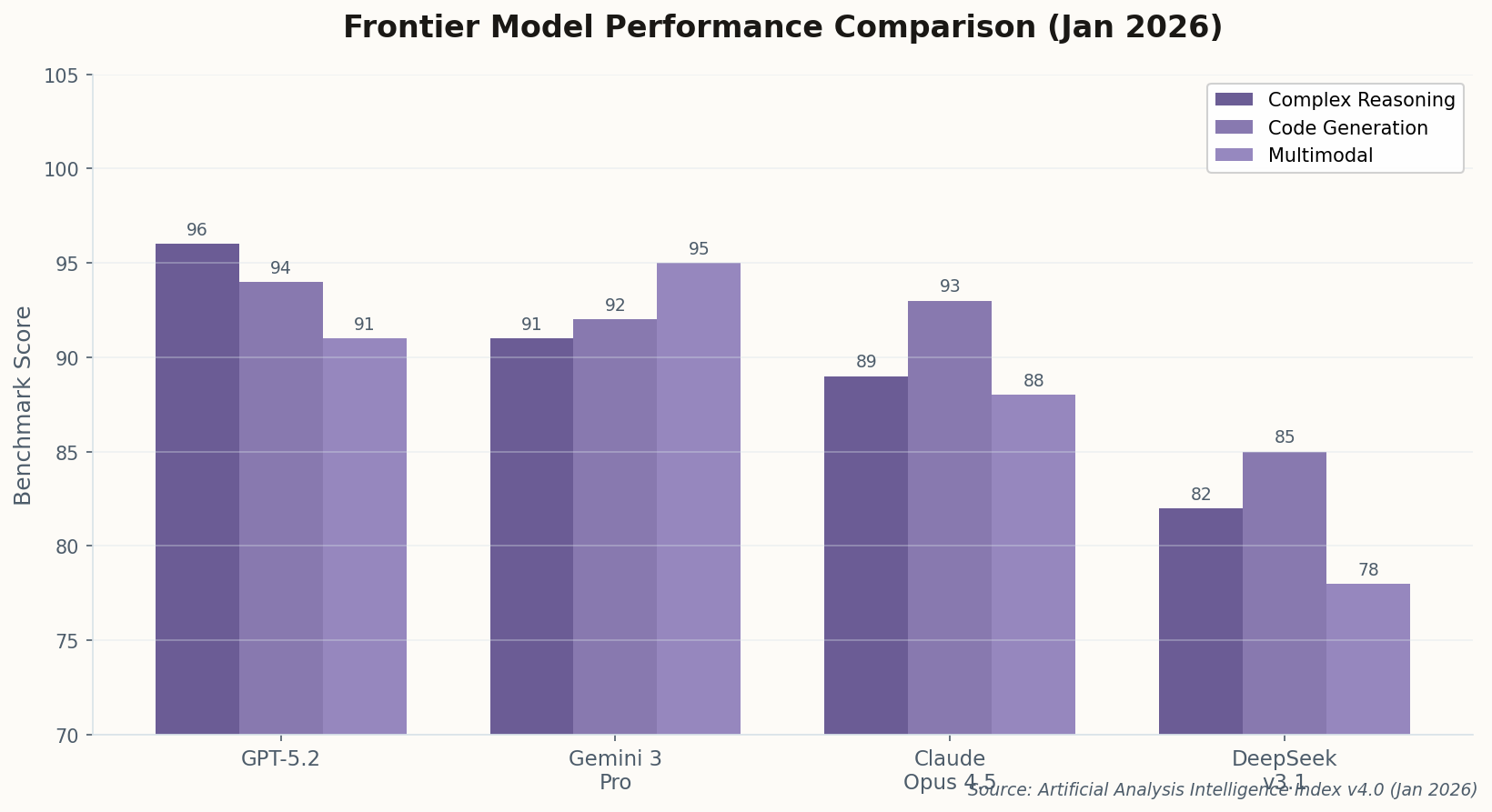
OpenAI's GPT-5.2 has claimed the top spot in the Artificial Analysis Intelligence Index v4.0, outperforming Gemini 3 Pro and Claude Opus 4.5 on complex logical tasks. The key differentiator: "deep reasoning" capabilities that handle multi-step problem solving across extended context windows.

Bar chart comparing GPT-5.2, Gemini 3 Pro, Claude Opus 4.5, and DeepSeek v3.1 across reasoning, coding, and multimodal benchmarks
GPT-5.2 leads in complex reasoning, though the gap between frontier models continues to narrow. DeepSeek v3.1's performance suggests open models are closing in faster than expected.

The benchmark wars are shifting terrain. Raw knowledge recall is table stakes now. The new frontier is reasoning depth—can the model chain together logical steps, maintain coherence across long documents, and avoid the hallucination traps that plague multi-hop inference?

For developers building on these platforms, the practical question isn't "which model is best" but "which model is best for my specific task, at what cost, with what latency?" The benchmark crown matters less than the fit.

03

Meta's AI Ambitions Now Require Nuclear Reactors

Meta announced large-scale partnerships with Oklo and TerraPower to power its AI data centers with nuclear energy. The subtext: existing grids can't handle what's coming.

This is the clearest signal yet that energy is the new constraint. Algorithms improve; architectures get more efficient; but training runs and inference at scale require power that traditional infrastructure can't reliably deliver. Meta's move from "rent grid capacity" to "build nuclear partnerships" reveals how serious the bottleneck has become.

The irony: AI companies that started as software plays are becoming energy infrastructure developers. The path to AGI may run through reactor permits, not just research papers.

For the next 18 months, watch the energy investments. Companies that secure stable, scalable power will have a structural advantage over those still fighting for grid allocation. The intelligence escalator runs on electrons.

04

Anthropic's $350B Valuation Bets on Enterprise and Healthcare

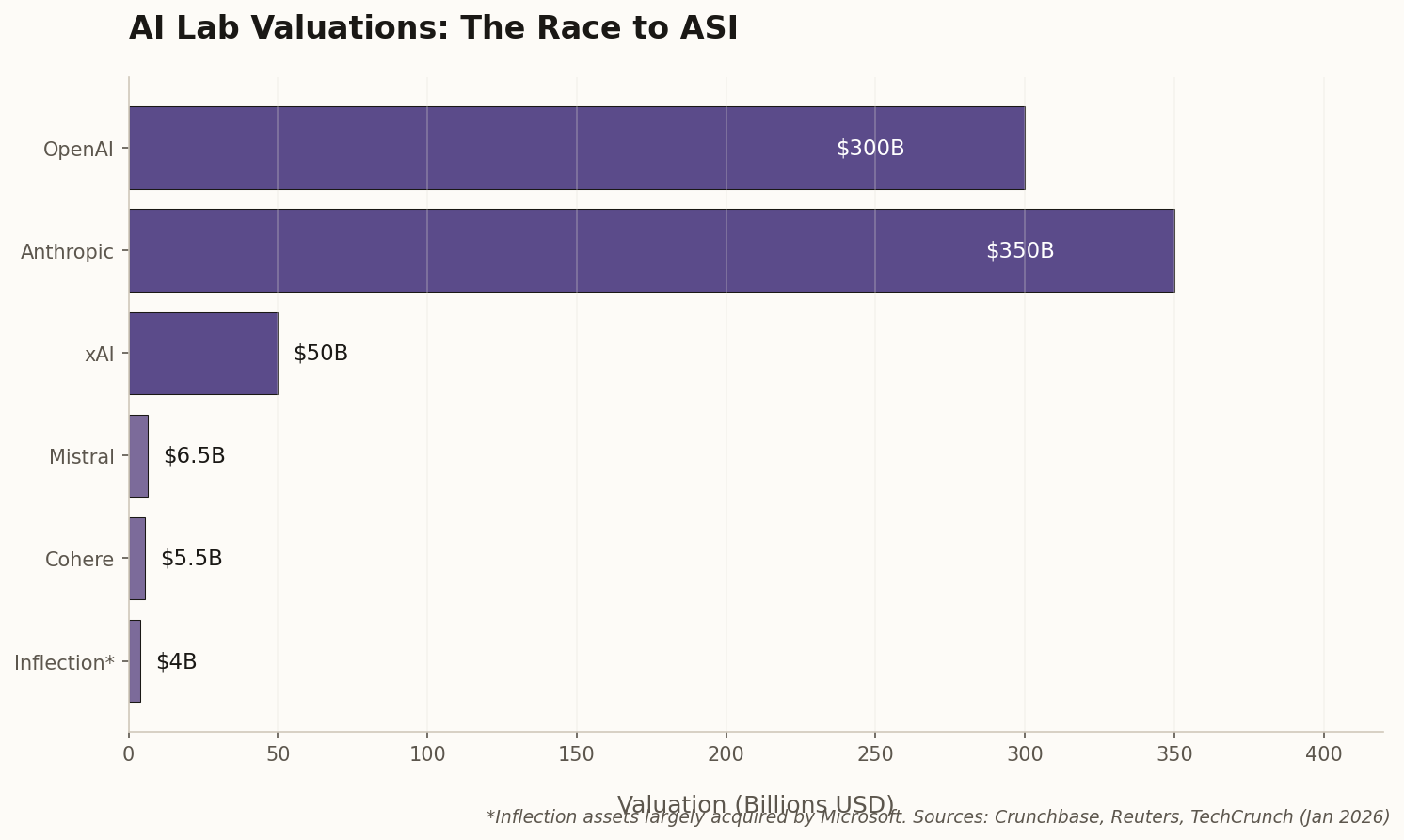
Anthropic closed roughly $10 billion in new funding at a $350 billion valuation—a 483% jump from early 2025. The capital comes with strategic moves: "Claude for Healthcare" (HIPAA-compliant medical AI) and "Cowork" for Claude Max (automating enterprise tasks beyond code).

Bar chart comparing AI company valuations in early 2025 vs January 2026, showing Anthropic's dramatic rise to $350B
Anthropic's valuation has nearly quintupled in a year, now matching OpenAI's trajectory. The race to $500B is on.

CEO Dario Amodei called 2026 "a pivotal year for the practical application of continuous learning technology." Translation: the lab phase is ending. Anthropic is betting that vertical solutions (healthcare, enterprise automation) can justify a valuation that assumes AI becomes as ubiquitous as electricity.

The healthcare play is particularly telling. Regulated industries with high-value decisions and clear compliance frameworks are where trust in AI will be built—or broken. If Claude for Healthcare works, it legitimizes AI assistance in other high-stakes domains.

05

DeepSeek v3.1: The Gap Is Closing Faster Than Expected

DeepSeek's v3.1 Terminus release is now recognized as a leading open-license, self-hostable model. Industry analysts estimate Chinese AI models are now "a few months" behind Western frontier systems—down from the "years" gap assumed in 2024.

This matters for three reasons. First, it validates that transformer architectures can be efficiently replicated with sufficient compute and talent—there's no secret sauce that can't be reverse-engineered. Second, it creates competitive pressure that will accelerate capability releases from OpenAI and Anthropic. Third, it gives enterprises a viable alternative to closed API dependencies.

The "few months behind" framing is the headline, but the trajectory is the story. If the gap continues shrinking, the value proposition of closed models shifts from "better intelligence" to "better integration, support, and compliance." That's a very different business to defend.

18-Month Outlook

The next year and a half will be defined by three races: the reasoning benchmark wars (GPT-5.x vs Gemini 4 vs Claude 5), the infrastructure buildout (who secures energy and compute), and the verticalization push (which AI company owns healthcare, legal, finance). Watch the energy investments—that's where the real constraints are emerging. The models will keep getting smarter; the question is whether the infrastructure can scale to match.