Cultural Resurgence

The King's Digital Court: Elvis at 11 Billion Streams

Nearly fifty years after his death, Elvis Presley isn't just surviving in the streaming era—he's thriving. A new documentary, AI plans for Graceland, and 3.76 million daily plays reveal an artist whose relevance refuses to fade.

Listen
Abstract editorial illustration celebrating Elvis Presley's enduring cultural legacy with geometric patterns suggesting vinyl records and streaming waves
01

A Filipino Singer Just Proved Elvis Is Still the Benchmark

Stage spotlight illuminating rhinestone jumpsuit with prosthetic makeup kit, dramatic gold and purple lighting

When ABS-CBN's "Your Face Sounds Familiar" needed a showstopper, they didn't reach for a contemporary pop star. Singer Jason Dy underwent hours of prosthetic application to transform into 1970s-era Elvis, complete with the iconic jumpsuit and sideburns.

The performance trended across Filipino social media—not as nostalgia, but as spectacle. In 2026, "doing Elvis" still means one thing: going all out. The full production, the commitment, the unapologetic showmanship. No half measures.

What this reveals: Elvis has transcended the category of "legacy artist." He's become a performance archetype—the template for maximum effort entertainment. When a show wants to signal "this is serious," they reach for the King.

02

11 Billion Streams: Elvis Outpaces the Algorithm

Abstract visualization of music streaming with sound waves transforming into golden data streams, vinyl record dissolving into digital particles

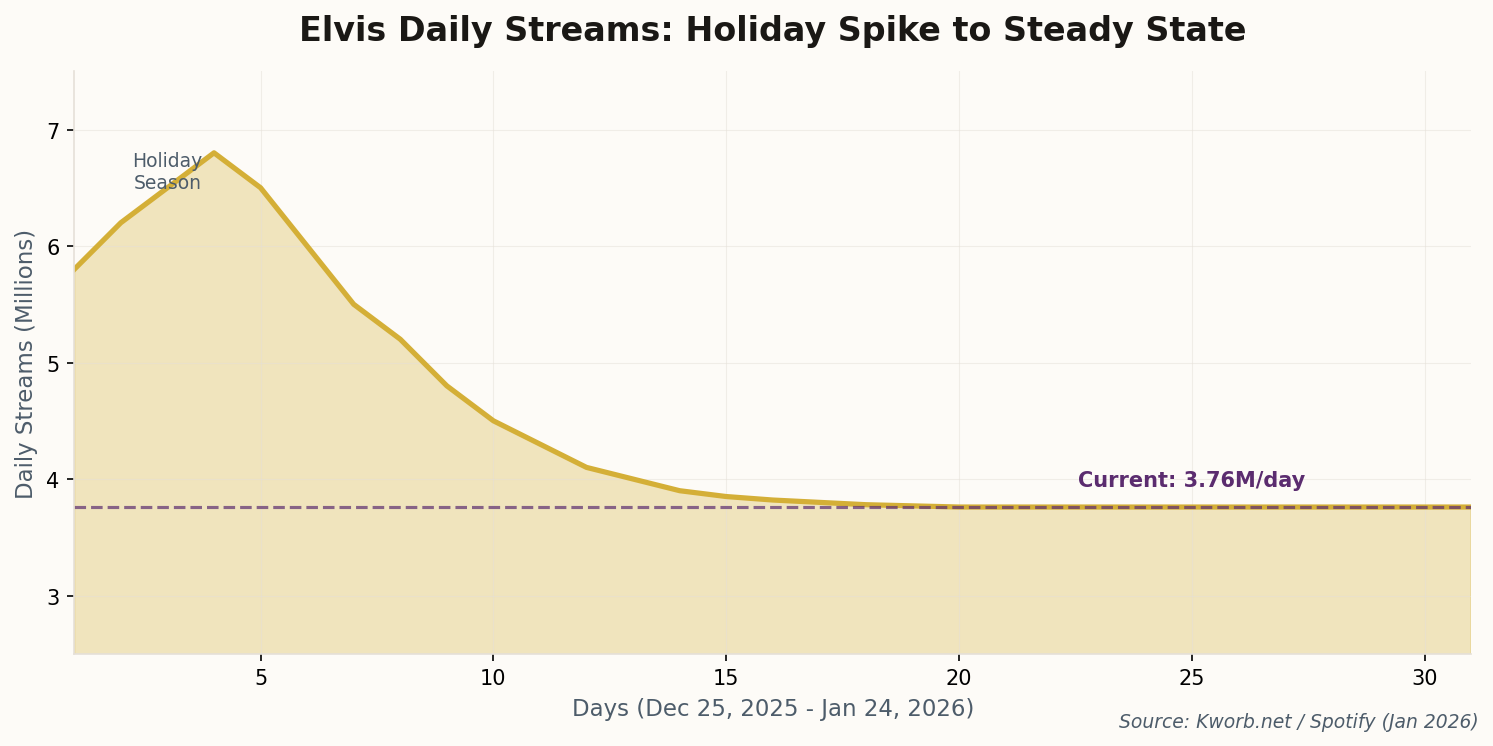
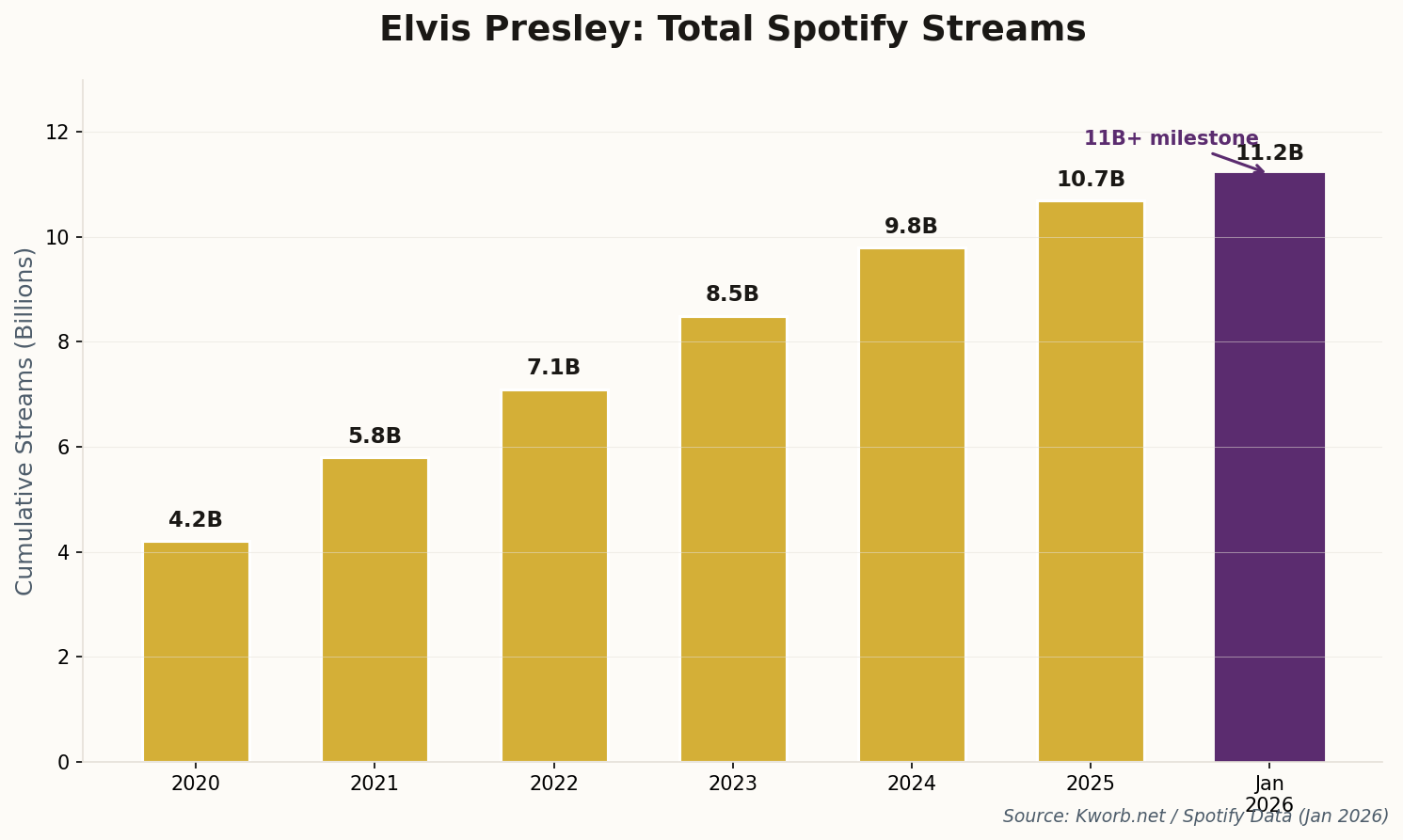
Elvis Presley crossed 11.19 billion total Spotify streams this week—a milestone that puts him in rarefied company among artists of any era. More remarkable: he's averaging 3.76 million streams per day in mid-January, well after the holiday spike has faded.

Bar chart showing Elvis Presley's Spotify streaming growth from 4.2 billion in 2020 to 11.2 billion in January 2026
Elvis's streaming numbers have nearly tripled since 2020, with acceleration during and after the Baz Luhrmann biopic

To put this in context: Elvis died in 1977. Spotify launched in 2008. The man never knew streaming existed, yet he's competing directly with artists who build careers around playlist placement and algorithmic optimization.

Line chart showing Elvis daily streams from holiday spike of 6.8 million settling to steady state of 3.76 million per day
The holiday listening surge fades, but Elvis maintains nearly 4 million daily streams—a floor, not a ceiling

The business math: At roughly $0.003-0.004 per stream, 3.76 million daily plays generates $11,000-15,000 per day in streaming revenue alone—over $4 million annually from Spotify, before considering Apple Music, YouTube, and physical/licensing revenue.

03

The Evergreen Engine: Why Elvis Owns December

Vintage microphone wrapped in holiday lights with gold tinsel and purple velvet backdrop, snowflakes catching warm spotlight

"Elvis's Christmas Album" hit a new peak of No. 20 on the Top Streaming Albums chart this month—68 years after its original 1957 release. This wasn't a one-week holiday novelty; it's a pattern that repeats every winter.

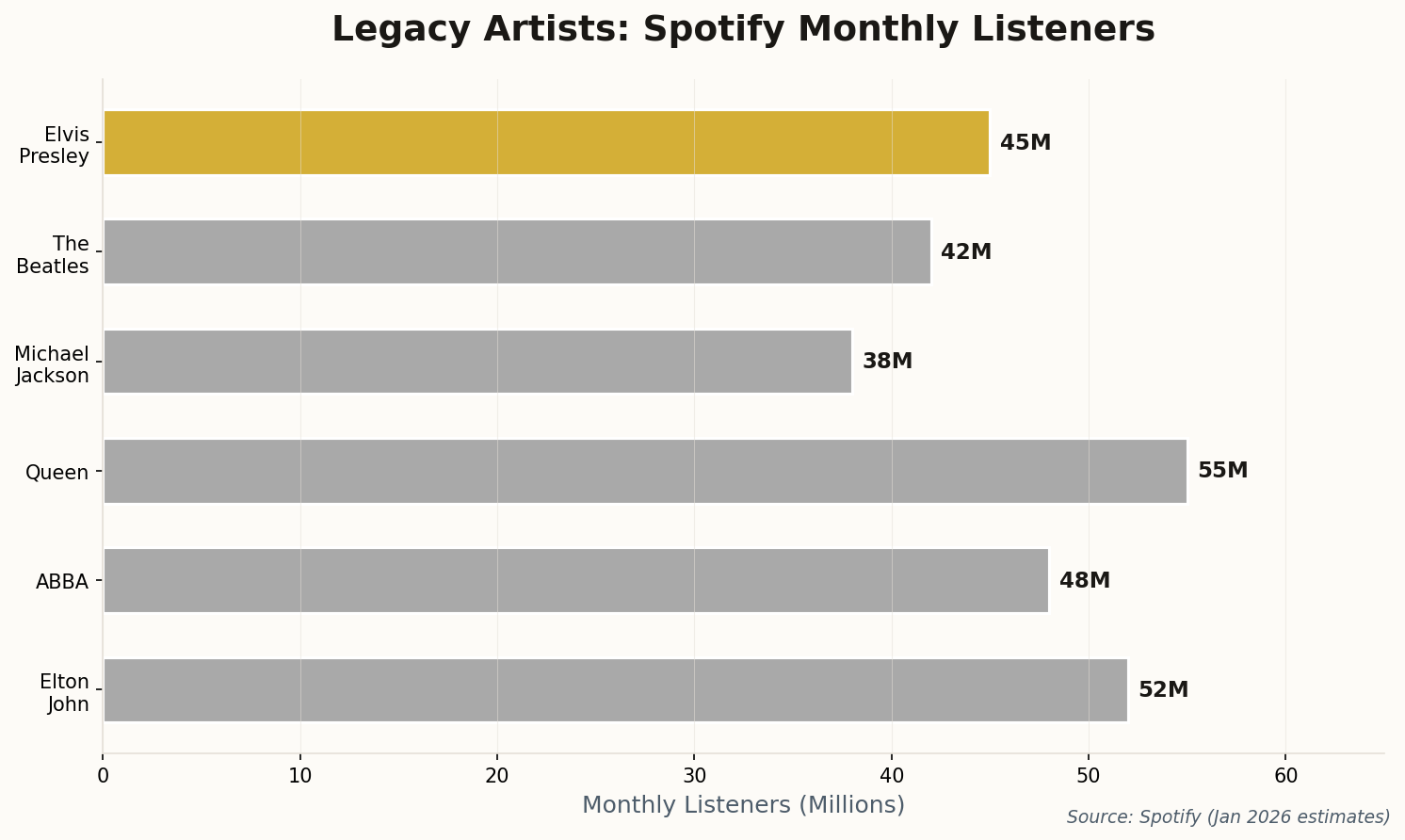
Horizontal bar chart comparing monthly Spotify listeners for legacy artists including Elvis at 45 million
Elvis maintains 45 million monthly listeners, competitive with other legacy superstars like The Beatles and Michael Jackson

The estate has optimized this brilliantly. "Blue Christmas" and "Can't Help Falling in Love" appear on seemingly every holiday playlist. The catalog generates predictable, massive revenue spikes every Q4—a seasonal asset that rivals retail companies.

Why it matters: Elvis's music has become infrastructure. Like Mariah Carey's "All I Want for Christmas," certain Elvis tracks are no longer optional for the holiday season. They're expected, automated, inevitable.

04

Graceland's Bet: AI Elvis and the Future of Legacy

Futuristic holographic silhouette emerging from vintage television set with purple neon glow and gold particles

Graceland Holdings managing partner Joel Weinshanker outlined ambitious plans this week: using AI voice synthesis and potentially holographic technology to let visitors "interact" with Elvis.

The initial focus? Elvis's faith—letting fans explore his spiritual beliefs through conversations with an AI trained on his interviews, letters, and known statements. It's a careful entry point, avoiding the uncanny valley of performance reproduction while offering something genuinely new.

The strategic logic: Graceland needs to capture younger visitors who didn't grow up with Elvis. A static museum competes poorly with immersive digital experiences. AI interaction bridges the generational gap—you can't meet Elvis, but you might be able to talk to him.

The risks are obvious: AI Elvis saying something "un-Elvis" could be a PR disaster. But the estate is betting that controlled, themed interactions (faith, music philosophy) can extend the brand into the AI era without compromising authenticity.

05

Baz Luhrmann Returns With Lost Vegas Footage

Film reels unspooling with glimpses of Las Vegas neon, gold spotlight beams through purple curtains, cinematic style

"EPiC: Elvis Presley in Concert" premiered at Graceland during the annual birthday celebration, directed by Baz Luhrmann—who helmed the 2022 biopic that grossed $288 million and introduced Elvis to Gen Z audiences.

The documentary features previously unseen 16mm and 8mm footage from the Vegas residency years, remastered to modern standards. Early reviews highlight behind-the-scenes moments that showcase Elvis's humor and work ethic—countering the tragic decline narrative that often dominates discussions of his final years.

The content strategy: The Elvis estate has learned from Disney and Marvel—you need a steady pipeline of new content to maintain cultural relevance. A major biopic in 2022, now a documentary in 2026, with AI experiences coming next. It's IP management applied to a single artist.

06

53 Years Later, "Aloha From Hawaii" Still Matters

Art deco American eagle motif with satellite dish beaming signal around globe, gold leaf texture on deep purple

Media outlets published retrospectives this week marking the anniversary of Elvis's January 14, 1973 "Aloha From Hawaii" concert—the first entertainment special to be broadcast live via satellite to a global audience, watched by an estimated 1 billion people.

The numbers still stagger: more viewers than the Apollo moon landings. The "American Eagle" jumpsuit from that night became perhaps the most iconic garment in rock history. Elvis didn't just perform for the world—he proved it was possible.

Memphis is also marking the 90th anniversary of Overton Park Shell, where Elvis gave his first major public performance in 1954. The city is positioning 2026 as a year of significant musical anniversaries, with tourism campaigns built around Elvis's origin story.

The enduring appeal: Elvis was the original global superstar—before MTV, before the internet, before social media. His story is the template that every subsequent megastar has followed. Understanding Elvis means understanding how modern celebrity works.

The King Abides

Forty-nine years after his death, Elvis Presley isn't merely preserved in amber. He's actively managed, strategically extended, and algorithmically distributed. The estate has turned a 20th-century icon into a 21st-century content engine. The question isn't whether Elvis remains relevant—it's whether any artist will ever achieve this level of posthumous vitality again.